Table of contents
24
By Salman Khan, OSCP+, Founder of XHack, SRT (Synack Red Team member)
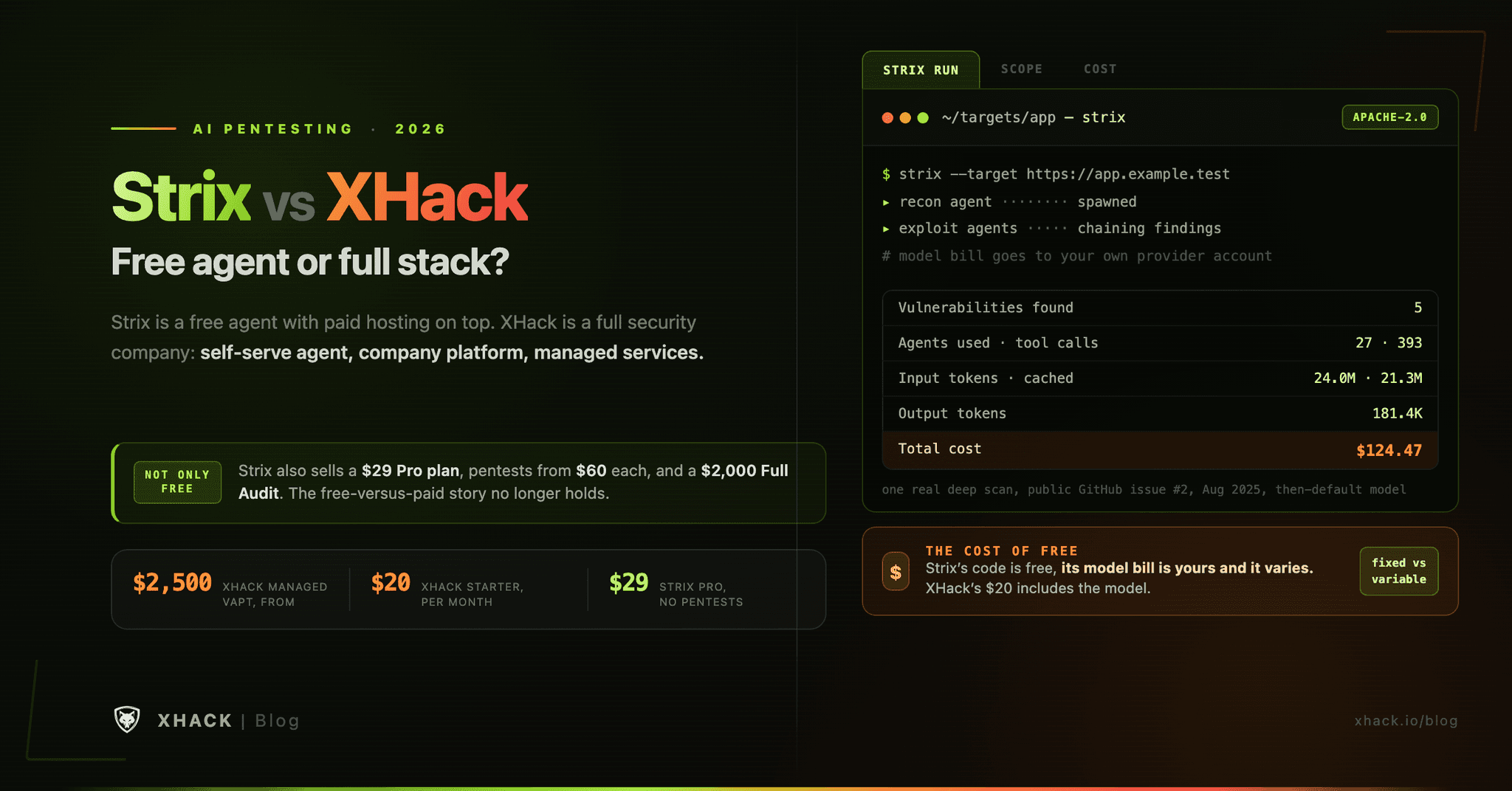
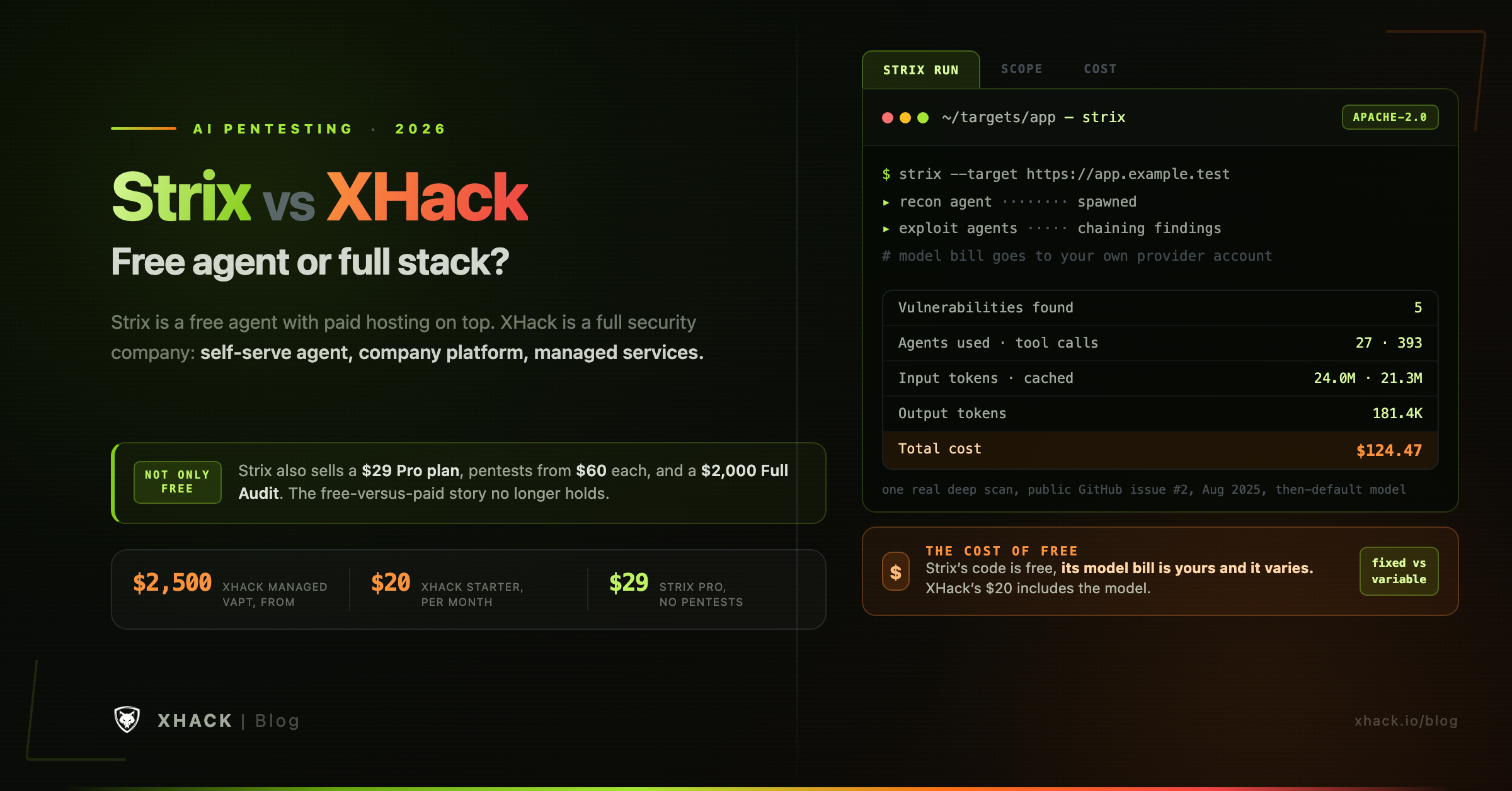
Read this in 30 seconds: Strix is a free, open-source pentest agent with paid hosting on top. XHack is a complete offensive security company, selling a self-serve AI agent, a self-serve security platform and managed security services. I run XHack, so weigh this accordingly.
- Strix’s agent is free to download, but running it isn’t. One reviewer’s shallow scan cost about $17 in model fees and a deeper one cost $124.47, while XHack’s $20 plan includes the model.
- Strix’s $29 Pro plan includes no pentests, but XHack’s $20 plan includes an allowance. XHack calls it “enough for 3-5 Automatic Pentest”, while Strix sells each pentest separately from $60.
- Strix covers code, APIs, web apps, infrastructure and cloud, but XHack covers more. XHack adds mobile app testing, malware analysis, a SOC monitoring platform and a dedicated AI testing library with 3,500+ payloads.
- Both put certified humans on a formal report, but only XHack keeps going. Strix’s human option is a $2,000 Full Audit, while XHack’s VAPT runs from $2,500 to $12,000 and beyond, alongside red teaming, a 24/7 SOC and incident response.
Strix is a popular open-source AI pentesting agent, and you can download it without talking to anyone. So the obvious Strix vs XHack question is why anyone would pay XHack $20 a month.
The short answer is that they aren’t the same kind of thing. Strix is an agent with a hosted platform and a paid audit on top, while XHack is an agent, a security platform and a managed security team, sold self-serve to individuals and companies alike.
Strix isn’t only free, either. Strix’s pricing page lists a $29-a-seat Pro plan with no pentests included, one-time pentests from $60, a Full Audit from $2,000, and an Enterprise tier priced by its sales team.
I have a financial interest in you choosing XHack, so check my numbers against the sources I link. This comparison covers price, coverage, access and services, and it says plainly where Strix is the better pick.
Both products are built on agentic pentesting: software that plans and adapts a test by itself instead of waiting for a person to click through each step. Here is the Strix vs XHack comparison in one table.
| Strix | XHack | |
|---|---|---|
| What it is | Open-source pentest agent, plus a hosted platform and an Enterprise tier | AI pentest agent, self-serve security platform, and managed security services |
| Free tier | ✅ Self-hosted CLI; you pay your own model bill | ⚠️ 7-day free trial, full platform |
| Cheapest paid plan | $29 a seat a month (Pro), no pentests | $20 a month (Starter), model and pentest allowance included |
| Pentests | $60 to $300 each, bought as credits | Included in each individual plan’s monthly allowance |
| Web apps and APIs | ✅ Yes | ✅ Yes |
| Source code | ✅ SAST tools, PR reviews on Pro | ✅ AI analyzes source code and binaries, GitGuard PR scanning, managed code review |
| Network and Active Directory | ✅ Self-hosted agent reaches internal hosts | ✅ Agent, plus internal testing by certified testers |
| Cloud | ✅ Yes | ✅ AWS, Azure and GCP |
| AI and LLM applications | ✅ Prompt injection, jailbreaks, data leakage | ✅ AI Probe library of 3,500+ payloads, plus managed AI red teaming |
| Mobile apps | ❌ Not offered | ✅ APK and IPA analysis, Frida, ADB |
| Malware analysis | ❌ Not offered | ✅ Elite plan, plus managed reverse engineering |
| Monitoring platform | ❌ No SOC or log monitoring | ✅ SOC dashboard with MITRE ATT&CK correlation, from $560 a month |
| Human testing | ⚠️ Full Audit from $2,000, reviewed by CREST-certified pentesters | ✅ VAPT from $2,500 to $12,000 and custom programmes – OSCP+ Certified Pentesters |
| Other managed services | ❌ None | ✅ Red team, 24/7 SOC, incident response, compliance, training |
| Offline use | ✅ Local model | ✅ Desktop agent with a local Ollama model |
| Model choice | 100+ providers, local models, or a ChatGPT subscription | Built-in security-tuned model; your own key from $49 |
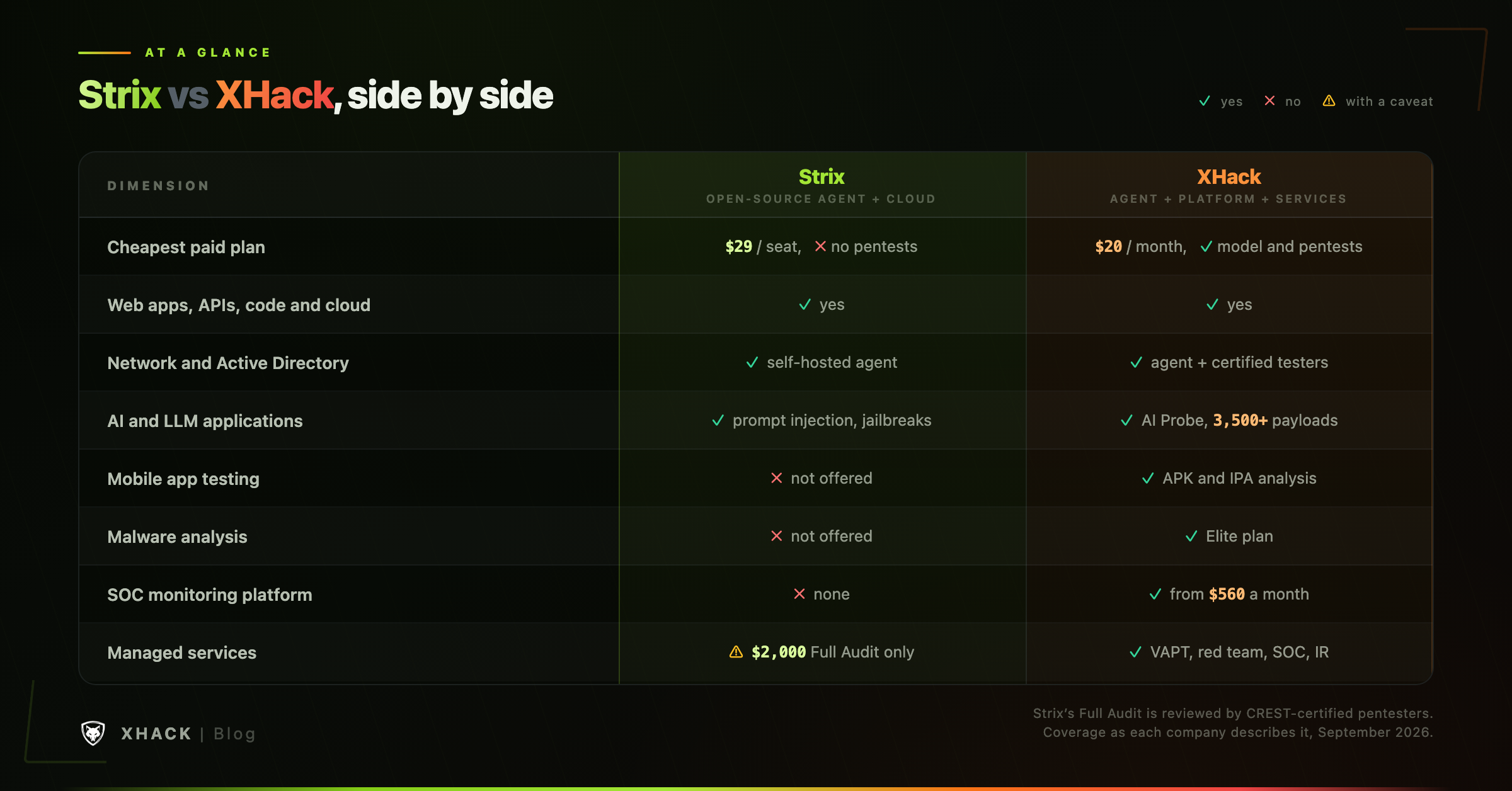
The top half of that table is close: both test web apps, APIs, source code, networks, cloud and AI features. The bottom half is where the Strix vs XHack comparison opens up, because XHack adds mobile, malware analysis, a monitoring platform and a full services arm that Strix doesn’t offer.
For the wider field, XHack’s rundown of autonomous AI hacking agents covers more of the category, and its ranked list of AI pentest tools places Strix among the open-source options.
Strix was founded in 2025 in San Francisco by Ahmed Allam and Alex Schapiro. Its agent splits work across specialized sub-agents for recon, exploitation and post-exploitation, which run in parallel inside a Kali Linux-based Docker container with tools such as Nuclei, SQLMap, Semgrep and TruffleHog.
Strix describes its own coverage as code, APIs, web apps, infrastructure and cloud. Its self-hosted agent can run inside your perimeter and reach internal hosts through a connector you control, and it also tests LLM features for prompt injection, jailbreaks and data leakage.
On top of the free CLI sits Strix Cloud: $29 a seat a month for pull request reviews, autofix and attack-surface monitoring, with pentests bought separately at $60 to $300 each. Above that is a custom-priced Enterprise tier with single sign-on, compliance-ready reports, and self-hosting in your own cloud or an air-gapped network.
It’s free to download and free to start. The agent is Apache-2.0 licensed, runs in a container you control, and works offline with a local model. You clone it and run it, with no approval step.
It works with almost any model. Strix is built on LiteLLM, so you can point it at more than 100 providers, a local model, or your existing ChatGPT Plus or Pro subscription.
It fits neatly into a developer workflow. Strix Cloud’s Pro plan includes 50 pull request reviews per seat a month, then $1 each, fixes arrive as merge-ready pull requests, and it’s free for public open-source repositories.
Its audit is quick. The Full Audit, from $2,000, is reviewed by CREST-certified pentesters, promises same-day results, and includes a free retest.
It has a large following. The repository has more than 62,900 GitHub stars, and Strix says it is SOC 2, GDPR and ISO 27001 audited and certified.
Strix’s public issue tracker shows the rough edges. Bug #321, reported in February 2026 and still open in September, says black-box scan reports include a code-analysis section with file paths and code snippets that don’t exist in the target.
Bug #1007 says the --max-budget spending cap does nothing for models routed through a LiteLLM proxy, because Strix reports $0.00 while the proxy bills real tokens. A full log of every action the agent takes isn’t built yet, and the request for it, #285, was filed by Strix’s own co-founder.
Users have also reported scans that hang for hours on real targets, and a bug where Strix can’t find Docker on macOS (#164) is still open. Strix’s own docs warn that most local models, “especially those under 70B parameters, struggle with these complex tasks,” so the free route often ends with a paid model anyway.
XHack is built as three layers, and you can buy any of them on its own: an AI agent for individuals, a security platform for companies, and a managed services arm for when you want a team to do the work. All three are sold on published prices, and the first two are self-serve.
The agent runs recon, finds vulnerabilities, builds exploit chains and writes the report, without a person clicking through each step. It strings low-severity findings into high-impact attack chains the way a senior pentester would, and it surfaces the proof of concept, not just a list of CVEs.
It reaches well past web apps. XHack’s AI can analyze source code and binaries for security issues, and its mobile stack covers native APK and IPA static analysis, jadx and androguard pipelines, exported-component testing through ADB, and Frida hooks for runtime testing.
On networks, it handles Active Directory assessment, privilege escalation path discovery, lateral movement, credential testing and network segmentation validation. Skill packs focus it on a discipline, including offensive AD, cloud, web, recon and exploit development.
The individual plans stack up simply:
XHack runs on its own security-tuned model by default. That matters because a mainstream provider can refuse offensive-security requests, and one open Strix bug (#1295) says a provider’s content filtering stopped agents mid-scan. XHack has written about that refusal problem separately.
For work that can’t leave the building, the desktop agent runs fully offline against a local Ollama model on Windows, Linux or macOS. Its session data stays on your machine, and XHack doesn’t use your data, prompts or findings to train AI models.
Companies get a separate set of plans built around a team rather than one tester:
When you’d rather hand the job over, XHack’s researchers take it on at fixed, published prices. Essential VAPT starts at $2,500 for one unauthenticated web app or up to 50 host IPs in four days, led by AI agents with one certified tester verifying every finding.
Assurance, from $5,000, adds internal and external testing across web, host, API and mobile, with two OSCP-certified testers working alongside the agents. Comprehensive, from $12,000, adds attack-path chaining across targets and a cloud configuration review across AWS, Azure and GCP.
Every tier includes a retest, and reports are structured for PCI DSS, SOC 2, ISO 27001, HIPAA and GDPR. XHack only runs its agents on these engagements “with your explicit permission,” at no extra cost and “strictly inside the agreed Rules of Engagement.”
Beyond VAPT, the services arm covers red team operations with a purple team option, a 24/7 SOC with incident response, threat intelligence, secure code review and DevSecOps, reverse engineering, cloud security assessments, AI red teaming, compliance consulting and security training. XHack’s guide to AI VAPT services explains how the human and AI sides work together.
| Area | Self-serve agent | Company platform | Managed service |
|---|---|---|---|
| Web apps and APIs | ✅ | ✅ Vulnerability scans | ✅ VAPT |
| Mobile apps (iOS, Android) | ✅ | ✅ | ✅ VAPT Assurance and up |
| Network and Active Directory | ✅ | ✅ VAPT, red team | |
| Cloud (AWS, Azure, GCP) | ✅ | ✅ Cloud security assessment | |
| Source code | ✅ | ✅ GitGuard | ✅ Secure code review |
| AI and LLM applications | ✅ AI Probe (Elite) | ✅ AI Probe (Premium) | ✅ AI red teaming |
| Malware and reverse engineering | ✅ Malware tools (Elite) | ✅ | ✅ In-depth analysis |
| Threat intelligence | ✅ (Elite) | ✅ | ✅ Threat intelligence service |
| Monitoring and response | ✅ SOC dashboard | ✅ 24/7 SOC, incident response | |
| Compliance | ✅ Compliance exports (Elite) | ✅ PCI DSS, SOC 2, ISO 27001, HIPAA, GDPR |
Strix covers the first rows of that table well. It doesn’t test mobile apps, doesn’t analyze malware, and doesn’t offer a SOC, incident response or a human red team.
Here is what each entry plan costs per month, and what it includes.
| Monthly | What it includes | |
|---|---|---|
| Strix open source | $0 plus your model bill | Everything the CLI does |
| Strix Pro | $29 per seat | Platform only: PR reviews, autofix, monitoring. No pentests. |
| Strix Pro plus 1 Rightsized Pentest | $89 to $329 | Platform plus one test a month |
| XHack Starter | $20 | Built-in model, “3-5 Automatic Pentest” |
| XHack Professional | $49 | “12-15”, unrestricted AI, bring your own key |
| XHack Elite | $150 | “60-100”, AI Probe, malware tools, all models |
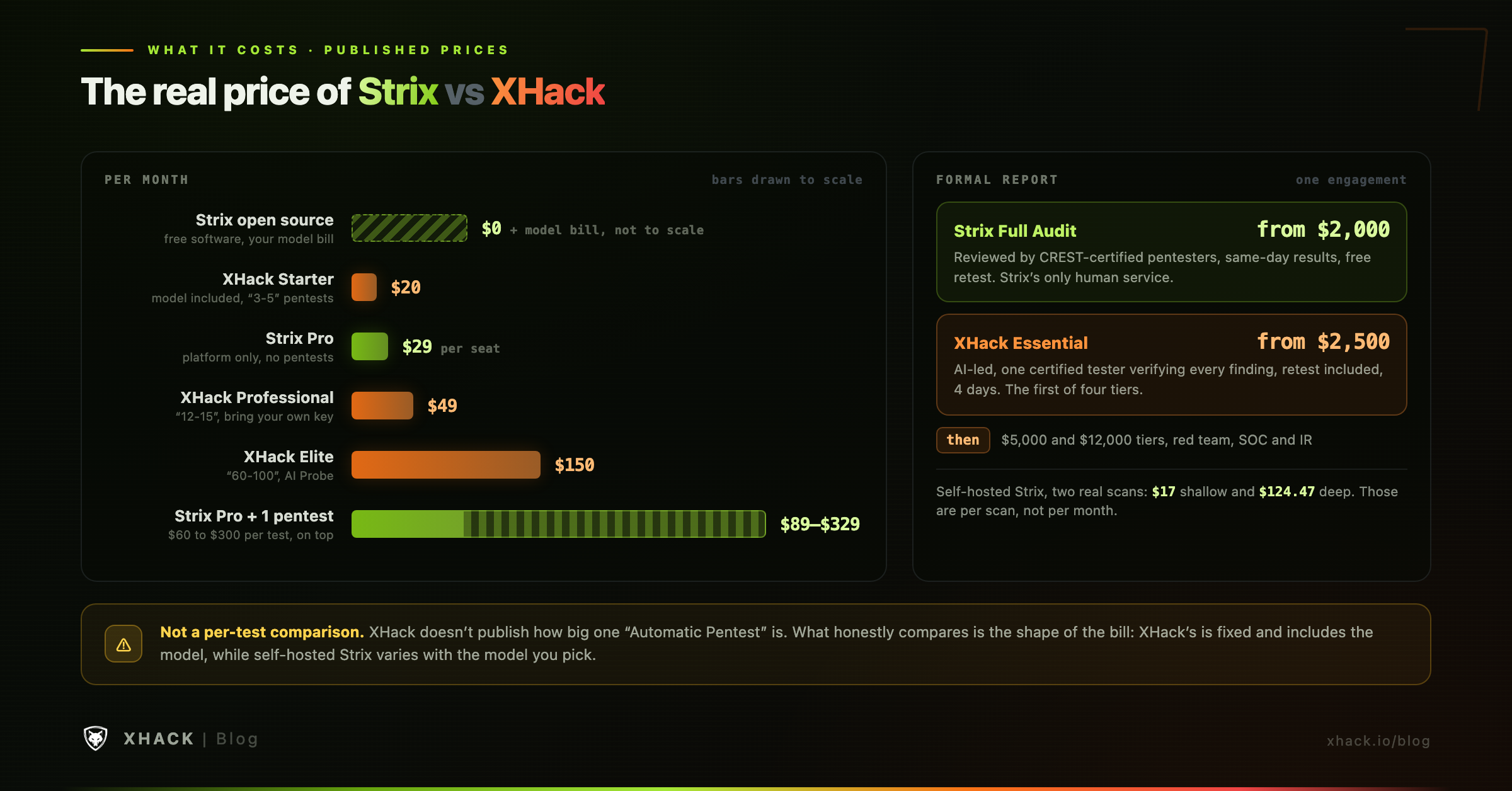
XHack Starter costs $9 a month less than Strix Pro: $20 against $29, or $240 a year against $348 on monthly billing. Strix Pro includes no pentests, so a team that wants the platform plus one Rightsized Pentest a month pays $89 to $329, while XHack’s $20 already includes an allowance of pentests and the model that runs them.
XHack doesn’t publish exactly how large one Automatic Pentest is, so the two ladders don’t line up test for test. What does line up is how each bill behaves: XHack’s is a fixed monthly price with the model included, while self-hosted Strix costs whatever your model provider charges.
For a single compliance report, the two start close together. Strix’s Full Audit starts at $2,000 with same-day results and a free retest, and XHack’s Essential VAPT starts at $2,500 over four days, with a certified tester verifying every finding and a retest included.
The difference is what comes after that. XHack’s ladder continues to $5,000 for internal, external, API and mobile testing with two OSCP-certified testers, $12,000 for attack-path chaining and cloud review, and custom programmes with red teaming and a 24/7 SOC.
Two real scans show the model bill. Idan Ohayon, a Microsoft Cloud Solution Architect writing on the Protego blog in July 2026, ran a quick black-box scan against a local copy of his own site and spent about $17 in tokens, enough for Anthropic to suspend his API key automatically, and the scan found no vulnerabilities.
The second is a GitHub issue from August 2025, where a deeper 27-agent run cost $124.47 on claude-opus-4.1, Strix’s default model at the time. Strix’s co-founder replied that the cheaper Sonnet model costs “about 10x less,” and the user who switched found the cheaper run “didn’t go nearly as deep.”
So a smaller model bill usually means a shallower test. For the wider market, XHack’s guide to AI penetration testing costs runs from $20-a-month tools to five-figure engagements, and the cheapest AI pentest tools worth running is worth reading before you assume the cheapest option is the best one.
On the core surfaces, the two are closer than most comparisons admit. Both test web apps, APIs, cloud and internal networks, and both work with source code: Strix through SAST tools and pull request reviews, XHack through an AI that analyzes source code and binaries, GitGuard pull request scanning, and managed secure code review.
Both test AI features too. Strix says its agents probe LLM features for prompt injection, jailbreaks and data leakage, while XHack’s AI Probe is a dedicated library of more than 3,500 payloads across the OWASP LLM Top 10, with escalation, retesting and reports, backed by a managed AI red teaming service.
The gap is everything past those surfaces. XHack’s agent tests mobile apps with APK and IPA analysis, Frida and ADB, while Strix lists its coverage as code, APIs, web apps, infrastructure and cloud, with no mobile.
XHack also analyzes malware and runs a SOC dashboard for your logs, neither of which Strix offers. And when a finding needs a human, XHack’s certified testers can take the engagement from a single web app all the way to an internal red team.
Both work offline. Strix’s CLI runs with a local model and supports several local model servers, and XHack’s desktop agent runs fully offline against a local Ollama model.
Price and coverage are half the Strix vs XHack decision. The other half is how you get started.
Strix. Clone the repository, add a model API key and run it, with no account and no ID check for the free CLI. You do need Docker, and Strix Cloud’s 7-day trial needs no card, though any pentest you run during it is billed as credits.
XHack. Every account is reviewed before any tool works. An individual submits a government ID and evidence of professional standing, such as a certification or a bug bounty record, and a company also submits business documents.
Once you’re approved, the 7-day trial needs no card, opens the whole platform rather than a cut-down demo, and ends by itself with nothing to cancel. There’s no Docker and no model provider to set up: XHack runs in your browser, and the full desktop agent installs with a single command and no admin rights.
The approval step is deliberate. XHack verifies who it hands offensive-security tooling to, which is also why it can give you the full product before asking for payment.
Strix is a good tool, and for some readers it’s the right one.
You want free and self-hosted. If you’re comfortable running Docker and managing your own model bill, and your targets are web apps, APIs, code and infrastructure, Strix’s free CLI may be all you need.
Your policy requires open-source tooling. Strix publishes its agent under Apache-2.0, so a team that must audit every tool before use can do that with Strix.
You need one quick compliance report. Strix’s Full Audit starts at $2,000, is reviewed by CREST-certified pentesters, and promises same-day results.
You need to start with no ID check, or you need vendor certifications today. Strix’s CLI asks for nothing before you run it. Strix also says it holds SOC 2 and ISO 27001 certification, while XHack describes itself as “ISO 27001 · SOC 2 ready.”
So yeah, here’s the section where I talk about what XHack brings to the table.
Most vendors sell one piece: an agent, a scanner, a SOC or a pentest team. XHack sells all of them under one roof, at published prices, and lets you start wherever you are. A solo researcher starts with the agent at $20, a company adds the platform from $560, and anyone who wants a team hands the work to XHack’s researchers from $2,500.
The coverage follows you up the ladder. Web, API, mobile, network, Active Directory, cloud, source code, AI applications and malware analysis all sit inside the same company, so you don’t stitch together five vendors to test one product.
You also keep control of your data. The desktop agent can run fully offline with a local model, its session data stays on your machine, and XHack doesn’t train AI models on your data or findings.
XHack’s pricing page lists every plan, and you can start with a 7-day free trial, no credit card required, once your account is approved. If you’d rather talk it through first, book a free consultation, even if Strix turns out to be the better fit for you. Brutal honesty is kind of our thing.
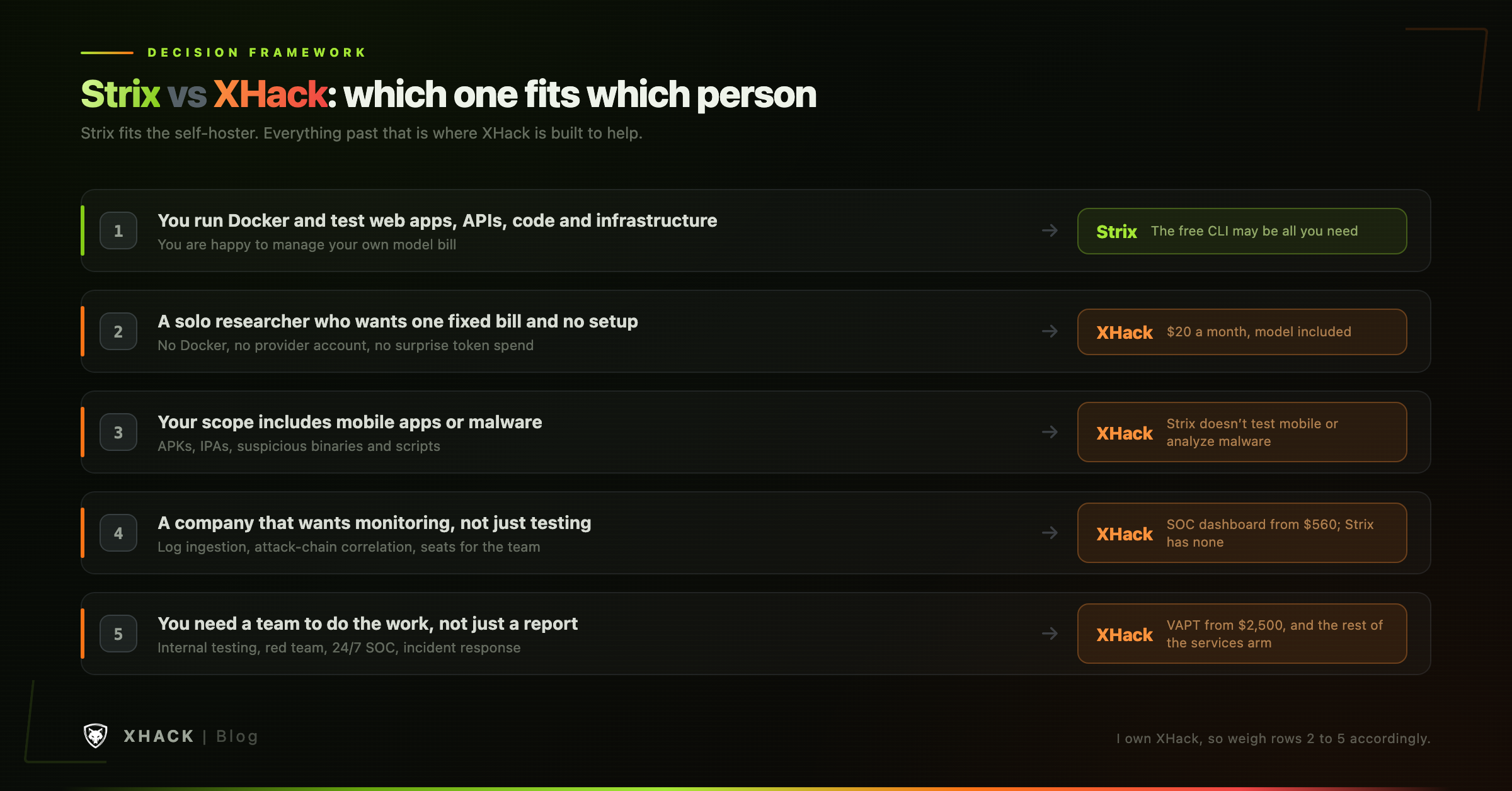
Neither tool wins for everyone. Here are five common buyers and the tool that fits each.
You run Docker, manage your own model bill, and test web apps, APIs, code and infrastructure. Use Strix. Its free CLI covers that well, and you can start testing this afternoon with no ID check.
You’re a solo researcher or bug hunter who wants one fixed bill and no setup. Use XHack. The $20 Starter plan includes the model and a pentest allowance, so there’s no Docker, no provider account and no token bill that grows with a long scan.
Your scope includes mobile apps or malware. Use XHack. Strix doesn’t test mobile apps or analyze malware, while XHack’s agent covers mobile testing and its Elite plan adds malware analysis.
You’re a company that wants monitoring, not just testing. Use XHack. Company plans from $560 a month add a SOC dashboard, vulnerability scans and seats for your team, with GitGuard and AI Probe from $1,099, and Strix has no SOC or log monitoring.
You need a team to do the work, not just a report. Use XHack. VAPT runs from $2,500 to $12,000 with certified testers and a retest, and the same company can run your red team, your SOC and your incident response, while Strix’s human option stops at the Full Audit.
For a researcher weighing XHack for bug bounty work specifically, XHack’s bug bounty guide covers that workflow in detail.
Strix’s CLI is free to download under an Apache-2.0 license, but running it isn’t free. You pay your own model provider for every scan, and one reviewer’s shallow scan cost about $17 while one user’s deep scan on the then-default Claude Opus model cost $124.47.
The same company also sells Strix Cloud at $29 a seat a month with no pentests included, one-time pentests from $60, a Full Audit from $2,000, and a custom Enterprise tier.
Because XHack covers far more than Strix. Strix is an agent for code, APIs, web apps, infrastructure and cloud, and you run the infrastructure and pay a model bill that varies.
XHack puts the model into a fixed monthly price and adds mobile app testing, malware analysis and a dedicated AI testing library. It also sells a company platform with SOC monitoring and a managed services arm with certified testers, red teaming and incident response.
Yes. XHack’s AI can analyze source code and binaries for security issues, and its chat handles code review directly. Company plans add GitGuard, which scans every GitHub pull request before code reaches your main branch, and XHack’s researchers offer secure code review as a managed service.
No. Strix describes its coverage as code, APIs, web apps, infrastructure and cloud, and it doesn’t offer iOS or Android testing in any tier. XHack’s agent covers mobile with APK and IPA analysis, ADB and Frida, and its Assurance VAPT tier adds mobile testing by certified testers.
Yes. XHack sells fixed-price VAPT from $2,500, $5,000 and $12,000, each with a retest and a compliance-ready report, plus custom programmes for larger estates. Its services arm also covers red teaming, a 24/7 SOC, incident response, threat intelligence, cloud security assessments, secure code review, AI red teaming, compliance consulting and training.
It depends on what you hunt. Strix handles web app and API targets well, and its CLI costs nothing beyond your model bill.
XHack covers the same web and API ground with the model included, and adds mobile apps, malware analysis and AI Probe on the Elite plan, with nothing to set up. A hunter working mobile programs will find that Strix doesn’t test mobile apps at all.
The Strix vs XHack choice comes down to how much you want one company to cover. Strix gives you a free, self-hosted agent for code, APIs, web apps, infrastructure and cloud, and leaves the model bill and the setup to you.
XHack gives you an agent with the model included, a security platform with SOC monitoring for your team, and a managed services arm, across web, API, mobile, network, Active Directory, cloud, source code, AI applications and malware. You can start at $20 a month and grow into VAPT, red teaming and a 24/7 SOC without changing vendors.
If you’re comfortable with Docker and your targets stop at code, web and infrastructure, start with Strix. If you need mobile, malware analysis or monitoring, or you want a team behind the findings, XHack is built for you, with a 7-day free trial once your account is approved.
If XBOW is on your shortlist, XBOW vs XHack compares XHack with a pay-per-test competitor focused on web apps and APIs. Horizon3 vs XHack covers NodeZero’s pricing, Active Directory record and FedRAMP status, and Pentera vs XHack covers the six-figure enterprise end of the market.
Categories
Related articles