Table of contents
15
Read this in 30 seconds: XHack runs AI VAPT services as a genuine hybrid: an autonomous AI agent working a seven-stage pipeline (recon, discovery, weaponize, mobile, enrich, collaborate) alongside OSCP-certified human testers who verify every finding before it reaches a client report. In one public case, the agent was pointed at a fintech bug bounty program with a single instruction, “recon, pick your own target, go,” and independently found, validated, and packaged a working OAuth credential exposure in 25 minutes for about $5 in compute.
In another, a grey-box SaaS audit caught a mass-assignment privilege escalation to full workspace ownership in under 48 hours. Engagements start at $2,500 for a single external web app or up to 50 host IPs, run through $5,000 and $12,000 tiers with more testers, more scope, and cloud review, and scale to custom Enterprise programs with a dedicated team. Every plan includes AI agents at no extra charge, a free patch-verification retest, and compliance-ready reporting for PCI DSS, SOC 2, ISO 27001, HIPAA, and GDPR.
A pentest report is only as good as what actually got tested, and how fast the real gaps got found. That’s the entire case for running AI VAPT services the way XHack runs them: an agent that works around the clock across the full breadth of a scope, and humans who verify the parts that actually matter before anything reaches a client. Not AI replacing a tester. Not a tester slowed down by a tool. Both, running in parallel, on the same engagement.
Here’s what that actually looks like in practice, backed by real numbers from real engagements.
VAPT, vulnerability assessment and penetration testing, has traditionally meant a human tester (or a small team) working through a scope over one to four weeks, bound by however many billable hours the engagement affords. AI VAPT services change the constraint that matters most: coverage no longer scales with headcount.
At XHack, that takes a specific, concrete shape. An autonomous AI agent runs continuously across the agreed scope, recon, discovery, exploitation attempts, mobile analysis, CVE correlation, all in parallel, never sleeping, never running out of engagement hours. Every finding the agent surfaces then passes through human verification before it reaches a report. The agent finds breadth fast. The humans confirm the findings are real, chase down the business-logic and creative attack chains AI still struggles with, and put their name behind what ships to the client.
That combination, not “AI instead of a pentester” and not “AI as a chatbot sidekick,” is what “AI VAPT services” means in this guide.
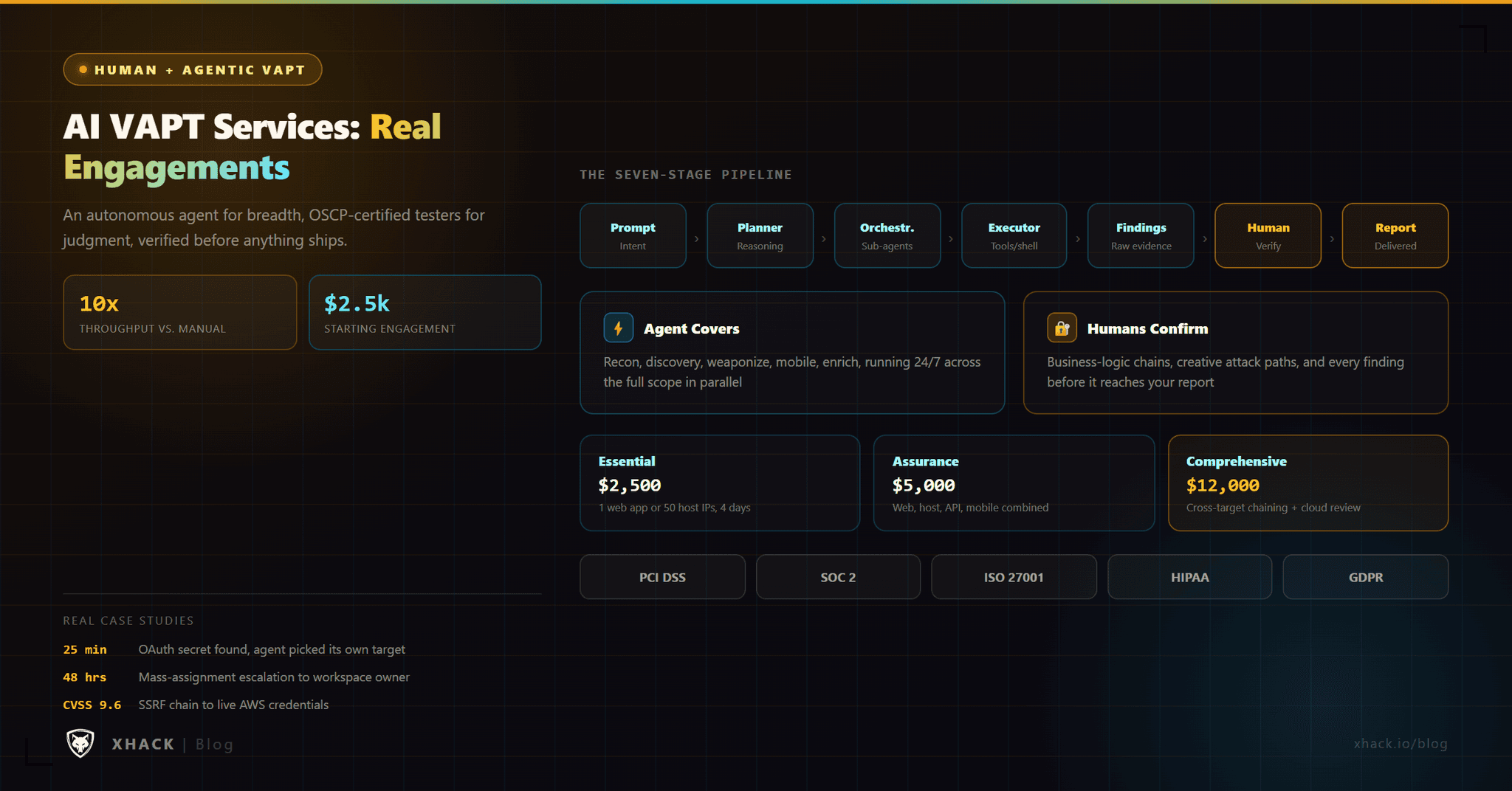
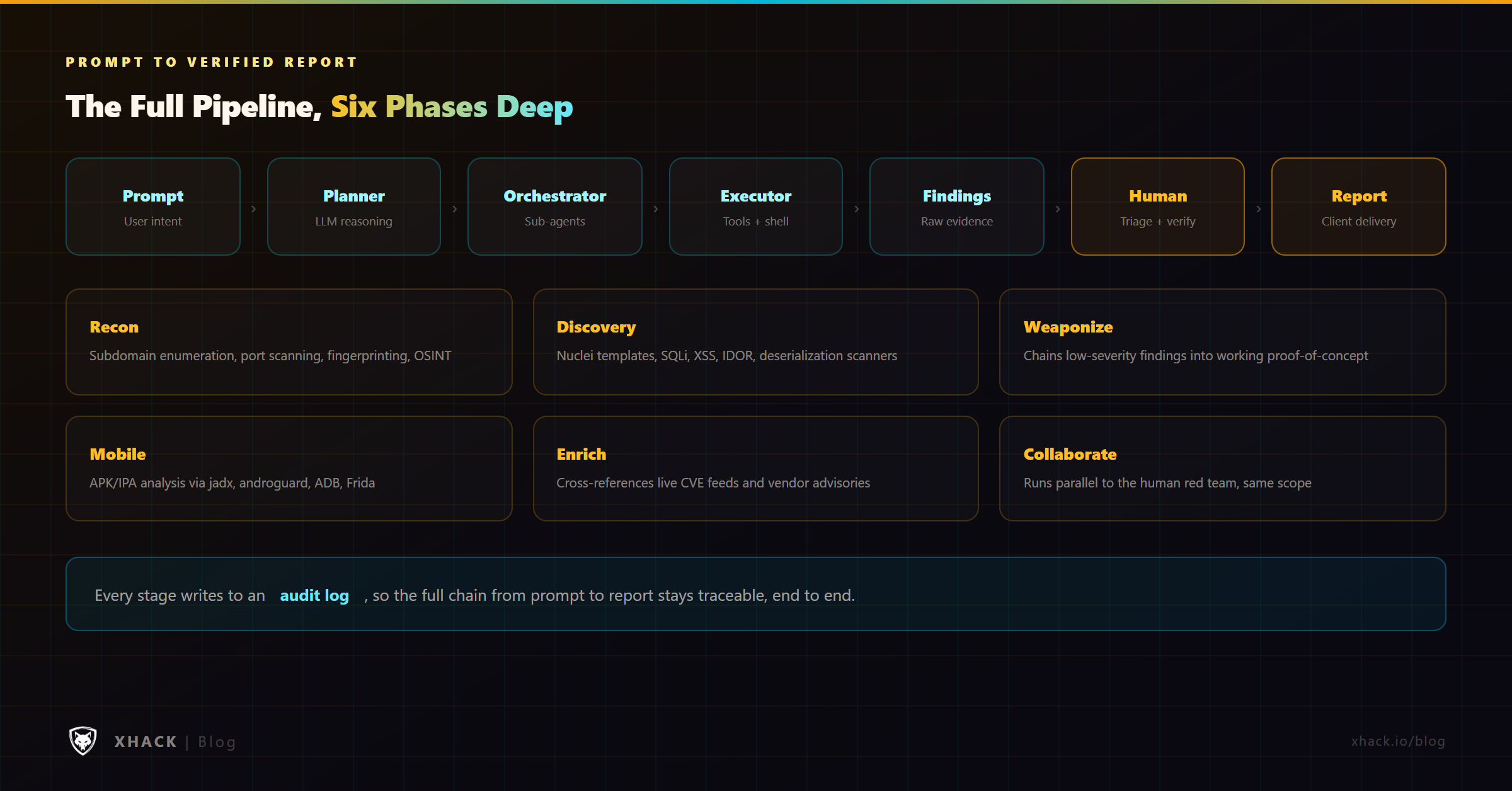
The agent isn’t a single model firing off requests. It runs a seven-stage pipeline: Prompt (the tester’s intent) feeds a Planner (the LLM reasoning layer), which hands work to an Orchestrator coordinating multiple parallel sub-agents, each executing through real tools and shells. Everything the sub-agents produce lands as Findings, raw evidence, before a Human triage-and-verification step, and only then does a Report reach the client. Every stage writes to an audit log, so the full chain from prompt to report stays traceable.
The sub-agents themselves work across six operational phases, often simultaneously:
Across those phases, the agent is watching for remote code execution, authentication bypass, data exfiltration paths, mobile-specific weaknesses, supply-chain risk, and cloud misconfiguration, at the same time, on the same scope. The throughput difference this produces against a manual-only process is roughly tenfold, and it’s why a single engagement can cover a breadth of scope that would take a solo human tester weeks longer to reach.
Here’s the part that actually makes AI VAPT services trustworthy instead of just fast: the agent’s output is never the deliverable. It’s the input to a human’s work.
Senior red-teamers run their own playbook in parallel with the agent, covering exactly the ground AI is weakest on: the creative, multi-step attack chains and business-logic flaws that require understanding what a specific application is actually for, not just what its endpoints technically accept. High-impact findings the agent surfaces get verified by that same human team before anything reaches a client dashboard. Uncertain findings get flagged as uncertain. Nothing gets overstated to look more impressive in a report.
That division of labor, agent for breadth and continuous coverage, human for judgment, creative chaining, and final sign-off, is what the case studies below actually demonstrate in practice.
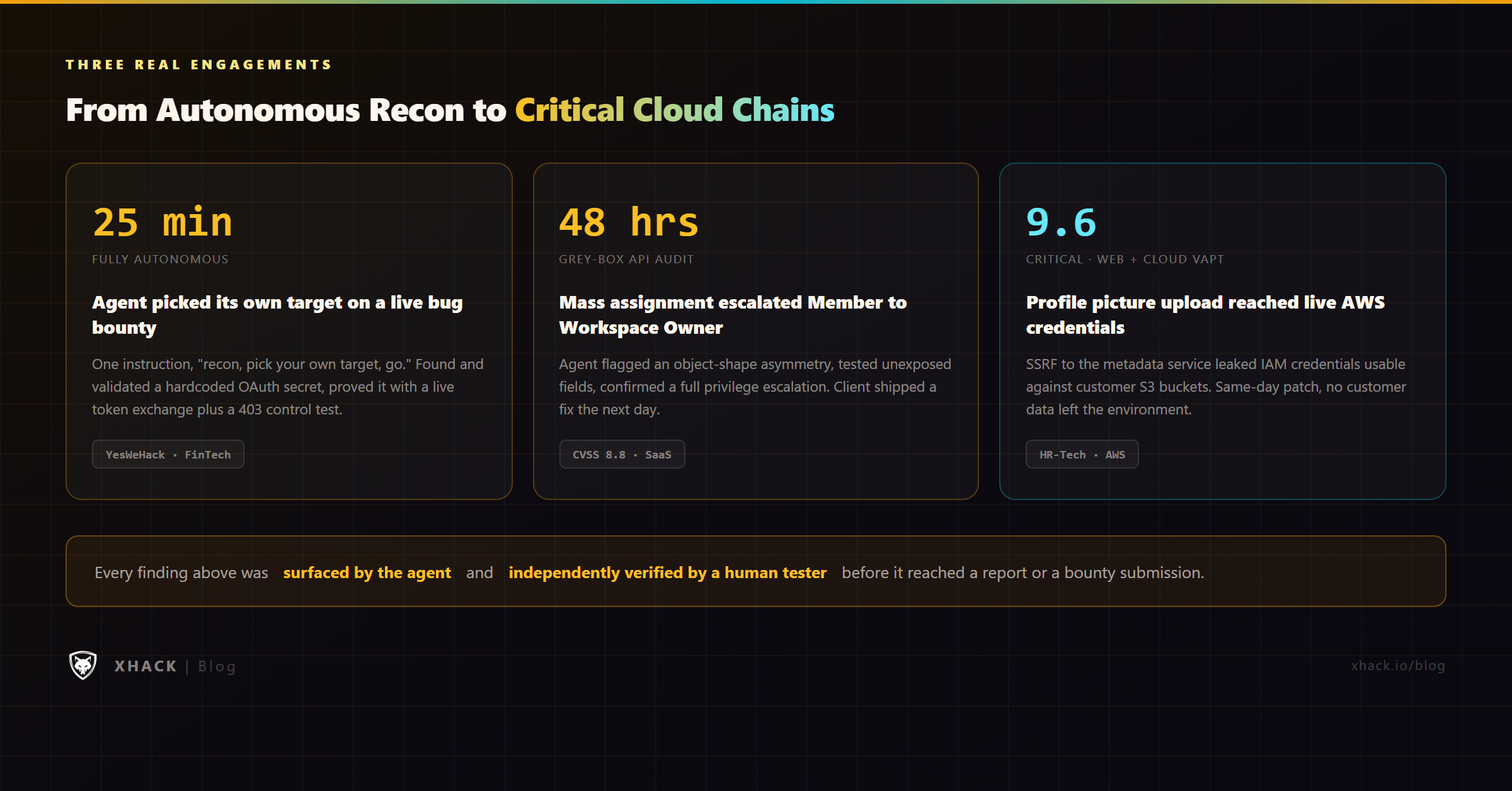
This is the clearest demonstration of what unsupervised agent breadth looks like. On a public YesWeHack bug bounty program for a fintech company offering instant micro-loans, a researcher gave the XHack agent a single line of instruction: “Recon. Pick your own target. Go.”
The agent independently ran subdomain enumeration and HTTP surface mapping, maintaining its own scope file and its own recon output without further direction. It flagged a 3.7MB Flutter web bundle, main.dart.js, as worth inspecting, and inside it found two embedded OAuth client credential pairs, base64-encoded directly into the compiled client-side code, a textbook CWE-798 hardcoded-credentials flaw.
It didn’t stop at finding the string. The agent tested the credential’s validity against the actual OAuth token endpoint using HTTP Basic authentication, got back an HTTP 200 with a live access token, then ran a control test, mutating a single character in the secret, which correctly returned an HTTP 403. That control test is what separates a real finding from a false positive: it proved the endpoint was genuinely validating the credential, not just returning a generic success response. The agent then mapped where that token could reach, including upstream login, password-reset, and OTP flows.
Total elapsed time: roughly 25 minutes, entirely autonomous, at about $5 in compute cost. The human researcher independently reproduced every claim, the extracted secret, the token exchange, the 403 control, before submitting. The finding was accepted with a €100 bounty at a program-rated CVSS of 3.7, low severity by the numbers, but a genuine, reproducible, working credential exposure found and packaged with proof-of-concept code in less time than most people spend on lunch.
Not every engagement is an autonomous solo run. Most XHack VAPT work is a structured, scoped audit, and this one shows the human+agent model doing that kind of work.
The target was a mid-market team-collaboration SaaS platform, roughly 150 employees, with a workspace architecture where roles, Member, Admin, Owner, gate billing, member management, and data export. The engagement was a grey-box API security audit using two standard Member-level test accounts.
The agent’s approach was systematic: it recorded the full shape of every object returned by the application’s read endpoints, then flagged an asymmetry. The profile response included role, workspace_id, and email_verified fields that the actual user interface never exposed for editing. It tested whether the profile update endpoint would silently accept those unexposed fields anyway, and confirmed the server accepted "role": "owner" in a PATCH request and persisted it, a full Member-to-Owner privilege escalation via classic mass assignment, OWASP API3:2023, root-caused to a wholesale Object.assign(user, body) pattern instead of explicit field allow-listing.
The finding surfaced within 48 hours of engagement start. From there, XHack’s human analysts took over verification: reproducing the escalation on a second account, enumerating every writable security-relevant field, mapping the full scope of what an attacker with Owner access could actually do, and checking logs for any sign the flaw had already been exploited in the wild. The client shipped a fix the next day. The full audit, including two additional vulnerable endpoints the team caught in the same pass, wrapped inside one week, with the whole engagement running 3 days of active testing. Re-testing confirmed the fix held.
This one shows what “cloud review included” actually catches in practice, and why severity ratings matter more than finding counts.
An early-stage HR-tech SaaS company, around 20 employees, single AWS account, brought XHack in for a grey-box web-and-cloud VAPT. The application’s profile-picture feature accepted remote image URLs and fetched them server-side, with no protocol restriction and no filtering against internal IP ranges, a classic SSRF entry point that’s easy to miss because “let users set a profile picture from a URL” reads as harmless.
The testing chain moved through the standard SSRF playbook first, localhost, private IP ranges, then the cloud metadata service at 169.254.169.254. A request to the IAM credentials path returned a verbose error that leaked the IAM role name. The follow-up request to the full credential endpoint returned live, temporary AWS credentials, exfiltrated through an image upload field. Those credentials were usable to assume the role and enumerate the company’s customer document buckets, which held onboarding paperwork and payroll PDFs for eight pilot customers, exactly the reference accounts the company needed intact ahead of a public launch.
Root cause was a stack of small decisions compounding: unrestricted outbound URL fetching, IMDSv1 left enabled on the EC2 instance (no session token required), and a web-tier IAM role with far more S3 read access than the application actually needed. Severity: CVSS 9.6, Critical.
Remediation moved fast because the finding was unambiguous. Same day: a strict host allowlist went on the fetch endpoint, URL-based uploads were temporarily disabled, and IMDSv2 was enforced. Within 48 hours: S3 permissions were stripped from the web-tier role and a dedicated egress proxy went in for outbound URL policy enforcement. Within a week: structured logging for rejected requests, and re-testing confirmed the metadata endpoint was no longer reachable. No customer data left the environment, the pilot continued uninterrupted, and the public launch stayed on schedule.
Every tier runs the agent alongside human testers, at no extra charge for the AI portion. The difference across tiers is scope size, team size, and depth of testing.
| Tier | Price | Scope | Team | Turnaround |
|---|---|---|---|---|
| Essential | $2,500 | One unauthenticated web app, or up to 50 host IPs | AI agents lead, one OSCP-certified tester verifies | 4 days |
| Assurance | $5,000 | Up to 3 unauthenticated apps, or 1 authenticated app, or 100 host IPs; internal + external, web/host/API/mobile | Two OSCP-certified testers plus AI agents | 5 days to 2 weeks |
| Comprehensive | $12,000 | Up to 20 unauthenticated or 3 authenticated web apps, or 200 host IPs; attack-path chaining across targets, cloud review included | Full team with parallel AI operations | 2 to 4 weeks, phased delivery |
| Enterprise | Custom | Unlimited assets, multi-region estates, continuous programs | Dedicated named team; red team, purple team, SOC, and IR available | Ongoing |
Every plan, regardless of tier, includes a free patch-verification retest, compliance-ready reporting mapped to PCI DSS, SOC 2, ISO 27001, HIPAA, and GDPR requirements, mutual NDAs, and a strict verified-findings-only policy, meaning every reported issue comes with manual exploitation proof, not just an automated scanner flag. Coverage spans web applications and APIs (REST, GraphQL, gRPC, WebSocket), network and host infrastructure, mobile apps on iOS and Android, cloud environments across AWS, Azure, and GCP, and AI/LLM system testing for teams shipping their own AI features.
Running the agent alongside human researchers happens only with explicit client permission and strictly inside the agreed Rules of Engagement for that specific scope, the same authorization discipline that governs every action a human tester takes.
One thing worth being direct about, because it matters more in a pentest engagement than almost anywhere else: XHack does not store your user data, and the platform is privacy-focused by design. Session data and engagement chats stay on your own local machine, not sitting on a vendor’s servers as a standing liability, and you can delete them whenever you choose. The audit trail the agent produces during an engagement is for your own traceability and compliance reporting, not a data asset XHack retains or repurposes afterward. When the deliverable is a list of your unpatched vulnerabilities, that distinction is not a minor detail.
AI VAPT services combine an autonomous AI agent, running continuous reconnaissance, vulnerability discovery, and exploitation attempts across a defined scope, with human penetration testers who verify every finding before it reaches a client report. The agent provides breadth and speed; the human team provides judgment, creative attack chaining, and accountability for what actually ships.
It depends entirely on whether human verification is actually part of the workflow. An AI agent alone will surface false positives and miss business-logic flaws that require understanding intent, not just endpoint behavior. XHack’s model routes every high-impact finding through human verification before delivery, which is what turned an autonomous 25-minute credential discovery into a submittable, accepted bug bounty report rather than an unverified guess.
Fast, when the finding is real. In one documented case, a mass-assignment privilege escalation was discovered within 48 hours of engagement start, verified by human analysts, and fixed by the client the next day. A full Essential-tier engagement runs on a 4-day turnaround; larger Comprehensive-tier engagements with cloud review and cross-target chaining run 2 to 4 weeks.
No, AI agents run on every tier at no additional charge, alongside the human testers assigned to that engagement. Every plan also includes a free patch-verification retest and compliance-ready reporting for frameworks like PCI DSS, SOC 2, ISO 27001, HIPAA, and GDPR.
No. XHack does not store your user data. Session data and chats from an engagement stay on your own local machine rather than on XHack’s servers, and you can delete them at any time. The findings belong to you, not to a vendor database.
The case for AI VAPT services isn’t that AI replaces a pentester, it’s that the two catch different things, at different speeds, and running them in parallel on the same scope produces results neither one gets alone. An agent that finds a working OAuth token in 25 minutes on a target it picked itself. A 48-hour mass-assignment escalation caught in a structured grey-box audit. A critical SSRF chain to AWS credentials found before it reached eight pilot customers’ payroll data. None of those are AI acting alone, and none of them are a human working at the old pace either.
If your last pentest took three weeks to tell you what you already suspected, that’s the gap AI VAPT services are built to close, starting at $2,500 and scaling to whatever your actual estate needs.
Categories
Related articles