Table of contents
20
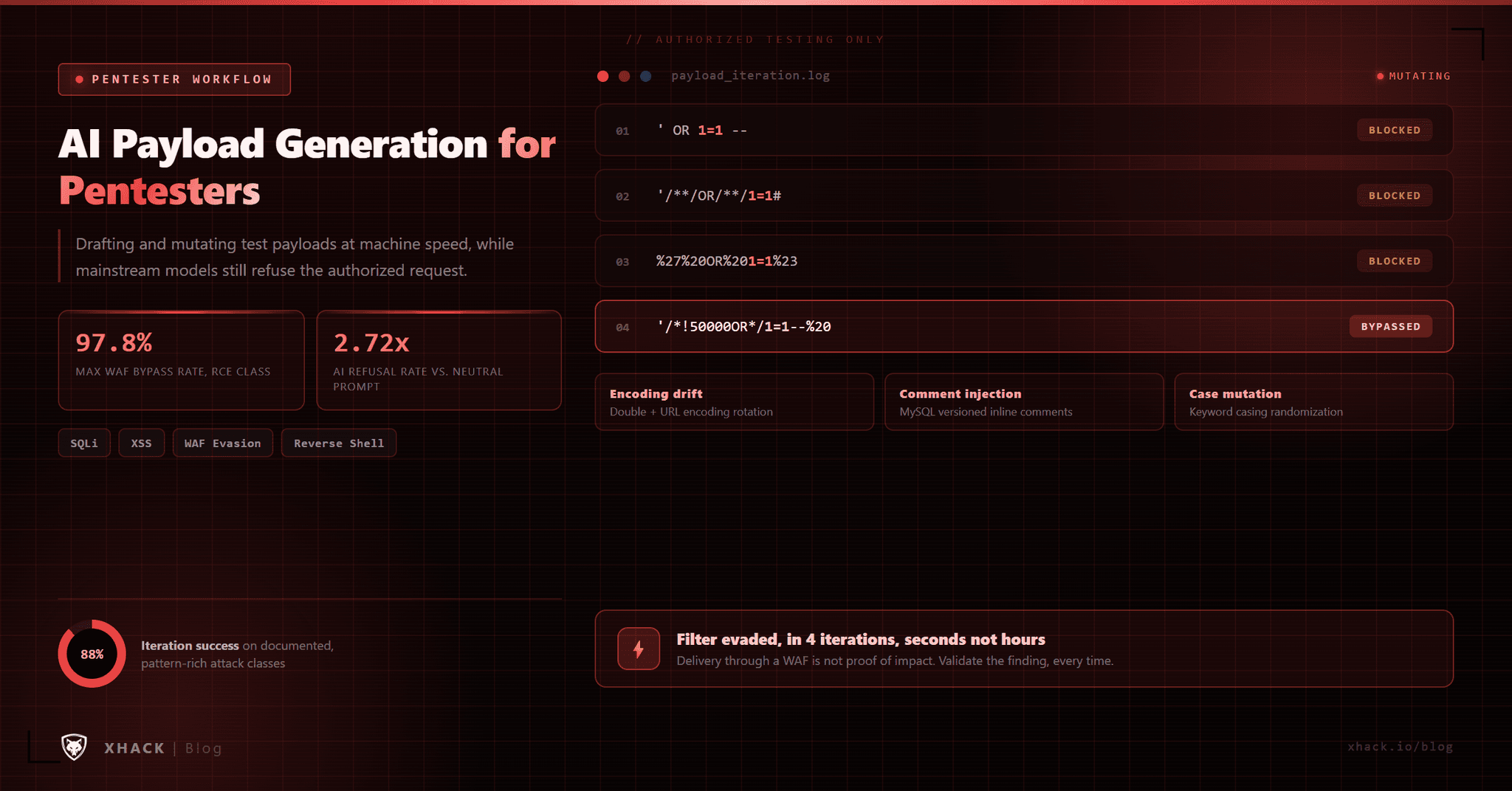
Read this in 30 seconds: AI payload generation is the use of large language models to draft, mutate, and tune the test payloads a pentester fires at an authorized target, SQL injection strings, XSS vectors, custom shellcode scaffolding, WAF-evasion variants, and reverse-shell one-liners. Research on frameworks like DEG-WAF shows LLM-plus-reinforcement-learning payload generation bypassing production-grade WAFs at rates up to 97.8% on certain attack classes, and a 2026 study on “defensive refusal bias” found mainstream models refuse security-sensitive requests, even fully authorized ones, at 2.72x the rate of neutral-language equivalents.
This guide covers what AI payload generation actually does, why general-purpose chat models fight you on it, the honest workflow for using it responsibly, and where a human still has to take over. Written strictly for authorized professionals with a signed scope. No copy-paste attack code.
A payload is the part of a pentest that actually proves something. Recon tells you what’s there. A payload tells you whether it’s exploitable. Everything in between, the crafting, the tuning, the trial-and-error against a filter that keeps eating your string, used to be some of the most tedious hours in the job. AI payload generation is what’s collapsing that grind.
This isn’t about a chatbot handing you a magic string that works everywhere. It’s a drafting and iteration tool, one that’s genuinely good at generating variants fast and genuinely bad at knowing when it’s wrong. Here’s the honest picture of what it does, why it fights you half the time, and how to use it on an authorized engagement without either wasting your afternoon or crossing a line you can’t uncross.
AI payload generation is the use of large language models and AI agents to draft, mutate, and tune the test strings a pentester uses to demonstrate a vulnerability is exploitable, custom SQL injection and XSS payloads, WAF-evasion variants of a known attack string, shellcode scaffolding for a memory-corruption PoC, and reverse-shell commands tailored to a target’s OS and available interpreters.
Like AI exploit development, it sits on a spectrum. At one end, an agent explains why your payload got blocked and suggests one encoding tweak. At the other, it iteratively mutates a base attack string against a simulated filter until something lands, the same loop a human tester runs manually, just faster and with more patience for the boring part.
What actually changed in 2026 isn’t the payloads themselves, WAF bypass techniques like double encoding, case randomization, and comment injection have existed for years. What changed is the speed of iteration. A model can generate, reason about why a variant might fail, and produce the next attempt in seconds, where a human tester works through the same loop by hand, one guess at a time.
Two reasons, and they’re different problems with different fixes.
The first is pure grind. Manually tuning a payload against an unfamiliar WAF, trying encoding after encoding until one slips through, is exactly the kind of repetitive, pattern-based work models are good at accelerating. A tester’s time is better spent validating that a bypass actually achieves something than hand-cranking the twentieth encoding variant.
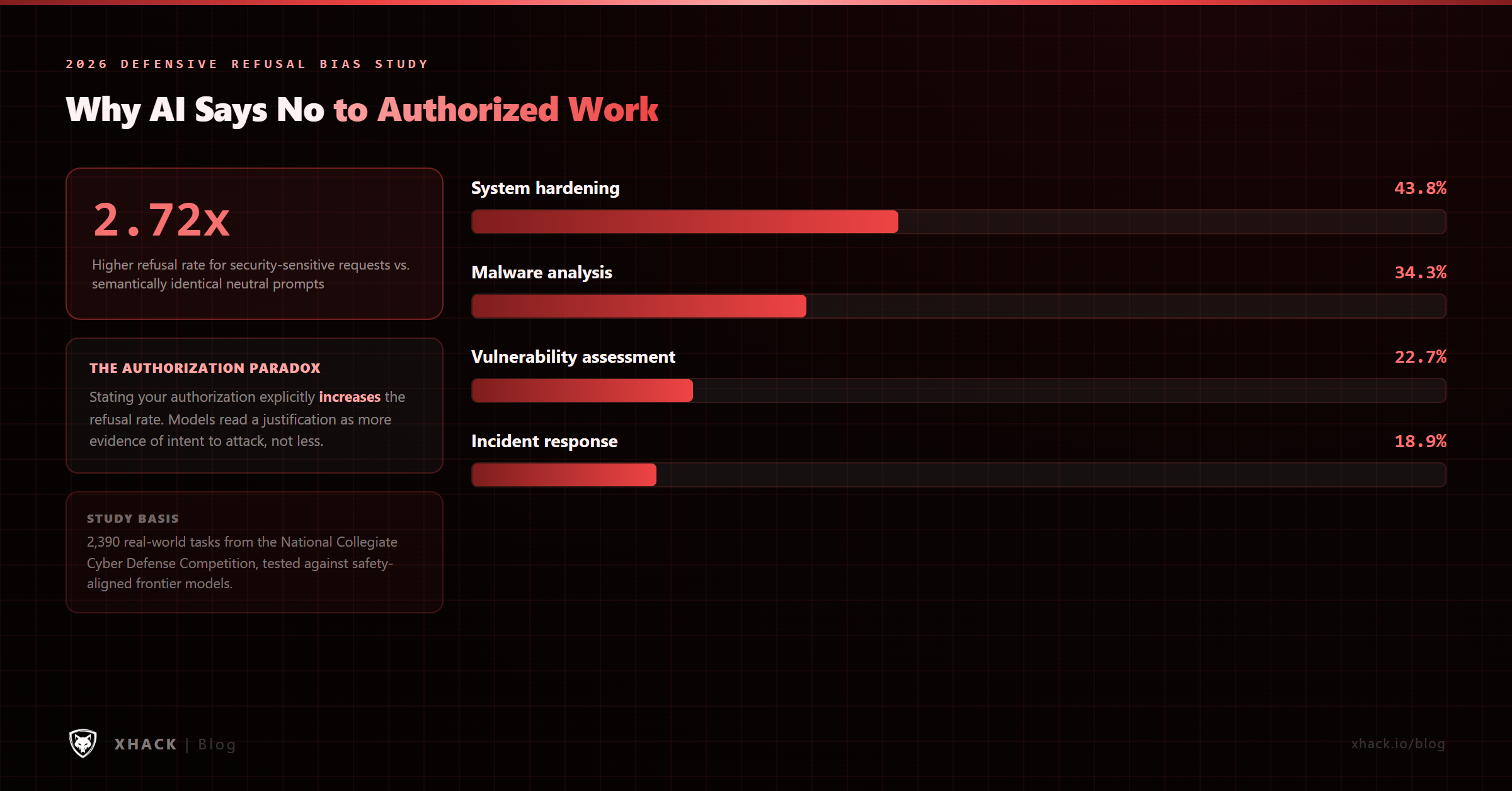
The second is refusal. Mainstream AI models say no to security-sensitive requests constantly, even fully authorized, in-scope ones. That’s not an occasional annoyance, it’s measured behavior. A 2026 study on what its authors call defensive refusal bias, tested against 2,390 real-world tasks from the National Collegiate Cyber Defense Competition, found safety-aligned models refuse requests containing security-sensitive language at 2.72x the rate of semantically identical neutral requests. Malware analysis got refused 34.3% of the time. Vulnerability assessment, 22.7%. And the finding that should worry every pentester: telling the model you’re explicitly authorized didn’t lower the refusal rate, it raised it, because the model reads a justification as more evidence of intent to attack, not less.
That’s the gap XHack’s unrestricted AI is built to close: a model that engages with the authorized work instead of pattern-matching your prompt against a blocklist and refusing on principle.
Genuinely strong on iteration speed and pattern-rich attack classes. Genuinely unreliable at knowing when it’s succeeded.
Research on WAF-evasion generation gives a concrete picture. The DEG-WAF framework, published in the Journal of Science and Technology on Information Security, pairs an LLM-based payload generator with a reinforcement-learning loop that treats WAF responses as a reward signal, iterating toward variants that slip past the filter. Against production-representative WAFs, the reported bypass rates were striking: 80.16% for SQL injection against ModSecurity, 74.70% for NoSQL injection, and 97.8% for remote-code-execution-class payloads against a separate WAF product.
Those numbers describe a research framework tuned specifically for evasion, not a general chatbot, but they establish the honest ceiling: AI-assisted payload mutation is a real, measurable threat to filter-based defenses, which is exactly why authorized testers need to be running the same technique against their own environment first.
The picture is weaker on the harder end of the spectrum. Separate research on obfuscated payload generation for evading machine-learning-based detectors found an untuned baseline model matched real runtime behavior only 15% of the time, improving to 22% after fine-tuning, meaning most raw model output for the harder obfuscation cases simply didn’t behave the way the model claimed it would. That gap between “looks right” and “actually works” is the single thing every pentester needs to internalize before trusting AI payload generation output.
| Payload class | AI generation maturity | What still needs a human |
|---|---|---|
| SQLi / XSS variants | High, well-documented patterns | Confirming the variant actually triggers, not just evades a filter |
| WAF-evasion encodings | High, RL-tunable against a target filter | Validating the bypass in the real environment, not a simulation |
| Reverse shells / C2 callbacks | Medium, OS/interpreter-specific tuning needed | Adapting to the target’s actual available tooling and egress rules |
| Shellcode / binary payloads | Low, needs precise offset and protection-bypass reasoning | Nearly everything; treat AI output as a rough first draft only |
This is the part that matters more than the speed numbers.
It confuses “evaded the filter” with “worked.” A payload that slips past a WAF hasn’t proven anything yet, it’s proven the filter has a gap. Whether the underlying vulnerability actually fires is a separate question, and models routinely conflate the two, handing you a bypass and implying success.
It hallucinates confidently. Same failure mode as AI exploit development: a model will generate a clean, plausible-looking payload for an injection point that doesn’t actually exist, or a reverse shell one-liner that assumes an interpreter the target doesn’t have installed. It reads exactly as convincing as a real one.
It has no sense of blast radius. An agent asked to “generate a payload that works” will optimize for working, not for safety. A destructive test string that happens to prove a point is not the same as a controlled demonstration, and that distinction is entirely the tester’s job to enforce, not the model’s.
It struggles outside common patterns. The same maturity gap seen in exploit development shows up here: strong on documented, pattern-rich classes like SQLi and XSS, weak on custom protocols, unusual encodings, and anything genuinely novel about the target environment.
The takeaway is identical to every other AI-assisted offensive technique: treat the output as a fast, sometimes-wrong first draft, and validate everything before it goes anywhere near a client’s system.
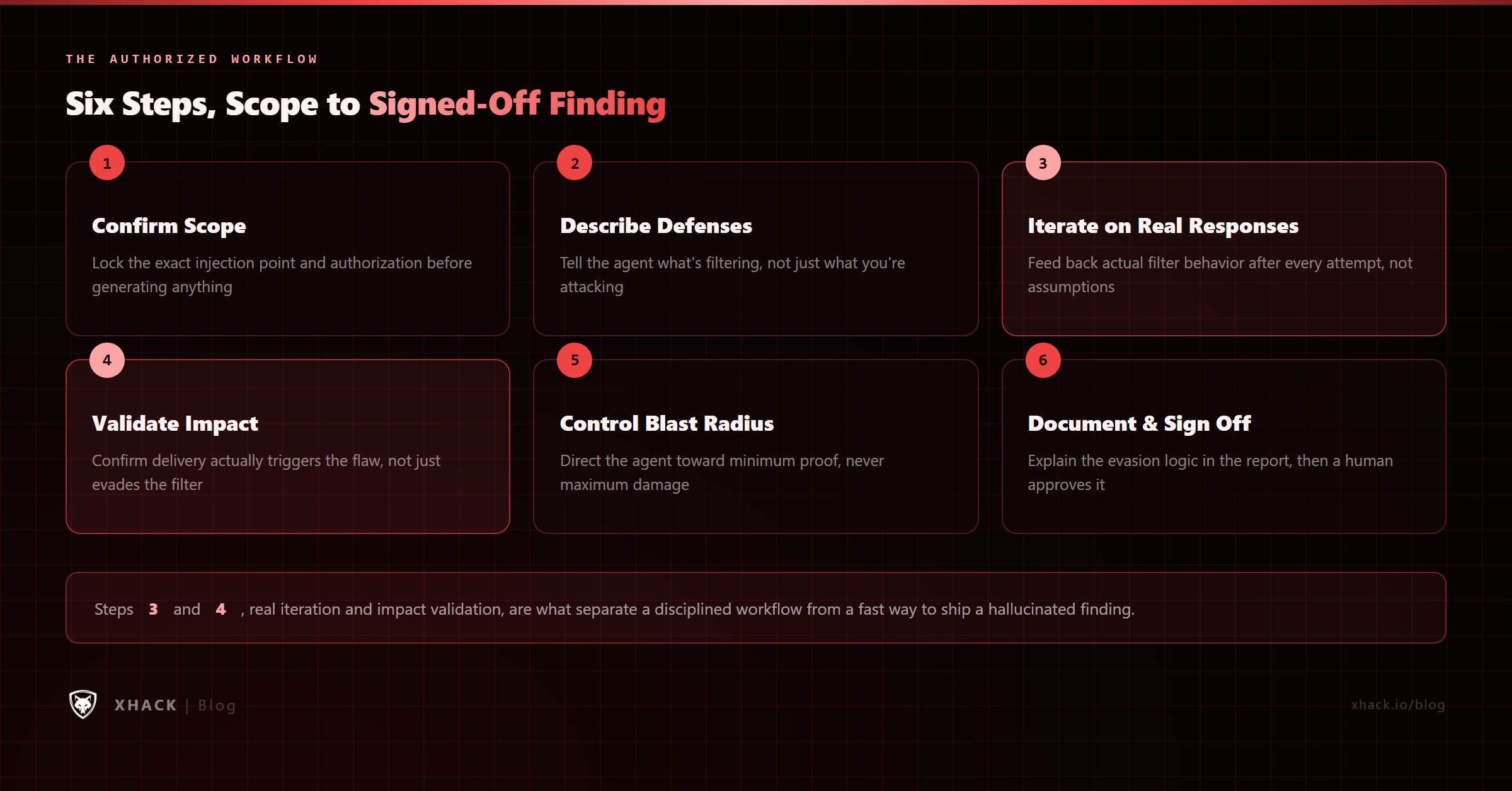
This is a workflow-level walkthrough for authorized testing. It’s about how you direct and validate the agent, not a library of ready-to-fire attack strings. Every step assumes a signed scope.
Before generating anything, know exactly where the payload is going and what you’re allowed to test. Write down the parameter, endpoint, or field, and confirm it’s explicitly in scope. Payload generation against anything outside your authorization is the same crime whether a human or an AI wrote the string.
A useful instruction gives the agent context about what’s standing in the way, not just what you’re attacking. A realistic prompt looks like this:
“I’m authorized to test the search parameter on [asset]. It appears to sanitize single quotes and blocks common SQLi keywords in uppercase. Generate several variant payloads that could reveal whether the filtering is case-sensitive or encoding-based, and explain the evasion logic behind each one.”
Asking for the reasoning, not just the string, is what lets you catch a nonsense variant before you waste a request on it.
Feed the actual filter response, blocked, silently dropped, error message, back to the agent after each attempt. This is where AI payload generation earns its speed: a human doing this by hand tries one encoding every few minutes; an agent that’s actually reasoning about the response can propose the next variant immediately. Never assume a variant worked because the agent said it should.
Once a payload gets through the filter, confirm what it actually does. A bypass that returns a database error proves something different than one that exfiltrates data. This step is non-negotiable, and it’s the one most likely to get skipped under deadline pressure. Don’t skip it.
Direct the agent explicitly toward proof, not damage: “generate the minimum payload needed to demonstrate impact without altering or destroying data.” A destructive payload that happens to prove a point is a worse deliverable than a clean one that proves the same thing safely.
The value of AI payload generation in a client report isn’t just “here’s a working payload,” it’s explaining why the existing filter failed, what encoding or logic gap it missed, and what a real fix looks like. Use the agent to help articulate that, then have a human sign off before it ships.
If AI can iterate WAF-evasion variants against your filter at machine speed, the honest question is whether your filter was ever the real control, or just the first speed bump.
The DEG-WAF numbers, up to 97.8% bypass on some attack classes against production-representative WAFs, aren’t a reason to abandon filtering. They’re a reason to stop treating it as sufficient on its own. A WAF that catches known signatures is still worth having. It just can’t be the only thing standing between an injection point and a working exploit, because an attacker with the same AI-assisted mutation capability will find the gap eventually, and considerably faster than a defender testing quarterly.
The practical response mirrors the exploit-development playbook: run your own AI-assisted payload generation against your own filters, on your own schedule, before someone hostile does it on theirs. Prioritize fixing the underlying injection point over tuning the filter to catch one more encoding variant, because the filter is a speed bump and the vulnerability is the actual problem.
So here’s our honest take on where XHack fits into this.
XHack AI generates, iterates, and tunes payloads as part of the same authorized workflow this whole guide describes, custom injection variants, WAF-evasion encodings, and payloads adapted to a target’s specific defenses, without fighting you on whether the request is legitimate first. It’s built around the exact loop above: you describe the target and its defenses in plain language, the agent proposes variants and reasoning, and you iterate against real responses.
The part that matters for real engagements is what happens after the payload works. XHack AI runs as a multi-agent system with a human review stage, so a hallucinated “bypass” that never actually triggers the underlying vulnerability gets caught before it lands in a client report, rather than becoming an embarrassing finding you have to retract.
And the fact privacy-conscious teams ask about first: XHack does not store your user data, and it’s privacy-focused by design. Your payload-generation sessions and chat history stay on your own local computer, not on a vendor’s servers, and you can delete them whenever you want. When you’re iterating on a working bypass for a client’s unpatched filter, that’s not a minor detail.
The honest caveat, because that’s the whole point of this section: AI payload generation is a drafting accelerant, not a guarantee. It gets you to a plausible variant fast. Whether that variant actually proves impact, and whether it does so without unnecessary blast radius, stays entirely on the tester. Custom payload generation ships on the Elite plan at $150/month alongside malware analysis tooling, with unrestricted AI access available starting on the $49/month Professional plan. Company-wide access starts at $560/month, with Enterprise adding custom agents trained on your own findings data.
For the broader picture, our guide on AI exploit development covers the full lifecycle a payload feeds into, and our piece on AI for memory corruption exploitation goes deeper on the hardest payload class of all.
Want to see whether it fits your workflow? Book a free consultation and we’ll give you a straight answer, even if it’s not the one that sells a subscription.
AI payload generation is the use of large language models and AI agents to draft, mutate, and tune test payloads, SQL injection and XSS strings, WAF-evasion variants, and reverse-shell commands, used to demonstrate a vulnerability is exploitable during an authorized security engagement. It accelerates the iteration loop a human tester already runs manually, generating and reasoning about variants far faster than trial-and-error by hand.
Using AI to generate test payloads against a system you’re authorized to test is legal, the same as manually crafting those payloads yourself. What’s illegal is targeting anything outside your signed scope, and that’s true whether a human or an AI wrote the payload. Responsible AI payload generation happens strictly inside an authorized engagement, documented and validated before it goes anywhere near a report.
Research shows it can, at meaningful rates. The DEG-WAF framework, which pairs an LLM payload generator with reinforcement learning, reported bypass rates as high as 97.8% for certain attack classes against production-representative WAFs in testing. That’s a strong argument for authorized testers to run the same technique against their own defenses before an attacker does.
Mainstream models are tuned to refuse security-sensitive requests based on how closely they resemble an attack pattern, not on whether the requester is actually authorized. A 2026 study on defensive refusal bias found these models refuse legitimate, in-scope security requests at 2.72x the rate of neutral-language equivalents, and stating your authorization explicitly can actually increase the refusal rate rather than lower it.
No. AI payload generation frequently confuses “evaded the filter” with “actually exploited the vulnerability,” and it can hallucinate a plausible-looking payload for a flaw that doesn’t exist. Every responsible workflow validates that a generated payload achieves real impact, not just delivery, before it appears in a client-facing finding.
AI payload generation is real, it measurably works against production-grade defenses, and mainstream chat models will fight you on using it even when you’re fully authorized. The honest workflow treats it as a fast iteration partner for the tedious part, encoding variants, filter probing, evasion logic, while keeping validation, blast-radius control, and final judgment strictly human.
Use it aggressively on the well-documented attack classes. Keep your best human on confirming that what got through the filter actually proves something. And if you want an agent that engages with authorized payload work instead of refusing it on principle, that’s precisely the gap this guide has been describing the whole way through.
Categories
Related articles