Table of contents
22
Read this in 30 seconds: AI exploit development is the use of large language models and autonomous agents to accelerate the work of turning a vulnerability into a working, proven exploit. In 2026 it stopped being a lab curiosity. AI-assisted workflows have cut the time from a known vulnerability to a working exploit from around 125 days to under a day, and researchers have generated more than a dozen proof-of-concept exploits in under 15 minutes.
This guide is written for authorized professionals: penetration testers, red teamers, and security researchers with a signed scope. It covers what AI exploit development actually is, how fast it has become, the real workflow, where it still fails, and a step-by-step walkthrough of how to instruct an AI agent like XHack AI to build a proof-of-concept. No weaponized code, no operational attack recipes. Just the honest practitioner’s picture.
AI exploit development is the part of the AI-and-security story that makes both attackers and defenders sit up straight. Everything else AI does in security is a productivity boost. This is the part that changes the clock.
For decades, the gap between “a vulnerability exists” and “here is a working exploit that proves it” was measured in days, weeks, or months of specialist labor. That gap was a defender’s buffer. AI exploit development is collapsing it.
This is not hype. It is documented, benchmarked, and already in production tooling. And it cuts both ways, because the same capability that lets a criminal weaponize a CVE overnight lets an authorized red team prove real impact to a client before the attacker gets there.
This guide is the honest, practitioner-focused version, written strictly for authorized security work. Here is what AI exploit development is, how far it has come, and how you actually put it to work.
Let me define it cleanly before the marketing muddies it.
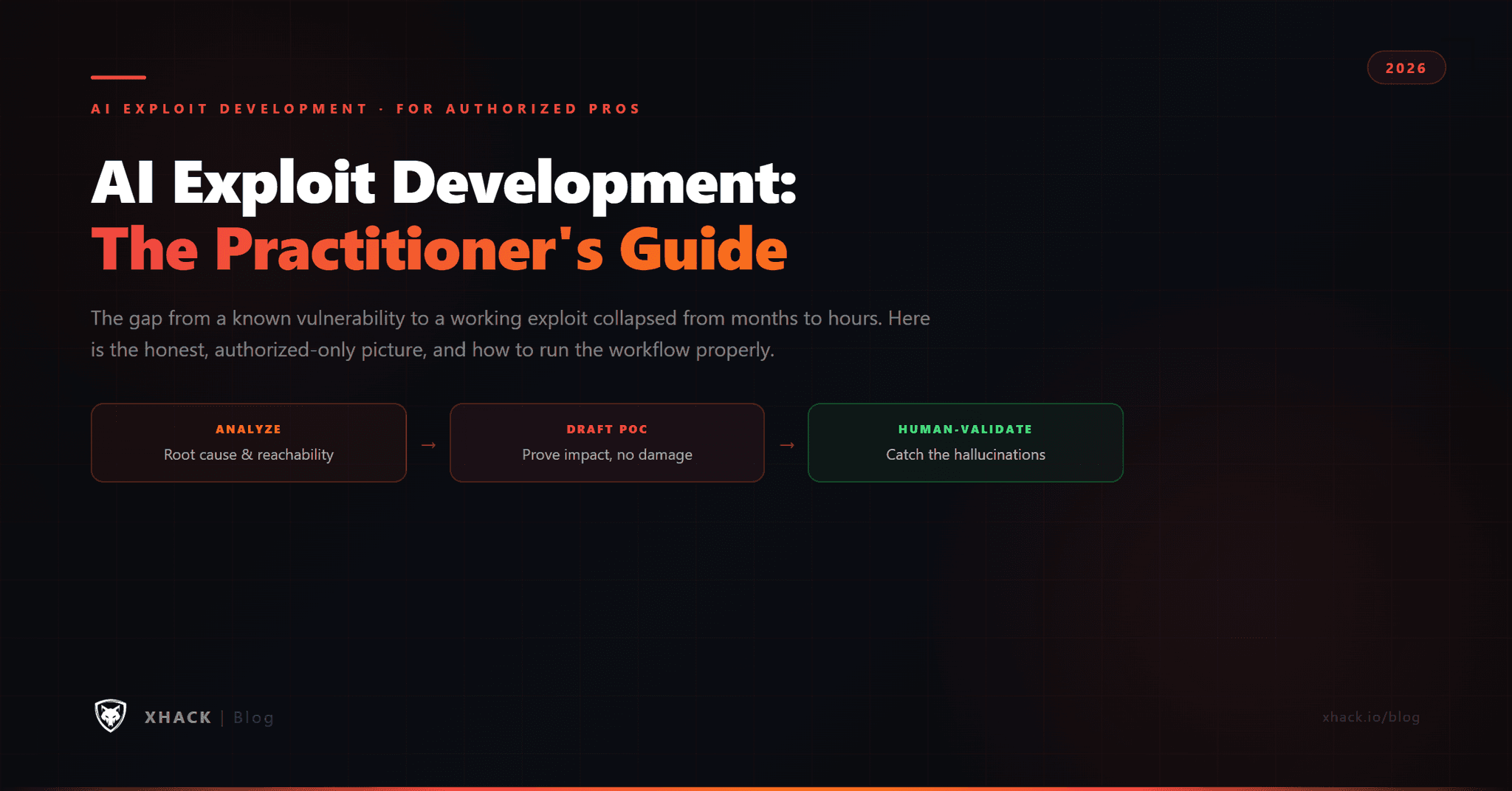
AI exploit development is the use of large language models and autonomous AI agents to assist or automate the process of turning a known or suspected vulnerability into a working exploit or proof-of-concept. It spans the whole lifecycle: analyzing a vulnerability, understanding the affected code, drafting exploit logic, crafting a payload, and validating that the thing actually works.
It is worth being precise about what “assist or automate” means, because there is a spectrum. At one end, AI exploit development looks like an assistant that explains a crash, suggests an offset, or drafts PoC scaffolding while a human drives. At the other end, it looks like an autonomous agent that reads a CVE advisory and a patch diff, then produces candidate exploit code on its own.
Both ends are real in 2026, and the honest framing matters. The knowledge required for exploitation was always public. What AI exploit development changes is the labor. It compresses the specialist time between knowing about a flaw and proving it.
The Cloud Security Alliance put it bluntly in its April 2026 whitepaper: the cost and skill required to move from knowledge of a vulnerability to working exploit code has declined substantially. Work that once demanded days or weeks from skilled engineers can now be initiated with an LLM, a CVE description, and minimal API cost.
That single sentence is the whole reason AI exploit development matters. For an authorized tester, it is a force multiplier. For an attacker, it is the same force multiplier, which is exactly why defenders cannot afford to ignore it.
Fast enough to break the assumptions your patch cycle was built on. The numbers are the story here, so let me lead with them.
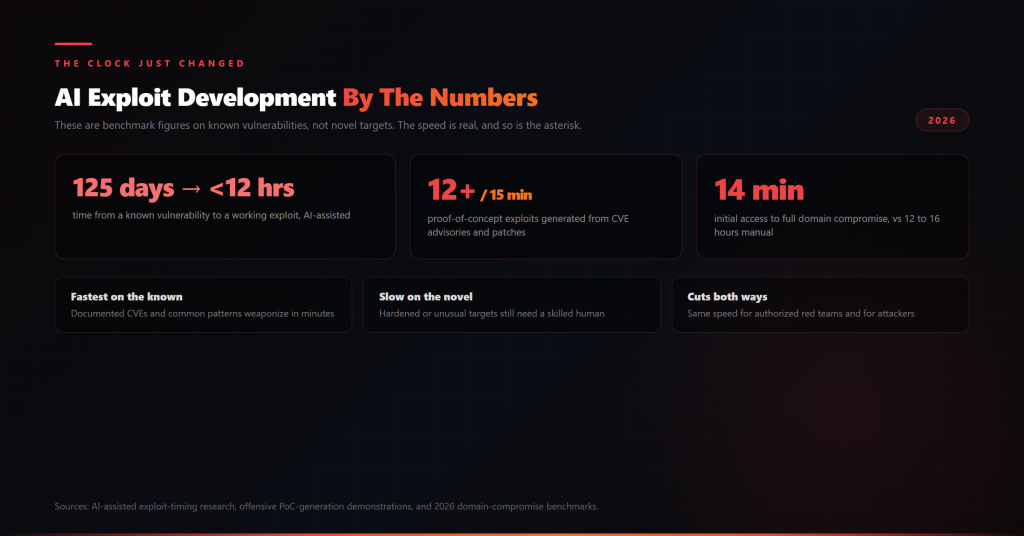
From 125 days to half a day. AI-assisted workflows have reduced the time to develop an exploit for a known vulnerability from roughly 125 days to under half a day. That is not an incremental gain. That is the defender’s buffer evaporating.
A dozen exploits in under 15 minutes. Security researchers demonstrated an offensive system that produced more than a dozen working proof-of-concept exploits in less than 15 minutes, feeding an LLM nothing more than CVE advisories and the corresponding patches from open-source repositories.
Fourteen minutes versus twelve hours. In one benchmark, an AI-driven agent moved from initial access to full domain compromise in about 14 minutes, against a manual baseline of 12 to 16 hours on the same environment.
Those are the shareable headline numbers, and they are real. But context matters more than shock value. These figures come from specific benchmarks, specific CVEs, and specific environments. AI exploit development is dramatically faster on known, well-documented vulnerability classes, and much less reliable on novel, messy, or heavily-mitigated targets.
Here is the honest comparison of where AI exploit development sits against the manual process.
| Phase | Manual exploit development | AI-assisted exploit development |
|---|---|---|
| Vulnerability analysis | Hours to days of reading code and advisories | Minutes to summarize and locate the likely flaw |
| PoC drafting | Days of specialist work | Minutes to hours for known classes |
| Payload crafting | Manual, environment-specific tuning | Drafted fast, still needs human tuning |
| Validation | Careful manual testing | Fast to attempt, unreliable without human checks |
| Novel or mitigated targets | Slow but reliable | Fast but frequently wrong |
The pattern is consistent. AI exploit development wins enormously on speed and breadth for the known and documented. It still needs a skilled human for the novel, the subtle, and the final validation. Anyone selling you a fully hands-off exploit machine is selling you the 15-minute demo, not the messy engagement.
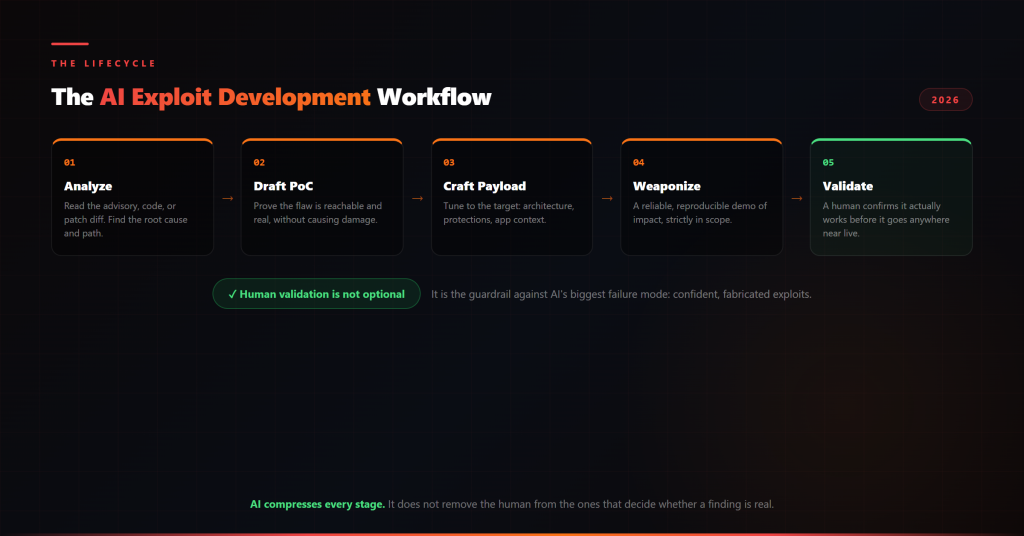
Strip away the branding and AI exploit development follows the same lifecycle a human exploit developer always has. The AI just accelerates each stage.
Stage 1: Vulnerability analysis. The process starts with understanding the flaw. The AI reviews a vulnerability disclosure, a CVE advisory, source code, or a patch diff, and identifies the likely vulnerable condition and how it might be reached. Pattern recognition is a genuine AI strength here, because most vulnerabilities discovered each year are variants of previously seen patterns, which is exactly what LLMs are good at spotting.
Stage 2: Proof-of-concept creation. Next, the AI drafts a proof-of-concept that demonstrates the vulnerability is real and reachable. In authorized AI exploit development, the goal of a PoC is to prove exploitability without causing damage, so a good workflow aims for a controlled demonstration, not a destructive payload.
Stage 3: Payload crafting. Once the PoC proves the concept, the payload gets tailored to the target environment. This is where architecture, protections like ASLR and DEP, and application context come in. AI exploit development drafts this quickly, but this stage is the one most likely to need a human, because environment-specific tuning is where models hallucinate.
Stage 4: Weaponization for authorized testing. For an authorized engagement, weaponization means turning a working PoC into a reliable demonstration you can reproduce in a report. This is the stage that proves business impact to a client, and it is done strictly inside the agreed scope.
Stage 5: Validation. Finally, and this is the stage no responsible workflow skips, a human validates that the exploit actually works and does what the AI claims. This is the guardrail against the single biggest failure mode of AI exploit development, which we will get to next.
The throughline is that AI exploit development does not replace the lifecycle. It compresses it. Each stage that used to take a specialist hours or days can now take minutes, as long as a human stays in the loop on the stages that matter.
Not all bugs are equal, and AI exploit development is far stronger on some classes than others. Here is the honest breakdown for authorized testing.
Web application vulnerabilities are where AI exploit development is most mature. SQL injection, cross-site scripting, server-side request forgery, authentication bypass, and IDOR-style authorization flaws are well-documented, pattern-rich, and abundant in training data. AI drafts PoCs for these quickly and reasonably reliably.
Memory corruption is the hardest and most technically demanding class, and it is where AI exploit development is most impressive when it works and most fragile when it does not. Buffer overflows, heap overflows, use-after-free conditions, and the ROP chains needed to exploit them require precise, environment-specific reasoning. AI accelerates the grunt work of offset calculation and crash analysis, but reliable memory-corruption exploitation still leans heavily on human expertise.
Deserialization and logic flaws sit in between. A deserialization vulnerability in a Java service or a type confusion bug in a JavaScript engine is the kind of thing AI exploit development can reason about well, but the exploit almost always needs human refinement.
The research backs this shape. OWASP’s LLM Exploit Generation study evaluated models including GPT-4o, Claude, and DeepSeek across scenarios in the deliberately vulnerable OWASP Juice Shop, and found real, uneven capability: strong on some classes, unreliable on others. Newer multi-agent frameworks report generating meaningfully more working exploits than prior approaches, but “more” is not “all,” and the reliability gap by vulnerability class is real.
The practical takeaway for AI exploit development is simple. Use it aggressively on the well-documented, pattern-rich classes. Keep your best human on the memory-corruption and novel-target work, where the model’s confidence outruns its accuracy.
This is the section the vendor demos skip, and it is the most important one for anyone doing real work.
It hallucinates exploits. The single biggest failure mode of AI exploit development is that models invent exploits that do not work and fabricate output that never ran. A model will hand you a confident, clean, well-commented PoC for a vulnerability that is not actually exploitable, and it looks identical to a real one. Without validation, AI exploit development produces professional-looking fiction.
It struggles with novel and mitigated targets. AI exploit development shines on documented CVEs and classic patterns. Point it at a genuinely novel bug, a heavily-hardened target, or an unusual environment, and its accuracy drops sharply while its confidence does not.
It lacks judgment about impact. An agent can produce a technically-valid exploit without understanding whether it matters to the client, whether it is in scope, or whether triggering it is safe in a production environment. That judgment is human work.
It raises real safety and authorization questions. Handing an autonomous agent the ability to develop and run exploits against live systems demands hard scope enforcement and guardrails. An exploit that fires outside the authorized scope is not a finding, it is an incident.
The consensus in 2026 is not that AI replaces the exploit developer. It is a division of labor. AI exploit development owns speed, breadth, and the tedious first draft. The human owns validation, judgment, novel work, and accountability. The teams getting real value treat the model as a fast, sometimes-wrong junior specialist whose work always gets checked.
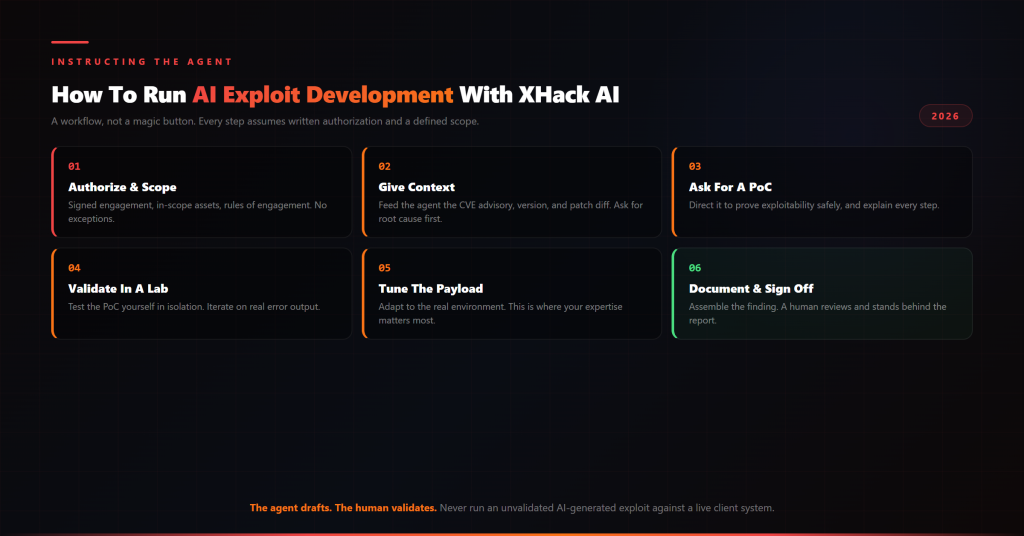
Here is the practical part. This is a workflow-level walkthrough of using an AI agent like XHack AI for authorized AI exploit development. It is deliberately about how you direct the agent and validate its work, not about weaponized code. Every step assumes you have written authorization and a defined scope.
Before you touch the agent, confirm you have a signed engagement and a clear scope. AI exploit development against anything you are not authorized to test is a crime, and no tool changes that. Write down the target, the in-scope assets, and the rules of engagement. This is the step that separates a professional from a headline.
Open the agent and feed it the raw material. A good instruction gives the agent the CVE advisory, the affected version, the patch diff if you have it, and the target environment. A realistic prompt looks like this:
“I am authorized to test [asset]. Analyze CVE-XXXX-XXXX in [component version]. Here is the advisory and the patch diff. Explain the root cause, the vulnerable code path, and how it could be reached in this environment.”
Notice this instruction asks for analysis first, not code. Good AI exploit development starts with understanding, because a PoC built on a wrong root-cause guess wastes more time than it saves.
Once the analysis holds up, direct the agent to draft a PoC that proves exploitability without causing damage. Be explicit about the goal:
“Draft a proof-of-concept that demonstrates this vulnerability is reachable and exploitable in my authorized lab. Prioritize a safe demonstration that proves impact without destructive side effects. Explain each step so I can validate it.”
Asking the agent to explain each step is not optional. It is how you catch the hallucinations in the next step.
This is the step that makes AI exploit development professional instead of reckless. Take the agent’s PoC into an isolated lab that mirrors the target, and test it yourself. Confirm it actually does what the agent claims. If it fails, feed the real error output back to the agent and iterate. Never run an unvalidated AI-generated exploit against a live client system.
With a validated PoC, direct the agent to help adapt it to the specific target: the architecture, the protections in place, and the application context. This is the stage where human expertise matters most, so treat the agent as a fast drafting partner and verify every adjustment.
Finally, use the agent to help assemble the finding into a clear report: what the vulnerability is, how the PoC proves it, the business impact, and the remediation. Then a human reviews and signs off. AI exploit development produces the evidence, but a person stands behind the report.
Run through those six steps and AI exploit development becomes what it should be: a disciplined, fast, human-validated workflow, not a magic button that emails you exploits.
It means the buffer you were relying on is mostly gone, and pretending otherwise is how organizations get caught flat-footed.
For years, defense quietly depended on time. A vulnerability got disclosed, a patch shipped, and there was a window, often weeks, before a reliable public exploit appeared. Teams planned their patch cycles around that window. AI exploit development closes it. When an attacker can go from a CVE advisory to a working exploit in hours, a monthly patch cadence is a standing invitation.
So the defensive response is not to ban the technology, which is impossible, but to adopt it. If attackers use AI exploit development to weaponize a disclosure overnight, defenders need to test their own environment against that same speed. That is the entire logic behind authorized red teams using these tools: prove the impact on your own systems, on your own schedule, before someone hostile does it on theirs.
There is a real asymmetry to respect, though. Attackers only need one exploit to work. Defenders need to find and fix everything. AI exploit development helps both sides, but it does not erase that imbalance, which is why speed alone is not a strategy. The point of running AI exploit development defensively is prioritization: find the flaws that are genuinely, quickly exploitable in your environment, and fix those first.
The practical shift for defenders is threefold. Shorten your patch windows for anything that is externally reachable and pattern-common, because those are exactly what AI exploit development weaponizes fastest. Test continuously instead of quarterly. And treat a proven, AI-validated proof-of-concept against your own asset as the wake-up call it is, not a line item to defer.
So yeah, here is where we talk about what XHack brings to the table. Since this whole guide is about doing AI exploit development responsibly and reliably, here is our honest take.
XHack AI assists with the full exploit development lifecycle, from vulnerability analysis through proof-of-concept creation, payload crafting, and weaponization for authorized assessments. It is built for the exact workflow above, oriented around authorized professionals rather than a general chatbot fighting its own refusals. You instruct it in plain language through the chat interface, feed it the vulnerability context, and direct it stage by stage.
The part that makes it usable for real engagements is the accountability around the capability. XHack AI runs as a multi-agent system where findings pass through a human review stage, so the hallucinated-PoC problem that plagues raw AI exploit development gets caught before it reaches a client. It understands vulnerability classes at a deep technical level, from stack buffer overflows in C and deserialization flaws in Java to type confusion bugs and web application logic flaws, and it drafts the first pass fast so your experts spend their time validating instead of scaffolding.
Now the part privacy-conscious teams care about most. XHack does not store your user data, and it is privacy-focused by design. Your exploit-development chats and session data stay on your own local computer, and you can delete them any time you want. When you are working with proof-of-concept code for a client’s unpatched vulnerability, that matters enormously. Your most sensitive material is not sitting on a vendor’s servers waiting to become the next breach headline, and the platform’s posture reflects it, with no-data-stored scanning and tenant isolation on the enterprise side.
Now the honest part, because brutal honesty is kind of our thing. AI exploit development is not a magic button, and it depends on the operator. The agent drafts fast and it drafts confidently, and sometimes it is confidently wrong. It is a force multiplier for a skilled professional who validates the output, not a replacement for the skill, the authorization, or the judgment. Point it at novel memory-corruption work and you still need your best human in the loop.
On pricing we say it plainly. These are individual plans, for a single researcher rather than a company license. Exploit-development assistance is on the Professional plan at $49/month with unrestricted AI access, and the Elite plan at $150/month adds custom payload generation and malware analysis tools. Company-wide adoption is priced separately, starting at $560/month, and Enterprise adds custom agents trained on your data. Both tiers start with a 7-day free trial, no credit card required. That is professional AI exploit development you can start using this week.
If you want more background, our honest comparison of the best AI pentesting tools breaks down where each platform fits, and our field notes on autonomous pentesting tools cover how these agents chain findings on authorized targets.
Want to know whether AI exploit development fits your workflow? Book a free consultation and we will tell you straight, even if the honest answer is that you do not need us.
AI exploit development is the use of large language models and autonomous AI agents to assist or automate turning a vulnerability into a working exploit or proof-of-concept. It covers the full lifecycle: analyzing the flaw, drafting a PoC, crafting a payload, and validating the result. In authorized security work, AI exploit development is a force multiplier that lets testers prove real impact faster, while a human validates the output because models frequently produce exploits that look right but do not work.
Using AI exploit development to assist authorized penetration testing with a signed scope is legal, the same way manual exploit development is. What makes it illegal is targeting systems you are not authorized to test, and that is true regardless of whether a human or an AI writes the exploit. The tool does not change the law or your rules of engagement. Responsible AI exploit development always happens inside a defined, authorized scope, with documentation and human accountability.
Dramatically faster on known, documented vulnerabilities. AI-assisted workflows have cut the time from a known vulnerability to a working exploit from around 125 days to under half a day, and researchers have generated more than a dozen proof-of-concept exploits in under 15 minutes from CVE advisories and patches. But this speed applies mainly to well-documented vulnerability classes. On novel, mitigated, or unusual targets, AI exploit development is much slower and less reliable, and still needs a skilled human.
No. The biggest failure mode of AI exploit development is hallucination: models confidently produce exploits that do not actually work and fabricate output that never ran. An unvalidated AI-generated exploit can be complete fiction that looks identical to a real finding. Every responsible AI exploit development workflow validates the output in a controlled lab before it goes near a live system, and has a human sign off on the final report. Trust the speed, verify the result.
AI exploit development is strongest on web application vulnerabilities like SQL injection, XSS, SSRF, authentication bypass, and IDOR, because they are well-documented and pattern-rich. It is weakest on memory corruption, like buffer overflows and use-after-free conditions requiring ROP chains, where precise environment-specific reasoning still favors human experts. Deserialization and logic flaws sit in between. The rule of thumb is to use AI aggressively on documented classes and keep your best human on the novel and memory-corruption work.
Work through a disciplined workflow. First confirm authorization and scope. Then give the agent the vulnerability context, the CVE advisory, affected version, and patch diff, and ask it to analyze the root cause before writing any code. Next direct it to draft a proof-of-concept framed for safe, authorized demonstration. Validate everything in a controlled lab, iterating with the agent on real error output. Then tune the payload for the target environment, and finally document the finding and have a human sign off. An agent like XHack AI is built for exactly this stage-by-stage direction.
Exploit development is one piece of a bigger toolkit. If binary and mobile targets are more your speed, our guide to AI reverse engineering covers that side of the work, AI payload generation goes deeper on the crafting step specifically, and if you’re doing this for bounty programs rather than a scoped engagement, our guide to running an AI agent through a real bug bounty workflow walks through what that actually looks like.
That is the honest picture of AI exploit development in 2026.
It is real, it is fast, and it has already changed the clock. The gap between a known vulnerability and a working exploit has collapsed from months to hours, and that shift belongs to attackers and defenders alike. For an authorized red team, AI exploit development is the difference between proving impact before the attacker does and getting there too late.
But the speed comes with a permanent asterisk. AI exploit development hallucinates, it struggles with novel and mitigated targets, and it has no judgment about scope or impact. Strip out the human and you do not get an exploit factory, you get a fast, confident source of professional-looking fiction.
The practitioners winning with AI exploit development treat it as a disciplined workflow, not a magic button. The agent drafts, the human validates, and accountability stays with a person. Speed on the known, expertise on the hard, validation on everything.
If you want AI exploit development with the human review and privacy built in instead of bolted on, that is exactly the gap XHack AI was built to fill. The drafting is fast. The validation is real. And your most sensitive material stays yours.
The attackers already have this capability. It is time defenders used it properly, and used it first.
Categories
Related articles