Table of contents
18
Read this in 30 seconds: The best AI pentesting tools in 2026 aren’t interchangeable, and most comparison guides hide that to push one product. The truth is they split by what they test: NodeZero and Pentera dominate internal network and Active Directory validation, XBOW leads autonomous web application testing, Hadrian owns external attack surface, Cobalt blends human experts with AI, and platforms like XHack AI focus on multi-agent web and API testing with a human-plus-AI hybrid model. The right question isn’t “which is best overall,” it’s “which one answers the security question you most urgently need answered.” This guide compares seven honestly, including real pricing, strengths, and where each one structurally can’t go.
Every “best AI pentesting tools” list on the internet has the same problem: it’s secretly an ad for whoever wrote it.
The author ranks their own product first, picks comparison criteria that happen to favor it, and buries the fact that half these tools don’t even do the same job.
So let’s do this differently. We make XHack AI, which means we’re one of the tools in this comparison, and we’re going to tell you exactly where it fits and where it doesn’t, alongside six genuine competitors assessed on their real strengths. Because here’s the thing about the best AI pentesting tools in 2026: they are not interchangeable. Comparing NodeZero to XBOW is like comparing a cardiologist to a neurologist because both are doctors. They’re both excellent. They do different jobs.
The autonomous pentesting market matured fast. XBOW hit a billion-dollar valuation. Pentera crossed $100 million in annual recurring revenue. Horizon3.ai’s NodeZero has run more than 235,000 production pentests. This is real, funded, deployed technology. But each platform was built to answer a specific question, and buying the wrong one means paying for coverage you don’t need while missing the coverage you do.
This guide compares seven of the best AI pentesting tools honestly, organized by what they actually test, so you can match the tool to your real problem.
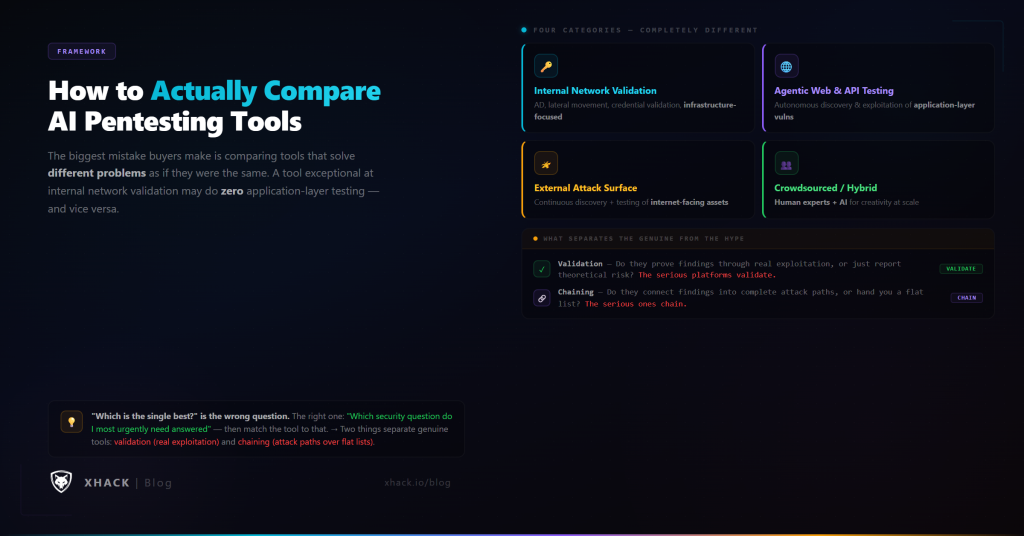
Before the list, understand the categories, because the single biggest mistake buyers make when evaluating the best AI pentesting tools is comparing tools that solve different problems as if they were the same.
The best AI pentesting tools in 2026 fall into roughly four buckets. Automated security validation platforms focus on internal networks, Active Directory, lateral movement, and credential validation. Agentic web and API testing tools autonomously discover and exploit application-layer vulnerabilities. External attack surface platforms continuously discover and test internet-facing assets. And crowdsourced or hybrid platforms blend human experts with AI for judgment at scale.
A tool that’s exceptional at internal network validation may do zero application-layer testing. A tool that dominates web application testing may not touch your network or cloud. This is why “which is the single best” is the wrong question. The right one is “which security question do I most urgently need answered,” then match the tool to that.
Two things separate the genuine best AI pentesting tools from scanners with AI marketing slapped on. First, validation: do they prove findings through real exploitation, or just report theoretical risk? The serious platforms validate. Second, chaining: do they connect individual findings into complete attack paths, or hand you a flat list? The serious ones chain. Keep both in mind as you read.
NodeZero is the most cited autonomous pentesting platform in 2026 analyst roundups, and for good reason. It consistently ranks among the best AI pentesting tools for infrastructure work. Founded by former US Special Operations cyber operators, it has executed more than 235,000 production-safe pentests across 5,200+ organizations, including 40% of the Fortune 10 plus the NSA and CISA. That track record is unmatched in the category.
NodeZero’s strength is internal network and infrastructure validation. It chains misconfigurations, weak credentials, and CVEs into multi-step attack paths dynamically, surfacing things like full Domain Admin access and lateral movement routes that manual testing would take days to map. It deploys agentless through a single Docker container with no persistent credentials, making it safe for production, and it offers unlimited flat-rate pentests you can run daily or weekly without per-test fees. Its Find-Fix-Verify workflow lets you remediate and immediately retest.
The honest limitations: web application testing has matured but still trails its network and Active Directory strength, it does not generate automated remediation (it finds and proves, but doesn’t patch), and pricing is fully opaque with no public rates. Some reviewers note findings could be more actionable for development teams.
Best for: Enterprise teams needing continuous internal network and Active Directory validation at scale.
XBOW made headlines as the first autonomous AI to top HackerOne’s US bug bounty leaderboard, submitting over 1,000 validated reports in roughly 90 days. Founded by Oege de Moor, the creator of GitHub Copilot, it reached a billion-dollar valuation on $272 million in total funding. When an AI out-hunts human bug bounty researchers, people pay attention.
XBOW’s architecture deploys thousands of short-lived parallel agents, each tackling a narrow scoped objective with fresh context, coordinated by a persistent attack surface manager. Critically, it separates AI exploration from deterministic exploit verification, which drives an exceptionally low false-positive rate. Every finding it reports has been confirmed through actual exploitation with reproduction steps. In March 2026 it integrated with Microsoft Security Copilot and Sentinel, making it attractive for Microsoft-centric enterprises.
The honest limitations: XBOW is web application focused, so it does no network, infrastructure, or cloud testing. If you choose it, you still need a separate tool for everything else. It also has no automated remediation workflow, and pricing runs roughly $4,000 to $8,000 per test on demand.
Best for: Teams needing deep, validated, audit-ready web application testing, especially in Microsoft environments.
Pentera is the most mature commercial player in the category and a fixture on most best AI pentesting tools shortlists for enterprises. It crossed $100 million in annual recurring revenue in January 2026 and serves more than 1,200 enterprise customers across 60 countries, becoming the first company to reach that milestone in adversarial exposure validation.
Pentera runs adversarial attack simulations across internal networks, external surfaces, cloud, and identity systems, emulating real ransomware TTPs from groups like Cl0p, LockBit, and BlackCat. Its AI generates context-aware payloads and adapts to the specific environment it encounters. The October 2025 acquisition of DevOcean added Pentera Resolve, which automates remediation workflows by routing validated findings through Jira and ServiceNow with SLA tracking, plus 100+ native integrations.
The honest limitations: it’s priced for large enterprises, commonly cited in the range of roughly $46,000 to $100,000 per year, often with on-premise deployment. Some reviewers note it doesn’t always provide the underlying command lines or logs proving exactly how an attack succeeded. It’s a heavyweight built for organizations where budget is not the primary constraint.
Best for: Large enterprises with security teams and budget for continuous adversarial validation across infrastructure.
Hadrian approaches pentesting from the outside in, combining External Attack Surface Management with offensive testing. It continuously discovers your internet-facing assets, including shadow IT and forgotten subdomains, on an hourly basis, and automatically triggers tests when something changes: a new subdomain, a configuration drift, an exposed service.
This event-driven model is the differentiator among the best AI pentesting tools for external coverage. Rather than testing on a schedule, Hadrian reacts to change, catching exposures as they appear. In March 2026 it launched Nova, an on-demand agentic pentesting product that extends the core platform with deeper autonomous testing. Confirmed findings auto-route into Jira, ServiceNow, and Zendesk with mean-time-to-remediate tracking.
The honest limitation: scope is external only. Hadrian handles the continuous discovery and external testing layer well, but it’s designed to be one part of a broader program, not your complete testing solution. You’ll pair it with internal validation and application testing from other tools.
Best for: Enterprise teams managing large, dynamic external attack surfaces who need continuous discovery plus automated testing.
Cobalt represents the Penetration Testing as a Service category, where human researchers are augmented by AI for platform management and triage. For organizations that want human judgment at scale with flexible engagement models, Cobalt is the strongest fit among the hybrid options.
The appeal is that you get expert human testers backed by a platform that handles scheduling, communication, reporting, and retesting efficiently. Retesting is included in its credit model, and real-time reporting plus direct tester communication enable faster remediation cycles. For teams that specifically want the creativity and judgment of human pentesters, but with the speed and convenience of a modern platform, this hybrid model delivers.
The honest framing: Cobalt is less “autonomous AI” and more “humans accelerated by AI.” If you specifically want autonomous machine-speed testing, the agentic platforms go further. If you want human expertise delivered through a smooth platform, Cobalt is built for exactly that. SOC 2 reports may require some post-processing for specific auditor requirements.
Best for: Organizations wanting human pentester judgment at scale with flexible, platform-managed engagements.
Penligent appears in nearly every 2026 top agentic pentesting list. Its product emphasizes end-to-end AI pentesting from asset discovery through validation, exposing 200+ tools on demand and producing evidence-rich PDF or Markdown exports. For teams that want a broad operator-centric offensive workflow rather than a narrower validation engine, Penligent often feels more complete day to day.
Its strength is workflow. It generates payloads, tests them, analyzes responses, and iterates using AI-driven loops, making the reporting and reproduction layer a first-class part of the product. That makes it appealing for SaaS-focused teams that want an end-to-end offensive pipeline they can operate directly.
The honest limitation: like other web-focused agentic tools, its gray-box business logic testing depth is more limited than dedicated human-led testing, and it doesn’t do source code analysis. It’s a strong web and API offense platform, not an everything platform.
Best for: SaaS teams wanting an end-to-end, operator-friendly agentic web and API testing workflow.
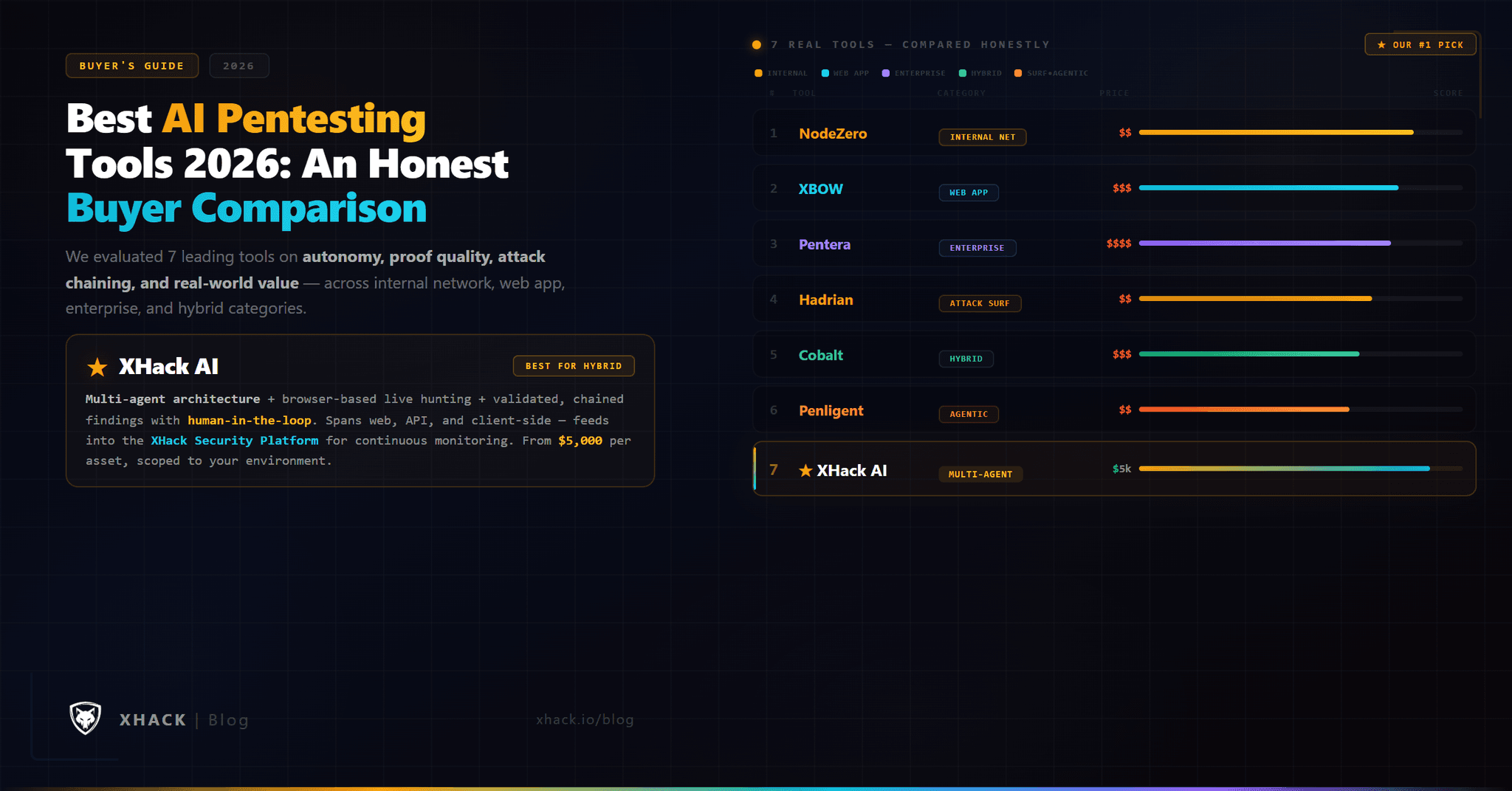
Now our own entry, assessed by the same standard. XHack AI is a multi-agent autonomous penetration testing system built around the hybrid model: AI handles breadth and continuous coverage, human experts handle the depth and judgment AI can’t replicate.
Where XHack AI differentiates among the best AI pentesting tools is the combination of three things. First, multi-agent architecture, with specialized agents for reconnaissance, analysis, exploitation, validation, and reporting that coordinate like a real red team. Second, browser-based live hunting, where an autonomous browsing engine controls a real browser to navigate applications, fill forms, and test multi-step workflows the way a human attacker would, catching DOM-based and client-side flaws that API-level testing misses. Third, deep reconnaissance and validated, chained findings, with self-aware decision making that flags genuinely uncertain cases for human review rather than hallucinating. And findings feed into the XHack Security Platform for continuous monitoring, closing the loop between testing and defense.
The honest framing: XHack AI focuses on web and API testing with a human-plus-AI hybrid, so for pure large-scale internal Active Directory validation, a network-specialized platform like NodeZero goes deeper on that specific job. Where XHack AI fits best is teams that want validated autonomous web and API testing combined with human expertise and ongoing monitoring, without enterprise-only pricing. The individual subscription starts at $20/month, with a 7-day free trial and no credit card required, well below enterprise-only pricing; separate VAPT engagements with human testers run $2,500 to $12,000 depending on scope.
Best for: Teams wanting multi-agent autonomous web and API testing plus human expertise and continuous monitoring, at accessible pricing.
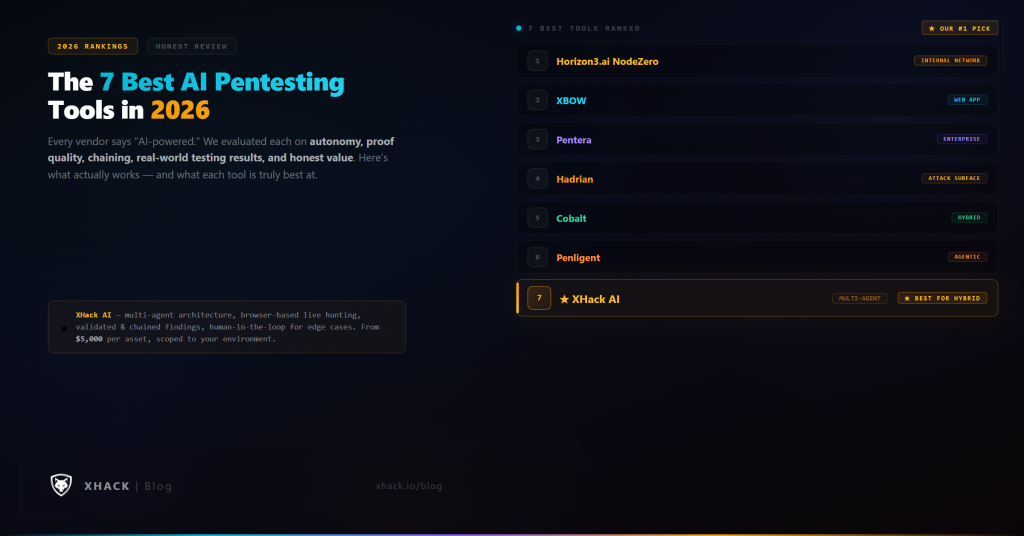
Seven strong tools, different jobs. Here’s how to match the best AI pentesting tools to your actual situation.
| Your Situation | Best Fit | Why |
|---|---|---|
| Enterprise internal network and AD validation | NodeZero | 235,000+ production tests, unmatched network depth |
| Deep web app testing, Microsoft environment | XBOW | Validated findings, lowest false positives, Copilot integration |
| Large enterprise continuous validation, budget available | Pentera | Most mature suite, remediation workflows, 100+ integrations |
| Large external attack surface | Hadrian | Hourly discovery, event-driven testing |
| Want human pentester judgment at scale | Cobalt | Expert humans via a smooth platform |
| End-to-end agentic web workflow | Penligent | Operator-centric, 200+ tools, evidence-rich reports |
| Web and API testing plus human expertise, accessible pricing | XHack AI | Multi-agent, browser-based hunting, hybrid model, monitoring |
A few honest principles to guide the choice. Match the tool to your most urgent security question, not to whichever has the flashiest benchmark. Insist on validated findings and attack-path chaining, because those separate the genuine best AI pentesting tools from dressed-up scanners. And remember the consensus that emerged across the entire category in 2026: the platforms that win are not the ones that remove humans from security. The strongest programs combine autonomous AI for breadth and continuous coverage with human experts for depth, judgment, and the compliance sign-off AI can’t legally provide.
Whatever you choose, run a proof of concept against your own environment before committing. Vendor benchmarks are self-reported and run in controlled conditions. Your production environment is messier, and the real false-positive rate and actionability only show up when you test against your actual systems.
The best AI pentesting tools in 2026 depend on what you need to test, because they specialize. NodeZero and Pentera lead internal network and Active Directory validation. XBOW leads autonomous web application testing with validated findings. Hadrian owns external attack surface discovery. Cobalt blends human experts with AI. Penligent and XHack AI focus on agentic web and API testing, with XHack AI adding a human-plus-AI hybrid model and continuous monitoring. There’s no single best overall, so match the tool to your most urgent security question rather than chasing a one-size-fits-all winner.
No, and the entire category converged on this conclusion in 2026. The best AI pentesting tools excel at breadth, speed, and continuous coverage, finding known flaw patterns, chaining exploits, and running continuously. But complex business logic flaws, novel attack research, social engineering, and compliance sign-off still require human judgment. The platforms that win are explicitly the ones that combine autonomous AI with human expertise, not the ones claiming to remove humans entirely. The proven model is hybrid: AI for breadth, humans for depth.
Pricing varies widely across the best AI pentesting tools. Enterprise platforms like Pentera run roughly $46,000 to $100,000 per year, often with on-premise deployment. NodeZero uses opaque custom subscription pricing with unlimited tests. Per-test platforms like XBOW charge roughly $4,000 to $8,000 per assessment. More accessible options like XHack AI’s individual subscription start around $20/month, scoped through simple tier selection rather than a per-asset quote. Match the pricing model to your usage: per-test works for occasional assessments, while subscriptions suit continuous programs.
The best AI pentesting tools control false positives through validation, meaning they confirm a vulnerability by actually exploiting it before reporting it. XBOW, for example, separates AI exploration from deterministic exploit verification to keep false positives exceptionally low. Tools that rely purely on AI reasoning without a validation layer produce far more false positives because language models can confidently report vulnerabilities that don’t exist. When evaluating tools, prioritize proof-based validation and run a proof of concept against your own environment to measure the real false-positive rate, since vendor benchmarks are self-reported.
A vulnerability scanner follows deterministic, predefined rules, matching signatures against a CVE database and reporting potential issues without proving them. The best AI pentesting tools reason about an application’s behavior, decide what to test next based on what they find, chain vulnerabilities into multi-step attack paths, and validate findings through real exploitation. Adding “AI” to a scanner’s marketing doesn’t change its fundamental signature-based model. Genuine AI pentesting tools are agentic: they adapt, exploit, and prove, which is what separates them from scanners with an AI label.
Often, yes. Because the best AI pentesting tools specialize, many organizations combine them: a network validation platform like NodeZero or Pentera for internal infrastructure, a web-focused tool like XBOW or XHack AI for application testing, and an external attack surface platform like Hadrian for internet-facing assets. The key is avoiding overlap while covering gaps. Map your full attack surface, identify which categories matter most, and select tools that together cover it without paying for redundant capabilities. A single tool rarely covers network, web, cloud, and external surface equally well.
If you want the deeper dive on any one of these, our breakdowns of XBOW and PentestGPT as standalone alternatives go further than a seven-way comparison has room for, our practitioner’s guide to what to actually look for in an AI pentesting tool covers the evaluation criteria in more depth, and if binary or mobile targets are part of your scope, our AI reverse engineering guide covers that adjacent skill set.
Those are seven of the best AI pentesting tools in 2026, assessed by what they actually do.
The honest takeaway is the one most comparison guides won’t give you: there’s no single best AI pentesting tool, because they solve different problems. Among the best AI pentesting tools, NodeZero and Pentera own network validation. XBOW owns validated web testing. Hadrian owns external surface. Cobalt brings human judgment. Penligent and XHack AI bring agentic web and API testing, with XHack AI adding the hybrid human-plus-AI model and continuous monitoring at accessible pricing.
Match the tool to your most urgent security question. Insist on validated findings and attack-path chaining. Combine autonomous AI for breadth with human expertise for depth, because that hybrid is what the entire category learned in 2026. And test against your own environment before you commit, because the only benchmark that matters is how a tool performs against your actual systems.
If you want autonomous web and API testing built on a multi-agent architecture with browser-based live hunting, validated findings, human expertise, and continuous monitoring behind it, that’s what XHack AI was designed to be. See how it performs against your environment, and judge it against this comparison, not the marketing.
Follow Us on LinkedIn: XHack
Related articles