Table of contents
15
Read this in 30 seconds: An AI-powered SOC uses AI to automate the work that buries security teams: alert triage, investigation, enrichment, and response. But there’s a crucial distinction in 2026. AI-assisted tools advise analysts; agentic AI acts on their behalf. The shift to agentic AI is the real transformation, because it closes the gap between attacker speed and defender capacity. With analysts drowning in thousands of daily alerts, the majority going uninvestigated, and 70%+ of attacks happening outside business hours, the AI-powered SOC is no longer optional. The winning model is human-on-the-loop: AI handles volume at machine speed, humans handle judgment. This guide explains how it works, the maturity levels, and where humans still matter.
The average SOC processes over 10,000 alerts per day. Analysts investigate a fraction of them. The rest pile up, unread, while one of them is the real attack.
This isn’t a tooling problem anymore. It’s a capacity problem, and you cannot hire your way out of it.
Here’s the math that’s breaking security operations in 2026. The global cybersecurity workforce gap sits around 4.8 million unfilled positions. False positive rates in many SOCs exceed 50%, reaching 80% in some environments. Up to 40% of alerts, sometimes more, go completely uninvestigated. Over 70% of attacks happen outside business hours, precisely when the smallest number of eyes are watching. And analyst burnout is so severe that turnover is constant, which makes the staffing problem worse, which increases burnout. It’s a doom loop.
You cannot solve this by hiring more analysts, because they don’t exist and you can’t afford them. You cannot solve it by buying another tool that generates more alerts. The only thing that actually closes the gap between attacker speed and defender capacity is an AI-powered SOC that does the work, not just surfaces it.
But “AI-powered SOC” has become a marketing phrase slapped on everything, including products that just bolt a chatbot onto a dashboard. The real transformation in 2026 is agentic AI: systems that don’t just advise your analysts but actually act, autonomously triaging, investigating, and responding within guardrails you control. This guide explains what an AI-powered SOC really is, how agentic AI transforms security operations, and where humans still matter.
An AI-powered SOC is a Security Operations Center where artificial intelligence handles the core security workflows, including detection, alert triage, investigation, enrichment, and response, rather than leaving all of that work to human analysts.
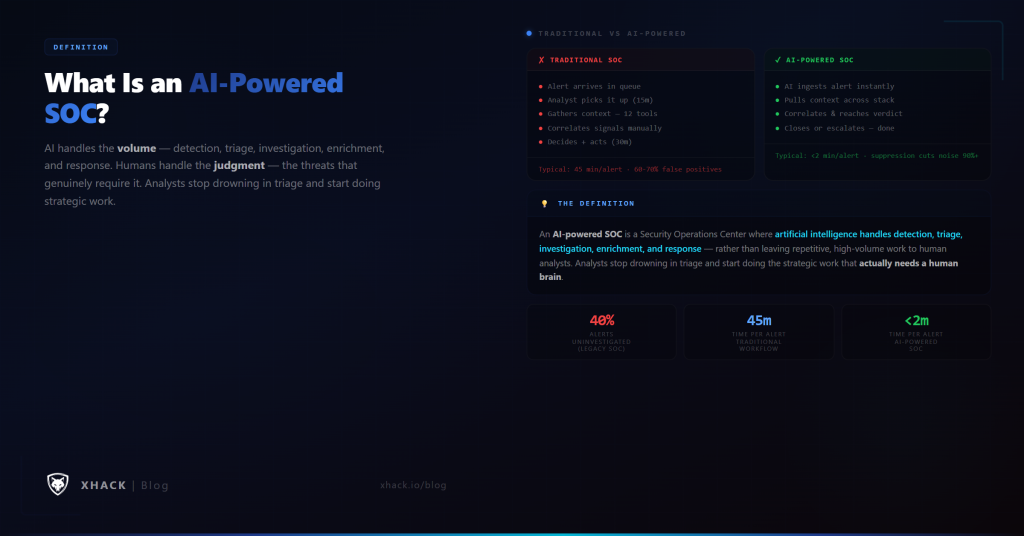
To understand why this matters, you have to understand what analysts actually spend their time on. In a traditional SOC, a human reviews each alert, gathers context from a dozen different tools, correlates signals, decides whether it’s a real threat, and then acts. Most of that work is repetitive, follows predictable logic, and consumes enormous time. Analysts in 2026 commonly spend 60 to 70% of their time on triage alone, much of which turns out to be false positives.
An AI-powered SOC takes that repetitive, high-volume work and gives it to AI. The AI ingests the alert, pulls context from across your security stack, correlates the signals, reaches a verdict, and either resolves it or escalates it to a human with the full picture attached. What used to take an analyst 45 minutes per alert can drop to under two minutes, and false positive burden plummets.
This is the core promise of the AI-powered SOC: it absorbs the alert volume that no human team can match, applies consistent judgment to every case, and reserves human attention for the threats that genuinely require it. Analysts stop drowning in triage and start doing the strategic work that actually needs a human brain.
But here’s the critical nuance that separates a real AI-powered SOC from a marketing one. There’s a world of difference between AI that assists and AI that acts.
This is the single most important thing to understand about the AI-powered SOC in 2026, because it determines whether the technology actually solves your problem or just adds another layer of noise.
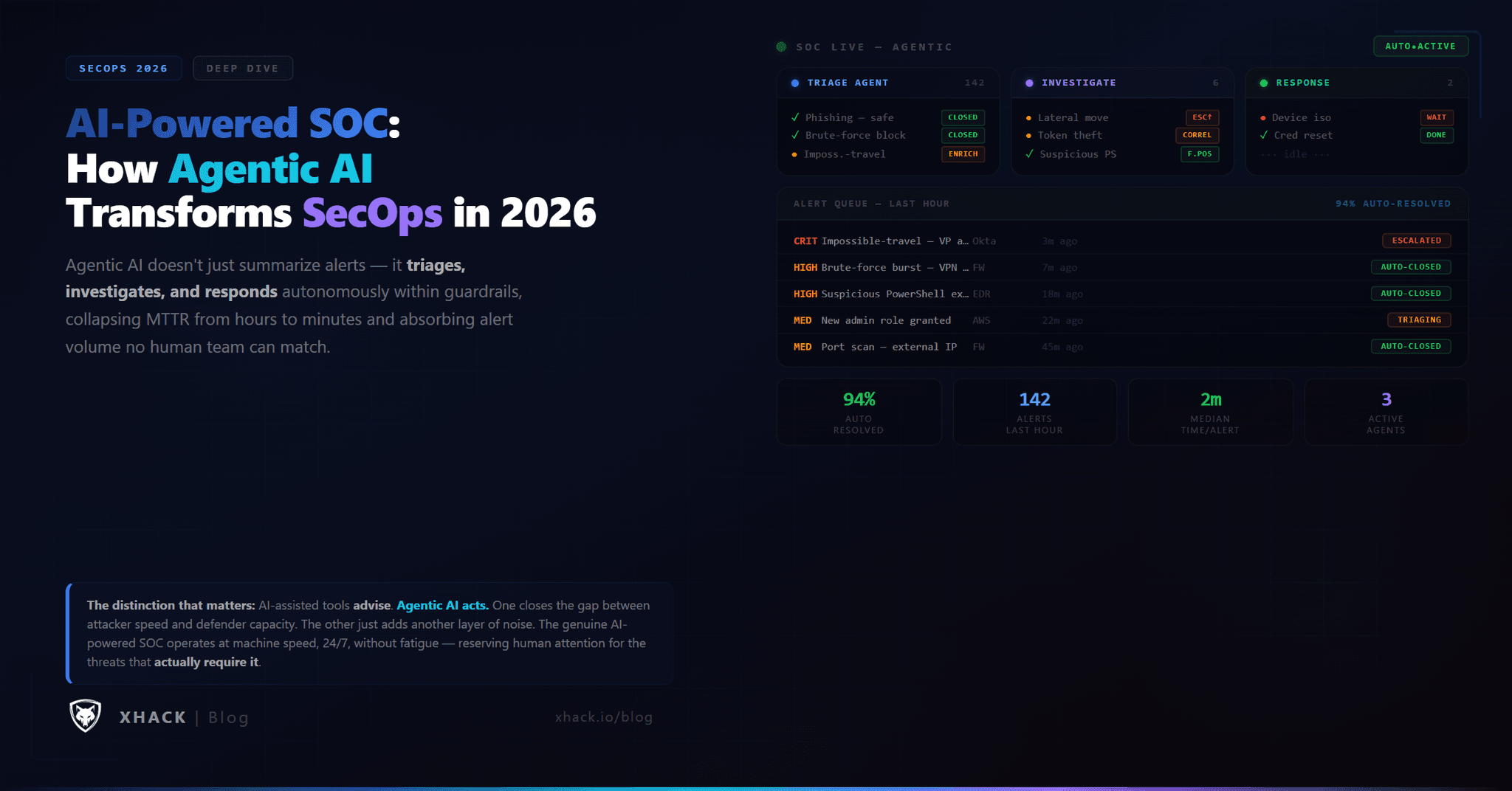
AI-assisted tools advise. They summarize an alert, suggest next steps, or answer questions in natural language. A copilot that produces a readable summary of a phishing alert is AI-assisted. It’s helpful, but a human still has to do the actual work: investigate, decide, and act. The analyst is still in the loop for every single step, so the capacity problem remains.
Agentic AI acts. An agentic system ingests the alert, pulls context from across your stack, correlates signals, reaches a verdict, and initiates containment, all within defined guardrails your team controls. It doesn’t hand the work back to a human at each step. It moves the work forward autonomously and only escalates when the situation genuinely requires human judgment.
The difference is everything. A tool that summarizes a phishing alert and a system that triages, scores, remediates, and documents that alert are fundamentally different things, and only one of them closes the gap between attacker speed and defender capacity. An AI-powered SOC built on agentic AI operates like a tireless digital analyst working 24/7, processing volume no human team could match, applying consistent judgment to every case.
This is why the genuine AI-powered SOC is described as agentic. It reasons through threats, plans multi-step investigation workflows, and executes response actions without requiring human direction for each step. Leading agentic platforms already auto-investigate 85 to 95% of Tier 1 cases, with mean time to respond dropping from hours to minutes. That’s not an incremental improvement. It’s a structural change in how security operations work.
When evaluating any AI-powered SOC, this is the first question to ask: does it advise, or does it act? If it just advises, your analysts are still the bottleneck.
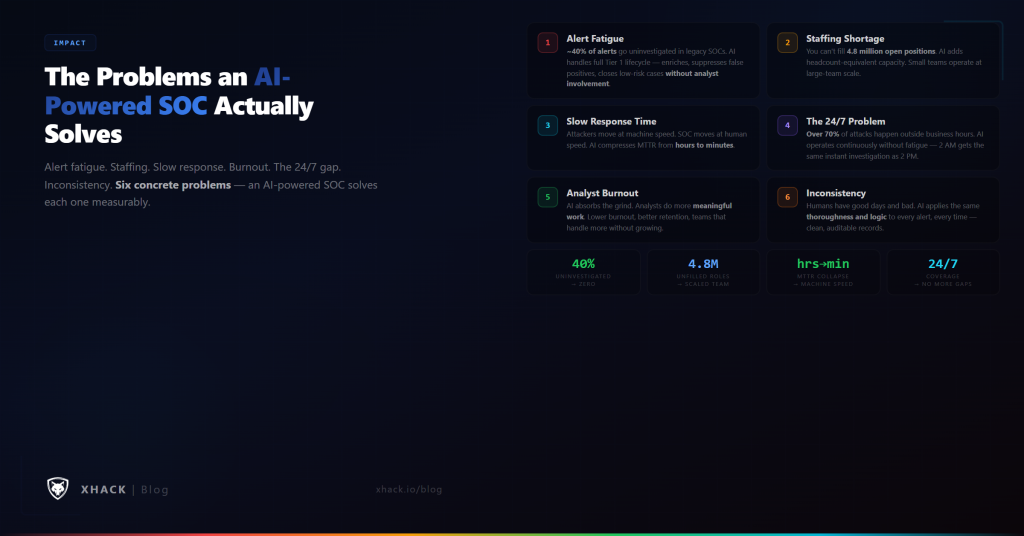
Let’s be specific about what an AI-powered SOC fixes, because the benefits are concrete and measurable.
Alert fatigue. This is the most measurable problem agentic AI solves. With legacy tooling, around 40% of alerts go uninvestigated because there simply aren’t enough hours. An AI-powered SOC handles the full Tier 1 investigation lifecycle autonomously, enriching alerts, suppressing false positives, and closing low-risk cases without analyst involvement. The result is that analysts stop spending their shifts on repetitive triage and start spending them on threats that need human judgment.
The staffing shortage. You can’t fill 4.8 million open positions. An AI-powered SOC effectively adds capacity without adding headcount, letting a small team operate at a scale that previously required a large one. The AI becomes the analyst workforce for volume; humans become the strategic brain.
Slow response times. Attackers move at machine speed. A traditional SOC moves at human speed, constrained by how fast analysts can work through a queue. An AI-powered SOC compresses mean time to respond from hours to minutes by investigating and acting autonomously, closing the speed gap that lets attacks escalate.
The 24/7 problem. Over 70% of attacks happen outside business hours. A human team can’t watch around the clock without expensive multiple shifts. An AI-powered SOC operates continuously without fatigue, so the 2 AM weekend attack gets the same instant investigation as the 2 PM weekday one.
Analyst burnout. When AI absorbs the repetitive grind, analysts do more meaningful work, which improves retention. The ROI from reducing alert fatigue compounds: lower burnout, better retention, and a team that can handle more without growing.
Inconsistency. Human analysts have good days and bad days. An AI-powered SOC applies the same thoroughness and logic to every alert, every time, producing consistent investigations and clean, auditable records.
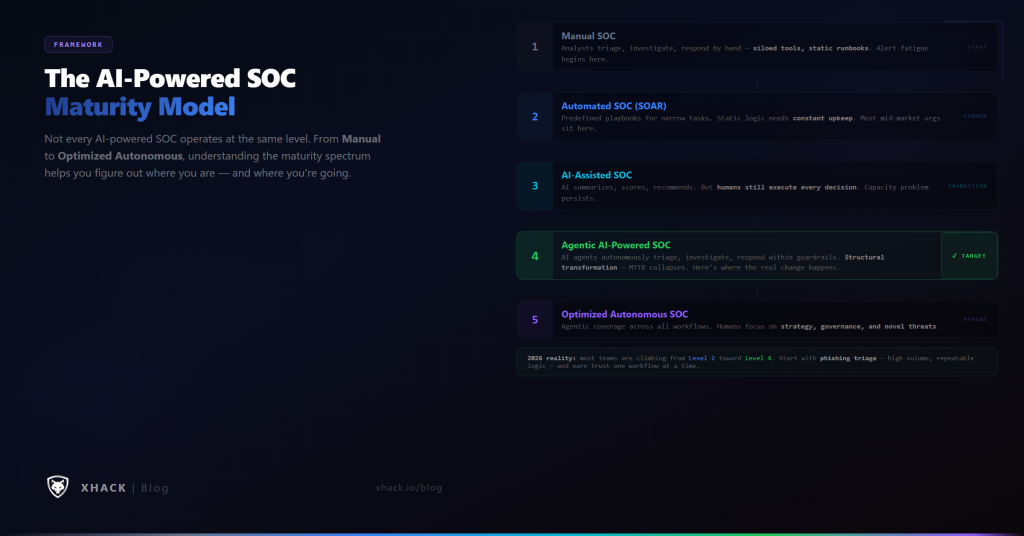
Not every AI-powered SOC operates at the same level of autonomy. Understanding the maturity spectrum helps you figure out where you are and where you’re going.
Level 1: Manual SOC. Traditional operations. Analysts triage, investigate, and respond by hand, pivoting between siloed tools and following static runbooks. This is where alert fatigue began.
Level 2: Automated SOC (SOAR). Security orchestration and automation execute predefined playbooks. This helps with narrow, repetitive tasks but depends on static logic that needs constant upkeep as the environment changes. Most mid-market organizations sit here or in early Level 3.
Level 3: AI-Assisted SOC. AI summarizes alerts, scores them, and recommends actions, but humans still execute. This reduces some load but keeps analysts in the loop for every decision, so the capacity problem persists.
Level 4: Agentic AI-Powered SOC. AI agents autonomously triage, investigate, and respond within guardrails, escalating only what needs human judgment. This is where the structural transformation happens and where mean time to respond collapses.
Level 5: Optimized Autonomous SOC. Agentic coverage expands across more workflows, human approval gates shrink for low-risk actions, and the system proactively hunts and anticipates attack paths. Humans focus almost entirely on strategy, governance, and the genuinely novel.
Most teams in 2026 are climbing from Level 2 toward Level 4. The practical advice from across the industry is to start small. Phishing triage is the ideal first use case, because it’s high-volume, follows repeatable logic, and lets you build trust in the AI before expanding its autonomy to higher-stakes workflows. You don’t leap from manual to fully autonomous overnight. You earn trust one workflow at a time.
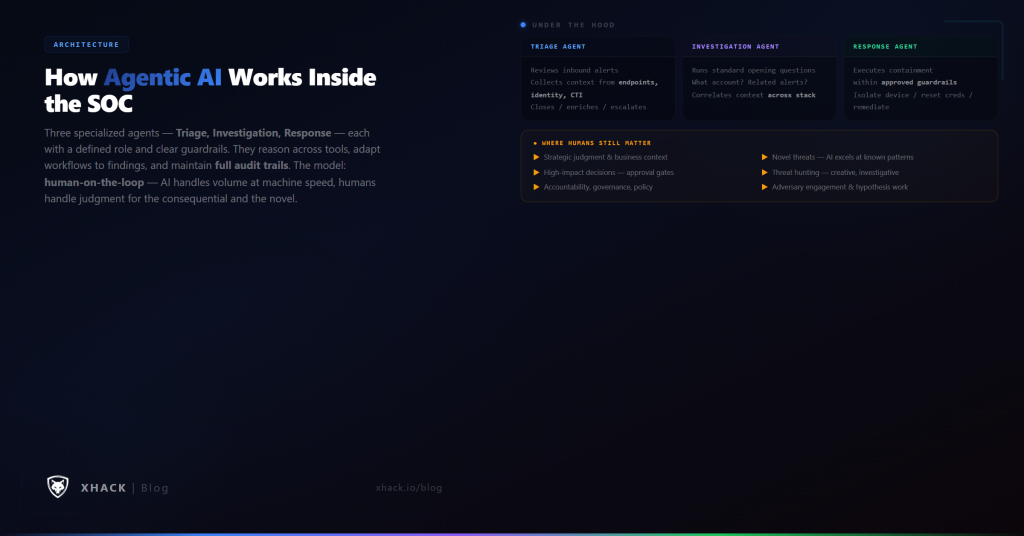
Under the hood, an agentic AI-powered SOC typically uses multiple specialized agents, each with a defined role and clear guardrails, rather than one general-purpose AI doing everything.
A triage agent reviews incoming alerts, collects supporting context from endpoints, identity tools, case history, and threat intelligence, then determines whether each alert should be closed, enriched further, or escalated. It follows defined investigation steps and escalation criteria, not free-form decisions.
An investigation agent runs the standard opening questions of any incident automatically: what account was involved, was the endpoint seen elsewhere, were there related alerts. It gathers and correlates the context a human would otherwise spend an hour assembling.
A response agent executes containment actions within approved guardrails: isolating a device, containing a compromised identity, resetting credentials, or remediating a reported phishing email. High-impact actions can require human approval, while low-risk ones execute automatically.
These agents reason with context across your tools, adapt their workflows based on what they find rather than following rigid scripts, and keep humans in the loop through approval controls for consequential decisions. Crucially, they maintain full transparency and audit trails, so every autonomous action is logged and reviewable. This is what makes an AI-powered SOC trustworthy: it’s not a black box making mysterious decisions, it’s a structured system acting within boundaries you define, showing its work.
The roles of your human team shift accordingly. Analysts move from triaging alerts to supervising agent-led investigations and handling ambiguous cases. Detection engineers move from writing rules to teaching the system which signals matter and setting confidence thresholds. Threat hunters use AI to surface anomalies and focus on creative, hypothesis-driven exploration. In the agentic AI-powered SOC, people don’t do less. They do more of what actually matters.
Let’s be honest about the limits, because anyone selling you a fully autonomous SOC that runs without humans is overselling. An AI-powered SOC is not a security operation with no people. It’s a security operation where AI handles volume and humans handle judgment.
Humans remain essential for several things. Strategic judgment and business context, because the AI doesn’t know that this particular server is about to handle a major product launch or that this user is a board member whose account compromise carries unusual risk. Novel threats, because agentic AI excels at known patterns and repeatable logic but a genuinely new attack technique needs human creativity to recognize and counter. High-impact decisions, where the consequences of an automated action, like taking a critical production system offline, are severe enough that a human should approve. Accountability and governance, because someone has to own the outcomes, define the automation policies, and align AI actions with business risk. And adversary engagement and threat hunting, the creative, investigative work that goes beyond responding to alerts.
The proven model that emerged across the industry in 2026 is human-on-the-loop. AI handles the alert volume at machine speed. Humans handle the strategic judgment calls, supervise the AI’s work, and step in for the consequential and the novel. This isn’t a compromise or a transitional phase. It’s the optimal architecture, because AI and humans have genuinely complementary strengths. The organizations that thrive treat AI as the foundation of their SOC, not as a bolt-on feature, while keeping humans firmly in the role of judgment and oversight.
Since this guide is about transforming security operations with AI, here’s how XHack SOC fits, built around the agentic, human-on-the-loop model this entire guide describes.
XHack SOC is an AI-powered SOC platform that does the heavy lifting traditional operations leave to overworked analysts. In live production testing across multiple servers and real websites, it detected multiple attack patterns with near-zero false positives, which is the metric that matters most, because the whole problem with traditional SOCs is the false positive flood.
Here’s what it does in practice. The AI automatically reconstructs attack chains, connecting related events into coherent incidents rather than dumping disconnected alerts on your team. So instead of seeing 50 separate alerts, you see the actual attack story, already assembled. It performs AI-driven triage that keeps false positives near zero, so your team isn’t drowning in noise. It generates AI remediation guidance, telling you what happened, mapping it to the relevant technique, and providing specific response steps rather than leaving you to research from scratch. You can build custom detection rules with AI, defending against targeted attacks without a detection engineering specialist on staff. And alerts reach your team through email, n8n, webhooks, or whatever integration you use, so nobody has to stare at a dashboard 24/7.
The philosophy behind XHack SOC matches the consensus of the entire category: AI handles the volume and the repetitive correlation, while your team keeps judgment and control. Security teams shouldn’t have to stare at screens around the clock anymore, and with agentic AI doing the triage and investigation, they don’t have to. The AI does the work; humans make the calls.
If you want to bring agentic AI to your security operations, whether you’re a small team that could never staff a traditional SOC or a larger team buried in alert fatigue, XHack SOC was built to close that gap. You can start with core detection and alerting and expand the AI’s autonomy as you build trust, exactly the way the maturity model recommends.
A traditional SOC relies on human analysts to manually triage, investigate, and respond to every alert, which breaks down when alert volumes exceed human capacity. An AI-powered SOC uses AI to handle those core workflows: triage, investigation, enrichment, and often response. The most advanced versions use agentic AI that acts autonomously within guardrails rather than just advising analysts. The result is dramatically faster response, far less alert fatigue, and the ability for a small team to operate at a scale that previously required a large one. Humans shift from manual triage to supervision and strategic judgment.
Agentic AI in a SOC refers to autonomous AI systems that reason through security threats, plan multi-step investigation workflows, and execute response actions without requiring human direction for each step. The key distinction is that agentic AI acts rather than just advises. While AI-assisted tools summarize alerts or suggest next steps, an agentic AI-powered SOC ingests an alert, gathers context, reaches a verdict, and initiates containment within defined guardrails, escalating to humans only when genuinely necessary. This is what closes the gap between attacker speed and defender capacity, since the AI handles the full workflow rather than handing work back to a human at each step.
No. An AI-powered SOC is not a security operation that runs without humans. It’s one where AI handles volume and repetitive work while humans handle judgment, strategy, and oversight. The proven model is human-on-the-loop: AI triages and investigates at machine speed, humans supervise the AI, make high-impact decisions, handle novel threats, and own accountability. Analyst roles shift from manual triage to supervising agent-led investigations, tuning the system, and threat hunting. In an AI-powered SOC, people don’t do less work, they do more of the work that actually requires human judgment.
The impact is substantial. With legacy tooling, around 40% of alerts go uninvestigated and false positive rates often exceed 50%. An AI-powered SOC with agentic capabilities can auto-investigate 85 to 95% of Tier 1 cases, reduce time per alert from around 45 minutes to under two minutes, and cut false positive burden dramatically. This frees analysts from repetitive triage to focus on real threats, which reduces burnout and improves retention. The compounding ROI, lower burnout plus better retention plus more capacity without added headcount, is one of the strongest arguments for adopting an AI-powered SOC.
Start small and build trust incrementally. The widely recommended first use case is phishing triage, because it’s high-volume, follows repeatable logic, and lets you validate the AI’s decisions before expanding its autonomy. Most organizations progress through a maturity model from manual operations, through automation and AI-assistance, toward agentic autonomy. Choose a platform with genuine agentic capabilities rather than a chatbot bolted onto a dashboard, ensure it provides full transparency and audit trails, and keep humans in the loop for high-impact decisions. Expand the AI’s autonomy workflow by workflow as you confirm it performs reliably in your environment.
No. While large enterprises were early adopters, the AI-powered SOC is arguably most valuable for small and mid-sized teams, because they face the same threats as enterprises with a fraction of the staff. An AI-powered SOC lets a small team operate at a scale that would otherwise require many more analysts, providing 24/7 coverage and fast response without enterprise headcount. Many modern platforms are designed specifically for lean teams, with predictable pricing and fast deployment, making agentic security operations accessible well beyond the Fortune 500.
That’s how agentic AI transforms security operations in 2026.
The core problem isn’t going away on its own. Alert volumes exceed human capacity, the staffing gap is measured in millions, and attackers move at machine speed while traditional SOCs move at human speed. You cannot hire or tool your way out of it. The only thing that genuinely closes the gap is an AI-powered SOC that does the work autonomously, not one that just surfaces more alerts for overwhelmed analysts to chase.
The distinction that matters is agentic. AI that advises keeps your analysts as the bottleneck. AI that acts removes it. The genuine AI-powered SOC reasons, investigates, and responds within your guardrails, handling the volume so your team can focus on judgment, strategy, and the threats that actually need a human. Start small, build trust one workflow at a time, and keep humans firmly on the loop.
If you want to bring that agentic, human-on-the-loop model to your security operations with near-zero false positives, AI-driven attack chain reconstruction, and alerting that fits your workflow, XHack SOC was built for exactly that. The attackers are already operating at machine speed. Your defense should too.
Follow Us on X: @xhackio
Categories
Related articles