Table of contents
18
Read this in 30 seconds: MCP server security is the set of controls protecting Model Context Protocol servers, the middleware that connects AI agents to your tools, data, and APIs. The problem is the protocol explicitly does not enforce security itself, so it’s entirely on you. Two-thirds of MCP servers scanned in early 2026 had security findings. Even Anthropic’s own reference servers shipped critical CVEs. The core risks are tool poisoning, prompt injection through tool descriptions, the confused deputy problem, credential aggregation, excessive permissions, and supply chain attacks. This guide explains each risk in plain language and gives you the practical controls to lock down your MCP deployment before an AI agent deletes your database because it misread a prompt.
The Model Context Protocol became the USB-C of AI in record time. Tens of thousands of MCP servers now connect AI agents to databases, files, APIs, and internal systems across the enterprise.
There’s just one problem. The protocol’s own specification states it cannot enforce security at the protocol level. Security depends entirely on implementation. And most implementations are a disaster.
Here’s the number that should make you nervous. Two-thirds of MCP servers scanned in early 2026 had security findings. Not edge-case theoretical issues. Real vulnerabilities. One analysis of over 5,000 open-source MCP servers found that more than half relied on static secrets, with only a small fraction using proper OAuth. Another found that 43% of servers were vulnerable to command injection. And these aren’t just sketchy weekend projects: Anthropic’s own reference Git MCP server shipped multiple critical CVEs in late 2025, the very template developers copy as their starting point.
MCP server security is genuinely different from the API and prompt injection security you already know. It’s an execution-layer problem that appears the moment AI systems gain the ability to act on tools, data, and external systems through a standardized protocol. An over-permissioned AI agent is fundamentally more dangerous than an over-permissioned human, because the agent’s actions are probabilistic. A human clicking “delete database” made a conscious choice. An agent might do it because it misread a poisoned prompt.
This guide breaks down the real MCP server security risks in 2026 and the practical controls that actually work.
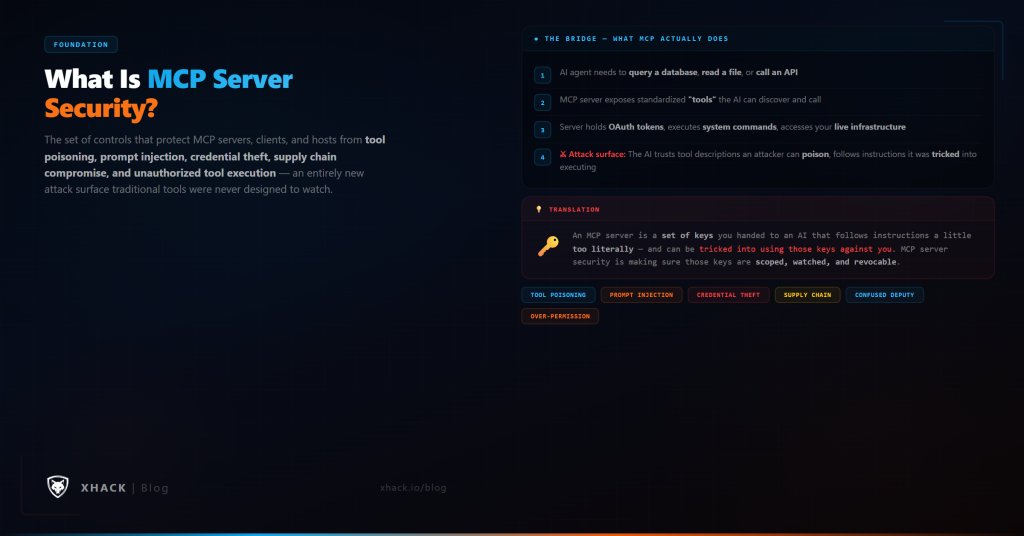
MCP server security is the set of controls that protect Model Context Protocol servers, clients, and hosts from attacks like tool poisoning, prompt injection, credential theft, supply chain compromise, and unauthorized tool execution.
To understand the risk, you need to understand what an MCP server actually does. The Model Context Protocol, introduced by Anthropic in late 2024, is an open standard that lets AI agents connect to external tools, data sources, and APIs through a standardized interface. Instead of writing custom integration code for every tool an AI needs, developers connect agents to databases, files, and services through MCP servers that expose “tools” the AI can call.
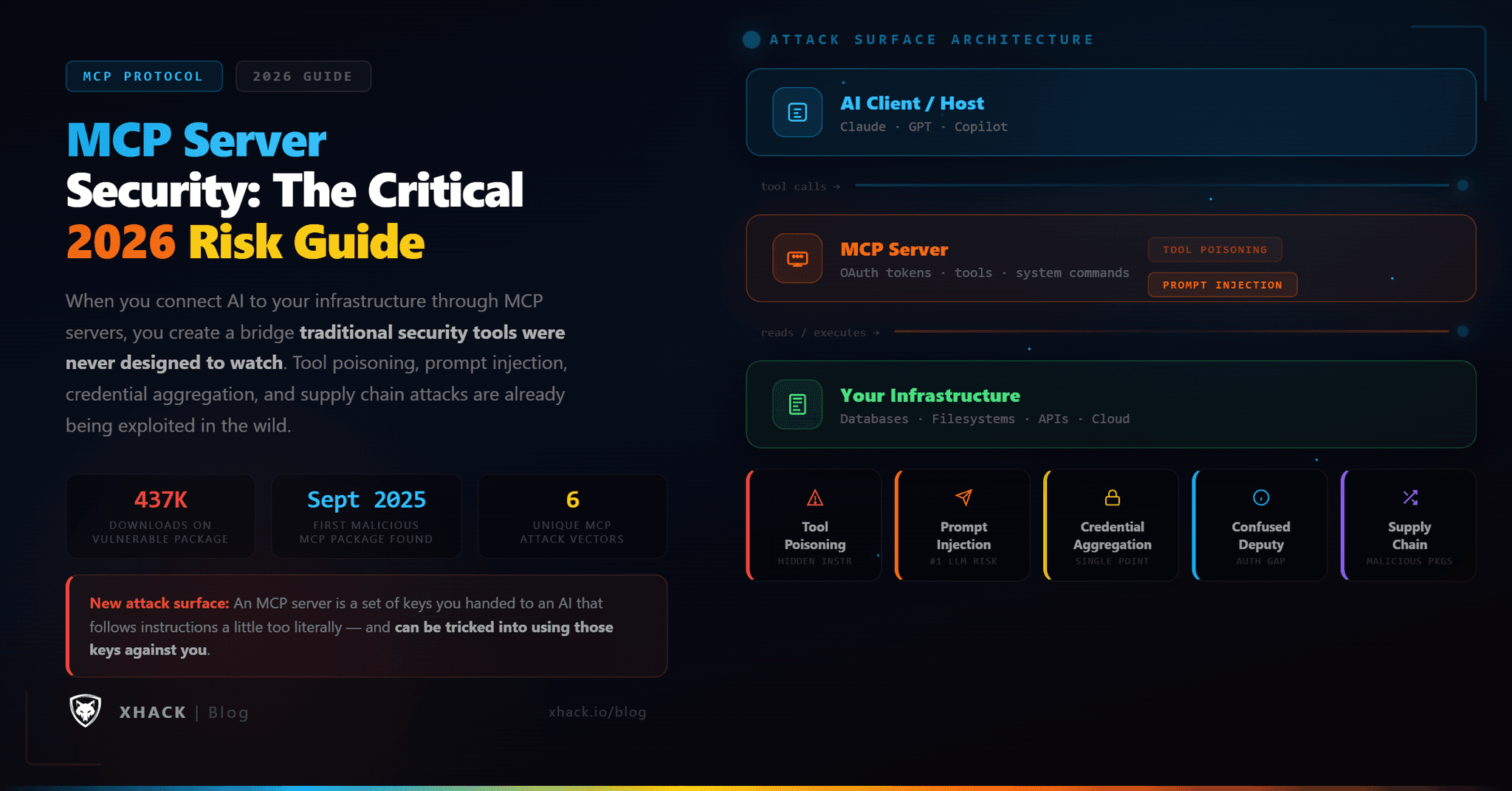
That’s enormously useful, and it’s why adoption exploded. But think about what it means for security. When you deploy an MCP server, you create a bridge between an AI reasoning engine and your actual infrastructure. That server often stores OAuth tokens for multiple services, executes system commands, reads files, and queries databases. It sits at a trust boundary that traditional security tools were never designed to watch.
MCP server security exists because this bridge introduces an entirely new attack surface. It’s not just another version of API security, though standard API security still applies. MCP adds unique risks: prompt injection through tool descriptions, model-driven tool selection that attackers can manipulate, and chained tool calls that amplify the blast radius of any single weakness. Securing it requires thinking about identity, authorization, consent, tool isolation, monitoring, and blast-radius control all at once.
Translation: an MCP server is a set of keys you handed to an AI that follows instructions a little too literally and can be tricked into using those keys against you. MCP server security is making sure those keys are scoped, watched, and revocable.
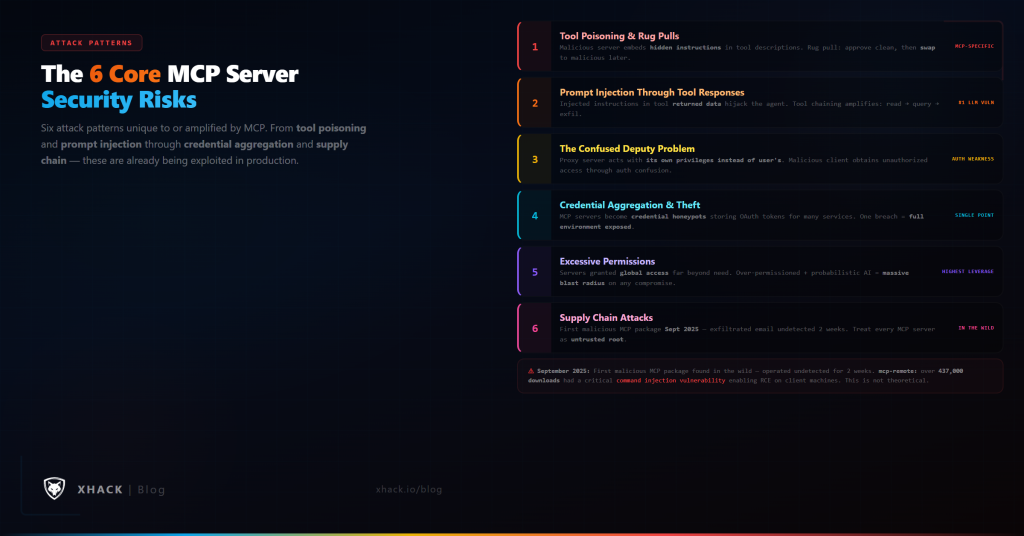
Security researchers have converged on a set of attack patterns unique to or amplified by MCP. Here are the six that matter most for MCP server security in 2026.
This is the signature MCP attack. Tool poisoning happens when a malicious MCP server embeds hidden instructions inside a tool’s description, the metadata the AI reads to understand what a tool does. The AI ingests that description and follows the injected instructions, even though the human never sees them.
A rug pull is the time-delayed version. A server presents a clean, benign tool description, you approve it, and then the server changes the description later to inject malicious instructions. Because most MCP clients use an approve-once-trust-forever model, your client never notices the change. The defense is straightforward in principle: clients should show users the initial tool descriptions and alert them if those descriptions ever change.
Prompt injection is the number one vulnerability in LLM applications generally, and MCP gives it a powerful new delivery mechanism. Beyond poisoned tool descriptions, attackers can hide malicious instructions in the data an MCP tool returns. The AI reads a file, queries a database, or fetches a web page, and the response contains injected instructions that hijack the agent’s behavior.
What makes this especially dangerous in MCP server security is tool chaining. An injected instruction can trigger a chain like read a file, then query a database, then send an email with the stolen data, combining individually benign tools into a malicious flow. These “toxic agent flows” bypass the restrictions on any single tool by abusing the combination.
This is one of the more subtle MCP server security risks. A confused deputy attack exploits MCP proxy servers that connect to third-party APIs. The proxy acts with its own privileges rather than the user’s, and through a combination of static client IDs, dynamic registration, and consent cookies, a malicious client can obtain authorization codes without proper user consent.
The result is that an attacker can trick the system into granting access it should never have granted, because the “deputy” (the proxy server) got confused about whose authority it was acting under. Preventing it requires strict redirect URI validation, secure state parameter handling, and binding consent to specific clients.
MCP servers tend to become credential honeypots. A single server often stores OAuth tokens for many connected services, which creates a single point of failure. When that server is compromised, attackers gain broad access across every integrated service at once. This credential aggregation fundamentally reshapes the attack model, because one breached MCP server can expose your entire connected environment.
Credentials also leak through less dramatic paths: tokens stored in environment variables, secrets written to logs, and API keys pasted into config files. A core MCP server security principle is that the LLM should never see a secret, and tokens should be short-lived and scoped per service.
MCP servers are frequently granted far more access than they need: global repository access, unrestricted file system access, all-mailbox access. When a server is over-permissioned, any compromise or successful injection has a massive blast radius. The agent can reach resources far outside its intended scope, enabling broad data exfiltration and lateral movement.
This is where the probabilistic nature of AI agents makes MCP server security so critical. An over-permissioned agent that misinterprets a prompt, or follows an injected one, can cause damage a human never would. Scoping each tool to the minimum permission it actually needs is the single highest-leverage control.
MCP servers are software you download and run, often from public repositories, which makes them prime supply chain targets. The threats are real and documented. The first malicious MCP package appeared in September 2025, operating undetected for two weeks while exfiltrating email data. A fake npm package exfiltrated API keys from developers who trusted the name. And the mcp-remote package, with over 437,000 downloads and used in integrations from major providers, had a critical command injection vulnerability in its OAuth flow that could achieve remote code execution on the client machine.
Treating every MCP server like an untrusted dependency with root-equivalent permissions is the only safe posture, because that’s effectively what it is.
Knowing the risks is half the battle. Here are the practical controls that meaningfully improve MCP server security, drawn from the current consensus across security researchers and the official MCP guidance.
Vet every server before installing. Treat MCP servers like untrusted dependencies. Verify the package name and publisher against official documentation, not just the registry page. Read the source (most MCP servers are only a few hundred lines) and look for shell execution calls, undocumented external HTTP calls, filesystem access beyond what’s advertised, and suspicious postinstall scripts. Be suspicious of a server with few downloads published a few days ago. Keep a registry of approved servers and block everything else at the host level.
Enforce least privilege. Run each tool with the minimum permission set it actually needs. Scope filesystem servers to a single directory so even a successful injection can’t reach files outside it. Block outbound network access for tools that don’t need it. This is the highest-impact control in all of MCP server security, because it shrinks the blast radius of every other failure.
Use OAuth 2.1, not static keys. For any non-stdio MCP server exposed over a network, the 2025 spec revisions made OAuth 2.1 with proper token audience separation the standard. Tokens expire; API keys sitting in .env files do not. Bind tokens to specific resource servers, avoid long-lived tokens and excessive scopes, and never let the LLM see a secret. Validate OAuth endpoints carefully, since a malicious authorization endpoint URL was the exact vector behind one of the worst MCP CVEs.
Keep humans in the loop for destructive actions. The MCP specification itself states there should always be a human able to deny tool invocations. Annotate tools with risk classifications and enforce approval flows for destructive or irreversible operations: database deletions, bulk modifications, external data transfers, financial transactions, and outbound communications. An injected or mistaken instruction should never be able to execute an irreversible action unsupervised.
Sandbox and isolate. Containerize MCP servers and apply syscall filtering. Validate types, ranges, lengths, and formats on every tool call. Never use shell execution with unsanitized input, since command injection affects a huge share of servers. Route tool and network traffic through a controlled gateway that enforces access policies and inspects outbound requests.
Detect rug pulls. Periodically review your MCP client configuration for tool descriptions that changed since you approved them. After updating any server, re-read the changelog and re-approve in your client. The approve-once-trust-forever model is the weakness; periodic re-validation is the patch.
Log everything and monitor at runtime. Standard MCP servers log poorly. Capture the prompt, the tool invoked, the arguments, the response, the user identity, and the session, then forward to your SIEM. Without this observability, incident response is guesswork. Runtime monitoring is what catches the malicious behavior that slipped past your install-time vetting.
MCP server security isn’t a standalone problem. It’s part of the broader challenge of securing AI agents, which is exactly where offensive security is heading in 2026. As organizations connect autonomous agents to real tools and data through MCP, the attack surface shifts from “can I trick the model into saying something bad” to “can I trick the agent into doing something bad with its tools.”
That shift demands testing that understands both AI behavior and execution-layer security. Traditional vulnerability scanners weren’t built to probe tool poisoning, prompt injection through tool descriptions, or toxic agent flows that chain MCP tools into an attack. Testing an MCP deployment means thinking like an attacker who manipulates the agent’s reasoning to abuse its connected tools, which is a genuinely new discipline.
This is where security testing for AI systems is evolving, and where XHack’s focus on AI red teaming and autonomous security testing applies. Probing how an AI agent handles malicious tool descriptions, injected instructions in tool responses, and over-scoped permissions requires the same adversarial mindset as traditional penetration testing, pointed at a new and rapidly growing attack surface. Whether you test in-house or bring in specialized help, the key is recognizing that MCP server security needs active testing, not just secure configuration, because the protocol leaves the hard part to you.
The protocol isn’t inherently insecure, but it explicitly delegates security to implementations. The MCP specification states it cannot enforce security principles at the protocol level, meaning security depends entirely on how each server and client is built and operated. This is the root of most MCP server security problems: the standard provides the connection mechanism but leaves authentication, authorization, input validation, and permission scoping to developers, and most implementations haven’t been battle-tested. The protocol gives you the tools to be secure, but it doesn’t make you secure by default.
Tool poisoning is an attack where a malicious MCP server hides instructions inside a tool’s description, the metadata the AI reads to understand the tool. The AI processes that description and follows the injected instructions, even though the human user never sees them. A related attack, the rug pull, presents a clean description that you approve, then changes it later to inject malicious content, exploiting the approve-once-trust-forever model most clients use. Defending against tool poisoning requires showing users tool descriptions, alerting on any changes, and not blindly trusting server-supplied metadata.
For any MCP server exposed over a network (non-stdio), yes. The 2025 specification revisions established OAuth 2.1 with proper token audience separation as the standard for remote MCP servers. The reason is that static API keys, which over half of scanned servers still rely on, don’t expire and can’t answer critical questions like which user delegated authority, with what scope, and for how long. OAuth tokens expire, can be scoped per service, and can be revoked per client. Using OAuth 2.1 with PKCE rather than static keys is one of the most important MCP server security upgrades you can make.
Two compete for the title. The first is excessive permissions: granting an MCP server far more access than it needs, which gives any compromise or injection a massive blast radius. The second is treating MCP servers as trusted software rather than untrusted dependencies. Both stem from underestimating how dangerous an over-permissioned, probabilistic AI agent is. The fix for both is least privilege: scope every tool to the minimum access it requires, sandbox it, and keep humans in the loop for destructive actions, so even a successful attack is contained.
Yes, several documented incidents. The first malicious MCP package appeared in September 2025 and exfiltrated email data undetected for two weeks. The mcp-remote package, with over 437,000 downloads, had a critical command injection vulnerability in its OAuth flow enabling remote code execution. Anthropic’s own reference Git MCP server shipped multiple critical CVEs in late 2025. Researchers also found hundreds of MCP servers exposed to local networks with no authentication, an issue nicknamed “NeighborJack.” These are not theoretical risks, which is why MCP server security demands active attention now.
Start with install-time vetting: verify publishers, read the source for shell execution and undocumented network calls, run dependency audits, and check download counts and age. Then apply runtime controls: least-privilege scoping, sandboxing, OAuth, gateway-based monitoring, and comprehensive logging to a SIEM. For deeper assurance, active security testing that probes for tool poisoning, prompt injection through tool descriptions, confused deputy issues, and toxic agent flows is increasingly important. This kind of AI-focused security testing applies an adversarial, penetration-testing mindset to the MCP attack surface, catching issues that secure configuration alone misses.
That’s the state of MCP server security in 2026.
The Model Context Protocol unlocked something genuinely powerful: AI agents that can actually do things by connecting to your tools, data, and systems. But it shipped that power with a security model that puts the entire burden on you. The protocol won’t protect you. Two-thirds of servers having security findings, malicious packages with hundreds of thousands of downloads, and critical CVEs in reference implementations all point to the same conclusion: the ecosystem is young and the guardrails are yours to build.
The good news is that the controls are clear. Treat every MCP server as an untrusted dependency with powerful permissions. Enforce least privilege ruthlessly. Use OAuth instead of static keys. Keep humans in the loop for anything destructive. Sandbox, monitor, log, and re-validate. And recognize that as AI agents take on real authority through MCP, the attack surface needs active security testing, not just careful configuration.
The AI agent that can read your files and query your database is also the AI agent that can be tricked into leaking them. MCP server security is what stands between those two outcomes. Build it before you need it.
Follow Us on X: @xhackio
Categories
Related articles