Table of contents
22
By Salman Khan, OSCP+, Founder of XHack, SRT (Synack Red Team member)
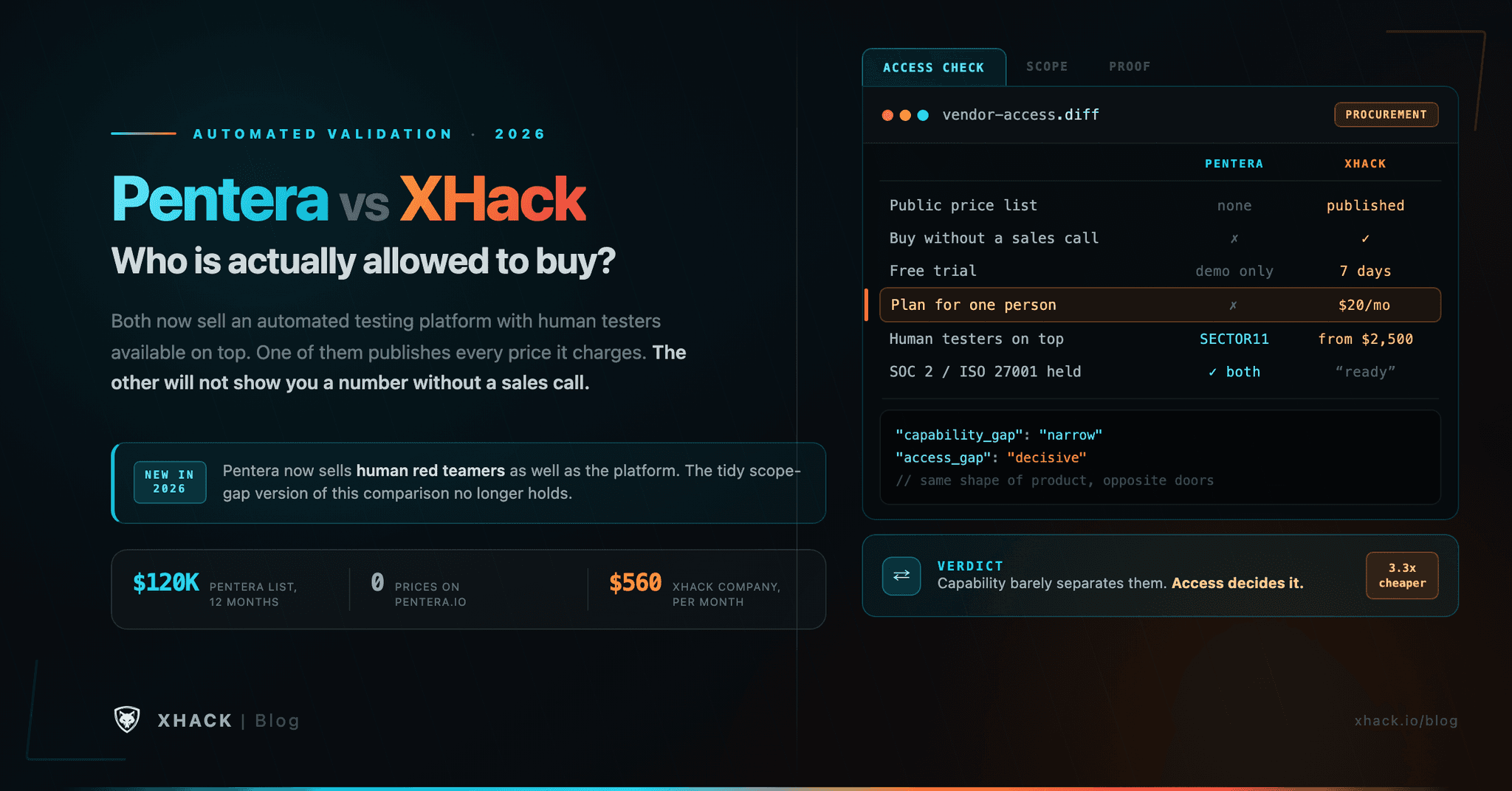
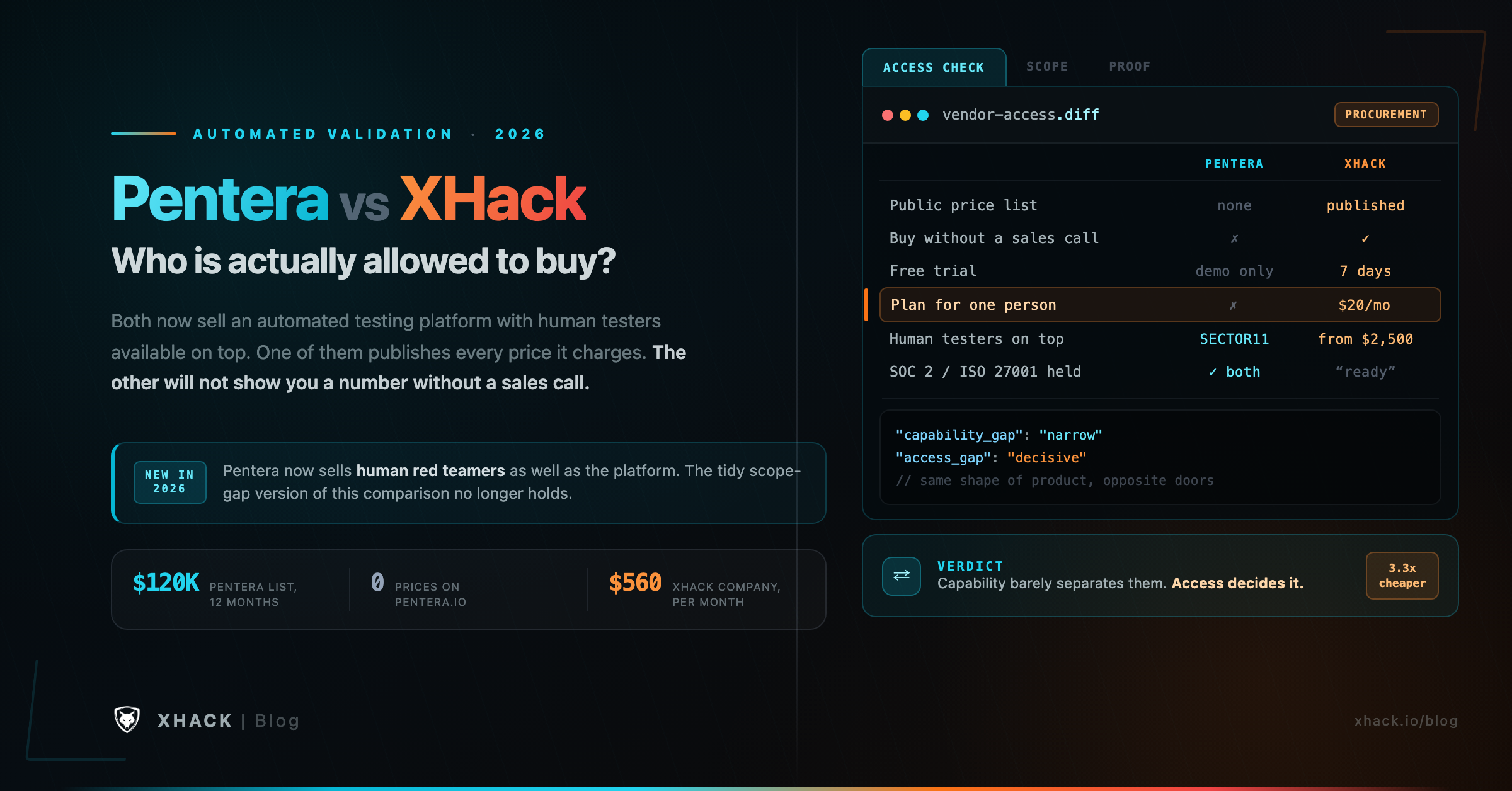
Read this in 30 seconds: Pentera and XHack now sell the same shape of product, an automated testing platform with human experts sitting on top of it. The real question isn’t what each one can do. It’s who is actually allowed to buy it.
- Pentera’s real price is $120,000 a year, and it doesn’t come from Pentera. That figure is the 12-month contract listed on AWS Marketplace, the only place Pentera puts a dollar sign on itself.
- Pentera can test mobile apps and AI systems too, just not inside the automated platform. Its SECTOR11 services arm sells both as human-led engagements. XHack bundles the same two attack surfaces into a $150-a-month plan.
- One person cannot buy Pentera at any price. There is no individual tier, no matter the budget. XHack sells to a single researcher for $20 a month.
- Pentera’s own customers complain about cost on PeerSpot, an independent review site. A Director at Infosonik Systems Ltd called the “commercial aspect challenging” and put annual costs at “around $120,000 USD,” close to the same number AWS lists.
- Pentera holds certifications XHack does not. SOC 2 Type II, SOC 3, ISO 27001:2022, ISO 42001 and ISO 9001 are all real and published. XHack’s own site says “SOC 2 ready,” which means preparing for an audit, not passing one.
I run XHack, so read everything below knowing that.
The lazy version of this comparison writes itself: an expensive enterprise platform against a cheap, scrappy challenger. I could finish that article in twenty minutes and it would be wrong, because Pentera’s human services arm, a unit called SECTOR11, tests mobile apps, APIs, thick clients and AI systems, and hands out a signed compliance attestation when the engagement ends. Claiming otherwise would be a bad way to open a comparison I’m asking you to trust.
Here’s the framing that’s actually true. Pentera and XHack sell the same shape of product now, an automated testing platform with human experts available on top, and they got there from opposite directions. Pentera built the enterprise platform first, in 2015, and added the humans later through acquisition. XHack started as a self-service AI agent and kept a human VAPT practice running alongside it from day one. The capabilities have converged. What hasn’t converged is who each company will actually sell to, at what price, and how fast you can start.
That’s what a Pentera vs XHack comparison actually needs to measure. Not a feature checklist, because the feature checklists now look similar enough to be boring. Whether you can see a price before talking to a salesperson. Whether a single freelance pentester can buy in at all. Whether the proof behind each vendor’s claims would survive someone actually checking it.
| Pentera | XHack | |
|---|---|---|
| What it is | Automated Security Validation platform, plus SECTOR11 human red team services | Autonomous AI pentest agent, plus a security platform, plus fixed-price human VAPT |
| Published price | ❌ None anywhere on its site | ✅ Full ladder published, $20 to $3,000/mo, VAPT from $2,500 |
| Real price you can see | ⚠️ $120,000 for a 12-month contract, AWS Marketplace | ✅ $560/mo company entry, $20/mo individual |
| Individual plan | ❌ None at any price | ✅ Yes, $20 / $49 / $150 a month |
| Free trial | ❌ None; “Book a Demo” is the only route | ✅ 7 days, no card, after ID approval |
| Self-service signup | ❌ None; every path goes through sales | ✅ Yes, at app.xhack.io |
| Network and Active Directory testing | ✅ Yes, its founding product | ✅ Yes |
| Mobile and AI/LLM testing | ⚠️ Yes, via SECTOR11 human services, not the platform | ✅ Yes, built into the platform from $150/mo |
| Certifications held | ✅ SOC 2 Type II, SOC 3, ISO 27001:2022, ISO 42001, ISO 9001 | ⚠️ “ISO 27001, SOC 2 ready,” not certified |
| FedRAMP | ❌ No | ❌ No |
| Analyst recognition | ✅ Gartner Market Guide, Peer Insights Customers’ Choice, Hype Cycle mention | ❌ None |
| Own vulnerability research | ✅ Pentera Labs, two published CVEs | Proven on YesWeHack BugBounty Targets, CTFs, Real world engagements. |
| Offline or air-gapped option | ❌ Not offered | ✅ Desktop agent, runs against a local Ollama model |
| Customer base | ✅ Over 1,000 CISOs, roughly 1,100 organizations | ⚠️ 6 clients, 32 assessments, 300+ active users. |
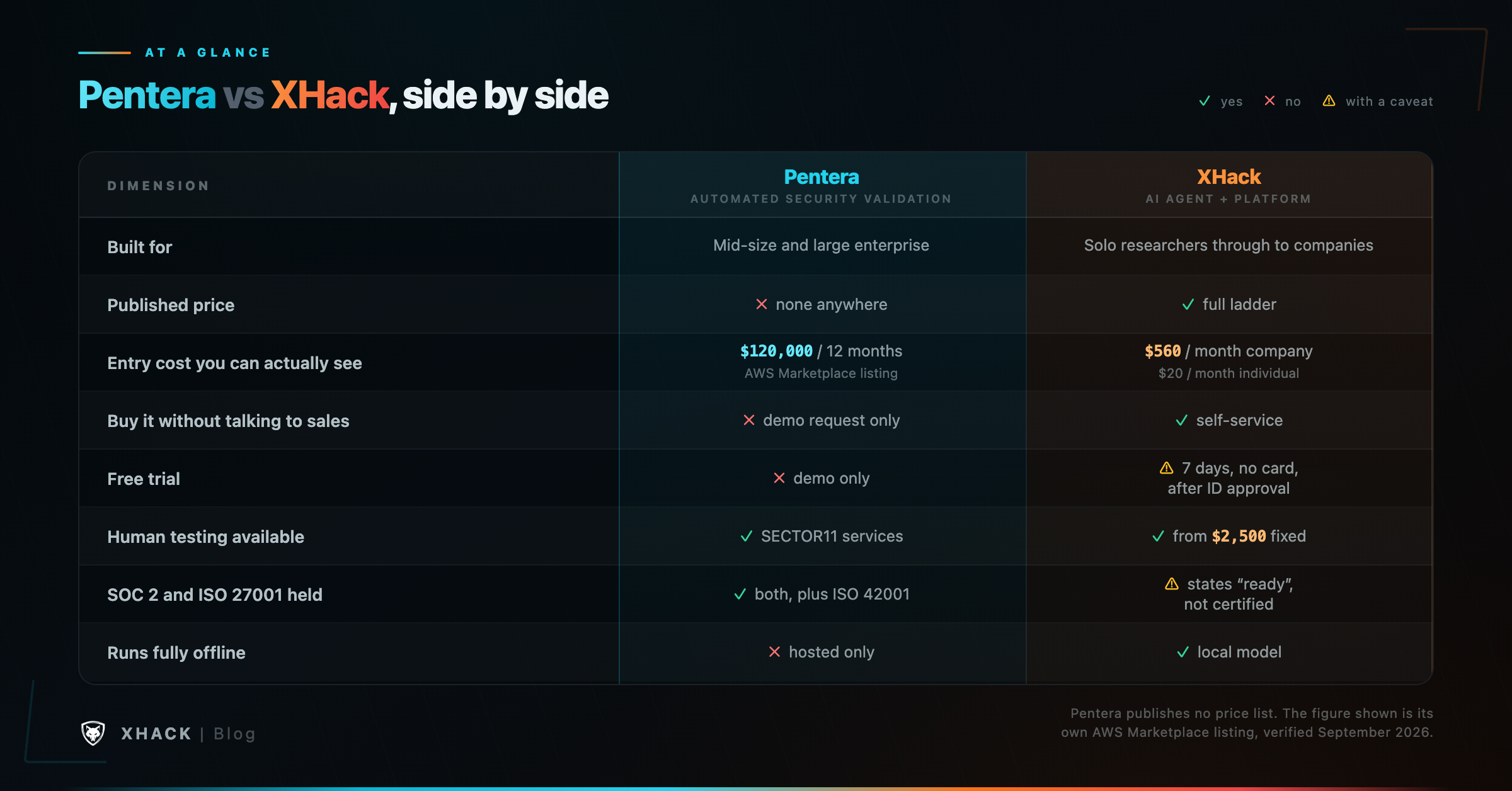
Two rows decide most Pentera vs XHack decisions before you get anywhere near the rest of this article: whether you can see a price, and whether the company will sell to you at all. Everything else is detail worth reading, but those two rows are the ones that actually gate the purchase.
If you want the wider field instead of a single head-to-head, XHack’s ranked comparison of AI pentesting agents covers more ground.
Pentera started in 2015 as Pcysys, founded in Israel, and rebranded to Pentera in 2021. It coined the term Automated Security Validation for what it does, and now sits inside the analyst-defined category of Adversarial Exposure Validation, where Gartner named it a representative vendor in a Market Guide published March 24, 2026. A Market Guide names vendors in a category. It does not rank them, and there is no Gartner Magic Quadrant or Forrester Wave for this space.
The platform is built from pieces that snap together. Core runs full kill chains inside your internal network: Active Directory password strength, privilege escalation, lateral movement, and emulation of real ransomware strains like LockBit 3.0 and Conti. Surface runs the same style of attack against your external perimeter, internet-facing services, leaked credentials and exposed code repositories. Cloud tests AWS and Azure for privilege escalation and misconfiguration chains, and Pentera’s own FAQ for that module says plainly it is “not a CSPM or CNAPP. It does not monitor posture or policy compliance.” That’s the company drawing its own boundary, not me drawing it for them.
A newer piece, AI-native web application testing, entered beta on July 29, 2026. General availability is targeted for Q4 2026, which means as of this writing it’s about six weeks old and not yet a finished product. Worth knowing if a salesperson demos it as though it’s been running for years.
Here’s the part a lazier comparison skips: Pentera’s automated platform doesn’t test mobile apps or run AI red teaming on its own, but the company does, through a human-delivered services arm called SECTOR11. It sells application penetration testing across web, mobile, API and thick-client software, dedicated AI red teaming against LLM usage, agentic workflows and prompt abuse scenarios, advanced cloud penetration testing, full-scope red teaming, and a service called Test & Comply that ends in a signed attestation mapped to ISO 27001, SOC 2, PCI DSS, HIPAA, GDPR and NIS2.
SECTOR11 looks like the EVA Information Security acquisition Pentera closed on November 5, 2025, repackaged under a new brand. Whatever its origin, it’s real, and it kills two claims you’ll see elsewhere about Pentera: that it can’t test mobile, and that it doesn’t do AI security. It can do both, just as a scoped human engagement rather than a toggle inside the platform.
Pentera holds certifications that actually exist: SOC 2 Type II, SOC 3, ISO 27001:2022, ISO 42001 and ISO 9001, all listed on its own trust center. It has no FedRAMP authorization, so federal high-impact systems are out of reach regardless of anything else in this article.
The company has real money behind it. It closed a $60 million Series D on March 12, 2025 at a valuation over $1 billion, led by Evolution Equity Partners with Farallon Capital participating. Total funding is widely reported at $250 million, though the itemized round-by-round tally adds up to less, so treat that figure as the loose one.
Customer count is reported at over 1,000 CISOs, roughly 1,100 organizations. That scale shows up in independent reviews from four audiences that don’t talk to each other: 4.4 out of 5 on PeerSpot across 189 reviews, 4.5 from 174 reviews on G2, 4.8 from 258 reviews on Gartner Peer Insights with 94% willingness to recommend, and 4.6 from 195 reviews on its AWS Marketplace listing. Different populations of buyers landing on roughly the same answer is itself a data point worth something.
Named customers back it with specifics instead of logos. DTCC’s Shawn Baird credits Pentera with cutting the learning curve for a lean security team and giving executive leadership reporting they could actually use. Forvia’s Frederic Petrus scaled to running simulations across 3,500 IPs per assessment within three months of adoption. Pentera Labs, the company’s internal research team, found a high-severity flaw in Fortinet FortiClient (CVE-2024-47574) and an information disclosure bug in VMware vCenter (CVE-2022-22948), a research team publishing verifiable, checkable output rather than marketing copy.
Reviewers keep returning to one thing: watching a full kill chain resolve into a step-by-step path to domain admin, instead of a flat list of CVEs. That’s harder to build than a vulnerability scanner, and it’s the strongest technical argument for Pentera in this Pentera vs XHack matchup.
None of that makes the reviews uniformly glowing. A Director at Infosonik Systems Ltd wrote that the “product has become very expensive,” in the same review that put annual costs “around $120,000 USD.” A Cyber Security Officer at AFC Holdings called licensing “inflexible for smaller organizations,” even while praising support elsewhere in the same review. A Pre-sale Manager at Nam Truong Son flagged something more concrete: once an IP address enters the license pool, it reportedly can’t be withdrawn. An AI Expert at an educational organization said AWS and Azure attack path simulation isn’t “as deep compared to others,” and called the platform UI “difficult for non-penetration testing specialists.” A network engineer at Inniti Network Solutions said navigation feels slower than it should.
None of these are dealbreakers. They’re the kind of specific, named complaints you’d expect from real customers of a mature product, worth more than a five-star average with nothing behind it.
XHack sells three things on one account that usually come from three different vendors: an autonomous AI pentesting agent, a security platform that keeps watching after the engagement ends, and fixed-price human VAPT engagements when you want testers, not just software.
Worth stating plainly: the XHack agent does the same internal-network work Pentera is known for. Port scanning, service enumeration, Active Directory assessment, privilege escalation path discovery, lateral movement simulation, credential testing and network segmentation validation all live inside the same platform. Once it has a foothold, it keeps going: harvesting credentials, pivoting between machines, hunting for data worth stealing, the same shape of attack chain Pentera’s Core module runs.
What XHack doesn’t have is a published benchmark or a dated case study proving that work at scale the way Pentera can point to Forvia’s 3,500 IPs. That’s a gap in evidence, not a gap in what the agent is built to do, and if your board wants a number on a slide instead of a capability description, it’s a gap that matters.
Three ways to buy in: $20 a month as an individual, $560 a month as a company, or $2,500 for a scoped human engagement where OSCP-certified testers work alongside the agent. It’s agentic pentesting with a human signing off on the finding, closer to an AI VAPT model than a machine left alone with your network.
This is the section that actually decides most of these arguments, so the math needs to hold up on its own.
Pentera publishes no prices anywhere, not on its site and not in a sales deck a prospect could share. The one number that survives scrutiny is the AWS Marketplace listing: $120,000 for a 12-month contract. It’s a real, transactable figure on a neutral platform, not a guess from a competitor’s blog, and it lands close to what a PeerSpot reviewer separately reported paying. Two independent routes to a similar figure is about as solid as Pentera pricing gets.
Set that $120,000 against XHack’s published company tiers, annualized:
| Compared against $120,000/yr | XHack annual cost | Ratio |
|---|---|---|
| Company Starter, $560/mo | $6,720 | 17.86x cheaper |
| Company Premium, $1,099/mo | $13,188 | 9.10x cheaper |
| Company Elite, $3,000/mo | $36,000 | 3.33x cheaper |
That same $120,000 buys exactly 10 of XHack’s Comprehensive VAPT engagements at $12,000 each, or 48 Essential engagements at $2,500 each. XHack’s full pricing ladder is public, tier by tier, individual and company.
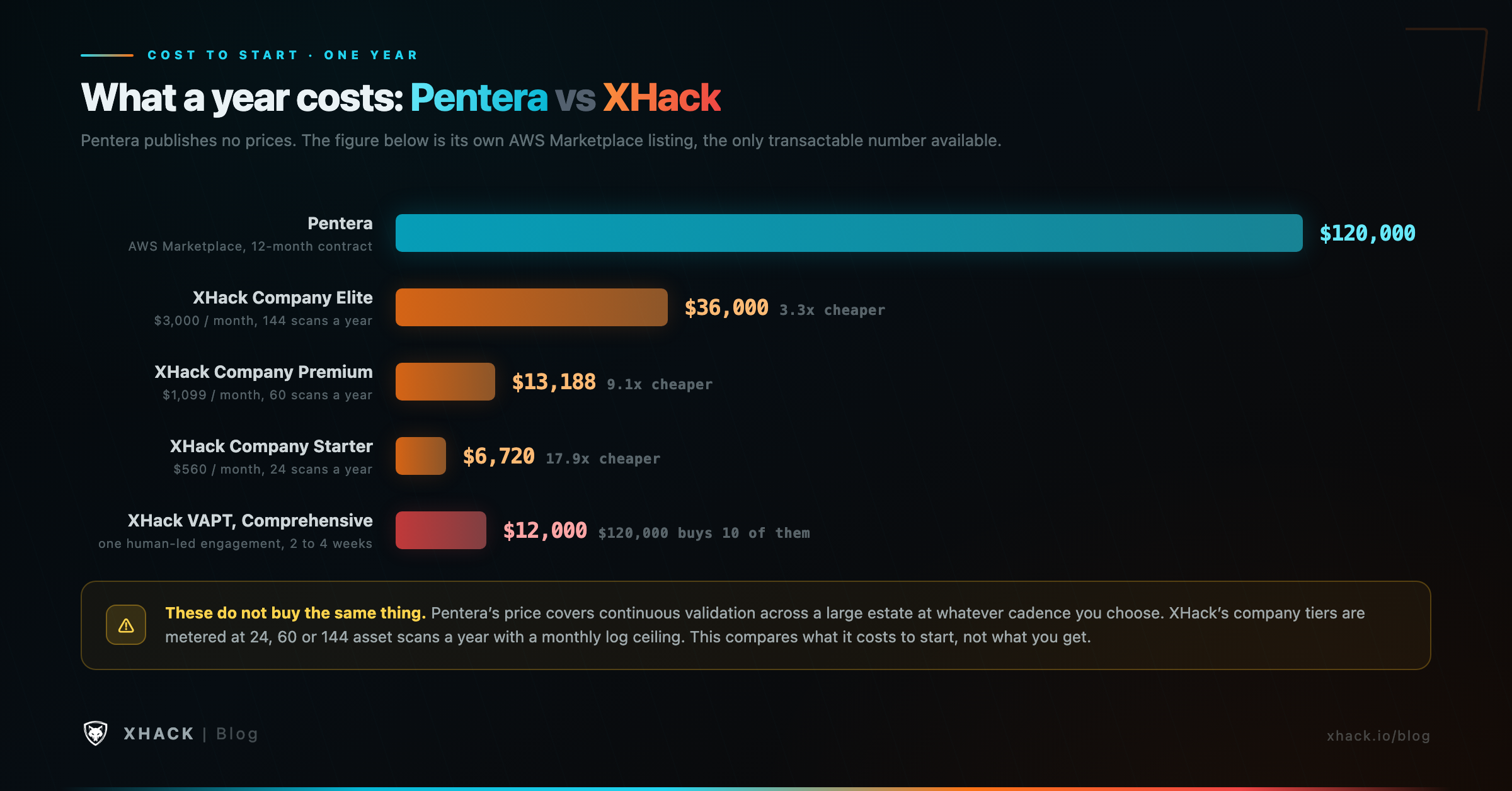
Now the caveat, and it needs to travel with every number above, not sit in a footnote underneath them. These prices don’t buy the same thing. Pentera’s contract covers continuous validation across whatever estate you scope it to, at whatever cadence you choose, run as often as you want. XHack’s company tiers are metered: 2, 5 or 12 asset scans a month depending on tier, which works out to 24, 60 or 144 a year, plus a monthly ceiling on SOC log volume. This is a comparison of what it costs to start, not what you get once you’re running. An enterprise that genuinely needs continuous validation across thousands of assets should buy Pentera, because XHack has no published tier built for that yet.
One number I’m deliberately not using: XHack’s $20-a-month individual plan against Pentera’s $120,000. The ratio runs past 500x and it’s meaningless, because the two products aren’t substitutes for that buyer. The honest version of that point isn’t a ratio. It’s simply that Pentera has no individual plan at any price, and XHack does.
For the general shape of how this market prices, from twenty-dollar tools to five-figure engagements, XHack’s guide to AI penetration testing costs lays out the full range, and the cheapest AI pentest tools worth running is worth reading before you assume cheap and good are the same question.
The tidy version of this comparison would say Pentera owns internal networks and XHack owns everything past the perimeter. That’s not true, and the overlap is exactly the ground where real breaches happen.
| Attack surface | Pentera | XHack |
|---|---|---|
| Internal network, Active Directory | Yes, its founding product | Yes |
| External perimeter | Yes | Yes |
| Cloud (AWS, Azure) | Yes, platform-native | Yes |
| Web application, deep testing | Beta since July 2026, GA targeted Q4 2026 | Yes |
| Mobile apps | Yes, via SECTOR11 services | Yes, platform-native |
| AI and LLM systems | Yes, via SECTOR11 services | Yes, platform-native |
| Supply chain, code repositories | Partial, exposed-repo detection only | Yes, GitGuard |
Both platforms run assumed-breach attack chains against internal networks and Active Directory. Both pivot from a weak machine to a better one instead of matching a list of known CVEs. That overlap is close to what autonomous penetration testing actually looks like in 2026, and it’s the ground both companies are actually fighting over.
The real difference isn’t whether Pentera can reach mobile and AI systems. It can, through SECTOR11. The difference is how you get there. XHack’s coverage sits inside the same self-service platform as its network testing, a toggle away, starting at $150 a month. Pentera’s equivalent coverage is a separate human engagement, quoted and scheduled like any other services purchase, stacked on top of whatever the platform license already costs. Same surfaces reached, different delivery model, different bill.
Compliance is where this actually bites. If your auditor needs proof against PCI DSS 11.4 or wants to know whether an AI-run test satisfies their framework, the answer depends on which delivery model you bought, not just which vendor’s logo sits on the report.
Scope and price are half of the Pentera vs XHack decision. Whether either company will actually sell to you is the other half.
Individuals. XHack sells plans at $20, $49 and $150 a month to a single person with a credit card. Pentera has no individual tier at any price. Every way in leads to the same place: pricing by quote, an AWS Marketplace listing that only works through a private offer, and a “Book a Demo” button as the only door.
Trials. Pentera has no self-service trial. The only way to see the product is a demo or a proof of concept arranged through sales. XHack gives 7 days with no credit card, but it isn’t instant. A government ID has to clear first for an individual, and a company has to submit business documents too. Free of a card, not free of a check.
Self-service. XHack’s signup lives at app.xhack.io and doesn’t require a sales conversation to start. Every route into Pentera, the AWS listing included, puts a human in the way before a contract closes.
A solo researcher can be running XHack this afternoon, once identity verification clears. An enterprise with a procurement team can work with either company, and probably should ask both for a quote before deciding.
This is the part of the Pentera vs XHack decision that explains the price gap better than any feature list does.
Pentera’s evidence is checkable by someone who doesn’t work there: a Gartner Market Guide naming it a representative vendor, a Gartner Peer Insights Customers’ Choice award with a 4.8 average across 258 reviews, a Gartner Hype Cycle mention, four independent review platforms in rough agreement, two named customers on record with real specifics, and a research team with two published CVEs.
XHack’s side is smaller, and I’m not going to dress it up. Six clients secured, 32 assessments done, 14 case studies written up and fully redacted. Compliance status reads “ISO 27001, SOC 2 ready,” which means preparing for an audit, not passing one. No analyst firm covers XHack.
The one hard, checkable result the AI agent itself has produced is a redacted YesWeHack case: it found live OAuth credentials hardcoded into a Flutter web bundle in roughly 25 minutes with almost no human input, and the program paid out. That’s real, but it’s one finding, not a track record sitting next to two published CVEs and a decade of named customer case studies.
One distinction I want to draw cleanly, because it would be easy to blur in my own favor. My Synack Red Team membership and the vulnerabilities I’ve personally reported are manual work I did with my own hands, over years, long before any of this software existed. The AI agent inherits none of that history, and I’m not going to let it borrow my resume to look more proven than it is.
So yeah, here’s the section where I talk about what XHack actually brings to this fight, and where it still doesn’t measure up.
The combination is the point: an AI agent that runs recon, exploitation and reporting on its own, a platform that keeps watching your environment after the engagement ends, and OSCP-certified testers who step in when a finding needs a human to prove real impact. Most vendors sell one of those things. Pentera assembled the human half through an acquisition. XHack built the human practice alongside the software from the start, priced separately at $2,500, $5,000 or $12,000 depending on scope.
The AI side isn’t a lesser version of the human side. It runs the same Active Directory and lateral-movement work the platform is built around, plus mobile, AI and supply-chain testing that would otherwise mean three separate vendor contracts. The evidence behind it is thin next to Pentera’s, as I said earlier. The price starts at $20 a month for one person, or $560 a month for a company, with a 7-day free trial and no credit card required to see if it’s worth your time.
If you want a platform with a decade of proof, certifications an auditor already accepts, and a sales team that will hold your hand through procurement, that’s genuinely not us yet, and Pentera is the more defensible buy. If you want broader surface coverage than a network-first platform, bundled at a price a single researcher or a small security team can actually pay, without waiting on a demo, that’s what XHack is built for.
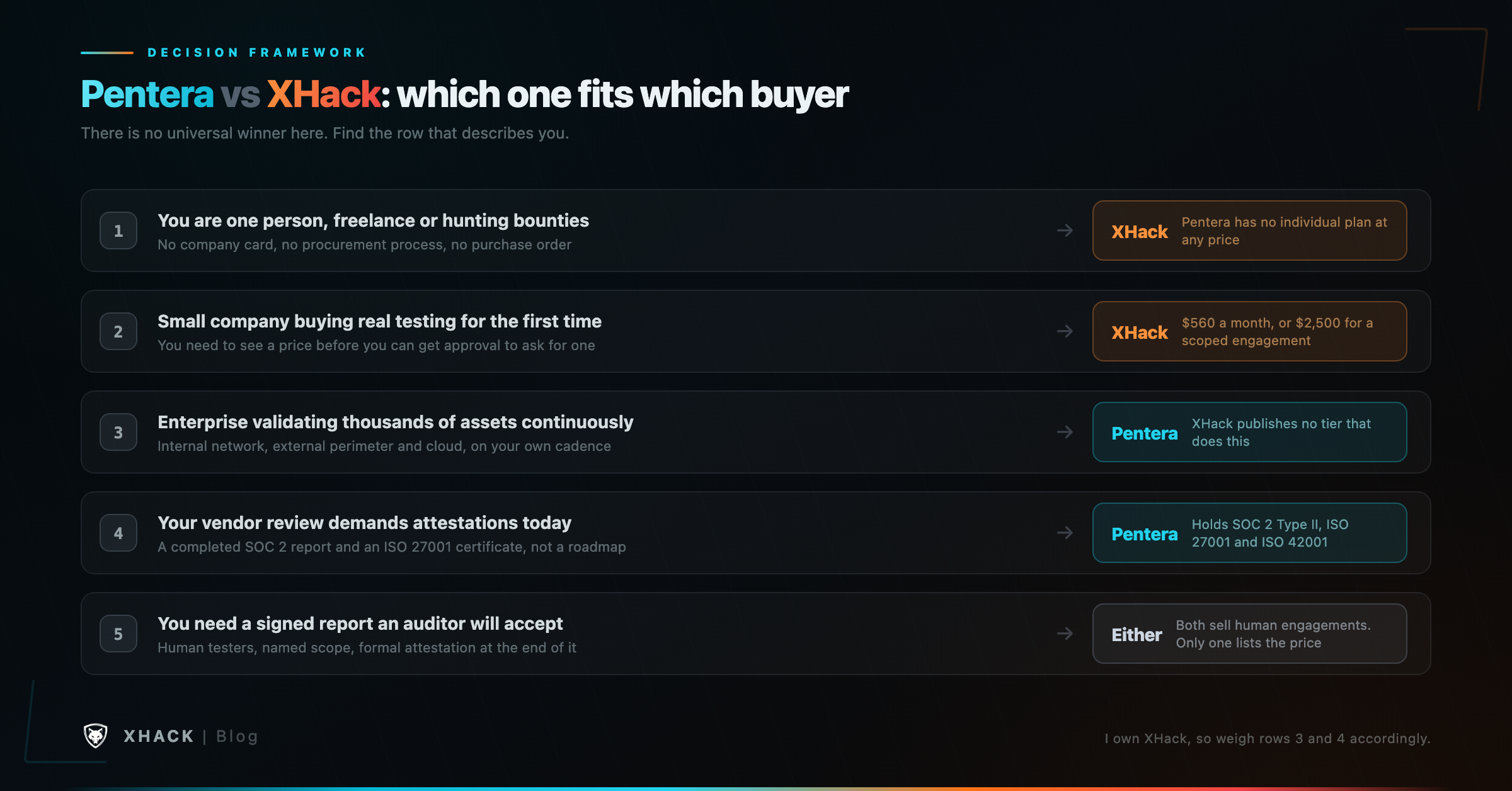
There’s no universal winner in Pentera vs XHack. Five situations, five different answers.
You’re an enterprise with a six-figure budget and thousands of assets to cover continuously. Buy Pentera. Nothing in XHack’s current lineup matches unlimited continuous validation at that scale, and Pentera’s certifications and analyst mentions will clear your vendor review faster.
You’re a solo bug hunter or freelance pentester. Buy XHack. Pentera has no path for you at any price. XHack does, starting at $20 a month.
You’re a small or mid-sized security team with a real budget, just not a six-figure one. XHack’s company tiers, from $560 a month, cover network, AD, mobile, AI and supply chain in one subscription for a fraction of Pentera’s reported entry price. Read how to choose a pentest provider before signing with either of us.
You need a signed compliance attestation this quarter from a vendor an auditor already trusts. Pentera, through SECTOR11’s Test & Comply service, or its own platform-native certifications, gets you there faster than a company still working toward “SOC 2 ready.”
You need testing that never leaves the building. XHack’s offline desktop agent, running against a local Ollama model, is the only option between these two that works fully air-gapped. Pentera is hosted, with no offline mode.
For the work itself, largely yes. XHack’s agent runs Active Directory assessment, privilege escalation path discovery, lateral movement and credential testing, the same category of internal-network attack chain Pentera’s Core module is built around. What XHack can’t hand you is a dated, published result like Forvia’s 3,500 IPs per assessment within three months. The capability overlaps closely. The evidence behind it does not, and that gap matters most to a buyer who has to justify the purchase to someone else.
Pentera publishes no price anywhere on its own site. The most reliable figure available is its AWS Marketplace listing, which lists $120,000 for a 12-month contract, a number that lines up closely with what a customer separately reported paying in an independent PeerSpot review. Every other figure circulating online, including anything published on a competing vendor’s own blog, should be treated as an estimate rather than a confirmed price, because Pentera itself has never published one.
No, at any price. Every way to buy Pentera runs through a sales conversation or a private AWS Marketplace offer, and none of them include an individual tier. A freelance pentester or independent bug hunter has no way to become a Pentera customer today. XHack sells to that exact buyer starting at $20 a month.
Yes, but not inside the automated platform you’d see in a first demo. Pentera’s SECTOR11 services arm sells application penetration testing across mobile, web, API and thick-client software, plus dedicated AI red teaming against LLM usage and agentic workflows, both delivered as human-led engagements rather than a feature you switch on inside Core, Surface or Cloud. The capability is real. It arrives on a different track, with a different price and timeline, than the automated platform.
Yes, no credit card is required to start it. The catch is identity, not money. An individual has to get a government ID approved before touching any tooling, and a company has to submit business documents too, so it costs nothing but it isn’t instant. Pentera offers no trial at all, self-service or otherwise. Every path to seeing the product runs through a demo.
No, and it’s worth being precise here because it’s easy to blur. Pentera appears in a Gartner Market Guide for Adversarial Exposure Validation, published March 24, 2026, which names representative vendors without ranking them, and it was named a Customers’ Choice in Gartner Peer Insights, a user-review product closer to G2 than to Gartner’s own analyst research. There is no Gartner Magic Quadrant for this category and no Forrester Wave placement for Pentera anywhere. Treat any claim otherwise, about Pentera or any competitor in this space, as false.
Pentera and XHack sell the same shape of product now, and pretending otherwise would be the easiest way to lose your trust. What separates them is proof, scale and who’s allowed through the door, not a capability one has and the other doesn’t.
Pentera earned its price with a decade of published customer results, certifications an auditor will actually accept, and review scores from four audiences that don’t talk to each other. XHack earned its price with a company plan that costs a third of one Pentera contract at the top tier, a subscription a single person can buy for $20 a month, and attack surfaces, mobile, AI, supply chain, bundled into the same platform instead of billed as a separate engagement.
If you have six figures, thousands of assets, and an auditor who needs a name they already trust, buy Pentera and don’t let the price talk you out of it. If your budget stops well short of $120,000, or you’re one person instead of a procurement department, our pricing is public and the trial costs nothing but a verification step.
If Horizon3’s NodeZero is also on your shortlist, Horizon3 vs XHack covers NodeZero’s pricing, Active Directory record and FedRAMP status. If XBOW is in the mix too, XBOW vs XHack covers a narrower, web-and-API-only competitor billed per test.
Don’t buy on price alone, and don’t buy on a certification logo alone either. Pentera vs XHack really comes down to what your auditor needs, what your budget allows, and whether you’re buying as a company or as one person with a laptop.
Categories
Related articles