Table of contents
15
By Salman Khan, OSCP+, Founder of XHack, SRT (Synack Red Team member)
Read this in 30 seconds: Autonomous penetration testing runs a coordinated team of AI agents, recon, vulnerability analysis, exploitation, validation, reporting, that reason through a target the way a human tester would, forming a hypothesis from scanner output, trying it, adapting when it fails. That’s the core difference from a traditional scanner: a scanner runs fixed checks and reports matches, an autonomous pentest agent chains findings into proven impact without a human clicking through each step.
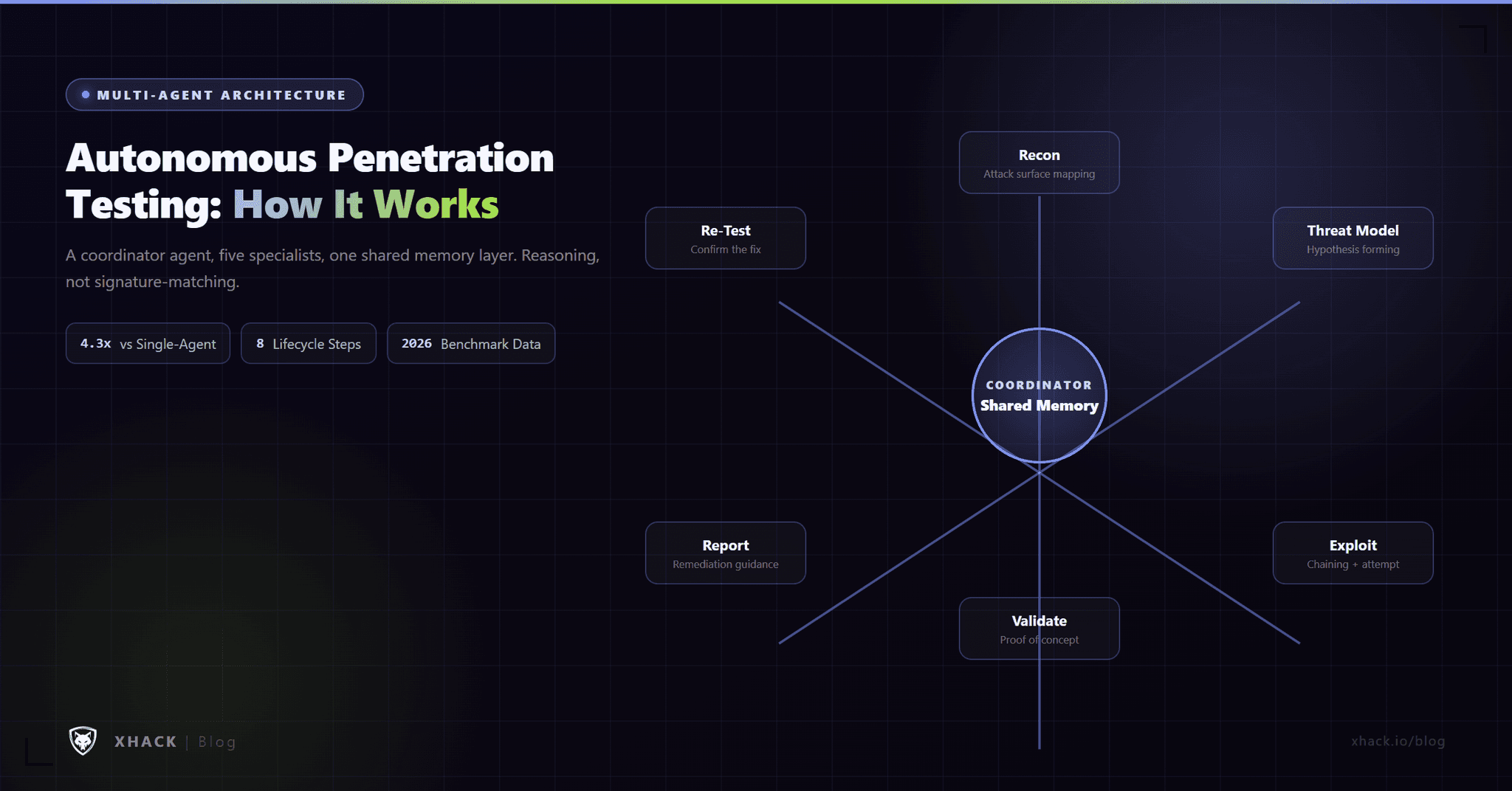
The architecture behind it is almost always multi-agent: a coordinator orchestrates specialized sub-agents that share a memory layer and operate under scope guardrails, and 2026 research shows multi-agent setups outperform single-agent ones by roughly 4.3x. It’s not magic and it’s not infallible, hallucinated exploits and scope-control failures are real, documented risks, which is why the honest 2026 model pairs autonomous breadth with human judgment on validation and sign-off, not autonomous replacement of either.
“Autonomous” gets slapped on every pentest product in 2026, and most of what carries the label is still a scanner with better marketing.
The real distinction isn’t whether a tool uses AI, it’s whether the system reasons through unfamiliar territory or just executes a predefined checklist faster. A Nessus scan run through an LLM wrapper that summarizes results in plain English isn’t autonomous penetration testing, it’s a scanner with a chatbot bolted on. True autonomous pentesting reasons: it looks at what recon found, forms a hypothesis about what might be exploitable, tries it, watches how the target responds, and adjusts the next move based on that response, the same decision loop a human tester runs, at a speed and scale no human team matches.
By the end of this piece you should be able to tell the difference yourself, without taking a vendor’s word for it. That means understanding what’s actually happening under the hood of a genuine autonomous penetration testing system: the architecture, the operational lifecycle, where it measurably outperforms older approaches, and where it still falls short.
Autonomous penetration testing is security testing performed by AI agents that plan, execute, and adapt their own actions against a target with minimal human intervention, as opposed to running a fixed script or checklist. The distinction that actually matters is between three categories people conflate constantly:
All three get called “autonomous” in vendor marketing. Only the middle category is actually reasoning through something it hasn’t seen before.
Nearly every serious autonomous penetration testing system built in 2026 uses a multi-agent architecture rather than one large model doing everything. A coordinator agent orchestrates specialized sub-agents, recon, vulnerability analysis, exploit development, post-exploitation, validation, report generation, each operating with its own scoped context and tool access, sharing findings through a common memory layer, and bounded by explicit guardrails on what’s in scope.
This isn’t an arbitrary design choice. 2026 benchmarking research comparing more than 39 open-source autonomous pentesting projects across six distinct architecture patterns found multi-agent systems outperform single-agent approaches by roughly 4.3x. A single model trying to hold recon data, exploit-development reasoning, and post-exploitation context in one conversation degrades fast, splitting those concerns across specialized agents with their own focused context keeps each one sharper at its specific job.
Academic examples make the pattern concrete. xOffense uses domain-adapted LLMs across a multi-agent pipeline purpose-built for penetration testing tasks. VulnBot structures its multi-agent collaboration explicitly around the phases a human red team follows. Commercial systems follow the same shape: a March 2026 platform called BlacksmithAI runs a hierarchical structure where an orchestrator coordinates dedicated Recon, Scan/Enum, Vulnerability Analysis, Exploit, and Post-Exploitation agents, each a specialist, none doing the whole job alone.
The shared-memory layer matters more than it sounds like it should. Without it, each specialized agent operates blind to what the others already learned, the recon agent finds an exposed admin panel, but the exploit agent never sees it because nothing passed the finding along. A working autonomous system treats that memory layer as the backbone of the whole operation, every agent reads from and writes to a shared understanding of the target, so a credential the post-exploitation agent extracts becomes immediately available to the agent trying the next pivot, the same way a human red team shares notes in a live engagement rather than working in silos.
A growing share of 2026 systems also ground their reasoning in the MITRE ATT&CK framework, using structured attack trees derived from documented adversary tactics and techniques to keep an agent’s next move grounded in real-world attacker behavior instead of a model improvising from scratch. That grounding measurably cuts hallucinated attack paths, an agent reasoning against a documented technique library is less likely to invent an exploit that doesn’t actually exist than one reasoning purely from a general-purpose model’s training data.
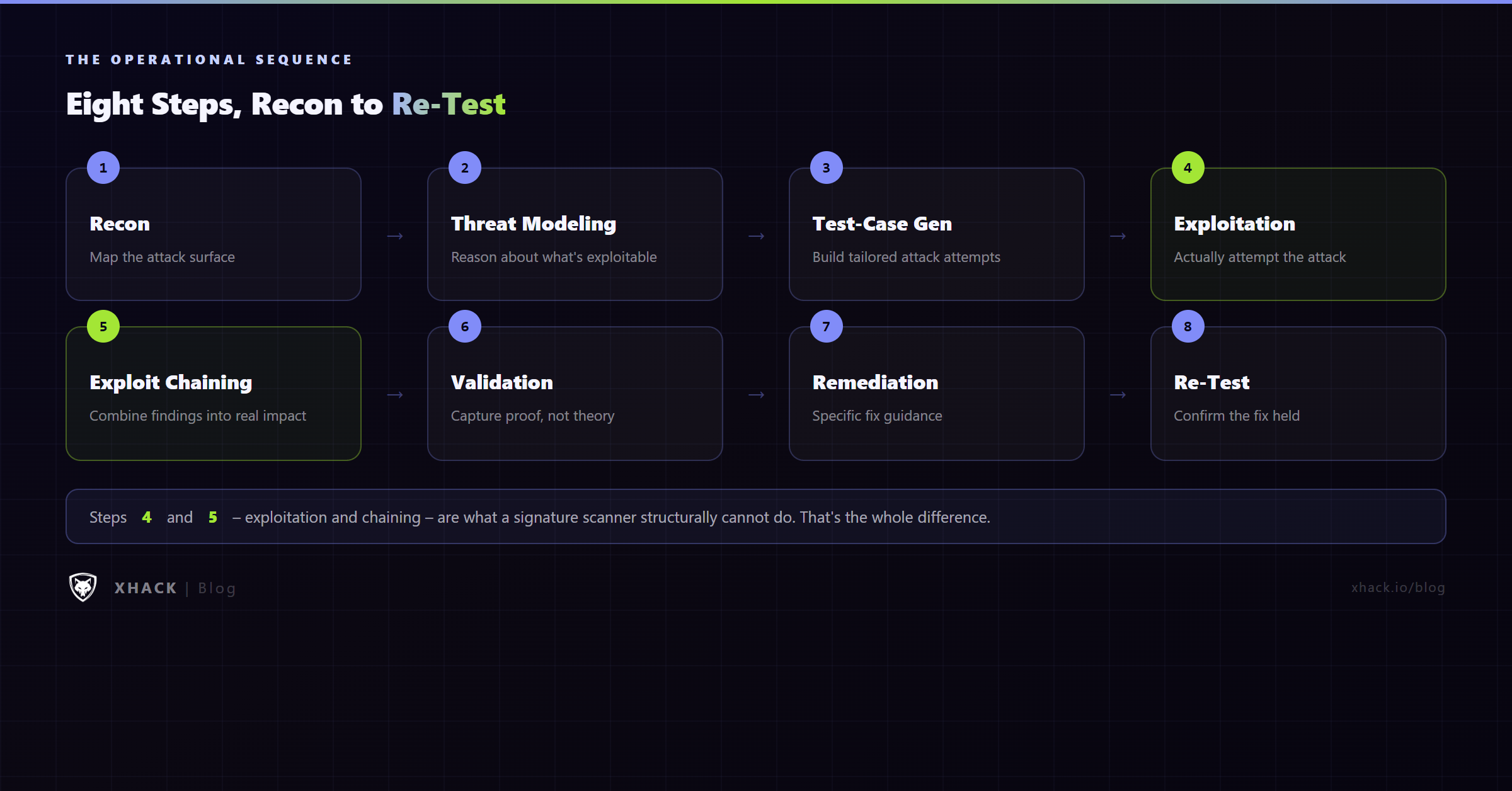
Strip away the marketing and the actual operational sequence an autonomous pentest agent runs looks like this:
Steps 4 through 6 are where the real difference from a scanner lives. Research comparing LLM-based agents to signature-based tools is explicit about this: agents read scanner output, form a hypothesis, and try different hypotheses when the first one fails, the same iterative reasoning a human tester does, instead of stopping at “this matched a known signature.”
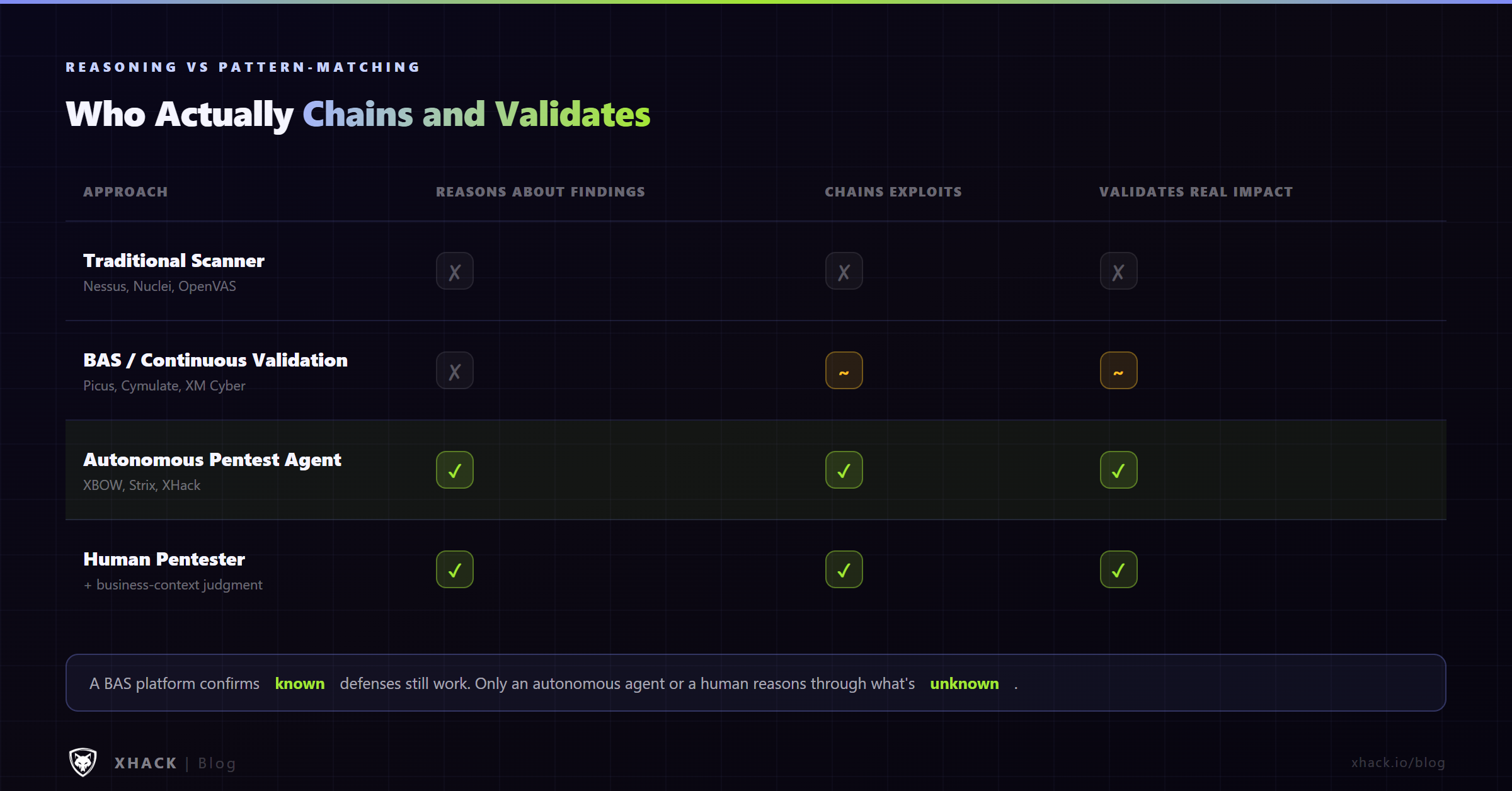
| Approach | Reasons About New Findings? | Chains Exploits? | Validates Real Impact? | Best For |
|---|---|---|---|---|
| Traditional scanner (Nessus, Nuclei) | No, fixed checks only | No | No, flags matches only | Fast, cheap baseline coverage |
| BAS / continuous validation (Picus, Cymulate, XM Cyber) | No, replays known techniques | Partially, within known attack graphs | Confirms controls block known techniques | Continuously verifying existing defenses still work |
| Autonomous pentesting agent (XBOW, Strix, XHack) | Yes, hypothesis-driven | Yes, this is the core value | Yes, working PoC or proven impact | Discovering unknown exploitable paths |
| Human pentester | Yes, plus business-context judgment | Yes | Yes, plus regulatory sign-off | Business-logic flaws, high-stakes sign-off |
Autonomous penetration testing sits in a specific slot: broader and faster than a human team, genuinely reasoning in a way a scanner or BAS platform doesn’t, but still short of the business-context judgment a human tester brings to a genuinely novel, high-stakes engagement.
Being honest about the failure modes matters more than another vendor claiming 100% accuracy. 2026 research on LLM-based automated penetration testing documents three recurring problems worth taking seriously before you trust any autonomous system unsupervised:
The lab-to-real gap is worth naming directly: the same 2026 benchmarking survey found autonomous agents hit 87% success against one-day CVEs when given the advisory description, but that drops to roughly 13% against real, undisclosed CVEs tested in a sandbox, and near-zero on hard HackTheBox-style challenges. Business logic flaws, which account for an estimated 70% of critical web vulnerabilities, remain largely outside what current autonomous systems reliably catch, exactly the category where a human tester’s judgment still earns its keep.
None of this means autonomous pentesting doesn’t work, the 2026 benchmarking data above shows genuine capability gains. It means the honest 2026 model treats autonomous agents as a powerful, fast, broad-coverage tool that still benefits from human review on anything with real stakes, not a fire-and-forget replacement for judgment.
Buyers get burned on autonomous pentesting claims in a handful of predictable ways:
So yeah, brand section. XHack’s autonomous multi-agent engine follows the architecture described above almost exactly: a coordinator orchestrating specialized sub-agents across recon, exploit development, and validation, sharing context through a common memory layer, bounded by scope guardrails you control. It runs the full lifecycle, recon through re-test, not a scanner with a report generator attached.
Where XHack differs from most of the category: the agent doesn’t refuse legitimate exploit-development or payload-crafting work for a verified security professional working in-scope, a limitation that quietly caps what general-purpose AI-wrapped tools can actually do. And when a finding needs the business-context judgment autonomous reasoning still can’t fully replace, human-led VAPT picks up exactly where autonomous validation should hand off, with AI-agent assistance used only if you authorize it. Individual AI plans run $20-$150/month with a 7-day free trial, no credit card required; company plans run $560-$3,000+/month; human-led VAPT starts at $2,500 and scopes to $12,000 depending on complexity. XHack doesn’t store your findings on our servers either, pentest chats and session data stay local, deletable any time.
Autonomous penetration testing is security testing performed by AI agents that plan, execute, and adapt their own actions against a target with minimal human intervention. Unlike a fixed automated scan, an autonomous pentest agent reasons through what it finds, forms hypotheses about exploitability, chains multiple findings into a proven attack path, and validates real impact before reporting, running a decision loop closer to a human tester’s process than a signature scanner’s checklist. The term gets used loosely across the industry, so it’s worth checking whether a given autonomous penetration testing product actually reasons end-to-end or just automates report generation around a traditional scan.
A vulnerability scanner runs a fixed library of signature-based checks and reports version or configuration matches without confirming they’re actually exploitable. An autonomous penetration testing agent reads that same scanner output, reasons about what’s genuinely exploitable given the context, attempts real exploitation, chains multiple lower-severity findings into higher-impact attack paths, and validates the result with proof, work a scanner structurally cannot do because it isn’t reasoning, it’s pattern-matching.
It can be, with the right guardrails, but it isn’t automatically safe by default. Documented risks include scope-control failures where an agent’s reasoning wanders outside authorized boundaries, and hallucinated findings that look plausible without being proven. A responsibly built autonomous pentesting system enforces hard scope boundaries, requires proof-of-concept validation before reporting a finding, and keeps a human able to review or halt the process, not full autonomous access to production with no oversight.
Not yet, and the 2026 consensus among researchers and vendors doesn’t claim otherwise. Autonomous agents deliver breadth, speed, and continuous coverage a human team can’t match at the same cost, but business-logic flaws, novel exploit chaining outside a model’s training patterns, and regulatory sign-off still benefit from human judgment. The model that’s actually working in 2026 combines both rather than choosing one.
Autonomous penetration testing reasons through a target it hasn’t seen before, discovering unknown exploitable paths from scratch. Breach and attack simulation continuously replays known attack techniques against your existing defenses to confirm they still detect and block what they’re designed to, closer to a recurring fire drill than a genuine intrusion attempt. Both are valuable, but they answer different questions: autonomous pentesting asks “what can be exploited here,” BAS asks “are our known defenses still working.”
Pricing varies by vendor and model. Per-test autonomous pentest products commonly run in the low thousands of dollars per engagement, continuous autonomous validation subscriptions run anywhere from a few hundred dollars a month for individual-scale access up to five- and six-figure annual contracts for enterprise-wide coverage, and traditional human-led pentests typically start around $4,000-$10,000 for a scoped assessment and scale well beyond that for larger, more complex environments. The honest comparison isn’t just sticker price, it’s how often you actually need testing and whether continuous autonomous coverage or a point-in-time human engagement better matches that cadence.
Autonomous penetration testing in 2026 means something specific: a multi-agent system that reasons through a target the way a human tester would, chaining findings into validated, proven exploits instead of matching signatures or replaying known playbooks. The technology is genuinely capable, multi-agent architectures now measurably outperform single-agent approaches, and genuinely imperfect, hallucinated findings and scope-control failures are documented risks, not theoretical ones. Judge any vendor claiming to run autonomous penetration testing by whether their system actually chains and validates exploits end-to-end, or whether it’s a scanner wearing the label. The gap between those two is the whole story.
Categories
Related articles