Table of contents
13
By Salman Khan, OSCP+, Founder of XHack, SRT (Synack Red Team member)
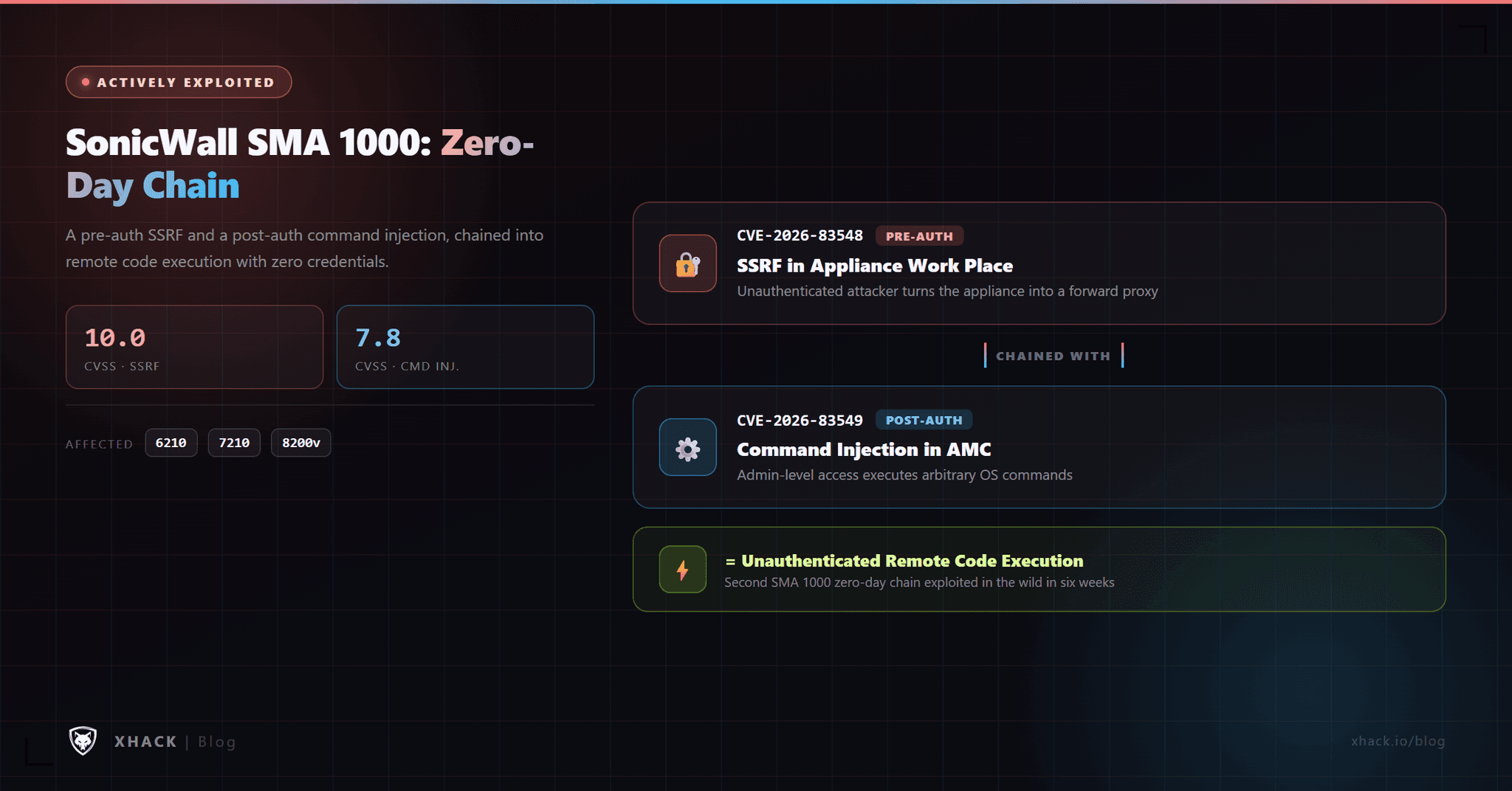
Read this in 30 seconds: SonicWall confirmed active exploitation of two SMA 1000 zero-days on September 2, 2026. CVE-2026-83548 (CVSS 10.0) is a pre-authentication SSRF in the Appliance Work Place interface that lets an unauthenticated attacker turn the appliance into an unauthorized forward proxy. CVE-2026-83549 (CVSS 7.8) is a post-authentication OS command injection in the Appliance Management Console. Chained together, they give an attacker with zero credentials a path to remote code execution on the device.
Only SMA 1000 models 6210, 7210, and 8200v are affected, running platform-hotfix builds 12.4.3-03453 or 12.5.0-02835 and older. Patches shipped as 12.4.3-03526 and 12.5.0-02952. This is the second SonicWall SMA 1000 zero-day chain exploited in the wild in six weeks, after CVE-2026-15409 and CVE-2026-15410 were used by threat group UTA0533 to deploy KNUCKLEBALL malware in July. Patch now, and if you find signs of compromise, re-image rather than just update.
Two SonicWall SMA 1000 zero-day chains, exploited in the wild, six weeks apart. That’s not a coincidence worth shrugging off, it’s a pattern: remote-access gateways are the single most consistently exploited class of edge device in 2026, and SonicWall’s flagship secure mobile access appliance is now on its second confirmed zero-day chain of the summer.
CVE-2026-83548 (CVSS 10.0) is a pre-authentication server-side request forgery flaw in the SMA 1000’s Appliance Work Place interface, the portal end users hit to reach their published apps and desktops. SonicWall’s advisory describes the root cause as an unintended alternate access path that can effectively function as an unauthorized forward proxy: an unauthenticated attacker can route requests through the appliance itself to reach sensitive internal functionality that was never meant to be internet-facing.
CVE-2026-83549 (CVSS 7.8) sits on the other side of the login wall. It’s an OS command injection bug in the Appliance Management Console, the administrative interface used to configure the box. An authenticated administrator session, or one an attacker fakes its way into, can inject arbitrary operating system commands under specific conditions, landing full remote code execution as whatever privilege the AMC process runs under.
Separately, that’s a max-severity information-disclosure-and-access bug plus a privileged RCE bug. Chained, SonicWall says, they let an attacker skip the credential requirement entirely: the SSRF opens the unauthorized path in, and the command injection turns that access into arbitrary code execution on the appliance. No username, no password, no MFA prompt to phish. Just two requests and a foothold on the device that sits at the edge of the network, in front of every remote worker’s VPN session.
A CVSS 10.0 on its own gets attention. What makes this one worth an actual incident-response conversation is where it lives. SMA 1000 appliances aren’t a peripheral service, they’re the gateway that terminates remote-access sessions for an entire workforce. Compromise the appliance and an attacker doesn’t just get a box, they get a vantage point that sees every credential, session token, and internal route the VPN carries.
That’s the same shape of risk we flagged with the TeamCity RCE chain a few weeks back: the danger isn’t the server itself, it’s everything the server sits in front of. For a build server that’s your software supply chain. For an SMA gateway, it’s every remote session your organization runs through it.
SonicWall’s own advisory language is notably blunt for a vendor bulletin: “SonicWall PSIRT has investigated a case indicating the active exploitation of the vulnerabilities.” That’s vendor-speak for “we found this because someone was already using it,” not because a researcher reported it responsibly ahead of time. Bleeping Computer’s coverage and Help Net Security’s writeup both note SonicWall has yet to publish a public IOC list, which is unusual for a disclosure this severe.
This isn’t SonicWall’s first SMA 1000 incident of the season, and that context matters for how seriously to take patch timing.
Two zero-day chains on the same appliance family in six weeks, with the first one graduating from targeted intrusion to ransomware tooling in under a month, is the pattern that should worry defenders more than any single CVSS score. If history holds, expect CVE-2026-83548 and CVE-2026-83549 to follow the same trajectory: narrow exploitation now, broader ransomware-affiliate reuse within weeks of proof-of-concept details circulating.
Only three SMA 1000 hardware and virtual models are in scope: 6210, 7210, and 8200v. SonicWall firewalls running SSL-VPN are not affected, and neither is the separate SMA 100 series, a distinction worth double-checking before you assume you’re clear, since the two product lines get confused constantly in vendor advisories.
Vulnerable firmware is platform-hotfix build 12.4.3-03453 or 12.5.0-02835 and older. Patched builds are 12.4.3-03526 and 12.5.0-02952. SonicWall has not published a public IOC list as of this writing, so detection currently relies on your own log review rather than a known signature to hunt for.
Brand note: most vulnerability scanners check the SMA firmware version against a CVE database and call it done. That tells you if the patch is missing, it doesn’t tell you what an attacker could actually reach once inside, which internal services the appliance can proxy to, what a compromised admin session exposes downstream, or whether your logging would even catch the SSRF pivot in the first place.
The XHack AI agent chains findings the way an attacker does, mapping what access an exposed gateway actually grants rather than stopping at “this version is vulnerable.” For infrastructure that sits at the edge of your network, human-led VAPT validates that exposure the same way a real intrusion would, and XHack never stores your findings on our servers, chats and results stay local and fully deletable by you.
CVE-2026-83548 is a CVSS 10.0 pre-authentication server-side request forgery vulnerability in the SonicWall SMA 1000 Appliance Work Place interface. It lets an unauthenticated attacker use the appliance as an unauthorized forward proxy to reach sensitive internal functionality.
CVE-2026-83549 is a CVSS 7.8 post-authentication OS command injection vulnerability in the SonicWall SMA 1000 Appliance Management Console. An authenticated administrator, or an attacker who reaches that access via CVE-2026-83548, can inject operating system commands leading to remote code execution.
Only SMA 1000 models 6210, 7210, and 8200v are affected. SonicWall firewalls running SSL-VPN and the separate SMA 100 series product line are not impacted by this SonicWall SMA 1000 zero-day chain.
SonicWall has not published a formal IOC list. Review Appliance Work Place logs for anomalous outbound requests consistent with forward-proxy abuse, and check the Appliance Management Console for unauthorized configuration changes, unfamiliar admin sessions, or new accounts you don’t recognize.
No, CVE-2026-83548 and CVE-2026-83549 are a separate vulnerability chain from CVE-2026-15409 and CVE-2026-15410, the SMA 1000 flaws exploited by threat group UTA0533 in July 2026 to deploy KNUCKLEBALL malware. Both incidents hit the same product line within six weeks of each other.
SonicWall’s SMA 1000 line has now had two separate zero-day chains exploited in the wild inside six weeks, and the first one graduated from targeted intrusion to ransomware tooling within a month. Patch CVE-2026-83548 and CVE-2026-83549 today, treat any internet-facing, unpatched appliance as potentially compromised rather than just out-of-date, and lock down administrative access to the AMC regardless of patch status. Edge gateways that terminate remote access for your whole workforce don’t get the luxury of a slow patch cycle.
Categories
Related articles