Table of contents
17
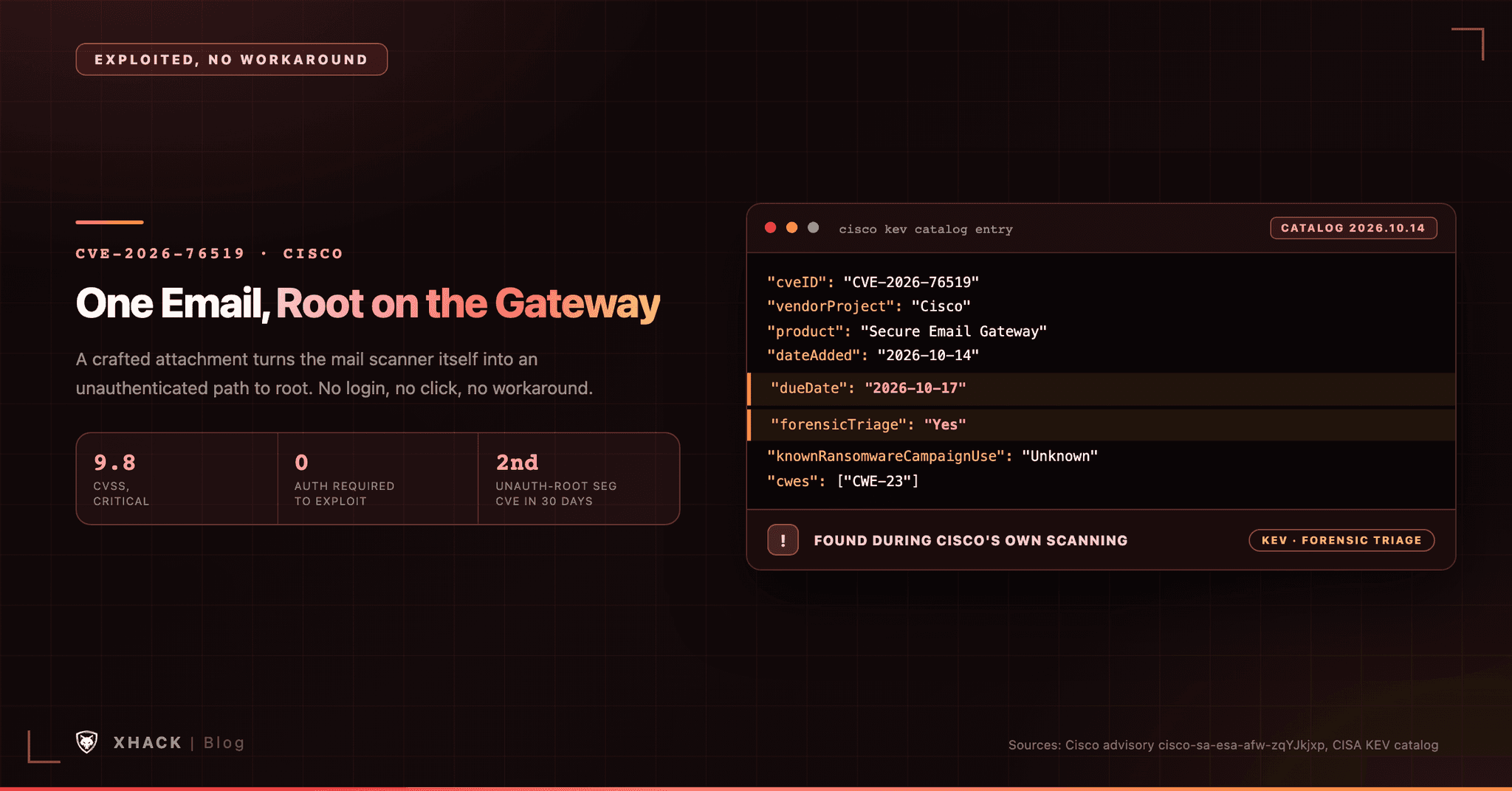
Read this in 30 seconds: CVE-2026-76519 lets an unauthenticated attacker send a single crafted email attachment to a Cisco Secure Email Gateway and get root command execution on the underlying OS, no login, no click, nothing but a vulnerable mail policy setting. Cisco found it during its own internal security scanning, confirmed active exploitation in October 2026, and CISA added it to the KEV catalog on October 14 with a forensic-triage requirement, due October 17.
- The trigger is just an email. The flaw sits in the Advanced Malware Protection (AMP) file reputation service, so scanning the attachment is what exploits the device, not opening it.
- This is Cisco’s second unauthenticated-root Secure Email Gateway CVE in exactly 30 days. CVE-2026-76461 (SQL injection) was added to KEV on September 14, 2026; this one landed October 14.
- You can patch without a software upgrade. Updating the Content Scanner Tools component to 25.3.0.5525 or later fixes it, no AsyncOS upgrade or appliance restart required.
- Cisco already found real victims. The company says it directly contacted Secure Email Cloud customers where it identified indicators of compromise, before this advisory even published.
- A compromise can spread to other appliances. Successful exploitation can expose the private SSH keys appliances in a cluster use to authenticate to each other.
An email security appliance has to open and inspect everything that comes in, which is exactly the job CVE-2026-76519 turned into a root compromise.
Cisco Secure Email Gateway appliances scan inbound attachments so nothing malicious reaches a user’s inbox. CVE-2026-76519 broke that assumption: the scanning step itself, specifically the Advanced Malware Protection file reputation check, could be made to write arbitrary files and execute commands as root, triggered by a single crafted attachment with no authentication required.
This article covers what Cisco’s own advisory says about CVE-2026-76519, the exact two conditions that make a device vulnerable, how to patch it without a full software upgrade, what Cisco’s log-based indicators actually look like, and why this is the second time in a month this exact product line has made the KEV catalog for an unauthenticated path to root.
A Secure Email Gateway’s entire job is to process content nobody has vetted yet. Every inbound attachment gets scanned before a human ever sees it, which means the scanning engine itself has to be more trustworthy than anything it inspects. CVE-2026-76519 is what happens when that assumption fails: the scanner became the attack surface.
Cisco’s own advisory for CVE-2026-76519 is specific about the blast radius. A successful exploit “could allow the attacker to write arbitrary files and execute commands with root privileges on the underlying operating system,” and in a clustered deployment, the compromise can reach further: cluster members authenticate to each other using SSH key pairs, and those keys “could be accessed on a compromised appliance,” giving an attacker a path to every other appliance in the cluster.
Cisco’s advisory cisco-sa-esa-afw-zqYJkjxp rates it Critical and describes the root cause as “improper handling of email attachments when the file reputation service is enabled.” An attacker exploits it “by sending an email that contains a crafted attachment through an affected device.”
The facts, straight from Cisco and NVD:
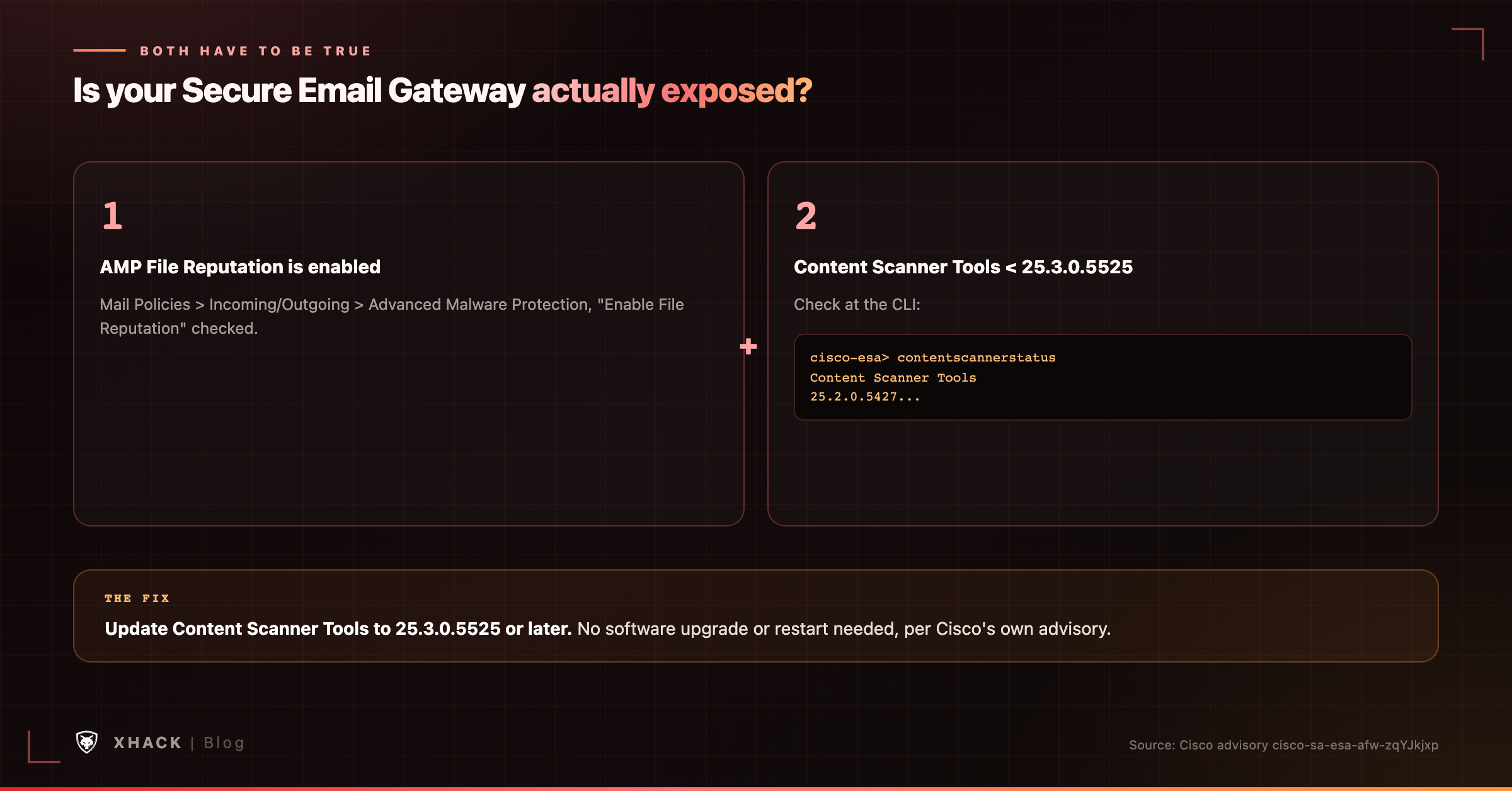
Not every Secure Email Gateway is exposed. Cisco’s advisory names exactly two conditions, and both have to be true:
contentscannerstatus command.cisco-esa> contentscannerstatus
Component Version Last Updated
Content Scanner Tools 25.2.0.5427.15.5.001 Never updatedThat output is Cisco’s own example of a vulnerable version in the advisory. If your Content Scanner Tools version reads 25.3.0.5525 or later, that specific device is already patched regardless of your AsyncOS version.
Cisco also confirms what is explicitly not affected: Secure Email and Web Manager and Secure Web Appliance are both named as confirmed not vulnerable. This is a Secure Email Gateway-specific bug.
This is the part of the advisory worth reading twice, because the fix is unusually light for a 9.8:
contentscannerupdate.The practical takeaway: you do not need to wait for a maintenance window to patch this. The Content Scanner Tools update alone closes the hole, with no restart.
Cisco gives a direct command and a table of exact log strings to search for, which is more concrete IOC guidance than most advisories publish on day one.
esa-appliance> grep "System Security" system_logsRun it on every device in a cluster, not just one, since Cisco notes cluster members should each be checked individually.
| Log message | What it means |
|---|---|
| “System Security: Suspected compromise indicator was found.” | Compromise detected. Contact Cisco TAC immediately. |
| “System Security: Security scan did not complete.” | Contact TAC for support; the scan itself failed to finish. |
| “System Security: No compromise indicator was found.” | No compromise detected. Patch if the device is still on an affected release. |
Cisco adds an important caveat for Secure Email Cloud customers specifically: administrators without CLI access may not be able to check these indicators themselves, which is why Cisco says it “directly contacted customers who own Cisco Secure Email Cloud devices on which malicious activity was detected.” If you run Secure Email Cloud and haven’t heard from Cisco, that is some signal, but not a guarantee you weren’t hit, since Cisco’s own notes stop short of saying every victim was contacted before this advisory published.
One more thing Cisco flags explicitly: a successful attacker gets root, which means they can delete or alter the very logs you’d use to detect them. Cisco’s recommendation is to cross-check network and firewall logs that live outside the appliance itself, specifically watching for unexpected uploads to external IPs or downloads from suspicious ones, since on-device evidence alone cannot be fully trusted after a compromise.
Cisco’s remediation steps differ by deployment type, and the virtual-appliance guidance is the more involved of the two:
Physical appliances: contact Cisco TAC directly and make sure remote access is enabled on the device to speed up their investigation.
Virtual appliances, if compromise is suspected:
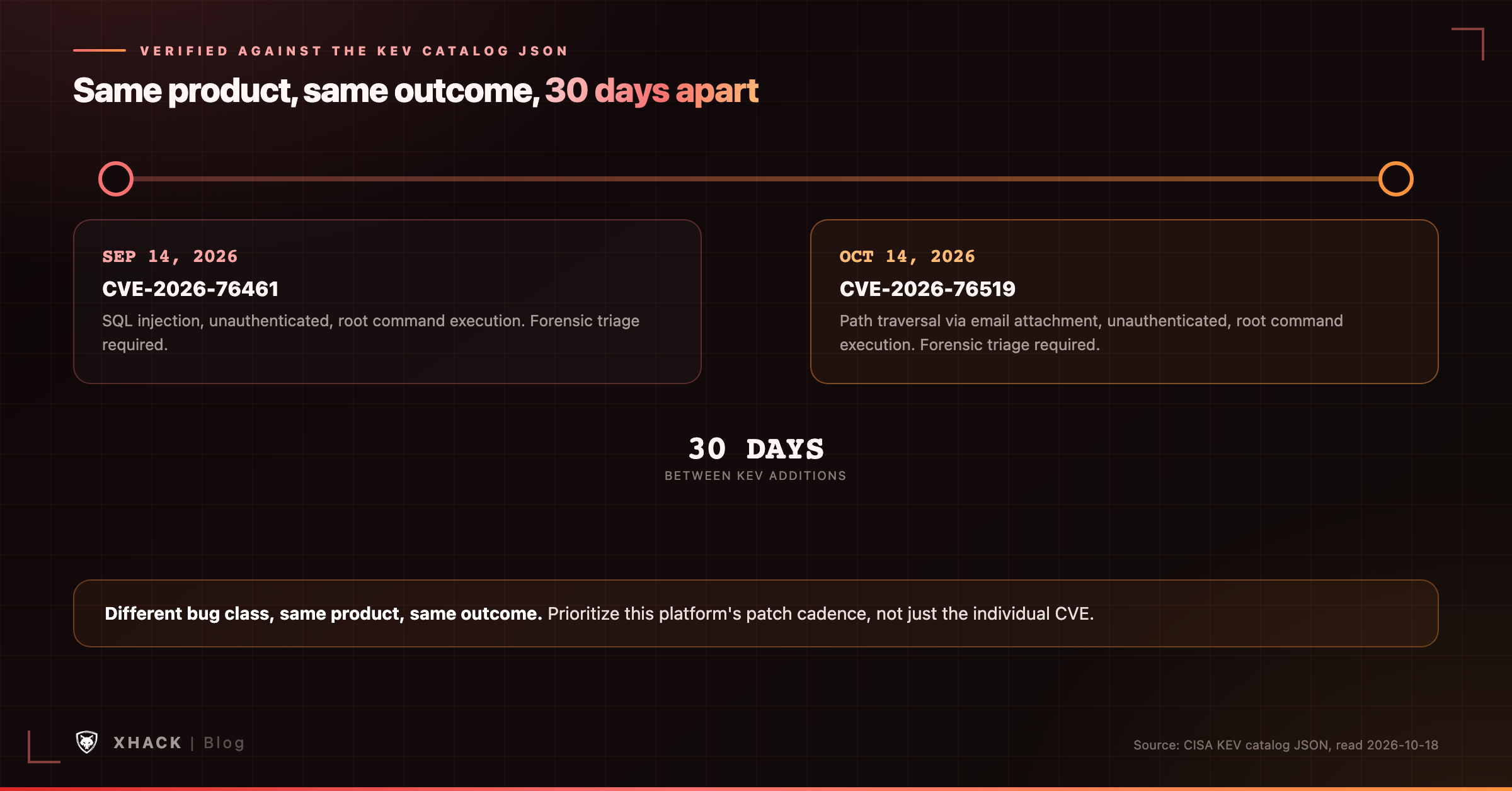
We pulled CISA’s own KEV catalog JSON to verify this rather than repeat a claim: CVE-2026-76461, a SQL injection in the same Secure Email Gateway product that also allowed unauthenticated root command execution, was added to KEV on September 14, 2026. CVE-2026-76519 was added exactly 30 days later, on October 14. Both carry Cisco’s forensic-triage flag under BOD 26-04, and both reached root with zero authentication.
Different bug class (SQL injection versus path traversal in attachment handling), same outcome, same product line, one month apart. That is worth factoring into how urgently a Secure Email Gateway deployment gets prioritized for patching going forward, independent of either CVE’s individual severity.
Beyond the log grep Cisco published, the general hardening advice doubles as prevention against the next bug in this product:
# Illustrative: search externally-forwarded logs for the exact strings Cisco
# published, across every appliance hostname in your fleet, not just one.
grep -E "System Security: (Suspected compromise|Security scan did not complete)" \
forwarded_esa_logs/*.logSo yeah, here’s the part where we talk about our own angle, clearly marked as that.
What stands out here is the attack surface itself: a security control (AMP file scanning) became the vulnerability. That is a recurring pattern worth testing for specifically, not just patching around after the fact. Our AI VAPT services include reviewing exactly this kind of inversion, where the defensive layer processing untrusted input is itself unauthenticated and internet-facing, on infrastructure you’re authorized to test.
A penetration test report documents what was tested. It does not certify that a gateway is patched or clean, and it does not replace Cisco’s own Content Scanner Tools update or the forensic steps above if you suspect compromise. XHack does not store your data, and your session data stays on your own computer.
CVE-2026-76519 is a critical (CVSS 9.8) relative path traversal vulnerability in Cisco Secure Email Gateway’s Advanced Malware Protection file reputation feature. An unauthenticated attacker can send an email with a crafted attachment and get arbitrary file write and root command execution on the underlying OS, with no login and no user interaction required.
Yes, confirmed directly by Cisco. The company states its PSIRT became aware of active exploitation in October 2026, and it directly contacted Secure Email Cloud customers where it found indicators of compromise before this advisory even published.
No, not necessarily. Updating the Content Scanner Tools component to version 25.3.0.5525 or later fixes the vulnerability without a software upgrade or appliance restart. A full AsyncOS upgrade to 15.5.5-014 or 16.5.0-780 is a separate, optional path if you want the fully current release.
Cisco Secure Email Gateway, both physical and virtual appliances, when the File Reputation service is enabled on a mail policy and the Content Scanner Tools version is older than 25.3.0.5525. Cisco explicitly confirms Secure Email and Web Manager and Secure Web Appliance are not affected.
No. Cisco’s advisory states plainly that no workarounds exist. The only mitigation Cisco offers is the Content Scanner Tools update itself, which is lightweight enough that there is little reason to delay it.
No, it’s the second in close succession. CVE-2026-76461, a SQL injection in the same product allowing unauthenticated root command execution, was added to KEV on September 14, 2026, exactly 30 days before CVE-2026-76519 was added on October 14.
CVE-2026-76519 turned a Secure Email Gateway’s own malware-scanning feature into an unauthenticated path to root, confirmed exploited before most customers had even read the advisory. The fix is unusually painless for a 9.8, a Content Scanner Tools update with no restart, which removes most excuses for leaving it unpatched.
If you run Secure Email Gateway with File Reputation enabled, check your Content Scanner Tools version today, run Cisco’s log grep across every appliance in any cluster, and treat a second unauthenticated-root CVE in this product inside thirty days as a signal to prioritize this platform’s patch cadence going forward, not just this one bug.
Categories
Related articles