Table of contents
21
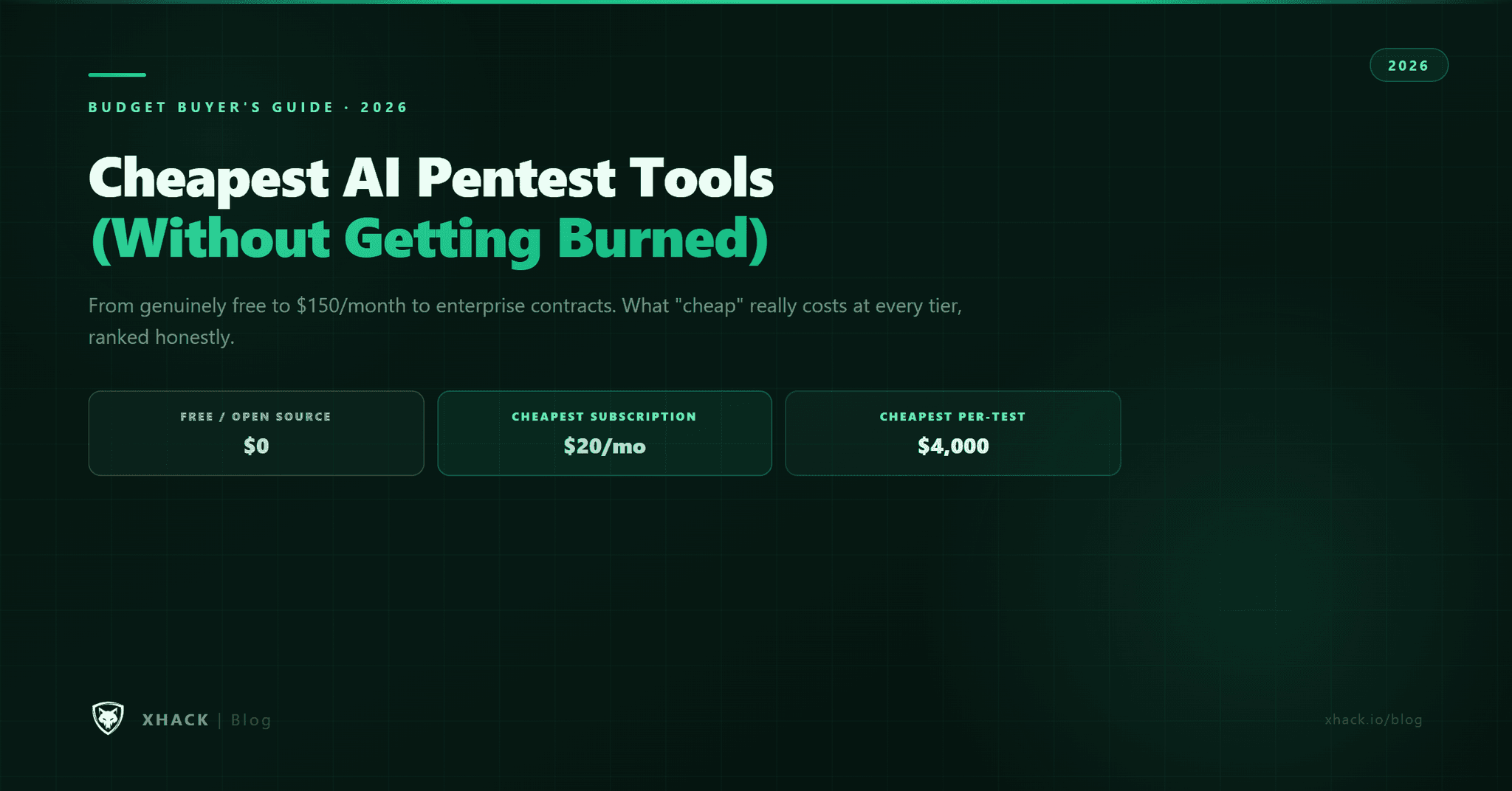
Read this in 30 seconds: The cheapest AI pentest tool depends entirely on how you define cheap. If you mean free, open-source agents like Strix cost nothing in licensing but demand your own hosting, Docker skills, and time, a real cost just paid differently. If you mean the lowest commercial entry point, most named platforms cluster around $4,000 per test, XBOW, Intruder, and Aikido all start there.
If you mean the lowest all-in monthly cost for an autonomous agent with human validation, XHack AI starts at $20 a month. This guide ranks the real cheapest AI pentest tool options across every price tier, honestly flags what “cheap” hides at each level, and compares all of them against the $18,300 average cost of a traditional manual pentest, so you can pick based on total cost, not just the sticker price.
Everyone wants the cheapest AI pentest tool until they find out what “cheap” actually costs them.
A free tool that eats a weekend of your time isn’t free. A $4,000 test that only covers web apps isn’t cheap if you also need network coverage. And a $150-per-year enterprise contract before add-ons is not the “affordable AI pentesting” the ad promised.
This guide ranks the real options, from genuinely free to enterprise, and tells you honestly what each price point actually buys. No vendor here, including us, gets the easy version of this comparison.
Before ranking anything, let’s fix the definition, because “cheapest” means three different things depending on who’s asking.
Cheapest as in free. Open-source, self-hosted agents that cost nothing in licensing. The real cost is your time: setup, Docker familiarity, and no managed reporting.
Cheapest as in lowest commercial entry point. The lowest price a named platform charges to run one assessment. Several land at the same number, which is itself revealing.
Cheapest as in lowest total cost of ownership. The number that matters if you test more than once. A cheap one-time test that you need to repeat every month adds up fast; a low monthly subscription might beat it easily across a year.
Every “best cheap AI pentest tool” list on the internet picks one of these definitions and pretends it’s the only one. This guide ranks all three honestly, so you can pick the one that matches how often, and how broadly, you actually need to test.
Here’s the honest tier list, from genuinely free to enterprise-only, with real 2026 pricing.
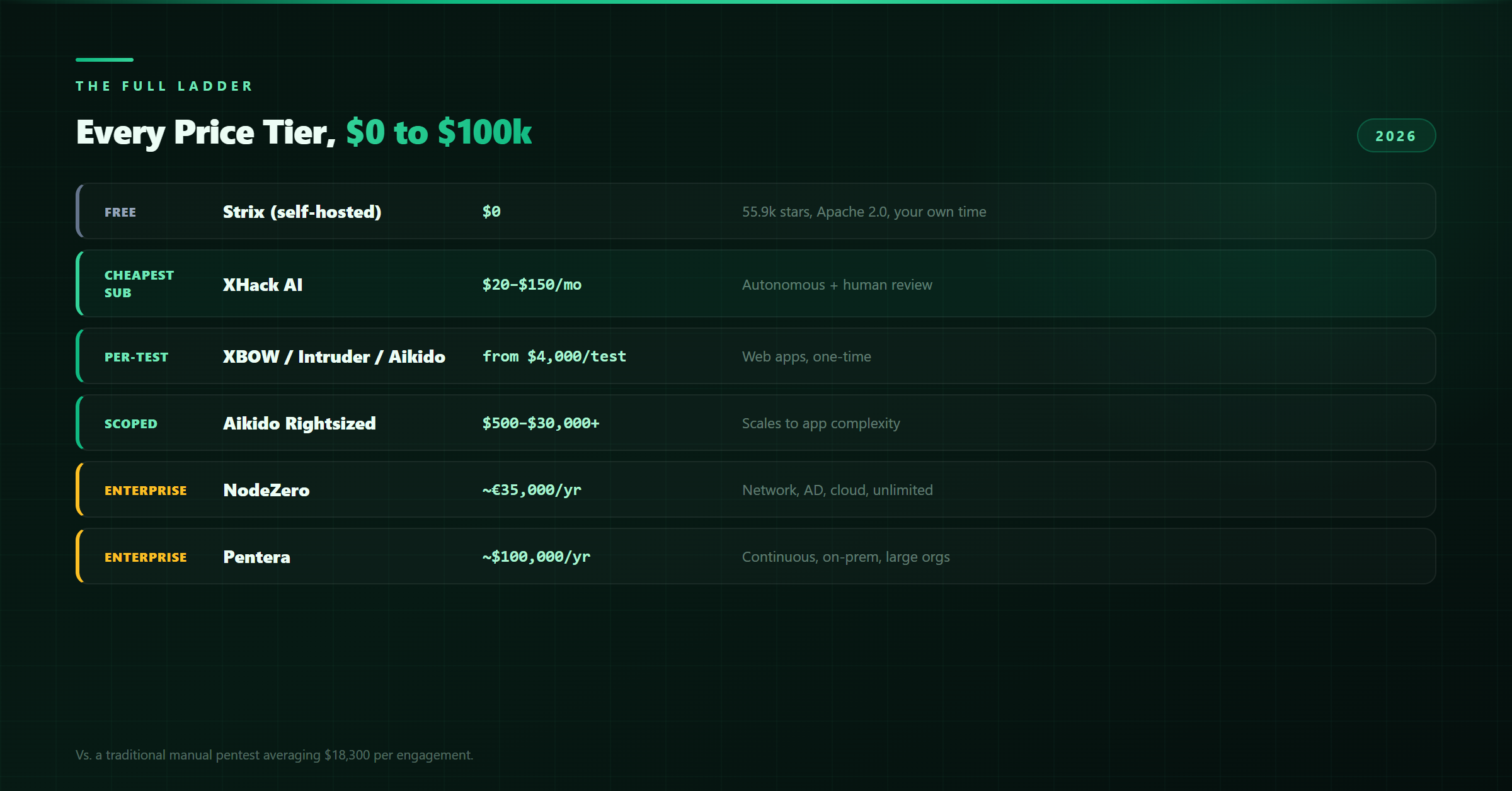
| Tier | Tool | Price | What you’re really paying for |
|---|---|---|---|
| Free | Strix (self-hosted) | $0, or $29/seat/mo hosted | Your own time, Docker setup, no managed reports |
| Cheapest subscription | XHack AI (individual) | $20 to $150/month | Autonomous web/API testing plus human review |
| Cheapest per-test entry | XBOW, Intruder, Aikido | From $4,000/test | Full autonomy, web apps only, one-time |
| Mid enterprise | Aikido Rightsized | $500 to $30,000+ | Scoped to app complexity, wide range |
| Enterprise network | NodeZero (Horizon3.ai) | Roughly EUR 35,000/year | Network, AD, cloud, unlimited tests |
| Enterprise validation | Pentera | Roughly $100,000/year | Continuous adversarial validation, on-prem |
The pattern is stark. There is a genuine floor at $0 (paid in your time) and a genuine ceiling near $100,000 a year, and almost everything commercial in between clusters either around $4,000 per test or a low monthly subscription. Knowing which cluster you’re shopping in changes the whole decision.
If your definition of the cheapest AI pentest tool is literally zero dollars, open-source agents deliver.
Strix is the standout: a free, open-source autonomous pentesting framework with 55,900-plus GitHub stars and an Apache 2.0 license, deploying AI agents that identify and validate vulnerabilities through dynamic testing and proof-of-concept generation. It also offers an optional hosted tier at $29 per seat per month if you’d rather not self-host.
Other free options worth knowing: PentestGPT (the original USENIX Security 2024 research tool, now free and open source) works as an interactive copilot rather than a fully autonomous agent, and CAI (Cybersecurity AI) is another actively developed open-source multi-agent framework. None of these charge licensing fees. All of them charge you in setup time.
The real cost of “free”: self-hosting, Docker comfort, no managed client-ready reporting, and model API usage costs that, while small individually, add up with heavy use. If your team already has the DevOps skill to run these comfortably, free is genuinely the cheapest AI pentest tool tier that exists. If it doesn’t, the “free” tool costs a weekend of setup and an ongoing maintenance tax that a $20-a-month subscription would have avoided entirely.
If you want a managed, autonomous AI pentest tool without per-test billing, this tier is where the real “affordable AI pentesting” search ends for most buyers.
XHack AI runs $20 to $150 per month for individual plans, the lowest all-in subscription price among the platforms compared here that pair autonomous testing with any form of validation. The Starter plan at $20 a month includes the autonomous security agent, exploit-development assistance, and vulnerability analysis. Professional at $49 a month adds unrestricted AI access and pentest report generation. Team plans for organizations start at $560 a month.
What that price buys: a multi-agent engine testing web applications and APIs, findings passed through a human review stage rather than delivered raw, and a broader security platform behind it rather than a single-purpose scanner. For a solo researcher or small team, this tier is usually the actual answer to “what is the cheapest AI pentest tool that won’t waste my time.”
If you specifically need a one-time, fully autonomous web application test rather than a subscription, this is where the field converges.
XBOW, Intruder, and Aikido all start around $4,000 per test. That is not a coincidence, it appears to be roughly where the market has settled for a single, audit-ready, fully autonomous web app assessment with proof-of-exploit validation. XBOW is the fully autonomous specialist with no human in the loop. Intruder blends automated scanning with an AI layer. Aikido’s Standard test is flat-priced at that entry point, with a Rightsized option that scales from $500 to $30,000-plus depending on your application’s actual complexity.
This tier is genuinely the cheapest AI pentest tool option if you need exactly one assessment, on exactly a web application, and can absorb a four-figure one-time cost. Run tests more than two or three times a year, and the math tips hard toward a subscription instead. Two tests here is $8,000, close to a full year of XHack AI’s Elite plan and nowhere near its Starter tier.
At the top end, “cheapest” stops being the relevant question, but it’s worth understanding why these cost what they do.
NodeZero (Horizon3.ai) runs roughly EUR 35,000 a year for autonomous network, Active Directory, and cloud pentesting with unlimited tests included, or is sometimes priced around £40 per IP address annually for networks up to 2,500 IPs. Pentera runs roughly $100,000 a year, with mandatory on-premise deployment aimed squarely at large enterprises running continuous adversarial validation.
Industry-wide, autonomous platforms in this bracket generally range from $10,000 to $150,000 a year, and most mid-market buyers end up spending $25,000 to $60,000 annually on tooling on top of an annual human-led pentest. That is the real budget context “cheapest AI pentest tool” searches are usually reacting against.
Generic rankings miss the point. The actual cheapest AI pentest tool depends on what you’re testing and how often. Here’s the breakdown by real-world situation.
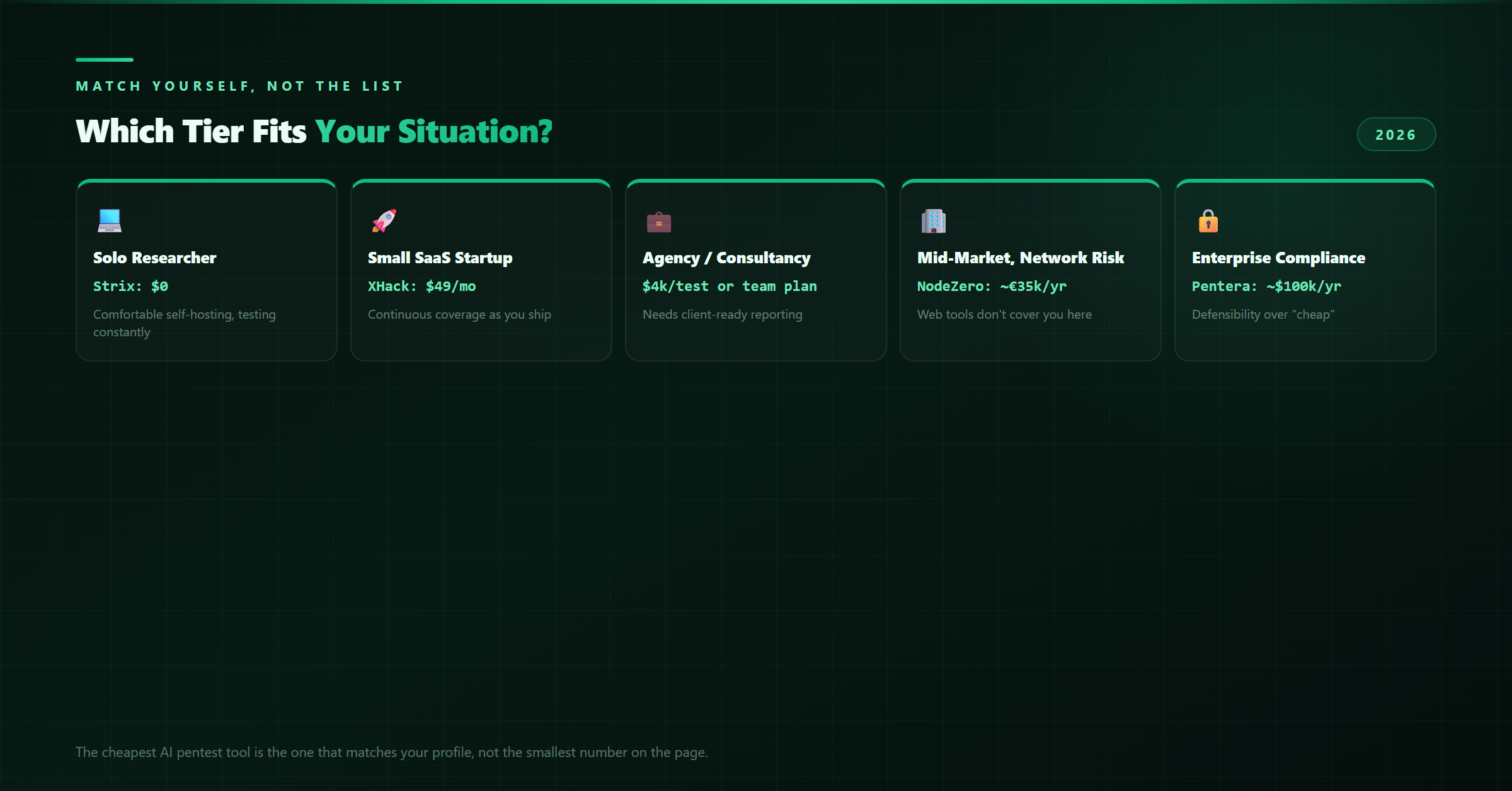
Solo bug bounty hunter or indie researcher. Your time is the scarce resource, not money, and you’re testing constantly across many targets. Strix’s free CLI is genuinely the cheapest option if you’re comfortable running it yourself, since you’re already living in a terminal. If you’d rather not manage infrastructure, XHack AI’s $20 Starter plan is cheap enough not to matter and saves the setup time.
Small SaaS startup, one or two web apps. You need continuous coverage as you ship, not a single point-in-time snapshot. This is the clearest case for a subscription over a per-test tool: XHack AI’s Professional tier at $49 a month covers ongoing testing for less than one-eightieth of a single manual engagement’s average cost.
Agency or consultancy running client engagements. You need managed reporting you can hand to a client, which rules out the raw free tools unless you build your own reporting layer. The $4,000-per-test tier or a mid-range XHack AI team plan both work, depending on whether your billing model is per-engagement or retainer-based.
Mid-market company with a real internal network. None of the cheap web-focused options actually cover you. This is where the enterprise tier stops being optional. NodeZero’s roughly EUR 35,000 a year is expensive relative to everything else on this list, but it’s still cheaper than the alternative of an unpatched Active Directory breach.
Enterprise with compliance requirements. At this scale, “cheapest” is rarely the deciding factor, defensibility and audit trail are. Pentera’s roughly $100,000-a-year price reflects continuous validation and on-premise deployment that smaller options simply don’t offer, and for a large enough organization, that cost is a rounding error against the cost of a real breach.
Match yourself to one of these five profiles before you compare a single price tag. The generic “top 5 cheapest AI pentest tools” list can’t do that matching for you, because it doesn’t know which one you are.
This is the comparison that actually justifies the “cheapest AI pentest tool” search in the first place, so let’s put a real number on it.
A traditional manual penetration test in 2026 averages around $18,300, with most engagements landing between $5,000 and $100,000-plus depending on scope, and a typical small-business web app assessment running $5,000 to $15,000. That is the baseline every AI pentest tool, cheap or not, is implicitly competing against.
Against that baseline, even the “expensive” $4,000 per-test tier looks cheap. And the actual cheapest AI pentest tool tier, XHack AI’s $20-to-$150-a-month subscription, is not a modest discount on manual testing, it’s a different order of magnitude entirely. Twelve months of the Professional plan at $49 a month totals $588 a year, against a single average manual engagement at $18,300.
That gap is the entire reason budget-conscious teams are searching for the cheapest AI pentest tool instead of booking a traditional engagement. The honest caveat: AI tools and manual pentests are not perfect substitutes. A skilled human tester brings judgment, creativity, and compliance sign-off that no AI agent, free or paid, fully replicates yet. The realistic answer for most budget-conscious teams is AI for continuous, frequent coverage, with a human-led test reserved for the engagements that need a name and a signature behind them.
Every cheapest AI pentest tool option hides a tradeoff. Here’s the honest version of each.
Free tools cost your time. Self-hosting, Docker, dependency management, and no managed reporting pipeline. That is a real cost, just paid in engineering hours instead of dollars.
The $4,000 per-test tier costs flexibility. You get one assessment, on one scope, at one moment in time. Need continuous coverage or a second test next month, and the math resets from zero.
Ultra-low subscriptions can cost breadth. A tool priced at $20 a month is not going to out-cover a $100,000-a-year enterprise network platform. Scope-matching matters more than price at every tier, and the cheapest AI pentest tool for your web app might be the wrong tool entirely for your internal network.
Enterprise pricing costs accessibility. NodeZero and Pentera are excellent at what they do, and neither is remotely an option for a small team or solo researcher. Their price is the real gatekeeping mechanism in this market.
Understanding which tradeoff you’re accepting, not just which number is smallest, is what separates a genuinely smart cheap AI pentest tool choice from a costly mistake six months later.
A quick framework before you commit to anything on this list.
Match scope before price. The cheapest AI pentest tool for the wrong job is not actually cheap, it’s a second purchase waiting to happen. Confirm web, API, network, or cloud coverage before comparing dollar signs.
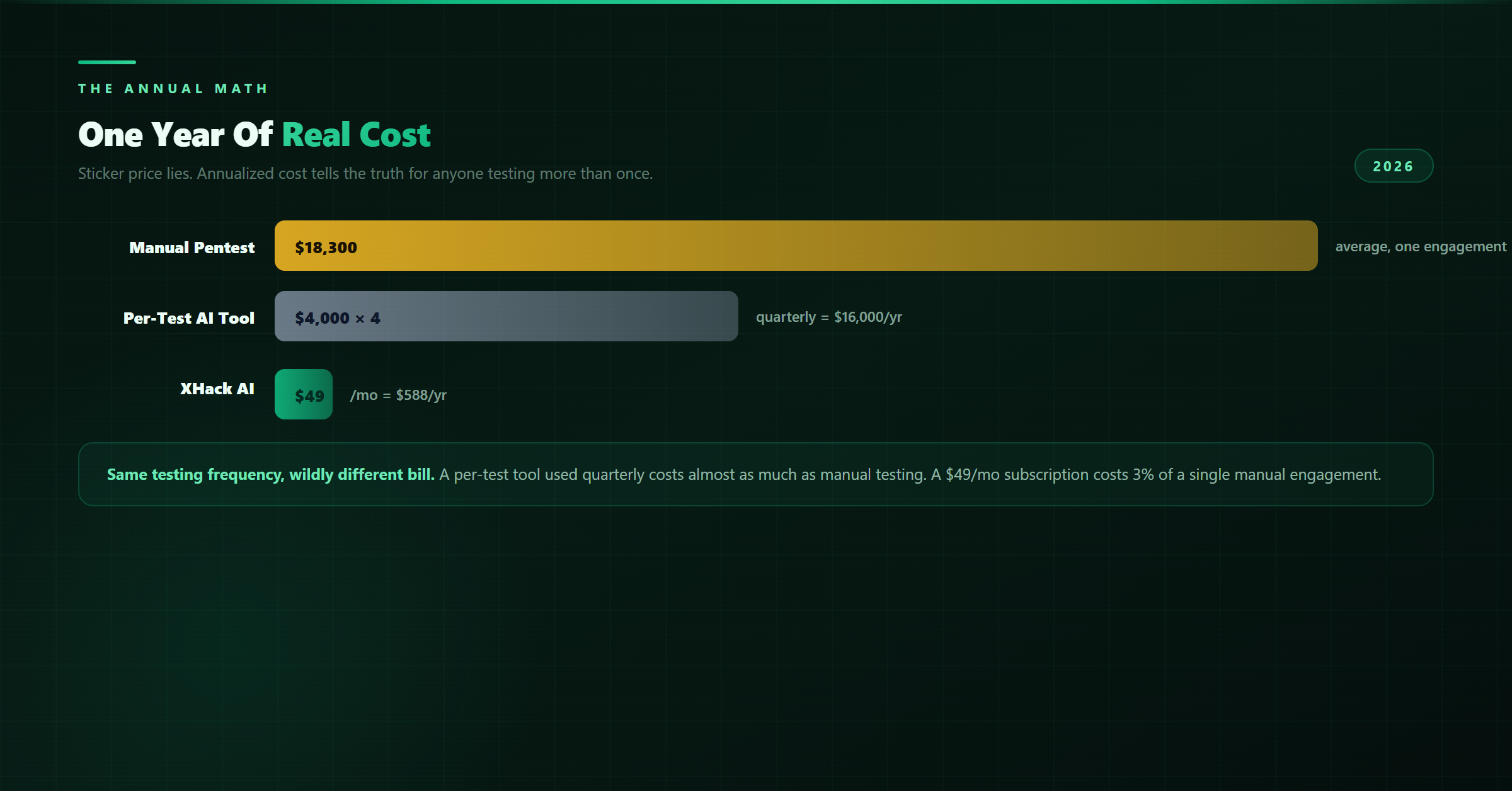
Calculate your real annual cost, not the sticker price. A $4,000 per-test tool used quarterly costs $16,000 a year. A $49-a-month subscription used continuously costs $588. Do this math before choosing based on the number that looks smallest today.
Price in your own time for free tools. If your team doesn’t already have the DevOps skill and spare hours to run an open-source agent well, factor that cost in honestly before calling it free.
Check what validates the findings. A tool that hands you raw output with no human or AI validation layer is not saving you money, it’s shifting the cost onto your team’s time spent triaging false positives. This matters as much at the cheap end as the expensive one.
Start with a trial or the lowest tier before committing. Almost every option in this list, from Strix’s free CLI to XHack AI’s $20 Starter plan, lets you test the real output before you scale spend. Use that instead of trusting a comparison article, including this one.
Even budget-conscious buyers get this wrong. The recurring mistakes are worth naming plainly.
Comparing sticker price instead of annual cost. A $4,000 test looks cheaper than a $49-a-month subscription on the page, until you realize the subscription costs $588 a year and you were planning to test quarterly anyway. Always convert to the same time unit before comparing.
Choosing free without an honest time audit. Self-hosting Strix or CAI is a legitimately smart choice for a team with spare DevOps capacity. It’s a costly mistake for a team that will spend three days fighting Docker configuration instead of shipping. Be honest about which team you actually have.
Buying scope you don’t need, or missing scope you do. The cheapest AI pentest tool for a web application is worthless against your internal network, and paying enterprise prices for network coverage you don’t have is just as wasteful in the other direction. Scope mismatch wastes money at every price point, not just the top.
Skipping the trial. Nearly every tool in this comparison, from Strix’s free CLI to XHack AI’s $20 tier to XBOW’s single-test entry, lets you see real output before committing serious budget. Skipping that step to save a few minutes is how teams end up locked into the wrong tool for a year.
Assuming cheap means low quality. This is the mistake vendors selling five-figure contracts want you to make. A $20-a-month tool with a real multi-agent architecture and human review can outperform a stripped-down “budget” scanner charging ten times as much. Price and quality are not the same axis in this market, and the cheapest AI pentest tool is sometimes also the smartest one.
Avoid those five and the right choice usually becomes obvious well before you reach for a credit card.
So yeah, here’s the dedicated brand section. Since XHack AI is one of the options in this comparison, here’s the honest version of where it earns the “cheapest” claim and where it doesn’t.
XHack AI is the cheapest subscription-based AI pentest tool in this comparison that pairs autonomous testing with human validation. Starter is $20 a month, Professional is $49 a month with unrestricted AI access, and Elite is $150 a month with malware analysis and custom payload generation. Team and enterprise plans scale from there. Against the $4,000-per-test tier or the five- and six-figure enterprise contracts, that is a genuinely different price category, not a modest discount.
What that price buys is the part worth being specific about. A multi-agent engine autonomously tests web applications and APIs, and every finding passes through a human review stage before it reaches you, the same accountability layer the free, unvalidated open-source options leave entirely on your plate. It’s built on the same “humans and AI both hunt” model behind our full VAPT services, so the cheap entry tier is not a stripped-down toy version of the product.
Here’s what privacy-conscious teams care about. XHack does not store your user data, and it is privacy-focused by design. Your pentest chats and session data stay on your own local computer, and you can delete them any time.
Now the honest limits, because brutal honesty is kind of our thing. XHack AI is priced for web and API testing. It is not the cheapest AI pentest tool for internal network or Active Directory work, that is NodeZero’s lane, at enterprise pricing. And no $20-a-month tool, ours included, replaces a human-led engagement when you need a name and a signature on a compliance report. We would rather tell you that now than have you find out after checkout.
If you want more background, our honest comparison of the best AI pentesting tools covers the full field beyond just price, and our XBOW alternatives guide breaks down the $4,000-per-test tier in more depth.
Want to know whether XHack AI is genuinely the cheapest AI pentest tool for your situation? Start on the $20 Starter plan, free for 7 days with no credit card required, or book a free consultation, and we’ll tell you straight if a different tier or a different tool actually fits you better.
It depends on your definition of cheap. If you mean zero licensing cost, Strix is free and open source with over 55,000 GitHub stars, though it requires self-hosting. If you mean the cheapest managed subscription with any validation, XHack AI starts at $20 a month. If you mean the cheapest one-time commercial test, XBOW, Intruder, and Aikido all start around $4,000 per test. There is no single cheapest option, only the cheapest option for your specific need.
The licensing is free, but the total cost isn’t zero. Open-source agents like Strix or CAI require you to self-host, manage dependencies, and handle Docker setup yourself, with no built-in client-ready reporting. That time cost is real, even if no invoice reflects it. For a team without spare DevOps capacity, a low-cost subscription like XHack AI’s $20-a-month tier can end up cheaper in practice than a “free” tool that eats a week of setup and maintenance.
Dramatically cheaper at the subscription tier. A traditional manual pentest averages around $18,300, with most engagements between $5,000 and $100,000-plus. XHack AI’s Professional plan costs $588 a year at $49 a month, and even the $4,000-per-test commercial tier is roughly a fifth of the average manual engagement. The honest caveat is that AI tools and manual, human-led tests are not perfect substitutes: a skilled human tester still brings judgment and compliance sign-off that AI does not fully replicate.
No, and this is the most common mistake in this category. The cheapest tool for your actual scope, tested at your actual frequency, is the best value. A $20-a-month web and API tool is a poor value if your real risk is your internal network. A $4,000 one-time test is a poor value if you need continuous monthly coverage. Match scope and frequency to price before comparing dollar signs.
A monthly subscription beats per-test pricing once you test more than two or three times a year. XHack AI’s $20 to $150 monthly tiers include continuous autonomous testing rather than single assessments, at a fraction of what two or three $4,000 per-test engagements would cost. If you specifically need network or Active Directory coverage continuously, NodeZero offers unlimited tests within its annual subscription, though at enterprise pricing far above the web-focused options.
Choose based on your team’s actual capacity, not the price tag alone. A free tool like Strix is an excellent choice if you have the DevOps skill and time to self-host and maintain it. A cheap paid subscription like XHack AI’s Starter tier is the better choice if you want managed infrastructure, human-reviewed findings, and no setup burden, for a price low enough that the time saved likely outweighs the monthly cost.
Yes, when the underlying agent architecture is sound, price alone doesn’t determine finding quality. Strix’s 55,900-plus GitHub stars reflect a large community actively validating its results at zero cost. XHack AI’s $20-a-month tier runs the same multi-agent engine as its higher tiers, just with lower usage limits, not a weaker detection model. The bigger quality risk at the cheap end isn’t the findings themselves, it’s the lack of validation: a free or ultra-cheap tool that hands you raw, unreviewed output can bury real vulnerabilities in false positives just as easily as it can miss them. Validation, not price, is the better quality signal to check.
That’s the honest picture of the cheapest AI pentest tool market in 2026.
There is no single answer, because “cheapest” splits into at least three real options: genuinely free and open source if you have the time and skill to self-host, a low monthly subscription around $20 to $150 if you want managed autonomy with validation, or a roughly $4,000 per-test entry point if you need exactly one audit-ready web app assessment. Enterprise platforms exist too, but they stopped being about “cheap” a long time ago.
The tools that look cheapest on a landing page often hide their real cost in your time, your scope gaps, or your testing frequency. The tools worth actually choosing are the ones honest about that tradeoff upfront.
Compared to the $18,300 average cost of a manual pentest, nearly everything on this list qualifies as the cheapest AI pentest tool relative to the old baseline. The real decision is just which tradeoff, time, scope, or frequency, you’re willing to make.
Go back to the five use-case profiles if you’re still unsure: solo researcher, startup, agency, mid-market, or enterprise. Each one has a genuinely different correct answer, and none of them is wrong just because it isn’t the single cheapest line item on this page. The mistake isn’t picking a tool that costs more than the absolute floor. The mistake is picking one that doesn’t match how you actually work.
If you want the cheapest subscription option that pairs autonomy with human validation instead of raw, unverified output, that is exactly the gap XHack AI’s $20-a-month tier was built to fill.
Categories
Related articles