Table of contents
24
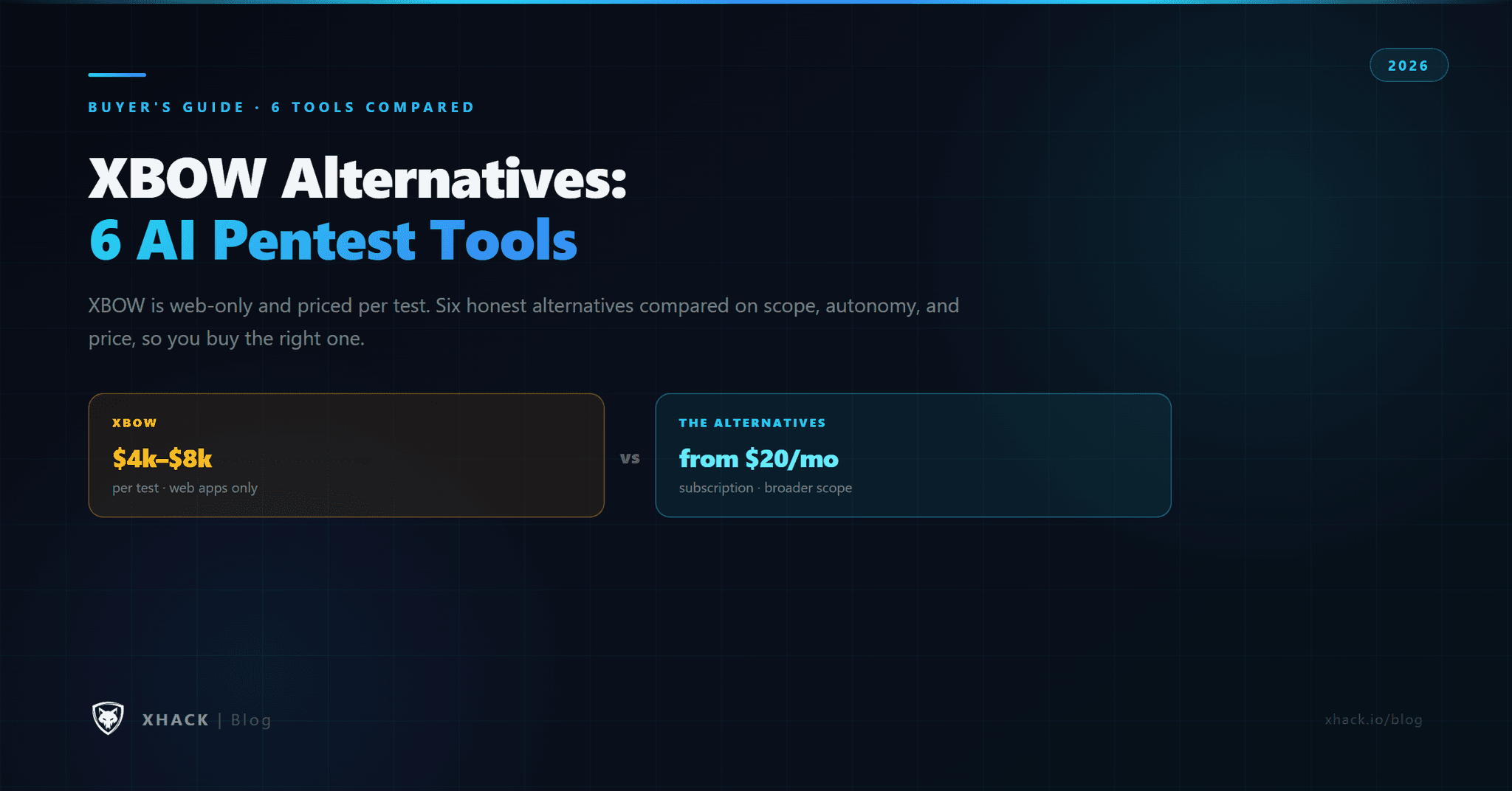
Read this in 30 seconds: XBOW is the AI pentester everyone is talking about. It became the first autonomous system to hit number one on HackerOne’s US leaderboard and raised $120 million in early 2026. But it has two real limits that send people looking for an XBOW alternative: it only tests web applications, and it charges per test, from $4,000 for a simple app to $8,000 for a complex one. If you need network, Active Directory, or cloud coverage, or you just cannot stomach four-figure-per-test pricing, you need something else.
This guide compares six honest XBOW alternatives across scope, autonomy, price, and validation: XHack AI, Horizon3.ai NodeZero, Pentera, Escape, RunSybil, and Aikido Security. XHack AI, our own platform, runs $20 to $150 a month instead of thousands per test, so yes, we are in this list and we will tell you exactly where we fit and where we do not. The right XBOW alternative depends entirely on what you actually need to test.
XBOW earned its hype, and that is exactly why you should shop for an XBOW alternative before you buy. When one tool dominates the conversation, it gets bought for problems it was never built to solve.
XBOW is genuinely impressive. It became the first autonomous system to reach number one on HackerOne’s US leaderboard, submitting over a thousand validated vulnerabilities in 90 days, and investors rewarded it with a $120 million round at a billion-dollar-plus valuation. That is a real achievement, not marketing.
But impressive is not the same as right for you. XBOW does one thing, web application testing, and it charges per test at a price that assumes an enterprise budget. For a huge number of teams, the smart move is to compare the XBOW alternative options first.
This is the honest comparison. Six real XBOW alternatives, what each one actually does, what it costs, and which one fits which job. We make one of them, XHack AI, so we will be upfront about where it wins and where a different XBOW alternative is the better call.
Because XBOW is excellent at a narrow job, and most teams need more than that narrow job covered.
There are two concrete reasons an XBOW alternative makes sense, and neither is a knock on XBOW’s quality.
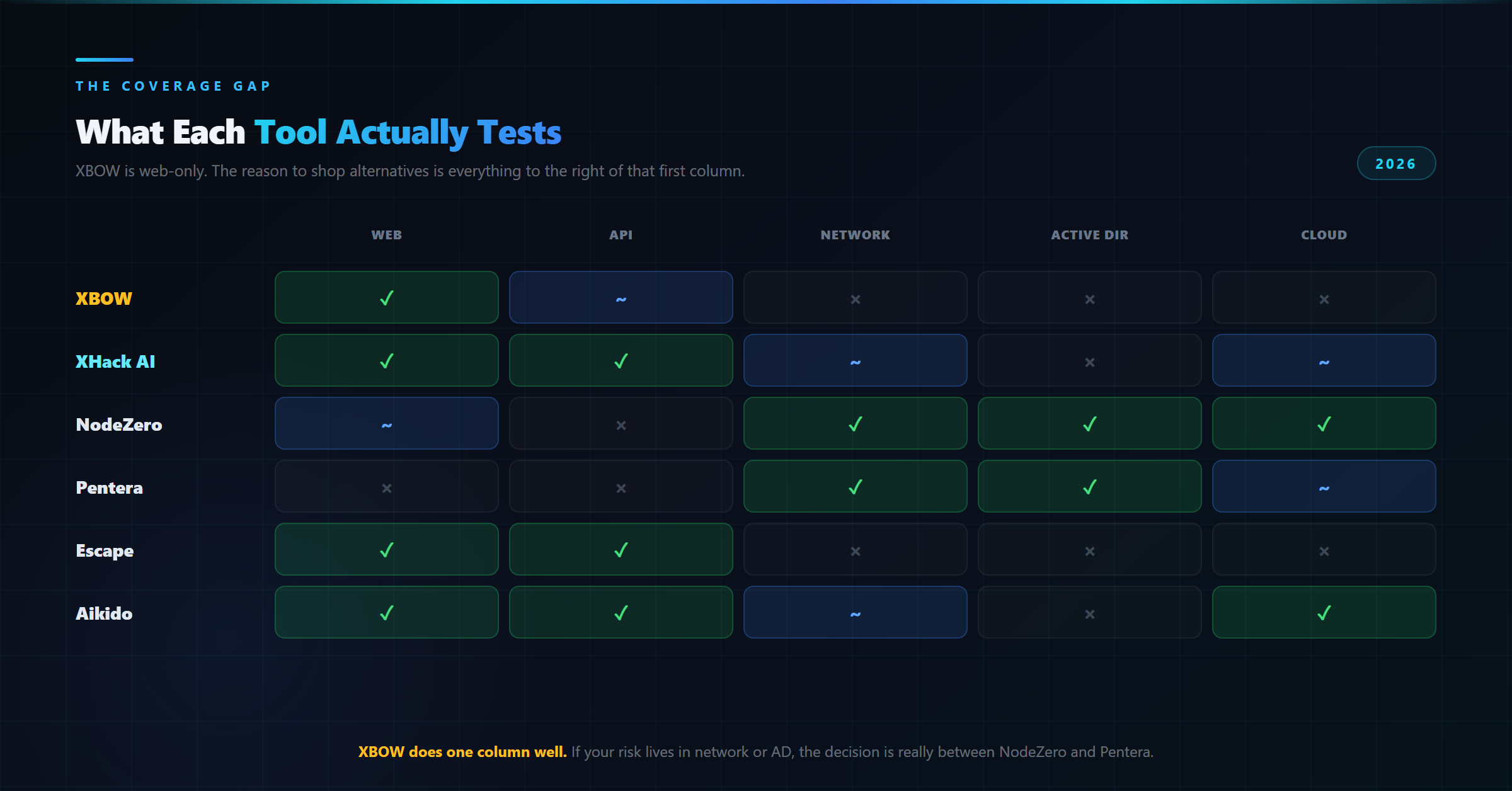
Reason one: scope. XBOW only tests web applications. No network pentesting, no infrastructure, no Active Directory, no cloud security. If your attack surface is bigger than your web apps, and almost everyone’s is, then XBOW leaves the rest untested. You would need a second tool anyway, so the question becomes whether an XBOW alternative can cover more ground on its own.
Reason two: price. XBOW charges per test, and the tests are not cheap. Published pricing runs $4,000 for a lightweight application and $8,000 for a complex one. For a company running frequent assessments across many assets, that per-test model adds up fast. A subscription-based XBOW alternative can cost less for the year than a handful of XBOW tests.
There is also a philosophical split worth naming. XBOW is fully autonomous with no human in the loop, which is great for speed and scale but means no human validation or judgment on findings. Some teams want that hands-off model. Others specifically want an XBOW alternative that pairs AI speed with human review. Your preference here narrows the field immediately.
So the case for shopping an XBOW alternative is simple: match the tool to your real attack surface, your real budget, and your real appetite for autonomy versus oversight. XBOW is a great fit for one specific profile. The other profiles have better options.
To keep this honest, every tool here is judged on the same five criteria, the ones that actually decide fit.
No single tool wins every criterion, which is the whole point. The best choice is the one whose strengths line up with your specific need, not the one with the loudest launch.
Here is the honest side-by-side before we go tool by tool. This is the fast way to spot the XBOW alternative that matches your situation.
| Tool | Primary scope | Autonomy | Price model | Best for |
|---|---|---|---|---|
| XBOW (baseline) | Web apps only | Fully autonomous | $4,000 to $8,000 per test | Audit-ready web app testing at enterprise budget |
| XHack AI | Web + API, plus platform | AI + human hybrid | $20 to $150/mo (individual) | Affordable, human-validated web/API testing |
| NodeZero (Horizon3.ai) | Network, AD, cloud | Autonomous | Enterprise subscription | Internal network and Active Directory validation |
| Pentera | Internal network, endpoints | Autonomous | Enterprise subscription | Large enterprise continuous validation |
| Escape | API + web, GraphQL | Autonomous, continuous | Platform subscription | Engineering-led API and web coverage |
| RunSybil | Web apps | Fully autonomous | Subscription (premium) | XBOW-style autonomy without per-test billing |
| Aikido Security | Full-stack appsec | Automated | Predictable tiers | Dev teams wanting full-stack plus flexible hosting |
The pattern jumps out immediately. If you need what XBOW does not do, network and AD, look at NodeZero or Pentera. If you want the same web focus for far less money, XHack AI or RunSybil fit. If you are engineering-led and API-heavy, Escape is the one that fits.
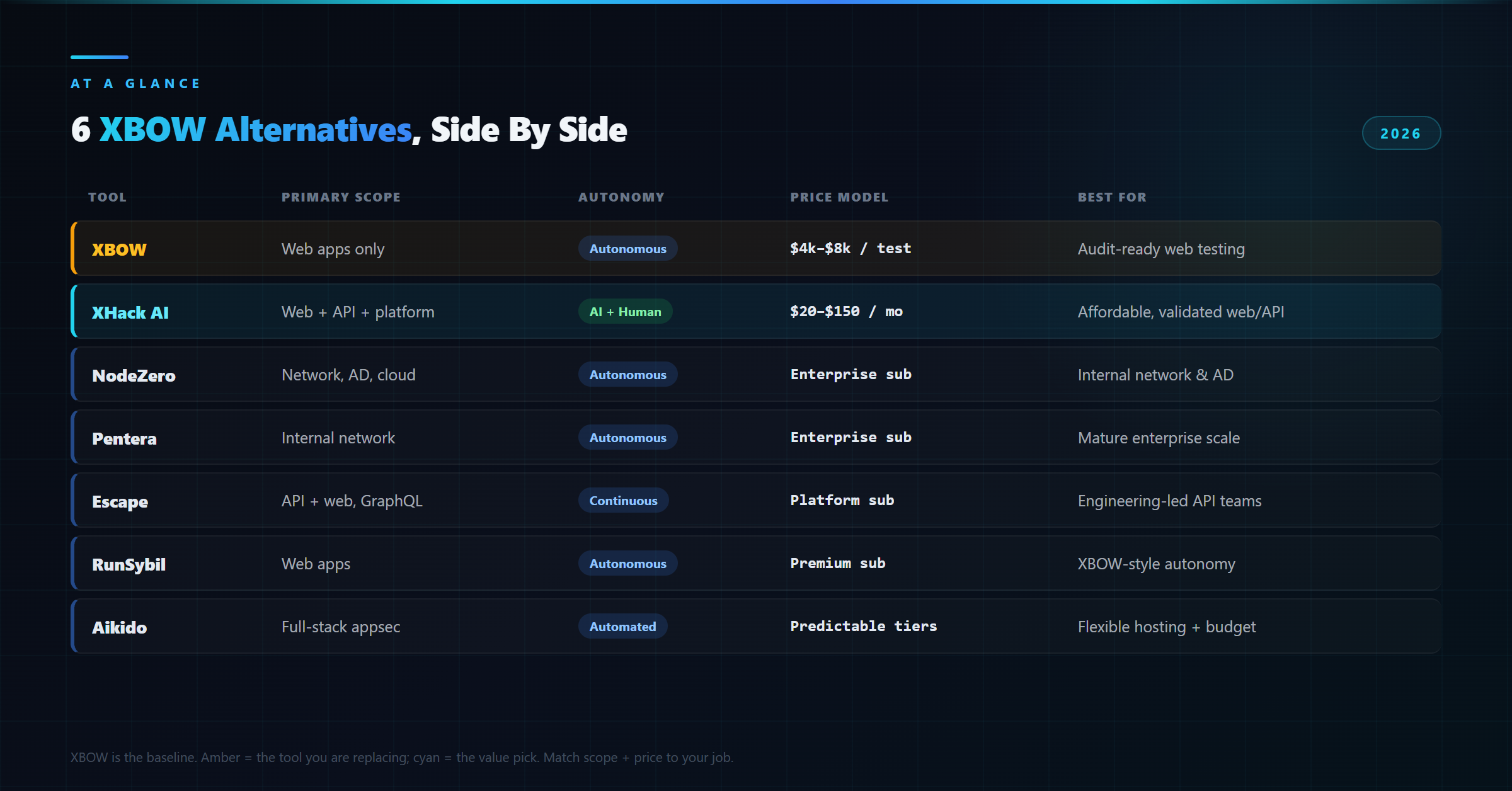
Now the detail. Each one gets the honest treatment: what it is, where it wins, and where it does not.
We make XHack AI, so read this with that in mind, and we will keep it straight.
XHack AI is a multi-agent platform that autonomously tests web applications and APIs, then passes findings through a human review stage. That hybrid is the core difference from XBOW: you get AI speed and breadth plus human validation, rather than fully hands-off autonomy with no human in the loop.
The headline reason teams consider XHack AI as an XBOW alternative is price. It runs $20 to $150 per month for individual plans and $560 to $3,000 per month for team plans, against XBOW’s $4,000 to $8,000 per test. Both plans include a 7-day free trial with no credit card required. For continuous testing across many assets, that is a categorical difference, not a discount.
XHack AI is also more than a scanner: it pairs the autonomous agent with human red-team experts and a broader security platform, and it is privacy-focused, with your data staying local. Where XBOW is the better call: XBOW’s fully autonomous engine and 40-plus compliance framework mapping are purpose-built for audit-ready, high-volume web app testing at enterprise scale, and if that exact profile is you, XBOW earns its price. XHack AI is the XBOW alternative for teams that want human-validated web and API testing without the per-test bill.
NodeZero covers the entire category XBOW ignores. It is the leader in autonomous network, Active Directory, and cloud pentesting.
It runs as a self-service SaaS that is safe to execute against production, needs no persistent agents, and chains weaknesses across internal and hybrid environments without scripts. If your risk lives in your internal network and your AD, not just your web apps, NodeZero is the one that actually covers it.
It is enterprise-priced on subscription rather than per test. This is not the cheap option, but for internal network and AD validation it is the depth leader, and it complements a web-focused tool rather than competing head-on.
Pentera is the most established name in automated security validation. It crossed $100 million in annual recurring revenue in early 2026 and serves over 1,200 enterprise customers across 60 countries.
Pentera focuses on automated internal pentesting: credential abuse, lateral movement, and Windows endpoint exploitation, continuously validated. It is built for large organizations with a SOC team that need depth, integrations, and compliance certifications.
Pentera is an enterprise purchase with enterprise pricing. It is the pick for the Fortune 500 buyer who wants a proven, mature platform for continuous internal validation, not a lean tool for a small team.
Escape is the XBOW alternative for engineering-led organizations that live in APIs. It runs continuous AI pentesting across web apps and APIs, with native GraphQL coverage that many tools handle poorly.
It leans into the developer workflow: regression testing at scale, findings delivered with stack-specific code fixes tied to the asset owners who can actually fix them. If your priority is continuous API and web coverage wired into engineering, Escape is a strong fit.
It is sold as a platform subscription. For API-heavy, engineering-driven teams, it is arguably a better fit than XBOW’s web-only, per-test model.
RunSybil is the XBOW alternative for teams that specifically want XBOW’s fully autonomous model. Its Sybil agent runs continuous autonomous pentests against live applications with no humans in the loop, which makes it the closest AI-native tool to XBOW itself.
If hands-off autonomy is the feature you are buying, RunSybil delivers it in a subscription form rather than per test. The honest caveat is that it is not the cost-efficient choice in this list, so it competes with XBOW on capability more than on price.
Pick RunSybil as your XBOW alternative when you want XBOW-style autonomy without XBOW’s per-test billing, and price is not your first concern.
Aikido Security is the XBOW alternative for dev teams that want broad, predictable coverage. It offers full-stack appsec and pentest coverage with EU and US hosting flexibility and, importantly, predictable pricing rather than per-test surprises.
For a lot of engineering teams, that predictability plus full-stack coverage makes Aikido the practical pick: less specialized than XBOW on deep web-app exploitation, but broader and easier to budget.
It is the one to shortlist when flexible hosting and a flat, forecastable bill matter as much as raw exploitation depth.
MindFort is worth a look if you want an AI security engineer that runs tasks end to end, continuous testing, code analysis, triage, and validated fixes shipped as pull requests. Its pricing is transparent and among the most cost-efficient in this space, starting around $199 per month.
It did not make the core six because its autonomous-fix-focused model overlaps heavily with Escape and Aikido, but for a small engineering team that wants remediation baked into the workflow rather than just findings, MindFort is a legitimate contender worth trialing alongside your shortlist.
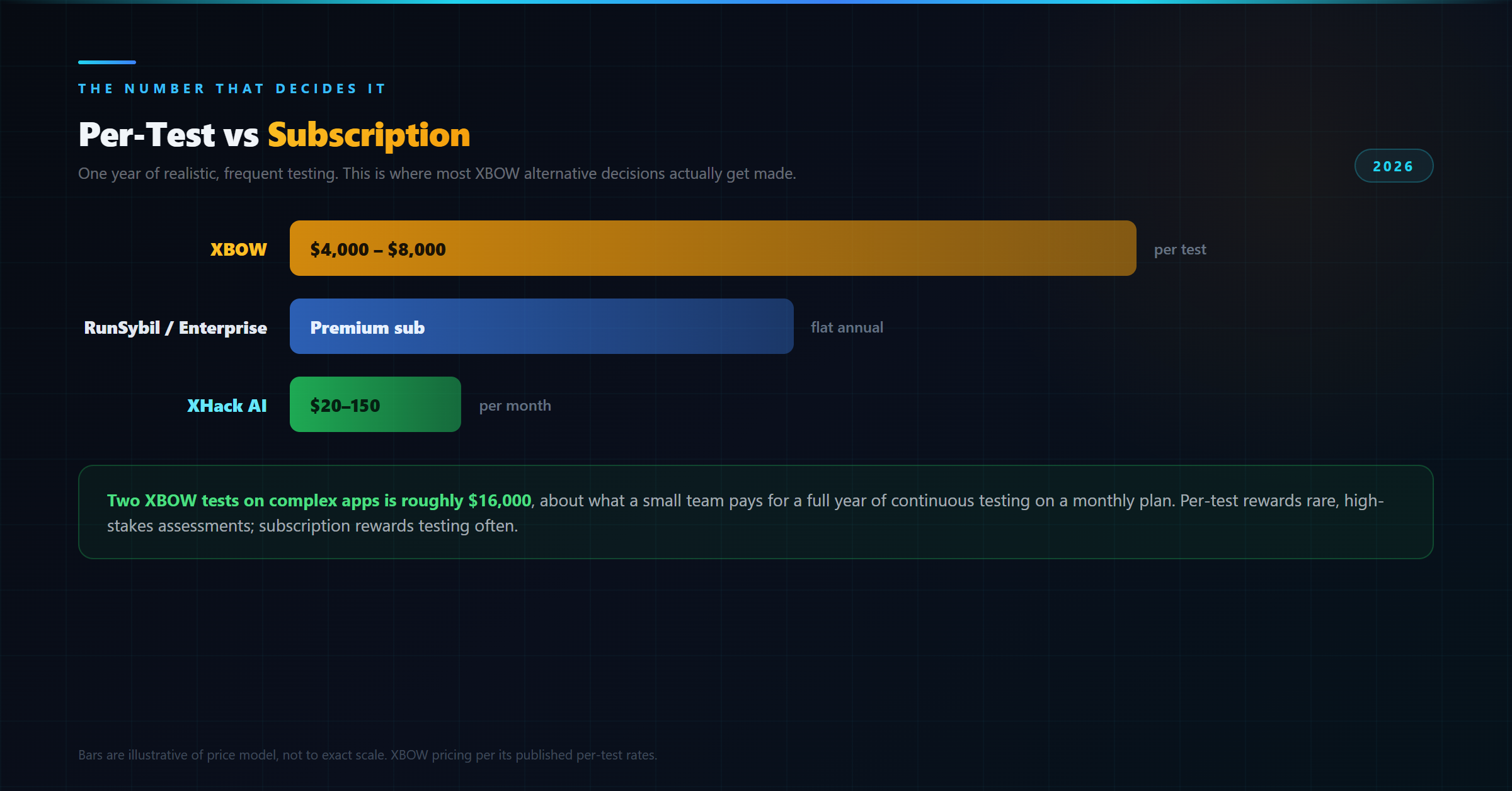
For most buyers, price is where the XBOW alternative decision actually gets made, so let me put it plainly.
XBOW charges $4,000 to $8,000 per test. That is per test, not per year. Run assessments regularly across a handful of apps and you are into five or six figures quickly.
Now the contrast. XHack AI runs $20 to $150 per month. Escape and Aikido sell flat platform subscriptions. Even the premium autonomous options like RunSybil, and the enterprise platforms like NodeZero and Pentera, use subscription models that make annual cost predictable instead of scaling with every test.
Think in annual terms, not per assessment. Two XBOW tests on complex applications is $16,000, roughly what a small team would pay for an entire year of continuous testing on a monthly subscription elsewhere. The per-test model is not wrong, it simply rewards infrequent, high-stakes assessments and punishes continuous testing. If your goal is to test often, the math bends hard toward a subscription, and that single realization ends most of these buying decisions.
The takeaway is not that XBOW is overpriced. For audit-ready, high-volume web app testing with compliance mapping, its price reflects real value. The takeaway is that if that exact profile is not you, an XBOW alternative on a subscription model can cover the same or more ground for a fraction of the annual spend. The price gap between $20 to $150 a month and $4,000 to $8,000 a test is the single biggest reason the XBOW alternative search exists.
Match the tool to your real need, and the decision makes itself.
No single option is best for everyone. The best XBOW alternative is the one whose scope, autonomy model, and price line up with the job in front of you.
Never buy an autonomous pentest tool on the strength of a demo. Run a proof of concept, because the gap between a polished sales deck and real-world output is where budgets get wasted.
Here is a practical way to trial any XBOW alternative before you commit.
Test it on something you already understand. Point the tool at an application whose vulnerabilities you already know, ideally a deliberately vulnerable app or a system you have tested manually. You want to see whether it finds what is actually there, not just whether it produces a long report.
Measure the false-positive rate. Autonomous tools vary wildly here. A tool that floods you with findings you then have to manually disprove is not saving you time. Count how many of its findings are real, exploitable, and worth acting on. This is where human-validated options tend to pull ahead of fully autonomous ones.
Confirm the scope actually matches your attack surface. This is the whole reason the XBOW alternative search exists. If you need network and Active Directory coverage, verify the tool truly delivers it in the trial, not just on the feature page. Test the edges, not the happy path.
Check the reporting and the fixes. A finding you cannot act on is noise. Look at whether the tool proves exploitability, explains impact clearly, and tells your team how to fix it. Some options deliver code-level fixes tied to owners, which is a real workflow advantage.
Model the annual cost honestly. Take your realistic testing frequency and multiply it out. A per-test tool and a subscription tool can look similar on one assessment and wildly different across a year of real use. Run that math before you sign anything.
Run any XBOW alternative through those five checks and the marketing falls away fast. The tool that finds real bugs, in your actual scope, at a cost you can defend, is the one to buy.
Even careful buyers get this wrong. The recurring mistakes are worth naming.
Buying on hype instead of fit. XBOW’s leaderboard win and funding round are real, but they do not mean XBOW, or the loudest alternative, fits your job. The best XBOW alternative is boringly specific to your scope and budget, not the one with the biggest headlines.
Ignoring scope until after you buy. The single most common mistake is purchasing a web-app specialist when your real risk is in your internal network, or vice versa. Map your attack surface first, then shop. Scope mismatch is the number one reason tools get abandoned.
Treating fully autonomous as automatically better. No-human-in-the-loop autonomy is great for speed, but it also means no one is validating findings before they hit your report. For some teams that is fine, for others it is a liability. Decide deliberately whether you want a hybrid model with human review.
Underestimating the annual bill. A four-figure-per-test price looks manageable for one assessment and brutal across a year of continuous testing. Always model real usage, not a single test, when comparing a per-test tool against a subscription.
Avoid those four and you will land on the right XBOW alternative instead of the most-marketed one.
So yeah, here is the dedicated brand section. Since we are one of the six, here is the honest version of when XHack AI is the right XBOW alternative and when it is not.
XHack AI is the XBOW alternative for teams that want AI speed with human validation, at a price that does not require an enterprise budget. It autonomously tests web applications and APIs with a multi-agent engine, then routes findings through a human review stage, so you get breadth and speed without the fully-hands-off, no-human-in-the-loop model that XBOW and RunSybil use. For teams that want a person accountable for the findings, that hybrid is the point.
The price difference is the headline. XHack AI runs $20 to $150 per month on individual plans and $560 to $3,000 per month for teams, versus XBOW’s $4,000 to $8,000 per test. And XHack AI is more than a scanner: it pairs the agent with senior human red-teamers and a continuous security platform, so findings feed into monitoring instead of just landing in a report.
Here is the part privacy-conscious teams care about. XHack does not store your user data, and it is privacy-focused by design. Your pentest chats and session data stay on your own local computer, and you can delete them any time. When you are testing a client’s or your own unpatched application, that material is not sitting on a vendor’s servers.
Now the honest limits, because brutal honesty is kind of our thing. XHack AI focuses on web and API testing, so for deep internal Active Directory and network validation, a specialized XBOW alternative like NodeZero goes further on that specific job. And if you truly need XBOW’s exact profile, fully autonomous, audit-ready, high-volume web testing with 40-plus compliance frameworks mapped, XBOW itself may be worth its price. We would rather tell you that than oversell.
If you want more context, our honest comparison of the best AI pentesting tools breaks down the whole field, and our guide to autonomous pentesting tools covers how these agents actually work.
Want to know whether XHack AI is the right XBOW alternative for you? Book a free consultation and we will tell you straight, even if the honest answer is that a different tool fits you better.
There is no single best XBOW alternative, because the right one depends on your need. For internal network and Active Directory testing, which XBOW does not do, NodeZero and Pentera are the strongest options. For affordable, human-validated web and API testing, XHack AI is the value pick at $20 to $150 per month. For engineering-led API coverage, Escape fits best, and for XBOW-style pure autonomy, RunSybil is the closest match. Match the tool to your scope and budget rather than chasing one winner.
Two main reasons. First, scope: XBOW only tests web applications, with no network, Active Directory, or cloud coverage, so teams with a broader attack surface need an XBOW alternative that covers more. Second, price: XBOW charges $4,000 to $8,000 per test, which adds up fast for frequent assessments, so subscription-based alternatives can cost far less per year. A third reason is autonomy preference, since some teams want human validation rather than XBOW’s fully hands-off model.
XHack AI is the clearest low-cost XBOW alternative, at $20 to $150 per month for individuals and $560 to $3,000 per month for teams, compared with XBOW’s $4,000 to $8,000 per test. Escape and Aikido Security also use flat subscription pricing that is more predictable than per-test billing. The savings are largest for teams running frequent tests across many assets, where a per-test model like XBOW’s scales up quickly while a subscription stays flat.
XBOW is a fully autonomous, web-application specialist with strong compliance mapping, over 40 frameworks, and proof-of-exploit on every finding, purpose-built for audit-ready web app testing at scale. Its no-human-in-the-loop autonomy and leaderboard-proven exploitation are genuinely strong. Where alternatives pull ahead is breadth and price: NodeZero and Pentera cover network and Active Directory, Escape covers APIs deeply, and XHack AI adds human validation at a fraction of the cost. XBOW is excellent within its lane and silent outside it.
An XBOW alternative, without question, because XBOW does not do network pentesting at all. It is web-application only. For internal network, Active Directory, and cloud testing, NodeZero is the category leader and Pentera is the mature enterprise choice. If network coverage is your priority, XBOW should not be on your shortlist, and the decision is really between the network-focused alternatives rather than XBOW versus anything.
Yes. RunSybil is the closest XBOW alternative on autonomy, running fully autonomous continuous pentests with no humans in the loop, the same hands-off model as XBOW. The trade-off is that it is not the cheapest option. Other alternatives like XHack AI deliberately choose a hybrid model instead, pairing autonomous testing with human validation, which many teams prefer for accountability. So you can match XBOW’s autonomy if that is what you want, or choose an alternative that intentionally keeps a human in the loop.
That is the honest map of the XBOW alternative landscape in 2026.
XBOW deserves its reputation. Hitting number one on HackerOne and raising $120 million are not accidents. But XBOW is a specialist, web applications only, priced per test at enterprise rates, and fully autonomous with no human validation. Those traits make it perfect for one profile and wrong for many others.
That is why the XBOW alternative search exists. NodeZero and Pentera cover the network and Active Directory that XBOW ignores. Escape owns API-first engineering teams. RunSybil matches XBOW’s autonomy. Aikido offers predictable full-stack coverage. And XHack AI delivers human-validated web and API testing at $20 to $150 per month instead of thousands per test.
The right XBOW alternative is not the most hyped one. It is the one whose scope, autonomy, and price match the job you actually have. Figure out what you need to test and what you can spend, and the choice gets obvious fast.
If a human-validated, affordable XBOW alternative sounds like your fit, that is exactly what XHack AI was built to be. And if it is not, we just told you which of the others is. Brutal honesty, remember.
Categories
Related articles