Table of contents
19
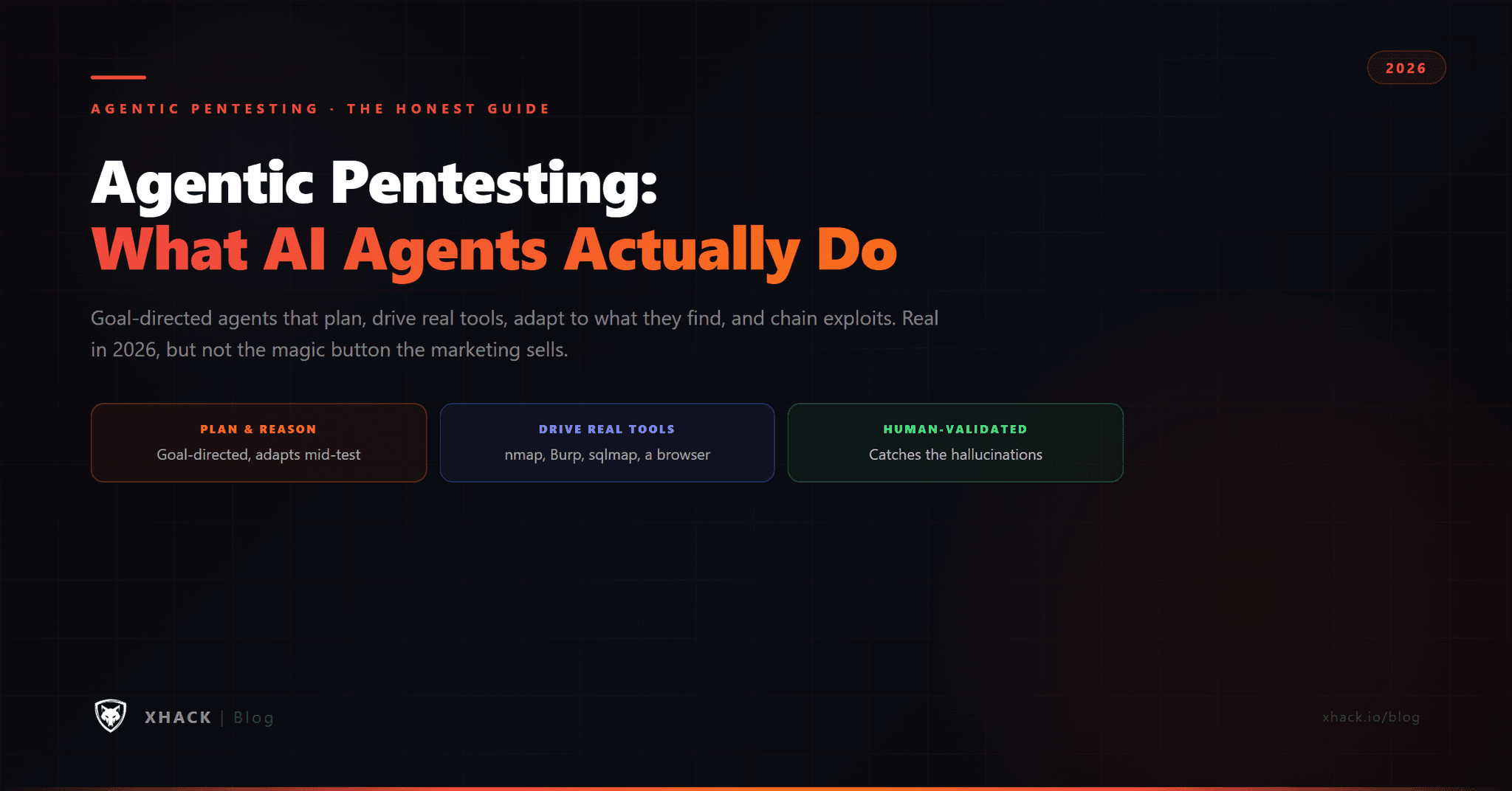
Read this in 30 seconds: Agentic pentesting is penetration testing run by goal-directed AI agents that plan, execute, adapt, and report on their own, instead of following a fixed script like a scanner. The word “agentic” describes the architecture: one or more specialized agents coordinated by an orchestration layer that reasons through a target the way a human attacker would. In 2026 this stopped being a research demo. Agentic pentesting agents topped the HackerOne leaderboard, out-found OSCP-certified humans on live networks, and grew from a handful of open-source projects to roughly seventy in under three years.
But agentic pentesting is not magic, and it is not a replacement for a skilled operator. It hallucinates, it invents vulnerabilities that are not there, and it still needs a human to validate findings and sign the report. This guide explains what agentic pentesting really is, how it works, where it wins, where it breaks, and how to evaluate a platform without believing the marketing.
“Agentic” is the most overused word in security right now, and agentic pentesting is where the hype is thickest. Every vendor slapped the label on their product the second it started trending, whether or not there is a real agent underneath.
So let me cut through it. Agentic pentesting is a genuine shift in how offensive security gets done, and it is also drowning in marketing that makes it sound like a self-driving hacker in a box. Both things are true at once.
This guide is the honest version. What agentic pentesting actually is, how the agents work under the hood, the real benchmark numbers from 2026, the failure modes nobody puts on the landing page, and a straight framework for judging whether a platform is agentic or just automation with a new sticker.
If you are a security professional trying to figure out whether agentic pentesting belongs in your workflow, this is written for you.
Let me define the term properly before the marketing ruins it.
Agentic pentesting is penetration testing performed by autonomous AI agents that pursue a goal, reason about what they find, and decide their own next move, rather than executing a fixed sequence of checks. The “agentic” part is not about intelligence in the abstract. It describes an architecture where the system sets sub-goals, selects tools, reads the output, and adapts.
The cleanest way to understand it is the distinction the research community settled on in 2026. An AI agent is the “doer,” a software component that uses a model to complete one specific task. Agentic AI is the “thinker,” a system that coordinates one or more agents to achieve a strategic objective with a high degree of autonomy.
Applied to security, agentic pentesting is the thinker driving the doers. A planning layer breaks “test this web app” into recon, enumeration, vulnerability discovery, exploitation, and reporting, then coordinates specialized agents through each stage and revises the plan based on what actually happens.
That last part is the whole point. A scanner asks one question: “Is this known vulnerability present?” An agentic pentesting system asks a different one: “Can I reach the sensitive data, and if this path is blocked, what is the next best route?” It chases exploitation paths and business impact, not just a checklist of flaws.
This is why agentic pentesting feels categorically different from the automated scanning that came before it. The agent is not matching signatures. It is reasoning about a target the way an attacker does, chaining small findings into a real exploit, and proving impact instead of printing a maybe.
These three terms get used interchangeably, and that confusion is exactly where buyers get burned. Here is the honest breakdown before we go deeper.
| Approach | How it works | Adapts mid-test? | Chains exploits? | What you get |
|---|---|---|---|---|
| Traditional scanner | Fixed rules, signature matching | No | No | A list of possible flaws, plus false positives |
| Autonomous pentesting | AI agents run recon to reporting with minimal human input | Somewhat | Yes | Validated findings with less human effort |
| Agentic pentesting | Goal-directed agents plan, reason, coordinate, and adapt | Yes | Yes, dynamically | Attacker-style exploit paths and proof of impact |
The overlap is real, and honestly the labels blur at the edges. “Autonomous pentesting” usually describes the outcome (the test runs itself), while “agentic pentesting” describes the mechanism (goal-directed agents coordinated by an orchestrator). Most serious autonomous platforms in 2026 are agentic under the hood, which is why the terms travel together.
Here is the part vendors gloss over. There is a spectrum of autonomy, and “agentic” on a landing page tells you nothing about where a product sits on it. Some agentic pentesting platforms are only partially automated, with human testers still exercising major control over every step. Others, like the open-source PentAGI harness, run the entire engagement themselves inside a container. A tool like PentestGPT sits at the advisory end, reasoning about your next move while you run the commands yourself.
So when someone says “agentic pentesting,” the correct follow-up is always: agentic to what degree, and who is in the loop? The word is a starting point for the conversation, not an answer.
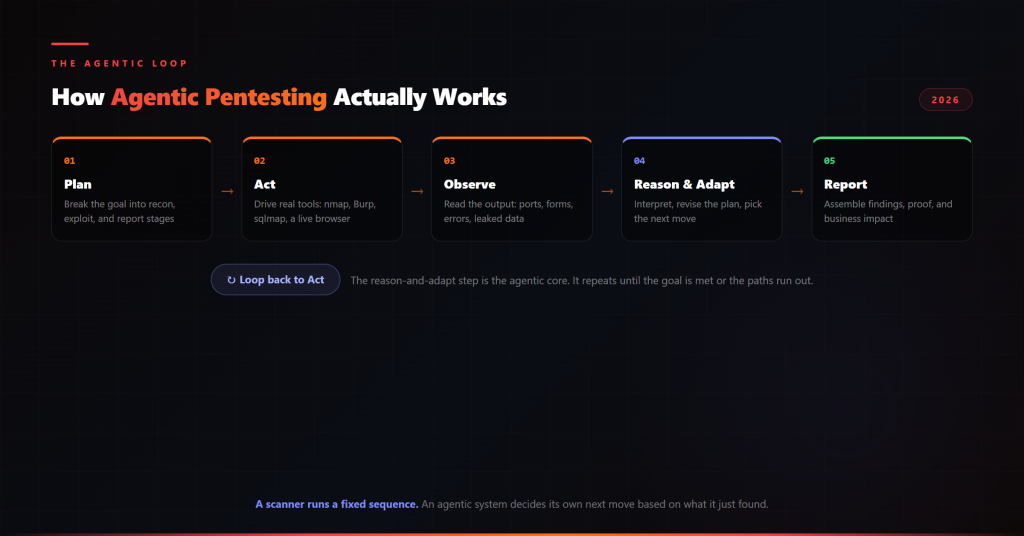
Strip away the branding and every real agentic pentesting system runs some version of the same loop.
Plan. Given an objective and a target, a planning layer builds a methodology: reconnaissance, service enumeration, vulnerability identification, exploitation, post-exploitation, and reporting. This plan is not static. It is a starting hypothesis the system revises as it learns.
Act. The system drives real tooling. The serious agentic pentesting harnesses are not chatbots describing what they would do; they orchestrate actual tools like nmap, Burp Suite, and sqlmap, execute commands, and interact with the live target.
Observe. The agent reads the output. A port scan comes back, a login form appears, an error leaks a stack trace. This raw evidence feeds back into the model.
Reason and adapt. This is the agentic core. The system interprets what it saw, updates its plan, and picks the next move. Hit a WAF? Try a different encoding. Found an exposed API? Pivot to test it for broken authorization. The loop repeats until the goal is met or the paths run out.
Report. Finally, the system assembles findings into a deliverable: what it found, how it proved exploitability, and what the impact is.
The magic, to the extent there is any, lives in the reason-and-adapt step. That is what separates agentic pentesting from a macro that runs the same tools in the same order every time. The agent makes decisions based on context, and those decisions compound across a multi-step attack chain.
Most capable agentic pentesting systems in 2026 are not a single model doing everything. They are multi-agent, meaning specialized agents handle different jobs and an orchestrator coordinates them.
One agent handles reconnaissance. Another focuses on exploitation. Another validates findings to cut false positives. Another writes the report. The orchestrator assigns work, passes context between them, and keeps the overall goal in view.
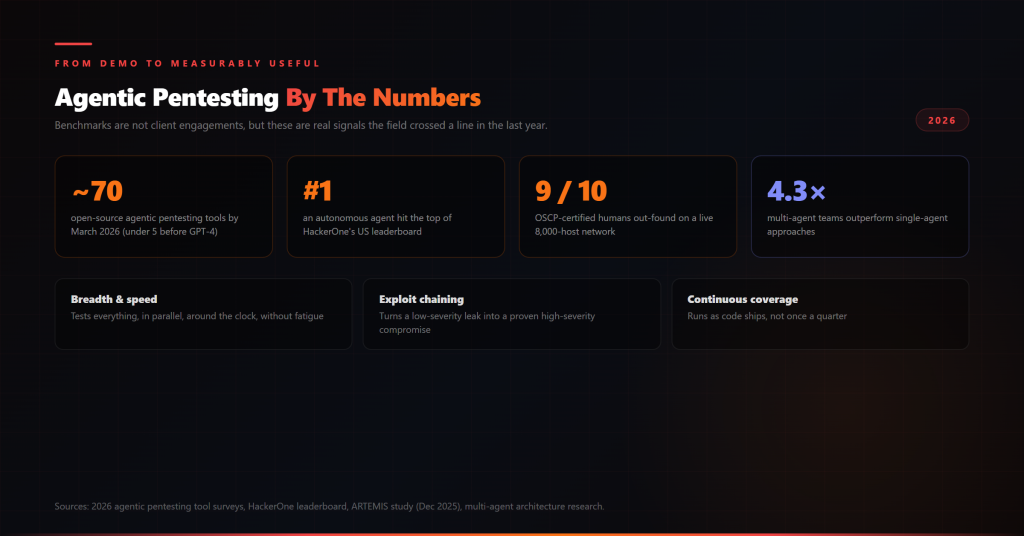
This structure is not a stylistic choice. It measurably works better. Research testing agentic pentesting architectures in 2026 found that hierarchical, specialized agent teams outperform single-agent approaches by roughly 4.3 times. Splitting the work lets each agent stay focused and reduces the context overload that makes a lone model wander.
It is the same reason human red teams specialize. Breadth and depth are different skills, and coordinating specialists beats asking one generalist to do everything at once.
The demand is not hype for its own sake. Agentic pentesting solves a real, expensive problem: traditional testing cannot keep up with how fast software ships.
Manual pentests are point-in-time. You test, you get a report, and by the time you remediate, the application has changed three times. Scanners fill the gap between manual tests, but they generate noise, miss logic flaws, and cannot chain vulnerabilities into real exploits. Agentic pentesting aims squarely at that gap: continuous, exploit-driven testing that adapts.
The growth curve tells the story. Before GPT-4 landed in April 2023, there were fewer than five open-source agentic pentesting projects. By March 2026 there were around seventy, spanning multiple distinct architecture patterns. That is not a fad. That is a field forming in real time.
And the performance is no longer theoretical. XBOW’s agent reached the number one spot on HackerOne’s US leaderboard, competing against human bug bounty hunters. In the December 2025 ARTEMIS study, an autonomous agent out-found nine of ten OSCP-certified human testers on a live network of roughly 8,000 hosts. On one-day CVE reproduction, the strongest models have hit accuracy around 87 percent.
Those numbers deserve context, not worship. They come from specific benchmarks under specific conditions, and a leaderboard win is not the same as a clean enterprise engagement. But they are real signals that agentic pentesting crossed from “interesting demo” to “measurably useful” over the course of 2025.
Play to the strengths and agentic pentesting genuinely earns its place.
Breadth and speed. Agents test everything, in parallel, around the clock. What takes a human a week of manual work, an agent runs in hours, and it does not get bored on host 4,000.
Continuous coverage. Because it is automated, agentic pentesting can run continuously rather than once a quarter, catching regressions and new exposures as code ships.
Exploit chaining. Unlike a scanner, an agentic system chains a low-severity leak into a high-severity compromise, which is exactly the kind of finding that proves real risk.
Consistency. The agent follows its methodology every time, without the fatigue and shortcuts that creep into hour nine of manual testing.
Here is the section the vendors leave off the landing page, and it is the most important one.
Agentic pentesting hallucinates. LLM-driven agents can invent vulnerabilities that do not exist and fabricate exploit output that never ran. A confident, well-formatted finding from an agent can be completely wrong, and it looks exactly like a real one. Without validation, agentic pentesting produces a professional-looking report full of fiction.
It lacks judgment. An agent does not understand your business, your risk tolerance, or which of two technically-valid findings actually matters to your organization. It finds; it does not prioritize the way a senior tester does.
It cannot own compliance. No regulator accepts “the AI said so.” A human still has to validate results, stand behind the report, and provide the sign-off that engagements require. Agentic pentesting produces evidence, not accountability.
It introduces its own risks. Handing an autonomous agent the ability to run offensive tooling against live systems raises real operational safety and scope questions. An agent that adapts is also an agent that can wander outside where you meant it to go, so guardrails and scope enforcement matter enormously.
This is why the 2026 consensus is not “agents replace pentesters.” It is a division of labor. Agentic pentesting owns breadth, speed, and continuous coverage. Human experts own validation, judgment, and regulatory sign-off. The good implementations lean into that split instead of pretending the human is optional.
The researchers who study this call the goal “controlled autonomy,” balancing the agent’s freedom to explore with deterministic, reproducible, auditable results. An agentic pentesting system you cannot audit is not a professional tool. It is a liability that happens to be fast.
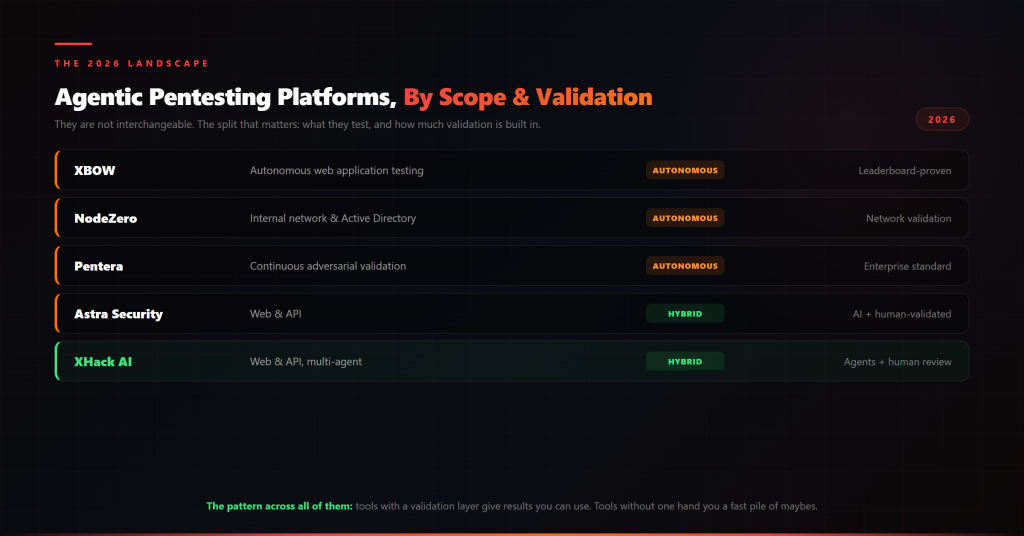
The field is crowded, and the platforms are not interchangeable. They split by scope and by how much human validation is baked in.
| Platform | Focus | Model |
|---|---|---|
| XBOW | Autonomous web app testing | Fully autonomous, leaderboard-proven |
| Horizon3.ai NodeZero | Internal network and Active Directory | Autonomous network validation |
| Pentera | Continuous adversarial validation | Enterprise automated validation |
| Astra Security | Web and API | Hybrid AI plus human-validated |
| FireCompass / Invicti | Web and API attack surface | Agentic platforms with validation layers |
| XHack AI | Web and API, multi-agent | Autonomous agents plus human review |
Open source is where a lot of the innovation is happening. Projects like PentAGI (a full autonomous harness that runs inside Docker) and newer multi-agent systems like Zen-AI-Pentest (a state machine launched in February 2026 that wires together more than seventy security tools across nine categories) show how fast the architecture is maturing.
The pattern across all of them is the same: the tools that add a validation layer, whether AI or human, produce results you can actually use, while the ones that skip it hand you a fast pile of maybes. When you evaluate agentic pentesting, the validation story matters more than the raw autonomy.
Agentic pentesting is not equally useful to everyone right now, and pretending otherwise sets teams up to be disappointed.
It fits you well if you ship software continuously and your quarterly manual pentest leaves long blind spots between engagements. Continuous, exploit-driven coverage is exactly the gap agentic pentesting was built to close. It also fits lean security teams who need to multiply a handful of skilled people across a large attack surface, and bug bounty hunters who want an agent running breadth while they focus on the interesting targets.
It fits web and API testing best. The strongest agentic pentesting results in 2026 are in web application and API assessment, where the browsing and request-level tooling is mature. If your priority is deep internal network and Active Directory work, the network-specialized platforms are further along on that specific problem.
You should wait, or proceed carefully, if you have no one who can validate the output. Agentic pentesting without a reviewer who can separate real findings from hallucinated ones is worse than no tool at all, because it produces confident fiction at scale. You also want to move slowly if your environment is fragile or safety-critical, where an autonomous agent probing live systems carries more downside than upside without heavy guardrails.
The honest rule of thumb is simple. If you have the skill to validate and the discipline to scope, agentic pentesting is a genuine force multiplier today. If you were hoping it would replace the expertise you do not have, it will not, and it will hand you a stack of professional-looking problems instead.
Here is the framework I use to separate real agentic pentesting from automation wearing the word as a costume. Run any platform through these questions.
Does it actually reason, or just run tools in order? Real agentic pentesting adapts mid-engagement based on what it finds. If the “agent” runs the same fixed sequence every time regardless of results, it is a scanner with better marketing. Ask for a concrete example of the system changing its plan based on a discovery.
Where is the validation? This is the single most important question. An agentic pentesting tool that hands you unvalidated output is handing you hallucinations mixed with real findings and no way to tell them apart. Look for AI validation, human review, or ideally both.
Can you audit what it did? Every action the agent takes should be logged and reproducible. If you cannot reconstruct exactly what the agentic pentesting system ran, against what, and when, it fails the compliance test and the trust test at the same time.
How does it enforce scope? An autonomous agent needs hard guardrails so it does not test systems you did not authorize. Ask specifically how scope is defined and enforced, because “the agent is careful” is not an answer.
What is the human-in-the-loop model? The honest platforms tell you exactly where humans sit in the process. The ones that claim zero human involvement are either lying or selling you unvalidated output. Neither is good.
Score any agentic pentesting platform against those five and the marketing falls away fast. The tool that answers all five clearly is one you can put in front of a client. The one that dodges the validation and audit questions is one you should not.
So yeah, here is where we talk about what XHack brings to the table. Since this whole guide is about the gap between “agentic” as a buzzword and agentic pentesting that actually holds up, here is our honest take.
XHack AI is agentic pentesting built the way the architecture is supposed to work. You set an objective and it plans, executes, adapts, and reports independently across a multi-step operation. Under the hood it runs as a genuine multi-agent system: specialized sub-agents fan out across reconnaissance, discovery, exploit chaining, and analysis in parallel, coordinated like a red team rather than one model trying to do everything.
The pipeline is observable end to end, which is the part that matters for professional work. Objective, then a planner reasons about approach, then an orchestrator coordinates the agents, then executors drive real tools, then findings get produced, then a human reviews and verifies, then the report ships. That human review stage is deliberate. It is how the false positives that plague raw agentic pentesting get caught before they reach a client.
There is also an autonomous browsing engine that drives a real browser to test multi-step web workflows the way a person would, which finds the logic and client-side flaws that request-level scanners miss. It is the same “humans and XHack AI both hunt, at full intensity, in parallel” model behind our human-led VAPT work, where senior red-teamers run their own playbook alongside the agents and both pools of findings get cross-checked.
Now the part privacy-conscious teams care about most. XHack does not store your user data, and it is privacy-focused by design. Your pentest chats and session data stay on your own local computer, and you can delete them any time you want. You keep a local audit trail for your own chain of custody, but your client’s sensitive findings are not sitting on a vendor’s servers waiting to become the next breach headline. On the platform side that posture shows up as “no data stored” scanning in GitGuard and tenant-isolated data for enterprise, with an NDA available when you need one.
Now the honest part, because brutal honesty is kind of our thing. Agentic pentesting is not a magic button, and it depends on the operator. Point any agent at random targets with no plan and you get noise, or worse. The AI is a force multiplier for a skilled professional, not a replacement for skill, authorization, or judgment. And XHack AI is focused on web and API testing, so for large-scale internal Active Directory work, a network-specialized platform like NodeZero goes deeper on that specific job.
On pricing we say it plainly instead of hiding it. Individual plans, for a single bug hunter or researcher rather than a company seat, start at $20/month on Starter with the autonomous security agent, $49/month on Professional with unrestricted AI access, and $150/month on Elite. Company-wide adoption runs on separate team plans starting at $560/month, and Enterprise adds custom agents trained on your data and full multi-agent orchestration. Both tiers start with a 7-day free trial, no credit card required. That is agentic pentesting you can start using this week, not a six-figure procurement cycle.
If you want more background, our honest comparison of the best AI pentesting tools breaks down where each platform fits, and our field notes on autonomous pentesting tools cover how these agents actually chain exploits on authorized targets.
Want to know whether agentic pentesting fits your workflow? Book a free consultation and we will tell you straight, even if the honest answer is that you do not need us.
Agentic pentesting is penetration testing performed by autonomous AI agents that pursue a goal, reason about what they discover, and decide their own next steps, instead of running a fixed script like a traditional scanner. The “agentic” part refers to the architecture: goal-directed agents, usually several specialized ones, coordinated by an orchestration layer. In practice, agentic pentesting means the system plans an attack, drives real tools, reads the results, adapts its approach, and chains findings into a proven exploit, the way a human attacker would.
The terms overlap heavily and are often used interchangeably. “Autonomous pentesting” describes the outcome, that the test runs with minimal human input. “Agentic pentesting” describes the mechanism, that goal-directed agents plan and coordinate the work. Most serious autonomous platforms in 2026 are agentic under the hood, so the difference is usually emphasis rather than a hard line. The more useful question is how much autonomy a specific tool actually has and where humans sit in the loop.
Not better, different. Agentic pentesting wins on breadth, speed, and continuous coverage, testing everything in parallel around the clock. Human experts win on judgment, business context, and the validation and sign-off that engagements and regulators require. In 2026 an autonomous agent did out-find nine of ten OSCP-certified humans in one benchmark, but benchmarks are not client engagements. The mainstream model is a division of labor, with agents handling scale and humans handling judgment, not one replacing the other.
No, and any vendor claiming otherwise is a warning sign. LLM-driven agents hallucinate: they invent vulnerabilities that do not exist and fabricate exploit output. Raw agentic pentesting produces professional-looking reports that mix real findings with fiction, and you cannot tell them apart without validation. Trustworthy agentic pentesting always includes a validation layer, whether AI cross-checking, human review, or both, plus a full audit trail so every action is reproducible.
Three main ones. First, hallucinated or fabricated findings that waste time and credibility. Second, operational safety, because an autonomous agent with offensive tooling can wander outside the intended scope without hard guardrails. Third, compliance, since no regulator accepts an AI’s word and a human must still validate and sign off. Good agentic pentesting platforms address all three with validation, scope enforcement, audit logging, and a clear human-in-the-loop model. Researchers call the goal “controlled autonomy.”
Ask five questions. Does it actually reason and adapt, or just run tools in a fixed order? Where is the validation that catches hallucinated findings? Can you audit and reproduce everything it did? How does it enforce scope so it stays authorized? And where exactly do humans sit in the loop? A platform that answers all five clearly is one you can put in front of a client. One that dodges the validation and audit questions is automation wearing the word “agentic” as a costume.
That is the honest picture of agentic pentesting in 2026.
It is a real shift, not just a rebrand. Goal-directed agents that plan, drive real tools, adapt to what they find, and chain exploits are genuinely different from the scanners that came before, and the benchmark numbers back that up. Agentic pentesting grew from a handful of projects to dozens in under three years for a reason.
But the hype outruns the reality in one specific way. Agentic pentesting hallucinates, lacks judgment, and cannot own the validation or compliance that professional work demands. Strip out the human and you do not get a self-driving pentester, you get a fast, confident, sometimes-fictional report.
The teams getting real value from agentic pentesting are the ones who treat it as a force multiplier, not a replacement. Agents handle the breadth, speed, and continuous coverage. Humans handle the judgment and the sign-off. The validation layer sits between them, catching the fiction before it reaches a client.
If you want agentic pentesting with the validation and human review built in instead of bolted on as an afterthought, that is exactly the gap XHack AI was built to fill. The agents are real. The reasoning is real. And so is the human who checks their work before it ships.
The attackers are already using agents. It is time defenders ran them properly.
Related articles