Table of contents
17
By Salman Khan, OSCP+, Founder of XHack, SRT (Synack Red Team member)
Read this in 30 seconds: A bug bounty career is not one job. It is a record of valid findings that other people read, and that record can open at least five different doors.
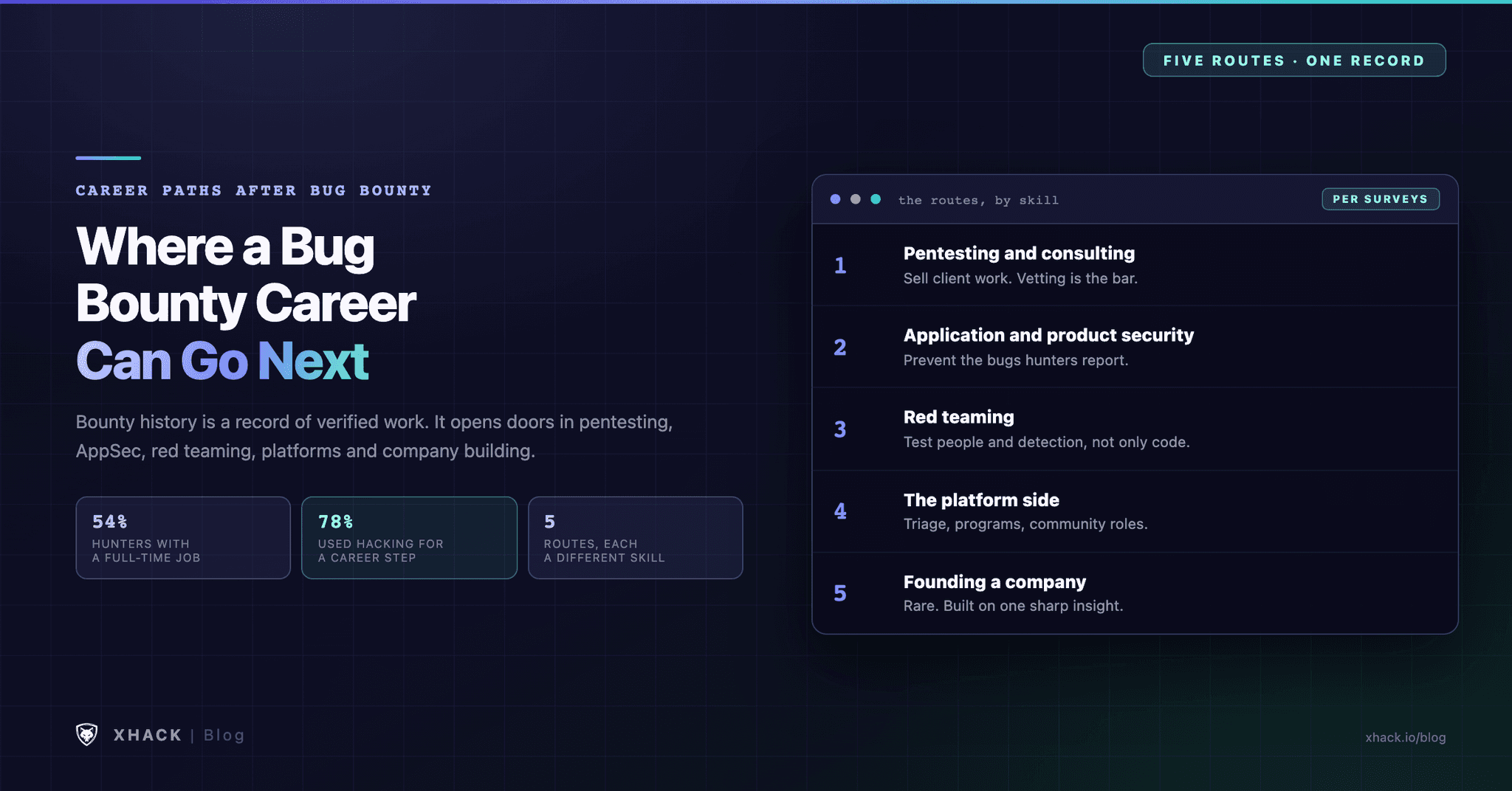
- Most hunters keep bounty on the side. In Intigriti’s 2022 survey of 1,759 researchers, 54% held full-time jobs elsewhere, and 86% called themselves part-time hunters.
- Bounty history helps most as proof of skill. HackerOne’s 2020 survey found 78% of hackers used their hacking experience to find or better compete for a career opportunity. That counts any opportunity, not specifically a security job.
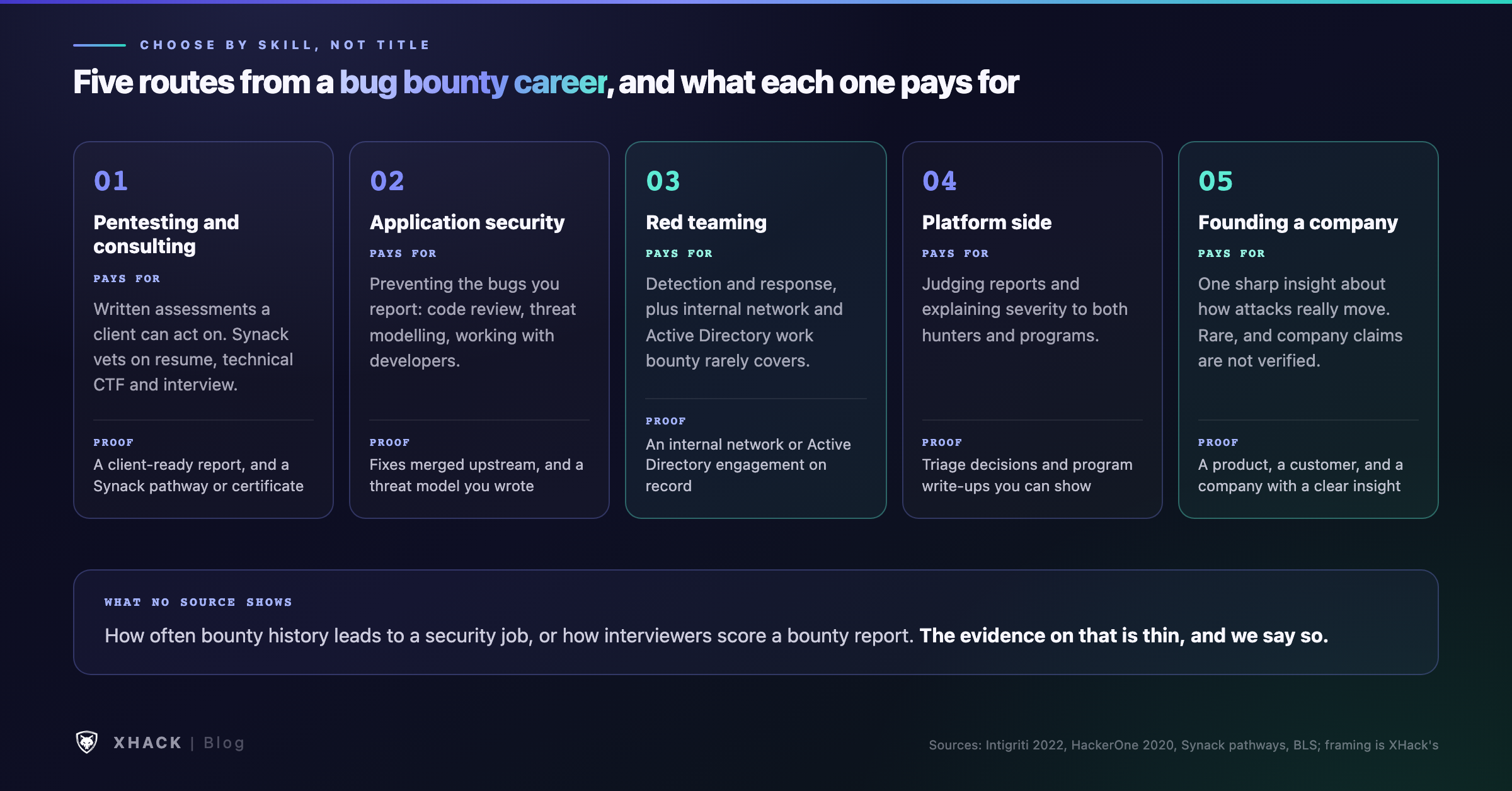
- The five routes are different bets. Pentesting and consulting, application or product security, red teaming, the platform side of bounty, and building a company each pay for a different skill set.
- No source tells you how interviewers score bounty reports. We looked. The article says where the evidence is thin.
- One thing helps on every route: a report a stranger can follow, reproduce and act on. We cover what that looks like below.
Hunters who ask about careers usually want a job, but the bounty record isn’t a résumé. It is evidence, and each career path reads that evidence differently.
A bug bounty career can mean very different things. For some hunters it is a side income that never turns into a job. For others it is the first line on a pentesting résumé, or the start of a company. This article walks through five routes, what each one asks for, and the honest limits of what we could verify.
We are not neutral about any bug bounty career. Our author runs XHack, a company that sells AI tools to hunters and testers, and is a Synack Red Team member. Read the evidence with that in mind, and check the sources we link.
Before choosing a route, it helps to know what other hunters did with their bug bounty career. Three surveys cover this, and all three were run by companies that sell into the bounty market, so treat them as indicative rather than representative.
Intigriti, 2022. The platform surveyed 1,759 security researchers. Its report found that 96% wanted to spend more time on bounty work, and 66% were considering it as a full-time career. The same report says that 54% of the community held full-time employment elsewhere, 32% were students, and 86% described themselves as part-time hunters. Among the 65% with hands-on penetration testing experience, the report describes a community that already works in security. The biggest appeal of full-time bounty work was money, named by 48%, followed by being your own boss and setting your own hours, named by 45%.
HackerOne, 2020. The platform surveyed 3,150 hackers in more than 120 countries. It found 18% described themselves as full-time hackers. It also found that 78% had used their hacking experience to help them find or better compete for a career opportunity. The second figure covers any opportunity, so it does not tell you what share got a security job specifically.
Bugcrowd, 2026. Its Inside the Mind of a Hacker report says nearly half of hackers spend fewer than 14 hours a week hacking, and more than 40% under 10 hours. Its text adds that “part-time hacking is often offset by full-time security roles.” That line is a claim from a platform, not a measured share, but it matches what the Intigriti numbers show.
Taken together, the pattern is consistent across the surveys, and it matters for any bug bounty career plan. Most hunters are not making a living from bounty alone, and a bug bounty career that pays the bills usually started as a side project. Many are already in security jobs, and bounty work sharpens them, or pays for the time. A bug bounty career for most people is therefore a question of which job they move into, not whether bounty becomes the job.
For a bug bounty career that values steady client work, this is the most common route.
This is the most common route, and the one with the clearest entry requirements, because firms and platforms that sell testing have to vet people they send to clients.
The best public example is the Synack Red Team, the invite-style platform run by Synack. Its pathway page sets out the onboarding stages in order: resume review, wait list review, technical review, personal interview, background and ID verification, and platform training. The technical review asks applicants to show hands-on skill through a private CTF on the HackTheBox platform, and applicants with qualifying certifications can bypass that step.
The page lists Priority pathways, which are credentials that speed up onboarding. The named providers are OffSec, CREST, HackTheBox, PortSwigger, SANS and SRT referrals. Preferred pathways, which improve your chances without skipping a stage, include APIsec University, TCM Security, Barracks and Black Hat University.
What the page does not say matters too. It does not state whether SRT membership is invitation-only, which the job-board listings suggest is an open application. It also does not say whether bug bounty experience counts toward eligibility. Our reading is that a clean bounty record helps in the technical and interview stages, but we could not confirm that from Synack’s own text.
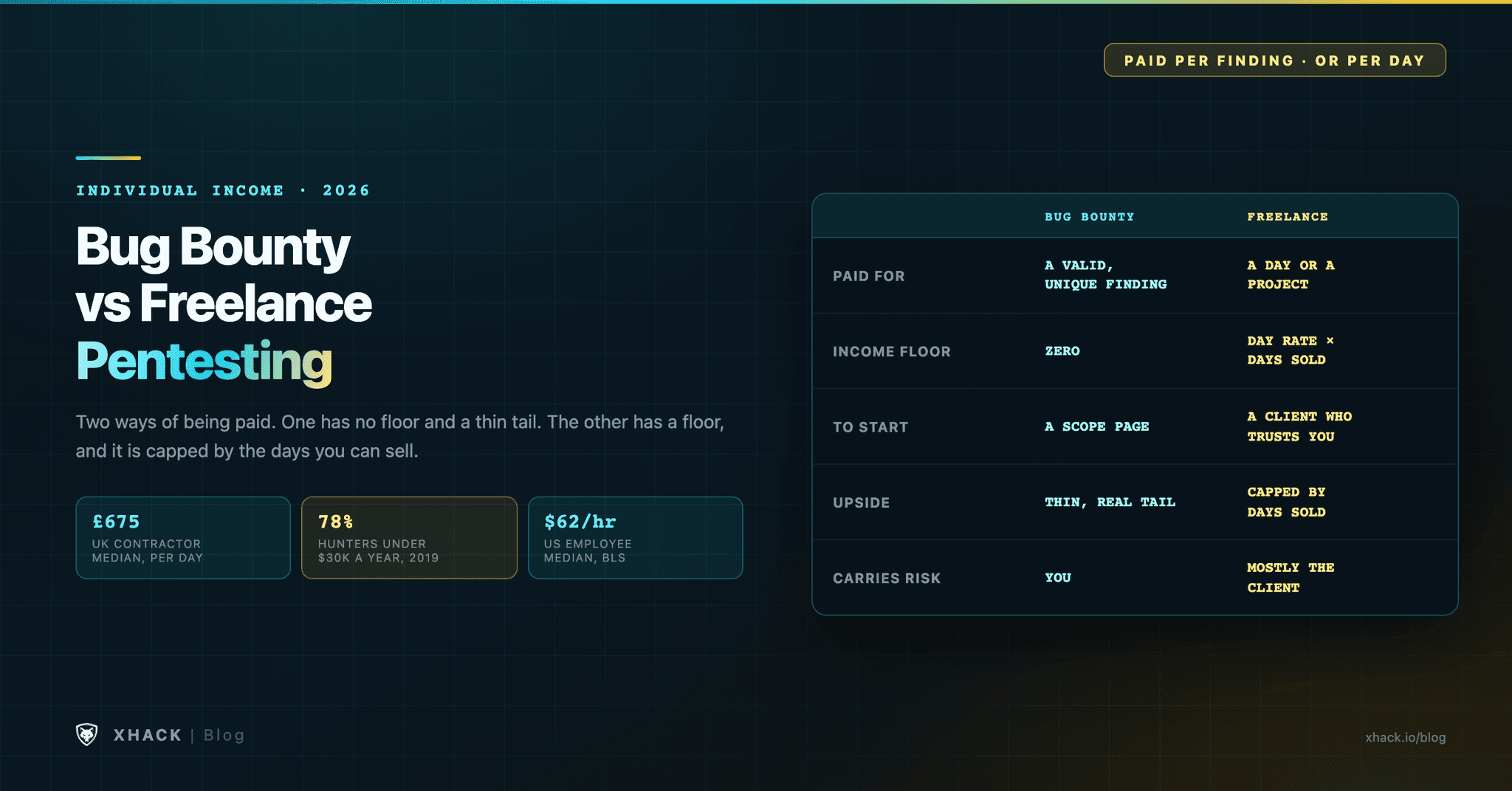
For the wider market, pentesting pay varies widely by country and by whether you sell days or findings. We covered the UK contractor numbers in how much bug bounty hunters make and the trade-offs in is bug bounty worth it. The short version: a salaried pentesting role gives a steadier income than bounty, and a freelance one gives a higher day rate but has to be sold.
The gap that most hunters have to close in a bug bounty career is the report. A client pays for a written assessment that someone else can act on, not for a single finding. Bounty reports already train that skill, and the nine-step recipe Daniel Stenberg published for curl’s maintainers is a good template. We cover it in why the curl bug bounty ended.
Another way to grow a bug bounty career is to move from finding bugs to preventing them.
Application security, often shortened to AppSec, means working inside a company that builds software. The job is to find and prevent the bugs that hunters report, not only to find them. A product security engineer does the same work for a company’s own products.
This route is a better fit for hunters who enjoy the fix as much as the exploit. Bounty work teaches you how software breaks from the outside. AppSec asks you to make it break less from the inside, through code review, threat modelling, secure design and working with developers.
Bugcrowd’s report has a line that fits this route. It says that when companies work well with hunters, “you might even end up hiring some onto your team as pentesters or security engineers.” That is a platform telling its customers to recruit from the community, not a survey of how often it happens, and we’re quoting it for what it says rather than as a measured rate.
Pay for these roles is the question people ask first. The US Bureau of Labor Statistics does not track application security engineers as their own occupation. Its closest category, information security analysts, had a median wage of $129,180 in May 2025, about $62 an hour, and projected growth of 21% from 2025 to 2035. Job boards and pay sites also publish averages for application security engineers. We could not open those pages to check how they were calculated, so we leave them out rather than quote numbers we cannot verify.
Red teaming is the route where a bug bounty career gets most technical, and most different from bounty itself.
Red teaming is adversary simulation: testing whether people and detection systems notice an attacker, not only whether a system has a bug. It is closer to the bounty mindset than AppSec is, but it asks for skills most bounty programs do not test.
One career guide we read describes the step from pentesting to red teaming as a matter of tradecraft more than tooling. It lists evading endpoint detection, running command-and-control infrastructure quietly, and keeping operational security as the dividing line. That is one author’s view, not a standard, but it points at what a bounty record does not show.
Bounty programs mostly test external web applications and APIs. The same guide suggests internal network and Active Directory work as the gap to close, and we agree that a bounty record alone rarely shows it. Lab certifications and a CTF record that covers networks and Windows environments fill that gap more directly.
Some red team jobs also ask for managing clients and leading engagements, which is a longer climb. We did not find a source that gives a reliable time to reach a lead role, and the figure one guide quoted is one we would treat as optimistic.
A bug bounty career can also run through the platforms themselves.
Bounty platforms need people on the other side of the table too: triage analysts, program managers, community staff and security advisers. These roles use the same knowledge a hunter has, but they ask you to judge reports, manage relationships and explain severity to both sides.
The history matters here. Press and company profiles say HackerOne was co-founded by Alex Rice, who previously led Facebook’s product security team and now serves as its co-founder and CTO. Coverage of Bugcrowd describes it as started by security researchers. Those are secondary sources, which we checked only against each other. The companies are evidence that a bug bounty career can move into the business side of the market, though it is not evidence that most hunters will.
The honest downside is that these roles are fewer than the hunters who want them, and they depend on the platforms hiring. Treat them as a possible move later in a career, not a first job.
Founding a company is the least common outcome of a bug bounty career we could find evidence for.
The most striking bug bounty career example in our research is Lupin & Holmes, a French security startup. Its founder, Roni Carta, was 23 when a March 2026 tech.eu report described his path. The report says he earned nearly $800,000 in bounties from Fortune 500 and large tech companies, including Google, Amazon and Netflix, and that he was named Most Valuable Hacker at two Google live hacking events. It describes his company’s product, Depi, as an upstream security platform that maps real attack paths, and it reports a $5.9 million pre-seed round led by 20VC and Seedcamp.
Read those as press and company claims, not verified facts. The bounty earnings figure comes from the report and the company, and we could not check it against any platform’s records. The product claim that bounty work shaped the design is the company’s own account of its insight.
The example also shows how rare this route is. A founder who earned that much from bounty, and who went on to raise a round, is a remarkable case. It is not the typical outcome, and nothing in the surveys above suggests it is.
If you are considering this route for your own bug bounty career, the lesson is less about money and more about insight. Carta’s account says hackers do not break through the front door but move through layers that tools miss. A company built around a specific observation about how attacks really happen has a better story than one built around general features.
Choose by the skill you want to be paid for, not the title. Whatever route you pick, the bug bounty career you build should show that skill in public.
| If you want to | Start with |
|---|---|
| Keep testing and sell your time | Pentesting or consulting, through a platform or direct clients |
| Build software that breaks less | Application or product security |
| Test people and detection, not just software | Red teaming, after closing the internal-network gap |
| Work with hunters, not as one | Platform, triage or community roles |
| Turn an insight into a company | Founding, after a sustained record |
The four-question test for any bug bounty career decision, in is bug bounty worth it still applies here. Can you name a first buyer? Can you go a few months without income? Do you have proof a buyer recognizes? Do you like writing for a reader you don’t know?
The honest answer is that the evidence on a bug bounty career is thin, and we want to be clear about where it runs out.
We found no survey that measures how often bounty history leads to a security job, and no source explaining how interviewers score bounty reports. One vendor guide advises employers to verify real-world experience, including CTFs, bug bounty and OSCP, because the field attracts many candidates who only know theory. That is advice from a vendor, but it suggests recruiters look for hands-on proof.
What we can say from the sources is what tends to make a bug bounty career record easy to trust:
These points are our synthesis of the sources, labeled as such, not a finding from a study of hiring decisions.
We build XHack AI, so here is exactly what it does for a bug bounty career, with no ranking claim.
It does not give you a client, a job, a certification or a reputation, and it does not decide whether a finding is worth reporting. Use it to produce reports you can check yourself. Individual plans start at $20 a month, with a 7-day free trial and no credit card.
The Intigriti and HackerOne surveys do not measure degrees, so we cannot say how often hunters without one get security jobs. The sources emphasize hands-on proof, such as reports, CTFs and certifications, over formal education. Check the requirements of the specific employer or platform you want.
Usually it is a good first step rather than a job. Most hunters in the Intigriti survey kept bounty part-time, alongside other work. Use it to build a record, then move toward a role with a steady income.
Probably, as proof of skill, but no source we found measures the effect. Synack’s pathway page does not say whether bounty experience counts toward eligibility, so do not assume it does.
We cannot give a reliable comparison across the five routes. Pay depends on country, seniority and whether you sell days or findings. The founder route can pay best, but it is the rarest, and the earnings figures in the example are company and press claims.
Certifications appear on Synack’s priority list and in several sources as useful for entry and mid-level roles. They are not required by bounty platforms. Pick one that matches the route you want.
Yes, and that is how most hunters in the surveys already work. Check your employer’s policy on outside testing, and keep any bounty work within each program’s scope and rules.
A bug bounty career is a record of verified work, and that record can lead to pentesting, AppSec, red teaming, the platform side of bounty, or a company of your own. The surveys say most hunters combine bounty with another security job, and that the record helps most as proof of skill.
Pick the route by the skill you want to be paid for. Build reports a stranger can act on. And be cautious about any single story of a fast climb, including ours.
Categories
Related articles