Table of contents
18
By Salman Khan, OSCP+, Founder of XHack, SRT (Synack Red Team member)
Read this in 30 seconds: The curl bug bounty ended on January 31, 2026 because AI slop buried it, but the sequel is stranger: the slop stopped, the reports got better, and curl still had to pause security reports for a month.
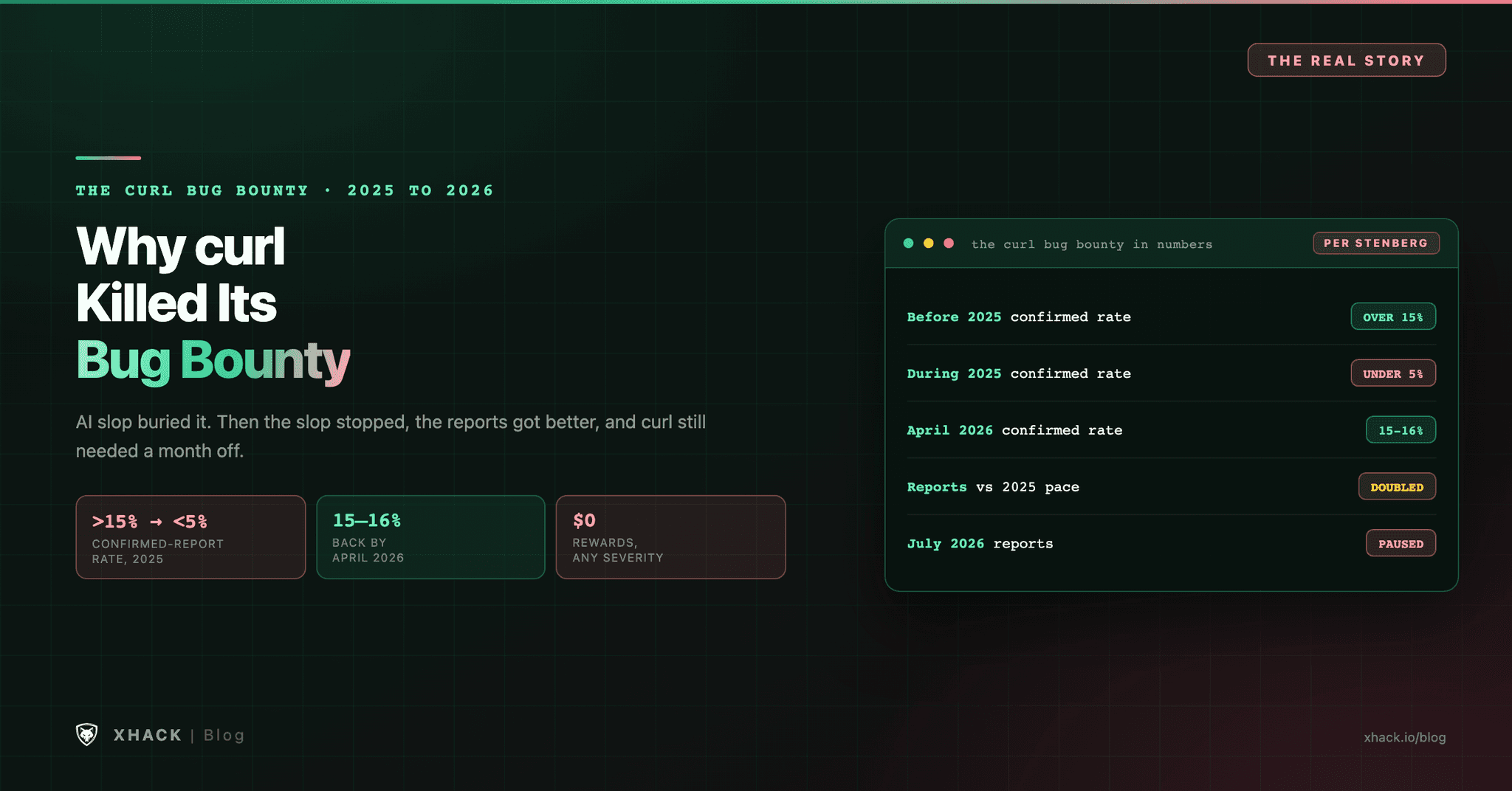
- The numbers that ended it. Stenberg says over 15% of reports used to be confirmed vulnerabilities, and from 2025 fewer than 5% were. The program had paid over $100,000 for 87 confirmed vulnerabilities.
- Then slop stopped being the problem. By April 2026, with curl back on HackerOne, the confirmed rate was back to 15-16%, and reports had doubled from 2025.
- The new problem is capacity. curl refused all vulnerability reports for July 2026, and the maintainers said it felt like relief.
- curl pays nothing now. Its policy says it never offers rewards for reported vulnerabilities, at any severity.
- Stenberg published a recipe for an excellent report. It’s nine steps, and almost none of them involve AI.
The headline said AI slop killed the curl bug bounty. The follow-up said AI made curl’s reports better and overwhelmed it anyway.
Most coverage stopped at January, with the program closing and the slop story wrapped up. Daniel Stenberg, curl’s founder, kept writing, and what he’s described since matters more to anyone who hunts bugs than the original shutdown did.
Here’s the full curl bug bounty timeline from his own posts, what actually changed, and what it means for you.
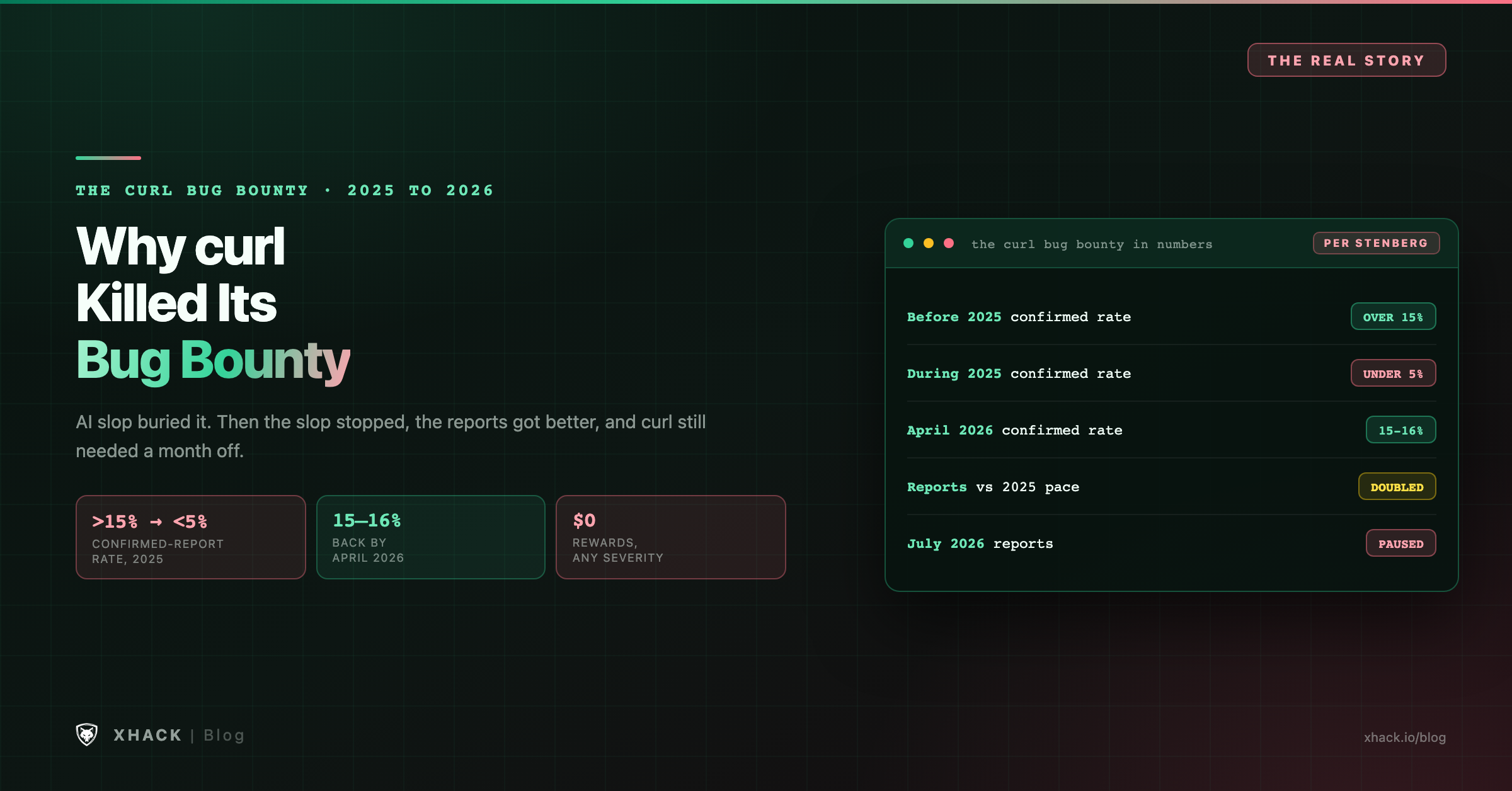
The curl bug bounty ran on HackerOne for years. By the time Stenberg announced its end in a January 26, 2026 post, it had produced 87 confirmed vulnerabilities and over $100,000 in rewards.
For most of that time, he writes, “somewhere north of 15%” of submissions ended up as confirmed vulnerabilities. That’s a healthy ratio for a popular program. Starting in 2025, it fell below 5%, which means fewer than one in twenty was real.
Curl is one of the most widely deployed pieces of software in the world, so the curl bug bounty was a magnet for anyone chasing a payout. The people reading those reports are a handful of volunteers who give curl limited weekly hours.
Stenberg described how the curl bug bounty was breaking in a July 2025 post titled “Death by a thousand slops.” About 20% of submissions that year were AI slop, he said, and only about 5% were genuine vulnerabilities.
The cost of running the curl bug bounty wasn’t the volume alone. Each report pulled in three or four members of the security team, for anywhere from 30 minutes to three hours each. A report that claims a hallucinated buffer overflow still has to be read, reproduced and disproved by a human.
He listed the tells: tidy bullet points, em-dashes, bold text, words like “delve,” and vulnerabilities that don’t exist in curl’s code. He also keeps a public gist of 49 slop reports from 2023 onward, mostly claiming memory bugs, injection, protocol exploits and broken crypto.
His proposals for the curl bug bounty at the time were to remove the money, charge a refundable fee per report, require a video proof of concept, or require reputation before bounty eligibility. He wanted to “reduce the amount of sand in the machine.”
By January, the argument was larger than slop. Stenberg named three trends: the mind-numbing AI slop, humans doing worse than ever, and what he called an apparent will to poke holes rather than help. The curl bug bounty paid people to find problems and, in his view, rarely led them to improve curl.
So on January 31 the bounty ended. Stenberg also stopped using HackerOne as the recommended channel, and sent reporters to GitHub’s private vulnerability reporting from February 1. Hunters had been paid for finding and reporting. Now they’d be paid nothing.
Bugcrowd’s guest opinion piece, published February 5, argued that laziness, not AI itself, killed the curl bug bounty. That’s a useful framing for what comes next.
This is the part most coverage missed. Here’s the sequence from Stenberg’s posts:
| Date | What happened |
|---|---|
| Jan 26 | Announces the end of the curl bug bounty, effective Jan 31 |
| Feb 1 | HackerOne stops being the recommended channel, GitHub private reporting takes over |
| Feb 25 | curl security moves again: 15 shortcomings of GitHub’s system listed, including no way to edit the CVE field, no labels, and full reports sent by email |
| Mar 1 | HackerOne becomes the official place to report again |
| Apr 22 | High-quality chaos: slop is no longer a problem, confirmed rate 15-16% |
| Jun 15 | Summer of bliss: no vulnerability reports during July |
| Jul 1 to Aug 3 | The pause. What the bliss taught us follows |
| Sep 2 | curl 8.22.0 ships with 9 security fixes, 70 days after the previous release |
The detour matters. curl left HackerOne and came back within a month because, in Stenberg’s list, GitHub couldn’t label reports as AI slop, couldn’t publish invalid reports, and sent whole reports over email. The platform’s moderation tools were part of what the curl bug bounty had needed all along.
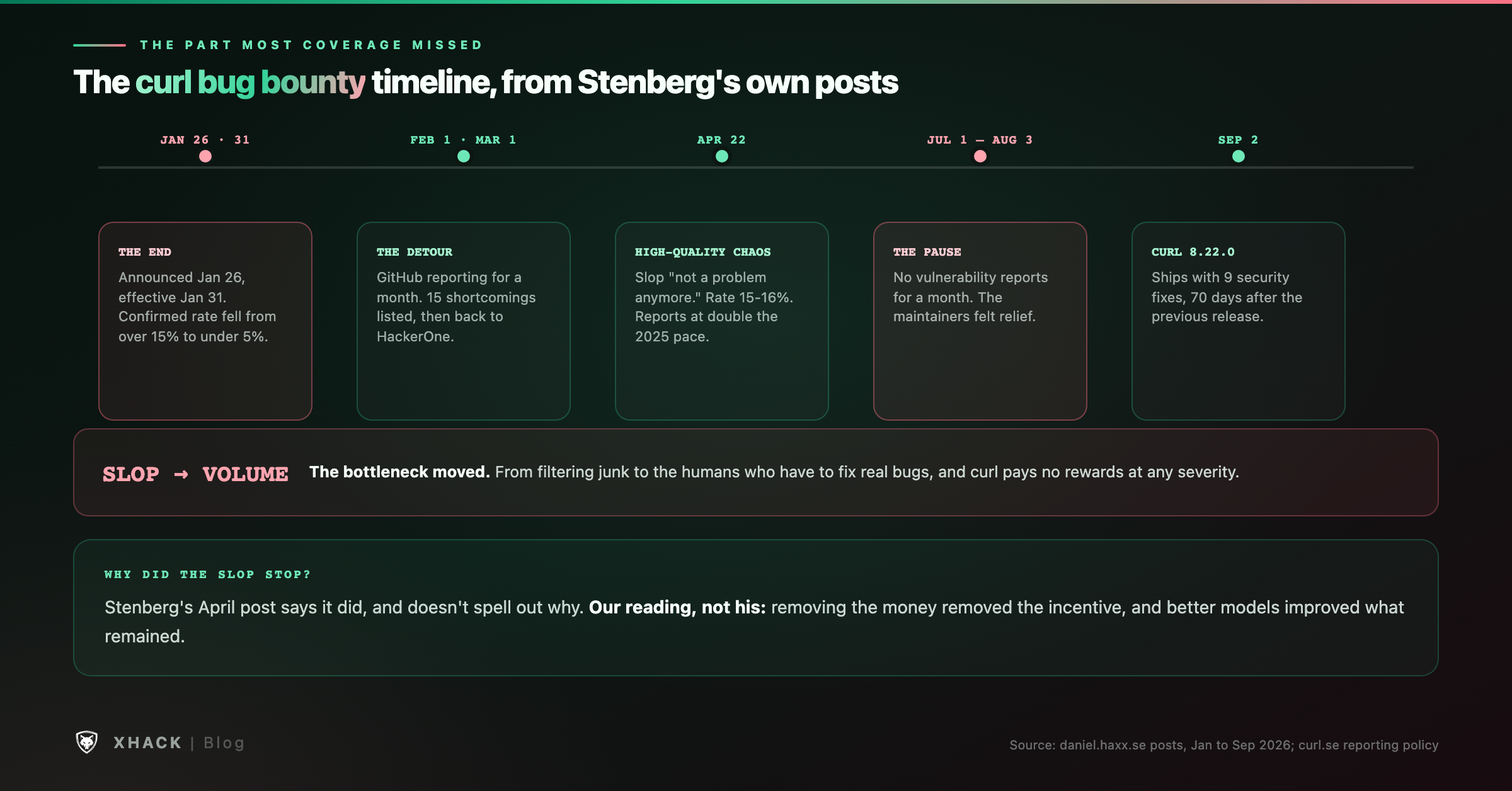
In his April post, Stenberg wrote that the slop situation “is not a problem anymore.” The confirmed rate was back to and above its pre-AI 2024 level, in the 15-16% range. And reports were arriving at double the 2025 rate, which had already more than doubled the years before.
He says almost every security report now uses AI to some degree, and the quality is high. He can tell by the wording, and by the fact that curl now gets very detailed duplicates “in ways that can’t be done” by humans alone. He notes that reporters rarely say which tool they used, and that curl doesn’t care.
That’s good news for security and bad news for maintainers. Stenberg predicted curl might publish closer to 50 vulnerabilities in 2026, warned the avalanche would make maintainer overload worse, and pointed out it’s also a good time for attackers, who can find the same issues with the same tools before projects have time to fix them. He said an informal poll showed the same shift at Apache httpd, the Linux kernel, Firefox, Python, Ruby, git and many others.
The April post says slop stopped. It doesn’t spell out why, and we shouldn’t invent a reason for Stenberg.
What changed is clear: the curl bug bounty was gone, and curl was back on HackerOne with its moderation tools. Our reading is that removing the money removed the incentive for low-effort submissions, and that better models made the remaining reports better. That’s inference from the sequence, not something the posts state.
It lines up with the Bugcrowd piece’s point: the problem was effort, and AI made lazy effort cheap. When there’s nothing to win, lazy effort stops being worth it.
If you hunt open source, or used to hunt the curl bug bounty, three things follow.
That connects to the rest of our research, which gives the curl bug bounty its wider context. Our guide to whether AI helps you win bug bounties covers how programs are responding, is bug bounty worth it covers the decision, and what bug bounty hunters make covers the money.
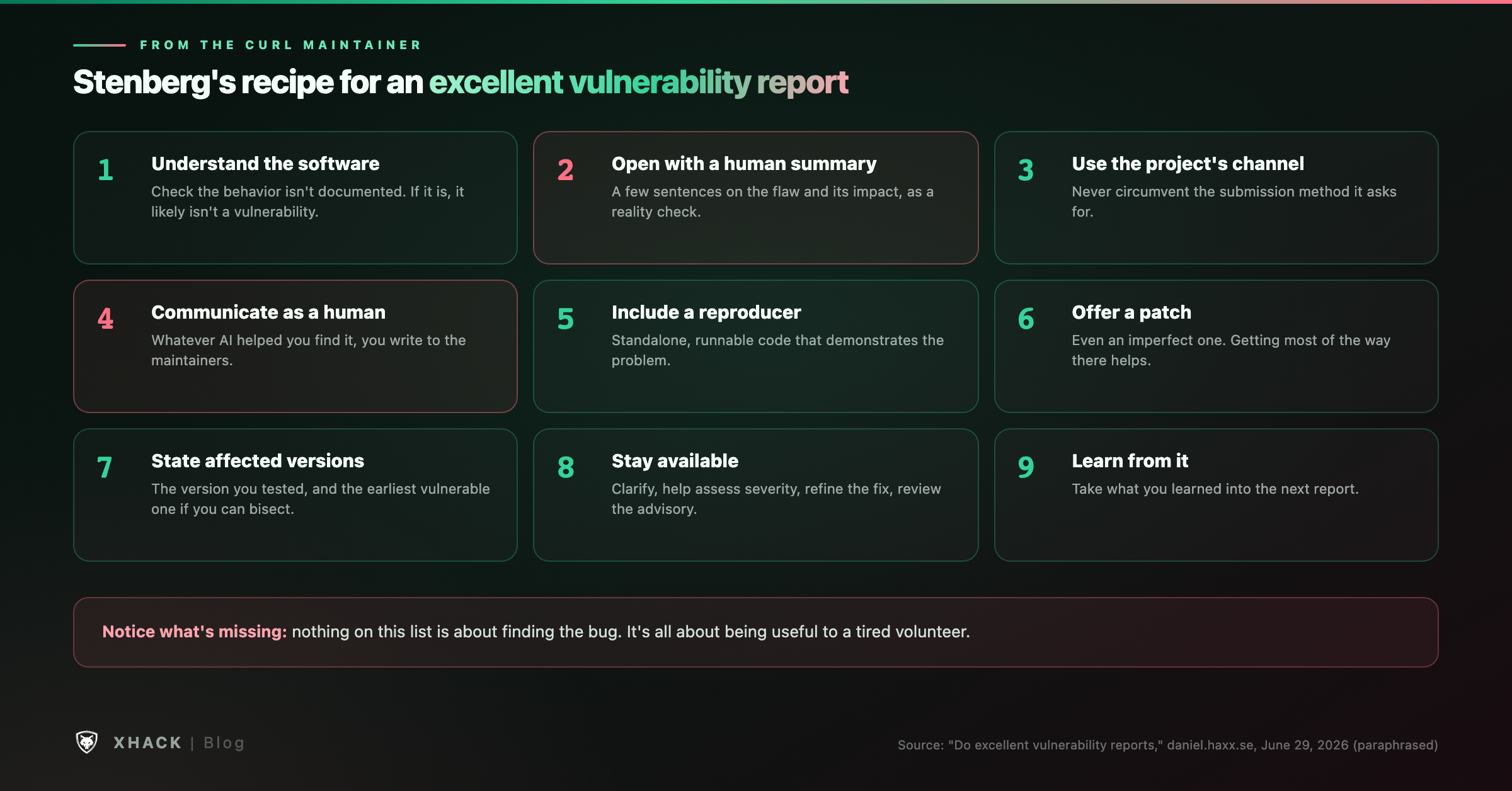
In June 2026, Stenberg published do excellent vulnerability reports. It’s the most useful thing to come out of the whole saga, and it reads like a checklist:
| Step | What it means in practice |
|---|---|
| Understand the software | Check the behavior isn’t documented. If it is, it probably isn’t a vulnerability |
| Open with a short human summary | A few sentences on the flaw and its impact, as a reality check |
| Use the project’s channel | Never circumvent the submission method it asks for |
| Communicate as a human | Whatever AI helped you find it, you write to the maintainers |
| Include a reproducer | Standalone, runnable code that demonstrates the problem |
| Offer a patch | Even an imperfect one. Getting most of the way there helps |
| State affected versions | The version you tested, and the earliest vulnerable one if you can bisect |
| Stay available | Clarify, help assess severity, refine the fix, review the advisory |
| Learn from it | Take what you learned into the next report |
Look at what’s on the list and what isn’t. Nothing on it is about finding the bug. It’s all about being useful to a tired volunteer, which is the opposite of what slop does.
We build XHack AI for bug hunters, so weigh this accordingly. It’s designed around the same idea as Stenberg’s recipe: the tool does the heavy lifting and you do the part only you can.
What it can’t do is write your opening summary, decide whether a behavior is documented, or stay available to the maintainer. Those are on you, and curl’s maintainers are explicit that they want to hear from a person. Access is gated by identity verification, and individual plans start at $20 a month with a 7-day free trial and no credit card.
Because AI-generated and other low-quality reports buried it. Stenberg says the confirmed-vulnerability rate fell from over 15% to under 5% in 2025, and he cited mind-numbing AI slop, humans doing worse than ever, and a will to poke holes rather than help. It ended January 31, 2026.
No. Its reporting policy says there is no bug bounty and the project never offers rewards for reported vulnerabilities. Reports go through HackerOne, which curl returned to on March 1, 2026.
Partly. AI-generated slop was a main cause. But by April 2026 Stenberg said the slop problem was gone and that almost every report now uses AI to some degree, with the confirmed rate back to 15-16%. Bugcrowd’s guest opinion piece argued the real cause was lazy hacking, not AI itself.
Yes, through HackerOne. It refused all vulnerability reports for July 2026, reopened on August 3, and Stenberg says it may repeat the pause. It doesn’t accept reports by email.
Follow Stenberg’s nine steps: understand the software, open with a short human-written summary, include a reproducer, offer a patch if you can, state affected versions, and stay available. Don’t paste long AI-generated explanations.
Nothing in Stenberg’s posts or curl’s reporting policy suggests it is. The policy says the project never offers rewards, and the curl bug bounty’s replacement is plain reporting through HackerOne with no payout.
That money attracts effort of every quality, that maintainer capacity is a scarce resource, and that AI changes the shape of the problem. Programs have since cut payouts, capped submissions or paused entirely, as we cover in our article on whether AI helps you win bug bounties.
The curl bug bounty ended because slop made it unworkable, but the more important fact is what came after: removing the money and returning to better tooling ended the slop, while AI-assisted reports doubled and kept coming. The bottleneck moved from filtering junk to the humans who have to fix real bugs.
For hunters, the lesson is to be the person a maintainer is glad to hear from. Use AI to find and reproduce, then write like a human, include a reproducer, offer a patch, and don’t expect the money. curl’s maintainers took a month off and nothing broke. That’s a better reason to hunt carefully than any bounty table.
Categories
Related articles