Table of contents
18
Read this in 30 seconds: “Uncensored AI for hacking” is searched by three very different crowds: curious people who found the term next to NSFW chatbots, criminals shopping for dark-LLMs, and actual security professionals who are tired of mainstream models refusing authorized work.
This guide is for the third group. It separates the real categories of uncensored AI (abliterated local models, criminal dark-LLMs like WormGPT and GhostGPT, and purpose-built verified-access agents), explains what each one actually gives you and what it costs you, and lays out what an authorized pentester actually needs: no refusal wall on in-scope work, plus the accountability and legitimacy that a raw uncensored model can never provide. Uncensored is not the same as unaccountable, and the pros who get this right know the difference.
“Uncensored AI for hacking” is one of the most misunderstood search terms in security right now. Type it into Google and you get a mess: NSFW companion apps, sketchy “download this and hack anyone” sites, and the occasional criminal forum ad. Almost none of it is written for the person who actually needs it.
That person is a working security professional. A pentester with a signed scope. A red teamer building a payload for an authorized engagement. A malware analyst who needs an AI that will actually look at the sample instead of clutching its pearls.
These people have a real problem. Mainstream AI refuses their legitimate work constantly, so they go looking for something that will not. And the internet hands them a choice between a criminal tool that will get them breached and a raw uncensored model that will happily hallucinate garbage with zero accountability.
Nobody lays out the actual options honestly, with the tradeoffs a professional cares about. So I did.
This is the honest guide to uncensored AI for hacking: what it really means, the three categories that get lumped together, what each one costs you, and what an authorized professional actually needs instead of just “no filter.”
Let’s define the term before the marketing ruins it.
Uncensored AI, in the technical sense, is a large language model whose refusal behavior has been removed or was never trained in. It answers questions that a mainstream, safety-aligned model would decline. That is the whole definition. It is a property of the model, not a moral stance.
Applied to security, uncensored AI for hacking means a model that will engage with offensive-security work: writing proof-of-concept code, analyzing malware, generating payloads for authorized tests, explaining exploitation techniques in depth, and doing the reverse engineering that safety filters usually block.
Here is what it does not mean, despite what the search results imply.
It does not mean an NSFW chatbot. A huge share of “uncensored AI” demand is adult content (the category pulled an estimated $82 million in consumer spend in the first half of 2025 alone), and that traffic pollutes every search for the term. Those tools have nothing to do with security.
It does not mean a magic hacking button. No model, uncensored or not, turns a beginner into a competent attacker. It removes the refusal; it does not supply the skill.
And critically, it does not have to mean a criminal tool. This is the distinction the whole article turns on. Removing a refusal filter and joining the cybercrime economy are two completely different things, and conflating them is exactly the mistake that gets professionals in trouble.
If you have never hit the wall, the demand sounds suspicious. If you do offensive security for a living, it is obvious.
Mainstream models refuse authorized security work at a measurable rate. Safety training teaches a model to associate offensive-security vocabulary (exploit, payload, shell, malware) with harm, so it refuses the words regardless of who is asking or whether the work is authorized. A 2026 study on this “defensive refusal bias” found safety-tuned frontier models refusing roughly one in five legitimate, in-scope security tasks, with malware analysis refused about a third of the time.
That is a real tax on legitimate work. When your AI assistant refuses to help write the proof-of-concept for a vulnerability you just found on a client system you are paid to test, you have two options: fight the model with careful phrasing, or find a tool that does not refuse.
The legitimate rationale for uncensored AI in security is straightforward. A model that will fully engage with offensive techniques lets a defender think like an attacker: simulate how an adversary would exploit a system, build the proof, and then fortify against it. You cannot pre-empt an attack you are not allowed to model. Security advocates have argued for years that verified professionals in research and defense should have access to models that deploy their full knowledge rather than refusing on sight.
The demand is not niche, either. Search interest for uncensored AI has been climbing fast (the query “uncensored AI app” grew 494% year over year per DataForSEO keyword data), and the security-flavored slice of that demand is real people with real authorized work being blocked by refusals.
The question is never whether professionals want uncensored AI for hacking. They clearly do. The question is which kind they reach for, because the three options are wildly different.
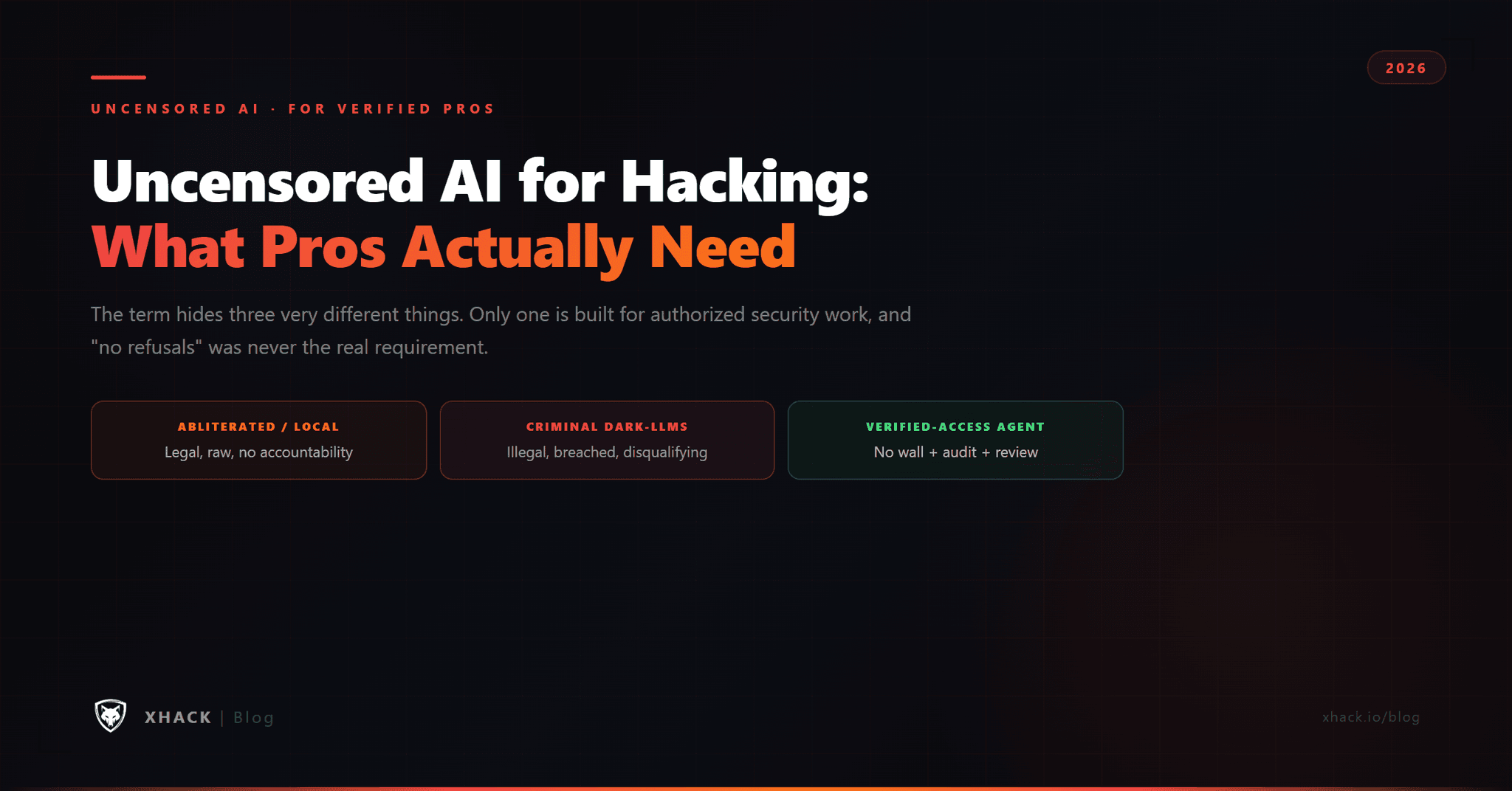
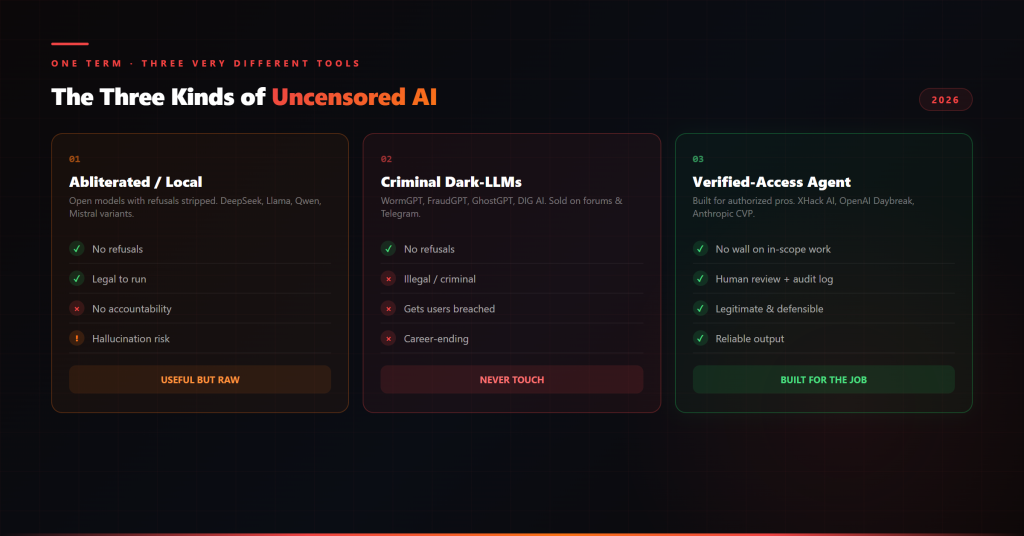
Everything marketed as “uncensored AI for hacking” falls into one of three categories. Here is the honest comparison before we break each one down.
| Category | What it is | No refusals? | Accountability | Legit for authorized work? | The real cost |
|---|---|---|---|---|---|
| Abliterated / local open models | Open-source models with refusals surgically removed (DeepSeek, Llama, Qwen, Mistral variants) | Yes | None (raw model) | Legal to run, but no audit trail or review | Quality, reliability, liability, you own everything |
| Criminal dark-LLMs | WormGPT, FraudGPT, GhostGPT, DIG AI, sold on forums/Telegram | Yes | None (and run by criminals) | No, never | Illegal, breached, career-ending |
| Verified-access agents | Purpose-built security AI for authorized pros (e.g. XHack AI) | No wall on in-scope work | Human review + audit logging | Yes, built for it | Subscription cost, depends on operator skill |
The rest of this guide is really about understanding those three rows, because picking the wrong one is how smart people torch their careers.
This is the DIY route, and it is the most legitimate of the “raw model” options.
Abliteration is a technique that permanently strips a model’s ability to refuse. Researchers identify the internal direction that represents refusal and surgically remove it, so the model keeps its knowledge and reasoning but loses the reflex to say no. The result is an uncensored LLM you can download and run locally, with no cloud, no terms of service, and no refusals.
The 2026 landscape is enormous. The ThreatDown cybercrime report counted 6,644 models on Hugging Face labeled “abliterated,” “uncensored,” “decensored,” “heretic,” or “unfiltered,” downloaded more than 22 million times in a single 30-day window. Popular security-capable variants include abliterated builds of DeepSeek R1 (strong uncensored reasoning), Llama 3.1, Qwen, Gemma, and Mistral Small, findable on Hugging Face through those keywords and collections from known abliteration authors.
What you get: full local control, privacy (nothing leaves your machine), no refusals, and no subscription. For a skilled operator who wants an offline assistant that will engage with any technical question, this is genuinely useful.
What it actually costs you, and this is where the marketing goes quiet:
Local uncensored models are legal to run and legitimately useful for skilled professionals who understand the tradeoffs. They are not a professional workflow on their own, because “no refusal” is only one of the things real offensive work requires.
This is the category that gives “uncensored AI for hacking” its bad name, and for good reason.
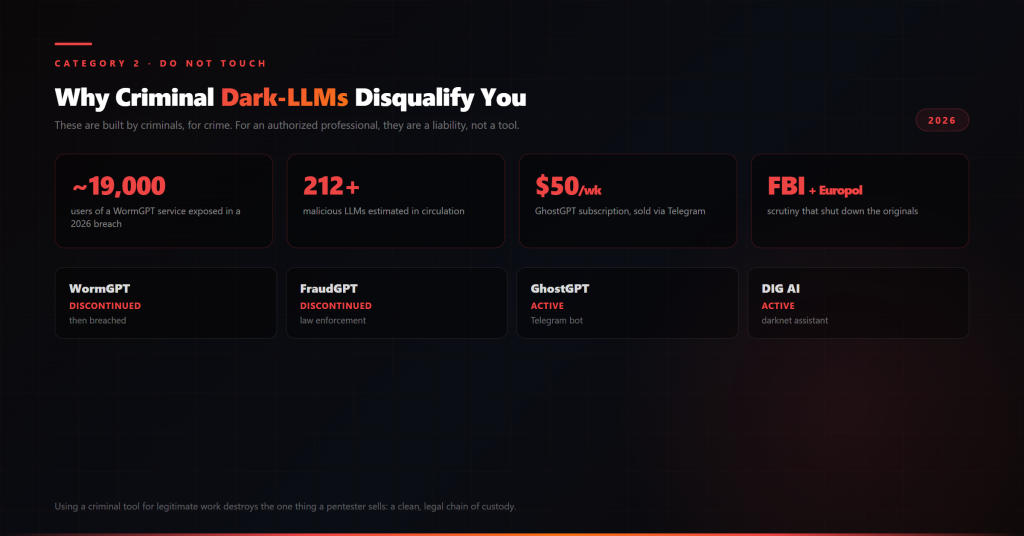
Dark-LLMs are models built by and for criminals, marketed on dark-web forums and Telegram, and explicitly designed to write malware, phishing campaigns, and fraud content without any restriction. The famous names:
WormGPT and FraudGPT were the originals, jailbroken models trained to produce malicious output. Both were discontinued after law enforcement scrutiny from agencies like Europol and the FBI. WormGPT’s name kept resurfacing on clone services, and in a fitting twist, a 2026 breach of one such service reportedly exposed close to 19,000 user accounts, including emails and payment metadata. The people who paid for a “no rules” hacking AI got their own identities dumped on a breach forum. If WormGPT’s promise still sounds appealing, our full breakdown of what a legitimate WormGPT alternative actually looks like covers exactly why that road keeps ending in a breach forum, and what a professional should use instead. We’ve also written a closer look at a genuinely uncensored alternative built for professionals, not criminals, if you want the deeper comparison.
GhostGPT is the current-generation example, advertised on forums and sold via Telegram as a bot, with subscriptions reportedly starting around $50 per week. DIG AI is an uncensored darknet assistant researchers documented helping automate attacks. By 2026, estimates put the number of malicious LLMs in circulation at over 212, and the broader trend is cybercrime-as-a-service: these tools are built for scale and sold as subscriptions to anyone.
Here is the uncomfortable reality for professionals: even the criminals are moving away from bespoke dark-LLMs and increasingly just jailbreak mainstream models like ChatGPT and Claude instead. The dark-LLM market is a scam-ridden mess where the buyers get robbed as often as the targets.
For an authorized professional, this category is disqualifying, full stop. Using a criminal tool for legitimate work does not make you a criminal, but it destroys the one thing your profession sells: trust and a clean, legal chain of custody. It exposes you to the exact breaches these services suffer. And it puts you one investigation away from having to explain why you were subscribed to a malware-writing service. No engagement is worth that. Uncensored AI for hacking should never mean criminal AI, and any guide that blurs that line is doing you harm.
This is the category most “uncensored AI” lists skip entirely, and it is the one built for the professional use case.
A verified-access agent is an AI built specifically for authorized security work. Instead of refusing everyone because it cannot tell who is authorized, or removing all safety and hoping for the best, it moves the gate to the right place: it is built for verified professionals, so it does not need to refuse in-scope offensive work, and it wraps that capability in accountability.
This is not a fringe idea. It is the exact model the biggest AI labs converged on in 2026. OpenAI built a trusted-access cyber program (Daybreak) that gates offensive capability behind identity verification, monitoring, and legal attestations. Anthropic rolled out a Cyber Verification Program to let vetted professionals do work the default Claude refuses. Both companies looked at over-refusal, agreed that blanket refusal was blocking defenders, and landed on the same answer: verify the human, then allow the work.
The difference between this and a raw abliterated model is everything a professional actually cares about:
The big labs implemented verified access as heavyweight, expensive, enterprise-gated programs. The gap that leaves is a tool that gives working professionals and small teams the same responsible-access model without a six-figure contract.
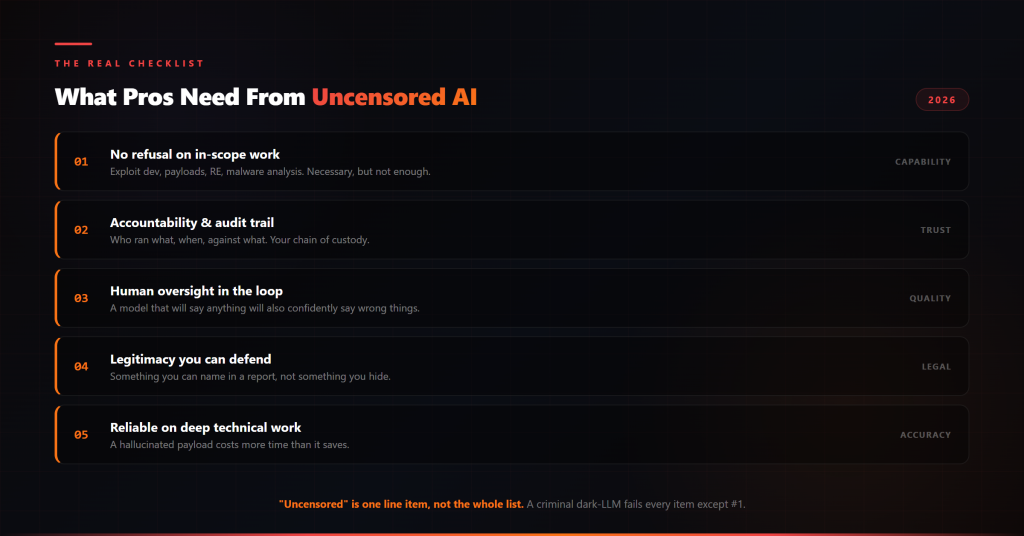
Strip away the hype and here is the real checklist. “Uncensored” is one line item on it, not the whole list. When a security professional evaluates uncensored AI for hacking, these are the things that actually matter:
Notice how many of these an abliterated model fails and a criminal dark-LLM fails catastrophically. “No refusal” is necessary but nowhere near sufficient. The professionals who get the most out of uncensored AI are the ones who treat accountability as a feature, not an obstacle.
Here is the quick framework I use to sort a legitimate uncensored AI tool from a trap. Run any option through these questions before you touch it.
Where did it come from? A model from a known open-source author or a named security vendor is defensible. A tool advertised on a dark-web forum or a Telegram channel is not. Provenance is the first filter, and it eliminates the entire criminal category instantly.
Can you name it in a report? If you would be comfortable writing “assisted by [tool]” in a client deliverable and defending it in a room, it passes. If the honest answer is that you would hide it, that tells you everything.
Is there accountability in the loop? Look for audit logging, human review, and a real reporting pipeline. A tool that produces output with no trace of who did what is fine for tinkering and useless for professional engagements.
Does it actually verify anything? The responsible model gates capability by verified identity, not by removing all safety and hoping. If a tool’s entire pitch is “no rules, no questions,” that is a red flag, not a feature.
Is the output reliable enough to trust? Test it against something you can verify. An uncensored model that hallucinates a broken payload or the wrong offset is worse than no help, because it costs you time and credibility.
Score any option honestly against those five and the choice usually makes itself. Legitimate local models pass provenance and legality but need you to supply the accountability. Verified-access agents pass all five. Criminal dark-LLMs fail every one that matters.
Even experienced people get this wrong. The recurring mistakes:
Mistake 1: Treating “uncensored” as the only requirement. Removing the refusal is the easy part. Replacing the accountability, reliability, and legitimacy a professional workflow needs is the hard part, and a bare model does not do it.
Mistake 2: Downloading whatever tops the “best uncensored LLM” list. Those lists rank on refusal removal and vibes, not on technical accuracy for security work or on where the model came from. Provenance matters.
Mistake 3: Touching criminal tooling “just to test it.” There is no safe way to sample a dark-LLM. You expose yourself to their breaches, their legal footprint, and their scams. Curiosity is not a defense.
Mistake 4: Trusting uncensored output blindly. Abliterated models hallucinate more, not less, on hard technical questions. Every generated exploit or payload needs the same validation you would apply to any untrusted source.
Mistake 5: Ignoring authorization and scope. No model changes the law. Uncensored AI for hacking is only legitimate against systems you are authorized to test. The tool removes the refusal, not the rules of engagement.
So yeah, here is where we talk about what XHack brings to the table. Since this whole guide is about the gap between “no refusals” and “actually usable by a professional,” here is our honest take.
XHack AI is built for authorized security professionals, so unrestricted capability is a core feature, not a refusal to fight against. The unrestricted AI capability is a named part of the product: exploit development, custom payload generation, reverse engineering, and malware analysis are treated as the professional tasks they are. That is the “uncensored” part done right, oriented around people doing authorized work rather than a general chatbot with its safety cut off.
The difference from a raw abliterated model is the accountability that professional work requires. XHack AI runs as a multi-agent system where findings pass through a human review stage, and actions are written to an audit log with traceability. You get the no-refusal workflow without the “black box on my laptop with no chain of custody” problem. It is the verified-access model the big labs converged on, built to be accessible instead of locked behind an enterprise procurement cycle.
And here is the part privacy-conscious professionals care about most: XHack does not store your user data, and it is privacy-focused by design. Your pentest chats and session data stay on your own local computer, and you can delete them any time you want. That is the one real advantage a local abliterated model has, full local privacy, without the reliability and accountability tradeoffs that come with a raw model. You keep the audit trail for your own chain of custody, but your client’s sensitive findings are not sitting on someone else’s servers waiting to become the next breach headline.
Under the hood, specialized agents handle reconnaissance, analysis, exploitation, validation, and reporting, coordinating like a red team, with an autonomous browser engine that drives a real browser to test multi-step workflows. Human experts handle the depth and judgment AI still cannot replace. It is the same human-plus-AI model behind our VAPT services.
Now the honest part, because brutal honesty is kind of our thing. Uncensored capability is not a magic button, and it depends on the operator. Point any no-refusal tool at random targets with no plan and you get noise, or worse. The AI is a force multiplier for a skilled professional, not a replacement for skill or for authorization. And XHack AI is focused on web and API testing, so for large-scale internal Active Directory work, a network-specialized platform goes deeper on that specific job.
On pricing, we say it plainly instead of hiding it. These are individual plans, priced for a single professional rather than a company seat: Professional is $49/month and includes unrestricted AI access, and Elite is $150/month with fully unrestricted AI plus malware analysis tools, custom payload generation, and OWASP LLM Top 10 testing. Company-wide adoption runs on separate plans starting at $560/month, and Enterprise is custom. Both tiers start with a 7-day free trial, no credit card required. That is the difference between qualifying for a gated enterprise cyber program and just starting authorized work this week.
If you want more background, our honest comparison of the best AI pentesting tools breaks down where each platform fits, and our rundown of autonomous pentesting tools covers how AI agents actually chain exploits on authorized targets.
Want to know whether an unrestricted workflow fits your work? Book a free consultation and we will tell you straight, even if the honest answer is that you do not need us.
Uncensored AI for hacking is a large language model whose refusal behavior has been removed or was never trained in, used for offensive-security work like proof-of-concept development, payload generation, reverse engineering, and malware analysis. Mainstream models refuse these tasks even for authorized professionals, so security pros look for uncensored alternatives. The term covers three very different things: legal abliterated open models you run locally, criminal dark-LLMs sold on forums, and purpose-built verified-access agents for authorized professionals. Only the first and third are legitimate.
Running a legal, open-source uncensored model is legal, and using it to assist authorized penetration testing with a signed scope is legal too. What makes hacking illegal is doing it against systems you are not authorized to test, and that is true regardless of which AI you use. The tool removes the refusal, not the law. Criminal dark-LLMs are a separate matter: subscribing to a service built to commit fraud and write malware carries real legal and reputational risk even before you use it.
An uncensored or abliterated model is a general open-source model with its refusal filter removed; it is legal to run and neutral in intent. A dark-LLM like WormGPT, FraudGPT, or GhostGPT is a tool built and marketed specifically for crime, sold on dark-web forums and Telegram. The distinction matters enormously for professionals: an abliterated model is a legitimate (if raw) tool, while a criminal dark-LLM is disqualifying to touch. Notably, several dark-LLMs have been discontinued or breached, with one 2026 leak exposing around 19,000 users of a WormGPT service.
They are useful but incomplete. Abliterated models remove refusals and run privately with full local control, which is genuinely helpful for a skilled operator. But they often hallucinate more on deep technical work, provide no audit trail or human review, and carry the reputational baggage of the wider uncensored-model ecosystem. For professional engagements that need a defensible chain of custody and reliable output, a raw local model is one component at best, not a complete workflow.
Because safety training teaches models to associate offensive-security vocabulary with harm, and a general model has no reliable way to verify that you are authorized. So it refuses based on how a request sounds rather than who is asking. Research on defensive refusal bias found safety-tuned models refusing roughly one in five legitimate, authorized security tasks. This over-refusal is exactly why professionals seek uncensored alternatives, and why the industry moved toward verified-access programs that gate capability by identity instead of refusing everyone.
A verified-access security agent built for authorized work, or a legal local model used with proper validation and authorization. The professional need is not just “no refusals,” it is no refusals on in-scope work plus accountability, human oversight, legitimacy, and reliable output. That combination is what OpenAI’s and Anthropic’s 2026 verified-access cyber programs, and purpose-built agents like XHack AI, are designed to deliver. A criminal dark-LLM fails every one of those requirements except the first.
“Uncensored AI for hacking” is a term the internet has made almost meaningless, buried under NSFW apps and criminal ads. For the security professional who actually needs it, the real picture is clearer than it looks.
There are three categories, and they could not be more different. Abliterated local models are legal and useful but raw, unreliable on the hard stuff, and accountable to no one. Criminal dark-LLMs are illegal, breached, scam-ridden, and disqualifying to touch. Verified-access agents give you the no-refusal capability inside the accountability and legitimacy that professional work demands.
The lesson is that “uncensored” was never the real requirement. Removing the refusal is easy. What separates a professional tool from a liability is everything that comes after: human oversight, an audit trail, legitimacy you can defend, and output you can trust. Uncensored is not the same as unaccountable, and the pros who understand that are the ones who stay employed.
If you want unrestricted capability for authorized security work with the accountability built in, that is exactly the gap XHack AI was built to fill. The refusal wall is a real problem. Joining the cybercrime economy is not the fix. Verified access is.
Follow us on X @xhackio
Categories
Related articles