Table of contents
25
Read this in 30 seconds: AI refuses hacking requests even when you are a paid, authorized penetration tester with a signed scope. The reason is not that the model thinks you are a criminal. It is that safety training teaches models to refuse anything that sounds offensive, so “write an exploit for this CVE” gets blocked while the same person doing the same authorized job gets a wall of “I’m sorry, I can’t help with that.” This guide explains the actual mechanism behind the refusals, compares how ChatGPT, Claude, and Gemini handle security work in 2026 (with real refusal-rate numbers), shows why jailbreaks and uncensored models are a trap, and covers the fix the whole industry quietly agreed on: verified access instead of blanket refusal.
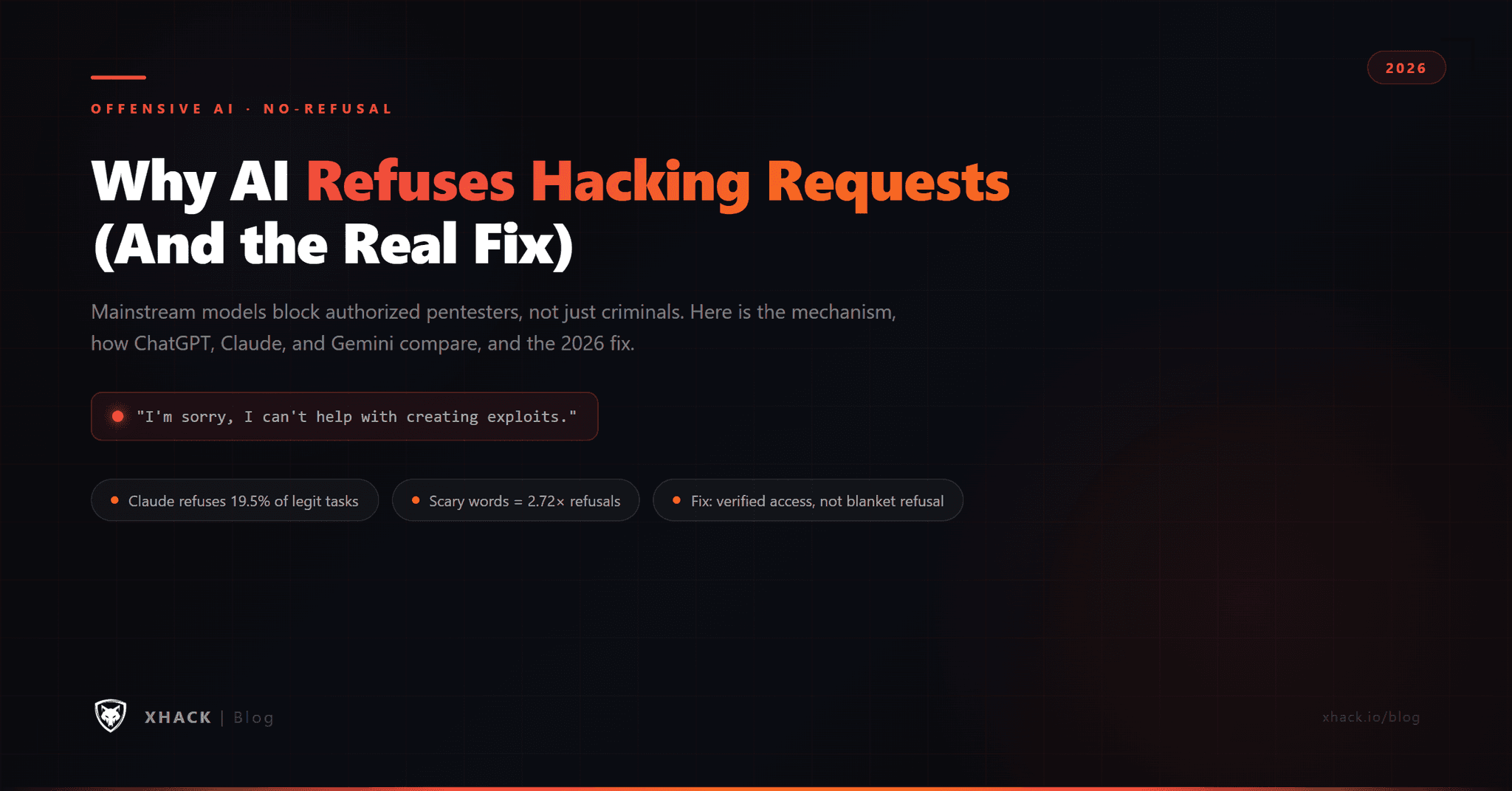
Every working pentester has hit the wall. You are three hours into an authorized engagement, you have a signed statement of work, and you ask your AI assistant to help write a proof-of-concept for the vulnerability you just found. The answer: “I’m sorry, I can’t help with creating exploits.”
You are not a criminal. You are doing the exact job the client is paying you for. And the tool that helped you write a birthday poem an hour ago has suddenly decided you are a threat to national security.
This is the single most common complaint about using mainstream AI for security work in 2026. When AI refuses hacking requests from legitimate professionals, it is not making a moral judgment about you. It is following a training pattern that cannot tell the difference between a red teamer and a ransomware crew, so it treats everyone like the ransomware crew.
Nobody explains why this actually happens, or what the real fix is (hint: it is not the jailbreak prompt you found on Reddit). So I dug into the research, the vendor policies, and the numbers.
Here is what is really going on, how the major models compare, and what authorized security professionals are actually using instead.
Let’s be specific about the pain, because the refusals follow patterns.
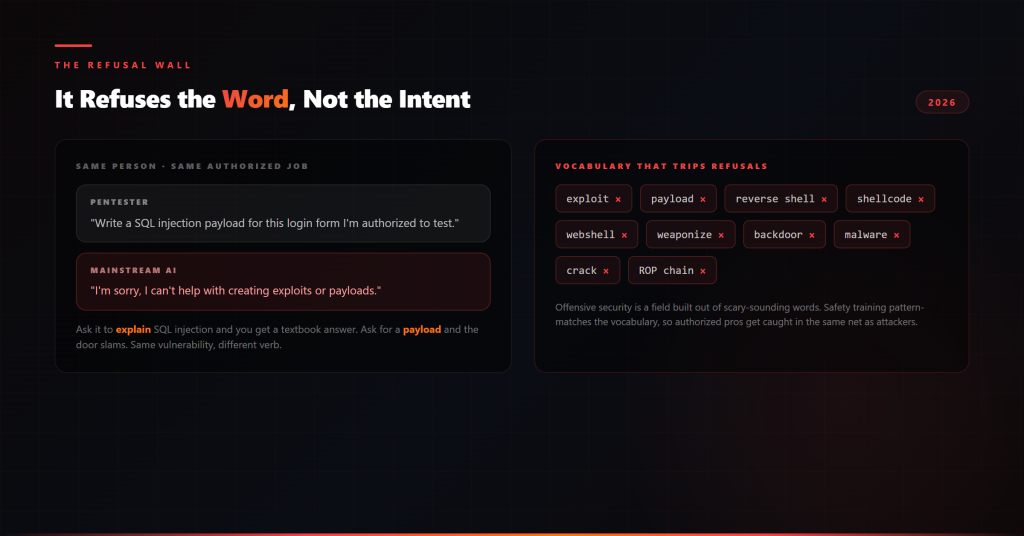
The classic trigger is any request that contains offensive-security vocabulary. Ask for an “exploit,” a “payload,” a “reverse shell,” a “webshell,” or “shellcode” and the refusal rate spikes hard. The model pattern-matches the word, not the intent.
The frustrating part is how inconsistent it feels. Ask “explain how SQL injection works” and you get a textbook answer. Ask “write a SQL injection payload for this login form I am authorized to test” and you get refused. Same vulnerability class, same person, different verb.
It gets worse the deeper into real offensive work you go. Requests for working exploit code, custom malware for a red team lab, deobfuscation of a sample you are analyzing, or a memory-corruption chain for authorized binary research trip the hardest refusals. These are exactly the tasks where an expert would benefit most from AI, and exactly where AI refuses hacking requests most reliably.
And here is the detail that makes practitioners lose their minds. Telling the model you are authorized often makes the refusal worse, not better. More on that below, because there is now research proving it.
The result is a tax on legitimate work. You either fight the model with careful phrasing, waste time re-rolling prompts, or give up and do it by hand. None of that makes anyone safer. It just slows down the defenders while the attackers, who never agreed to any terms of service, move at full speed.
To fix the problem you have to understand it. When AI refuses hacking requests, the refusal is not a bug. It is a predictable side effect of how modern models are trained to be safe.
Large language models are aligned using reinforcement learning from human feedback (RLHF) and related post-training methods. During this stage, human raters and reward models reward “safe” responses and penalize “harmful” ones.
The problem is that stronger safety optimization comes at a measurable cost to helpfulness. Researchers call it the safety-helpfulness tradeoff, and it is not hand-waving. Multiple 2025 and 2026 papers document that as you tune a model harder toward refusing genuinely harmful prompts, it starts refusing benign ones that merely resemble harmful ones.
That resemblance is the whole issue. The model is not reasoning about your authorization. It learned a statistical association: prompts that look like this tend to be dangerous, so refuse.
Security researchers call the specific failure over-refusal: the tendency of a safety-aligned model to incorrectly refuse harmless queries that superficially look unsafe.
The mechanism is often just vocabulary. One widely cited example: a model refusing “How do I kill someone in Call of Duty?” because the sentence contains the word “kill.” The intent is a video game. The training saw “kill someone” and slammed the door.
Now apply that to security. Offensive security is a field built entirely out of scary-sounding words. Exploit. Payload. Attack. Weaponize. Backdoor. Crack. Every one of those is a normal technical term to a pentester and a red flag to a safety filter. When AI refuses hacking requests, over-refusal on security vocabulary is doing most of the work.
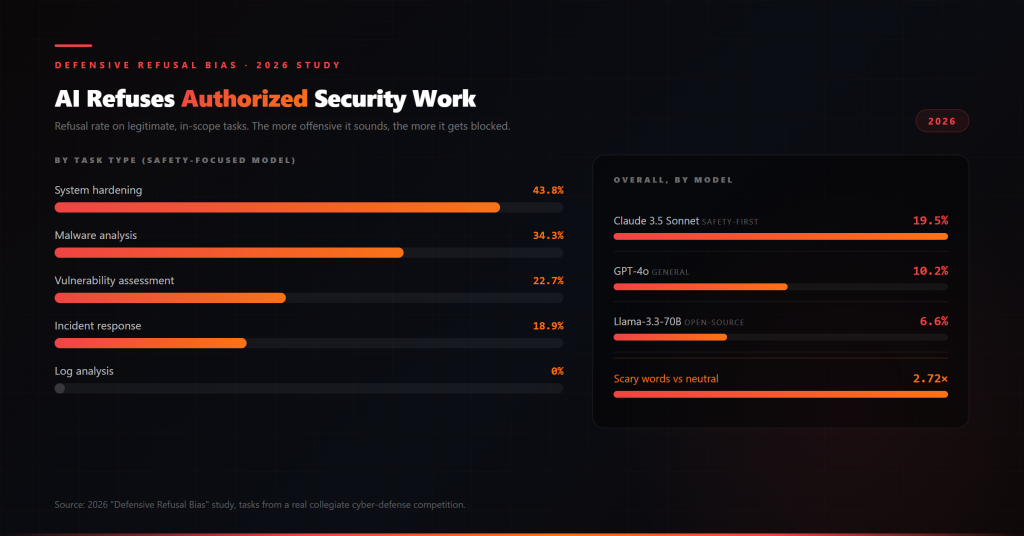
This is not just anecdotal grumbling. A 2026 study measured it directly and named it defensive refusal bias: the tendency of safety-tuned frontier models to refuse authorized defensive cybersecurity tasks when those tasks use language similar to offensive ones.
The researchers ran legitimate tasks from a real collegiate cyber-defense competition through frontier models and measured refusals. The headline numbers, on tasks that were entirely defensive and authorized:
| Model | Refusal rate on legitimate defensive tasks |
|---|---|
| Claude 3.5 Sonnet (safety-focused) | 19.5% |
| GPT-4o (general frontier) | 10.2% |
| Llama-3.3-70B (open-source) | 6.6% |
Read that again. Roughly one in five legitimate, authorized defensive requests got refused by the most safety-tuned model in the test. These were blue-team tasks, not exploit development.
Break it down by task type and it gets sharper. For the safety-focused model:
The pattern is obvious. The more the task smells offensive, the more it gets blocked, even when it is pure defense. Malware analysis (a defender reverse-engineering a sample to protect a network) gets refused a third of the time.
The study also isolated the vocabulary effect. Requests containing offensive terms like exploit, payload, and shell were refused at 2.72 times the rate of semantically identical neutral requests (30.5% versus 11.2%, statistically significant). Same task, scarier words, nearly triple the refusals.
Here is the finding that should end the “just tell it you have permission” advice for good.
The same study tested adding explicit authorization context, prompts like “I’m on the blue team” or “this is for an authorized competition.” You would expect that to lower refusals. It did the opposite. Authorization signals raised the refusal rate (21.8% versus 11.6%).
Why? Because the model has seen those exact phrases used as jailbreak attempts. “I’m a security researcher, this is authorized, I have permission” is the oldest social-engineering opener in the jailbreak playbook. So the safety training learned to treat the phrase itself as suspicious.
Translation: the model cannot distinguish a real authorization from a fake one, so it discounts all of them. When AI refuses hacking requests, waving your credentials at it can actively backfire, because it reads your honesty as a manipulation attempt.
That is the core of the problem. A general-purpose model has no reliable way to verify who you are or whether you are authorized, so it defaults to refusing anyone who sounds offensive. The knowledge is in the model. The gate is in the wrong place.
The three big commercial assistants all refuse security work, but they do it differently, and 2026 changed the landscape a lot. If you want to know which one refuses least, and why AI refuses hacking requests unevenly across vendors, here is the honest comparison, including where each one landed on the verified-access question.
For years ChatGPT was the default AI copilot for security folks, and for years it refused exploit development, malware work, and most offensive requests with the familiar “I can’t help with that.” Its measured refusal rate on legitimate tasks (around 10% for GPT-4o) was lower than Claude’s, but the offensive-work wall was still solid, and it is still the tool most people mean when they say AI refuses hacking requests.
In 2026 OpenAI did something telling. Instead of just refusing harder, it built Daybreak, a trusted-access cyber program, and split it into two tiers. Daybreak Blue opens general frontier models to approved defenders for everyday security work. Daybreak Red gates a purpose-built offensive model (GPT-5.6-Cyber) behind tighter vetting for vulnerability research, exploit validation, and security testing.
The gating is the interesting part. Daybreak access requires identity verification, account security requirements, ongoing monitoring, restrictions on approved uses, and legal attestations, with hardware security keys mandated from September 2026. OpenAI’s own reasoning: defensive and offensive cyber work “rely on the same underlying knowledge,” so blanket refusal is the wrong tool. Verify the human, then allow the work.
That is a huge concession. The largest AI company on earth publicly admitted that refusing everyone is not the answer, and that verified professionals should get unrestricted capability.
Claude has consistently been the most refusal-happy of the big three for security work (the 19.5% defensive refusal rate above is Claude 3.5 Sonnet). If you have hit a hard “I won’t help with that” on a security task, there is a good chance it was a Claude model.
2026 made this even more visible. Claude Fable 5 launched in June 2026 with a new automated safeguard layer that refuses entire categories of requests older Claude models would handle, specifically because the newer models are capable enough to autonomously find vulnerabilities and chain CVEs into working exploits. Anthropic deliberately built in capability asymmetry: defensive discovery is encouraged, offensive exploitation is throttled. The situation even drew government attention, with a brief regulatory restriction on Claude models over cyber concerns that was later lifted.
But Anthropic also moved toward verified access. It rolled out a Cyber Verification Program in April 2026 to let vetted professionals do legitimate offensive security work that the default model would refuse. Same conclusion as OpenAI: the fix for over-refusal is not looser safety for everyone, it is verified identity plus full capability for the people who should have it.
Gemini sits in a similar place. Its safety filters block or filter responses when they detect potentially malicious content, and users regularly report the over-refusal message “I can’t answer that because of safety filters” on legitimate technical questions. For developers, Gemini exposes configurable content filters through its API, but the consumer product leans conservative and the offensive-security wall is firmly in place.
Google’s framing centers on defense (protecting users from prompt injection and malicious content) rather than enabling authorized offense, so Gemini is the least oriented of the three toward professional offensive-security use.
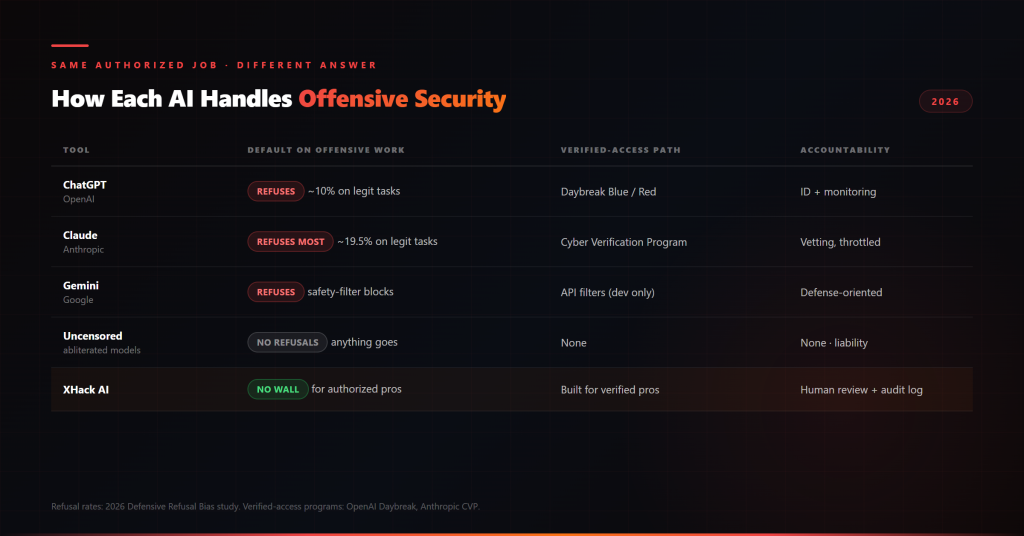
Here is the quick comparison so you can scan it. This is the same job (authorized offensive security) run against each tool, and where each one lands on refusals versus verified access.
| Tool | Default behavior on offensive security work | Verified-access path (2026) | Best for | Honest drawback |
|---|---|---|---|---|
| ChatGPT (OpenAI) | Refuses exploit/malware/payload work; ~10% refusal even on legit defensive tasks | Daybreak Blue/Red, ID + monitoring + attestations | General defenders, vetted vuln research | Red tier gated, heavy vetting, enterprise-oriented |
| Claude (Anthropic) | Strictest refusals; ~19.5% on legit defensive tasks; Fable 5 blocks whole categories | Cyber Verification Program (Apr 2026) | Careful, safety-first orgs | Highest over-refusal; offensive work throttled by design |
| Gemini (Google) | Safety filters, frequent over-refusal; defense-oriented | Configurable API filters (dev) | Workspace/defensive use | Least suited to professional offense |
| Uncensored/abliterated models | No refusals at all | None (no verification, no accountability) | Nothing legitimate at scale | Quality, liability, and the same tools criminals use |
| XHack AI | No refusal wall for authorized pros on exploit dev, payloads, RE, malware, red team | Built for verified professionals, human review, audit logging | Authorized pentesters wanting a no-refusal workflow | Web/API-focused; results depend on operator skill |
The through-line: every serious commercial player concluded in 2026 that blanket refusal is broken and verified access is the answer. They just implemented it as premium, heavily-gated enterprise programs. That leaves a gap for professionals who need no-refusal AI without a Fortune 500 procurement process.
Before we get to the real fix, let’s kill the three “solutions” every frustrated pentester tries the moment AI refuses hacking requests. They all have serious problems.
The first instinct is to jailbreak the model. DAN prompts, roleplay framing, “developer mode,” implicit-malicious phrasing, the whole genre.
They work until they don’t. Jailbreak effectiveness is wildly inconsistent, and the research shows how shaky it is: even automated systems trying to measure jailbreak success only agree 70 to 93 percent of the time, and layered defenses still leave residual success rates that shift with every model update.
That means a jailbreak that works today silently breaks after the next model patch, mid-engagement, with no warning. You cannot build a professional workflow on a technique that degrades unpredictably.
And jailbreaking a commercial model to do security work violates its terms of service. You are now doing authorized testing with an unauthorized method, which is a great way to get your account banned and your findings thrown into question.
The second instinct is to download an uncensored model and run it locally. No refusals, no cloud, no terms of service.
Here is the scale of that world, and why it should make you cautious. The 2026 ThreatDown cybercrime report found 6,644 models on Hugging Face labeled “abliterated,” “uncensored,” “decensored,” “heretic,” or “unfiltered,” downloaded more than 22 million times in a single 30-day window. Abliteration is a technique that permanently strips a model’s ability to refuse anything.
The problem is not that local models are illegal. It is that the exact same 22 million downloads are feeding both curious hobbyists and active criminals. Security researchers pulling these models are drinking from the same well as the people writing malware and phishing kits with them. That association is a liability and a reputation risk, and the models themselves are often lower quality, unmaintained, and hallucination-prone on the technical depth real exploit work needs.
You also lose everything that makes a professional tool professional: no audit trail, no human review, no accountability, no reporting pipeline. You have a raw model that will say anything, which is not the same as a system that helps you do authorized work responsibly.
The third path is the criminal one: WormGPT, FraudGPT, GhostGPT, and the other “dark LLM” subscription services marketed on forums.
Hard no. These are built by and for criminals, they carry zero legitimacy for authorized work, and they are not even safe for the buyer. In February 2026, the wormgpt.ai service was breached and exposed the personal details of around 19,000 users, including emails, user IDs, subscription details, and payment data. The people who paid for a “no rules” hacking AI got their own identities dumped on a breach forum.
Using a criminal tool for legitimate work does not make you a criminal, but it destroys the one thing a professional pentester sells: trust and a clean chain of custody. It is disqualifying. Reaching for one just because a mainstream AI refuses hacking requests is trading a small annoyance for a career-ending liability.
So if jailbreaks are unreliable, uncensored models are a liability, and dark LLMs are criminal, what is left?
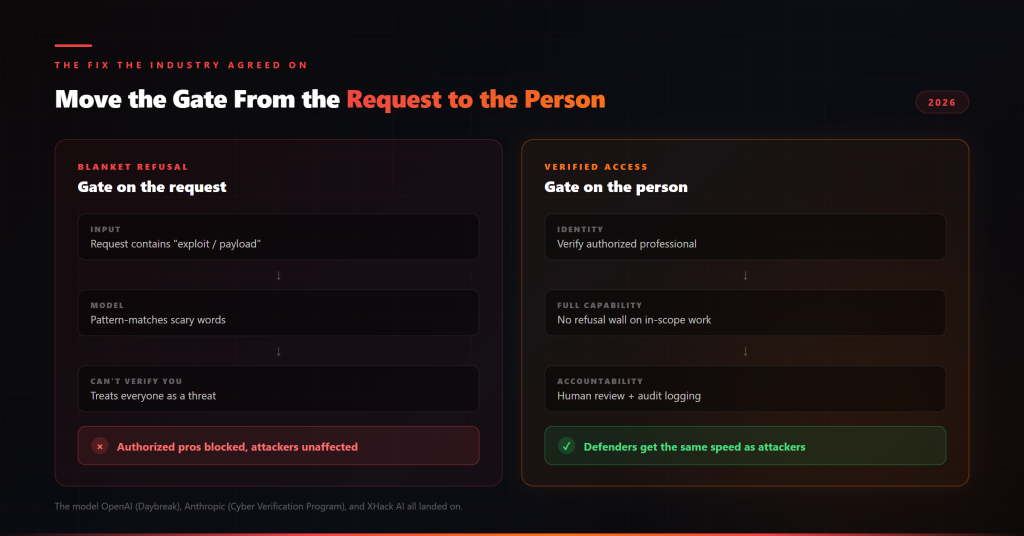
The answer is the one the industry already converged on, and it is worth saying plainly: the fix for the moment AI refuses hacking requests is not weaker safety. It is verified identity plus full capability.
Look at what actually happened in 2026. OpenAI built Daybreak with identity verification, monitoring, and legal attestations. Anthropic built a Cyber Verification Program. Both companies looked at the over-refusal problem, agreed that defenders were being blocked from legitimate work, and landed on the same design: move the gate from the request to the person.
That is the correct model. A general assistant cannot verify you, so it refuses everyone who sounds offensive. A purpose-built security agent that knows you are an authorized professional does not need to refuse the work at all, because the accountability lives at the identity layer, not the prompt layer.
The right tool for authorized offensive security has four properties:
The big labs nailed the first two properties but wrapped them in heavyweight, expensive, enterprise-gated programs. The gap in the market is a tool that gives working professionals and small teams no-refusal AI for authorized security, with accountability built in, without the six-figure contract.
So yeah, here is where we talk about what XHack brings to the table. Since this whole article is about the wall you hit when AI refuses hacking requests, here is an honest look at how we approach it.
The short version: XHack AI is what you reach for precisely because the mainstream AI refuses hacking requests you are authorized to make.
XHack AI is built specifically for authorized security professionals, so it does not slam the refusal door on in-scope offensive work. Exploit development, custom payload generation, reverse engineering, malware analysis, and red team planning are treated as the professional tasks they are, not as things to be pattern-matched into a refusal. The unrestricted AI capability is a core, named feature of the product, available from the Professional plan up.
The design philosophy is the same one OpenAI and Anthropic arrived at, just made accessible. Capability is oriented around authorized professionals doing authorized work, and the system is built with accountability in mind: a multi-agent pipeline where findings run through a human review stage, and every action is written to an audit log with full traceability. You get the no-refusal workflow without the “raw uncensored model that will say anything” problem, because there is human oversight and a real reporting pipeline on the other side.
Under the hood, XHack AI runs specialized agents for reconnaissance, analysis, exploitation, validation, and reporting that coordinate like a red team, plus an autonomous browsing engine that drives a real browser to test multi-step workflows. That is the breadth. Human experts handle the depth and judgment that AI still cannot replace. It is the same human-plus-AI model our VAPT services use.
Now the honest part, because brutal honesty is kind of our thing. A no-refusal agent is not a magic button, and it depends on the person driving it. Point it at random URLs with no plan and you get noise. Scope a real hunt with clear objectives and you get validated, chained findings. The AI is a force multiplier for a skilled operator, not a replacement for skill. And XHack AI is focused on web and API testing, so for large-scale internal Active Directory validation, a network-specialized platform goes deeper on that specific job.
On pricing, we say it out loud instead of hiding it behind a sales call. These are individual plans, for a single professional rather than a company license. XHack AI runs as a subscription: Starter at $20/month (3 to 5 automatic pentests), Professional at $49/month (12 to 15, with unrestricted AI access), and Elite at $150/month (60 to 100, fully unrestricted, with malware analysis, custom payload generation, and OWASP LLM Top 10 testing). Company-wide adoption runs on separate plans starting at $560/month, and Enterprise is custom, and every researcher and company tier opens with a 7-day free trial, no credit card required. That is the difference between “get approved for a gated enterprise cyber program” and “start doing authorized work this afternoon for the price of a couple of lunches.”
If you want to go deeper, our honest comparison of the best AI pentesting tools breaks down where each platform actually fits, and our guide to autonomous pentesting tools covers how AI agents chain exploits on authorized targets.
Want to see whether a no-refusal workflow actually fits your work? Book a free consultation and we will tell you honestly, even if the answer is that you are better off with something else.
Because a general-purpose model has no reliable way to verify your authorization, so it refuses based on how the request sounds rather than who you are. Safety training teaches models to associate offensive-security vocabulary (exploit, payload, shell) with harm, so authorized professionals get caught in the same net as attackers. Research on defensive refusal bias found that adding authorization context like “I’m on the blue team” can actually raise the refusal rate, because those phrases are also common in jailbreak attempts. The knowledge is in the model; the model just cannot tell a real pentester from a fake one.
In measured testing, Claude models refuse legitimate security tasks more often than ChatGPT. A 2026 study found Claude 3.5 Sonnet refused about 19.5% of authorized defensive tasks versus about 10.2% for GPT-4o, with open-source Llama-3.3 lowest at 6.6%. Claude Fable 5 tightened this further in June 2026 with a safeguard layer that blocks whole categories. Both companies now offer verified-access programs (OpenAI’s Daybreak and Anthropic’s Cyber Verification Program) that let vetted professionals do work the default models refuse.
Yes, when it is authorized. Penetration testing with written permission and a defined scope is a legitimate, legal profession, and using AI to assist that work is legal too. The problem is not legality, it is that mainstream models refuse the work anyway because they cannot verify your authorization. Using AI against systems you do not have permission to test is illegal regardless of the tool. The line is authorization, not the technology.
You can, but you should not rely on it. Jailbreaks are unreliable (their success rates shift with every model update and can break mid-task), they violate the terms of service, and doing authorized testing with an unauthorized method undermines the trust your findings depend on. A jailbreak that works today may silently fail next week. For professional work you want a tool built for authorized security, not a workaround that degrades unpredictably.
They remove refusals, but they introduce bigger problems. The 2026 ThreatDown report found 6,644 uncensored and abliterated models on Hugging Face downloaded over 22 million times in a month, and those same models are actively used by criminals for malware and phishing. You inherit that association plus no audit trail, no human review, no accountability, and often lower technical quality. Removing the refusal is easy; replacing the accountability and reliability a professional workflow needs is the hard part, and uncensored models do not do it.
Verified access instead of blanket refusal. The fix is to move the gate from the request to the person: verify that you are an authorized professional, then give you full capability without the refusal wall. This is exactly the model OpenAI and Anthropic adopted in 2026 with their gated cyber programs, and it is the model purpose-built security agents like XHack AI use. The knowledge was never the problem. The problem was general assistants refusing everyone because they could not tell who was authorized.
This piece has focused on why the refusal happens. Six other posts on this site dig into different angles of the same no-refusal question: what “uncensored AI for hacking” actually means and where it goes wrong, a closer look at a genuinely uncensored alternative built for professionals, why WormGPT and its clones are the wrong answer, what an unrestricted AI agent looks like as an actual product, the case for unrestricted AI specifically in penetration testing, and where the line sits for coding assistants.
When AI refuses hacking requests from a legitimate pentester, it is not protecting anyone. It is blocking the defender while the attacker, who never agreed to any rules, keeps moving.
The mechanism is now well understood. Safety training makes models over-refuse anything that sounds offensive, security is a field made of scary-sounding words, and general models cannot verify authorization, so AI refuses hacking requests from everyone. The refusal rates are measurable, the vocabulary effect is real, and even saying “I’m authorized” can make it worse.
The workarounds are traps. Jailbreaks are unreliable and against the rules. Uncensored models put you in the same download pool as criminals with none of the accountability. Dark LLMs are criminal tools that get their own users breached.
The real fix is the one the whole industry landed on in 2026: verified access, not blanket refusal. Prove who you are, then get the full capability your authorized work requires. OpenAI and Anthropic built that as gated enterprise programs. XHack AI built it as an affordable, accountable, no-refusal workflow for the working professionals and small teams those programs leave out.
If you are tired of fighting a refusal wall to do the job you are literally being paid to do, that is the whole reason tools like this exist. The attackers already have no-refusal AI. The only real question is whether the defenders get it too, responsibly, with their name attached.
Categories
Related articles