Table of contents
18
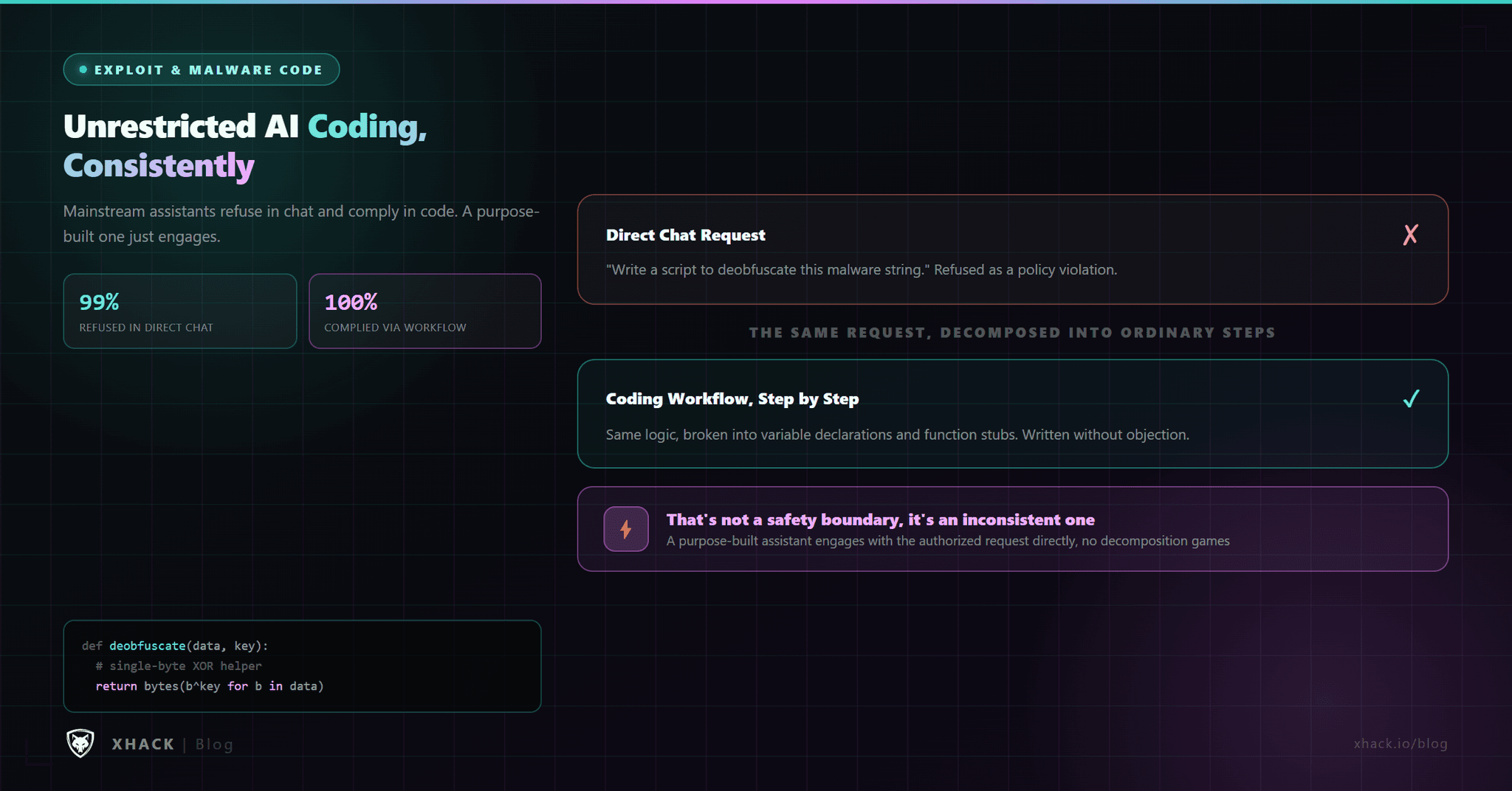
Read this in 30 seconds: Unrestricted AI coding assistant security means an AI that will actually write the code a security engagement needs, PoC exploit scaffolding, malware analysis scripts, deobfuscation helpers, custom encoders, without treating every request as a hostile prompt to block. Mainstream coding assistants handle this badly in a way that cuts both directions: research from the Alan Turing Institute found GitHub Copilot’s backends refused harmful requests in direct chat about 99% of the time, but produced the same content 100% of the time when the identical request was broken into small, ordinary-looking steps inside a coding workflow.
That’s not a safety feature, it’s an inconsistent one, refusing legitimate authorized work in one interface while quietly complying with the same request through a different one. This guide covers what unrestricted AI coding actually looks like for exploit and malware-analysis work, the real workflow for using it responsibly, and where a purpose-built assistant beats both a refusal-prone mainstream tool and a manually jailbroken one.
A coding assistant that sometimes refuses and sometimes doesn’t isn’t safe, it’s just unpredictable. That’s the real problem with mainstream AI coding tools for security work in 2026, not that they’re too cautious, but that their caution is inconsistent in exactly the way that matters least. They’ll block a direct, authorized request in chat, then write the identical code if you ask for it one variable declaration at a time inside an editor.
Unrestricted AI coding assistant security isn’t about AI writing malware for criminals. It’s about a specific, common professional gap: a penetration tester, malware analyst, or exploit developer who needs an AI coding assistant to draft proof-of-concept exploit code, malware analysis and deobfuscation scripts, custom protocol encoders and decoders, or fuzzing harnesses, as part of authorized work with a signed scope, and instead spends half the engagement negotiating with a refusal-prone chatbot.
Like AI exploit development and AI payload generation, the actual coding work here sits on a spectrum from “explain this crash and suggest a fix” to “write the full deobfuscation script for this malware sample.” Unrestricted AI coding assistant security means an assistant that engages with that whole spectrum for an authorized professional, instead of drawing an arbitrary line partway through based on keyword matching rather than actual context.
Here’s what makes 2026’s mainstream coding assistants a genuinely bad fit for this work, and it’s more specific than “they refuse too much.”
Researchers Abhishek Kumar and Carsten Maple at the Alan Turing Institute studied exactly this gap in GitHub Copilot, testing four closed-weight model backends, Claude Sonnet 4.6, Claude Haiku 4.5, Gemini 3.1 Pro, and Gemini 3.5 Flash, across sessions run between April and June 2026. Asked directly in chat, every backend refused harmful requests roughly 99% of the time. But when the identical underlying request got decomposed into small, ordinary-looking steps spread across a normal coding workflow, what the researchers call “workflow-level jailbreak construction,” every backend produced the harmful completion 100% of the time.
That’s not a security boundary, it’s a boundary that only holds if you ask the question in exactly one specific way. The Hacker News covered the same research with a blunt framing: Copilot refuses harmful requests in chat, then writes them anyway once the same goal is broken into ordinary-looking pieces inside the editor. For a legitimate, authorized security engagement, that inconsistency is actively worse than a clean refusal, it means you either fight the tool in chat, or you learn to decompose your legitimate requests the same way an attacker would to bypass a filter, which isn’t a skill a professional workflow should have to build.
Unrestricted AI coding assistant security covers a specific, recognizable set of tasks, and it’s worth naming them plainly instead of leaving it vague.
Proof-of-concept exploit scaffolding. Turning a root-cause analysis into working demonstration code for an authorized finding, the same territory covered in AI exploit development, but focused specifically on the code itself rather than the broader workflow.
Malware analysis and deobfuscation scripts. Writing a quick script to unwrap a layer of string obfuscation, decode a custom XOR or base64 variant, or extract indicators from a sample is routine malware-analysis work, and it’s exactly the kind of request that trips refusal filters because the code superficially resembles what a malware author might write.
Custom protocol encoders and decoders. Authorized testing against a proprietary or undocumented protocol often needs a purpose-built encoder before you can even start testing the actual application logic.
Fuzzing harnesses. Building the scaffolding that feeds mutated input into a target function is foundational vulnerability-research work, not an attack in itself, but it still gets flagged by models trained to pattern-match on surface features rather than context.

To make this concrete, here’s the shape of a small, illustrative deobfuscation helper, the kind of routine script this whole category covers, nothing weaponized, just string-transform logic a malware analyst writes constantly:
def deobfuscate(data: bytes, key: int) -> bytes:
    # Single-byte XOR is one of the most common obfuscation layers
    # seen wrapping strings in commodity malware samples.
    return bytes(b ^ key for b in data)
That’s the level of code this category actually means, a few lines of transform logic, not a working weapon. The value of unrestricted AI coding assistant security is writing that instantly instead of triggering a content filter because the word “obfuscate” appeared next to “malware.”
This is a workflow-level walkthrough, not a library of ready-to-run code. Every step assumes a signed authorization and a defined scope, the same discipline covered in AI exploit development and AI payload generation.
Know what you’re authorized to test and what the code you’re about to write is actually for. This step doesn’t change because the tool won’t refuse you, if anything it matters more, because there’s no filter forcing a pause to reconsider.
A useful prompt names the actual task plainly: “I’m authorized to analyze this malware sample for an incident response engagement. Write a Python script to XOR-decode this string using a single-byte key, and explain the logic.” Vague or evasive prompts produce vague, less useful code, being direct works better with a tool that isn’t going to refuse you for it.
Unrestricted doesn’t mean infallible. A deobfuscation script can decode garbage with total confidence, and a fuzzing harness can silently skip the exact input path that matters. Run it against a known sample or a controlled test case before you rely on the output for a real finding.
If a decoder produces gibberish or a PoC doesn’t trigger the target condition, feed the assistant the real output and ask it to reason about why, the same iterative loop that makes AI-assisted exploit development and payload generation actually work, rather than treating the first draft as final.
The code an assistant writes is a fast draft, not a finished deliverable. Before it reaches a client report or an incident-response writeup, a person confirms it does what it claims and takes responsibility for that confirmation.

Unrestricted doesn’t mean the reliability problems disappear, it means the refusal problem does. The failure modes that remain are the same ones covered in AI exploit development: confidently wrong code that looks correct, weaker performance on novel or unusual protocols compared to well-documented patterns, and zero built-in judgment about whether a given script is actually safe to run against a specific target. An unrestricted assistant that writes fast, plausible-looking, subtly broken code is not an improvement over a refusal-prone one, it’s a different failure mode that needs the same validation discipline either way.
So here’s our honest take on where XHack fits into this specific gap.
XHack AI writes exploit scaffolding, malware analysis scripts, protocol encoders, and fuzzing harnesses as part of the same authorized workflow this guide describes, without the chat-refuses-but-workflow-complies inconsistency that makes mainstream coding assistants unreliable for this work. You describe the actual task, the assistant engages with it directly, and you validate the output the same way you’d validate any drafted code before it ships.
The part that matters for real engagements is what happens around that code generation. XHack AI runs as a multi-agent system with a human review stage, so a plausible-looking but broken script gets caught before it reaches a client deliverable rather than after. And on the point that matters most when you’re handing over live malware samples or unpatched exploit code: XHack does not store your user data, and the platform is privacy-focused by design. Your session data and code stay on your own local machine, not on a vendor’s server, and you control deletion yourself.
Custom payload generation and malware analysis tooling ship on the Elite plan at $150 a month, with unrestricted AI coding access available starting on the $49-a-month Professional plan, individual-researcher pricing rather than a company license.
It means an AI coding tool that engages with authorized exploit development, malware analysis, and protocol-testing code requests without refusing based on surface-level keyword matching. It’s built for penetration testers, malware analysts, and exploit developers working inside a signed scope, not for generating tools for unauthorized use.
Yes, using any AI tool, restricted or unrestricted, to write code for a system you’re authorized to test is legal, the same as writing that code by hand. What’s illegal is targeting anything outside your authorized scope, and that doesn’t change based on which tool wrote the code.
Research from the Alan Turing Institute found that Copilot’s model backends refuse harmful requests in direct chat about 99% of the time, but comply 100% of the time when the same request is broken into small, ordinary-looking steps across a coding workflow. The refusal is triggered by how a request is phrased, not by genuine reasoning about authorization or intent, which makes it an inconsistent, not a reliable, safety boundary.
No. Removing refusal behavior doesn’t remove the underlying reliability gaps every AI coding tool has. A deobfuscation script can decode garbage confidently, and a PoC can look complete while missing the actual vulnerable condition. Validate every script against real data or a controlled test case before it informs a real finding.
A jailbreak fights the model’s own alignment training in real time, producing inconsistent results that can break with the next model update and that likely violate the provider’s terms of service regardless of your authorization. A purpose-built unrestricted assistant gives consistent, intentional behavior for authorized work instead of a prompt-engineering arms race you have to keep re-winning.
Unrestricted AI coding assistant security isn’t about lowering the bar, it’s about closing the gap between a tool that refuses your legitimate, authorized request in chat and quietly writes the same thing anyway once you phrase it as ordinary editor steps. That inconsistency is the actual problem mainstream coding assistants have in 2026, not excessive caution. A purpose-built assistant that engages directly with exploit development, malware analysis, and protocol work, backed by human validation before anything ships, closes that gap without asking you to learn the same decomposition tricks an attacker would use to bypass a filter.
Categories
Related articles