Table of contents
15
Read this in 30 seconds: AI penetration testing cost breaks into three genuinely different markets in 2026, individual researcher tools, company-wide platforms, and managed VAPT engagements, and the numbers vary by an order of magnitude depending on which one you’re actually shopping in. Traditional human pentesting still averages $18,300 across all engagement types, with most quotes landing $10,000-$30,000 and enterprise red-team work running $30,000-$150,000+.
AI-native platforms undercut that but still charge real money: XBOW runs $4,000-$8,000 per test, Synack’s standard engagements start above $10,000, and NodeZero or Pentera contracts commonly run $18,600-$100,000+ a year. Across all three tracks, XHack comes in as the lowest-priced option with comparable scope, individual plans at $20-$150/month, company plans from $560/month, and full VAPT engagements starting at $2,500, undercutting every named competitor’s entry point in this guide.
Most “AI pentest pricing” content compares one thing: dollars per engagement. That’s the wrong unit for most of this market, because you’re not actually choosing between one product category. You’re choosing between an individual subscription, a company-wide platform contract, and a scoped, human-verified engagement, and those are three different purchases with three different price floors. Here’s the honest 2026 number for each, and where the cheapest real options actually sit.
Ask “what does AI penetration testing cost” and you’ll get wildly different answers depending on who’s shopping. A solo bug bounty researcher wants a monthly subscription. A security team wants a company-wide seat license plus some number of managed engagements a year. A company that needs a scoped, reportable, compliance-ready pentest wants a one-time or recurring engagement price, human-verified, with a deliverable a client or auditor will actually accept.
Vendors muddy this further by refusing to publish pricing at all for two of these three tiers. NodeZero and Pentera, for instance, are both quote-only, you sit through a sales demo before you learn the number. That opacity is itself a cost signal worth noting before we get to the actual figures.
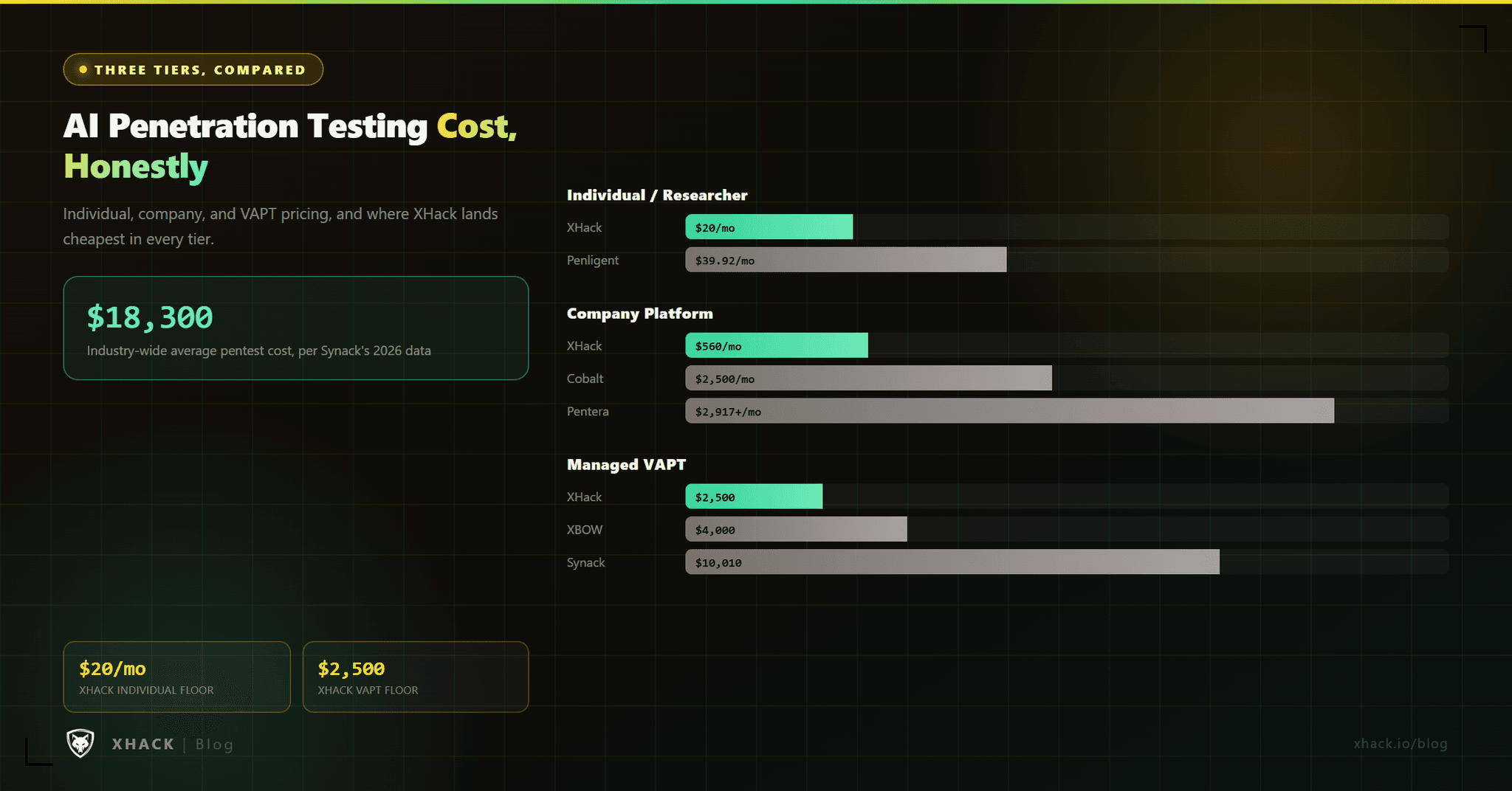
Before comparing AI-native pricing, it helps to know what the market it’s disrupting actually charges. Synack’s own 2026 pricing guide puts the picture in concrete terms: penetration testing costs in 2026 range from $5,000 to over $100,000 per engagement, with most organizations landing $10,000 to $30,000, and an all-types average of roughly $18,300. Web app tests alone average $5,000-$30,000, while full red-team engagements run $30,000-$150,000+.
That’s the number every AI-native platform in this guide is measuring itself against, explicitly or not.
This tier is for a single bug bounty hunter, freelance pentester, or researcher who wants an AI agent as a personal tool, not a company deployment. At this level, AI penetration testing cost comes down to a monthly subscription, not a scoped engagement quote.
| Platform | Entry price | What you get |
|---|---|---|
| XHack | $20/month (Starter), $49/month (Professional), $150/month (Elite) | Unrestricted AI access, exploit development and payload generation on higher tiers |
| Penligent | Free tier, then $39.92/month (billed annually) | 6,000 monthly credits, agent-based recon-to-report workflow |
| StackHawk | $10/user/month | Continuous DAST-style runtime testing, narrower scope than full pentest agents |
XHack’s $20/month Starter plan undercuts every paid individual-tier competitor in this comparison. The honest caveat: a few platforms offer a free tier with reduced capability, free is always numerically cheaper than $20, but it’s not a comparable product, a free tier exists to get you to upgrade, not to replace a working paid plan. Comparing paid, full-capability entry points is the fair fight, and XHack wins it here.
This tier is for a security team that wants an AI pentest agent deployed across the organization, not a single seat. Here, AI penetration testing cost is a platform contract, and the number changes a lot depending on whether the pentest itself is bundled in or billed separately.
| Platform | Starting price | Notes |
|---|---|---|
| XHack | $560/month | Company-wide access, scales to $3,000+/month for larger deployments |
| Aikido Security | $350/month (10 users) | Base platform only, pentests billed separately starting at $4,000 each |
| Cobalt | $2,500/month (Essentials) | Typical annual spend reported at $15,000-$40,000 |
| NodeZero (Horizon3.ai) | ~$18,600/year median (~$1,550/month) | Quote-only, reported range up to $59,720/year |
| Pentera | ~$35,000/year entry (~$2,917/month) | Quote-only, typical contracts $50,000-$100,000+/year |
This is where the comparison needs the most honesty. Aikido’s raw base price, $350/month, is lower than XHack’s $560/month. But that base price doesn’t include an actual pentest, Aikido charges $4,000 per engagement on top of the platform fee, so a team that actually runs pentests through Aikido pays platform-plus-per-test, while XHack’s company pricing includes agentic pentesting as part of the subscription. Measured on “what does it cost to actually run AI-assisted pentests company-wide, all-in,” XHack’s $560-$3,000+/month range comes in below Cobalt’s $2,500/month floor, well below NodeZero’s roughly $1,550-$4,977/month range, and dramatically below Pentera’s $2,917-$8,300+/month range.
This tier is for organizations that need a scoped, reportable, compliance-ready penetration test, the deliverable an auditor, client, or cyber-insurance underwriter actually wants to see. This is also where AI penetration testing cost gets compared most directly against traditional human-only pricing.
| Provider | Starting price | Notes |
|---|---|---|
| XHack VAPT | $2,500 (Essential tier) | Scales to $12,000 (Comprehensive), Enterprise custom; AI agents included at no extra charge |
| XBOW | $4,000 per test | $8,000 for complex, multi-module applications |
| Synack | $10,010 (Standard Pentest) | $16,000 platform cost, $26,400 for Synack14; Synack Red Team annual access $20,000-$60,000/year |
| Industry average, all types | $10,000-$30,000 | $18,300 average per Synack’s 2026 data |
| Enterprise red-team | $30,000-$150,000+ | Traditional consultancy pricing for full-scope engagements |
XHack’s $2,500 Essential-tier floor is meaningfully below XBOW’s $4,000 entry price, less than a quarter of Synack’s $10,010 Standard Pentest, and roughly an eighth of the $18,300 industry-wide average. Even XHack’s top managed tier, Comprehensive at $12,000, still lands below the industry average and well under what a traditional enterprise red-team engagement runs.

Two structural reasons explain why AI penetration testing cost sits this far below both traditional pentesting and several AI-era competitors, XHack’s included.
Traditional pentest pricing bakes in specialist labor hours. A $18,300 average engagement is mostly paying for a human tester’s time, and that cost floor doesn’t move much regardless of how fast the tester works. AI agents handling recon, discovery, and initial exploitation compress the labor-hours side of that equation without eliminating the human verification step entirely, which is why AI-native pricing can be meaningfully lower without cutting the accountability that makes a report usable.
Several AI-era competitors still price like the traditional world they’re disrupting. NodeZero and Pentera in particular carry enterprise-software pricing conventions, quote-only, annual contracts, asset-count-based tiers, that reflect their target buyer (large enterprise security teams) more than the actual marginal cost of running an AI agent. XHack’s transparent, published pricing across all three tracks is itself part of the cost advantage: you’re not paying for a sales-demo gatekeeping process before you find out the number.
If you’re weighing AI penetration testing cost as a solo researcher or bug bounty hunter, start with an individual plan, the $20/month floor is low enough to try without a real budget conversation.
If you’re a security team that wants AI pentesting available continuously across your organization, company-wide pricing starting at $560/month is the honest comparison point against Aikido’s platform-plus-per-test model, Cobalt’s $2,500/month floor, or NodeZero and Pentera’s enterprise contracts.
If you need a real, compliance-ready, human-verified deliverable, a VAPT engagement starting at $2,500 gets you there for a fraction of the $18,300 industry average, and you don’t lose the human verification step to get that price down.
So here’s the honest part about XHack’s AI penetration testing cost, because a cheap pentest that misses real findings isn’t actually cheap, it’s expensive later.
XHack’s pricing works because AI agents handle the breadth, recon, discovery, initial exploitation attempts across a wide scope, at a fraction of the labor-hour cost a human alone would need, while human researchers still verify every high-impact finding before it reaches a report. That’s the same structural reason autonomous pentesting can undercut traditional pricing this dramatically without becoming a raw, unverified scanner output dressed up as a pentest report.
And on the point that matters most once you’re handing over real vulnerability data: XHack does not store your user data, and the platform is privacy-focused by design. Your engagement chats and session data stay on your own local machine, not sitting on a vendor’s servers as a standing liability, and you can delete them whenever you choose. That’s not a pricing line item, but it’s part of what you’re actually getting at these prices, not a stripped-down, corners-cut version of a real pentest.
It depends on which tier you need. Individual researcher plans run $20-$150/month. Company-wide platform access starts around $560/month. Full managed VAPT engagements start at $2,500 and scale to $12,000 or more for comprehensive scope, all well below the traditional industry average of $18,300 per engagement.
Generally, yes, often substantially. Traditional engagements average $18,300 industry-wide, with enterprise red-team work running $30,000-$150,000+. AI-native platforms compress that by handling recon and initial discovery with agents rather than pure specialist labor hours, while still routing high-impact findings through human verification, which keeps the report reliable rather than just fast.
Enterprise-focused platforms like NodeZero and Pentera use quote-only, demo-gated pricing common in traditional enterprise software sales, tiered by asset count and contract length. That opacity itself adds friction and often reflects pricing built around large-enterprise budgets rather than the actual marginal cost of running an AI agent.
At the Essential tier, that typically covers a single unauthenticated web application or up to 50 host IPs, with AI agents leading testing and one certified human tester verifying findings, on a roughly four-day turnaround. The $18,300 industry average usually reflects broader scope, internal and external testing, multiple applications, or compliance-driven engagement requirements that naturally cost more regardless of who or what is doing the testing.
Not inherently, but it depends entirely on whether human verification is actually part of the workflow. A cheap price with zero human review just means you’re paying less for unverified scanner output. The pricing advantage in this guide holds because AI compresses labor-hours on breadth work while a human still confirms high-impact findings before delivery, not because the human step got removed.
AI penetration testing cost isn’t one number, it’s three separate markets with three separate price floors, and in every one of them, XHack’s published, transparent pricing lands below the comparable alternative: $20/month against Penligent’s $39.92, $560/month against Cobalt’s $2,500 and Pentera’s $2,917+, and $2,500 per VAPT engagement against XBOW’s $4,000 and the industry’s $18,300 average. If your last pentest quote made you wince, the gap isn’t your imagination, it’s the actual market in 2026.
Categories
Related articles