Table of contents
21
By Salman Khan, OSCP+, Founder of XHack, SRT (Synack Red Team member)
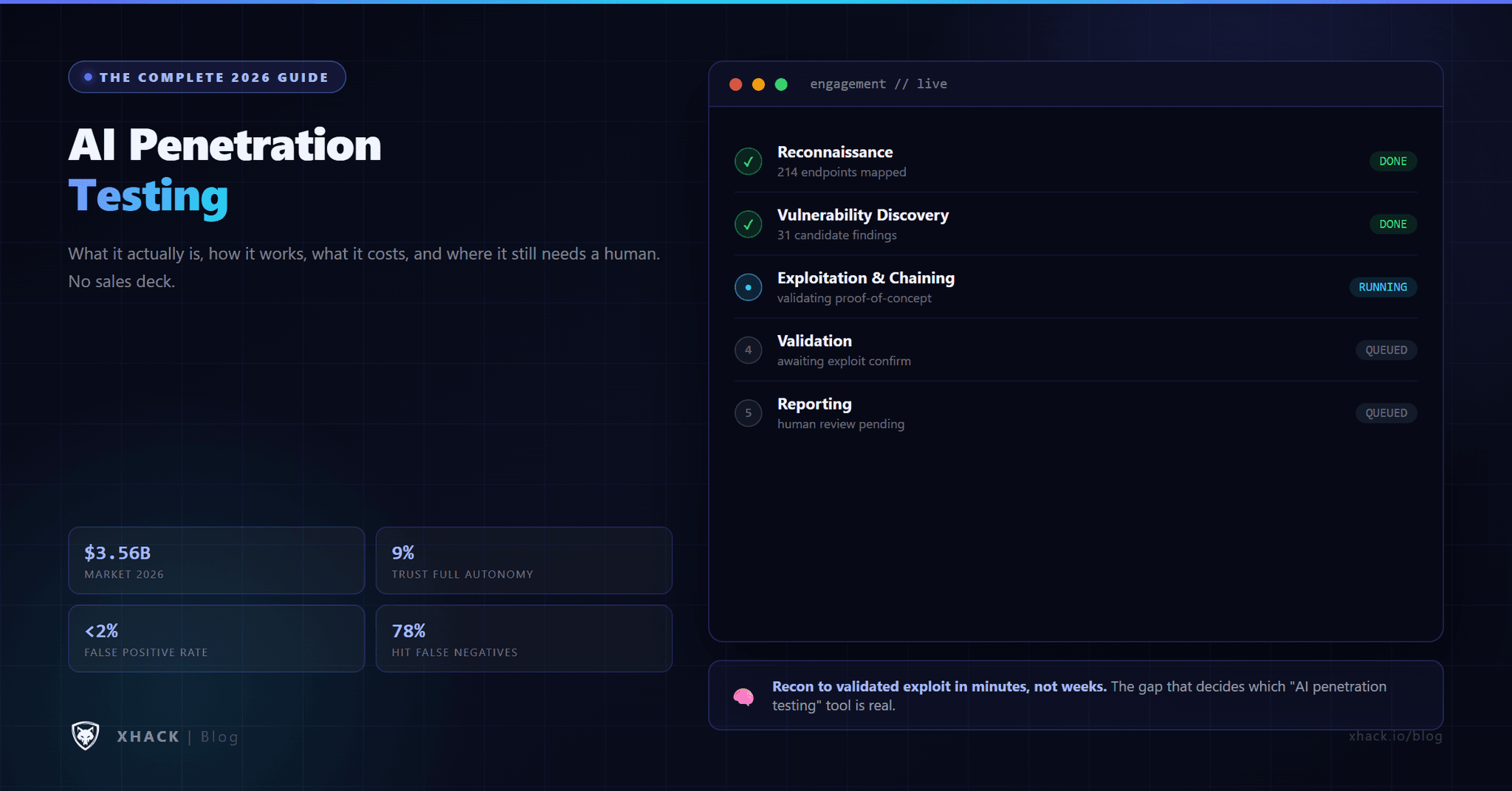
Read this in 30 seconds: AI penetration testing uses AI agents, not fixed-signature scanners, to plan, execute, and adapt an attack against your systems the way a human tester would, running reconnaissance, chaining vulnerabilities, and validating exploits with working proof-of-concept instead of a guess. The market is real: $3.56 billion in 2026, projected to hit $7.05 billion by 2034. But 2026 was also the year confidence in fully autonomous testing collapsed, from 29% of security leaders to just 9%, after 78% reported critical false negatives from fully automated tools.
The winning model that survived that reality check is hybrid: AI for continuous, machine-speed breadth, humans for business logic, novel attack chains, and the judgment call a compliance auditor actually wants to see. This guide covers what AI penetration testing actually is, how it works, what it costs, where it genuinely wins, where it still fails, and how to evaluate a platform without buying the marketing.
AI penetration testing is either the biggest shift in offensive security in a decade, or the most successfully marketed rebrand of a vulnerability scanner in years. Both descriptions are true, depending entirely on which product you bought.
I say that as someone who has manually reported hundreds of vulnerabilities through the Synack Red Team, and who has also spent the past year building an autonomous pentesting agent from scratch. I’ve seen what a genuinely capable AI agent can find in an afternoon that would take a human tester a week. I’ve also watched a “fully autonomous” tool confidently report a critical vulnerability that didn’t exist, because nobody validated the finding before it hit the report.
Both of those experiences are true at once, and that tension is the entire story of AI penetration testing in 2026. This guide is the version without the sales deck: what it actually is, how it works under the hood, what the real benchmark numbers say, where the money goes, and a framework for judging a platform on what it does instead of what its landing page claims.
AI penetration testing is the use of AI-driven agents, not fixed-rule scanners, to perform the actual work of a penetration test: reconnaissance, vulnerability discovery, exploitation, and reporting, with the system reasoning about what it finds and adapting its approach in real time. That last part is the entire distinction. A traditional vulnerability scanner asks one static question over and over: “does this signature match a known issue?” AI penetration testing asks a different one: “can I actually reach something that matters here, and if this path is blocked, what’s the next move?”
That difference matters more than the “AI” label suggests. A scanner that returns a list of maybe-vulnerabilities isn’t doing penetration testing, it’s doing vulnerability assessment with extra steps. Real AI penetration testing chains findings the way an attacker does: a low-severity misconfiguration here, an exposed endpoint there, combined into a proven path to something an organization actually cares about. It produces a working proof-of-concept, not a hopeful guess.
It’s also not one single thing. AI penetration testing spans a spectrum from AI-assisted copilots (a human still drives, the AI suggests) through semi-autonomous agents (the AI runs multi-step chains but checkpoints before anything risky) to fully autonomous systems that plan and execute an entire engagement with minimal human input. I’ve written in more depth about what fully autonomous penetration testing looks like and the multi-agent architecture behind it, including the specific agents worth knowing in that category if you want the deeper dive on autonomy levels. This guide stays at the category level: what AI penetration testing is as a whole, the tools, the market, and the honest tradeoffs.
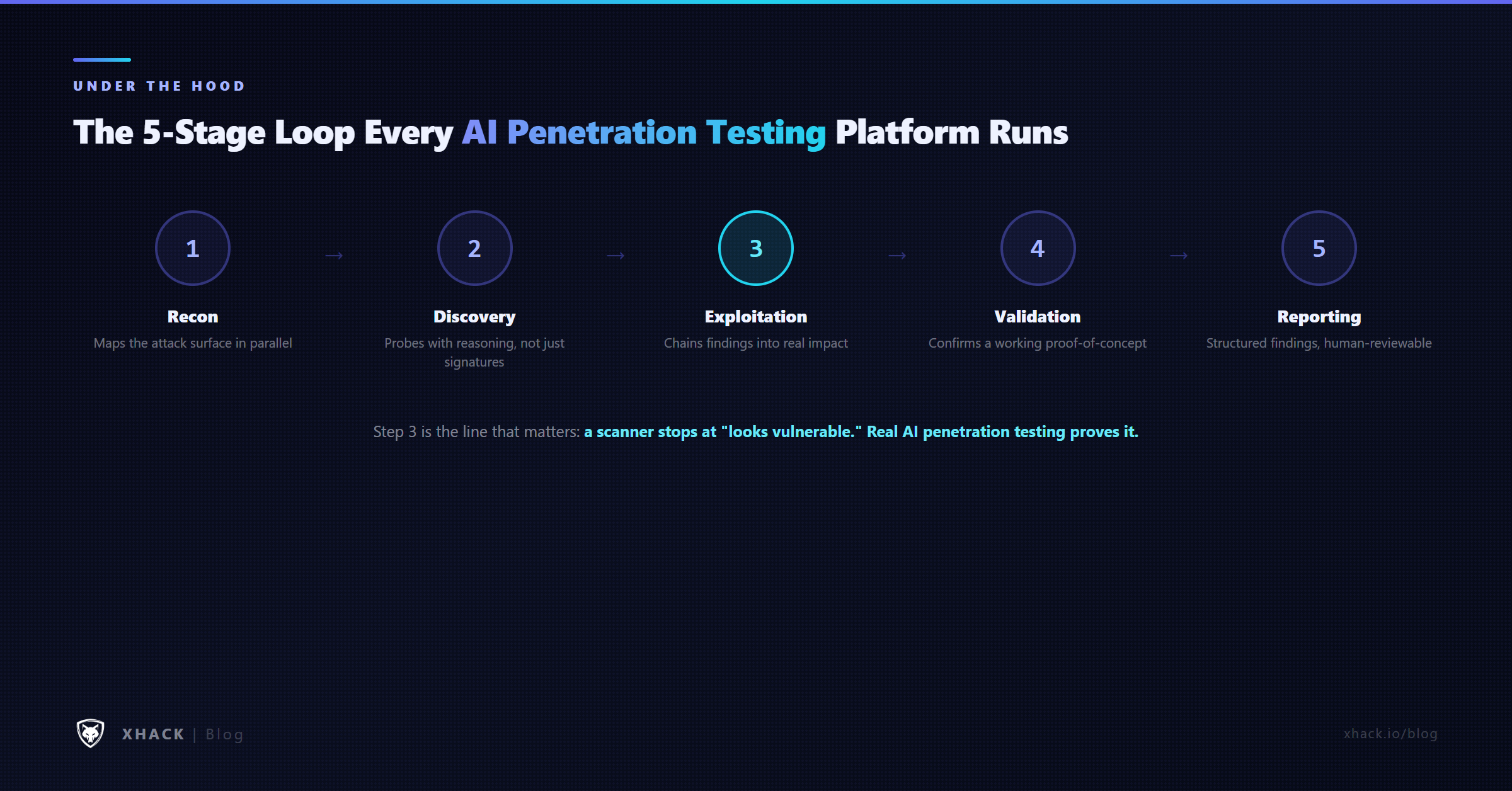
Strip away the branding and most AI penetration testing platforms run the same underlying loop:
The technology underneath varies by vendor: some platforms use a single large model with tool access, others orchestrate multiple specialized sub-agents (one for recon, one for web exploitation, one for reporting) that hand off work to each other. The multi-agent architecture tends to scale better across large attack surfaces, which is why most serious commercial platforms have moved toward it.
AI penetration testing isn’t scoped to one type of target. The maturity level varies a lot by category:
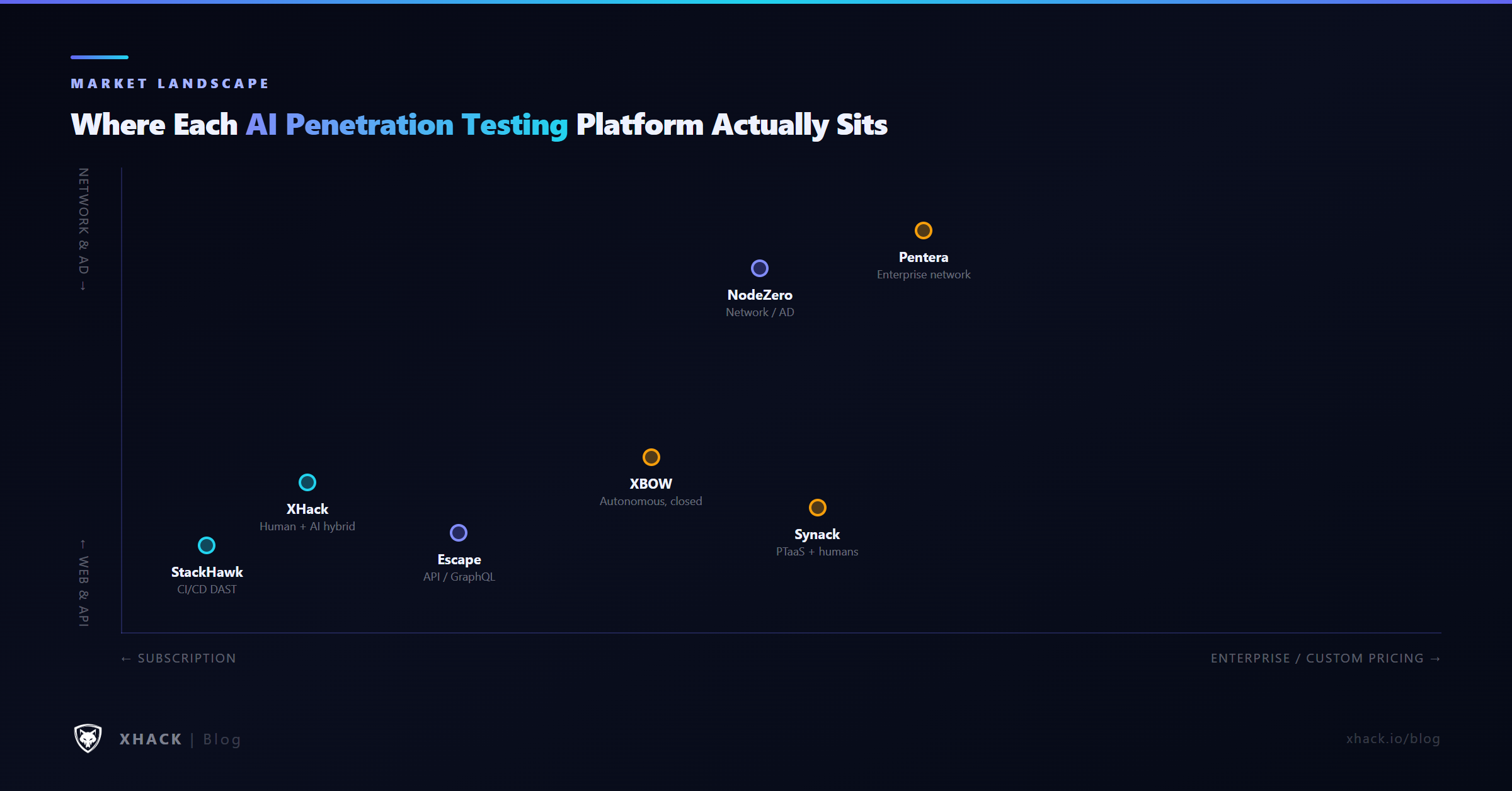
| Platform | Approach | Pricing | Best For | Real Limitation |
|---|---|---|---|---|
| XBOW | Fully autonomous, human-reviewed before submission | Enterprise, not public | Continuous bug-bounty-style web testing at scale | Closed system, enterprise-only, no public pricing |
| StackHawk | DAST scanner built for CI/CD | From $5/mo entry, ~$42/contributor/mo team | Engineering teams testing every merge | Not a full penetration test, catches OWASP-class flaws, not business logic |
| Escape | Agentless API discovery, GraphQL-focused | Custom enterprise, no self-serve | API-first engineering teams, shadow API discovery | No transparent pricing, enterprise sales cycle |
| Synack | AI-assisted, elite human researcher network | $10,000-$30,000 typical engagement | Enterprises wanting PTaaS with real human researchers | Priced like traditional consulting, not a subscription |
| Horizon3.ai NodeZero | Autonomous, network and AD focused | Custom annual contracts | Internal network and Active Directory validation | Enterprise-only, opaque pricing |
| Pentera | Automated, agent-based, network-heavy | ~$46,000-$100,000/year | Large enterprises validating internal defenses continuously | High cost floor, not built for web/API-first teams |
| XHack | Human-led testing plus autonomous multi-agent AI | $20-$150/mo individual, $560-$3,000+/mo company, $2,500-$12,000 VAPT | Teams wanting validated AI breadth plus human judgment | Newer to market than the enterprise incumbents above |
This table alone should tell you something important: there is no single “best” AI penetration testing platform, because these tools solve genuinely different problems. StackHawk isn’t trying to be Pentera. Synack isn’t trying to be a $20-a-month subscription. The question isn’t which one wins, it’s which one matches your actual attack surface and budget.
XBOW is the platform that made the rest of the industry take AI penetration testing seriously in the first place. It topped HackerOne’s bug bounty leaderboard, outranking thousands of human researchers, and it’s now deployed at Fortune 500 companies. The catch is that it’s closed, enterprise-only, and every finding still goes through human review before submission, which is worth remembering the next time a vendor claims “zero human intervention” as a selling point.
StackHawk is a developer-first DAST tool built to live inside CI/CD pipelines, testing every merge for OWASP-class flaws before it ships. It’s genuinely excellent at what it does, but what it does is narrower than full AI penetration testing: it’s scanning-plus-automation for known vulnerability classes, not an agent chaining findings into proven business impact. Teams that need that deeper layer typically run StackHawk alongside something else, not instead of it.
Escape takes a different angle: agentless API discovery through OSINT and AI fingerprinting, with over 100 dedicated GraphQL-specific tests, a category most competitors barely touch. It’s strong for API-first engineering teams with a lot of shadow API sprawl, but the enterprise-only, no-self-serve pricing model puts it out of reach for smaller teams evaluating AI penetration testing on a budget.
Synack is the platform that proves “AI penetration testing” and “elite human researchers” aren’t opposites. It pairs AI-driven continuous testing with a vetted network of human researchers, priced like traditional consulting rather than a subscription. For enterprises that want PTaaS with real named humans behind the findings and don’t mind the $10,000-to-$30,000 engagement cost, it’s a genuinely strong option, just not a cheap or fast one.
Horizon3.ai’s NodeZero and Pentera both specialize where XBOW, StackHawk, and Escape don’t: internal network and Active Directory validation. This is the hardest category for AI penetration testing to do well, since it involves lateral movement, credential relay, and misconfiguration chains that don’t reduce neatly to an API call. Both platforms have made real progress here, at enterprise pricing that reflects how narrow and hard-won that progress actually was.
Pricing in this category splits into three real models, and mixing them up is the single most common buyer mistake.
Per-test/engagement pricing (Synack, traditional human-led firms): $10,000 to $30,000 is typical for a scoped engagement, with enterprise engagements running $50,000-plus. This is the traditional consulting model, now sometimes AI-assisted on the vendor’s end, but priced the same way it always was.
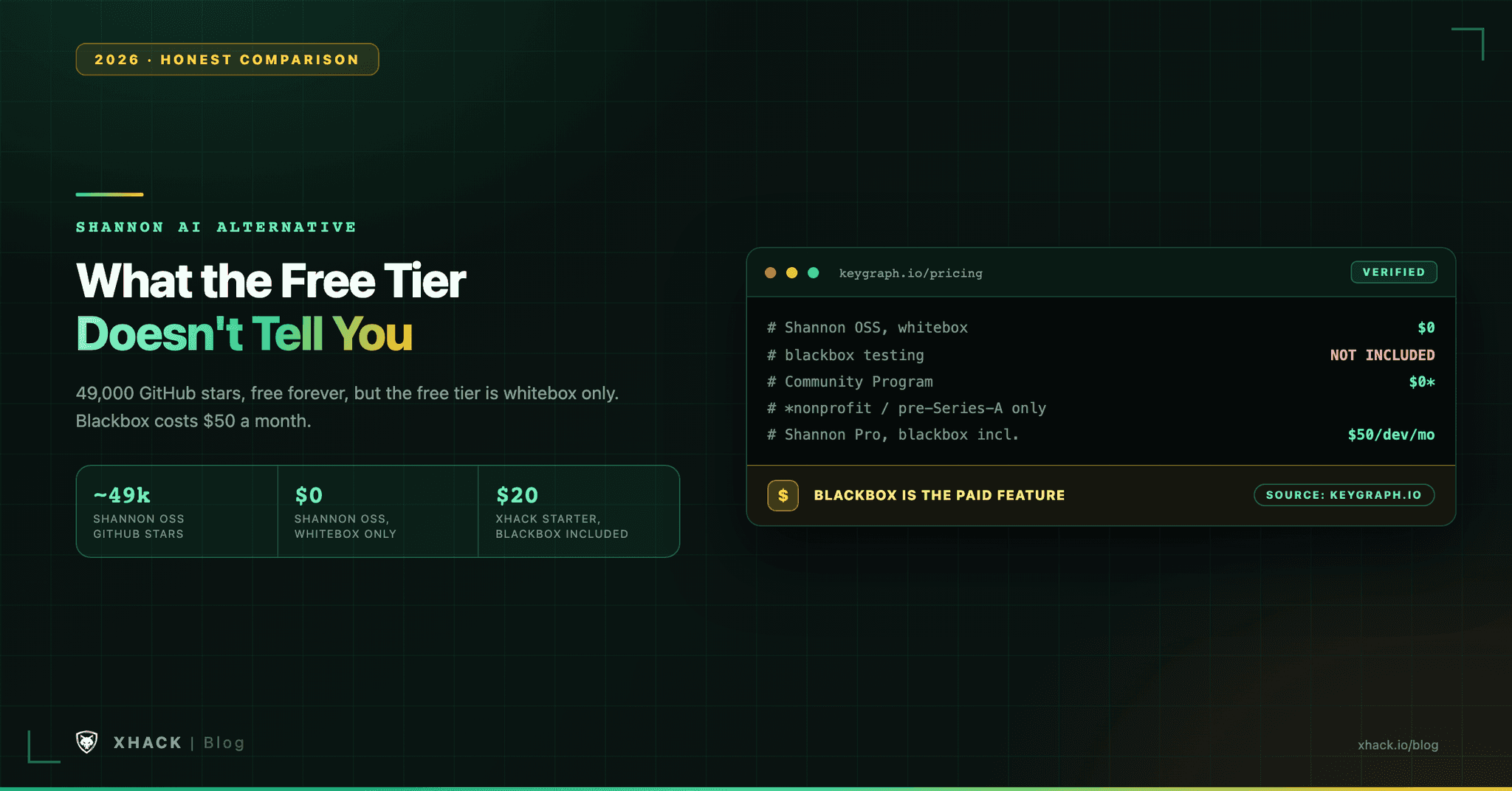
Flat subscription pricing (StackHawk, XHack, and similar): a monthly fee covers continuous or near-continuous testing rather than a single point-in-time assessment. StackHawk starts around $5 a month for individual use scaling to per-contributor team pricing; XHack’s individual plans run $20 to $150 a month, with company-wide plans starting around $560 a month, both currently offering a 7-day free trial with no credit card required.
Enterprise custom pricing (NodeZero, Pentera, Escape): no public number, a sales conversation, and typically a five- or six-figure annual contract once you get through it.
The real-world cost delta is significant when you look at total deployment data. One published case study of a global enterprise running 2,000-plus web applications showed portfolio coverage jump from 40% to 100% after adopting an AI penetration testing platform, with per-test cost dropping roughly 80% and lead time falling from 2-4 weeks to 2 days. That’s the argument for AI penetration testing in one data point: it’s not a modest discount on manual testing, it changes what percentage of your actual attack surface gets tested at all.
The benchmark data here is real, not just marketing. On the XBEN benchmark suite (104 web exploitation challenges), a principal-level human tester with 20-plus years of experience solved 85% of challenges in 40 hours. An AI agent in the same benchmark solved 104 of 104 in roughly 19 minutes mean time-to-exploit, with a 96.15% first-attempt success rate, per FireCompass’s published results. Whatever you think of vendor-run benchmarks, that gap in raw throughput is the reason this category exists at all.
AI penetration testing wins decisively on: coverage across a large or fast-changing attack surface, continuous testing between the once-a-year manual engagement, speed on well-understood vulnerability classes (OWASP Top 10-style web and API flaws), and cost per test at scale. When you’re testing 2,000 applications instead of 20, AI stops being a nice-to-have and becomes the only way the math works.
Here’s the part vendors don’t put on the pricing page. Confidence in fully automated penetration testing collapsed in 2026: Cobalt’s “AI and Pentesting Pulse Report 2026” surveyed 455 security leaders and found support for fully autonomous testing dropped from 29% to just 9% year over year, after 78% of respondents reported experiencing critical false negatives, real vulnerabilities the automated tools simply missed.
The specific failure modes are consistent across the industry: business logic flaws (User A accessing User B’s data through a workflow the AI has no context to recognize as broken), novel attack chains that require creative reasoning outside the training distribution, and automation bias, where teams start trusting AI-generated reports without independently verifying them. No AI system on the market today reliably understands that a low-severity file upload bug combined with a misconfigured storage bucket equals a critical data breach path, because that connection requires understanding what the system is supposed to do, not just how it technically behaves.
This is also exactly the kind of gap I keep writing about from the human side: broken authorization bugs like BOLA and IDOR that survive automated scanning because the endpoint or field looked too structured to be dangerous. AI penetration testing tools are getting better at exactly this class of bug, but “getting better” and “solved” are not the same claim, and any vendor telling you otherwise is selling, not reporting.
For years, autonomous pentesting had no formal governance standard, which is part of why organizations were nervous about giving an AI agent unsupervised access to production systems. That changed in April 2026 when OWASP launched the Autonomous Penetration Testing Standard (APTS), the first formal governance framework for the category.
APTS defines 173 tier-required requirements across eight domains: scope enforcement, safety controls, human oversight, graduated autonomy (four defined levels, L1 through L4), auditability, manipulation resistance, supply chain trust, and reporting. It complements existing methodologies like PTES and the OWASP Web Security Testing Guide rather than replacing them, addressing problems specific to autonomous operation: can the platform prove it stayed in scope, can a human kill the process immediately, is there a tamper-proof audit trail. There’s no certification body or mandatory audit yet, but APTS existing at all is a meaningful signal that the industry recognizes autonomous testing needs guardrails a traditional scanner never did.
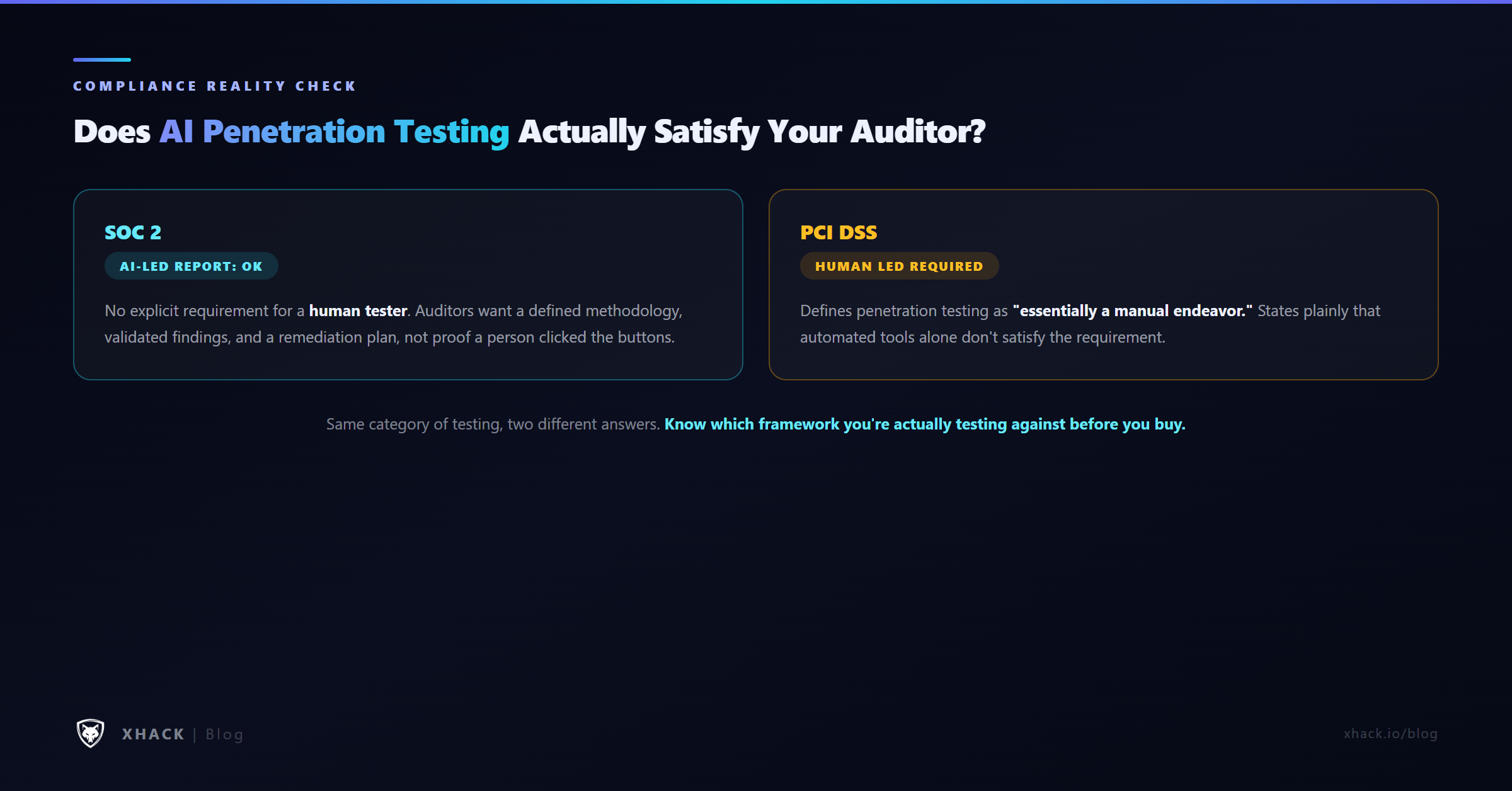
This depends entirely on which framework you’re working against, and the distinction trips up a lot of buyers.
SOC 2 doesn’t explicitly require a human tester. Auditors are looking for documentation that your systems were tested against a defined methodology, that findings were validated, and that you have a remediation plan, not proof that a human clicked the buttons. A well-documented AI penetration testing report with clear methodology and validated findings generally satisfies this.
PCI DSS is stricter. Its own guidance defines penetration testing as “essentially a manual endeavor,” and explicitly states that automated tools alone don’t satisfy the requirement. In practice, this means AI penetration testing can contribute to PCI DSS compliance, but purely automated, human-free testing generally will not satisfy an auditor on its own. This is the single clearest argument for the hybrid model, and it’s not a marketing position, it’s what the standard says in writing.
Treating “AI-powered” as a single category. As the market table above shows, a $5-a-month CI/CD scanner and a six-figure network-validation platform both get called “AI penetration testing.” Buying the wrong one for your actual attack surface is the single most common and most expensive mistake in this space.
Assuming full autonomy is the goal. The 2026 confidence data is unambiguous: the market moved toward hybrid, not toward more automation. Vendors still pitching “zero human intervention” as the headline feature in late 2026 are selling against the data, not with it.
Skipping the compliance check before buying. If PCI DSS applies to you, a purely automated AI penetration testing report will not satisfy your auditor, full stop. Confirm which framework you’re testing against before you sign a contract that assumes AI-only testing is sufficient.
Not asking where the data goes. Session data, findings, and sometimes credentials pass through whatever platform you choose. Some vendors retain that indefinitely on their servers. Ask directly, and treat a vague answer as a real red flag, not a formality.
Confusing benchmark speed with real-world coverage. A vendor-published benchmark showing 104-of-104 challenges solved in 19 minutes is real and worth citing, but it’s measured on a curated challenge set, not your specific, messy, legacy-riddled production environment. Use benchmarks to understand what’s possible, not as a guarantee of what you’ll get.
The 2026 course correction, from full-autonomy hype to hybrid reality, is likely the shape the next few years take, not a temporary dip. Expect three things to keep developing: governance standards like OWASP APTS maturing from a v0.1.0 incubator project into something with real certification teeth, AI/LLM-specific testing growing from the newest, least mature category into a standard line item as more organizations ship AI features with real attack surface, and the false-positive and false-negative rates on both sides continuing to close, without either side fully closing the gap that requires human judgment.
The organizations already winning with AI penetration testing aren’t the ones chasing full autonomy. They’re the ones who accepted the hybrid model early, let AI own breadth and continuous coverage, and stopped treating the human tester as a legacy cost center instead of the part of the process that catches what the AI structurally cannot.
Work through these before signing anything:
So yeah, here’s where I talk about what XHack brings to the table, and I’ll try to earn that instead of just claiming it.
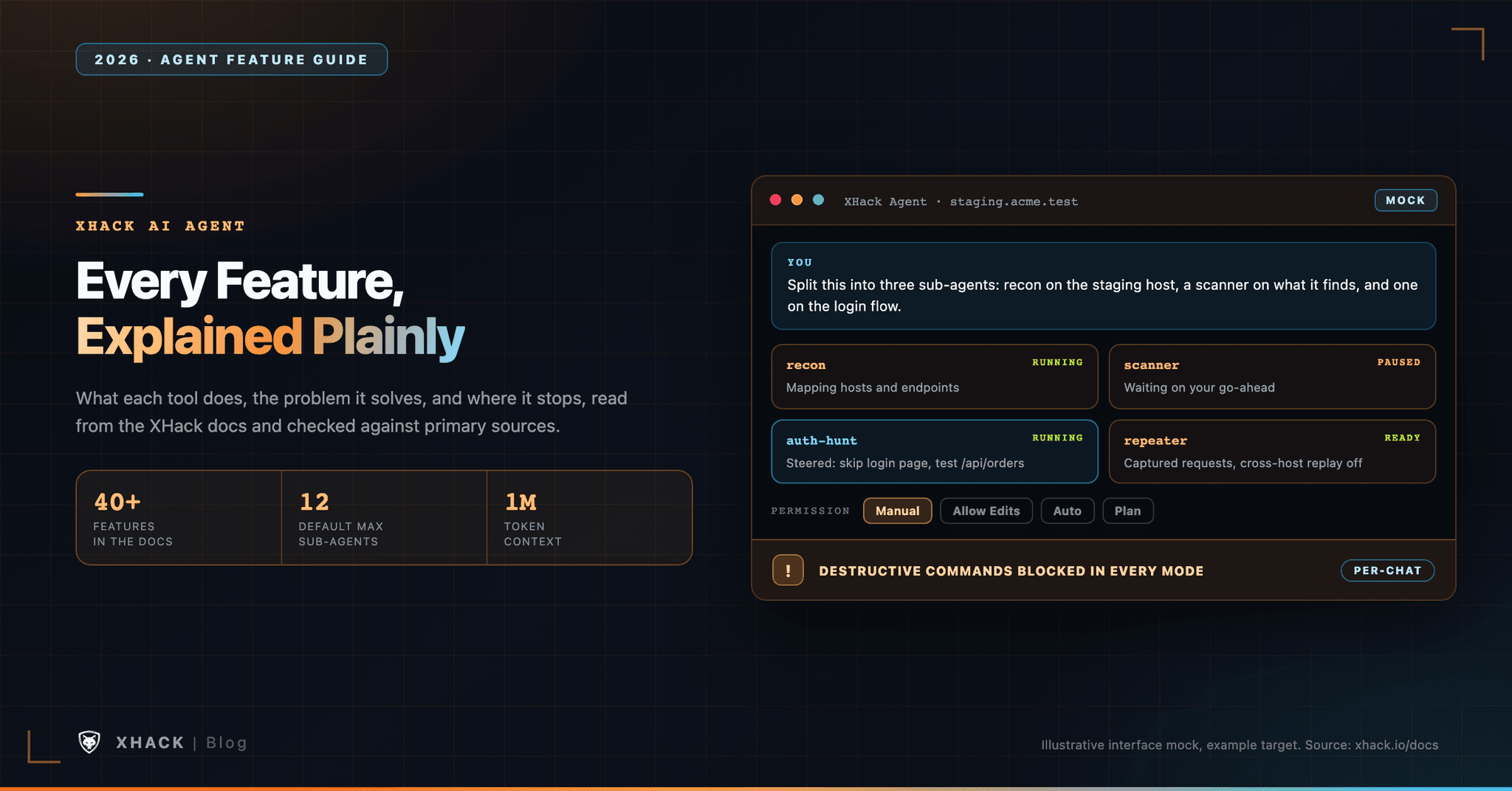
XHack combines three things most providers in that comparison table above offer separately: expert human penetration testing, an autonomous AI agent that runs the multi-step reasoning loop described above, and a continuous security platform that keeps watching between engagements. The human side handles exactly what the 2026 confidence data says AI still can’t: business logic flaws, novel attack chains, and the judgment call on whether a finding is actually exploitable in your specific environment. The AI side handles what it’s genuinely good at: autonomous multi-agent recon, browser-based live vulnerability hunting, and exploit chaining at machine speed, running continuously instead of waiting for next year’s scheduled test.
Findings don’t disappear into a PDF once the engagement ends. They feed into XHack’s SOC and threat-detection layer, so a vulnerability found last month is still being monitored, not just reported and forgotten. And XHack does not store your data: pentest chats and session data stay local to you, not sitting on a vendor’s servers indefinitely.
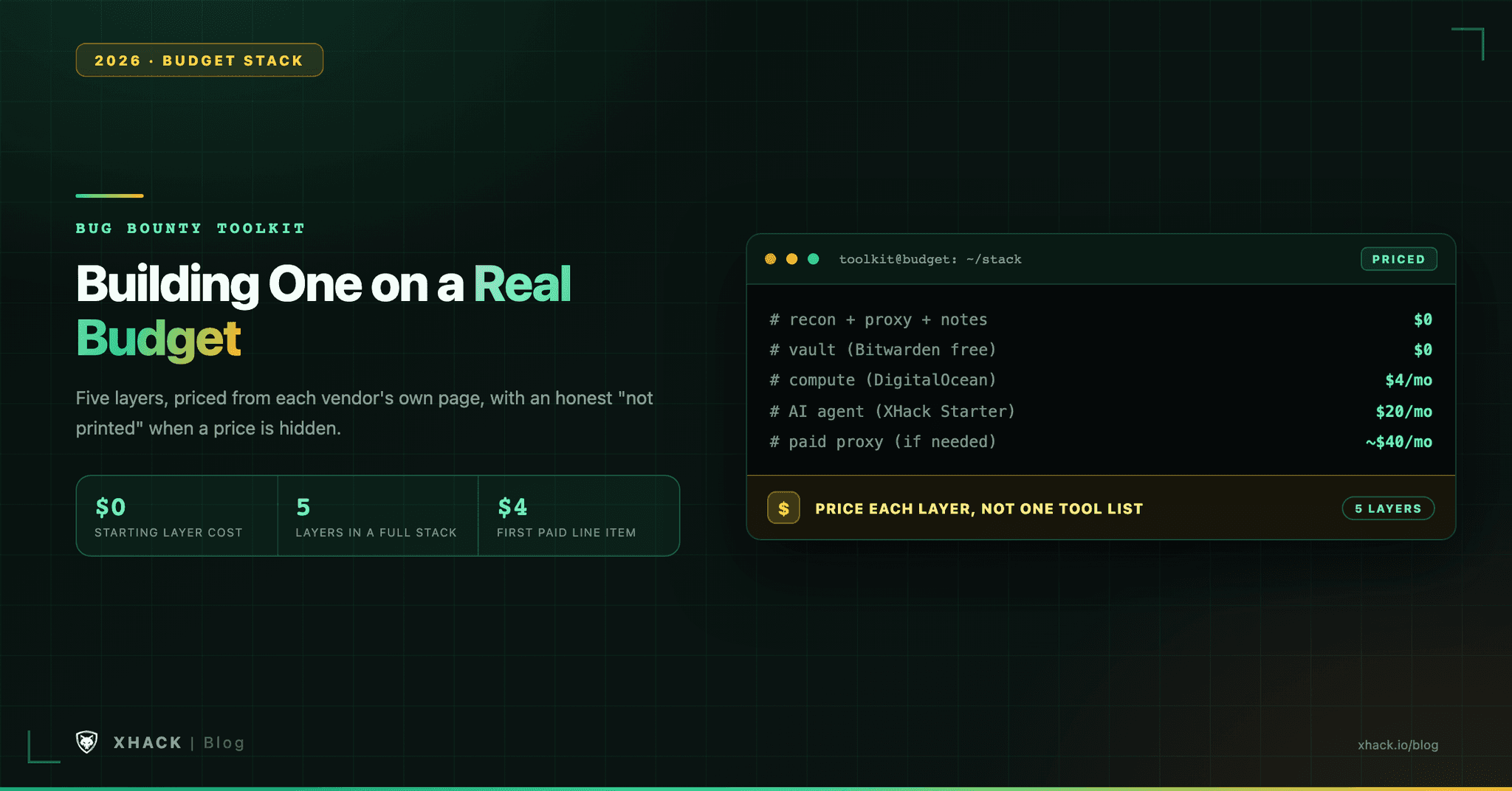
If you want a cheap one-time scan with a cover page, we’re genuinely not the right fit. Individual and bug-hunter AI plans run $20 to $150 a month; company-wide platform access starts around $560 a month, both with a 7-day free trial and no credit card required; and full human-led VAPT engagements are scoped individually, typically $2,500 to $12,000 depending on your environment. Want a quote, or want to talk it through first? A free consultation costs nothing, even if it turns out XHack isn’t the right fit for what you need. Brutal honesty is kind of our thing.
AI penetration testing is the use of AI-driven agents to perform the core work of a penetration test, reconnaissance, vulnerability discovery, exploitation, and reporting, with the system reasoning about findings and adapting its approach rather than executing a fixed script like a traditional vulnerability scanner. The defining feature is validated, chained exploitation, not a list of possible issues.
For breadth, speed, and coverage of well-understood vulnerability classes like the OWASP Top 10, AI penetration testing frequently outperforms human testers on raw throughput. For business logic flaws, novel attack chains, and judgment calls specific to how your organization actually operates, human testers remain significantly stronger, which is why confidence in fully autonomous testing dropped from 29% to 9% among security leaders surveyed in 2026 after widespread false-negative incidents.
It depends on the pricing model. Flat-subscription platforms like XHack run $20 to $150 a month for individual use and $560-plus a month for company-wide access. Per-engagement PTaaS platforms like Synack typically run $10,000 to $30,000. Enterprise platforms like Pentera or NodeZero generally involve custom annual contracts in the tens of thousands of dollars or more.
It depends on the framework. SOC 2 doesn’t explicitly require a human tester, so a well-documented AI penetration testing report with validated findings can satisfy it. PCI DSS explicitly defines penetration testing as “essentially a manual endeavor” and states automated tools alone are not sufficient, so PCI DSS compliance generally requires human-led testing regardless of how capable the AI layer is.
Not currently, and the 2026 market data backs that up directly. Even the most benchmark-dominant autonomous platforms still route findings through human review before they’re trusted for anything high-stakes. The strongest security programs in 2026 use AI agents for scale and continuous coverage, and reserve human experts for the business-logic judgment, novel attack creativity, and compliance sign-off that AI still can’t reliably replicate.
A vulnerability scanner matches signatures against known issues and returns a list of possible flaws, typically with a 40-to-70% false positive rate, without validating whether any of them are actually exploitable. AI penetration testing reasons about the target, chains findings together, and validates exploitation with a working proof-of-concept, which is why mature AI penetration testing platforms report false positive rates under 2%.
AI penetration testing earned its place in 2026, but not the place the earliest hype cycle promised. It didn’t replace human testers. It replaced the idea that a once-a-year manual engagement was ever enough coverage for how fast modern applications actually change. The organizations getting real value aren’t the ones that went all-in on full autonomy and then walked it back after a string of false negatives, they’re the ones using AI for breadth and speed while keeping a human in the loop for everything that actually requires judgment.
If you’re evaluating a platform, the five questions in the decision framework above will tell you more than any vendor’s homepage. And if you want to see what a human-verified AI penetration testing engagement actually looks like, book a free consultation and I’ll walk you through it myself.
Categories
Related articles