Table of contents
12
By Salman Khan, OSCP+, Founder of XHack, SRT (Synack Red Team member)
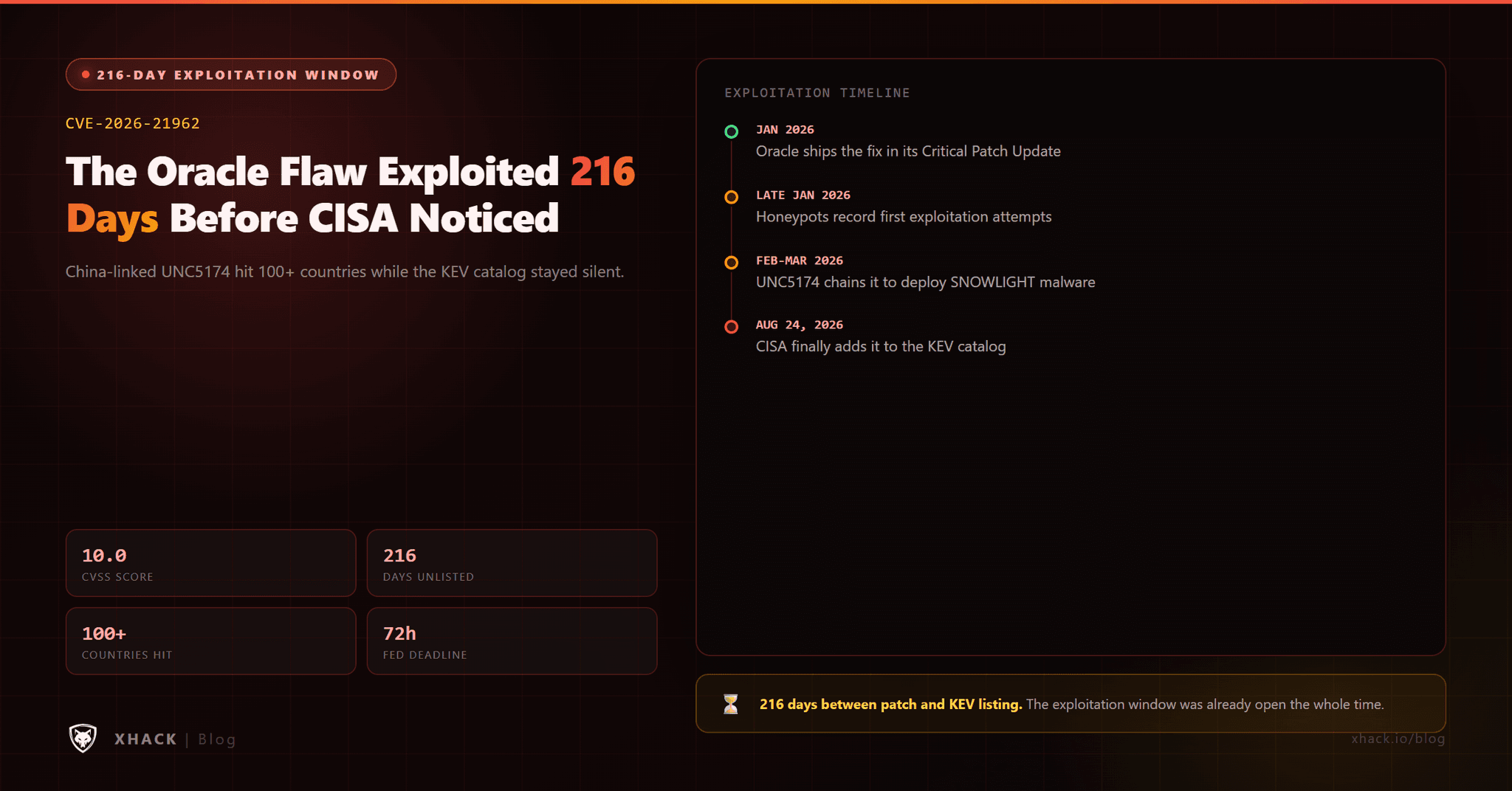
Read this in 30 seconds: CVE-2026-21962 is a maximum-severity (CVSS 10.0) improper access control flaw in Oracle HTTP Server and the WebLogic Server Proxy Plug-in, letting an unauthenticated attacker with network access reach, modify, or delete critical data through the proxy that bridges HTTP Server to WebLogic. Oracle patched it quietly in January 2026.
A China-linked group tracked as UNC5174 started exploiting it within days, chaining it with older WebLogic RCE bugs to drop SNOWLIGHT malware across government and commercial networks in more than 100 countries. CISA didn’t add it to the Known Exploited Vulnerabilities catalog until August 24, 216 days later, and gave federal agencies just 72 hours to patch. If you run Oracle HTTP Server or WebLogic anywhere in your stack, this is not a “get to it next sprint” bug.
A patch sat available for seven months while a nation-state actor used the hole it fixed to break into governments across more than 100 countries. Nobody outside a handful of threat intel shops noticed until three days ago.
That’s the actual story here, and it matters more than the CVSS score. Oracle did its part: the fix shipped in January. What happened in the 216 days after that is the part every security team should sit with, because “patched” and “actually applied” turned out to be two very different things, and the gap between them is exactly where UNC5174 lived.
The flaw sits in Oracle HTTP Server and the WebLogic Server Proxy Plug-in, the component that bridges HTTP Server requests through to a WebLogic backend. Per The Hacker News’s technical breakdown, it’s an improper access control issue: an unauthenticated attacker with plain network access over HTTP can reach functionality and backend resources that should have required authorization, with CISA’s own listing describing the impact as “unauthorized creation, deletion, or modification access to critical data as well as unauthorized access to critical data, or complete access to all Oracle HTTP Server and Oracle WebLogic Server Proxy Plug-in accessible data.”
No credentials. No social engineering. Just a request to a proxy that was supposed to enforce access rules and didn’t, which is why it landed a perfect 10.0 on CVSS.
Oracle shipped the fix in its January 2026 Critical Patch Update. Attackers didn’t wait. Per SecurityWeek, exploitation attempts hit honeypots by late January, with a public proof-of-concept and broader automated scanning following within weeks. CISA didn’t add CVE-2026-21962 to its Known Exploited Vulnerabilities catalog until August 24, 2026, seven months after the patch existed and roughly seven months after real exploitation began.
That gap is the headline, not the footnote. A KEV listing is supposed to be a forcing function, the thing that makes a patch actually get prioritized over the fifty other tickets in a security team’s backlog. For 216 days, this bug didn’t have that forcing function, even though it was already being weaponized against government infrastructure. Once CISA did act, it acted hard: federal agencies got a 72-hour deadline, one of the tightest windows CISA has issued in 2026.
This wasn’t opportunistic scanning. The exploitation is attributed to UNC5174, a China-linked threat actor first identified by Mandiant and described by Sysdig’s threat research team as likely operating as a contractor for the Chinese government, with a dual motive: espionage, and selling or brokering access to compromised environments for other actors to use.
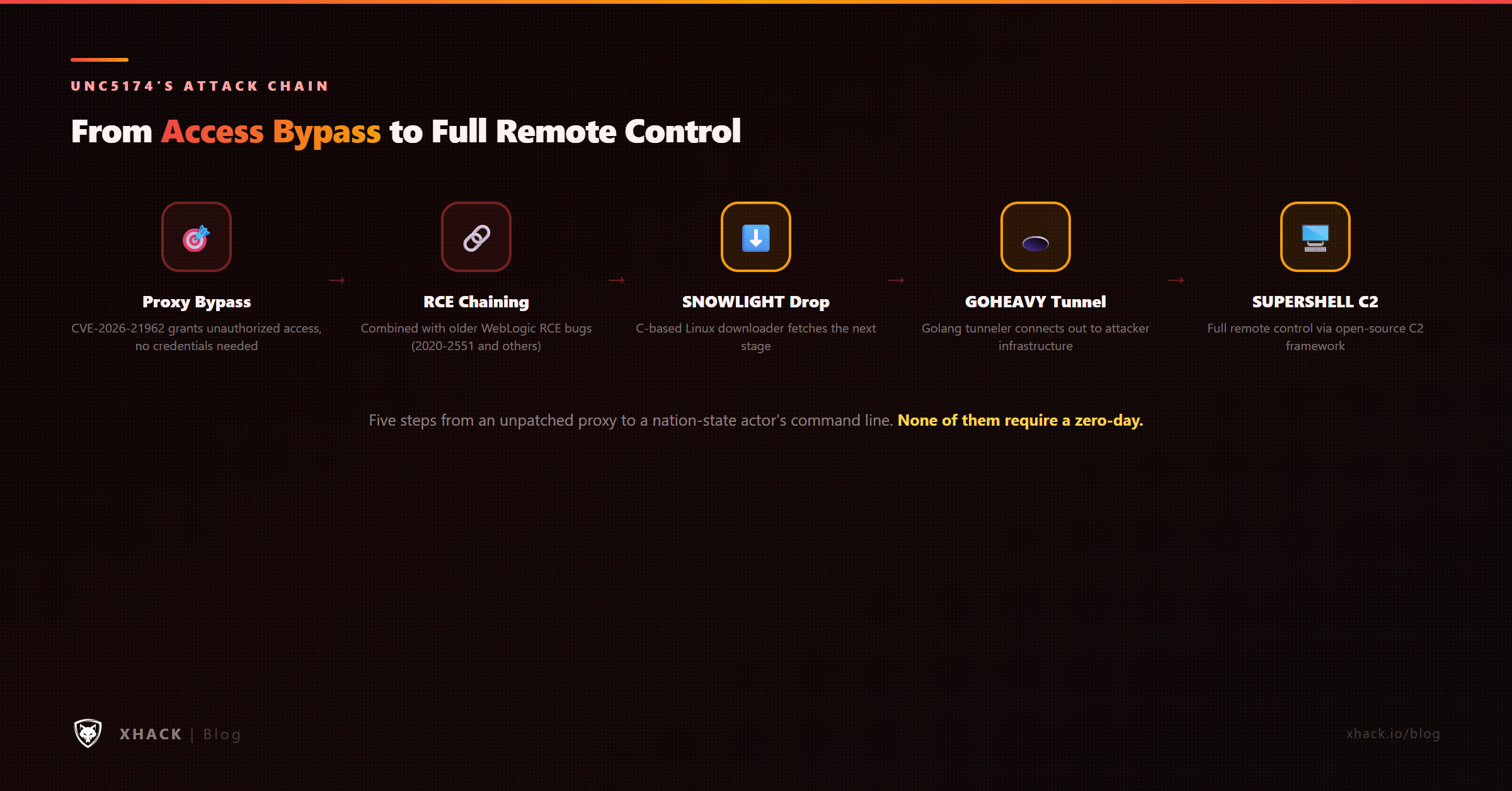
UNC5174 chained CVE-2026-21962 with older, already-known WebLogic remote code execution bugs (CVE-2020-14882, CVE-2020-14883, CVE-2020-2551, and CVE-2017-10271) to deploy SNOWLIGHT, a lightweight C-based Linux downloader that pulls in a Golang tunneler and hands off to a command-and-control framework called SUPERSHELL. The group has also been seen using VShell, an open-source post-exploitation tool, and GoCobaltStrike in the same campaigns. The targeting spanned government and commercial networks in more than 100 countries, concentrated heavily in financial services, healthcare, telecommunications, and critical infrastructure, exactly the sectors that tend to run Oracle middleware they can’t easily take offline for a weekend to patch.
Nothing about this attack chain required a novel technique. It worked because of a pattern that shows up in nearly every long-running exploitation campaign: old, business-critical middleware that nobody wants to touch, exposed to the internet, with a patch sitting unapplied because it never got flagged as urgent. WebLogic and Oracle HTTP Server run quietly for years, integrated deep enough that patching means a real change-control conversation, not a quick restart.
That’s precisely the profile CVE-2026-21962 exploited, and it’s the profile behind most multi-month exploitation windows on maximum-severity CVEs. The vulnerability isn’t clever. The gap between “patch exists” and “patch applied everywhere it needs to be” is where the damage happens, and that gap is a process failure, not a technical one.
If you run Oracle HTTP Server or WebLogic Server anywhere, treat this as urgent, not routine:
I covered the same underlying pattern, patches shipping months before defenders actually treat them as urgent, in my recent roundup of CISA’s August KEV additions. It repeats often enough to say plainly: a KEV listing is a lagging indicator. Treat any maximum-severity CVE in internet-facing middleware as urgent the day the patch ships, not the day a government agency finally adds it to a list.
So yeah, quick brand note: this exact failure mode, a patch existing but never verified as applied everywhere it needs to be, is what continuous testing catches and a once-a-year assessment structurally can’t.
The XHack AI agent runs continuous discovery against your actual exposed attack surface, not a static asset list from six months ago, so a WebLogic instance that was compliant in January and quietly fell behind by August gets flagged first. For infrastructure this critical, human-led VAPT adds what a scan alone won’t: confirming a “patched” instance is actually running the fixed version in production, not just in the change log. And XHack doesn’t store your findings on our servers. Session data stays local, which matters more when you’re investigating whether you were already a target.
CVE-2026-21962 is a maximum-severity (CVSS 10.0) improper access control vulnerability in Oracle HTTP Server and the WebLogic Server Proxy Plug-in. It allows an unauthenticated attacker with network access to gain unauthorized access to, or modify and delete, critical data accessible through the affected components, without needing any credentials.
If you’re running Oracle HTTP Server or the WebLogic Server Proxy Plug-in on a version predating Oracle’s January 2026 Critical Patch Update, you’re vulnerable. Check your current patch level against Oracle’s January 2026 CPU directly, and prioritize any instance reachable from the public internet.
UNC5174, a China-linked threat actor believed to operate as a contractor for the Chinese government, has been exploiting this flaw since shortly after the January patch, chaining it with older WebLogic RCE vulnerabilities to deploy SNOWLIGHT malware and related tooling across government and commercial targets in more than 100 countries. Researchers assess the group’s motives as both espionage and selling access to compromised networks.
Patching stops future exploitation of this specific flaw, but it does not undo access an attacker may have already gained during the 216-day window before CISA’s listing. If your WebLogic or Oracle HTTP Server instances have been internet-facing and unpatched at any point since January 2026, treat this as a potential compromise, not just a missing update, and hunt for the indicators described above before considering the incident closed.
Oracle did its job in January. CISA’s KEV catalog didn’t reflect reality for 216 days after that, and a state-linked threat actor used that gap to move through government and commercial networks in over 100 countries. If there’s one operational takeaway, it’s this: don’t wait for a KEV listing to treat a maximum-severity, unauthenticated vulnerability in internet-facing middleware as urgent. By the time it shows up on that list, the exploitation window has usually already been open for months.
Categories
Related articles