Table of contents
12
By Salman Khan, OSCP+, Founder of XHack, SRT (Synack Red Team member)
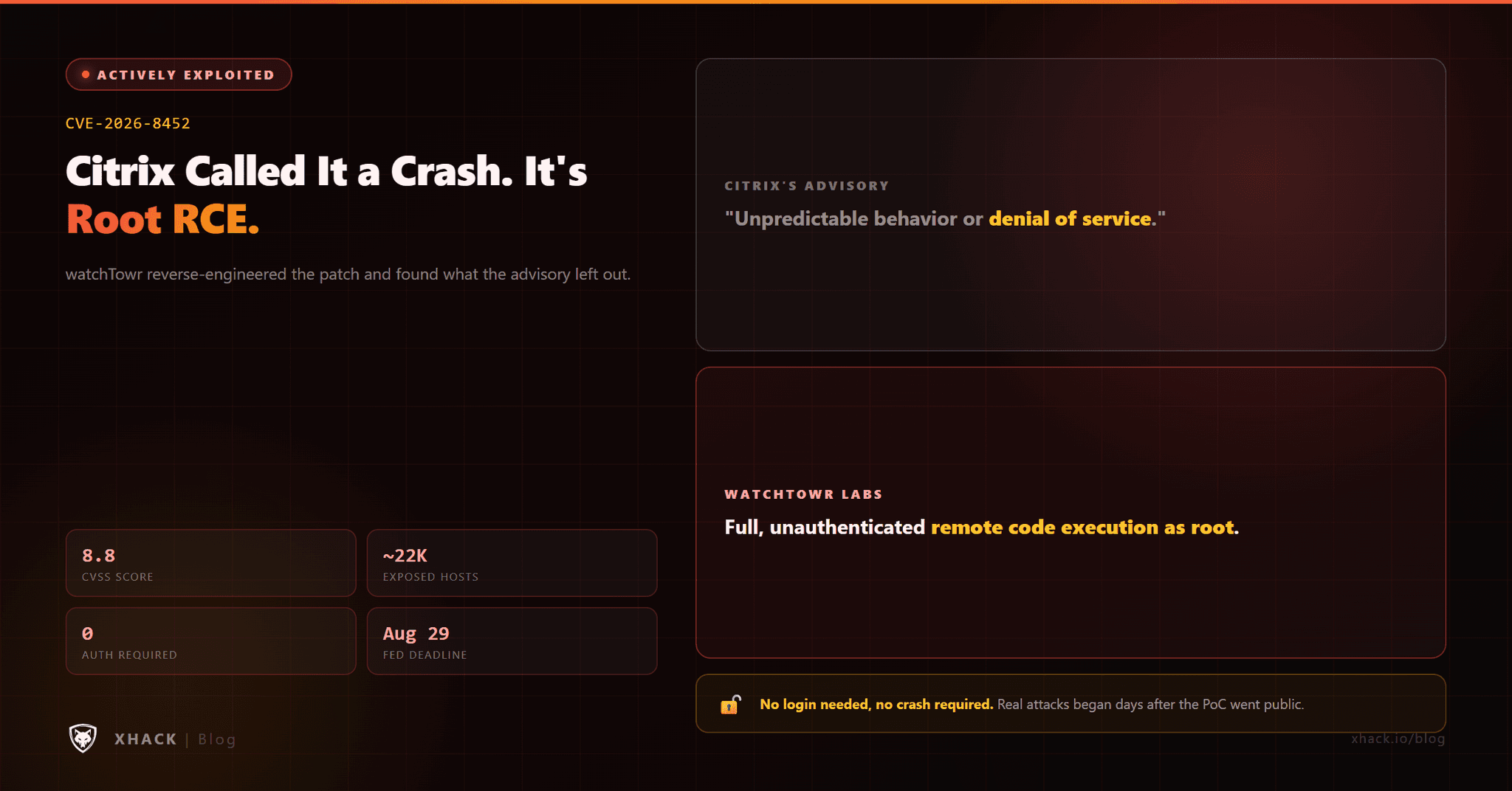
Read this in 30 seconds: CVE-2026-8452 is a pre-authentication vulnerability (CVSS 8.8) in Citrix NetScaler ADC and Gateway that Citrix originally described as a memory overflow causing “unpredictable behavior or denial of service” when it patched the flaw on June 30, 2026. That description undersold it. On August 14, researchers at watchTowr Labs reverse-engineered the patch, found the real root cause (a missing bounds check during SAML signature processing), and proved it’s a full unauthenticated remote code execution as root, not a crash.
Attackers moved fast: within days of watchTowr’s public proof-of-concept, real exploitation started, with web shells named
x.phpandz.phpshowing up on compromised appliances. CISA added it to the Known Exploited Vulnerabilities catalog on August 26 and gave federal agencies until August 29 to patch. Roughly 22,000 NetScaler ADC instances and 1,800 Gateway instances are visible on the open internet right now.
Citrix called this a crash bug. A third-party researcher proved it hands attackers root access with zero credentials, and the gap between those two descriptions is the whole story.
This is a different failure pattern than the usual “patch existed, nobody applied it” story. Citrix did patch it, back in June. The problem is Citrix’s own advisory undersold what the bug did, and severity assessments drive prioritization. A “may cause DoS” bug gets scheduled for the next maintenance window. An “unauthenticated root RCE” bug gets patched tonight. Thousands of NetScaler operators made a reasonable decision based on information that turned out to be wrong.
The flaw hits NetScaler ADC and Gateway appliances configured as a Gateway (SSL VPN, ICA Proxy, CVPN, RDP Proxy) or an AAA virtual server, the authentication-facing components most organizations expose to the internet on purpose. watchTowr Labs’ technical writeup, titled “You’re Back In The Room,” traces the root cause to a missing bounds check during SAML SignedInfo canonicalization. When NetScaler processes the XML signature, it copies data from an oversized PrefixList attribute inside the InclusiveNamespaces element into a fixed-size buffer without checking whether it actually fits.
That overflow spills into an adjacent memory chunk’s header, corrupting a data pointer. A later operation in NetScaler’s packet-handling code then uses that corrupted pointer, steerable by adjusting payload size, as the destination for a memory copy whose source is also attacker-controlled. Put plainly: the bug gives an attacker a write-what-where primitive, the ability to write arbitrary data to an arbitrary memory address, on a component that requires no login to reach. That’s a textbook path to remote code execution, not a crash.
Citrix’s June 30 advisory described CVE-2026-8452 as capable of causing “unpredictable behavior or denial of service.” That’s technically true, a crash is one possible outcome of an uncontrolled memory overflow, but it’s also the least severe possible outcome, and it’s the one Citrix put in writing.
watchTowr’s analysis shows the same overflow can be steered into full code execution as root, with no authentication required, confirmed independently by Help Net Security’s reporting on the discrepancy between Citrix’s advisory and the actual impact. That’s not a nuance, it’s the difference between a bug you fix on your normal patch cycle and a bug you fix the moment you read the advisory. Vendor severity descriptions shape real-world patching speed, and when a vendor’s own read of a bug undersells it, that gap becomes exactly the window an external researcher, and then real attackers, will use.
x.php and z.php on compromised NetScaler appliances, followed by reconnaissance commands like id and echo to fingerprint the compromised system.The gap between watchTowr’s public PoC and real attackers weaponizing it was days, not months. Once a working proof-of-concept for an unauthenticated RCE is public, the clock to real exploitation is now measured in days, regardless of how the vendor originally described the bug.
Shadowserver’s internet-wide scanning shows roughly 22,000 NetScaler ADC instances and close to 1,800 Gateway instances reachable from the public internet. There’s no clean breakdown of how many are honeypots, misconfigured, or already patched, but that’s still a large population of exactly the kind of internet-facing, authentication-adjacent appliance this bug targets.
If you run NetScaler ADC or Gateway configured as SSL VPN, ICA Proxy, CVPN, RDP Proxy, or an AAA virtual server, on 14.1 builds before 14.1-72.61 or 13.1 builds before 13.1-63.18 (including FIPS/NDcPP releases), you’re in the affected population, whether or not you’re currently seeing exploitation attempts.
x.php or z.php in web-accessible directories, and log entries showing reconnaissance commands like id or echo executed shortly after unusual requests to Gateway or AAA endpoints.So yeah, quick brand note: this is exactly the gap between “vendor’s advisory” and “actual exploitability” that a checkbox scan will never catch, since a scanner just checks your version number, not whether the patch fixed something worse than advertised.
The XHack AI agent doesn’t stop at version-matching. It probes the actual behavior of authentication-facing components, exactly the class of target this bug hit, for exploitable conditions a CVE description alone won’t reveal. For infrastructure this exposed, human-led VAPT catches a vendor’s underselling before a researcher’s writeup does it for you, and before attackers get there first. XHack doesn’t store your findings on our servers either, which matters more when you’re checking whether a gateway was already compromised.
CVE-2026-8452 is a pre-authentication vulnerability (CVSS 8.8) in Citrix NetScaler ADC and Gateway appliances configured as a Gateway or AAA virtual server. A missing bounds check during SAML signature processing allows an unauthenticated attacker to trigger a memory overflow that can be steered into full remote code execution as root, not just the denial-of-service impact Citrix originally described.
If you run NetScaler ADC or Gateway configured as SSL VPN, ICA Proxy, CVPN, RDP Proxy, or an AAA virtual server on 14.1 builds before 14.1-72.61 or 13.1 builds before 13.1-63.18 (or the corresponding FIPS/NDcPP releases), you’re affected. Check your exact build against Citrix’s advisory and patch to the fixed version regardless of whether you’ve seen exploitation attempts.
Check for web shells named x.php or z.php in web-accessible paths on your NetScaler appliance, and review logs for reconnaissance commands such as id or echo executed shortly after unusual requests to Gateway or AAA authentication endpoints. If you find either, treat it as a confirmed compromise and begin incident response, not just patching.
Citrix’s June advisory characterized the flaw as a memory overflow that could cause “unpredictable behavior or denial of service,” which is one real outcome of the underlying bug but not the most severe one. watchTowr Labs’ independent analysis of the patch found the same overflow could be precisely steered into a write-what-where memory corruption primitive, enabling full unauthenticated remote code execution as root, a significantly worse outcome than the original advisory suggested.
CVE-2026-8452 is a reminder that a vendor’s own severity language is a starting point, not the final word. Citrix patched a bug it called a crash risk. An independent researcher proved it was root-level remote code execution with no login required, and attackers were exploiting it within days of that proof going public. If you run NetScaler ADC or Gateway anywhere in your stack, patch now, hunt for the specific indicators above, and don’t wait for a KEV listing to tell you a pre-auth memory bug in an internet-facing appliance was always worth treating as critical.
Categories
Related articles