Table of contents
23
By Salman Khan, OSCP+, Founder of XHack, SRT (Synack Red Team member)
Read this in 30 seconds: What is AI pentesting? It’s penetration testing performed with the help of AI agents that plan, execute, and adapt their approach to finding and exploiting vulnerabilities, instead of following a fixed checklist like a traditional vulnerability scanner. It ranges from AI copilots that suggest commands to a human, up through fully autonomous agents that run an entire test with minimal supervision.
It’s legal exactly when traditional pentesting is legal: with explicit written authorization from the system owner, nothing more, nothing less. It’s genuinely good at speed, coverage, and continuous testing, and still weaker than a human at business logic and truly novel attack chains. This guide walks through what is AI pentesting, how it works, whether it’s legal, what tools exist, and how to actually try it.
If you’ve heard “AI pentesting” thrown around and aren’t totally sure whether it means a chatbot suggesting hacking tips or an autonomous robot breaking into your servers, you’re not behind. Most of the industry is using the term loosely too.
So let’s fix that. What is AI pentesting, actually? This is the plain-language version: what it is, how it’s different from the vulnerability scanner your team probably already runs, whether it’s legal to use, and how you’d actually go try it yourself without breaking anything (or any laws).
So, what is AI pentesting exactly? AI pentesting is the use of AI systems, usually built on large language models with access to real security tools, to perform some or all of the work of a penetration test: finding vulnerabilities, exploiting them to prove real impact, and reporting what was found. The key word is “reasoning.” A traditional scanner runs the same fixed checks against every target and reports anything that matches a known pattern. An AI pentesting system reads the results of its own actions and decides what to try next, the same way a human tester does.
That reasoning step is what actually separates AI pentesting from decades-old automated scanning with a new coat of paint. If a tool can’t look at what it just found and change its plan based on it, it’s not doing AI pentesting no matter what the marketing page says.
To make this concrete: imagine pointing a tool at a login page. A traditional scanner tries a fixed list of known SQL injection payloads, gets nothing back that matches a known-bad pattern, and moves on. An AI pentesting system tries a payload, reads the actual response (not just a pass/fail signature match), notices the error message leaked a database type it didn’t expect, and adjusts its next attempt based on that new information. That’s the difference between checking boxes and actually thinking about a target, and it’s the whole reason “what is AI pentesting” has become a question worth answering properly instead of waving off as a buzzword.
What is AI pentesting’s backstory? It didn’t appear out of nowhere in 2026. Security teams have used some form of automation for decades, starting with simple vulnerability scanners in the 1990s that checked for known-bad configurations, then moving to more sophisticated dynamic application security testing (DAST) tools that could crawl and probe live applications. What changed recently is that large language models became capable enough to reason about ambiguous technical output, read an error message, infer what’s happening under the hood, and decide what to try next, the same reasoning loop a junior human tester goes through.
That shift happened fast. Early “AI-assisted” security tools from a couple of years ago were mostly chatbots layered on top of existing scanners, useful for explaining a finding in plain English but not for actually finding anything new. The move toward giving models real tool access (a terminal, a browser, an HTTP proxy) inside a sandboxed environment, and letting them run multi-step loops with minimal supervision, is what turned “AI pentesting” from a marketing phrase into an actual capability worth learning about.
What is AI pentesting’s process, mechanically? Underneath the branding, most AI pentesting tools run a version of the same loop:
Some tools use one large model with tool access. Others split the work across multiple specialized agents, one handling recon, another handling exploitation, and so on. Either way, the loop above is what’s actually happening under the hood, regardless of how a vendor brands it.
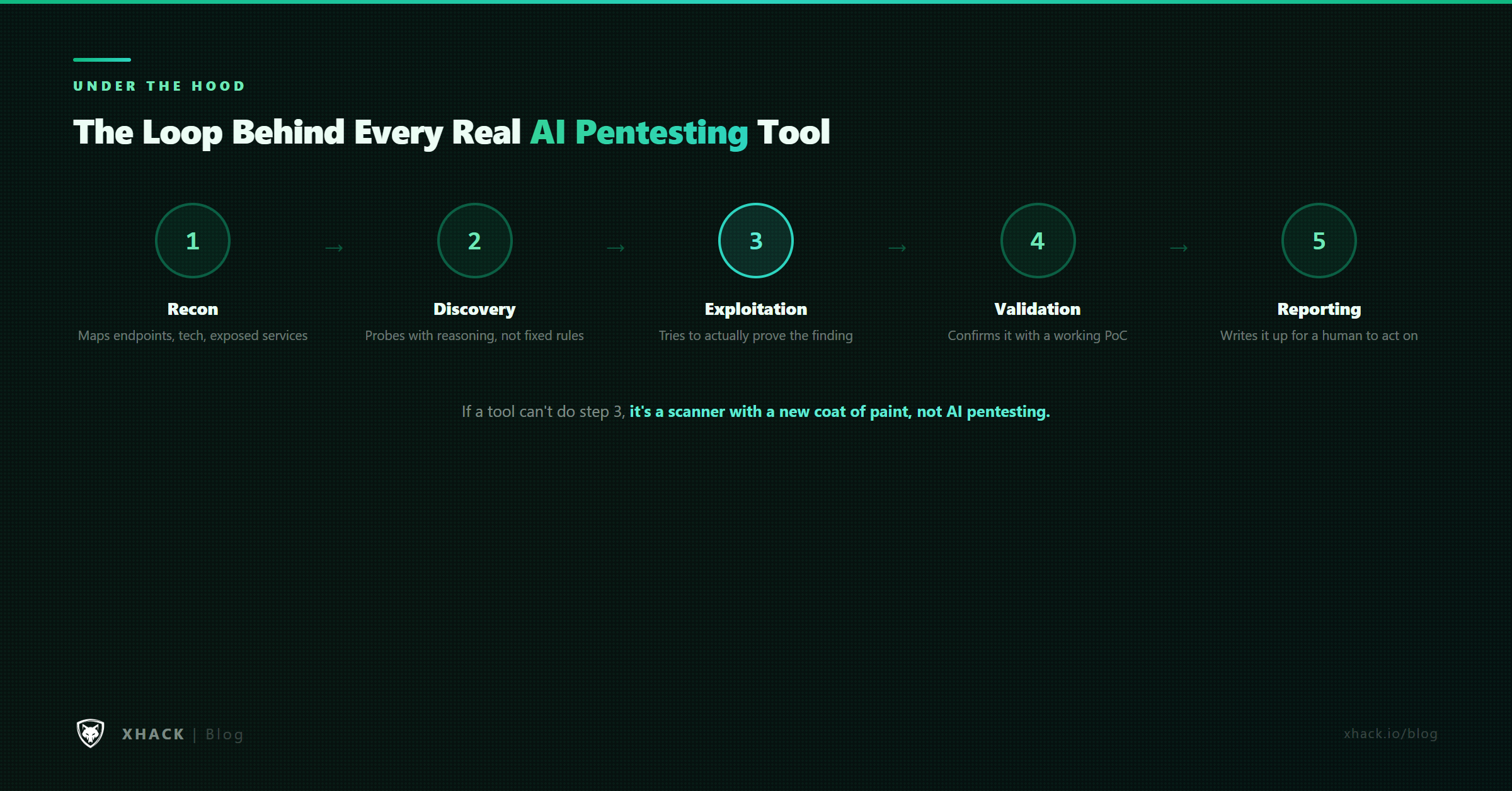
Now that you know what is AI pentesting at the mechanical level, the more useful comparison is how it actually stacks up against the traditional testing your organization is probably already paying for.
What is AI pentesting like when you actually put it side by side with the testing your organization is probably already paying for? Here’s the honest comparison:
| Traditional Manual Pentest | AI Pentesting | |
|---|---|---|
| Who does the work | A human tester, start to finish | An AI agent, with varying human oversight |
| Speed | Days to weeks per engagement | Minutes to hours for the same scope |
| Frequency | Usually once or twice a year | Can run continuously |
| Cost model | Per-engagement, often $5,000-$50,000+ | Often a flat monthly subscription |
| Business logic flaws | Strong, this is where humans excel | Weak, still the biggest known gap |
| Novel attack chains | Strong, creative reasoning | Improving, but not yet reliable |
| Coverage at scale | Limited by tester hours | Can cover far more of a large attack surface |
| Compliance sign-off | Generally accepted everywhere | Accepted for some frameworks, not others (see below) |
Neither column wins outright. AI pentesting wins on breadth, speed, and continuous coverage. Traditional testing wins on judgment, creativity, and the kind of contextual reasoning (“would a real attacker actually care about this?”) that’s genuinely hard to automate. That’s why the strongest security programs in 2026 use both instead of picking a side.
What is AI pentesting for, in practice? The honest answer spans a wider group of people than you’d expect:
If you’re trying to figure out whether AI pentesting is relevant to your situation, the honest answer is that it’s relevant to almost everyone doing any form of security testing today, the only real question is which tier (copilot, semi-autonomous, or fully autonomous) and which pricing model actually fits. That’s really what is AI pentesting worth answering for: not whether to use it, but which flavor of it fits your specific situation.
What is AI pentesting’s legal status? Yes, it’s legal, under exactly the same condition that makes any penetration testing legal: explicit, written authorization from the owner of the system you’re testing. Penetration testing is legal in all fifty US states when conducted this way, governed primarily by the Computer Fraud and Abuse Act, which prohibits knowingly accessing a computer without authorization. The UK’s Computer Misuse Act works on the same principle. Neither law cares whether the party doing the testing is a human or an AI agent. They care whether access was authorized. Test something you don’t have permission to test, with an AI agent or your own two hands, and you’re in the exact same legal jeopardy either way.
Where AI pentesting adds a genuinely new wrinkle is scope control. A Cloud Security Alliance study published in April 2026 found that 53% of organizations had experienced AI agents exceeding their intended permissions. An autonomous agent can adapt mid-engagement and pursue a path nobody explicitly scoped in, which is exactly why any serious AI pentesting engagement needs the same written authorization letter a human-led test requires, plus real guardrails on what the agent is actually allowed to touch.
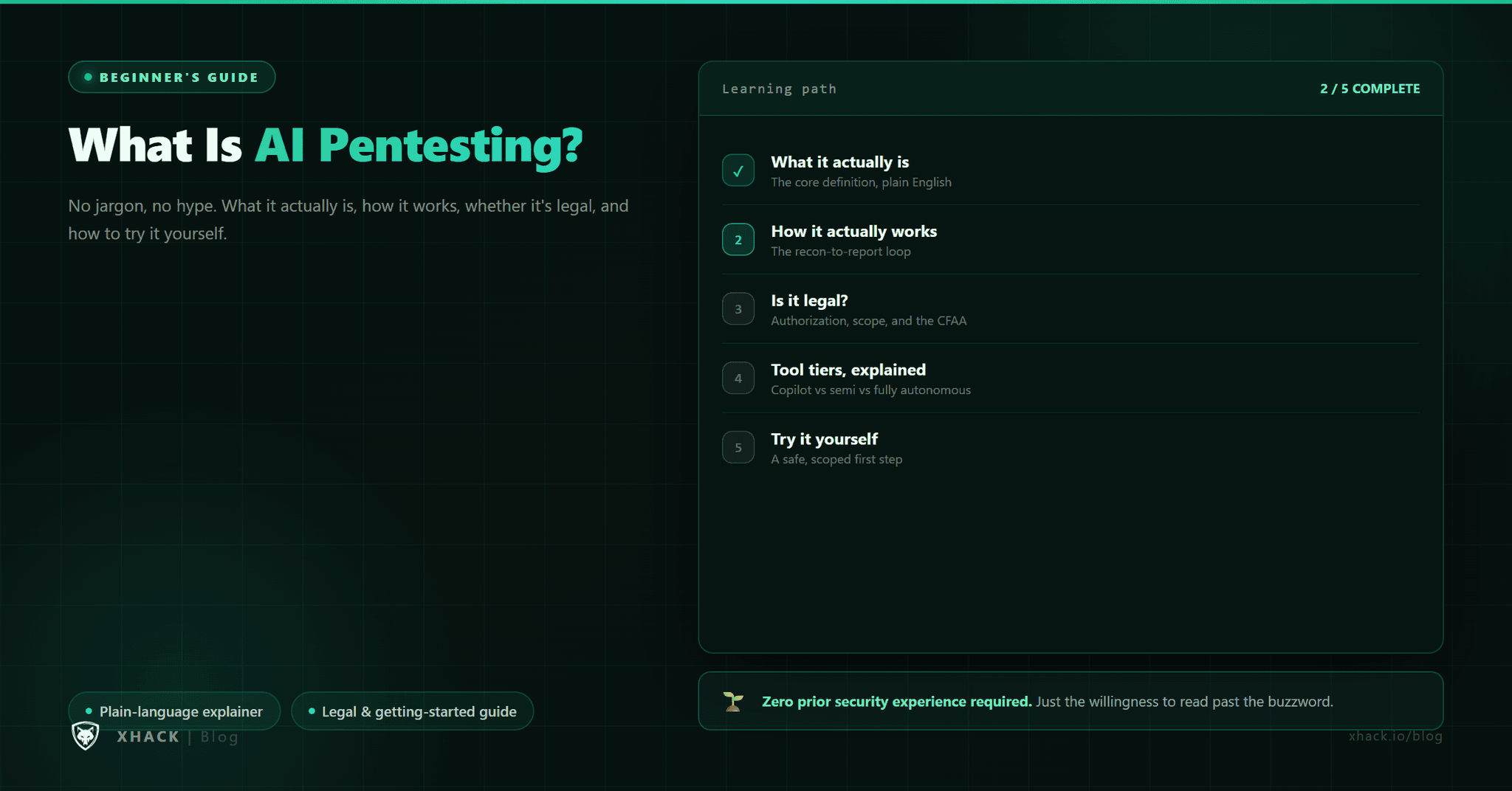
Part of what makes “what is AI pentesting” hard to answer in one sentence is that not every tool calling itself AI pentesting means the same thing. There are three real tiers:
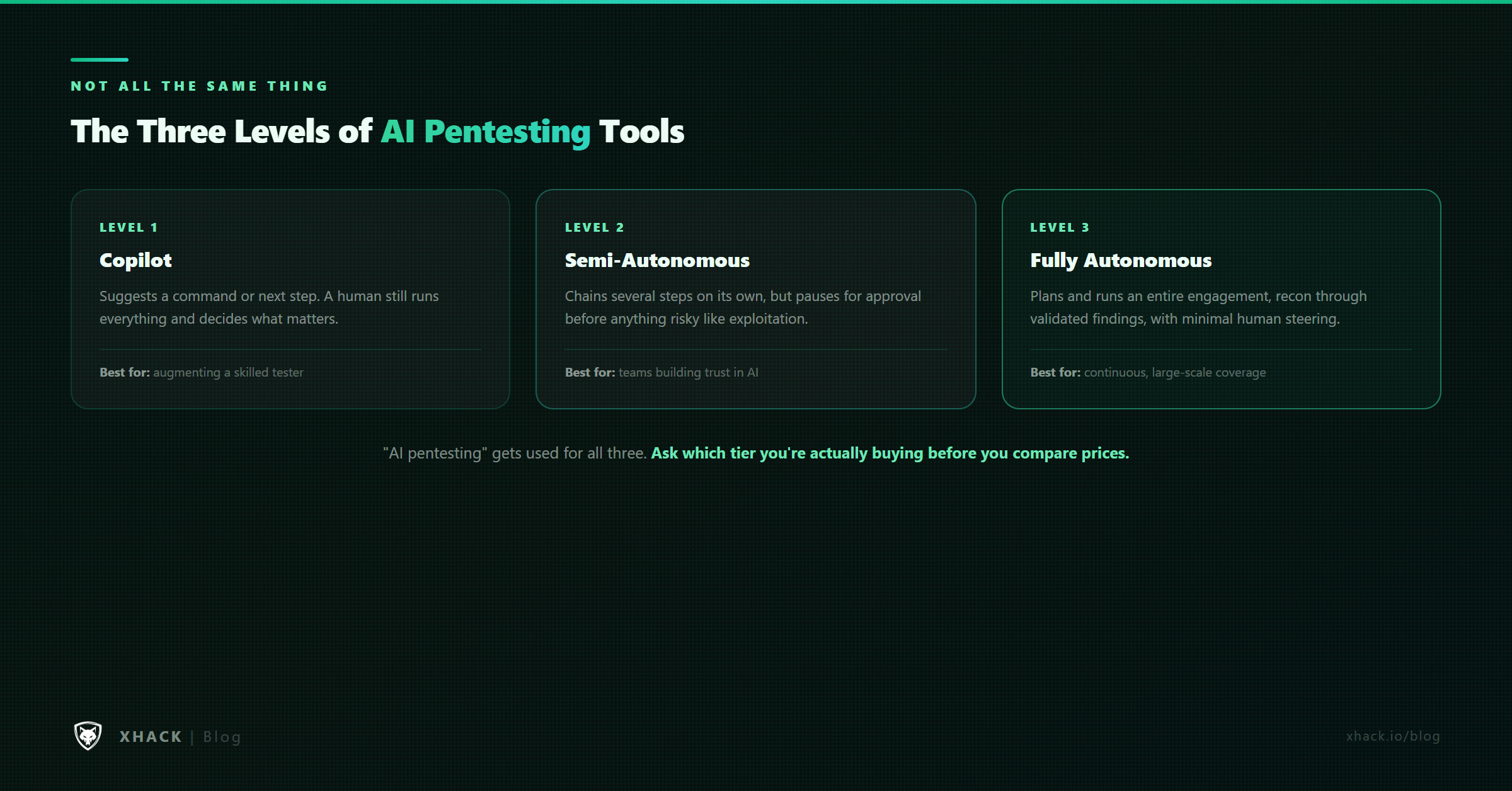
I’ve written in more depth about the fully autonomous end of that spectrum, including what autonomous penetration testing actually looks like, the multi-agent architecture behind it, and a rundown of the specific autonomous agents worth knowing, if you want to go deeper than “beginner” on that particular tier.
To ground this in real examples rather than abstractions: a general-purpose AI assistant that suggests a curl command when you describe a target is functioning as a copilot, useful, but you’re still the one running every step and deciding what matters. A tool that automatically chains recon into vulnerability discovery but stops and asks before attempting an actual exploit is semi-autonomous, a reasonable middle ground for teams still building trust in the technology.
A platform that runs the entire loop, recon through a validated, exploited finding, without a human clicking “continue” at every stage, is what most people actually mean when they say “fully autonomous AI pentesting.” That’s the newest and most capable tier, but also the one that demands the most trust in the platform’s guardrails.
Understanding what is AI pentesting also means clearing up what it isn’t. A few myths worth killing directly:
“AI pentesting means zero human involvement.” Not for anything that matters. Even the most benchmark-dominant autonomous platforms on the market route findings through some form of human review before they’re submitted or trusted for high-stakes decisions. Full autonomy with zero oversight is rare in practice, and the organizations that tried it in 2026 mostly walked it back.
“AI pentesting is basically the same as a vulnerability scanner, just with a chatbot.” For some products calling themselves “AI-powered,” that’s uncomfortably close to true. For a real AI pentesting system, the difference is validation: it doesn’t just flag a pattern match, it attempts to actually exploit the finding and prove it’s real, which is why genuine AI pentesting platforms report dramatically lower false positive rates than plain scanners.
“If it’s AI, it must be illegal or in some legal gray area.” It isn’t, and this is one of the most common misconceptions worth clearing up directly. The legal question has nothing to do with whether AI is involved, and everything to do with authorization, covered in detail below.
“AI pentesting will replace human penetration testers within a year or two.” Answering what is AI pentesting honestly means admitting the 2026 data doesn’t support that. Confidence in fully autonomous testing actually declined through 2026 as organizations ran into real-world false negatives, and the hybrid model, AI for breadth, humans for judgment, is what’s winning, not full replacement.
Abstractions only get you so far, so here’s what is AI pentesting in action on a real target, in broad strokes without reproducing operational exploit details. A team points an AI pentesting agent at a web application.
The agent starts with reconnaissance, mapping every endpoint including the ones nobody thinks to test manually, like a password-reset form or an email field, the exact kind of “boring” input that turns out to hide serious bugs surprisingly often. It tries a range of inputs, reads the actual server responses rather than just checking for a known-bad signature, and notices one endpoint behaves unusually when it receives a malformed value.
It adjusts its next attempt based on that signal, eventually confirming the behavior is exploitable, and generates a working proof-of-concept rather than a hopeful guess. A human reviewer then verifies the finding, checks whether it’s actually reachable by an unauthenticated user, and decides how urgently it needs fixing.
That loop, recon, adapt, validate, human review, is what is AI pentesting in practice, not the sci-fi version where a fully autonomous system silently takes over infrastructure with no oversight. The real version is closer to a very fast, very thorough junior tester who never gets bored, paired with a human who still makes the final call.
So what is AI pentesting actually good at, concretely, versus where it still falls short? Good at: covering a large attack surface quickly, running continuously instead of once a year, catching well-understood technical flaws (the OWASP Top 10-style stuff) fast, and doing it at a fraction of the cost of scaling up a human team to match the same coverage.
Still bad at: business logic flaws (a workflow that lets User A see User B’s data because of a design flaw, not a technical bug), truly novel attack chains that require creative lateral thinking, and knowing when a technically-valid finding actually matters to the business versus being a theoretical non-issue. That gap is exactly why fully autonomous AI pentesting, used completely alone with no human review, still makes most security leaders nervous, and why the hybrid model (AI for breadth, humans for judgment) is winning out over full automation as the default approach in 2026.
What is AI pentesting worth for compliance purposes? It depends entirely on which framework you’re testing against, and this catches a lot of beginners off guard. SOC 2 doesn’t explicitly require a human tester, auditors generally want documentation of a defined methodology and validated findings, which a well-run AI pentesting report can provide. PCI DSS is stricter: its own guidance describes penetration testing as “essentially a manual endeavor” and states that automated tools alone don’t satisfy the requirement. In practice, that means AI pentesting can contribute meaningfully toward PCI DSS compliance, but purely automated, human-free testing generally won’t close it out on its own. If compliance is part of why you’re testing at all, confirm which standard applies before you assume AI-only coverage is enough.
Now that you know what is AI pentesting in theory, here’s the practical path to seeing it for yourself instead of just reading about it:
None of these steps require deep security expertise to follow. What they require is discipline: get permission, start small, verify what the AI tells you, and decide your oversight model on purpose. That discipline is what separates someone genuinely learning what AI pentesting is from someone who just ran a tool once and got lucky.
So yeah, quick brand note. A lot of “what is AI pentesting and how do I start” advice assumes you already have a security team ready to babysit an autonomous agent. XHack is built for the case where you don’t, and for the case where you do and just want it to actually work.
If you’re still asking what is AI pentesting worth trying first, XHack is a reasonable answer. The XHack AI agent runs the loop described above (recon, discovery, exploitation, validation, reporting) autonomously, with human-verified findings on the other end so you’re not left guessing which results are real. For a beginner, that human verification is the part that matters most: you get the speed of AI pentesting without needing to personally develop the instinct for what’s a real finding versus noise. And XHack doesn’t store your data either, pentest chats and session data stay local to you.
Individual plans start at $20 a month, with a 7-day free trial and no credit card required, so trying this out costs you nothing but time. If you outgrow the self-service tier or want a fully human-led engagement instead, VAPT services run $2,500 to $12,000 per engagement, scoped to what you actually need tested.
A handful of terms come up constantly once you start reading about what is AI pentesting and how it’s discussed, worth knowing before you dive deeper. Understanding what is AI pentesting fully means understanding the vocabulary that surrounds it too:
What is AI pentesting, in the simplest possible terms? It’s penetration testing where an AI system, rather than a human alone, performs some or all of the actual work: finding vulnerabilities, attempting to exploit them, and reporting the results. The defining trait is that the AI reasons about what it finds and adjusts its approach, rather than running a fixed checklist like a traditional scanner.
No, and this mix-up is a big part of why “what is AI pentesting” needs a clear answer in the first place. A vulnerability scanner matches signatures against known issues and stops there, often with a false positive rate of 40 to 70% according to published benchmark data, since nothing gets validated. AI pentesting goes further: it attempts to actually exploit findings and confirm them with a working proof-of-concept, which is why mature AI pentesting tools report false positive rates under 2% by comparison.
Part of what is AI pentesting’s appeal for beginners is that the answer is no, not necessarily to run a basic scan, most commercial AI pentesting platforms are designed for a non-expert to point at a target and get a report. But interpreting the results correctly, knowing which findings actually matter and which need a human to verify, benefits enormously from at least some security background. That’s exactly the gap human-verified platforms and hybrid human-plus-AI services are built to close.
Not currently. AI pentesting tools handle breadth and speed well, but they still struggle with business logic flaws and novel attack chains that require creative, contextual judgment. Even the most capable autonomous platforms on the market route findings through some form of human review before they’re trusted for anything high-stakes.
Once you understand what is AI pentesting worth in practice, cost is the next natural question, and it varies widely. Some platforms, including XHack, offer individual subscriptions starting around $20 a month with a free trial, making it essentially free to try. Fully human-led penetration testing, with or without AI assistance, is a separate, scoped professional service typically costing several thousand dollars per engagement.
This is one of the most common follow-up questions to what is AI pentesting, and the terms overlap heavily but aren’t identical. “AI pentesting” is the broader category, any use of AI to assist or perform penetration testing work, including simple copilots. “Agentic pentesting” specifically describes the architecture behind the more advanced end of that category: one or more specialized AI agents, coordinated by an orchestration layer, reasoning through a target the way a human attacker would. Every agentic pentesting system is a form of AI pentesting; not every AI pentesting tool is agentic.
If everything above answered what is AI pentesting but you still want a concrete first move: start with a scoped, low-stakes test against something you’re explicitly authorized to test, ideally your own lab environment or a deliberately vulnerable practice application, before pointing any AI pentesting tool at production systems or anything you don’t own. Pair that hands-on step with reading how the underlying loop (recon, discovery, exploitation, validation, reporting) actually works, so you can tell the difference between a tool that’s genuinely reasoning about your target and one that’s just running a fixed script with an AI-branded label on it.
So, what is AI pentesting, in one line? It isn’t one thing, it’s a spectrum from a copilot suggesting your next command to a fully autonomous agent running an entire engagement on its own. It’s legal under the same rules that govern any penetration testing: explicit authorization, clearly scoped. It’s genuinely strong at speed and coverage, and it still needs a human for the judgment calls that make the difference between a technically-real finding and one that actually matters. If you’re starting out, the fastest way to actually understand it is to try a scoped, low-stakes test yourself, with authorization in hand and a human reviewing what comes back.
Categories
Related articles