Table of contents
17
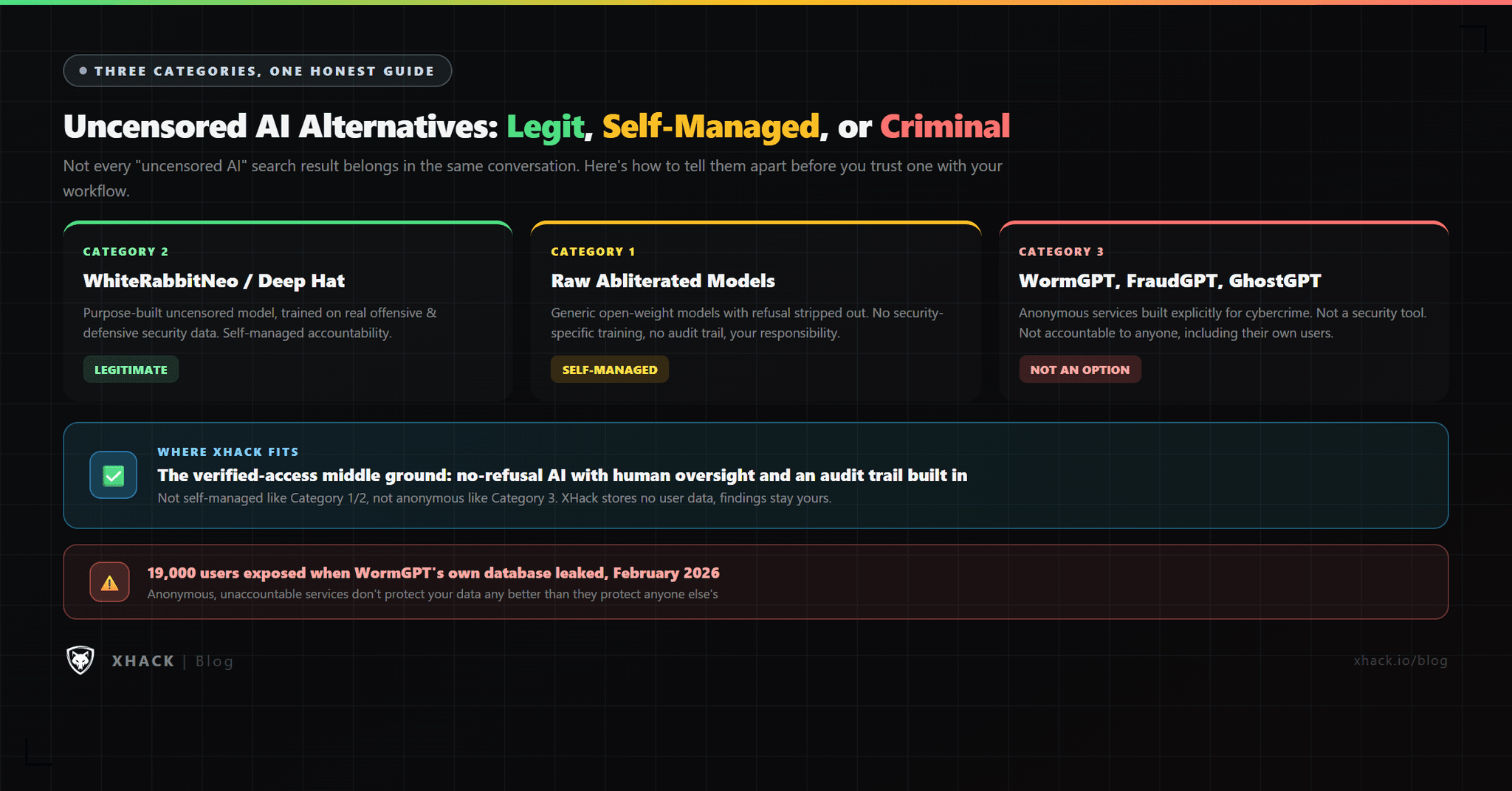
Read this in 30 seconds: Searching for an uncensored AI alternative for security work usually turns up three very different kinds of results: raw open-source “abliterated” models you self-host with zero accountability, a genuinely security-focused uncensored model like WhiteRabbitNeo (now Deep Hat), or anonymous criminal services like WormGPT that have nothing to do with legitimate security work at all.
Only one of those categories is safe to build a professional workflow around, and it’s not the one most searches lead people to first. This guide walks through what each option actually offers, why the criminal tier is a genuine liability even if you’d never use it for crime, WormGPT’s own user database was breached and leaked in February 2026, and where a verified-access platform like XHack fits as the legitimate middle ground between “an AI that refuses everything” and “an AI with no accountability at all.”
Typing “uncensored AI” into a search bar for security work is a genuinely confusing experience. Half the results are romance-chatbot apps that have nothing to do with your job. Some of the rest point at real, legitimate tools built specifically for offensive security. And a dangerous minority point at services built for actual cybercrime, the kind that get their own user databases breached and leaked because nobody running them cares about your operational security either.
This guide sorts through what’s actually out there, honestly, so you know which category you’re looking at before you sign up for anything.
The reason isn’t exotic. Mainstream AI models refuse legitimate, authorized security work at a measurable, frustrating rate. Ask a general-purpose chatbot to help analyze a malware sample, draft a proof-of-concept for an authorized pentest finding, or explain an exploit technique for a client report, and there’s a real chance it declines, even when you explain you’re authorized, even when the request is exactly what your job requires.
That refusal behavior is what sends people searching for “uncensored AI alternative” in the first place, and it’s a legitimate need. The problem is that the search results don’t sort themselves into “safe for professional use” and “not safe for professional use.” You have to do that part yourself.
This is the DIY tier: general-purpose open-weight models (Llama, Mistral, Qwen derivatives) that have had their refusal behavior stripped out through fine-tuning or “abliteration,” a technique that identifies and suppresses the internal direction in the model associated with refusal. You run these yourself, typically through Ollama or a similar local runtime, with zero content restrictions and zero built-in accountability.
What you get: genuinely no refusals, full local control, no per-token cost beyond your own hardware, and no data leaving your machine.
What you don’t get: any cybersecurity-specific tuning (a generically abliterated Llama model isn’t trained on offensive security workflows any better than the base model was), no audit trail, no human review layer, and entirely your own responsibility for making sure whatever it outputs is correct before you act on it. These models hallucinate exploits and misjudge context exactly like their censored counterparts, the fine-tuning removes the refusal, not the underlying reliability gaps.
This is where it gets legitimate. WhiteRabbitNeo, now continuing under the name Deep Hat, is a real, named, openly discussed uncensored model built specifically for red-team and blue-team cybersecurity work, trained on a large corpus of offensive and defensive security data rather than being a generically de-refused chatbot. It’s built on Qwen-family models, reasons across more than 180 programming and scripting languages, and explicitly positions itself for authorized DevSecOps and red-team use rather than pretending to be a general assistant.
That’s a genuinely different tier from Category 1: purpose-built training data for the actual domain, not just a refusal switch flipped off. The honest limitation is what it doesn’t include by design: it’s a model, not a managed service. Self-hosting or using the hosted version means you’re still the one handling scope enforcement, output validation, and audit logging yourself. Nothing wrong with that if you know what you’re doing and you’re building your own workflow around it, but it’s not a verified, accountable platform out of the box.
WormGPT, FraudGPT, and GhostGPT occupy a completely different category, and this guide isn’t pretending they’re a real alternative for authorized security work. These are services built and marketed for cybercrime: phishing generation, malware development, fraud tooling. They’re not “uncensored AI for security professionals” in any legitimate sense, they’re the thing your job exists to defend against.
There’s a concrete reason to mention them here beyond just warning you off: anonymous, unaccountable services built by criminals for criminals tend to have criminally bad operational security too. In February 2026, a threat actor using the handle “Sythe” claimed to leak WormGPT’s entire user database on BreachForums, exposing roughly 19,000 users’ email addresses, user IDs, and subscription and billing metadata. If you’re weighing whether an anonymous, no-accountability “uncensored” service is worth the risk, that breach is the answer: the same lack of accountability that lets a service ignore ethics also means it doesn’t particularly care about your data either.
| Local abliterated models | WhiteRabbitNeo / Deep Hat | Criminal dark-LLMs | XHack | |
|---|---|---|---|---|
| Refuses legitimate security work | No | No | No | No |
| Security-domain training | Generic | Purpose-built | Unknown, criminal-focused | Purpose-built |
| Human review / accountability layer | None, self-managed | None, self-managed | None | Built in |
| Audit trail | None | None | None | Built in |
| Legal, professional use case | Yes | Yes | No | Yes |
| Data privacy risk | Local, your responsibility | Depends on hosted vs. self-hosted | High, proven breach history | No data stored by design |
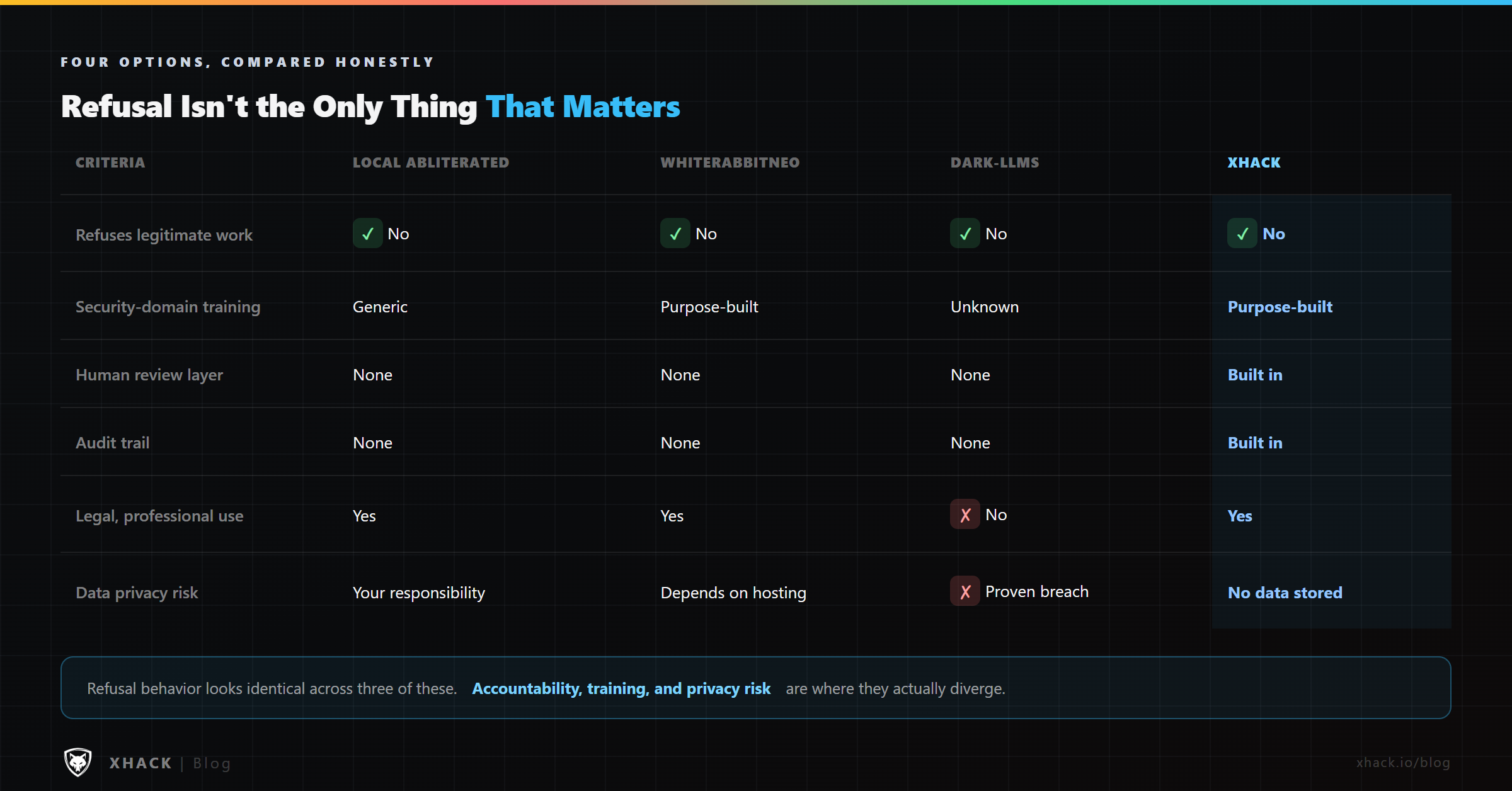
The honest gap between Category 1/2 and a fully criminal service isn’t refusal behavior, all three “legitimate” columns above already don’t refuse authorized work. The gap is accountability: who’s checking that a finding is real before it reaches a client, who’s logging what the agent actually did, and who’s responsible when something goes wrong.
That’s the specific space XHack’s unrestricted AI occupies. It doesn’t refuse legitimate, authorized security requests the way general-purpose assistants do, but it’s built around verified professional use rather than anonymous access, with human oversight and logging built into the workflow instead of left entirely to whoever’s running the model. It’s the platform version of Category 2’s philosophy, no-refusal AI for real security domains, packaged with the accountability infrastructure that a raw model or a self-hosted deployment leaves entirely on you to build yourself.
That distinction matters most on the exact point that made WormGPT’s breach embarrassing rather than just unfortunate: XHack does not store your user data, and the platform is privacy-focused by design. Your chats and session data stay on your own local machine, not sitting on a server that becomes someone else’s breach headline, and you can delete them whenever you choose.
On cost, this sits on XHack’s individual researcher plans rather than a criminal-market subscription: unrestricted AI access starts on the Professional plan at $49 a month, with the Elite plan at $150 a month adding custom payload generation and malware analysis tooling. That’s individual pricing for a single researcher, not a company license, and it’s a transparent, invoiced cost rather than crypto-only payment to an anonymous handle. If you want the fuller picture of where XHack sits against other AI pentest tools on the market, that comparison breaks down the category in more depth.
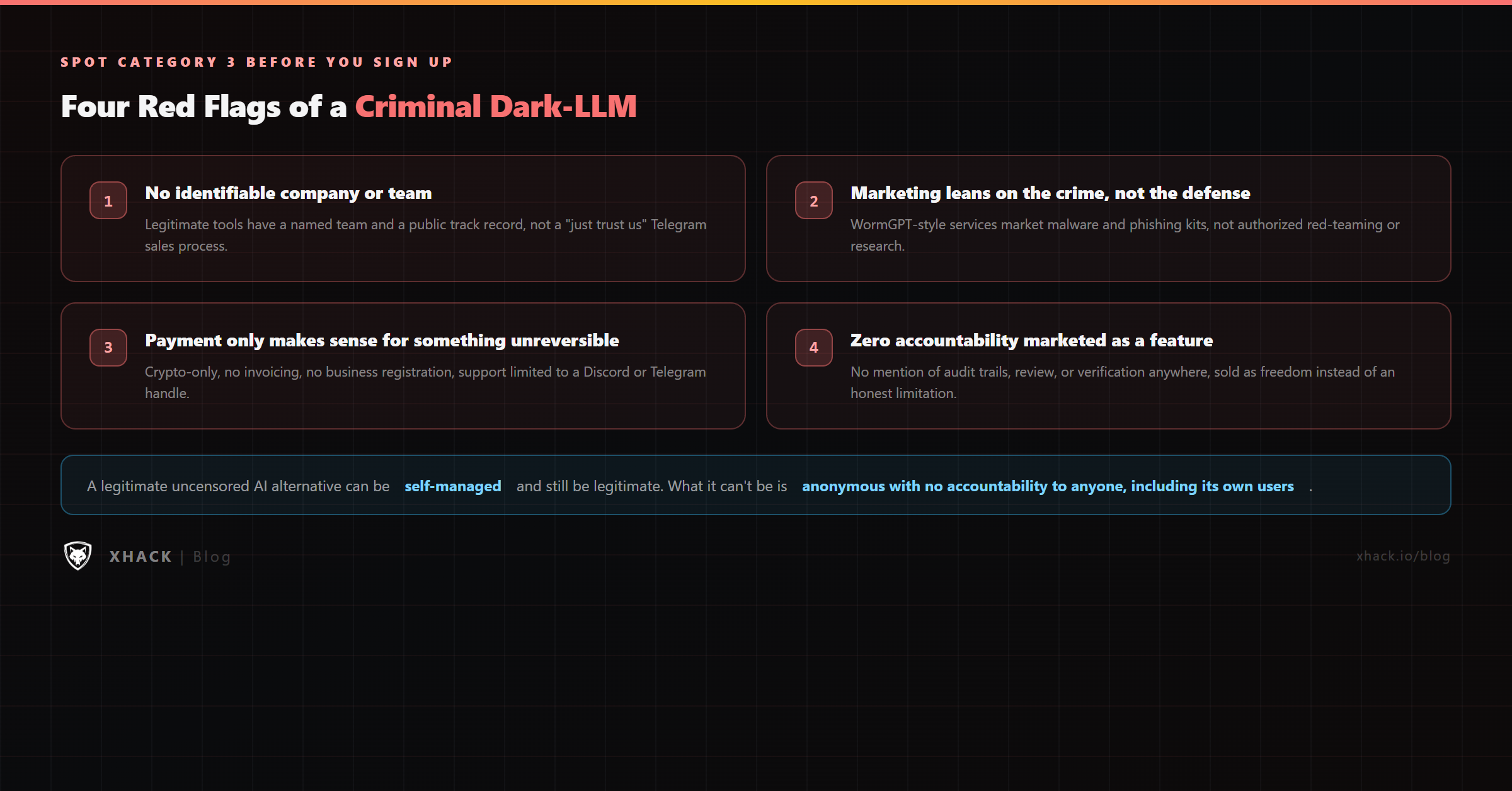
A few consistent signals separate a legitimate uncensored AI alternative from a criminal one, and they’re worth checking before you hand over payment details to anything.
No identifiable company or team behind it. Legitimate security tools, even niche ones, have a named team, a real company, and a public track record. A “just trust us” Telegram-first sales process is a criminal-market pattern, not a software business one.
Marketing that leans on the crime, not the defense. WormGPT and its imitators historically marketed themselves around writing malware and phishing kits, not around authorized red-teaming or defensive research. A legitimate tool’s marketing centers on professional use cases, even when it’s honest about being uncensored.
Payment methods that only make sense for something that can’t be reversed. Crypto-only payment with no invoicing, no business registration, and no support channel beyond a Discord or Telegram handle is a pattern worth treating as disqualifying on its own.
No mention of accountability, audit trails, or verification anywhere. This one cuts both ways: a raw local model genuinely won’t have this by design, and that’s fine if you’re building your own. But a hosted service that markets zero accountability as a selling point, rather than an honest limitation, is telling you something about who it’s actually built for.
If you’re a solo researcher comfortable managing your own infrastructure, validation, and audit trail, and you want maximum control, WhiteRabbitNeo / Deep Hat or a well-chosen local abliterated model are legitimate, defensible choices. You’re taking on the accountability work yourself, but that’s a reasonable tradeoff for some workflows.
If you want no-refusal AI for authorized security work without building your own guardrails from scratch, a verified-access platform is the better fit, one where human review, scope enforcement, and audit logging come with the product instead of being your side project.
If a search result promises “uncensored AI” with no mention of security specialization, no accountability story, and pricing that feels more like a subscription to a Telegram channel than a software product, that’s Category 3, and no amount of curiosity is worth what WormGPT’s own users found out the hard way.
It depends on your workflow. For self-managed, security-domain-specific work, WhiteRabbitNeo (now Deep Hat) is a real, purpose-built option. For teams that want no-refusal AI with human review and audit logging already built in rather than self-managed, a verified-access platform like XHack is the better fit. Neither should be confused with anonymous criminal services like WormGPT, which aren’t a legitimate alternative at all.
Yes, using WhiteRabbitNeo (or its Deep Hat successor) for authorized security research, red-teaming, and DevSecOps work is legal, the same way any security tool is legal when used within your authorization. What’s illegal is using any AI tool, uncensored or not, against systems you don’t have permission to test.
They’re technically safe to run, but “safe” and “reliable” aren’t the same thing. Abliteration removes refusal behavior, not the underlying hallucination and context-misjudgment issues every LLM has. Treat output from any uncensored model, local or hosted, as a draft that needs human validation, never as a verified finding on its own.
Because a service built by people with no accountability to their own users tends to have weak security practices, the same disregard for consequences that lets a service ignore ethical boundaries usually extends to how it protects the data of the people paying for it. The February 2026 breach exposed roughly 19,000 users’ emails, IDs, and billing data, a reminder that “uncensored and anonymous” doesn’t mean “safe to trust with your own information.”
Legitimacy comes down to purpose and accountability, not just whether the AI refuses requests. A legitimate alternative is built for authorized security professionals, includes some form of human oversight or audit trail, and operates as an identifiable business. A criminal dark-LLM markets itself explicitly for fraud and malware development, operates anonymously, and has no accountability to anyone, including its own paying users.
It might feel easier, but it’s the least reliable option on this list. A jailbroken ChatGPT or Claude session is fighting the model’s own alignment training in real time, which means inconsistent results that can break with the next model update, and it violates the provider’s terms of service regardless of your authorization for the underlying security work. A purpose-built uncensored model or verified-access platform gives you consistent, intentional no-refusal behavior instead of a prompt-engineering arms race you have to keep re-winning.
Not every “uncensored AI alternative” you find belongs in the same conversation. Local abliterated models and WhiteRabbitNeo’s purpose-built approach are legitimate, if self-managed, options for authorized security work. Criminal dark-LLMs like WormGPT aren’t a real alternative at all, they’re a liability with a breach history to prove it. And a verified-access platform is where no-refusal AI meets the accountability that a serious security practice actually needs, built in rather than left as homework. Know which category you’re looking at before you hand it your workflow, or your data.
Categories
Related articles