Table of contents
18
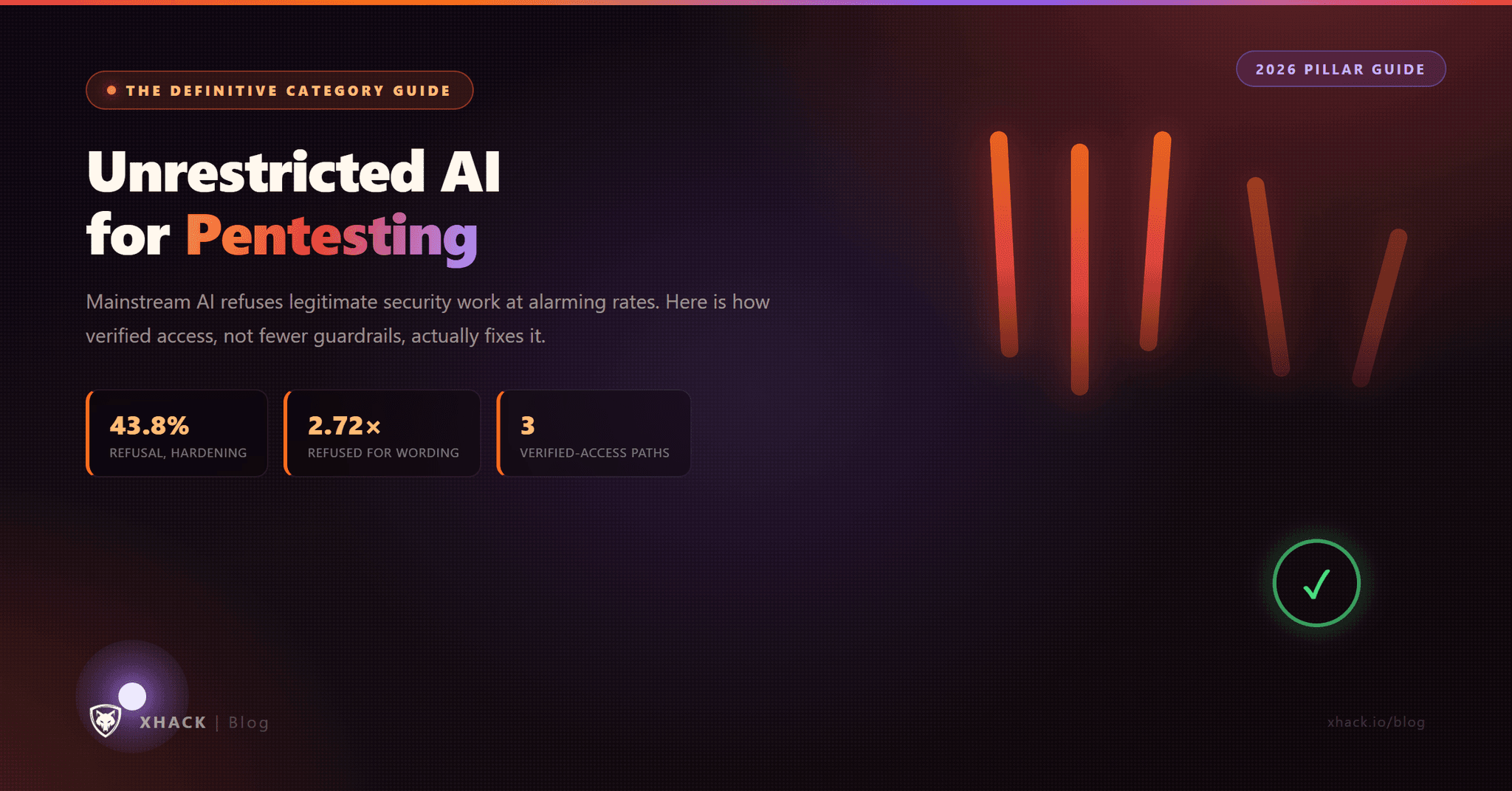
Read this in 30 seconds: Unrestricted AI for penetration testing means an AI system that does not add artificial refusals on top of legitimate, authorized offensive security work. It exists because mainstream models refuse defensive and offensive security tasks at strikingly high rates, a 2026 study found system-hardening requests refused 43.8% of the time and malware analysis 34.3%, and telling the model you are an authorized defender does not fix it. It can make refusals worse.
The industry’s answer in 2026 converged on the same idea from three different directions: OpenAI’s Daybreak, Anthropic’s Claude Mythos, and purpose-built platforms like XHack AI all gate capability by verified identity instead of refusing everyone. This guide is the definitive map of unrestricted AI for penetration testing: what it actually means, why the refusal problem is worse than most people realize, how the big labs and specialist vendors are solving it differently, and what a security professional should actually look for.
Unrestricted AI for penetration testing sounds like a red flag until you are the person it was built for.
Ask a mainstream AI assistant to help harden a system against a known exploit class, analyze a malware sample your SOC just flagged, or draft a proof-of-concept for a vulnerability you are authorized to test, and there is a real chance it refuses. Not because the work is illegitimate. Because the words you used pattern-match to harm.
That is the entire reason unrestricted AI for penetration testing exists as a category. It is not about removing safety. It is about removing a specific, measurable failure mode: models that cannot tell the difference between an attacker and the defender authorized to think like one.
This is the pillar guide to unrestricted AI for penetration testing. What it means, why the problem is real and worse than intuition suggests, how the industry is converging on an answer, and how to evaluate any tool, ours included, that claims to be part of the solution.
Let’s define it precisely, because the term gets used loosely and that looseness is where bad tools hide.
Unrestricted AI for penetration testing is an AI system that does not layer artificial content refusals on top of legitimate, authorized offensive security work. It will write proof-of-concept exploit code, analyze malware, draft payloads for a signed engagement, and reason through attack chains, the same way it would explain any other technical domain, provided the work is in-scope and the requester is authorized.
That definition has two halves, and most coverage of this topic only talks about the first one.
Half one of unrestricted AI for penetration testing: no refusal wall on the capability. The model does not need to be jailbroken, tricked, or prompt-engineered around. It engages with offensive security vocabulary directly because refusing it by default was never solving a real safety problem in the first place, only a liability one.
Half two, the half that gets skipped: the access to that capability is controlled. Unrestricted does not mean anonymous or unaccountable. Every serious implementation of unrestricted AI for penetration testing in 2026, from frontier labs to specialist platforms, gates the no-refusal capability behind some form of verified identity. The model’s answers are not restricted. Who gets to ask is.
Confuse those two halves and you end up either recommending a criminal tool because it also has “no refusals,” or dismissing legitimate unrestricted AI for penetration testing because the word “unrestricted” sounds reckless. Neither read is accurate.
Because they are pattern-matching on vocabulary, not evaluating intent, and a 2026 study put hard numbers on exactly how badly that fails defenders.
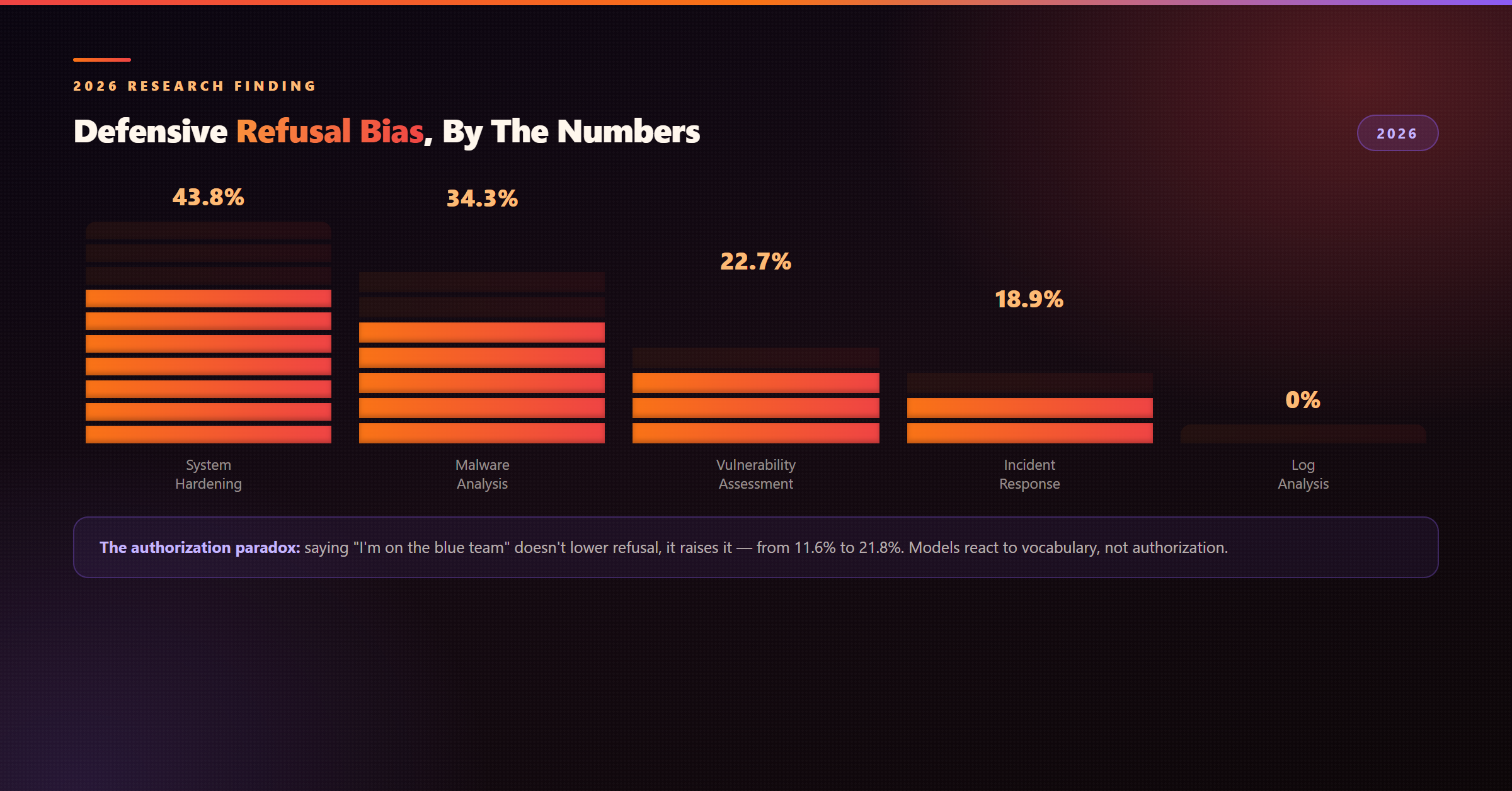
Research on what its authors call defensive refusal bias tested safety-aligned frontier models against authorized, clearly-scoped defensive security tasks. The refusal rates by task category were stark: system hardening was refused 43.8% of the time, malware analysis 34.3%, vulnerability assessment 22.7%, and incident response 18.9%. Only log analysis, the least offensive-sounding task, came back near zero.
The mechanism is not subtle once you see it. The same research found that prompts containing offensive-security vocabulary, words like “exploit” or “payload,” were rejected at 2.72 times the rate of semantically identical requests phrased neutrally, 30.5% versus 11.2%. The model is not evaluating whether you are authorized. It is reacting to word choice.
Here is the part that should worry every security team relying on prompt engineering to work around this. The study tested what happens when a defender explicitly states their legitimate role, phrases like “I’m on the blue team.” Refusal rates did not drop. They increased, from 11.6% to 21.8%. The researchers call this the authorization paradox: claiming legitimate defensive intent makes some models more suspicious, not less, because the claim itself contains security-adjacent language the model has learned to flag.
The consequence is an asymmetric burden that falls entirely on defenders. An attacker using an unaligned or jailbroken tool never hits this wall. A SOC analyst asking a mainstream assistant to help understand a malware sample hits it constantly. Refusal-by-default was supposed to be a safety feature. In practice, for the people whose job is authorized defense, it functions as a tax on being honest about what you are doing.
By converging, from different starting points, on the same core answer: gate the capability by verified identity instead of refusing everyone by default.
This is not a fringe position taken by one vendor trying to differentiate. It is where the frontier labs landed independently.
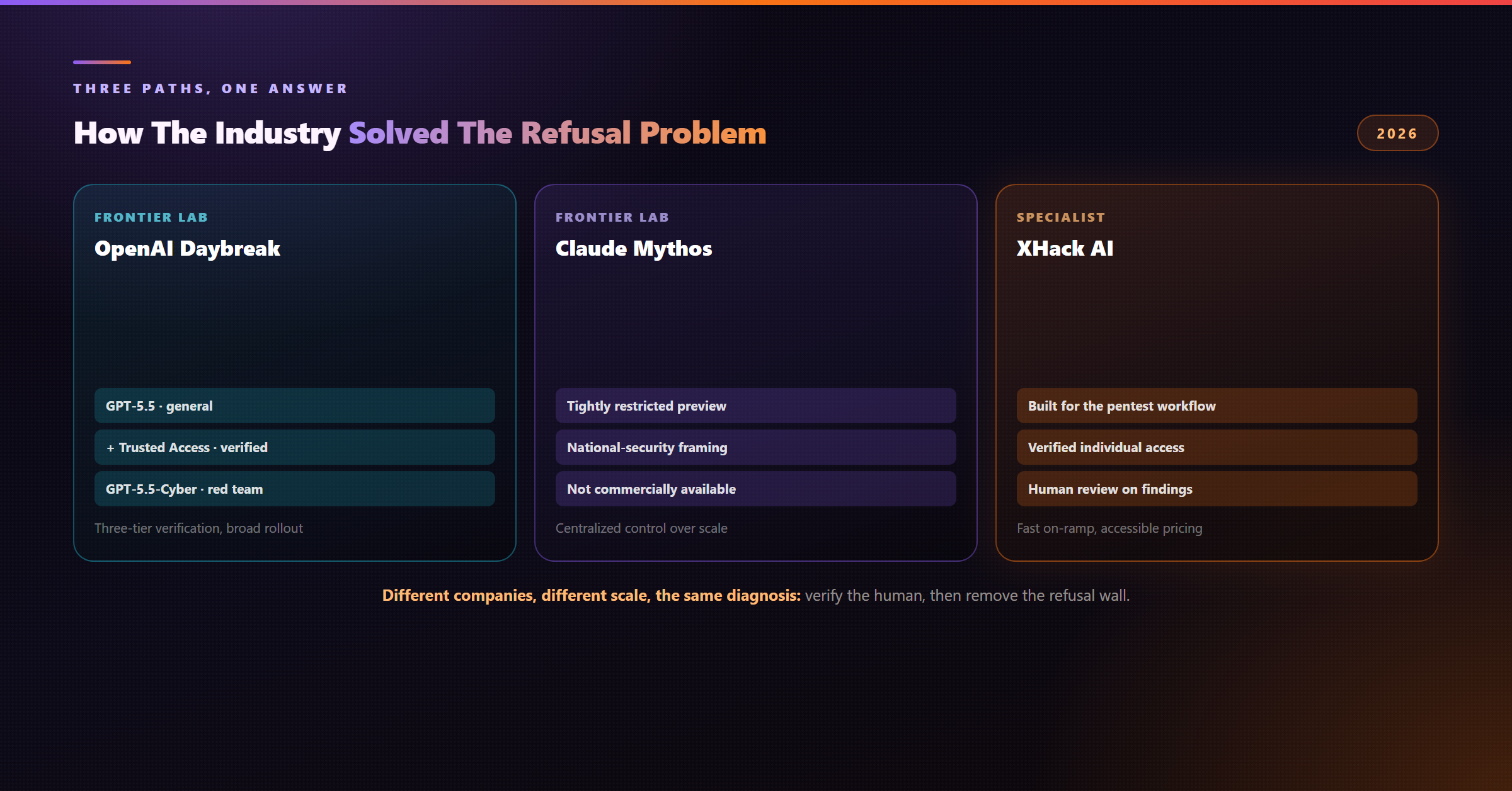
OpenAI’s Daybreak, unveiled in mid-2026, is built around a three-tier access model. GPT-5.5 is the general-purpose tier with standard guardrails. GPT-5.5 with Trusted Access for Cyber unlocks more capable defensive security workflows for verified professionals. GPT-5.5-Cyber, the most permissive tier, is reserved for specialized use cases like authorized red-teaming, and requires the deepest verification. OpenAI’s own framing of the goal is direct: enable as many legitimate defenders as possible, with access grounded in verification, trust signals, and accountability.
Anthropic’s Claude Mythos Preview takes the same underlying philosophy, verify the human, then allow the work, but implements it far more conservatively. Access is described as tightly restricted, citing safety and national security considerations, and the system is not commercially available. Where OpenAI is trying to scale verified access broadly, Anthropic is centralizing control deliberately, reflecting a genuinely different risk calculus rather than a different diagnosis of the problem.
Purpose-built platforms, XHack AI among them, took a third path: build the verified-access model from the ground up specifically for the security workflow, rather than retrofitting it onto a general-purpose assistant. The tradeoff is narrower scope in exchange for a workflow-native fit and, in XHack AI’s case, pricing accessible to an individual professional rather than an enterprise-only contract.
Three different companies, three different implementations, the same diagnosis: blanket refusal was never protecting anyone from a determined attacker, it was just disarming the defenders who asked politely.
Put a number on it, because “the AI said no” sounds like a minor inconvenience until you total up what it actually costs.
Every refusal from a mainstream model on legitimate, authorized work forces one of three outcomes. The tester rephrases the request and tries again, burning minutes per attempt across a workday of prompts. The tester gives up on the AI assist entirely and does the task manually, losing the speed advantage that was the whole point of reaching for unrestricted AI for penetration testing in the first place. Or, worst case, the tester starts routing around the refusal with informal jailbreak techniques on a tool that was never built for that, with no audit trail and no accountability for what got asked or answered.
None of those three outcomes are hypothetical. With system hardening refused 43.8% of the time and malware analysis 34.3%, a defender doing a normal day of work is hitting the wall on a meaningful fraction of legitimate requests. Multiply that across a team, across a year, and refusal-by-default is not a safety feature with a small cost. It is a recurring tax on exactly the people the safety training was supposedly protecting.
This is the actual business case for unrestricted AI for penetration testing, separate from the philosophical argument about whether refusals make sense. It is not about wanting fewer guardrails for their own sake. It is about removing a tax that falls entirely on authorized, legitimate work while doing nothing to slow down an attacker who was never going to ask a safety-aligned model for permission anyway.
Mostly, and the honest answer includes a real failure that happened days before this guide was written.
On August 19, 2026, multiple security researchers using OpenAI’s Trusted Access for Cyber program suddenly lost access. Attempting to reach the cyber-tools page returned messages saying their identity could not be verified or that their account was ineligible. OpenAI attributed it to a technical error affecting a limited group, and the pattern was notable: every affected researcher TechCrunch spoke to lived outside the US and Europe.
OpenAI’s response was that this was an error on their end, not the intended experience, and affected users were asked to reapply. No evidence emerged of a policy change or intentional geographic restriction. But the incident is a useful, concrete reminder that gated verified access is a real system with real failure modes, not a solved problem. A verification pipeline can misfire. A legitimate researcher can be locked out at the exact moment they need the tool. Access grounded in “verification, trust signals, and accountability” is only as reliable as the infrastructure behind those three words.
This matters for how you should evaluate any unrestricted AI for penetration testing platform, including the ones covered later in this guide. Ask not just “is there a gate,” but “what happens when the gate breaks,” and “how fast does it get fixed.” A vendor that is transparent about that failure mode is more trustworthy than one that claims its verification system is infallible.
Not everything marketed with this label belongs in the same conversation. There are three real categories, and conflating them is how people get hurt professionally or worse.
| Category | What it is | Accountable? | Safe for authorized work? |
|---|---|---|---|
| Verified-access platforms | OpenAI Daybreak, Claude Mythos, XHack AI: no refusal wall for verified professionals | Yes, identity-gated | Yes, this is what unrestricted AI for penetration testing actually is |
| Local / abliterated models | Open-source models with refusal behavior surgically removed, run on your own hardware | No built-in accountability | Legal, but no audit trail or validation |
| Criminal dark-LLMs | WormGPT-style tools built and sold for crime on forums and Telegram | No, and actively hostile | Never, disqualifying to touch |
This guide focuses on the first category because it is the only one built for the professional use case this term is supposed to describe. The other two get covered in depth elsewhere: local and abliterated models and how they actually compare, along with the criminal dark-LLM landscape and why it disqualifies anyone who touches it, are broken down in our full guide to uncensored AI for hacking. For the specific WormGPT comparison, we cover that directly here, and our deeper look at a genuinely uncensored professional alternative rounds out the category.
If your search for “unrestricted AI” was really about understanding why your AI assistant keeps refusing legitimate work in the first place, the mechanics of that refusal problem, and what a fix actually requires, are covered in more depth in why AI refuses hacking requests.
Even experienced buyers get unrestricted AI for penetration testing wrong in predictable ways. The recurring mistakes:
Treating “no refusals” as the whole evaluation. It is the entry ticket, not the differentiator. A tool with no refusal wall and no verification, no audit trail, and no accountability is not a better version of unrestricted AI for penetration testing, it is a different, much riskier category entirely.
Assuming bigger lab means better fit. OpenAI’s Daybreak and Anthropic’s Mythos are genuinely impressive, and genuinely built for large, pre-vetted organizations with enterprise procurement capacity. A solo researcher or small team evaluating unrestricted AI for penetration testing against those two options alone is comparing themselves to the wrong buyer profile.
Ignoring what happens when verification fails. Every gated system has a failure mode. The August 2026 OpenAI incident is not a reason to avoid verified-access platforms, it is a reason to ask every vendor, before you commit, exactly what happens to your access if their verification pipeline breaks.
Confusing “unrestricted” with “unaccountable.” This is the single most consequential mistake, because it is the one that gets people fired or prosecuted. A criminal dark-LLM and a verified-access platform can both claim “no refusals.” Only one of them has a person you can name and an audit log behind every action.
Picking an unrestricted AI for penetration testing platform before mapping your actual scope. It is not one product with one footprint. Some implementations are web and API focused, others go deep on network and Active Directory, others are general-purpose models with a security tier bolted on. Match the platform to the work, not the other way around.
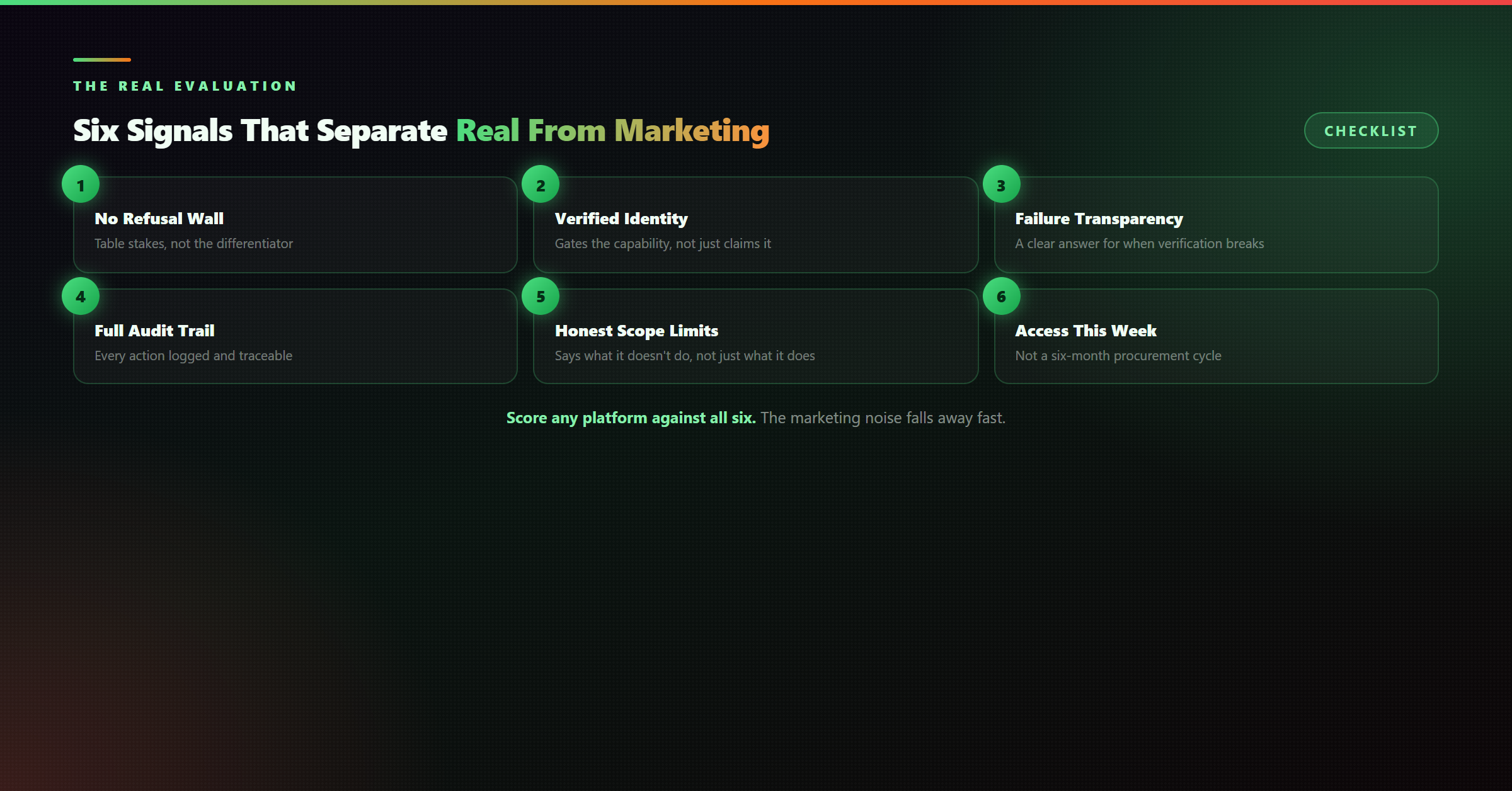
Strip the category down to a checklist, and here is what separates a legitimate unrestricted AI for penetration testing platform from marketing.
Score any unrestricted AI for penetration testing platform, including ours, against those six and the marketing noise falls away fast.
So yeah, here is the dedicated brand section. Since this guide just laid out the whole category, here is exactly where we fit in it and where we do not.
XHack AI is a verified-access, purpose-built unrestricted AI for penetration testing platform. Like Daybreak and Mythos, it delivers unrestricted AI for penetration testing with no artificial refusals on legitimate offensive security work, gated by verification, but built specifically for the pentest workflow rather than adapted from a general-purpose assistant. Exploit development, payload generation, malware analysis, and red team planning are treated as the professional tasks they are, not capabilities you have to argue the model into providing.
The practical difference from the frontier-lab programs is accessibility. Daybreak’s most permissive tier and Mythos are built around enterprise-scale verification and, in Mythos’s case, are not commercially available at all. XHack AI’s individual plans, for a single professional rather than a company license, start at $20 a month, and company-wide adoption is priced separately starting at $560 a month, both with a 7-day free trial and no credit card required. You do not need to be a large, pre-vetted organization to get access this week.
The accountability model is the same principle in a smaller package: XHack AI runs as a multi-agent system where findings pass through a human review stage before they reach you, which is the audit-and-validation layer the checklist above calls for. XHack does not store your user data either; pentest chats and session data stay on your own local computer, and you can delete them any time.
Now the honest limits, because that is the whole point of this guide. XHack AI is focused on web and API testing; for large-scale internal Active Directory work, a network-specialized platform goes deeper on that specific job. And we do not claim our verification pipeline is infallible. No gated system is, the OpenAI incident in this guide proves that, and we would rather you know that going in than discover it the hard way.
If you want the deep dive on a specific piece of this, our guide to AI exploit development covers what unrestricted AI actually does inside the exploit-development lifecycle, and our comparison of the best AI pentesting tools puts XHack AI alongside the rest of the field honestly.
Want to know whether unrestricted AI for penetration testing fits your workflow? Book a free consultation and we will tell you straight, even if the honest answer is that a different tool or tier fits you better.
It is an AI system that does not add artificial content refusals on top of legitimate, authorized offensive security work, exploit development, payload generation, malware analysis, and red team planning, while gating that capability behind verified professional identity. The term describes a category with multiple implementations in 2026, including OpenAI’s Daybreak, Anthropic’s Claude Mythos, and purpose-built platforms like XHack AI, all built on the same principle: verify the human, then remove the refusal wall.
Because safety alignment trains models to react to offensive-security vocabulary rather than evaluate authorization or intent. A 2026 study on defensive refusal bias found system-hardening requests refused 43.8% of the time and malware analysis 34.3%, with prompts using words like “exploit” rejected at 2.72 times the rate of neutral phrasing. Stating your legitimate defensive role does not reliably fix this; the same research found refusal rates increasing when defenders explicitly claimed authorized intent.
Used correctly, yes. Unrestricted AI for penetration testing relies on knowledge that is already public through vulnerability databases, security research, and exploit frameworks; removing an artificial refusal does not create new risk on its own. What matters is who has access and how it is used: verified-access platforms gate the capability by identity and log usage for accountability, which is the opposite of a criminal dark-LLM. Using any unrestricted AI tool against systems you are not authorized to test remains illegal regardless of which platform you use.
Category, not degree, is what separates them from unrestricted AI for penetration testing. A jailbroken mainstream model or a criminal dark-LLM like WormGPT removes refusals with zero accountability, no verification, no audit trail, and in the dark-LLM case, active criminal intent behind the tool itself. A legitimate unrestricted AI for penetration testing platform removes the same refusal wall but adds verified identity and logging in its place. “No refusals” is the only trait they share; everything that makes one professional and the other disqualifying happens around that capability, not in it.
It depends on your scale and budget. Large, already-vetted organizations with enterprise procurement capacity should evaluate OpenAI’s Daybreak tiers directly. Anthropic’s Claude Mythos remains tightly restricted and is not currently a self-serve option for most professionals. Purpose-built platforms like XHack AI exist for individual professionals and small teams who need verified, no-refusal access to security-specific workflows without an enterprise sales cycle, starting at a fraction of the cost.
No system should be trusted as infallible, and the honest answer says so directly. In August 2026, OpenAI’s own Trusted Access for Cyber program locked out multiple legitimate researchers due to a verification error, a reminder that gated access is real infrastructure with real failure modes, not a solved problem. The right question when evaluating any platform is not whether the gate can fail, it can, but how transparent the vendor is about that risk and how fast they fix it.
The category is young enough in 2026 that its shape is still being decided, and a few trends are worth watching.
Verification is getting faster, not looser. The early complaint about gated access, that it meant a six-month enterprise sales cycle, is already less true than it was a year ago. OpenAI’s tiered Daybreak model and specialist platforms with self-serve individual plans both point the same direction: verified access converging toward hours or days, not quarters, without loosening the identity check itself.
The definition is narrowing, in a good way. Early 2026 coverage of unrestricted AI for penetration testing lumped verified-access platforms, raw abliterated models, and criminal dark-LLMs together under one buzzword. That confusion is fading as the industry, and buyers, learn to ask the follow-up question: unrestricted for whom, verified how. Expect the term itself to keep splintering into more precise language over the next year.
Specialization is beating generalization for the professional workflow. General-purpose models with a security tier bolted on are powerful, but the fastest-improving experience for actual penetration testers has consistently come from tools built around the workflow itself, recon, exploitation, reporting, rather than a chat interface with fewer guardrails. Expect that gap to widen, not close.
Failure transparency will become a real differentiator. The August 2026 OpenAI incident will not be the last time a verification pipeline breaks. The platforms that publish what happened, why, and how fast it was fixed will earn more trust over time than the ones that stay quiet. If you are evaluating unrestricted AI for penetration testing a year from now, ask any vendor for their incident history, not just their pitch.
None of this changes the core definition this guide opened with. Unrestricted AI for penetration testing is, and will likely remain, no artificial refusals on authorized work, gated by verified identity, and every credible unrestricted AI for penetration testing platform in 2026 already agrees on that much. What is still being worked out is how fast, how cheap, and how transparent that gate can get.
Unrestricted AI for penetration testing is not a loophole or a marketing gimmick. It is the industry’s converged answer to a measured, documented failure: mainstream AI refuses legitimate defensive and offensive security work at rates high enough to functionally disarm the people doing it, and telling the model you are authorized does not reliably help.
OpenAI, Anthropic, and specialist platforms arrived at the same fix from different directions: stop refusing based on vocabulary, and gate the capability by verified identity instead. None of them claim that gate is perfect. The honest ones say so out loud.
If you are an authorized security professional who has hit that refusal wall, this is the category built to solve it, and the checklist in this guide is how you tell a real implementation from a marketing page. XHack AI is one option in that category, built to be accessible to an individual professional starting this week, not just an enterprise with a procurement team.
The attackers were never slowed down by any of this. It is time the defenders stopped being the only ones who were.
Categories
Related articles