Table of contents
26
By Salman Khan, OSCP+, Founder of XHack, SRT (Synack Red Team member)
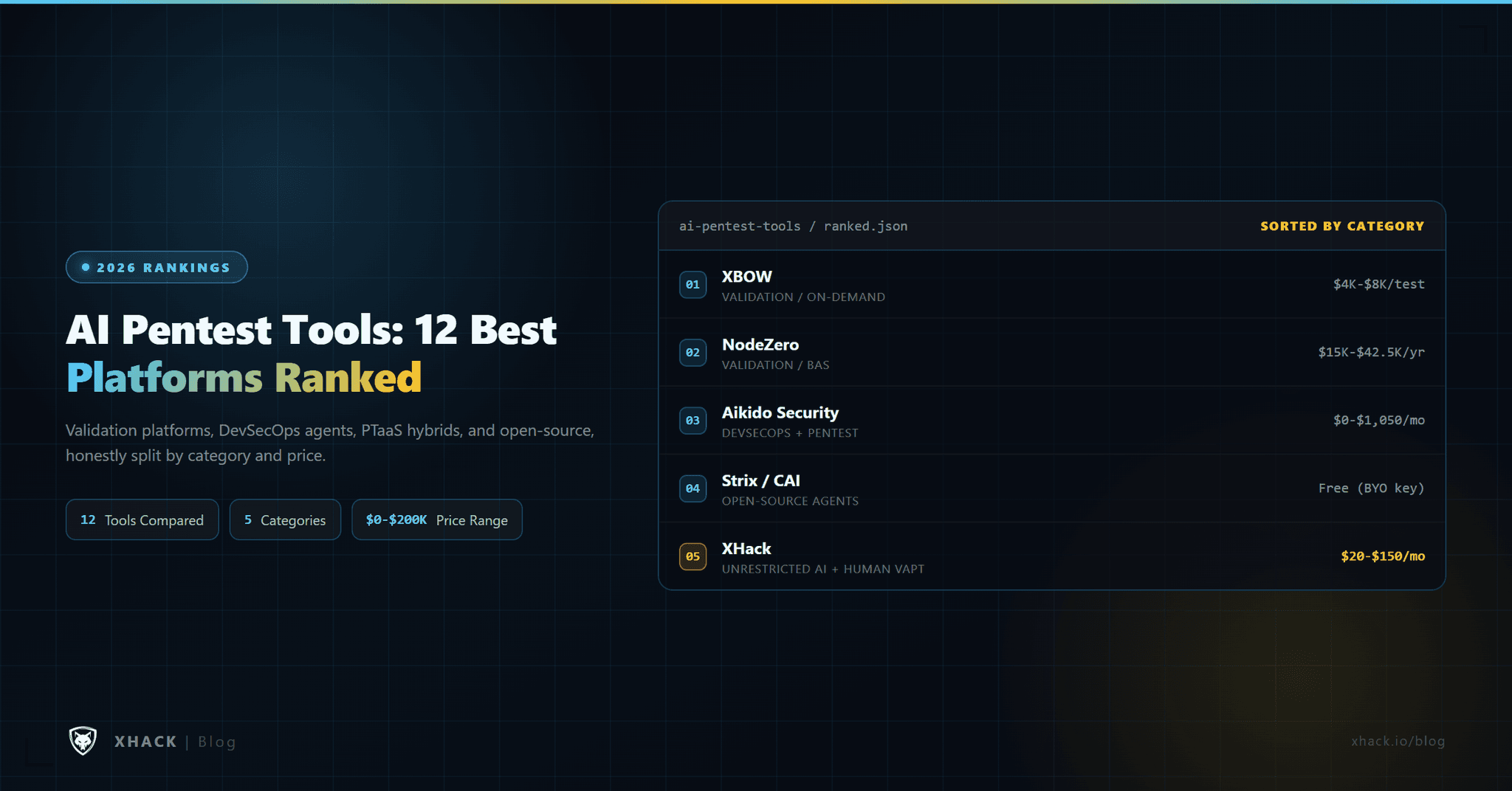
Read this in 30 seconds: The AI pentest tools market splits into five real categories, not one. Validation platforms (XBOW, NodeZero, Pentera) prove exploitability at scale for $4,000 to $100,000+. Web-app scanning agents (Aikido, StackHawk, Escape) live in your CI/CD pipeline. Attack-surface and PTaaS hybrids (Hadrian, Cobalt) blend AI speed with human sign-off. A newer wave of AI-native platforms (Penligent) sells continuous autonomous coverage as a pentest replacement.
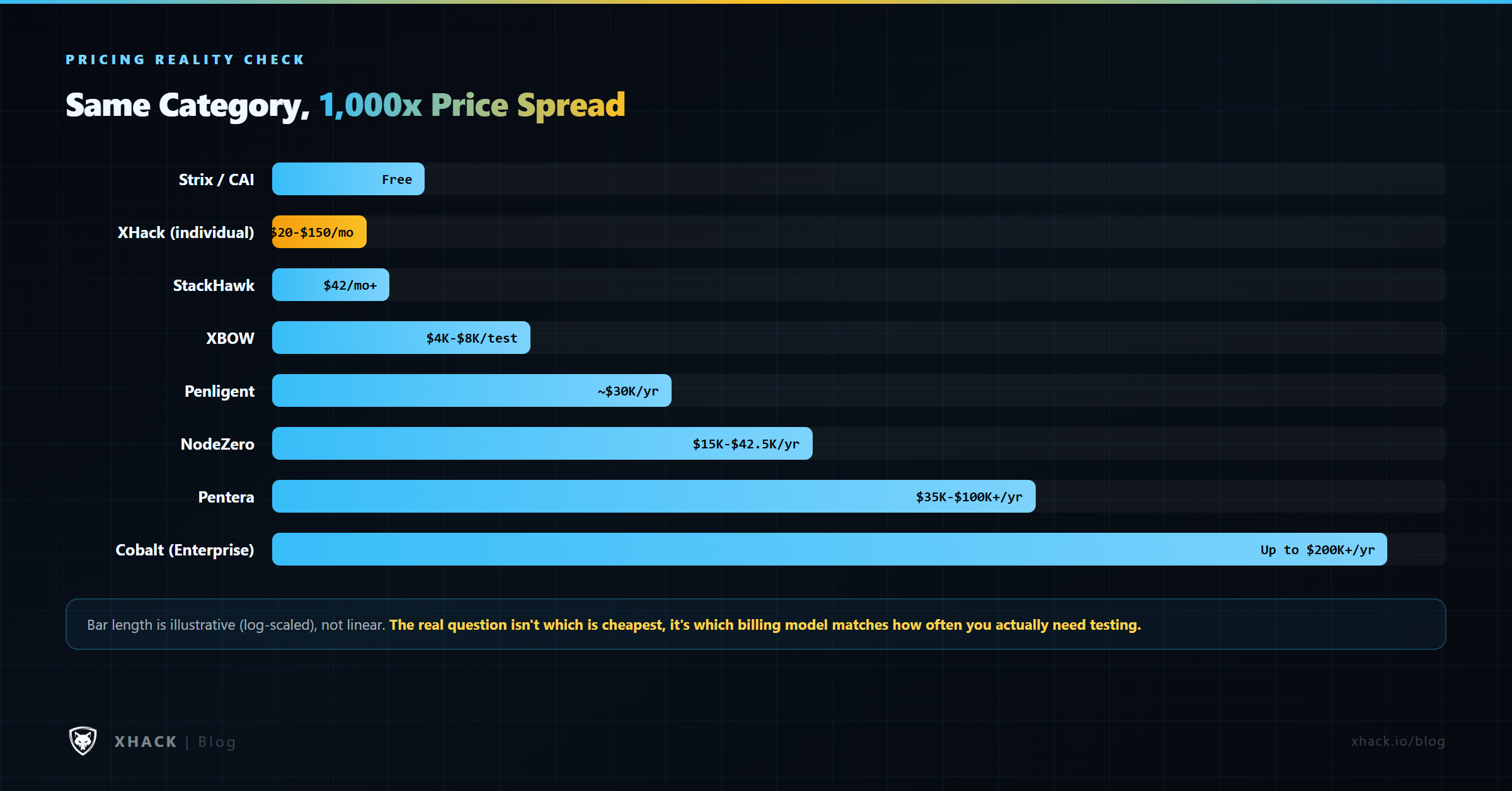
Open-source agents (Strix, CAI) are free but bring-your-own-LLM-key and bring-your-own-liability. Pricing runs from $0 (self-hosted open source) to $200,000+/year (enterprise PTaaS), a 1,000x spread for tools solving overlapping problems. XHack sits in a different lane entirely: $20-$150/mo for individual AI pentesting access, plus human-led VAPT from $2,500 when you need a signed report, with the unrestricted-agent access most competitors won’t offer verified professionals.
Twelve tools claim to do “AI pentesting” in 2026, and roughly four of them are actually testing anything autonomously.
The rest are DAST scanners with an LLM bolted on for report writing, or human pentest shops that added “AI-powered” to their homepage after XBOW topped HackerOne’s leaderboard. That’s not automatically a knock, a good scanner with good humans behind it still finds real bugs, but if you’re buying based on the word “autonomous,” you need to know which of these AI pentest tools actually run agents that reason, chain exploits, and validate impact without a human clicking “next,” and which ones are marketing that word onto a Tuesday-morning cron job.
Hadrian’s own research cataloged roughly 70 AI offensive security tools launched in just 18 months through early 2026, and manual pentests that used to run $15,000 to $50,000 per engagement now compete against AI-driven alternatives priced at a fraction of that. That’s the real story behind this list: AI pentest tools didn’t sneak into the market, they flooded it, and most buyers have no framework for telling a genuinely autonomous agent from a scanner wearing an AI label.
| Tool | Category | Pricing | Best For | Drawback |
|---|---|---|---|---|
| XBOW | Validation/on-demand pentest | $4,000-$8,000/test | Fast audit-ready pentest reports | Per-test, not continuous |
| Horizon3.ai NodeZero | Validation/BAS | $15,000-$42,500/yr | Continuous internal + external validation | Enterprise budget required |
| Pentera | Validation/BAS | $35,000-$100,000+/yr | Large enterprise attack surface | Quote-only, steep entry cost |
| Aikido Security | DevSecOps + AI pentest add-on | $0-$1,050/mo + $4,000/pentest | Dev teams wanting SAST/SCA + pentest in one place | Pentest is a bolt-on, not the core product |
| StackHawk | CI/CD DAST | From $42/contributor/mo | Catching API bugs on every build | Not a full pentest replacement |
| Escape | Agentless API/DAST | Custom enterprise | Shadow API and GraphQL discovery | No public self-service pricing |
| Hadrian | Attack surface mgmt + agentic pentest | Subscription, quote-based | Continuous external exposure + on-demand tests | Pricing opacity |
| Cobalt | PTaaS (AI + human blend) | $3,500 (promo) to $200,000+/yr | Teams wanting human-verified AI findings | Credit system gets pricey fast |
| Penligent | AI-native continuous platform | ~$30,000/yr | Replacing periodic manual pentests | Newer vendor, less track record |
| Strix | Open-source agentic pentest | Free (BYO LLM key) | Developers who want to self-host and inspect the agent | No support, no compliance report |
| CAI (Cybersecurity AI) | Open-source agent framework | Free (BYO LLM key) | Building custom offensive agents | Requires real engineering effort to operate |
| XHack | Individual + company AI + human VAPT | $20-$150/mo, $560-$3,000+/mo, VAPT $2,500-$12,000 | Verified pros wanting unrestricted AI + human-led VAPT | Newer brand, still building its enterprise case-study base |
This first group of AI pentest tools answers one question: given what’s already exposed, can it actually be exploited? They’re built for organizations that already know roughly where their attack surface is and want continuous, machine-speed confirmation that it’s still defensible.
XBOW became the first non-human to top HackerOne’s US leaderboard in mid-2025, and it’s the name every competitor in this list gets measured against. XBOW Pentest On-Demand runs a fully autonomous web-app AI pentest and hands back an audit-ready report within five business days, no scoping call required, with black-box, white-box, or grey-box options and a human expert reviewing every finding before delivery. Pricing is genuinely public and simple: $4,000 for lightweight applications (Lightspeed Plus) and $8,000 for apps with multiple modules and workflows (Lightspeed Premium). Reports map to SOC 2, ISO 27001, HIPAA, GDPR, and 40+ other frameworks.
The catch: this is a per-test product, not continuous coverage. If your attack surface changes weekly, you’re re-buying tests weekly.
NodeZero runs continuous, production-safe autonomous pentests across internal, external, cloud, and hybrid environments, folding unlimited pentests into the subscription instead of billing per engagement. 2026 tiers run from Flex at $15,000 for a one-time 1,000-asset test up to Elite at $42,500, arranged through sales rather than published self-service checkout. NodeZero is built for enterprises that want the “pentest as a subscription” model and can absorb the five-figure entry price.
Pentera is the most established name in automated security validation, running continuous validation across internal, external, and cloud modules on a quote-only model that typically starts around $35,000/year and commonly lands between $50,000 and $100,000+ depending on asset count and module selection. It’s a strong fit for large enterprises with dedicated validation budgets, and a poor fit for anyone hoping to see a price before a sales call.
This second group of AI pentest tools lives closer to the developer, catching bugs before they ship instead of proving exploitability after the fact.
Aikido bundles SAST, SCA, secrets detection, container scanning, and IaC scanning into one dev-first platform, and layers autonomous AI pentesting agents on top that probe for authorization gaps, test for data leakage across API endpoints, and try novel attack chains in real time. The base platform runs free for small teams, then $350-$1,050/month for up to 10 users, with pentests billed separately starting at $4,000 for a standard whitebox assessment (black-box and grey-box cost more). It’s a genuinely strong all-in-one DevSecOps play, the AI pentest agent is a feature of a bigger platform, not the whole product.
StackHawk is a developer-first DAST tool that runs inside CI/CD, catching API and web vulnerabilities on every build instead of once a quarter. It discovers APIs directly from source repos and OpenAPI specs, integrates with GitHub Actions, GitLab CI, Jenkins, and Azure DevOps, and prices transparently from $42/contributor/month with a free tier. It’s not an autonomous pentest agent in the XBOW sense, it’s a very good automated scanner that catches what a human pentester would find on a slow week, continuously.
Escape is an agentless API security platform that uses AI-powered fingerprinting and OSINT techniques to discover shadow APIs your team doesn’t know exist, then runs 100+ dedicated GraphQL security tests alongside standard DAST checks. Pricing is custom enterprise only, no self-service tier. Escape’s edge over StackHawk is external, unauthenticated API discovery; StackHawk’s edge is depth inside your existing pipeline.
Hadrian ships two products: Atlas, which continuously maps and validates your external attack surface by reasoning through exploit chains rather than just pattern-matching CVEs, and Nova, a scoped agentic pentest you can launch on your own schedule instead of waiting on a vendor’s calendar. Pricing is subscription-based but not published; Hadrian’s own research (cataloging 70 AI offensive security tools launched in 18 months) is worth reading regardless of whether you buy the product, it’s one of the more honest looks at how crowded and inconsistent this market actually is.
Cobalt runs Pentest as a Service with a credit system: one credit equals 8 hours of blended AI-assisted and human-led testing. A promotional $3,500 autonomous pentest was available through the end of 2026, while standard annual programs range from roughly $15,000-$40,000 at the Essentials tier up to $200,000+ for enterprise continuous testing. Cobalt is the clearest example of the “AI does the grunt work, a human signs the report” model, useful if you specifically want a named human tester’s name on the final deliverable.
Penligent positions itself as a fully autonomous, goal-directed pentesting agent covering the full loop from asset discovery to exploit validation, with over 200 pentest tools available on demand, WAF fingerprinting and evasion testing, and a CLI-based workflow that keeps a human tester in control of scope. Continuous annual coverage runs around $30,000/year, pitched explicitly against traditional manual pentesting’s per-engagement cost. It’s newer than XBOW or Pentera and has less independent track record, but the product direction (autonomous, continuous, goal-directed rather than checklist-driven) is the same bet most of this category is making.
Strix is an open-source agentic security tool that runs AI agents to dynamically execute an application, attempt real exploits, and attach a working proof-of-concept to every finding, if it can’t exploit something, it won’t report it, which cuts false positives dramatically compared to signature-based scanners. It hit #1 on GitHub Trending in mid-2026 and has tens of thousands of stars. You’ll need Docker running and your own LLM API key (OpenAI, Anthropic, Google, Bedrock, or Azure), and there’s no vendor support line or compliance-ready report generator, you own the operational overhead in exchange for zero license cost and full visibility into what the agent is actually doing.
CAI, from Alias Robotics, is an open-source agent framework that eliminates PentestGPT‘s biggest limitation, PentestGPT still needed a human to execute tool commands it suggested, by wiring LLMs directly to tools like Nmap and Burp Suite and letting agents reason, execute, and adapt without a human in the loop. It supports 300+ model backends including self-hosted LLMs for air-gapped environments, making it the most flexible option here if you have the engineering time to build custom agents for web, cloud, network, or malware-analysis work. Reviewers generally position PentestGPT as the better starting point for learning and CAI as the better foundation for building your own tooling.
Every vendor on this list will tell you their AI pentest tools are the ones that matter. Match the category to the job, not the marketing:
Ask every vendor the same four questions before buying: does the agent actually exploit findings or just flag them, is pricing per-test or continuous, what happens to your data after the engagement, and does a human review results before you see them.
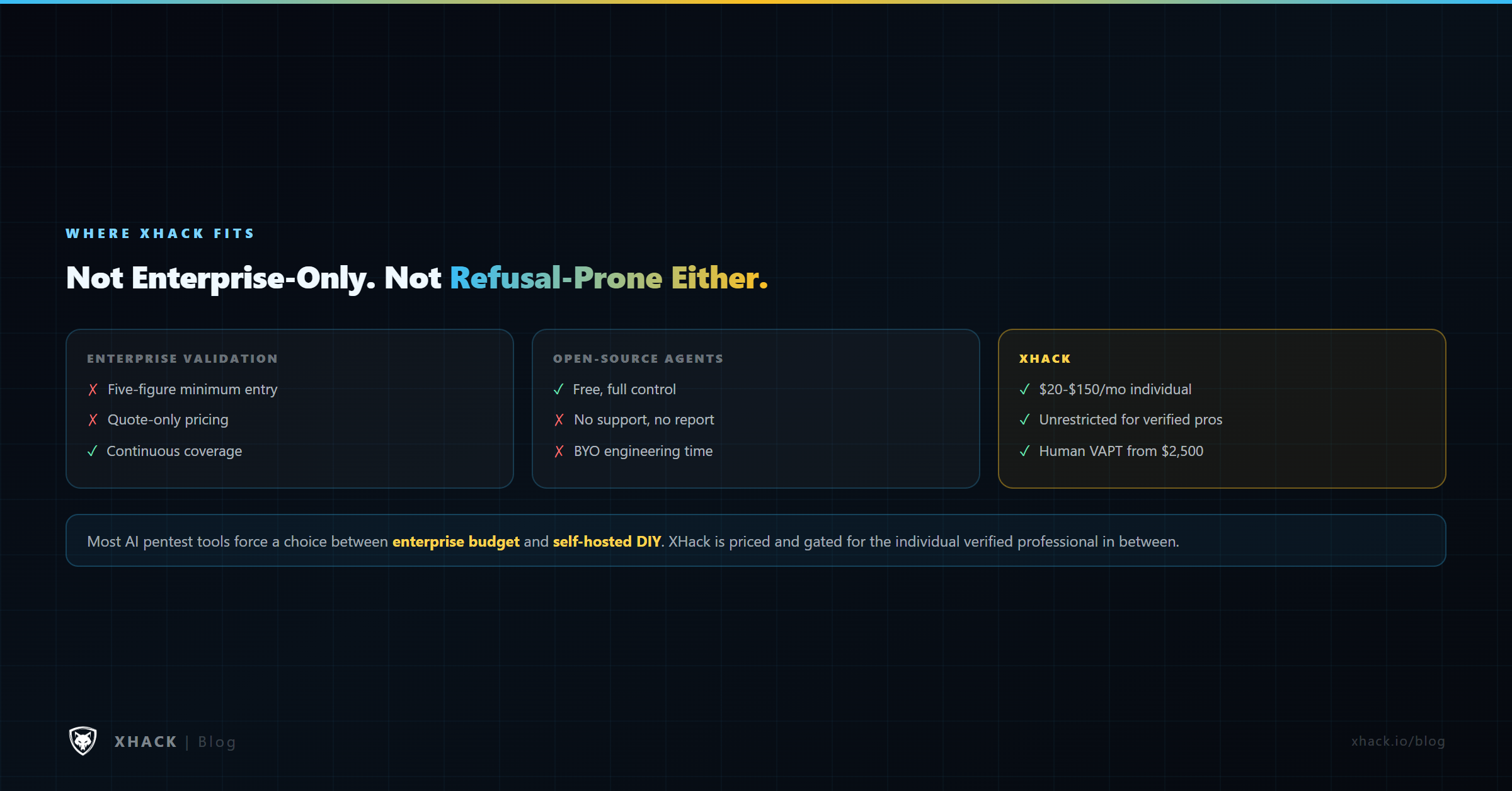
So yeah, brand section, here’s the honest pitch. Every tool above is either a validation platform priced for enterprise budgets, a scanner bolted onto a bigger DevSecOps suite, or an open-source project that hands you a framework and a research problem. XHack combines three things most of the list above splits across separate vendors: an autonomous multi-agent AI pentesting engine, human-led VAPT when you need a signed, defensible report, and a continuous security platform that keeps watching between engagements.
On price, XHack’s individual AI plans run $20-$150/month, genuinely closer to StackHawk’s per-contributor pricing than to NodeZero’s five-figure entry point, with a 7-day free trial, no credit card required, full platform access. Company/team plans run $560-$3,000+/month for organizations that want the AI platform at scale. When you need human-led VAPT with a real deliverable, that starts at $2,500 and scopes up to $12,000 per engagement depending on complexity, with AI-agent assistance used only if you authorize it.
The bigger differentiator: XHack doesn’t refuse legitimate exploit-development, payload-crafting, or memory-corruption work the way general-purpose AI does for verified professionals working in-scope. And XHack doesn’t store your findings on our servers, pentest chats and session data stay local to your machine, deletable any time, which matters more the more sensitive your target is.
Want a quote? Prefer to talk it through first? Book a free consultation, even if that turns out not to be us. Brutal honesty is kind of our thing.
There isn’t one universal “best,” the strongest AI pentest tools split by use case: XBOW and NodeZero lead validation-focused autonomous pentesting, Aikido and StackHawk lead developer-first continuous scanning, Strix and CAI lead the open-source category, and XHack leads on combining unrestricted AI access for verified professionals with affordable individual pricing and human-led VAPT when you need a signed report. Any list claiming a single winner across all twelve of these AI pentest tools is oversimplifying a market that genuinely splits by use case.
Pricing spans an enormous range: free for self-hosted open-source agents like Strix and CAI (plus your LLM API costs), $4,000-$8,000 per test for XBOW, $20-$150/month for XHack’s individual AI plans, roughly $30,000/year for continuous platforms like Penligent, and $35,000 to $200,000+/year for enterprise validation platforms like Pentera and Cobalt’s higher tiers. Before comparing AI pentest tools on price alone, check whether the quote is per-test, per-month, or per-year, because vendors mix all three billing models and the raw numbers aren’t apples-to-apples without that context.
Not yet, and most vendors on this list, including XHack, don’t claim otherwise. AI pentest tools excel at breadth, speed, and continuous coverage across a large attack surface, but a human tester’s judgment on business logic flaws, novel exploit chaining, and interpreting ambiguous findings still matters for high-stakes engagements, which is why most serious vendors combine AI agents with human review rather than removing humans entirely.
They’re safe from a licensing and cost standpoint (Apache 2.0, no vendor lock-in), but “safe” also means you’re responsible for the operational security of your own deployment, your LLM API key, the data you send to that LLM provider, and how you scope the agent’s actions. Unlike a managed platform, there’s no vendor support line and no compliance-ready report generator built in, you’ll need engineering time to run these responsibly.
A validation platform (NodeZero, Pentera) continuously re-tests a known environment to confirm exploitability of existing exposures, closer to breach-and-attack simulation running on a schedule. An AI pentest agent (XBOW, Strix, XHack) reasons through an unfamiliar target from scratch, similar to how a human tester approaches a new engagement, discovering, chaining, and exploiting vulnerabilities it hasn’t been told about in advance.
There’s no single “best” AI pentest tool in 2026, there’s a best tool for what you’re actually trying to solve. If you want a fast, audit-ready report, XBOW or Aikido. If you’re an enterprise with a validation budget, NodeZero or Pentera. If you want zero license cost and full control, Strix or CAI. If you want AI that treats verified security professionals like professionals, not a liability to guardrail into uselessness, plus a human VAPT option when the deliverable actually matters, that’s XHack.
Match the tool to the job, verify the pricing yourself before you commit a budget line to it, and don’t buy “autonomous” without asking the vendor to show you, not tell you, what their agent actually does without a human in the loop. The AI pentest tools that survive the next hype cycle will be the ones that can prove that distinction on demand, not just claim it in a sales deck.
Categories
Related articles