Table of contents
23
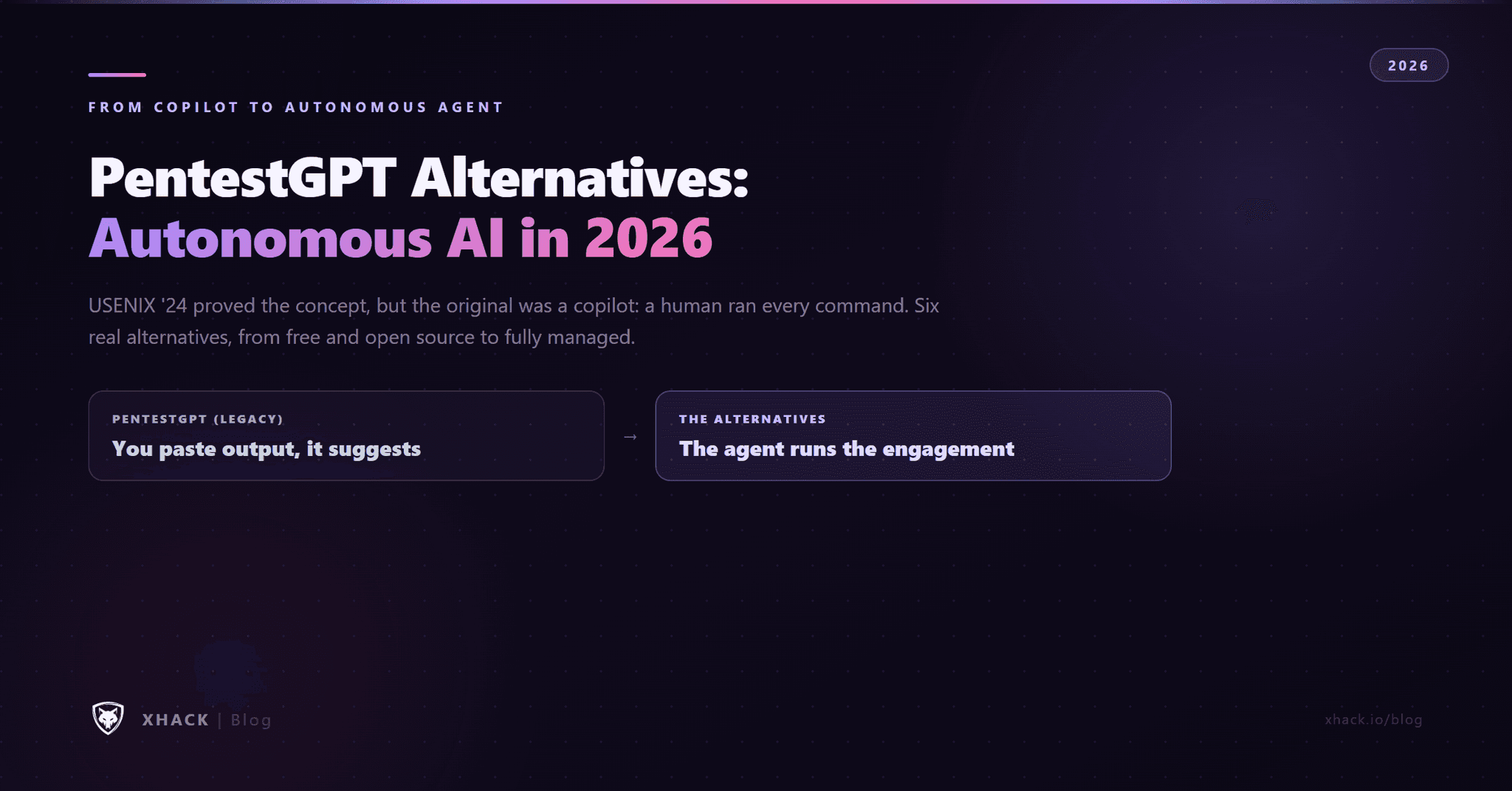
Read this in 30 seconds: PentestGPT Alternatives, PentestGPT was the tool that proved GPT-4 could meaningfully assist a penetration test, published at USENIX Security 2024 with a 228.6% task-completion gain over GPT-3 and over 4,700 GitHub stars. But the original PentestGPT was a copilot: a human had to sit at the keyboard, paste tool output into it, and manually run whatever it suggested next. In 2026, PentestGPT itself partially caught up with a new autonomous mode, but the wider market moved faster, toward agents that run reconnaissance, exploitation, and reporting without a human as the data bus.
This guide compares six real PentestGPT alternatives, from the fully autonomous open-source PentAGI to commercial platforms like XBOW, NodeZero, and XHack AI, so you can pick based on autonomy, scope, and price instead of which tool has the most GitHub stars.
PentestGPT deserves its reputation, and that is exactly why so many people now outgrow it.
Published at USENIX Security 2024, PentestGPT was a genuine research milestone. It proved that a large language model, broken into reasoning, generation, and parsing modules to fight context loss, could meaningfully accelerate a real penetration test. The paper reported a 228.6% task-completion improvement over raw GPT-3, and the open-source tool went on to collect more than 4,700 GitHub stars.
Here is the catch almost nobody mentions in the “best AI pentest tools” roundups. The original PentestGPT was not autonomous. It was a copilot, and a demanding one. A human had to run every Nmap scan, copy the output, paste it into PentestGPT, wait for a suggestion, then manually execute whatever command it proposed. Researchers who study these tools call this the “data bus” problem: the human becomes the plumbing between the model and the target.
That friction is precisely why the market moved on. This guide is the honest comparison of what replaced, extended, and outgrew PentestGPT in 2026, including what PentestGPT itself became.
Let’s be precise, because “PentestGPT” now means two different things depending on which version you touch.
The original PentestGPT (USENIX Security 2024) is a reasoning-assistant architecture. It splits the work across three self-interacting modules, reasoning, generation, and parsing, specifically to fight the context loss that made raw GPT-3 and GPT-4 unreliable across a long, multi-step engagement. The design worked: PentestGPT achieved a 228.6% task-completion increase over the GPT-3 baseline on benchmark targets, and performed well on real-world penetration testing challenges.
But architecturally, PentestGPT was and remains a copilot in its interactive mode. It maintains a task tree and suggests the next move, interprets tool output you paste in, and guides you through an engagement. It does not touch the keyboard. A skilled operator using it goes faster. An unskilled operator following its suggestions blindly gets nowhere, because PentestGPT was never built to replace an expert, only to accelerate one.
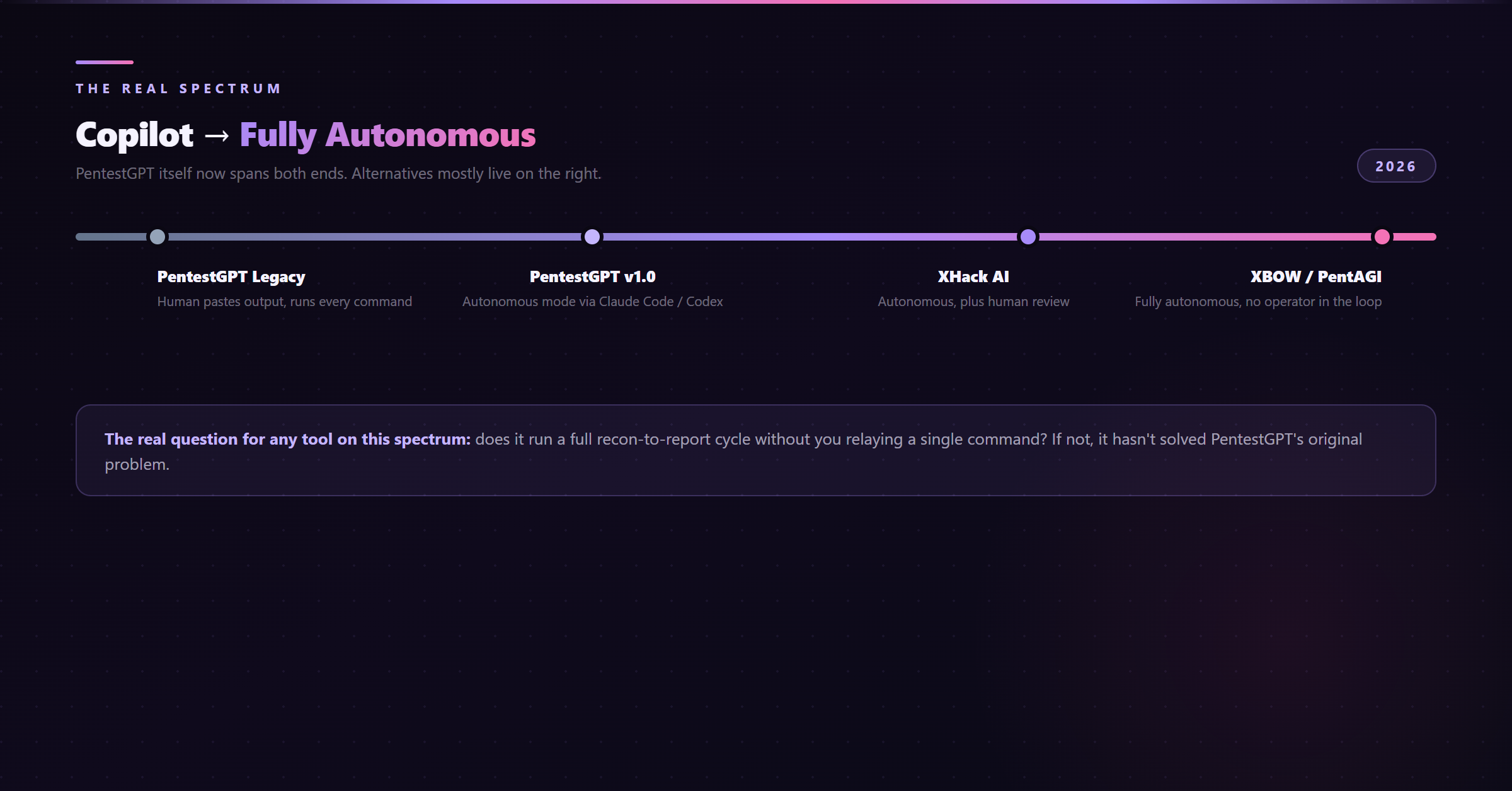
The 2026 evolution matters too, and most comparison articles miss it. The GreyDGL PentestGPT project shipped a v1.0 release that added a genuinely autonomous agent mode, built on top of Claude Code or Codex, which drives tools and reasons through staged phases without a human relaying every command. The original interactive, human-in-the-loop approach still exists, now labeled legacy mode. So PentestGPT the project partially solved its own biggest limitation, while keeping the copilot mode alive for people who still want it.
That nuance is the whole reason “PentestGPT alternative” is a more interesting search than it looks. You might be looking for a true autonomous agent because the original copilot friction wore you down, or you might specifically want PentestGPT’s newer autonomous mode and just not know it exists yet.
Three concrete reasons, and none of them are about PentestGPT being bad at what it does.
Reason one: the copilot friction. Even with improvements, running an LLM-assisted engagement where you are the one pasting Nmap output and manually executing every suggested Python script gets old fast. That friction is the single most common driver of the PentestGPT alternative search.
Reason two, and a common one behind the PentestGPT alternative search: real-world performance gaps. Benchmark numbers and field performance are not the same thing. GPT-4-class models exploit a striking 87 percent of one-day CVEs when handed the advisory text directly, but that number collapses to roughly 13 percent on real CVEs in more realistic benchmark settings, and drops close to zero on hard HackTheBox-style challenges that require creative, multi-step reasoning. A PentestGPT alternative that is honest about this gap, rather than quoting the best-case number, is worth more than one that isn’t.
Reason three, the one that decides whether a PentestGPT alternative needs to be commercial: no managed reporting or scope enforcement. PentestGPT, especially in its original form, has no built-in client reporting pipeline, no CI/CD integration, and no access controls. For a solo researcher or CTF player that is fine. For a team running client engagements, it is a real gap that pushes people toward a commercial PentestGPT alternative with reporting and audit trails built in.
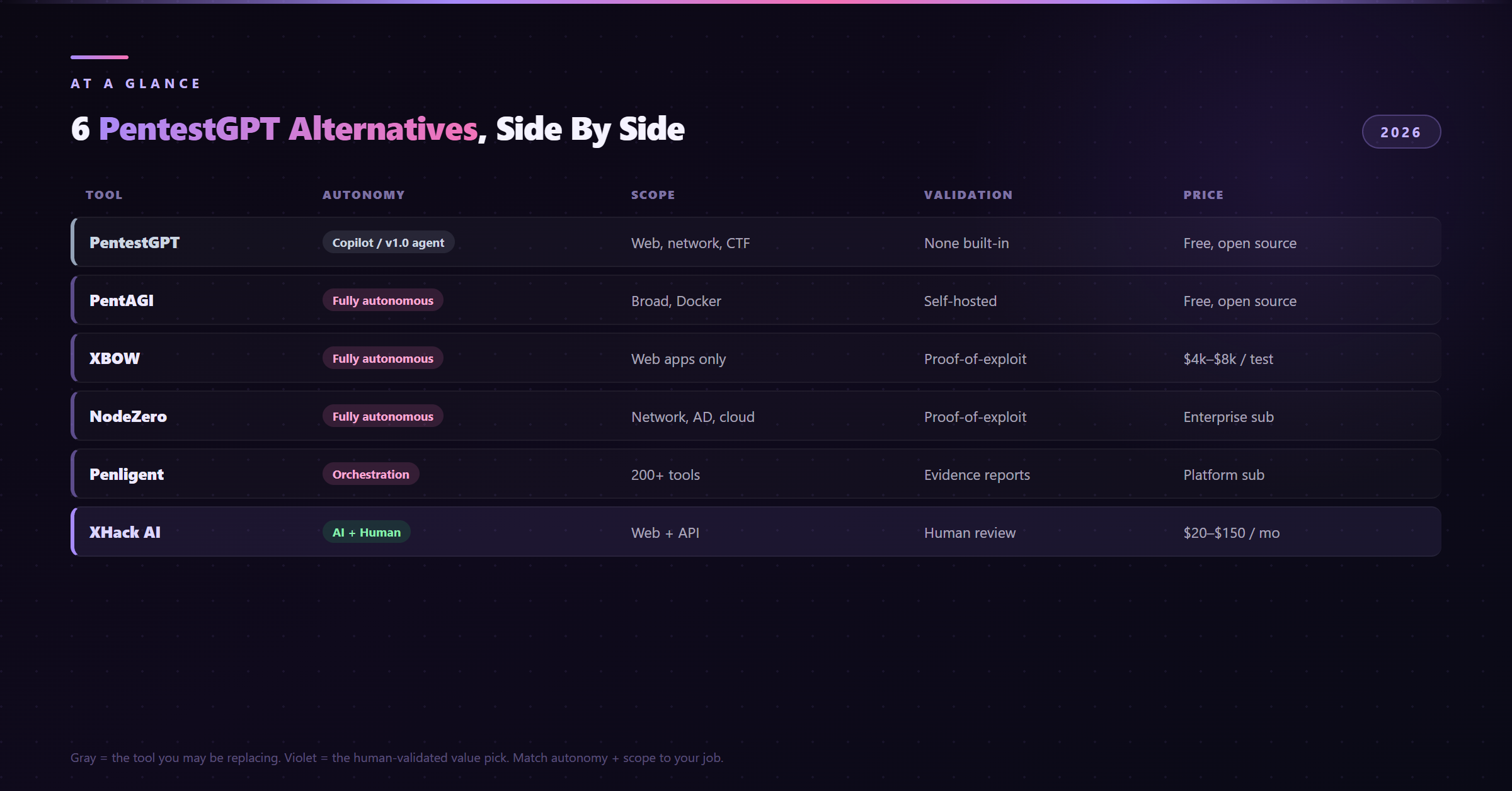
Here is the honest side-by-side before the detail. Every option here is judged on autonomy, scope, validation, and price, the things that actually decide fit.
| Tool | Autonomy model | Scope | Validation | Price |
|---|---|---|---|---|
| PentestGPT (baseline) | Copilot (legacy) / autonomous agent (v1.0) | Web, network, CTF-style targets | None built-in, human judgment | Free, open source |
| PentAGI | Fully autonomous, multi-agent | Broad, Docker-sandboxed | Self-hosted, human review needed | Free, open source |
| XBOW | Fully autonomous | Web applications only | Proof-of-exploit per finding | $4,000 to $8,000 per test |
| NodeZero (Horizon3.ai) | Fully autonomous | Network, Active Directory, cloud | Proof-of-exploit, safe on production | Enterprise subscription |
| Penligent | Autonomous multi-tool orchestration | 200+ tool coordination | Evidence-ready reporting | Platform subscription |
| XHack AI | AI + human hybrid | Web + API, plus platform | Human review stage | $20 to $150/mo (individual) |
The split is clear. If you want the closest open-source match to what PentestGPT was trying to be, but fully autonomous, PentAGI is the direct descendant. If you want commercial-grade autonomy with validation and a price tag to match, XBOW or NodeZero. If you want autonomy plus human review without an enterprise budget, that is XHack AI’s lane.
PentAGI is the tool most worth comparing directly against PentestGPT’s original promise, because it solves exactly the problem PentestGPT’s legacy mode has.
It runs as a delegation model: a central coordinator hands work to four named sub-agents, each with a defined job spanning OSINT, payload generation, dependency management, and offensive operations, all running in parallel inside Docker isolation. Nobody pastes Nmap output into it. It runs the engagement itself.
Where PentestGPT holds the strongest academic backing, from its USENIX Security 2024 validation, PentAGI offers the cleanest multi-agent delegation design among open-source options, with real Docker sandboxing rather than a shared environment. Both still need human oversight for creative exploitation and business logic testing, and neither ships client-ready reporting out of the box. If you liked PentestGPT’s reasoning approach but wanted it to actually run the commands, PentAGI is the closest free option.
XBOW is not built as a PentestGPT alternative specifically, it is a fully autonomous, purpose-built web application testing agent that happens to solve PentestGPT’s autonomy gap completely.
It performs reconnaissance, chooses attack strategies, exploits, chains findings, and writes the report without an operator relaying commands, and it backs every finding with proof-of-exploit. The tradeoff is scope and price: XBOW only tests web applications, nothing else, and it charges $4,000 to $8,000 per test rather than a subscription. For a team that specifically needs audit-ready, high-volume web app testing and can absorb the per-test cost, it is the strongest fully autonomous option in this list.
If your interest in PentestGPT was ever about internal network or Active Directory testing, NodeZero is the PentestGPT alternative that actually covers that ground, since neither PentestGPT nor most web-focused tools do.
Horizon3.ai’s NodeZero is the category leader in autonomous network pentesting, handling credential attacks, lateral movement, and Active Directory abuse paths at scale, safely enough to run against production without persistent agents. It is enterprise-priced on subscription. For internal, network-centric risk, it goes further than PentestGPT ever attempted to.
Penligent takes a different angle on solving PentestGPT’s core weakness. Instead of a small module split like PentestGPT’s reasoning-generation-parsing design, it uses agentic AI to coordinate over 200 industry-standard security tools directly, with evidence-ready reporting built into the workflow.
That breadth of tool orchestration is the pitch: rather than a lean reasoning assistant, Penligent aims to be the connective tissue across a large existing toolchain, with autonomy handling the parts that used to require you to manually chain tool outputs together. It is a platform subscription rather than an open-source project, which is the tradeoff for that managed reporting layer.
XHack AI approaches the PentestGPT problem from the accountability side rather than the raw-autonomy side.
It runs a multi-agent engine that autonomously tests web applications and APIs, reconnaissance, discovery, and exploit chaining happening without a human pasting output between tools, then routes findings through a human review stage before they reach a report. That hybrid is deliberate: full autonomy solves PentestGPT’s friction problem, and the human review stage solves the validation gap that raw autonomous tools like XBOW and PentAGI leave to you.
The price gap versus the commercial autonomous options is real. XHack AI runs $20 to $150 per month for individual plans, against XBOW’s per-test pricing or NodeZero’s enterprise subscription. It focuses on web and API testing rather than PentestGPT’s broader CTF-style scope, which is a real limitation to know going in.
Worth a mention alongside the bigger names as another PentestGPT alternative: the Cybersecurity AI Framework, known as CAI, is an open-source entrant in the same wave as PentAGI, aiming for agentic coordination across offensive security tasks without the copilot friction of PentestGPT’s legacy mode. Like PentAGI, it needs self-hosting and a comfortable-with-open-source team to get real value, and human oversight remains essential for both. It is worth a trial run alongside PentAGI if you want to stay entirely in open-source territory before considering a paid PentestGPT alternative.
This is worth its own section, because it is the single most misused statistic in this entire category, PentestGPT included.
The headline number circulating in comparison articles is that GPT-4-class models exploit 87 percent of one-day CVEs. That figure is real, but it comes from a specific, generous setup: the model is handed the CVE advisory text directly, essentially told what the vulnerability is before it starts. It measures whether the model can turn a known answer into working exploit code, not whether it can find the vulnerability in the first place.
Real-world performance looks different. On CVE-Bench, a more realistic benchmark of real-world web application CVEs, the strongest agent frameworks resolve up to 13 percent of vulnerabilities. On hard HackTheBox-style challenges, which demand creative, multi-step reasoning rather than executing a known playbook, success rates approach zero.
The lesson for evaluating any PentestGPT alternative, or PentestGPT’s own newer autonomous mode: demand the benchmark’s methodology, not just the headline percentage. A tool advertised on an 87 percent figure without disclosing whether that number came from advisory-assisted exploitation or genuine blind discovery is telling you the easiest possible story about itself. The honest PentestGPT alternatives in this list, including PentestGPT’s own newer benchmarking notes, are explicit that their historical research numbers are not a live performance guarantee.
Match the tool to the actual reason you went looking, and the decision gets fast.
You liked PentestGPT’s reasoning but wanted it to act on its own. Start with PentAGI. It is the closest thing to “PentestGPT, but it actually runs the commands,” and it costs nothing beyond your own hosting.
You need audit-ready web application testing and can absorb per-test pricing. XBOW is the strongest fully autonomous option here, with proof-of-exploit on every finding, though the $4,000 to $8,000 per-test cost only makes sense for infrequent, high-stakes assessments.
Your real risk is internal, not just your web apps. None of PentestGPT’s usual comparisons cover this, but NodeZero does, with autonomous network and Active Directory testing that PentestGPT was never built for.
You want a huge existing toolchain coordinated for you. Penligent’s 200-plus tool orchestration is built for teams who already have a security stack and want an agent gluing it together with reporting on top.
You want autonomy plus human validation, without an enterprise budget. That is XHack AI’s specific lane: a multi-agent engine on web and API testing, with a human review stage before findings reach a report, at $20 to $150 a month.
A useful gut check across all of them: a PentestGPT alternative earns the “autonomous” label only if it can run an entire reconnaissance-to-report cycle without you relaying a single command by hand. If a tool still needs you as the data bus at any stage, it has not actually solved PentestGPT’s original problem, no matter how it is marketed.
Do not adopt a new tool because a comparison article, including this one, ranked it well. Run a real trial.
Test it against a target you already understand. Point any PentestGPT alternative, or PentestGPT’s own autonomous mode, at a deliberately vulnerable app or something you have already manually tested, and see whether it finds what is actually there rather than producing an impressively long report.
Check whether it is really autonomous or still needs you as the data bus. Some tools marketed as “agentic” in 2026 still expect a human to copy-paste between steps, exactly PentestGPT’s original limitation with a new label. Watch what it actually does with its hands, not what the landing page claims.
Ask what percentage of findings are false positives. This is where validation layers, whether AI-based or human, separate the useful tools from the noisy ones. A PentestGPT alternative that floods you with unverified findings is not saving you the time it claims to.
Model your real annual cost. A per-test tool like XBOW and a subscription tool like XHack AI or Penligent can look similar for one assessment and wildly different across a year of realistic use. Do that math before committing.
Confirm the scope actually matches your job. PentestGPT itself spans web, network, and CTF-style targets loosely. Its alternatives specialize: XBOW is web-only, NodeZero is network and AD, XHack AI is web and API. Match scope to your actual attack surface, not the tool with the best demo.
Even people who did their homework get this wrong. The recurring mistakes are worth naming plainly.
Assuming “agentic” means autonomous. The word got attached to nearly every pentest tool marketed in 2026, including PentestGPT’s own legacy mode in some descriptions. Verify whether a tool actually executes commands on its own or whether “agentic” is describing a chatbot with a slightly better memory. This is the exact confusion that keeps people stuck with PentestGPT’s original friction under a new label.
Buying the benchmark number, not the methodology. The 87 percent one-day CVE figure gets quoted constantly, by PentestGPT comparisons and competitor marketing alike, without the context that it assumes the model is handed the vulnerability’s identity in advance. Ask what the number actually measured before you let it decide anything.
Ignoring scope until after signing up. PentestGPT’s own scope was loose, spanning web, network, and CTF-style targets inconsistently. Its specialized alternatives are narrower on purpose: XBOW is web-only, NodeZero is network and Active Directory, XHack AI is web and API. Map your real attack surface first, then pick.
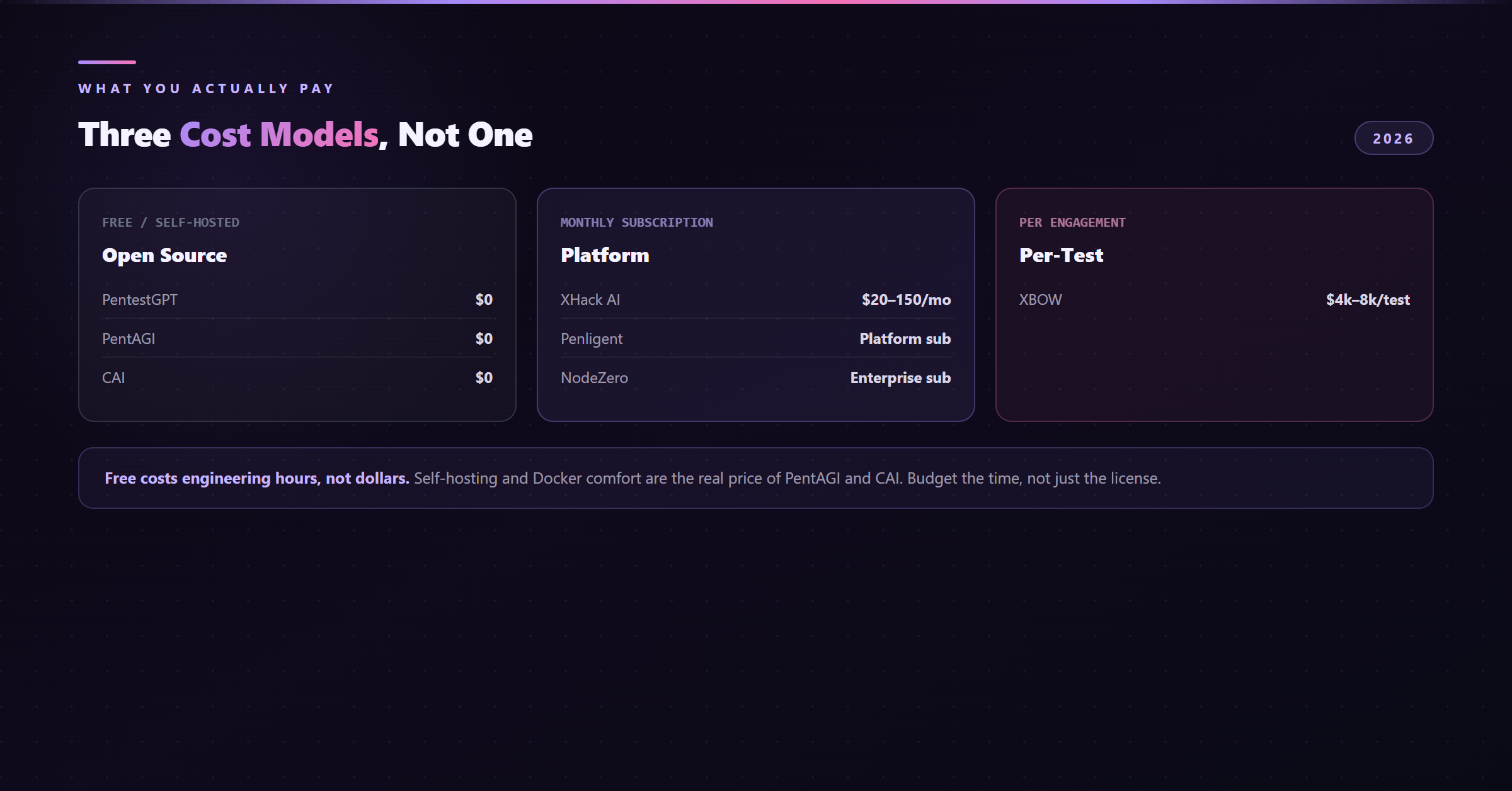
Choosing free tools without accounting for your own time. PentAGI and CAI cost nothing in licensing, but they demand self-hosting, Docker familiarity, and no managed reporting. That is a real cost, just paid in engineering hours instead of a subscription. Be honest about whether your team actually has that time before choosing the free path.
Skip those four mistakes and the right PentestGPT alternative becomes obvious fast, instead of becoming the second tool you have to replace in a year.
So yeah, here is the dedicated brand section. Since XHack AI is one of the options above, here is the honest version of where it fits.
XHack AI solves PentestGPT’s original friction problem, the human as the data bus, the same way the fully autonomous options do, but keeps a human in the loop for validation instead of leaving that entirely to you. Its multi-agent engine handles reconnaissance, discovery, and exploit chaining on web applications and APIs without an operator relaying every command, and every finding then passes through a human review stage before it reaches a report. That combination directly answers both of PentestGPT’s real gaps: the copilot friction, and the lack of built-in validation.
The price story is where XHack AI stands apart from the fully autonomous commercial options. It runs $20 to $150 per month on individual plans and $560 to $3,000 per month for teams, against XBOW’s per-test pricing in the thousands or NodeZero’s enterprise-only subscription. Both tiers start with a 7-day free trial, no credit card required. For a solo researcher or small team that outgrew PentestGPT’s copilot friction but cannot justify enterprise pricing, that gap matters.
Here is what privacy-conscious teams care about. XHack does not store your user data, and it is privacy-focused by design. Your pentest chats and session data stay on your own local computer, and you can delete them any time. If you are testing something sensitive, that data is not sitting on a vendor’s servers.
The honest limits, because brutal honesty is kind of our thing. XHack AI does not attempt PentestGPT’s broad CTF and general-target scope, it is focused specifically on web and API testing. For internal network and Active Directory work, NodeZero goes further. For pure open-source, self-hosted autonomy with no subscription at all, PentAGI is the better fit. We would rather point you to the right tool than pretend XHack AI is the answer to everything PentestGPT used to attempt.
If you want more background, our honest comparison of the best AI pentesting tools covers the wider field, and our XBOW alternatives guide breaks down the fully autonomous, higher-priced end of the market in more depth.
Want to know whether XHack AI is the right PentestGPT alternative for your workflow? Book a free consultation and we will tell you straight, even if a different tool on this list fits you better.
It depends on what frustrated you about PentestGPT. If it was the copilot friction, having to relay commands manually, PentAGI is the closest fully autonomous open-source successor. If you want commercial-grade autonomy with proof-of-exploit validation and can afford per-test pricing, XBOW is strongest for web apps and NodeZero for network and Active Directory. If you want autonomy plus human validation without enterprise pricing, XHack AI fits at $20 to $150 per month. There is no single best option, only the best fit for your scope and budget.
Both, depending on which mode you use. The original PentestGPT from the USENIX Security 2024 paper is a copilot: a human runs the tools, pastes output in, and executes whatever it suggests. In 2026 the project shipped a v1.0 autonomous agent mode, built on Claude Code or Codex, that drives tools and reasons through staged phases without that manual relay. The original interactive approach still exists as a legacy mode for people who prefer it. So PentestGPT itself is now one of its own alternatives, depending on which mode you choose.
Three reasons mainly. The original copilot mode requires a human to manually relay every command and tool output, which gets tedious fast on a real engagement. Its benchmark numbers, like the widely cited 87 percent one-day CVE exploitation rate, look much weaker in realistic settings, closer to 13 percent on more representative benchmarks. And it lacks built-in client reporting, CI/CD integration, or access controls, which matters for teams running commercial engagements rather than research or CTF work.
They are not directly comparable, they solve different halves of the same problem. PentestGPT has the strongest academic validation, from its USENIX Security 2024 publication and 228.6% benchmark improvement over GPT-3. PentAGI has the cleanest fully autonomous, multi-agent delegation design, running an entire engagement inside Docker without a human relaying commands. If you want proven reasoning architecture, PentestGPT’s research holds up. If you want genuine hands-off autonomy today, PentAGI is built for exactly that.
It depends on what you are buying beyond raw capability. Free, open-source options like PentAGI and CAI deliver real autonomy but require self-hosting, Docker comfort, and no built-in client reporting. Commercial options like XBOW, NodeZero, and XHack AI add proof-of-exploit validation, managed reporting, and in XHack AI’s case, human review, at a price. For a solo researcher or CTF player, free is usually enough. For a team delivering client engagements or needing an audit trail, the commercial layer earns its cost.
No, and the tools that claim otherwise should be treated skeptically. Every option in this comparison, including fully autonomous ones like XBOW and PentAGI, still needs human oversight for creative exploitation, business logic testing, and final judgment on what actually matters to a client. The realistic benchmark numbers make this concrete: even strong models solve only around 13 percent of real CVEs outside the most generous test conditions, and near zero on hard, creative challenges. Autonomy handles breadth and speed. Humans still own judgment.
That is the honest picture of PentestGPT alternatives in 2026.
PentestGPT earned its place in the history of this field. The USENIX Security 2024 research proved LLMs could meaningfully assist real penetration tests, and its module-based architecture solved a real context-loss problem. But its original copilot mode left a human as the data bus between the model and the target, and that friction is exactly why the market moved toward genuine autonomy.
The good news is that you now have real choices at every price point. PentAGI and CAI deliver free, fully autonomous, self-hosted alternatives if you want PentestGPT’s research spirit without the manual relay. XBOW and NodeZero deliver commercial-grade autonomy with proof-of-exploit validation, at enterprise prices, for web apps and networks respectively. Penligent orchestrates a huge existing toolchain. And XHack AI sits in between, autonomous testing with human validation, at a price a small team can actually afford.
Even PentestGPT itself evolved, adding an autonomous mode in 2026 while keeping its original copilot alive for people who still want it. The real lesson is not which tool wins. It’s that the copilot era is ending, and the honest question for any PentestGPT alternative is simple: does it actually run the engagement, or does it just tell you what to type next?
If autonomous testing with human validation at an accessible price sounds like your fit, that is exactly what XHack AI was built to be.
Categories
Related articles