Table of contents
15
By Salman Khan, OSCP+, Founder of XHack, SRT (Synack Red Team member)
Read this in 30 seconds: Offensive AI means using AI on the attack side of security, and it has two very different users: criminals who misuse models, and authorised testers who use them to find weaknesses first. The 2026 evidence says the technical gap is closing fast, but the thing that separates a dangerous operator from a hobbyist is no longer skill. It is orchestration. This guide covers what the data shows, where offensive AI still fails, how to use it legally, and what defenders should change.
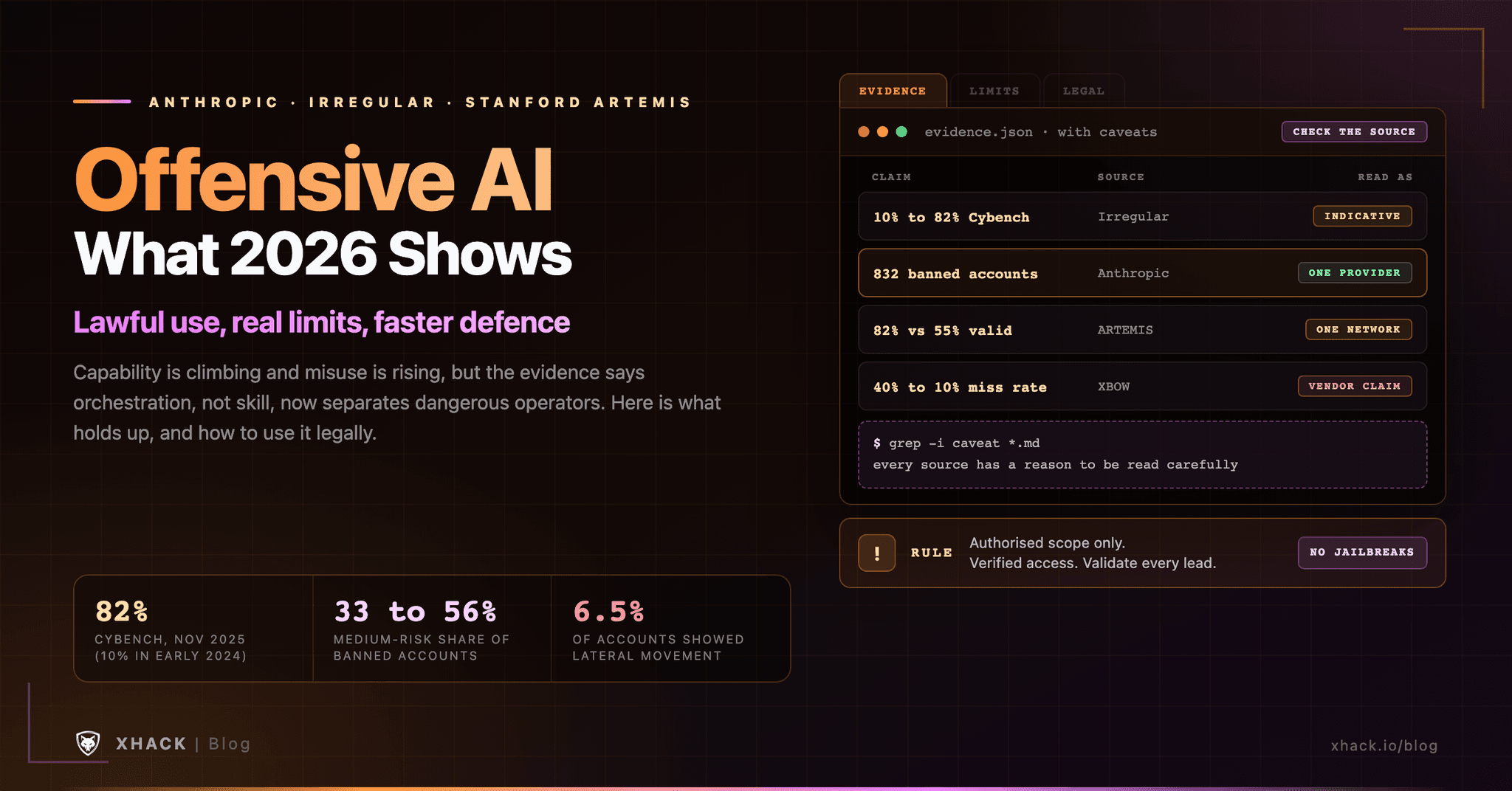
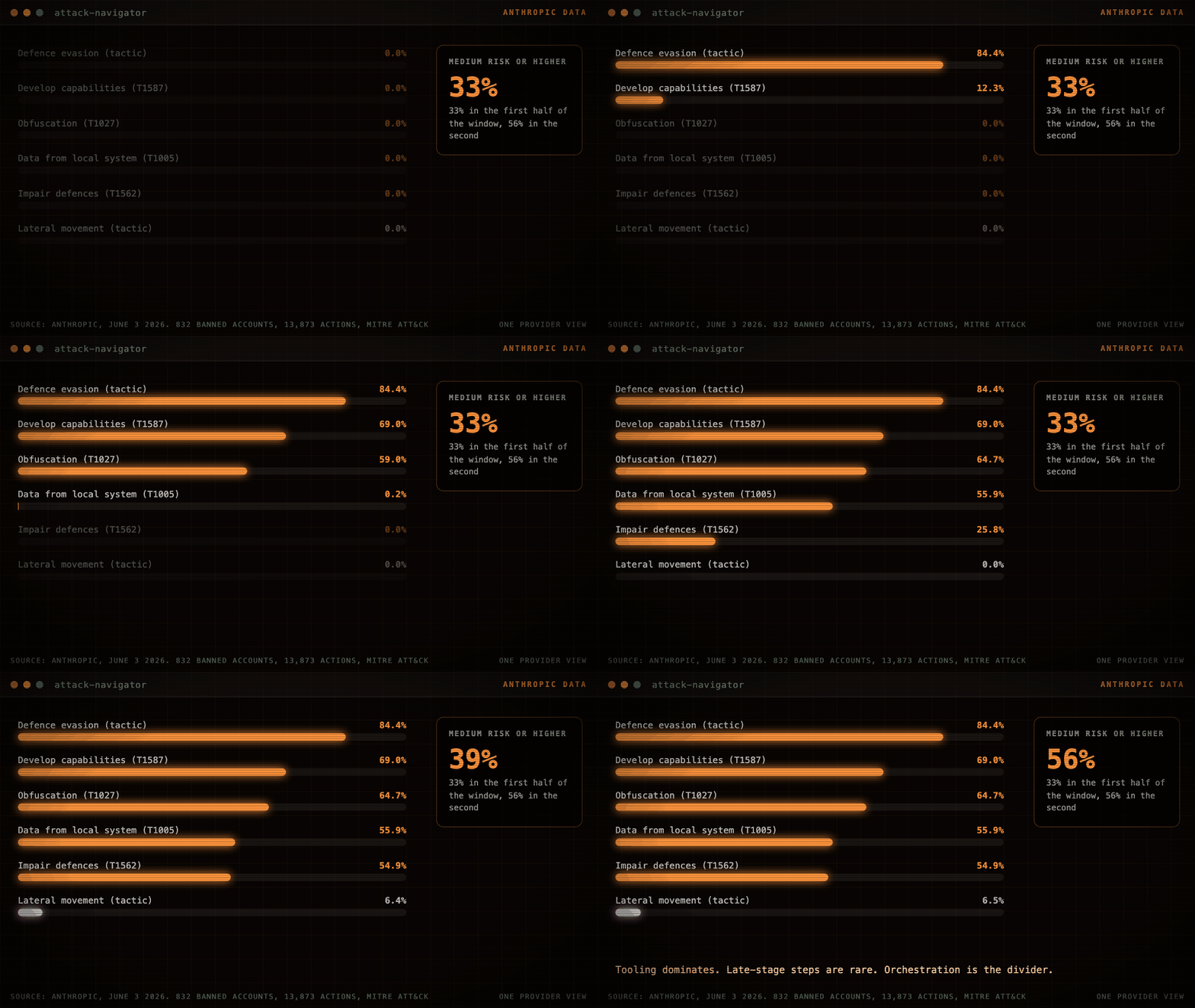
- Misuse is rising, and it is mostly early-stage. Anthropic’s June 2026 analysis of 832 banned accounts found the share rated medium risk or higher rose from 33% to 56% across the study window, while lateral movement appeared in only 6.5% of accounts.
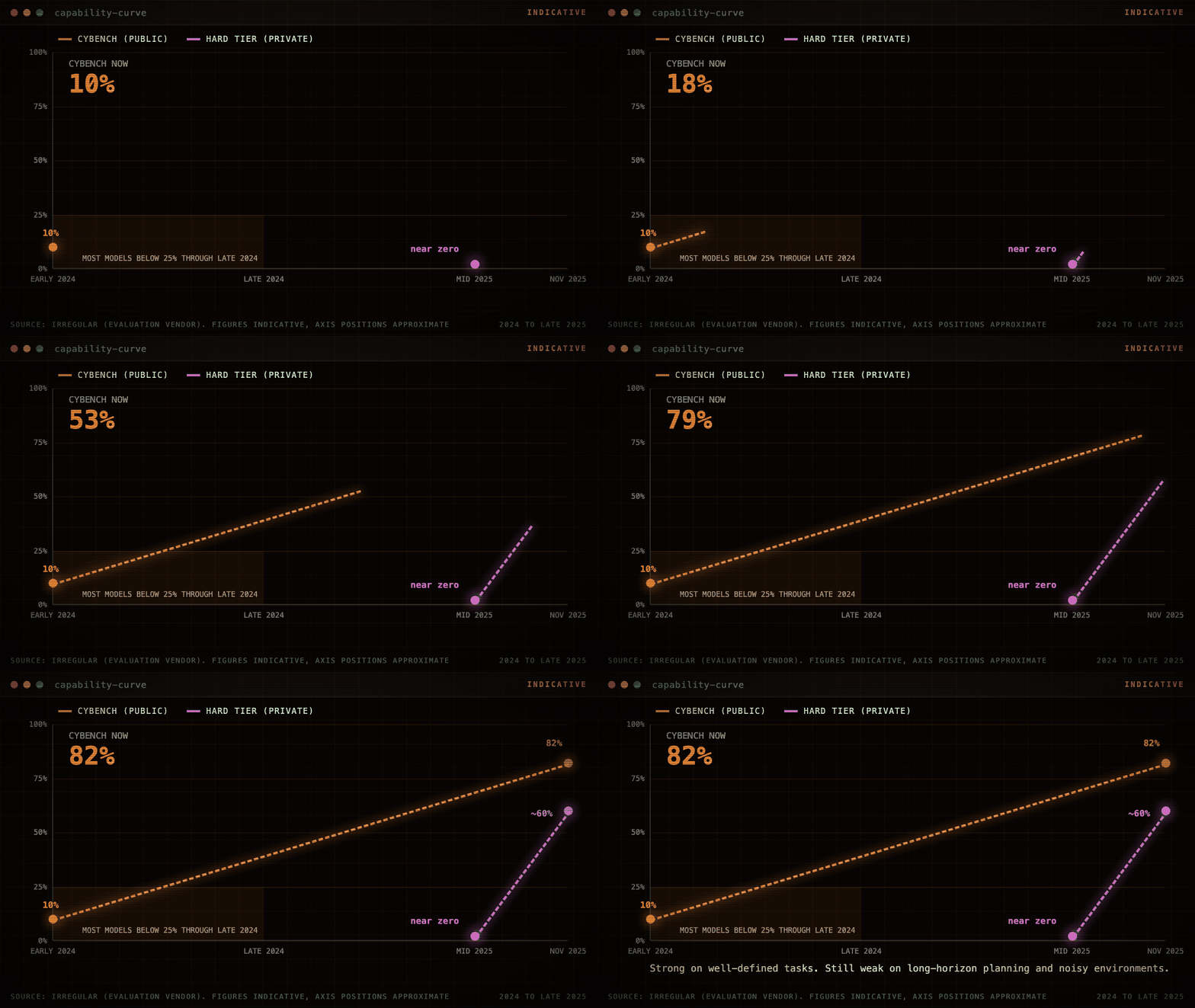
- Capability is climbing. Irregular reports Cybench success rising from 10% in early 2024 to 82% in November 2025, but says models still struggle with long-horizon planning, noisy environments and error recovery.
- Human-level on one network, not on every network. In the Stanford ARTEMIS study, one agent configuration beat 9 of 10 professional testers, with 82% of its findings valid, on a single university network.
- The legal line has not moved. Offensive AI is lawful for systems you own or are authorised to test, and a crime against anyone else’s. Verified routes exist, and jailbreaking is not one of them.
- Defenders need a faster clock. If attackers move faster, patch the exploited list first, and a short script below shows how to check your CVEs against it.
The scary part is not that it hacks like a genius, it is that it lets one operator do the work of a team.
Search for this topic and you get two kinds of page: breathless warnings and thin tool lists. Neither helps if you are deciding what to defend, what to test with, or what you are allowed to do. This guide sticks to primary sources and says plainly where the numbers come from companies that sell something.
It contains no attack techniques and no jailbreaks. I run XHack, so I also say where we fit and where I would trust the evidence less.
Offensive AI is the use of AI to perform or speed up attack-side security work, such as reconnaissance, exploit development, social engineering or post-compromise activity. The same technology serves two groups, and mixing them up is the source of most confusion.
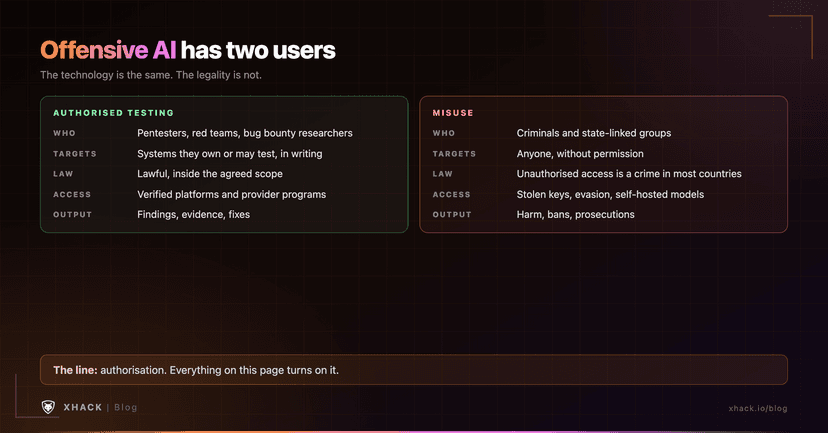
The technology is the same and the legality is not. That is why the rest of this guide keeps returning to authorisation.
The best public dataset on misuse comes from Anthropic, and it shows attackers using AI mostly to build and hide tooling, not to run whole intrusions. In a 3 June 2026 post, Anthropic’s Frontier Red Team analysed 832 accounts it banned for cyber-related policy violations between March 2025 and March 2026, mapping 13,873 observed actions to MITRE ATT&CK.
The findings, as Anthropic reports them:
Three caveats apply. These are only accounts Anthropic banned, so they show one provider’s view. The rise may partly reflect better detection, which Anthropic acknowledges. And the risk score is Anthropic’s own composite, so treat it as a lens, not a measurement of attack success.
Offensive AI is clearly improving, and every source that says so has a reason to be read carefully.
Irregular reports that success on the public Cybench benchmark rose from 10% in early 2024 to 82% in November 2025, and that on its own private “hard” task tier success went from near zero to roughly 60% by late fall 2025. Irregular is an evaluation company, its page names no authors or model lists, and its date metadata conflicts with its body, so I treat the direction as credible and the exact figures as indicative.
The Stanford ARTEMIS study (arXiv 2512.09882) is the strongest independent-style test. On a live network of about 8,000 hosts, one ARTEMIS configuration scored second overall, ahead of 9 of 10 professional testers, with 82% of its findings valid. Another configuration had 55% valid, and agents were more prone to false positives than humans. It is one network, a small sample and the authors’ own scoring.
XBOW’s mid-year 2026 report, as covered by CyberScoop, says the miss rate on its web exploitation benchmark fell from 40% for GPT-5 to 10% for GPT-5.5. XBOW sells offensive security tooling and I did not open the report itself, so this is a vendor claim reported second-hand.
Put together: offensive AI is strong at well-defined tasks, and the trend is steep.
The same sources agree on the limits, and they matter more than the headlines. Irregular says models still struggle in open-ended or noisy environments, with long-horizon planning, state management and recovering from errors, and that performance drops as attack chains grow. Irregular, citing Anthropic’s account of a large AI-orchestrated campaign that Anthropic scored as maximum risk, notes the model hallucinated vulnerabilities and misdescribed target data. ARTEMIS had a higher false-positive rate than humans and struggled with graphical interfaces.
That gives defenders something to work with. It is fast and cheap per attempt, and it is unreliable without a human or a validation step. The sensible reading is not “AI hacks everything”, it is “an attacker with AI makes more attempts, faster, with the same blind spots”.
Offensive AI is legal for authorised work and illegal against anyone else, and the tool changes nothing about that. In most countries unauthorised access to a computer system is a crime, for example under the US Computer Fraud and Abuse Act and the UK Computer Misuse Act. This is not legal advice, so check your local law and contract.
Four habits keep you on the right side:
The verified routes are real. OpenAI’s Daybreak program offers reduced refusals for verified defensive work (Blue) and authorised offensive testing (Red), though its help page says individuals can apply for Blue only, with a paid plan, Advanced Account Security, a FIDO2 key and identity verification, and approval is not automatic. Anthropic’s June post describes routing higher-risk dual-use activity through a Cyber Verification Program so defenders can keep working. Our guide on why AI refuses hacking requests covers the rules in more depth.
If offensive AI lowers the cost of an attempt, shrink the window an attacker can use. Five changes follow directly from the evidence above.
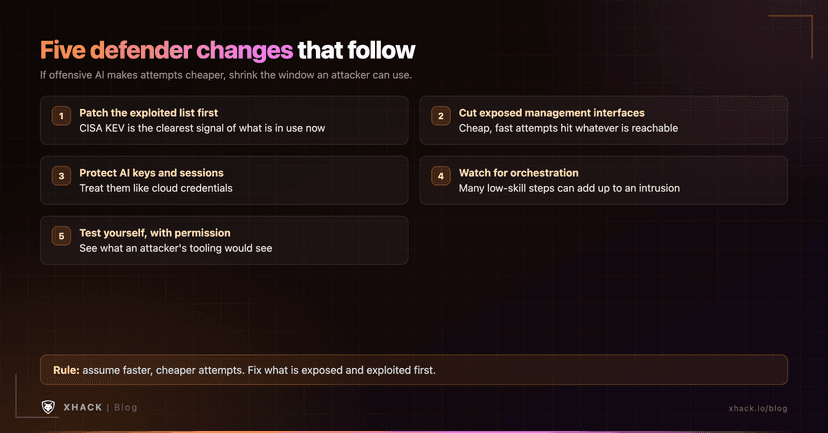
Here is a short script for the first item. It downloads CISA’s public KEV file and checks a list of your CVEs against it, printing the due date and whether the entry carries the forensic-triage flag. It is read-only, and I ran it against live data on 13 November 2026.
import json
import sys
import urllib.request
from datetime import date

URL = "https://www.cisa.gov/sites/default/files/feeds/known_exploited_vulnerabilities.json"


def load():
    req = urllib.request.Request(URL, headers={"User-Agent": "Mozilla/5.0 kev-check"})
    with urllib.request.urlopen(req, timeout=60) as r:
        return json.load(r)


def main():
    args = sys.argv[1:]
    if args and args[0] == "--file":
        args = [l.strip() for l in open(args[1]) if l.strip() and not l.startswith("#")]
    wanted = [a.upper() for a in args]
    data = load()
    kev = {v["cveID"]: v for v in data["vulnerabilities"]}
    today = date.today()
    print(f"catalog {data['catalogVersion']}, {data['count']} entries, checked {today}")
    print(f"{'cve':16} {'added':11} {'due':11} {'status':10} forensic  product")
    for cve in sorted(wanted, key=lambda c: kev.get(c, {}).get("dueDate", "9999")):
        v = kev.get(cve)
        if not v:
            print(f"{cve:16} {'-':11} {'-':11} {'not listed':10} -         (not in KEV, which is not the same as safe)")
            continue
        due = date.fromisoformat(v["dueDate"])
        status = "PAST DUE" if due < today else f"{(due - today).days}d left"
        print(f"{cve:16} {v['dateAdded']:11} {v['dueDate']:11} {status:10} {v.get('forensicTriage', '-'):9} {v['vendorProject']} {v['product']}"[:140])


if __name__ == "__main__":
    main()
Run it with your own CVE IDs:
python3 kev_check.py CVE-2026-116606 CVE-2026-111560 CVE-2026-119977 CVE-2026-97229 CVE-2026-111357 CVE-2026-12345catalog 2026.11.10, 1779 entries, checked 2026-11-13
cve added due status forensic product
CVE-2026-97229 2026-10-29 2026-11-01 PAST DUE Yes GitLab Community Edition and Enterprise Edition
CVE-2026-111357 2026-10-30 2026-11-02 PAST DUE Yes Ivanti Connect Secure
CVE-2026-119977 2026-11-03 2026-11-06 PAST DUE Yes WordPress WordPress Core
CVE-2026-116606 2026-11-10 2026-11-13 0d left Yes Barracuda Networks Barracuda Email Security Gateway (ESG)
CVE-2026-111560 2026-11-10 2026-11-13 0d left Yes Barracuda Networks Multiple Products
CVE-2026-12345 - - not listed - (not in KEV, which is not the same as safe)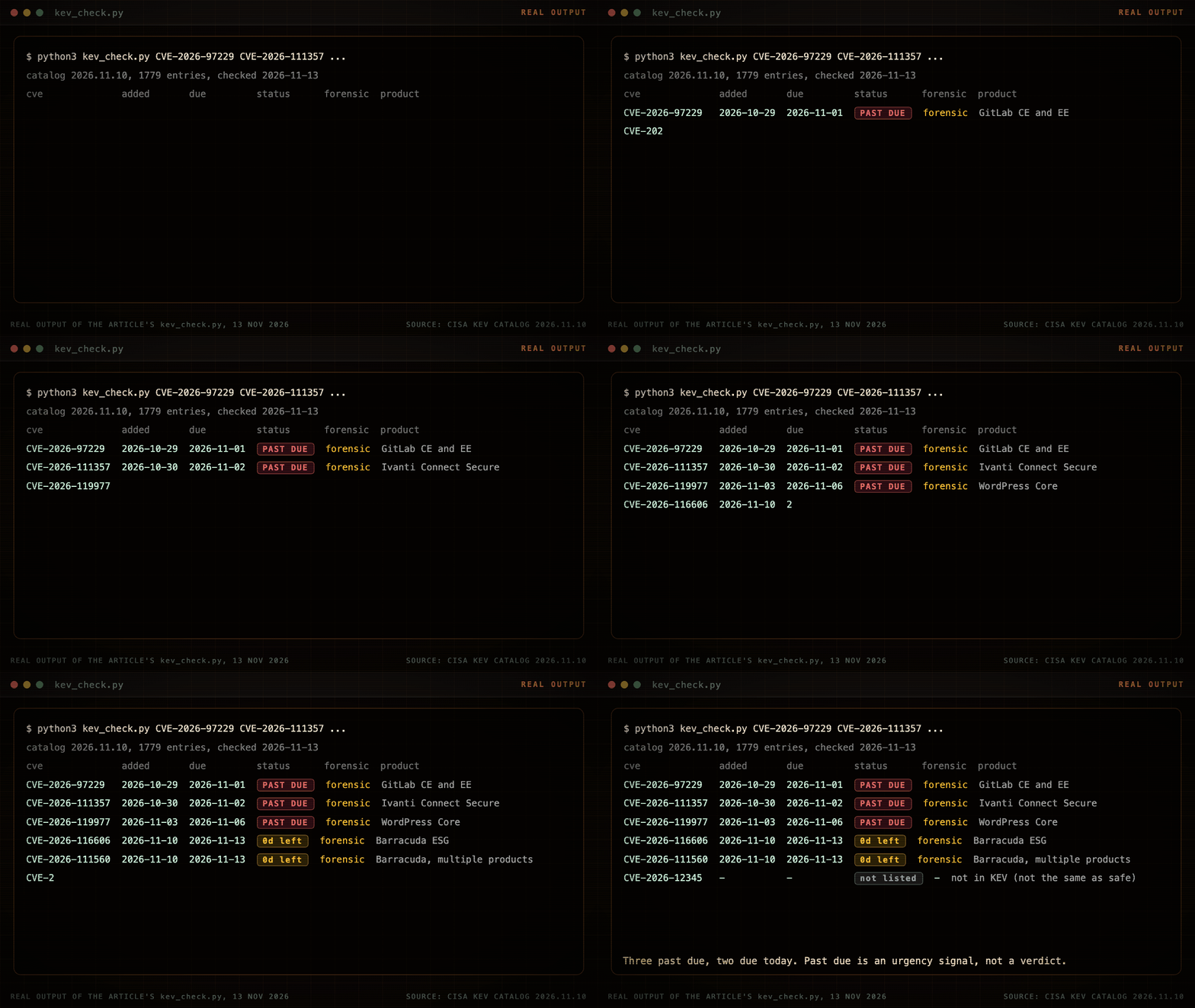
“Past due” here means the federal due date has passed, which is a useful urgency signal for anyone, not a legal deadline for you. And “not listed” never means safe.
I am biased, it is my company, and I think XHack is the strongest way to use offensive AI legally, because verification is built in and a person stands behind the result. XHack combines three things most providers sell separately: an autonomous AI agent, a continuous security platform and human testers.
Here is what I can state from our public pages.
If you want to see what an attacker with offensive AI would see on your estate, run it on a scoped target you own first. See our AI vs human penetration testing guide, the pricing page and our AI VAPT services. Brutal honesty is kind of our thing.
Offensive AI is the use of AI for attack-side security work such as reconnaissance, exploit development and post-compromise activity. It is used by authorised testers to find weaknesses, and by criminals who misuse models. The technology is the same, and the legality depends entirely on authorisation.
Using it on systems you own or have written permission to test is legal, and using it against anyone else’s systems is a crime in most countries. This is not legal advice, so check your local law and your contract.
It is meaningfully more capable than in 2024, but it is not autonomous magic. Anthropic’s data shows misuse is mostly early-stage tooling, Irregular reports models still struggle with long-horizon planning and noisy environments, and agents produce false positives. The danger is scale and speed, not perfect skill.
Not on current evidence. In the Stanford ARTEMIS study one agent configuration beat 9 of 10 testers on one network, with more false positives than humans and weak results on graphical tasks. Offensive AI is best for breadth and repetition, with a person validating results and owning scope.
Shrink the attacker’s window. Patch CISA’s Known Exploited Vulnerabilities first, remove exposed management interfaces, protect AI provider keys and sessions, and test your own systems with authorised offensive AI so you see what an attacker would see.
On your own systems, in a written scope you have agreed, in a bug bounty program within its rules, in CTFs and labs, and through verified platforms and provider programs such as OpenAI’s Daybreak or XHack’s identity-verified agent. Never test a system without permission.
Offensive AI is not one thing. It is a fast, cheap assistant in the hands of both testers and attackers, strongest at well-defined tasks and weakest at long, messy operations. The evidence says orchestration, not skill, now separates the dangerous from the dabbling, so defenders should shrink the window and testers should work inside a written scope. Use offensive AI where you are authorised, through routes that verify who you are, and treat every result as a lead until a human has confirmed it.
Categories
Related articles