Table of contents
17
By Salman Khan, OSCP+, Founder of XHack, SRT (Synack Red Team member)
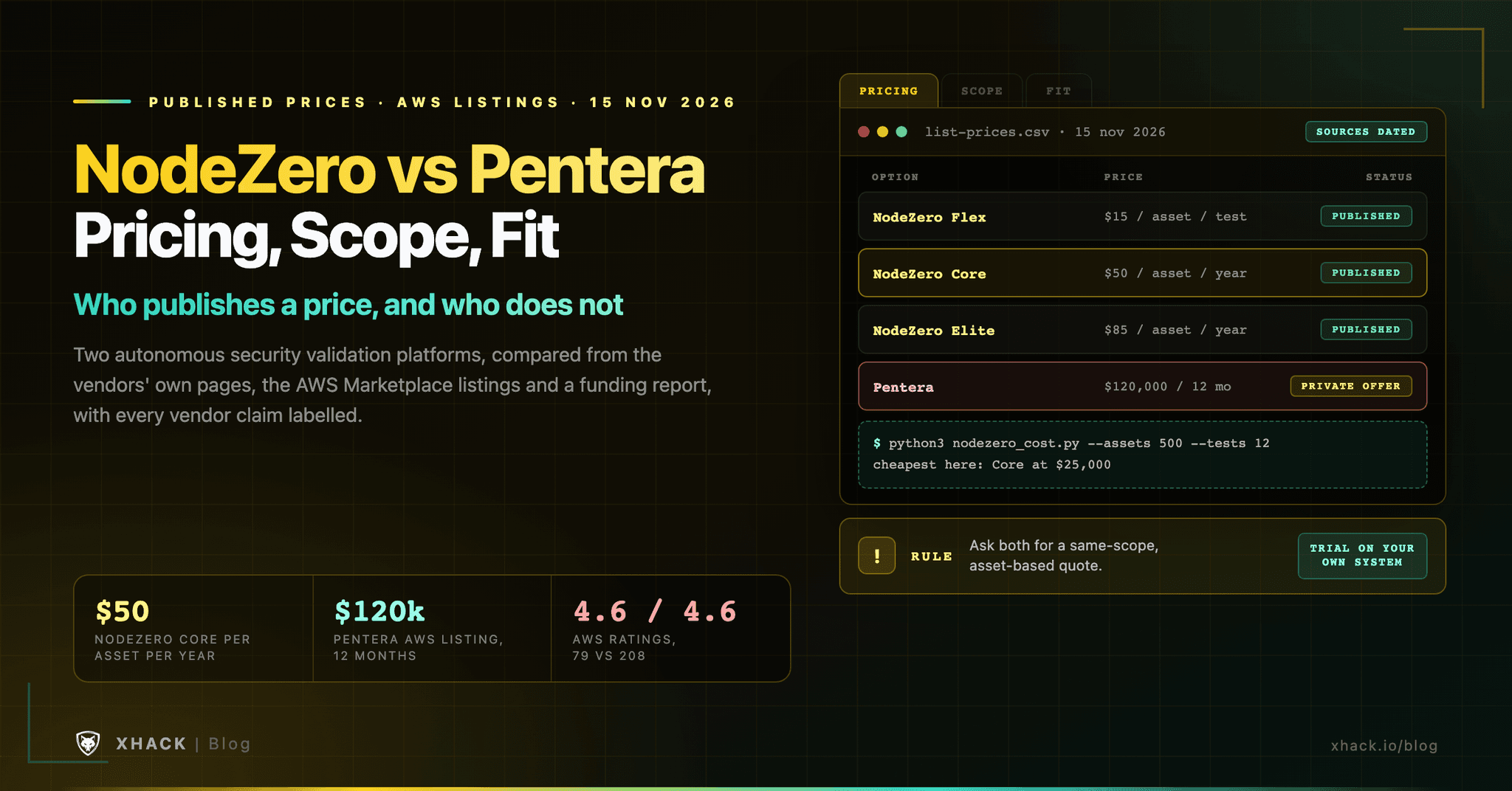
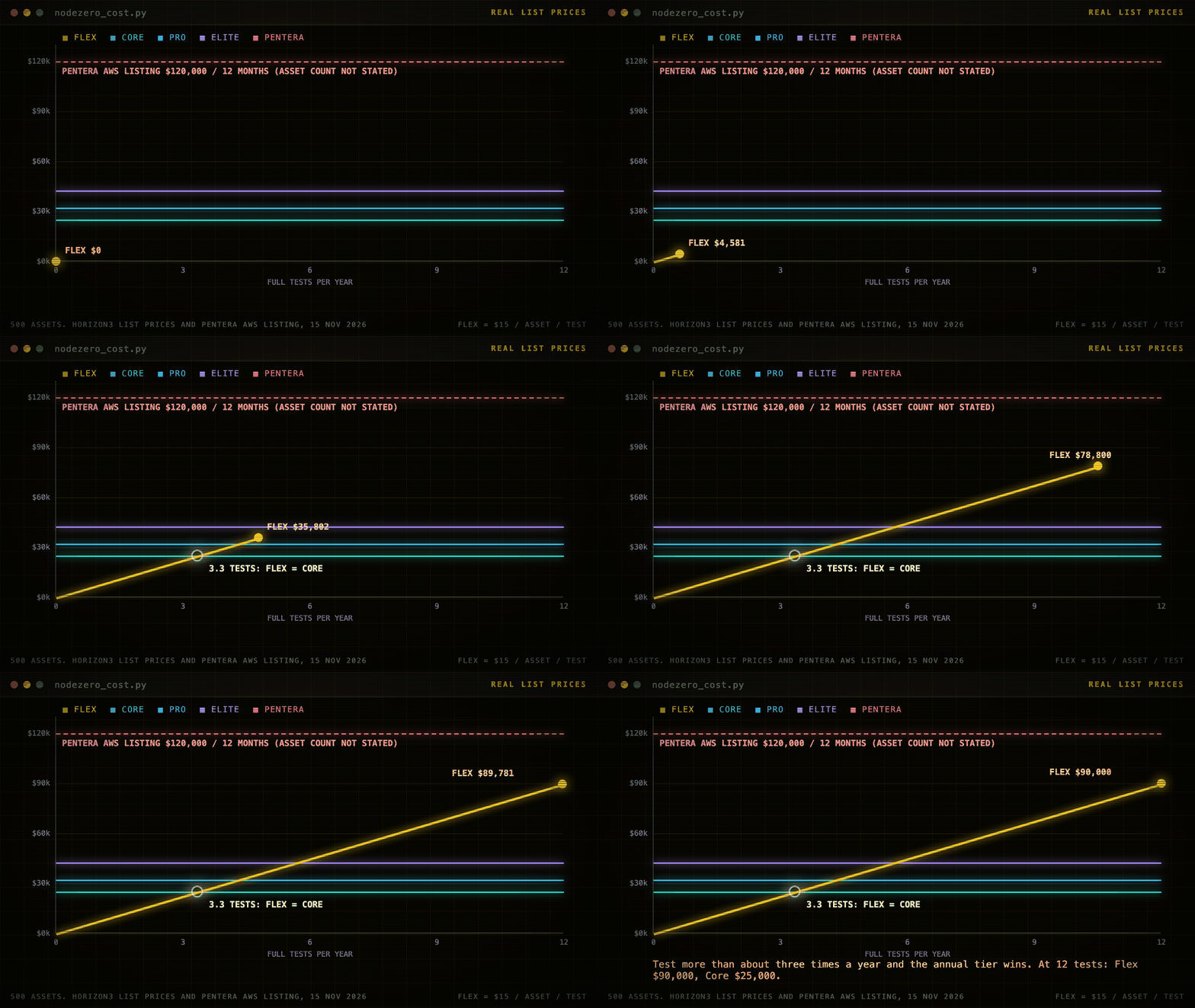
Read this in 30 seconds: NodeZero vs Pentera is a choice between two autonomous security validation platforms that are more alike than their marketing suggests. The biggest practical difference I found on 15 November 2026 is price transparency: Horizon3 now publishes per-asset prices for NodeZero, while Pentera publishes none and its only public number is $120,000 for a 12-month contract on AWS Marketplace.
- NodeZero publishes its prices. Horizon3’s site lists Flex at $15 per asset per test, and Core, Pro and Elite at $50, $65 and $85 per asset per year, with unlimited tests on the annual tiers.
- Pentera does not. The AWS Marketplace listing shows $120,000 per 12 months and asks you to request a private offer, and I found no list price, free trial or self-service signup on Pentera’s own pages.
- Both rate 4.6 on AWS. In NodeZero vs Pentera, NodeZero shows 4.6 from 79 ratings and Pentera 4.6 from 208 external ratings, so reviews will not break the tie.
- The certification gap is real but narrow. Pentera’s trust center lists SOC 2 Type II and ISO 27001, with SOC 2 scope named for Surface and Resolve, and claims no FedRAMP authorisation, while Horizon3’s trust center did not render for me.
- Neither is built for a solo researcher. If you need AI, web, mobile and human testers from $20 a month, that is a third lane, and it is the one XHack sits in.
The honest answer to NodeZero vs Pentera is that the right pick depends on how often you test and what an auditor will accept, not on which brand is bigger.
Most NodeZero vs Pentera pages are written by competitors, and many repeat price ranges that nobody can source. This one starts from the vendors’ own pages, the AWS Marketplace listings and a funding report, dated, with every vendor claim labelled as a claim. I did not run either product. I run XHack, so I also say where we fit.
Both products automate what a penetration tester does inside a network: find a way in, chain weaknesses and prove what is exploitable. They sell it as continuous testing rather than a yearly report.
Both are built for companies, not individuals, and both say their tests are safe to run in production. Those safety statements are vendor claims, and neither is independently verified in anything I read.
Here is the NodeZero vs Pentera comparison with the source and date for each row. Anything marked “not stated” means the page I read did not say, not that the feature is absent.
| NodeZero (Horizon3.ai) | Pentera | |
|---|---|---|
| List price | Published: $15 per asset per test (Flex), $50, $65, $85 per asset per year | None published; $120,000 per 12 months on AWS Marketplace |
| Free trial | The site links a trial sign-up, terms not stated on the pages I read | Not found; demo and “talk to an expert” only |
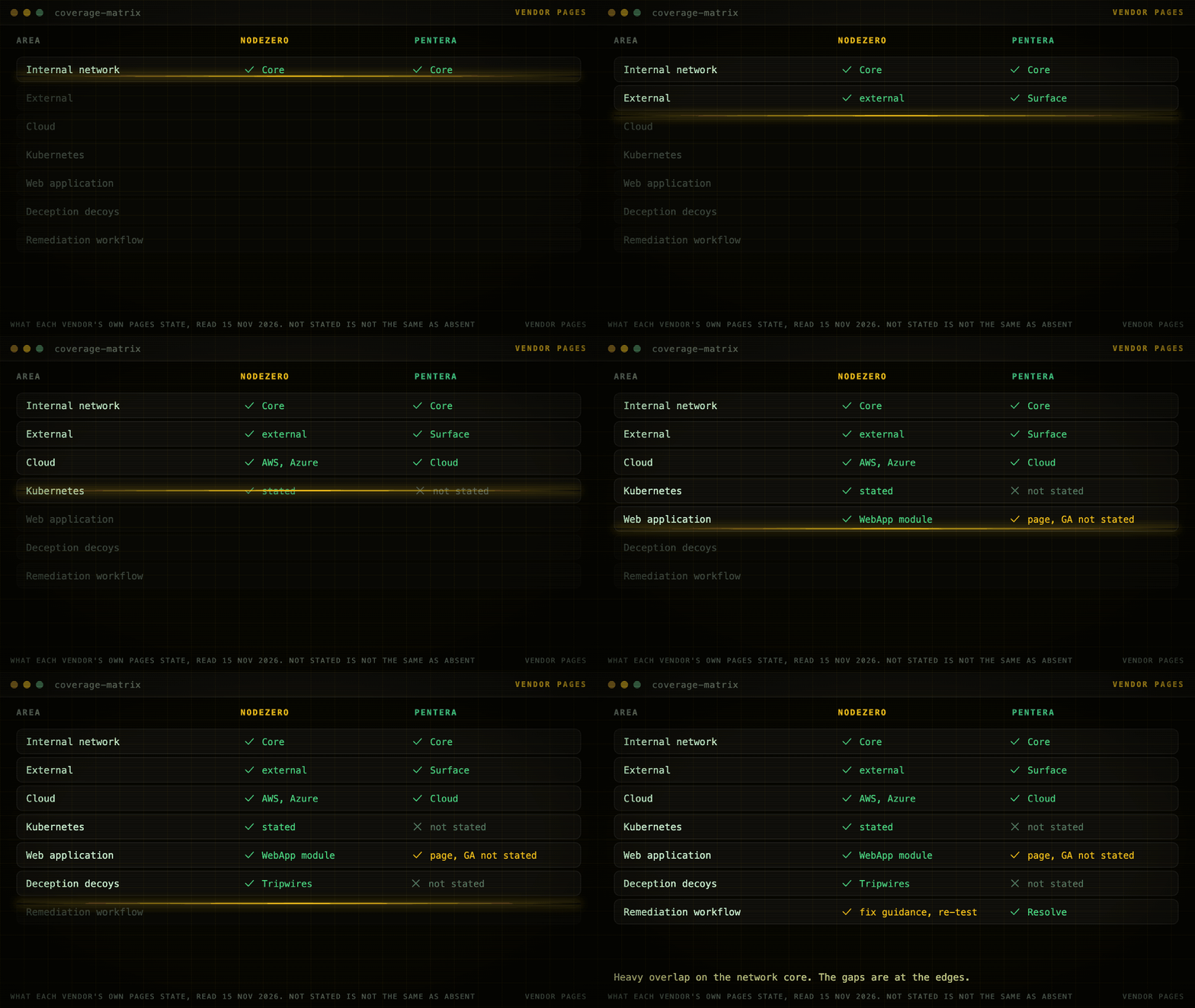
| Internal network | Yes | Yes (Core) |
| External | Yes | Yes (Surface) |
| Cloud | AWS and Azure stated | Yes (Cloud), identities and hybrid |
| Kubernetes | Yes | Not stated |
| Web applications | Separate module, from $10,000 per app per test | Solution page; general availability not stated |
| Deception decoys | Yes (Tripwires) | Not stated |
| Remediation workflow | Fix guidance and re-test | Resolve: tickets, ownership, revalidation |
| Deployment | “No agents”: Docker host or OVA for internal tests | Platform sold as SaaS on AWS; details gated |
| Certifications | Trust center did not render for me | SOC 2 Type II, SOC 3, ISO 27001:2022, ISO 42001, ISO 9001 listed |
| FedRAMP | Not stated on pages I read | Says it does not claim authorisation |
| Reviews on AWS | 4.6 from 79 ratings | 4.6 from 208 external ratings |
| Scale claims | 7,012 customers on its homepage | 1,300+ customer environments over 10 years |
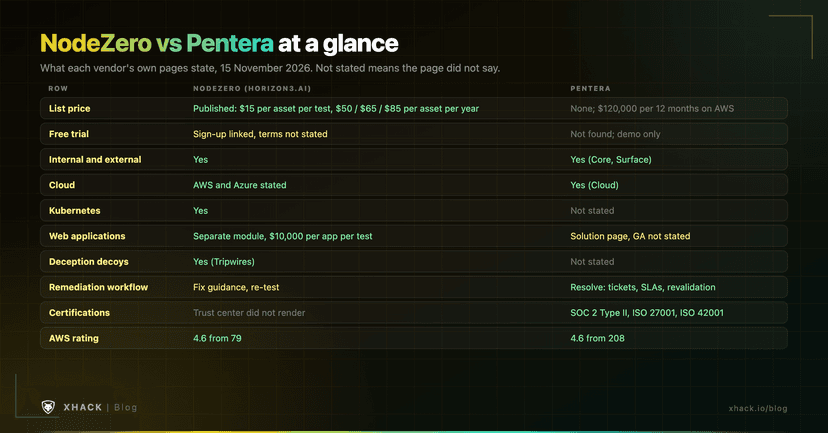
This is where the two diverge most, and where older articles are now out of date. Until recently the only public NodeZero prices were on AWS Marketplace. Horizon3’s own pricing page now lists them in US dollars, and the numbers reconcile with the Marketplace packages, which are sized for 500 assets.
| NodeZero option | Published price | 500 assets |
|---|---|---|
| Flex | $15 per asset per test, 12-month term | $7,500 per test |
| Core | $50 per asset per year, unlimited tests | $25,000 per year |
| Pro (adds Tripwires and Rapid Response) | $65 per asset per year | $32,500 per year |
| Elite (adds Insights and more) | $85 per asset per year | $42,500 per year |
| WebApp Flex | $10,000 per app per test | n/a |
The Marketplace also lists a Gold support add-on at $100,000 and says all fees are non-cancellable and non-refundable except as required by law. Horizon3’s own page adds support options priced as a share of the subscription.
Pentera is the opposite. Its AWS listing shows a single row, $120,000 per 12 months, with the instruction to request a private offer, and the same non-refundable terms. That is the only public figure, it does not state an asset count, and actual deals are negotiated, so it is a reference point and not a quote. Third-party pages quote lower ranges, but I could not source them, so I have not repeated them.
The practical takeaway for any NodeZero vs Pentera budget is arithmetic. Flex is cheaper for occasional tests and the annual tiers win once you test more than about three times a year, because $50 divided by $15 is 3.3. This script does that sum for your own asset count:
import argparse

FLEX = 15
TIERS = {"Core": 50, "Pro": 65, "Elite": 85}
PENTERA_LISTING = 120_000


def main():
    ap = argparse.ArgumentParser()
    ap.add_argument("--assets", type=int, required=True)
    ap.add_argument("--tests", type=int, required=True, help="tests per year across the whole estate")
    a = ap.parse_args()

    flex = a.assets * FLEX * a.tests
    print(f"{a.assets} assets, {a.tests} full tests a year")
    print(f"  Flex   ${flex:>9,}   (${FLEX} per asset per test)")
    for name, per in TIERS.items():
        print(f"  {name:6} ${a.assets * per:>9,}   (${per} per asset per year, unlimited tests)")
    print(f"  Flex beats Core only up to {TIERS['Core'] / FLEX:.1f} tests a year")
    cheapest = min([("Flex", flex)] + [(n, a.assets * p) for n, p in TIERS.items()], key=lambda x: x[1])
    print(f"  cheapest option here: {cheapest[0]} at ${cheapest[1]:,}")
    print(f"  Pentera reference: ${PENTERA_LISTING:,} per 12 months on AWS (asset count not stated)")


if __name__ == "__main__":
    main()
For 500 assets tested monthly it prints:
500 assets, 12 full tests a year
  Flex   $   90,000   ($15 per asset per test)
  Core   $   25,000   ($50 per asset per year, unlimited tests)
  Pro    $   32,500   ($65 per asset per year, unlimited tests)
  Elite  $   42,500   ($85 per asset per year, unlimited tests)
  Flex beats Core only up to 3.3 tests a year
  cheapest option here: Core at $25,000
  Pentera reference: $120,000 per 12 months on AWS (asset count not stated)
Run it with python3 nodezero_cost.py --assets 500 --tests 12, and check Horizon3’s pricing page first, because prices change. The honest limit of this comparison is that I cannot put Pentera on the same per-asset scale, so ask Pentera for an asset-based quote and compare like for like.
In NodeZero vs Pentera, the headline network work overlaps and the differences sit at the edges. Both test internal networks, external exposure and cloud, and both chain weaknesses into attack paths. The edges are these.
Funding, reviews and recent complaints tell you about momentum and friction, not about which product is better.
SiliconANGLE reported on 3 August 2026 that Horizon3.ai raised $250 million at a valuation above $2 billion, bringing total funding to $428.5 million, and that NodeZero is used by more than 6,500 organisations, up from about 3,000 at the previous round. Annual recurring revenue grew 120% year over year, with no absolute figure given. That is a company with money to build.
On AWS Marketplace, NodeZero shows 4.6 from 79 ratings and Pentera 4.6 from 208 external ratings. The five most recent NodeZero reviews shown, all from G2 between 30 October and 10 November 2026, praise easy setup and clear attack paths and complain about limited detail on failed exploit attempts, set-up problems in an isolated network zone and the loss of a free 30-day trial. Pentera’s listing showed no AWS reviews.
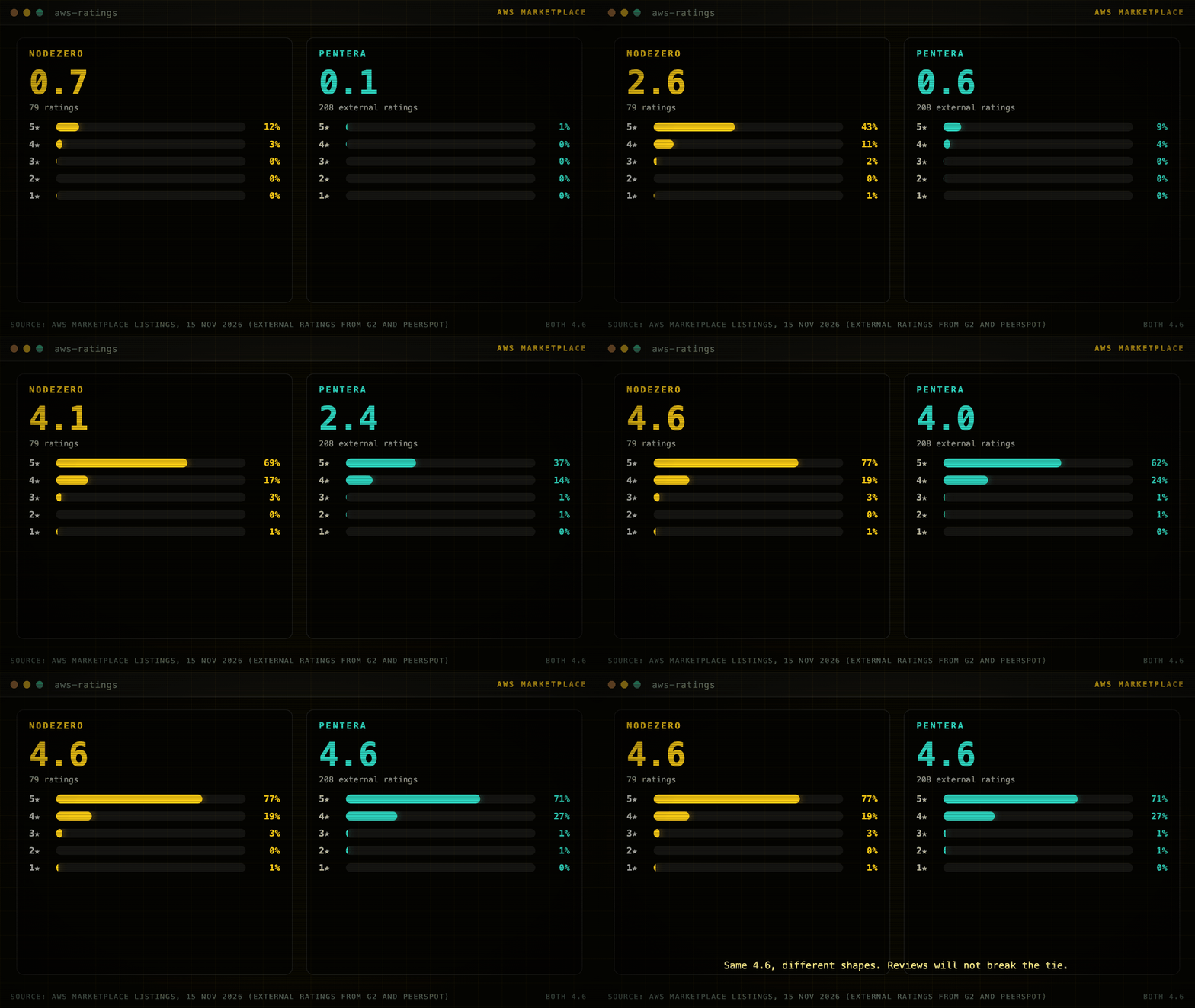
Two cautions for NodeZero vs Pentera. Vendor-reported figures such as customer counts, “zero downtime” claims and risk-reduction percentages are marketing, and review counts differ between pages. Weigh them accordingly.
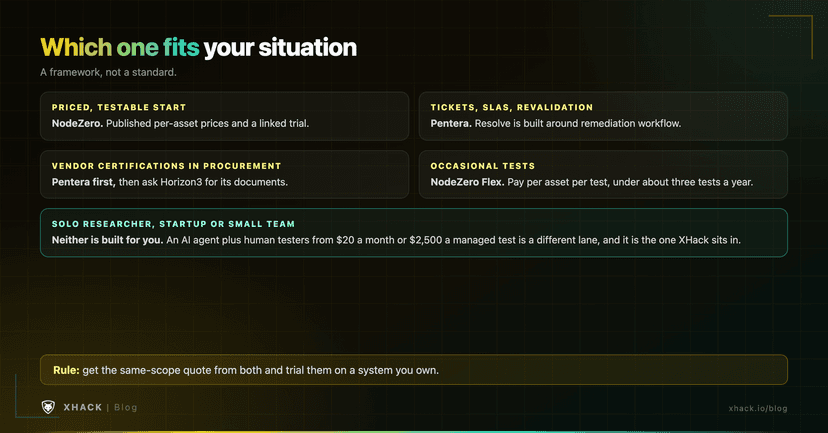
In NodeZero vs Pentera, match the product to the thing you are really buying: speed to first result, or evidence a regulated auditor will accept. This is my framework, not a standard.
| Your situation | Leans toward | Why |
|---|---|---|
| Mid-sized team wants a priced, testable starting point | NodeZero | Published per-asset prices and a linked trial |
| Large security team with ticketing and SLA workflows | Pentera | Resolve is built around remediation workflow |
| Buyer needs vendor certifications in procurement | Pentera, then ask Horizon3 | Pentera lists them; Horizon3’s I could not read |
| Occasional tests, not continuous | NodeZero Flex | Pay per asset per test, under about three tests a year |
| Solo researcher, startup or small team | Neither | Both are company products without an individual tier |
I am biased, it is my company, and I think XHack is the strongest answer when the NodeZero vs Pentera choice does not match your size or your attack surface. XHack combines three things most providers sell separately: an autonomous AI agent, a continuous security platform and human testers.
Here is what I can state from our public pages.
For direct head-to-heads, see our Horizon3 vs XHack and Pentera vs XHack comparisons, our XBOW comparison, the pricing page and our AI VAPT services. A report from any of these is evidence for your auditor, and the auditor decides what satisfies a framework. Run any of them on a scoped target and judge by what a person can reproduce.
Price transparency and shape. NodeZero vs Pentera comes down to published per-asset pricing and a web-friendly start on one side, and a workflow- and certification-heavy enterprise platform with no list price on the other. Both automate attack-path validation.
NodeZero’s site lists $15 per asset per test for Flex and $50, $65 and $85 per asset per year for Core, Pro and Elite. Pentera publishes no list price, and its AWS Marketplace listing shows $120,000 per 12 months. The asset count behind Pentera’s figure is not stated.
At the published prices, a 500-asset NodeZero Core subscription is $25,000 a year, against Pentera’s $120,000 listing figure. The two are not like for like, because Pentera’s asset count and scope are not stated, so request an asset-based quote from Pentera before concluding.
I did not find one. Pentera’s pages offer a demo and a conversation with an expert, and its AWS listing says to request a private offer. NodeZero’s site links to a free-trial sign-up, but I did not open it, so I cannot state its length.
Neither page proves it. NodeZero sells a separate WebApp module with a self-published false-positive claim, and Pentera lists web and API testing on a solution page without stating general availability. In a NodeZero vs Pentera trial, plant known web issues and count how many a human can reproduce.
Both are company products, and I found no individual tier on either. Small teams and solo researchers usually need a lower entry point and some human help, which is where XHack’s $20 individual plan and $2,500 managed tests sit.
It can. Pentera lists SOC 2 Type II, ISO 27001 and other attestations in its trust center, and Horizon3’s trust center did not render for me, so ask for its documents. In NodeZero vs Pentera, your auditor decides which evidence satisfies a framework, so ask them before you buy.
Agree the scope in writing, plant known issues on a system you own, and set pass marks first. Then count planted issues found, the share of findings a person can reproduce and how fast you can stop the test. That makes NodeZero vs Pentera a measured choice, not a demo contest.
NodeZero vs Pentera is closer than their marketing suggests. NodeZero is the easier one to price and start with, Pentera is the one with the visible certifications and remediation workflow, and both are built for companies with budget. Do the arithmetic for your asset count, ask each vendor for the same-scope quote, and trial both against a system you own with planted issues. If neither fits your size or your surface, that is the gap XHack is built for.
Categories
Related articles