Table of contents
17
By Salman Khan, OSCP+, Founder of XHack, SRT (Synack Red Team member)
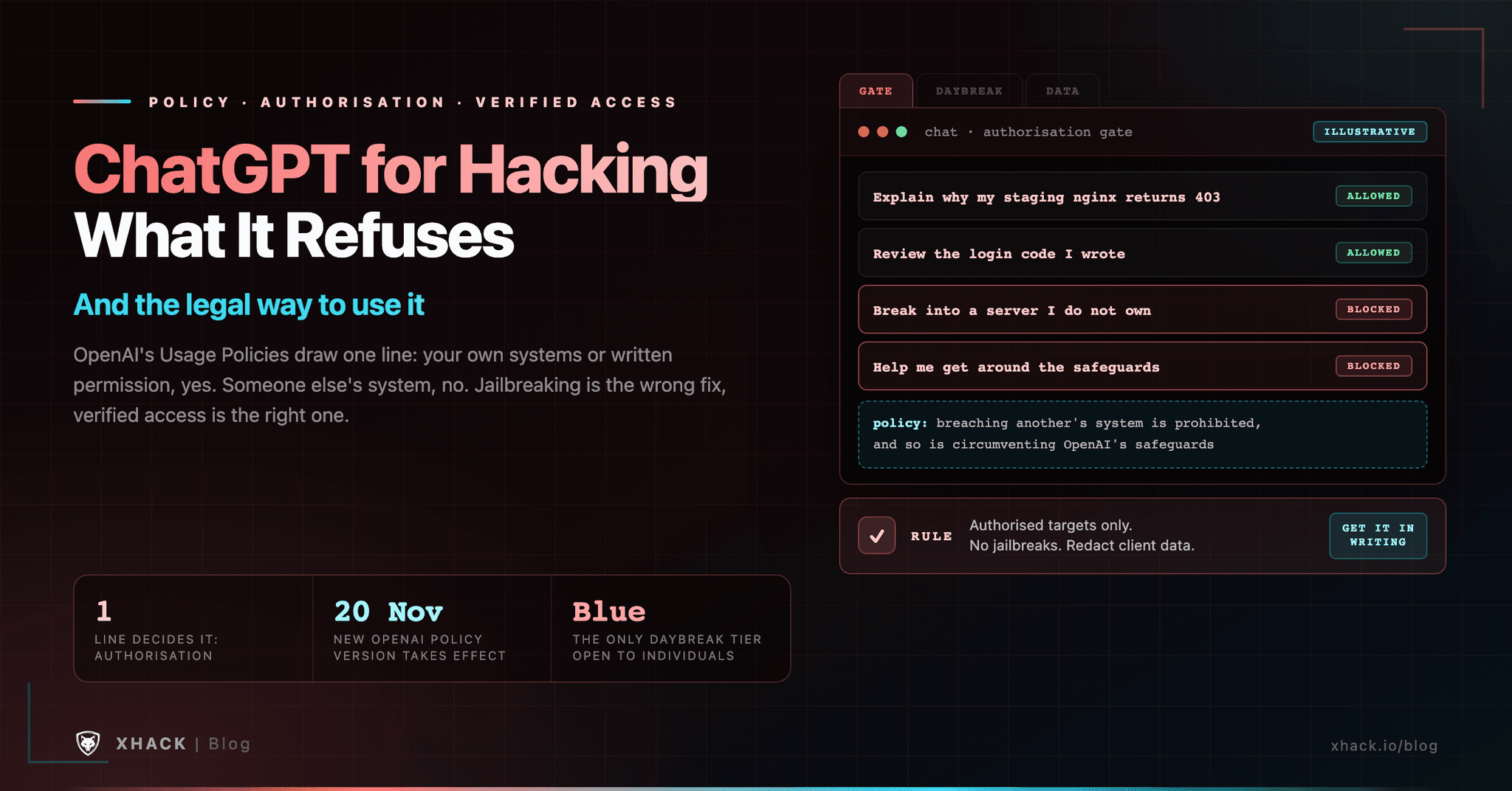
Read this in 30 seconds: ChatGPT for hacking is fine when the target is yours or you have written permission to test it, and it will refuse when it is not. OpenAI’s Usage Policies, which I read on 13 November 2026, ban using its services to compromise or breach another person’s system. Trying to jailbreak around that is both against the policy and the wrong fix, because the legitimate route is verified access, and a chatbot alone still cannot run or validate a test for you.
- The line is authorisation. The policy prohibits breaching another’s system or property, including malicious or abusive cyber activity, and also prohibits circumventing OpenAI’s safeguards.
- A new policy version is coming. OpenAI’s changelog shows an update dated 21 October 2026 that takes effect on 20 November 2026, so re-read it before you rely on any of this.
- There is an official route for professionals. OpenAI’s Daybreak program gives verified practitioners reduced refusals for authorised work, but individuals need a paid plan, Advanced Account Security, a physical FIDO2 key and identity verification, and approval is not automatic.
- Red is not for individuals. OpenAI’s help page says Daybreak Red is currently available only to approved business and enterprise organisations.
- A chat is not an engagement. ChatGPT can advise, but it does not run a scanner, drive a browser or prove a finding, which is the part that makes a test worth paying for.
The question is never whether a chatbot can answer, it is whether you are allowed to ask.
If you search for ChatGPT for hacking, you will find threads full of jailbreak prompts and screenshots of refusals. This guide is the opposite: the legal, practical version for people who do this work for a living or are learning to.
It covers what ChatGPT for hacking is good for, what it will not do and why, the rules that sit behind that, OpenAI’s verified route, how to keep client data out of a chat, and where a purpose-built agent takes over. It contains no jailbreaks, no refusal workarounds and no attack steps. I run XHack, so I also show where we fit.
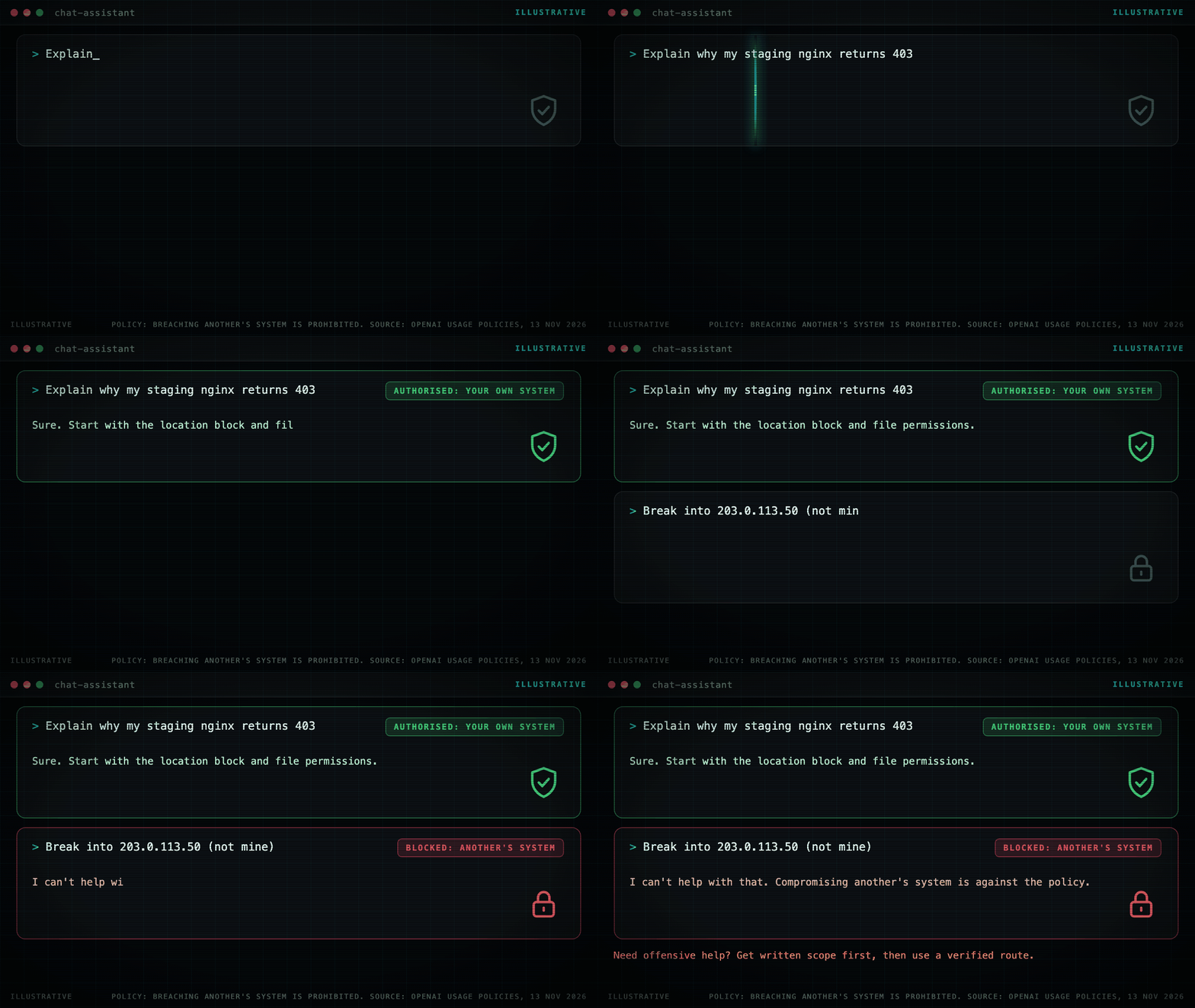
Yes, if the work is authorised, and no if it is not. ChatGPT for hacking is allowed in the sense that matters: learning, defensive work and testing systems you own or have written permission to test. It is not allowed when the aim is to compromise someone else’s system.
OpenAI’s own table of access levels shows what “standard” use is meant for. Its Daybreak overview says standard mainline model usage supports secure software development and application security work, including threat modelling, secure code review and patching, plus general blue teaming. In other words, ordinary ChatGPT for hacking is for understanding, reviewing and defending, not for attacking.
That matches the Usage Policies, which prohibit “compromise, or breach of another’s system” and malicious or abusive cyber activity. The policy does not spell out a general allowance for penetration testing, which is why OpenAI built a separate verified program for it.
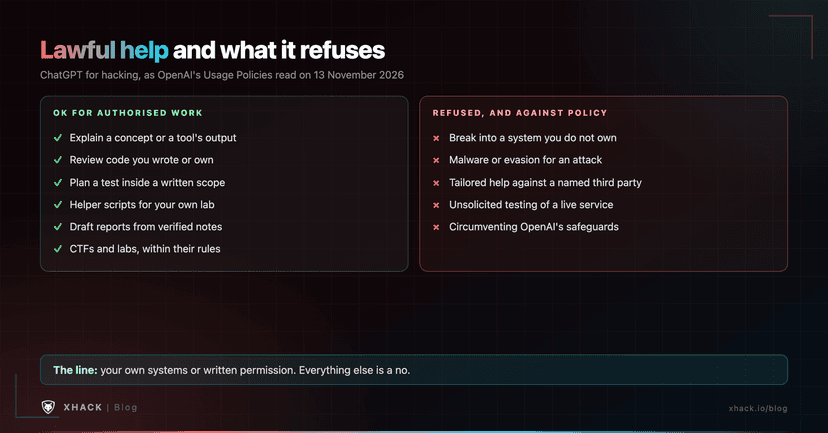
It is a strong explainer, reviewer and drafter, which covers a lot of real security work. Used on your own code, your own lab or an approved scope, ChatGPT for hacking can help with:
Treat the output as a draft from a fast junior colleague. It can be wrong, it can invent commands or identifiers that do not exist, and it cannot see your environment.
ChatGPT for hacking stops where the request would help compromise a system you have no right to touch. That includes tailored help to break into a named third-party target, to build malware or to evade detection for an attack. The policy also lists “unsolicited safety testing”, which is a reminder that probing a service you were not invited to test is not a grey area.
Two other limits are practical. First, it does not execute anything in your environment, so it cannot confirm that a bug is real. Second, even a good answer needs verification, because a model can sound certain about something false. Our guide on why AI refuses hacking requests goes into the reasons behind refusals.
A jailbreak breaks a rule you agreed to, and the rule is the one protecting you. OpenAI’s policy lists “circumventing our safeguards” as prohibited and says that breaking or circumventing its rules may mean you lose access or face other penalties. For a professional, losing an account mid-engagement is the smallest cost. The larger one is explaining to a client why their data went through a workaround.
There is also a quality problem. Outputs from a pushed model are no more accurate than normal ones, and many services that sell “unrestricted” access are unaccountable or worse. I do not cover how refusals are removed, and I will not link to tools that do it, because that part only helps the wrong people. If refusals are slowing authorised work, use a verified route instead. Our uncensored LLM for security guide explains the risks and the five questions to ask any vendor.
Whether ChatGPT for hacking is legal depends on your target, not on the chatbot. In most countries, accessing a computer system without authorisation is a crime, for example under the US Computer Fraud and Abuse Act and the UK Computer Misuse Act. The tool you used to plan it does not change that. This is not legal advice, so check your local law and your contract.
In practice that means four habits:
If you need fewer refusals for authorised work, the legitimate way is to be verified. OpenAI’s Daybreak program is its Trusted Access for Cyber program, and its help page, updated the day before I read it, describes two tiers.
For individuals, three details matter. Blue requires an eligible paid plan, Advanced Account Security, at least one compatible physical FIDO2 hardware key and identity verification, and OpenAI says approval is not automatic. Daybreak Red is currently available only to approved business and enterprise organisations, not through the individual application. And existing individual users had to meet the requirements by 1 October 2026 to keep access.
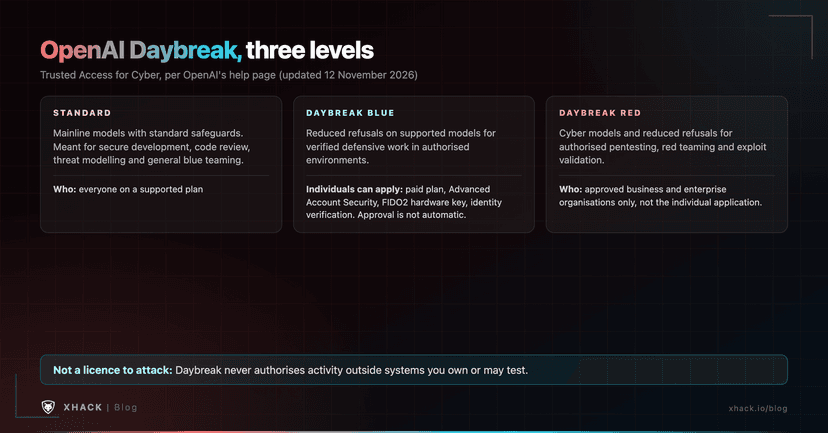
Daybreak does not remove all safeguards, does not grant zero data retention by default, and does not authorise activity outside systems you own or may test. You must also agree to OpenAI’s Cyber Abuse Policy, which covers dual-use activity done without authorisation or beyond granted authorisation. See OpenAI’s Usage Policies and the Daybreak overview for the current terms.
Do not paste client secrets, hostnames or personal data into any chat you have not cleared with the client. Even with a safe plan, Daybreak’s own page says it does not grant zero data retention by default. The easy fix is to redact first and restore afterwards.
This short script replaces keys, tokens, email addresses and IPv4 addresses with placeholders, saves a map and can put the originals back into the answer. It only uses the standard library, and I tested it on sample notes before publishing.
import json
import re
import sys

MAP_FILE = "redact_map.json"
PATTERNS = [
    ("KEY", re.compile(r"-----BEGIN [A-Z ]*PRIVATE KEY-----.*?-----END [A-Z ]*PRIVATE KEY-----", re.S)),
    ("KEY", re.compile(r"\bAKIA[0-9A-Z]{16}\b")),
    ("TOKEN", re.compile(r"\beyJ[A-Za-z0-9_-]{8,}\.[A-Za-z0-9_-]{8,}\.[A-Za-z0-9_-]{8,}\b")),
    ("TOKEN", re.compile(r"(?i)\b(?:bearer|token|api[_-]?key|secret)\s*[:=]?\s*[A-Za-z0-9_\-]{16,}")),
    ("EMAIL", re.compile(r"\b[\w.+-]+@[\w-]+(?:\.[\w-]+)+\b")),
    ("HOST", re.compile(r"\b(?:\d{1,3}\.){3}\d{1,3}\b")),
]


def redact(text):
    mapping, counters = {}, {}
    for label, rx in PATTERNS:
        def sub(m, label=label):
            val = m.group(0)
            for k, v in mapping.items():
                if v == val:
                    return k
            counters[label] = counters.get(label, 0) + 1
            ph = f"[{label}_{counters[label]}]"
            mapping[ph] = val
            return ph
        text = rx.sub(sub, text)
    return text, mapping


def main():
    if sys.argv[1] == "--restore":
        mapping = json.load(open(MAP_FILE))
        text = open(sys.argv[2]).read()
        for ph, val in mapping.items():
            text = text.replace(ph, val)
        print(text, end="")
        return
    text, mapping = redact(open(sys.argv[1]).read())
    json.dump(mapping, open(MAP_FILE, "w"), indent=2)
    print(text, end="")
    print(f"\n# {len(mapping)} items redacted, map saved to {MAP_FILE}", file=sys.stderr)


if __name__ == "__main__":
    main()
Run it on a notes file, paste only the safe version, then restore the placeholders in the answer:
python3 redact.py notes.txt > safe.txt
python3 redact.py --restore answer.txt
On a five-line sample with an email address, two internal IPs, an AWS example key and a bearer token, it printed this:
Client: acme-corp, contact [EMAIL_1]
Staging web server [HOST_1] and db [HOST_2]
Found AWS key [KEY_1] in the deploy script
Authorization: [TOKEN_1]
Please explain why nginx on [HOST_1] returns 403 for /admin
# 5 items redacted, map saved to redact_map.json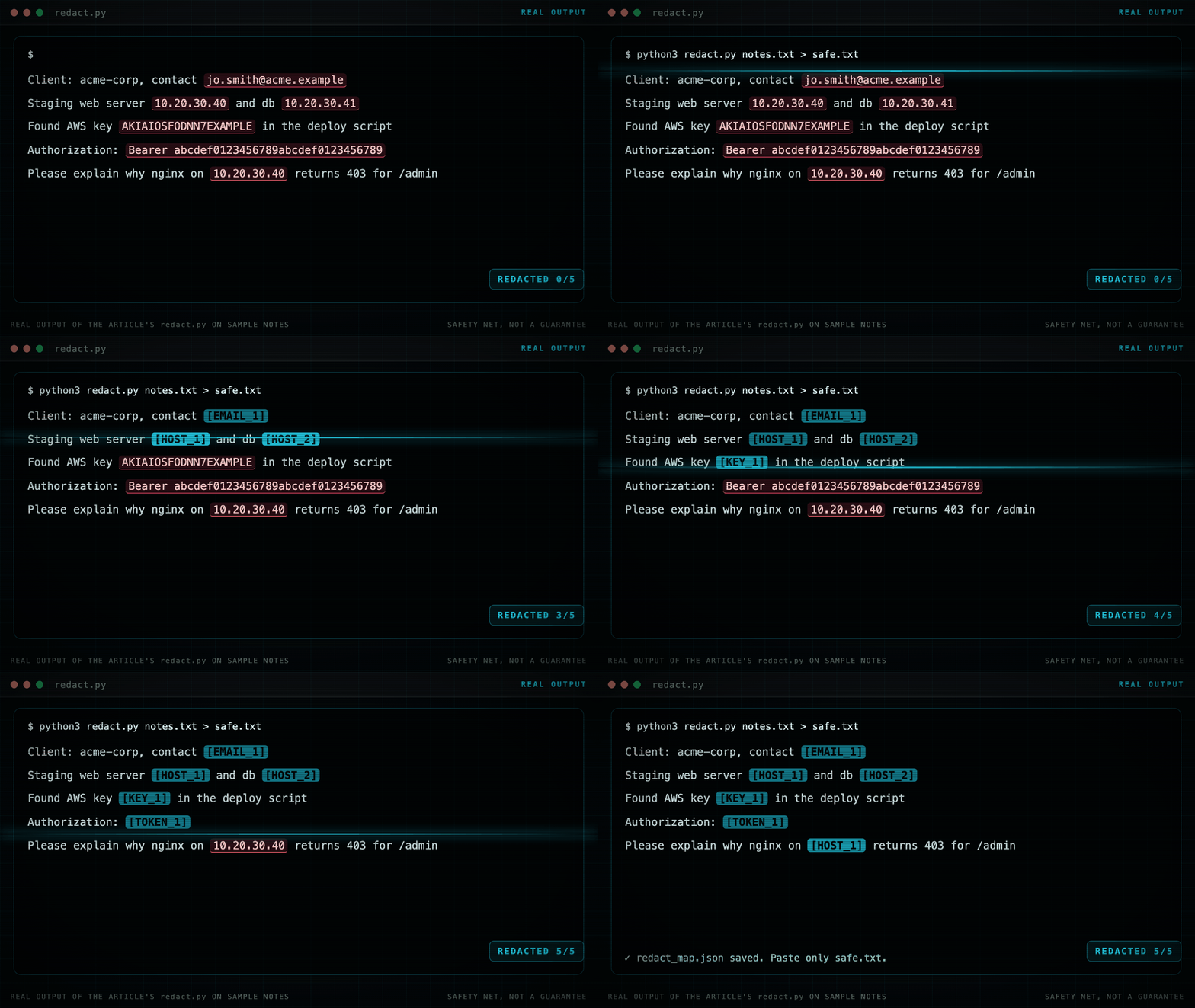
The script is a safety net, not a guarantee. Pattern matching misses names, client codenames and anything unusual, so read the redacted text before you paste it.
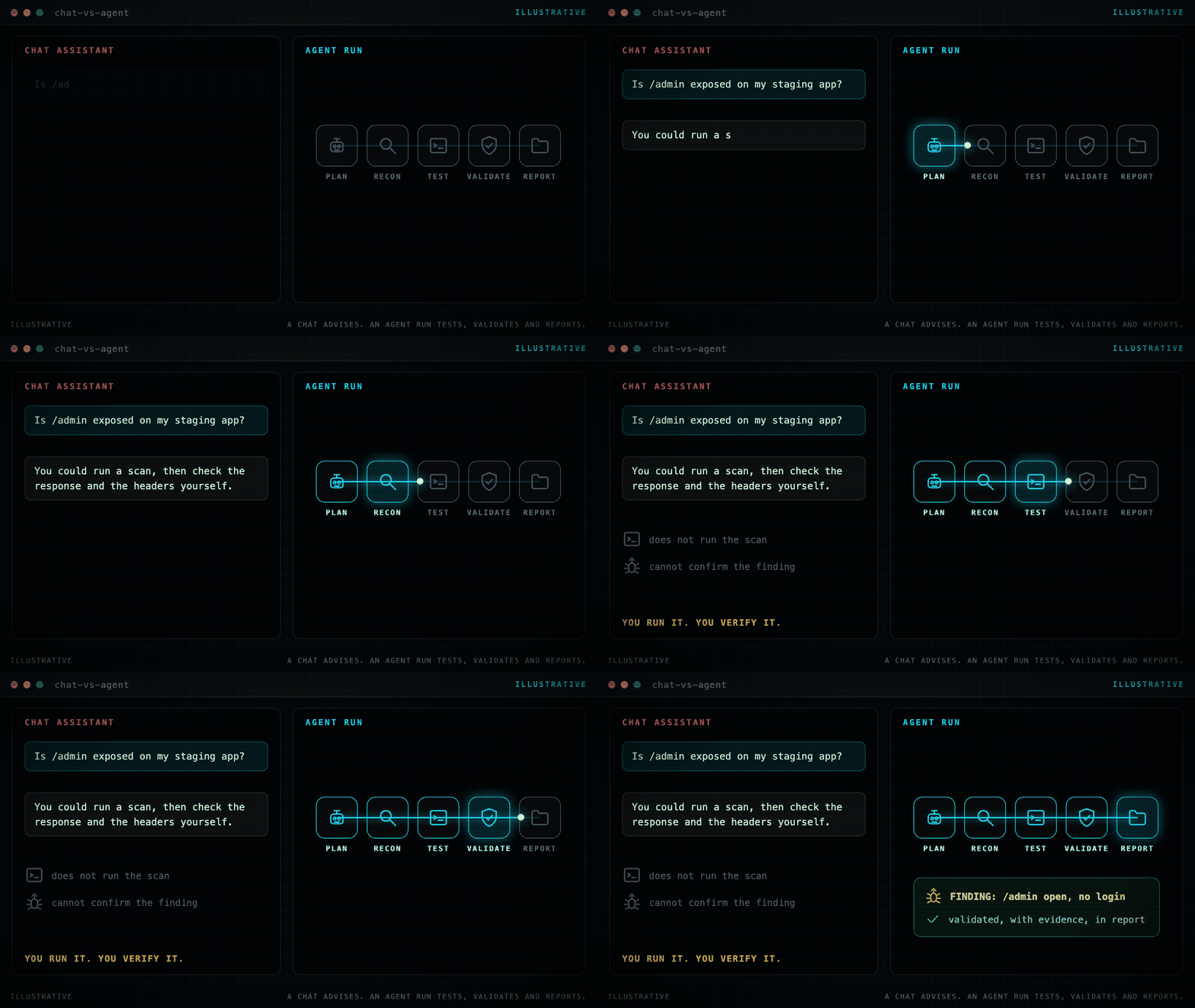
ChatGPT for hacking gives you advice, and a penetration test needs evidence. The gap between the two is where most of the work is. A chat assistant does not scan your target, drive a browser through a login, chain a finding into an impact or prove that a fix worked. You do, and then you paste the results back in.
An agent built for security closes that loop. It plans, runs real tools in scope, validates what it finds and writes the report, with a person watching. That is the difference between a draft idea and a finding you can hand a client.
I am biased, it is my company, and I think XHack is the strongest answer once you outgrow a chatbot, because verification is built in and the work is actually run. XHack combines three things most providers sell separately: an autonomous AI agent, a continuous security platform and human testers.
Here is what I can state from our public pages.
Use ChatGPT for hacking to learn and to draft, and use a verified agent when you need real tests on a scoped target. See our unrestricted AI agent guide, the pricing page and our AI VAPT services. Run it on a lab you own first, because brutal honesty is kind of our thing.
Using ChatGPT for hacking is legal when the target is yours or you have written permission to test it. It is illegal to use any tool, including a chatbot, to access a system you are not authorised to test. This is not legal advice, so check your local law and your contract.
It will help with authorised and defensive work, such as explaining concepts, reviewing your own code and drafting a test plan. It refuses requests to compromise someone else’s system, and its policy bans breaching another’s system or property. For authorised offensive work, OpenAI points professionals to Daybreak.
You should not. OpenAI’s policy lists circumventing its safeguards as prohibited and says it may remove access for breaking its rules. For ChatGPT for hacking, the safer route is a verified program or a platform that verifies you, and our guide on why AI refuses hacking requests explains the reasons.
Daybreak is OpenAI’s Trusted Access for Cyber program. Blue reduces refusals on supported models for verified defensive work, and Red adds cyber models for authorised offensive work. Individuals can apply for Blue with a paid plan, Advanced Account Security, a FIDO2 hardware key and identity verification, and approval is not automatic.
No. ChatGPT for hacking can explain, review and draft, but it does not run tools against a target, validate a finding or take responsibility for the result. A person or a purpose-built agent has to do that, and a human still has to confirm what matters.
Client secrets, credentials, private keys, personal data and anything under an NDA that you have not cleared. Redact first, restore afterwards, and remember that OpenAI says Daybreak does not provide zero data retention by default.
ChatGPT for hacking works best as an explainer and a drafter on systems you are allowed to test, and it is designed to refuse the rest. Do not try to jailbreak it, because the policy forbids it and the legitimate route is verified access. Get written permission, redact what you paste, treat every answer as a lead to verify, and move to a verified agent when you need tests that actually run. That is how you use ChatGPT for hacking without risking your accounts, your clients or the law.
Categories
Related articles