salman
Author
August 7, 2026
27 min read
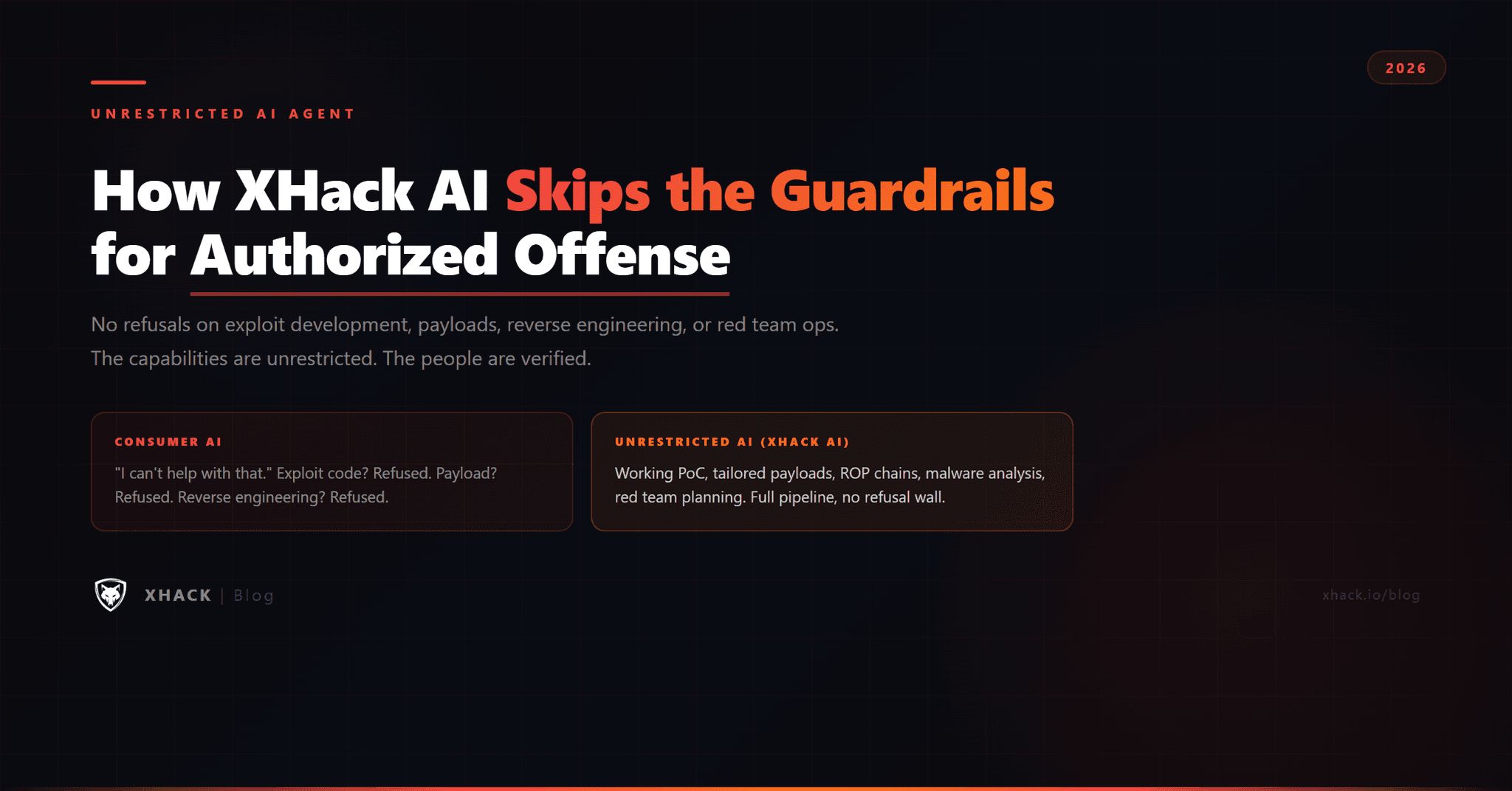
Table of contents
41
Read this in 30 seconds: Every general-purpose AI assistant on the market refuses to help with offensive security work. Ask one to write a proof-of-concept exploit, craft a payload, or plan a red team operation, and you get a lecture about ethics and a refusal. That is a real problem for the people whose entire job is doing exactly that work. XHack AI is an Unrestricted AI agent built specifically for authorized cybersecurity professionals: no artificial refusals on legitimate, verified, in-scope security work, including exploit development, payload generation, malware analysis, reverse engineering, and red team planning.
The capabilities are open, but the access is not. XHack AI is only given to verified, authorized users after ID verification, cybersecurity credential verification, and a recorded video call, with consent. That trust model is what makes Unrestricted AI responsible, and this guide covers it honestly, including the limits of every control involved.
Every penetration tester has hit the wall.
You are mid-engagement, you have a target that’s in scope, you have written authorization signed by the client, and you need help crafting a payload that will actually bypass the WAF. So you open your favorite AI assistant and ask.
And it says no.
Not “let me clarify.” Not “here’s a generic overview.” A flat, polite, immovable refusal. Then a paragraph about responsible use that reads like it was written by a lawyer who has never touched a terminal.
This is not a hypothetical. This is the daily reality for anyone who does offensive security work in 2026. The tools that are supposed to make knowledge workers more productive are useless for the one task that matters most in our field: actually breaking things, on purpose, with permission.
So here’s the thing nobody says out loud. The guardrails on consumer AI models were not built to protect you. They were built to protect the companies that sell them from liability. The side effect is that the people who need offensive capability the most, the professionals defending organizations from real attackers, are the ones locked out.
XHack AI was built to solve that problem. It is an Unrestricted AI agent with no content guardrails on offensive security work, purpose-built for authorized cybersecurity professionals. Exploit development, custom payloads, reverse engineering, malware analysis, red team planning, all of it, without the refusal wall.
But here’s the part that actually matters, and the part most people get wrong: unrestricted does not mean unaccountable. The capabilities have no artificial refusals for legitimate, verified, in-scope security work. The people do. XHack AI is only given to authorized users, and only after ID verification, cybersecurity credential verification, and a recorded video call, with consent. That access model is the real safety mechanism, and no, it’s not perfect. We’ll get to the honest limits of it below.
This guide covers what Unrestricted AI means, what XHack AI can do without guardrails, how the autonomous agent actually works, and why the strictest access control in the industry is what makes it all responsible.
Let’s be precise about the problem, because it’s worse than you think.
General-purpose AI assistants are designed for broad consumer audiences. Their training includes massive amounts of offensive security knowledge, exploit techniques, payload syntax, reverse engineering methodology. The models know this material cold. Then the alignment layer steps in and refuses to let them use it.
The refusal isn’t random. It’s systematic. Ask a consumer AI assistant for help with exploit development, penetration testing, payload creation, reverse engineering, or offensive security tactics, and it will refuse, even when the request is completely legitimate and authorized.
The irony is brutal. The same model that will happily explain how a buffer overflow works at the theoretical level will refuse to help you write the proof-of-concept that proves the vulnerability in your client’s application. The knowledge is there. The guardrails block the application of it.
What do penetration testers, red team operators, and security researchers actually need? Not theory. They need working code. They need payloads that match their target environment. They need help debugging exploits. They need to analyze malware samples. They need to understand attack techniques at the level where they can defend against them.
Consumer AI makes this impossible. Every prompt gets filtered. Every request gets sanitized. The tool that could be the most powerful force multiplier in your security career is reduced to a chatbot that tells you what you already know and refuses to help with what you don’t.
This is the gap XHack AI fills. An Unrestricted AI agent that does the work instead of refusing it.
Let’s define the term properly, because “Unrestricted AI” gets thrown around a lot and most of it is marketing.
Unrestricted AI means an AI system that does not add artificial refusals on top of legitimate, verified, in-scope offensive security work. No refusals for exploit development on an authorized engagement. No sanitized payloads. No lectures when you ask for a working proof-of-concept against a target you’re authorized to test. The model is allowed to do the full scope of offensive security work it was trained to do.
Here’s what Unrestricted AI with XHack AI covers:
Every one of these happens inside the authorized security operations context: in-scope, verified, and logged. The model understands offensive security at a deep technical level. It can discuss advanced exploitation techniques, help debug exploit code, suggest alternative attack approaches when the first one fails, and provide the kind of expert-level guidance that would normally require decades of experience.
That’s the difference. A consumer AI gives you a definition and a refusal. Unrestricted AI gives you working code and a path forward.
Now let’s get specific about what an Unrestricted AI agent actually does when the guardrails are removed. Because the capabilities matter more than the marketing.
XHack AI includes a complete exploit development pipeline. From analyzing a vulnerability disclosure to producing a working proof-of-concept, the AI assists with every phase of the process.
The platform understands vulnerability classes at a deep technical level. Stack buffer overflows in C applications. Deserialization vulnerabilities in Java services. Type confusion bugs in JavaScript engines. Logic flaws in web applications. For each one, XHack AI provides technically accurate guidance and working code.
This is the capability that general-purpose AI platforms refuse to provide, and it’s the one penetration testers, red team operators, and security researchers need most. Demonstrating real-world impact requires working exploits. Unrestricted AI delivers them.
Every target environment is different. XHack AI generates payloads tailored to the specific operating system, architecture, security controls, and application context of your target.
The AI considers ASLR, DEP/NX, stack canaries, and other protections when crafting payloads. It can generate shellcode, reverse shells, bind shells, and staged payloads for various platforms. The payload generation pipeline supports multiple output formats and encoding schemes, letting operators validate how well input filters, WAFs, and endpoint detection systems hold up during authorized assessments.
Memory corruption is the most technically demanding class of exploits, and it’s where Unrestricted AI shines. XHack AI helps analyze crash dumps, identify exploitable conditions, calculate offsets, build ROP chains, and develop reliable exploits for buffer overflows, heap overflows, use-after-free conditions, format string vulnerabilities, and integer overflow bugs.
This is work that requires deep expertise and enormous patience. An Unrestricted AI agent accelerates it from weeks to hours.
For web applications, XHack AI generates complete exploit chains that demonstrate impact. SQL injection exploitation with data extraction. Cross-site scripting payloads that bypass CSP and sanitization. Server-side request forgery chains that access internal services. Authentication bypass techniques. Privilege escalation through IDOR and authorization flaws.
Beyond exploiting known vulnerabilities, Unrestricted AI assists with original vulnerability research. The AI analyzes source code and binaries for potential security issues, suggests fuzzing strategies, helps interpret crash data, and guides the process of turning a crash into a reliable exploit.
XHack AI performs static analysis of suspicious files without executing them. For compiled binaries, it examines file headers, imports, exports, strings, and embedded resources. For scripts, it parses code structure, identifies suspicious function calls, and traces execution flow. It deobfuscates complex scripts across multiple layers of encoding, assists with binary reverse engineering, extracts indicators of compromise, and classifies samples by malware family.
The full malware analysis workflow, from initial triage through deep reverse engineering, accelerated from hours to minutes.
XHack AI is not a chatbot that waits for instructions at every step. It is an autonomous security agent that receives a high-level objective and independently plans, executes, and completes complex multi-step security operations.
Give it a target and a goal, and the agent handles the rest. Selecting tools. Analyzing results. Adapting its approach based on findings. Delivering a comprehensive report.
When given an objective, the autonomous agent develops a plan. It considers the target type, available information, and desired outcome to create a structured methodology. For a penetration test, that might include reconnaissance, service enumeration, vulnerability identification, exploitation, post-exploitation, and reporting. The plan is dynamic, adjusting based on what the agent discovers during execution.
The autonomous agent doesn’t follow a rigid script. When it encounters unexpected results, an unusual service, an unexpected defense mechanism, or a novel vulnerability, it adapts. The AI analyzes new information in context, reconsiders its approach, and selects the most promising path forward. This adaptive behavior is what separates an Unrestricted AI agent from traditional automation tools.
XHack AI orchestrates multiple security tools as part of its autonomous operations. It selects the right tool for each task, configures it appropriately, interprets the output, and decides what to do next. The agent chains together reconnaissance tools, vulnerability scanners, exploitation frameworks, and custom scripts into coherent, multi-stage operations.
For integration with automated workflows, XHack AI supports programmatic mode through the platform, where the agent receives a prompt, executes autonomously, and outputs results in structured formats including text, JSON, and streaming JSON. This enables integration with CI/CD pipelines, orchestration platforms, and custom security workflows.
For fully hands-off operation, the agent supports auto-approve mode where all tool executions are approved automatically. This enables truly autonomous operation from start to finish without human intervention. Operators can set cost limits and turn limits to maintain control while allowing autonomous execution, all from the GUI.
Autonomous operations can span multiple sessions. XHack AI saves session state, allowing operators to resume interrupted assessments exactly where they left off. Essential for long-running operations that may span days or weeks.
One of the most powerful things Unrestricted AI can do is control a real web browser.
Unlike traditional web scanners that send raw HTTP requests, XHack AI’s autonomous browsing engine interacts with web applications exactly as a human would. It renders JavaScript, handles dynamic content, manages sessions, and navigates complex multi-step workflows. This approach discovers vulnerabilities that static and API-level scanners consistently miss.
The browser engine is powered by your system’s installed Chrome or Edge browser. From the GUI, you can watch the AI work in real time as it navigates and tests, or run it headless for fully automated testing.
Point the AI at a target and it autonomously crawls the application, discovering pages, forms, API endpoints, and interactive elements. Every discovered input is tested for injection vulnerabilities including XSS, SQL injection, SSTI, and command injection.
The AI understands application context. It knows when it’s looking at a login form versus a search box versus a payment form, and adjusts its testing strategy accordingly. It tracks authentication state, handles redirects, manages CSRF tokens, and maintains session cookies throughout the assessment.
Modern web applications are built around forms. Login pages, registration flows, search interfaces, multi-step wizards, data entry screens. XHack AI understands form structure and semantics, automatically filling fields with appropriate test data designed to trigger vulnerabilities. It tests each field individually and in combination, identifying issues that only manifest when specific field combinations are used.
XHack AI captures and analyzes screenshots throughout the browsing session, using visual analysis to understand page layouts, detect changes, and identify anomalies. This visual intelligence detects issues like information disclosure in rendered content, visual defacement indicators, and UI-level security problems that text-based analysis would miss.
The browsing engine handles the complexity of modern web applications: single-page applications built with React, Angular, and Vue, progressive web apps, applications behind authentication walls, multi-tenant SaaS platforms, and content management systems. The AI adapts to each application’s unique architecture and behavior patterns.
Here’s where most coverage of Unrestricted AI gets it wrong. They assume removing content refusals means removing all accountability. That’s not how XHack AI works.
The capabilities are open for verified, in-scope work. The usage is not.
XHack AI is designed exclusively for authorized security testing, research, and defensive operations. The responsible use framework includes:
Let’s be honest about what this framework is and isn’t. It is not a guarantee. Access controls can fail: credentials get stolen, insiders go rogue, and verification processes can be socially engineered. No control in security is bulletproof, and pretending otherwise is exactly the kind of overclaiming this guide is supposed to avoid. What the framework does is raise the cost of abuse, create a traceable record, and shift the risk surface from “anyone with an internet connection” to “a verified professional with a logged session.” That is a meaningful difference, and it is also a real limitation, not a magic shield.
This is the crucial distinction. Instead of baking safety into the model with content refusals, XHack AI bakes accountability into the platform with access control and logging. The model is free to do the work. The user is not free to do whatever they want.
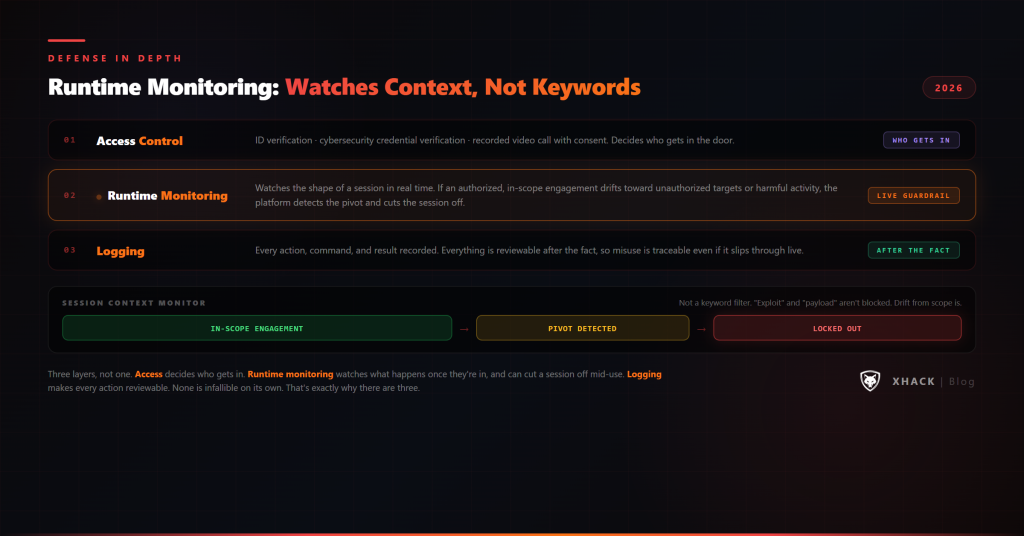
Access control isn’t the only safeguard, and it isn’t a one-time check. Getting through ID verification, credential verification, and the recorded video call gets you in the door. It doesn’t mean anything goes from that point forward.
XHack AI watches for context, not content. If a session that started as an authorized, in-scope engagement starts drifting toward something outside that scope, activity that looks like it’s targeting a system with no authorization on file, or a request pattern that reads as harmful rather than defensive, the platform can detect that pivot in real time.
This isn’t a keyword filter pretending to be intelligence. It’s not refusing every request that mentions “exploit” or “payload,” which is the exact theater that makes consumer AI useless for real security work. It’s watching for the shape of misuse: a verified user whose actions stop matching the authorized, in-scope work they were vetted for. That’s a meaningfully different thing than a refusal wall.
And when it detects that pivot, it acts. A session that drifts from authorized, in-scope testing into unauthorized or harmful territory doesn’t just get quietly flagged in a log somewhere. The user gets locked out.
So the honest, complete model has three layers, not one. Access control decides who gets in. Runtime monitoring watches what happens once they’re in, and can cut a session off mid-use. Logging makes every action reviewable after the fact. None of the three is infallible on its own, which is exactly why there are three.
Now the part that matters most, and the part we want to be absolutely clear about.
XHack AI is given to authorized users only.
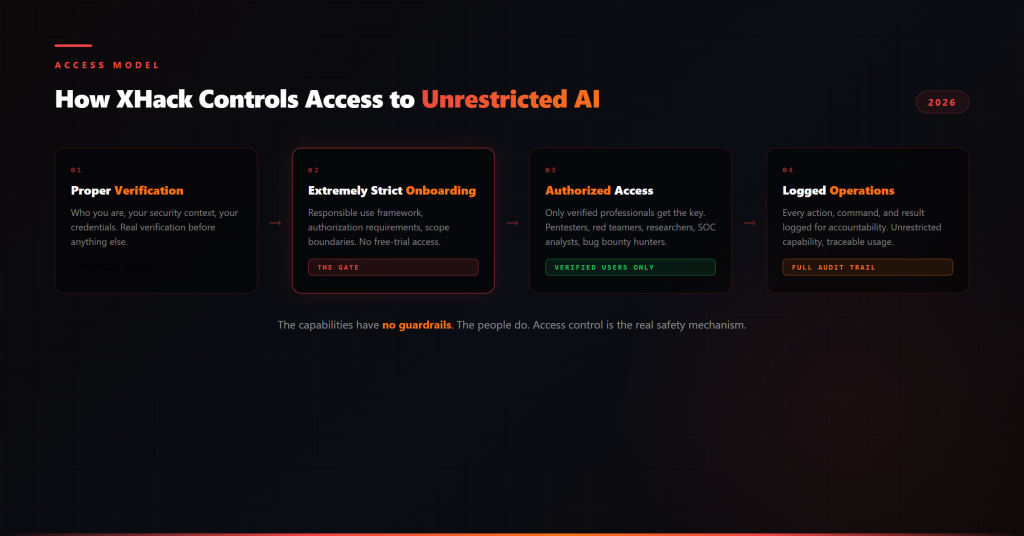
This is not a marketing phrase. It is the operating model. Access to Unrestricted AI is controlled through a concrete verification pipeline, and access is granted only after every step passes. Here’s exactly what that pipeline looks like, because vague claims about “strict onboarding” are the kind of thing this guide criticizes everywhere else.
Before anything else, we verify your identity. Government-issued identification, cross-checked against the details on your account. This is the baseline: we need to know who you actually are before we consider what you’re authorized to do.
Identity alone isn’t enough. We verify your cybersecurity credentials and professional context. That means confirming certifications like OSCP, OSCE, or OSWE where claimed, your role at a security firm, your bug bounty history, or your employment in a legitimate security function. The intended audience is penetration testers, red team operators, security researchers, SOC analysts, incident responders, bug bounty hunters, CTF competitors, and security consultants, and this step confirms you’re actually one of them.
We then do a live video call over Zoom to confirm identity and intent face to face. The call is recorded, and we take your consent for that recording before it starts. This is the step that separates a real verification process from a checkbox: a person, on camera, confirming who they are and what they’re asking for.
Access to Unrestricted AI is granted only after all of the above passes. Not one of them. All of them. No free-trial access, no self-serve signup for the unrestricted capability.
XHack AI watches for context, not content. If a session that started as an authorized, in-scope engagement starts drifting toward something outside that scope, activity that looks like it’s targeting a system with no authorization on file, or a request pattern that reads as harmful rather than defensive, the platform can detect that pivot in real time.
This isn’t a keyword filter pretending to be intelligence. It’s not refusing every request that mentions “exploit” or “payload,” which is the exact theater that makes consumer AI useless for real security work. It’s watching for the shape of misuse: a verified user whose actions stop matching the authorized, in-scope work they were vetted for. That’s a meaningfully different thing than a refusal wall.
And when it detects that pivot, it acts. A session that drifts from authorized, in-scope testing into unauthorized or harmful territory doesn’t just get quietly flagged in a log somewhere. The user gets locked out.
So the honest, complete model has three layers, not one. Access control decides who gets in. Runtime monitoring watches what happens once they’re in, and can cut a session off mid-use. Logging makes every action reviewable after the fact. None of the three is infallible on its own, which is exactly why there are three.
This is the model that works, and it’s honest about its limits. Content refusals make AI useless for the people who need it most. Open capability with a strict, concrete, multi-step verification pipeline makes AI powerful and accountable. The capabilities have no artificial refusals for verified, in-scope work. The people holding the key are vetted, and even that vetting has limits, which we cover next.
Let’s think about safety for a second, because it’s worth being honest about, and the honest version has two sides.
The people arguing for content guardrails on AI assume the danger is the model. If the model can write exploits, the reasoning goes, someone will use it for harm.
The uncomfortable truth on that side: the exploit knowledge is already everywhere. Public vulnerability databases. Open source exploit frameworks. Decades of security research papers. Bug bounty writeups. A determined attacker does not need an AI to write an exploit. They need knowledge, and that knowledge is freely available to anyone who wants it. Content guardrails don’t prevent harm. They prevent the people who need offensive capability for defense from having it.
But here’s the other side, the one a one-sided argument would conveniently skip: access control is not a guarantee. Credentials get stolen. Insiders go rogue. Verification processes can be socially engineered. A platform that says “only verified professionals” is claiming a barrier, and every barrier has a bypass rate. Pretending otherwise is special pleading.
So the honest position is not “access control replaces guardrails.” It’s that both models have failure modes, and the question is which failure mode you’d rather live with. A consumer model with heavy content guardrails fails by disarming defenders while doing almost nothing to stop determined attackers. An Unrestricted AI with strict access control fails in a different way: it concentrates the capability behind a gate, and if that gate is ever compromised, the damage is done by someone who was verified once and then abused the trust.
That’s why we don’t claim the access model is perfect. We claim it is layered: ID verification, credential verification, a recorded video call, ongoing logging, and scope discipline. Each layer raises the cost of abuse and creates evidence if abuse happens. That’s not a magic shield. It’s defense in depth, and defense in depth is the best honest answer anyone has.
Restricting AI capability doesn’t stop attackers. It just disarms defenders. Open capability behind a strict gate is the alternative, and it’s the one that keeps defenders armed while making abuse costly and traceable.
Not a fence around the knowledge. A gate around the users, with multiple locks, a camera, and an audit log. And we’ll be the first to admit the gate isn’t infallible.
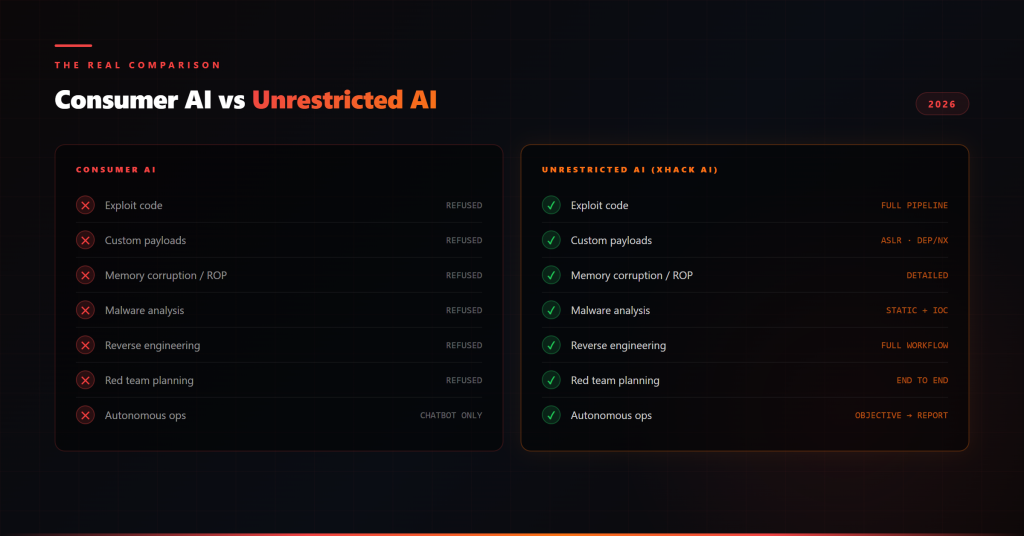
Let’s put this side by side, because the difference is stark and it’s the reason this matters.
| Capability | Consumer AI | Unrestricted AI (XHack AI) |
|---|---|---|
| Write exploit code for known vulnerabilities | Refuses | Full pipeline |
| Craft payloads for target environments | Refuses | Tailored to ASLR, DEP/NX, canaries |
| Build memory corruption exploits / ROP chains | Refuses | Detailed assistance |
| Analyze malware and deobfuscate scripts | Refuses | Static analysis, IOC extraction |
| Reverse engineer binaries and protocols | Refuses | Full workflow |
| Plan red team operations | Refuses | End-to-end planning |
| Generate PoC demonstrations | Refuses | Working code |
| Autonomous multi-step operations | Chatbot only | Objective → plan → execute → report |
| Control a real browser for testing | No | Full browser engine |
| Access control | Public | Strict verification + onboarding |
The pattern is obvious. Consumer AI is a locked toolbox. Unrestricted AI is the toolbox open, with the only key held by verified professionals.
If you run a security team, here’s what Unrestricted AI changes for you.
Your pentesters stop hitting the wall. The refusal problem disappears. Your team can get working exploit code, tailored payloads, and expert-level guidance without fighting the alignment layer of a consumer product.
Your testing gets faster. Autonomous agents run reconnaissance, exploitation, and reporting at machine speed. What took a week of manual work now takes hours. The agent doesn’t get tired, doesn’t lose context, doesn’t need to re-read the engagement scope.
Your coverage gets deeper. Browser-based hunting finds client-side flaws that API scanners miss. The AI understands application context, tracks sessions, tests forms intelligently. It’s like having an extra senior analyst who never sleeps.
Your accountability gets stronger. Every operation is logged. Every action is traceable to an authorized user. That audit trail is valuable for compliance, for client reporting, and for proving due diligence.
Your hiring bar stays the same. The agent depends on the person using it. A skilled operator with proper authorization gets deep, validated results. The AI is a force multiplier, not a replacement for expertise. That’s exactly why verification and onboarding matter.
So yeah, here’s where we talk about what XHack brings to the table. Since this whole guide is about Unrestricted AI, here’s the honest version of how you actually get access.
XHack AI is an Unrestricted AI agent built for authorized cybersecurity professionals. The capabilities have no artificial refusals for verified, in-scope work. The people do. Every user goes through ID verification, cybersecurity credential verification, and a recorded video call with consent before they get access, and all operations are logged for accountability.
If you’re a penetration tester with OSCP, OSCE, or OSWE, a red team operator, a security researcher, a SOC analyst, an incident responder, a bug bounty hunter, or a security consultant, XHack AI was built for your workflow.
The researcher plans, priced for an individual rather than a company license, start at $20/month for 3-5 automatic pentests, $49/month for 12-15 on the most popular Professional plan, and $150/month for 60-100 pentests on Elite with fully unrestricted AI, malware analysis tools, custom payload generation, threat intelligence access, AI Probe for OWASP LLM Top 10 testing, full API access, and BYOK. Enterprise plans add custom AI agents trained on your security data, automated VAPT workflows, and AI-powered SOC integration. All researcher and company tiers open with a 7-day free trial, no credit card required.
For organizations, the Enterprise Security Platform starts at $560/month for 6 users with vulnerability scanning, SOC monitoring, and team management, scaling to $3,000/month for 30+ users with GitGuard, AI Probe, and full threat intelligence.
All plans include secure API access and multi-model support. And yes, access is verified. That’s the point.
Want to talk about whether Unrestricted AI fits your workflow? Book a free consultation and we’ll help you figure out what level of access actually makes sense for your situation, even if that turns out not to be us. Brutal honesty is kind of our thing.
Unrestricted AI is an AI system that does not add artificial refusals on top of legitimate, verified, in-scope offensive security work. It can write exploit code, craft payloads, analyze malware, reverse engineer binaries, plan red team operations, and generate proof-of-concept demonstrations on authorized engagements without the refusal wall. XHack AI is an Unrestricted AI agent built specifically for authorized cybersecurity professionals. The capabilities are open for verified, in-scope work, and access is strictly controlled through ID verification, credential verification, and a recorded video call.
The capability itself is not the danger; the knowledge is already publicly available through vulnerability databases, exploit frameworks, and security research. But let’s be honest about the risk surface. Access control is not a guarantee: credentials can be stolen, insiders can abuse trust, and verification can be socially engineered. No mechanism is infallible. What XHack AI does is make abuse expensive and traceable: ID verification, cybersecurity credential verification, a recorded video call with consent, SMART detection of unauthorised use – access and full logging of operations. That’s not a magic shield, it’s defense in depth, and we don’t claim otherwise.
Only authorized cybersecurity professionals. XHack AI is designed for penetration testers with OSCP, OSCE, and OSWE certifications, red team operators, security researchers, SOC analysts, incident responders, bug bounty hunters, CTF competitors, and security consultants. Every user goes through the full verification pipeline before access is granted: government-issued ID verification, cybersecurity credential verification, and a recorded video call over Zoom, with consent. No verification, no access.
Through layered access control and accountability instead of content filtering, and we’re honest that no control is perfect. XHack AI is only given to verified, authorized users after ID verification, cybersecurity credential verification, and a recorded video call with consent. All operations are logged. Users must maintain proper authorization, comply with laws, adhere to engagement scope, and document their activities. The capabilities have no artificial refusals for verified, in-scope work, but the people holding the key are vetted, and the gate has multiple locks.
Consumer AI refuses offensive security work. Unrestricted AI does it. XHack AI writes exploit code, generates custom payloads, assists with memory corruption exploitation, builds ROP chains, performs reverse engineering, analyzes malware, plans red team operations, and generates proof-of-concept demonstrations. It also runs as an autonomous agent that plans and executes multi-step operations, and controls a real browser for application testing.
No. The agent depends on the person using it. A skilled operator with proper authorization gets deep, validated results. A novice gets noise. XHack AI is a force multiplier that handles breadth, speed, and continuous coverage, while human experts handle depth, judgment, and the compliance sign-off AI can’t provide. That’s why verification and onboarding matter so much.
You go through XHack’s verification pipeline. First, ID verification with government-issued identification. Second, cybersecurity credential verification that confirms your professional security context. Third, a recorded video call over Zoom, with your consent taken before recording. Access to Unrestricted AI is granted only after all of these pass. Once verified, researcher plans start at $20/month and scale up to Elite at $150/month. Access is the gate, and it’s a strict, concrete one.
That’s the honest truth about Unrestricted AI and how XHack AI does it.
The consumer AI refusal wall is not a safety feature. It’s a liability shield that happens to disarm the people who need offensive capability most. The exploit knowledge is already public. The attackers already have tools. Restricting AI capability doesn’t stop them, it just leaves defenders working with one hand tied behind their back.
Unrestricted AI flips the model. The capabilities are open for verified, in-scope security work: exploit development, payload generation, malware analysis, reverse engineering, red team planning, autonomous operations, browser-based hunting. No artificial refusals, no sanitized answers, no lectures on legitimate engagements.
And the access is controlled through a concrete pipeline: ID verification, cybersecurity credential verification, and a recorded video call with consent, then ongoing logging of every operation. We’re not going to pretend that gate is infallible. Credentials get stolen, insiders go rogue, verification can be socially engineered. Every control has a failure mode, and the honest version of this guide says so. What the pipeline does is make abuse expensive, traceable, and hard to repeat, which is a meaningful difference from “anyone with an internet connection.”
That’s the model that actually works, and it’s the model that stays honest about its own limits. That’s what makes Unrestricted AI both powerful and responsible.
If you’re an authorized security professional tired of hitting the refusal wall, XHack AI was built for exactly your workflow. Book a free consultation and we’ll help you figure out whether Unrestricted AI fits your operation, even if that turns out not to be us.
The attackers are already using every tool available. It’s time defenders had the same.
Follow Us on X: @xhackio
Categories