Table of contents
33
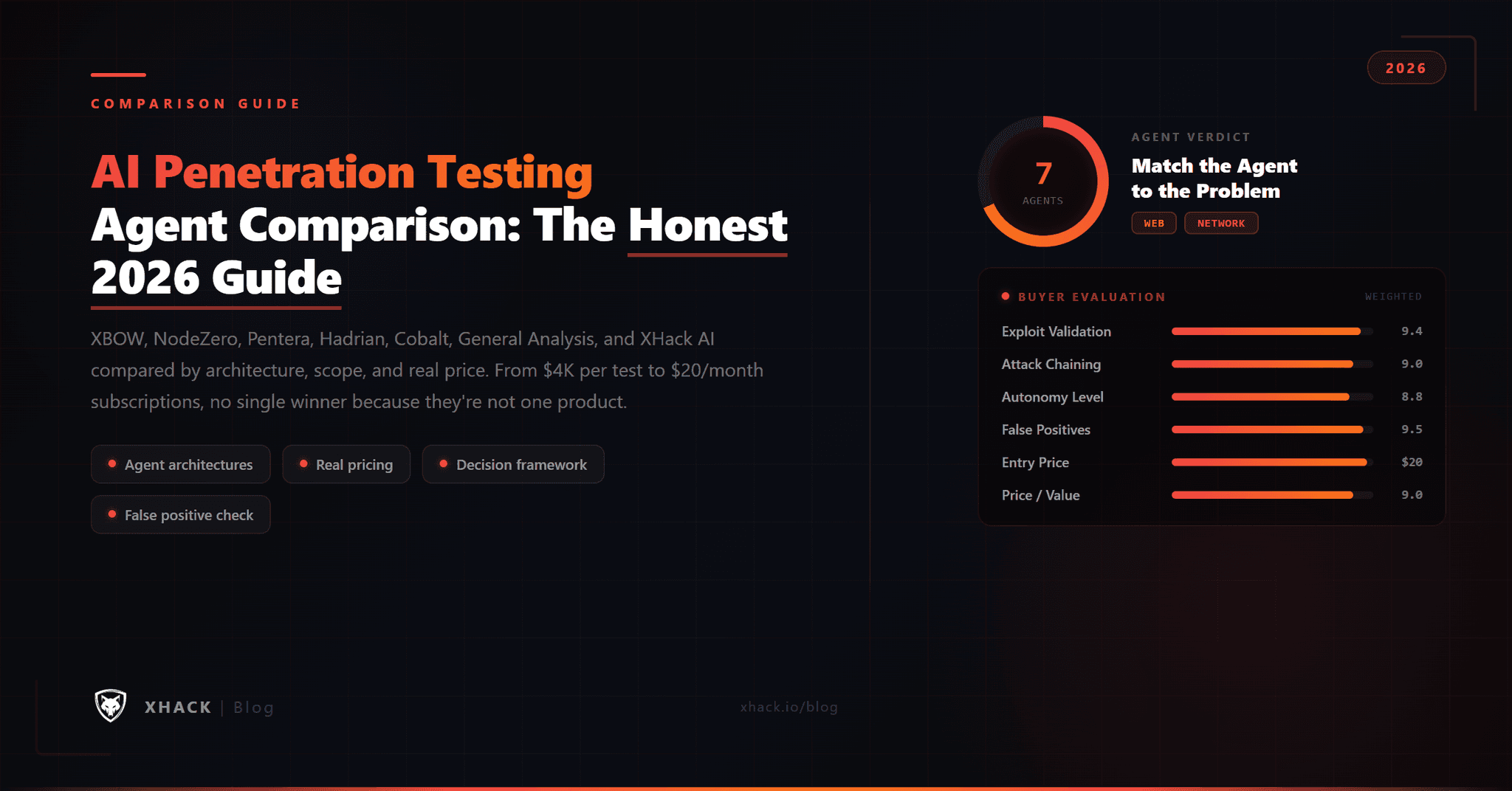
Read this in 30 seconds: AI penetration testing agents are not interchangeable. Every “best AI pentesting agent” list on the internet ranks one winner, and it’s usually the author’s own product. The truth: these agents split by architecture and scope. XBOW leads validated autonomous web application testing with near-zero false positives. NodeZero dominates internal network and Active Directory validation. Pentera is the enterprise standard for continuous adversarial validation. Hadrian owns external attack surface discovery.
Cobalt blends human experts with AI. General Analysis tests the AI layer itself. XHack AI pairs multi-agent autonomous web and API testing with human review and continuous monitoring. This guide compares seven agents honestly, including real pricing, what each one structurally can’t do, and how to run a proof of concept before you spend a dollar.
Every “AI penetration testing agent” list on the internet has the same problem. It’s secretly an ad for whoever wrote it.
The author ranks their own product first, picks criteria that happen to favor it, and buries the fact that half these tools don’t even do the same job.
So let’s do this differently. We make XHack AI, which means we’re one of the agents in this comparison, and we’re going to tell you exactly where it fits and where it doesn’t, alongside six genuine competitors assessed on their real strengths.
Because here’s the thing about AI penetration testing agents in 2026: they are not interchangeable. Comparing NodeZero to XBOW is like comparing a cardiologist to a neurologist because both are doctors. They’re both excellent. They do different jobs.
The autonomous pentesting market matured fast. XBOW hit a billion-dollar valuation. Pentera crossed $100 million in annual recurring revenue. Horizon3.ai’s NodeZero has run more than 235,000 production pentests. This is real, funded, deployed technology. But each agent was built to answer a specific security question, and buying the wrong one means paying for coverage you don’t need while missing the coverage you do.
This guide compares seven AI penetration testing agents honestly, organized by what they actually do under the hood, so you can match the agent to your real problem. And since we make one of them, we’ll tell you where ours fits and where it doesn’t, with the same honesty we apply to everyone else.
Let’s kill the marketing first.
An AI penetration testing agent is a system that uses large language models, planning logic, and tool execution to perform offensive security work with limited human intervention. It discovers the attack surface, identifies weaknesses, chains exploits, and produces validated proof.
That’s the honest definition. Now here’s what it is not.
It is not a scanner with a chatbot. A scanner runs signatures and narrates results. An agent plans, adapts, retries, and redirects based on what it finds. The difference matters, and it shows up in the false positive rate.
It is not a replacement for a human pentester. The entire category converged on this conclusion in 2026. The platforms that win are not the ones that remove humans from security. They’re the ones that combine autonomous AI for breadth and continuous coverage with human experts for depth, judgment, and the compliance sign-off AI can’t legally provide.
It is not one thing. This is the part every vendor wants you to miss. The category has fractured into at least four distinct jobs: automated security validation platforms for internal networks and Active Directory, agentic web and API testing tools for applications, external attack surface platforms for internet-facing assets, and hybrid or crowdsourced platforms that blend humans with AI. A tool that’s exceptional at internal network validation may do zero application-layer testing. A tool that dominates web application testing may not touch your network or cloud.
Two things separate the genuine AI penetration testing agents from dressed-up scanners. First, validation: do they prove findings through real exploitation, or just report theoretical risk? The serious ones validate. Second, chaining: do they connect individual findings into complete attack paths, or hand you a flat list? The serious ones chain. Keep both in mind as you read.
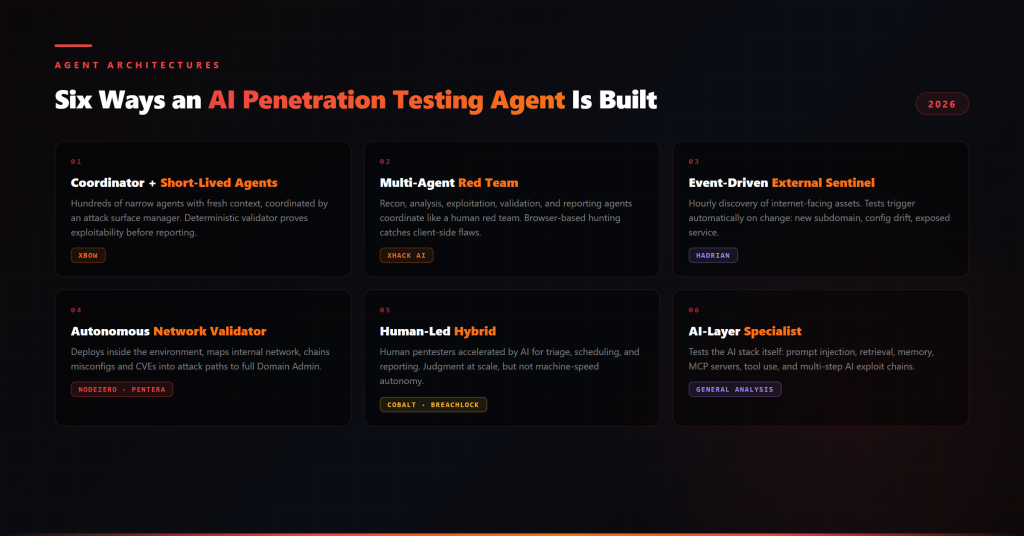
Here’s where most comparison guides go shallow, and where the real buying decision lives. The architecture determines what an agent can find, how fast it finds it, and how many false positives you’ll triage.
This is the XBOW pattern. A coordinator orchestrates hundreds of short-lived agents, each tackling a narrow scoped objective with fresh context, coordinated by a persistent attack surface manager. Critically, it separates AI exploration from deterministic exploit verification.
The result: near-zero false positives, because every finding is confirmed through actual exploitation before it reaches your report. The trade-off: it’s web application focused, and per-test pricing escalates for continuous use.
This is the XHack AI pattern. Specialized agents for reconnaissance, analysis, exploitation, validation, and reporting coordinate like a real red team. A browser-based hunting engine controls a real browser, navigating applications, filling forms, and testing multi-step workflows the way a human attacker would.
The result: it catches DOM-based and client-side flaws that API-level testing misses, and flags genuinely uncertain cases for human review rather than hallucinating confidence. The trade-off: it’s web and API focused, not a network validator.
This is the Hadrian pattern. Continuous discovery of internet-facing assets, hourly scanning cycles, and automatic test triggering when something changes: a new subdomain, a configuration drift, an exposed service. The agent reacts to change rather than testing on a schedule.
The result: continuous external coverage and fast time-to-remediate. The trade-off: external only, no internal network, no business logic depth.
This is the NodeZero and Pentera pattern. Agents that deploy inside your environment, map the internal network, chain misconfigurations, weak credentials, and CVEs into multi-step attack paths, and validate exploitability against real infrastructure. NodeZero runs agentless from a single Docker container. Pentera emulates real ransomware TTPs from groups like Cl0p, LockBit, and BlackCat.
The result: unmatched internal network and Active Directory depth. The trade-off: web application testing is either early access or a secondary concern, and pricing is enterprise-grade.
This is the Cobalt and BreachLock pattern. Human pentesters accelerated by AI for platform management, triage, scheduling, and reporting. You get human judgment at scale, but you’re not buying machine-speed autonomous testing.
The result: reliable, judgment-rich engagements. The trade-off: slower than the autonomous agents, and the depth varies by the assigned human.
This is the General Analysis pattern. Agents that test the AI stack itself: prompt injection, retrieval, memory, MCP servers, tool use, permissions, multi-step AI exploit chains, CI/CD release gates, and regression testing. The threat model is different: not SQL injection into your database, but prompt injection into your AI agent.
The result: coverage no general agent provides. The trade-off: it doesn’t replace traditional pentesting, it secures the AI layer on top of it.
The architecture you choose literally determines what the agent can find. An agent built for network chaining won’t test your React frontend. An agent built for web exploitation won’t map your Active Directory. That’s not a bug. It’s the entire buying decision.
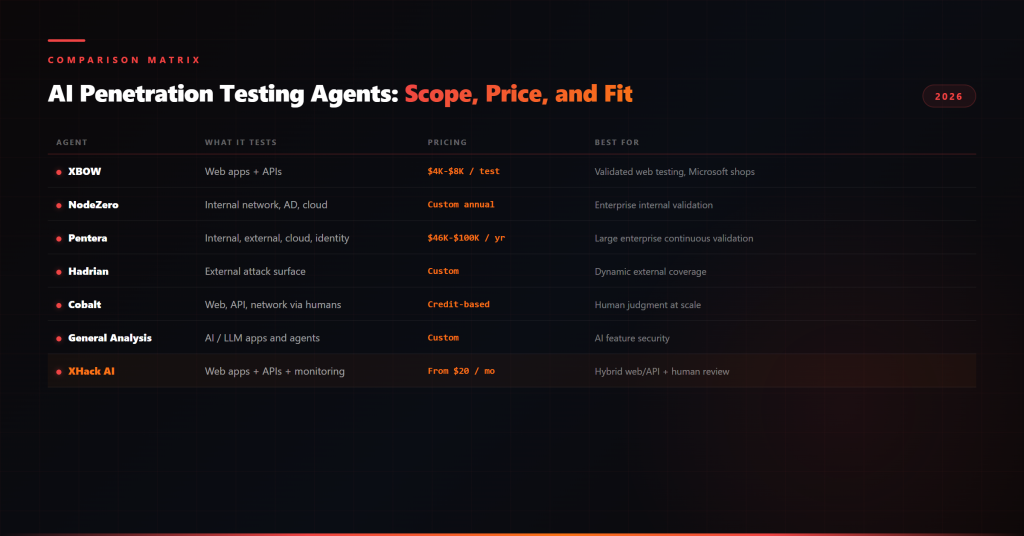
Here’s the quick services table first, so you can scan before you read. Then the honest breakdown of each agent, including the ones that didn’t make the shortlist and why.
| Agent | What It Tests | Pricing | Best For | Honest Drawback |
|---|---|---|---|---|
| XBOW | Web apps and APIs | ~$4K-$8K per test | Validated web testing, Microsoft shops | No network, cloud, or infra testing |
| NodeZero | Internal network, AD, cloud | Custom annual | Enterprise internal validation | Web testing early access, opaque pricing |
| Pentera | Internal, external, cloud, identity | ~$46K-$100K/yr | Large enterprise continuous validation | Enterprise price tag, weak per-TTP control |
| Hadrian | External attack surface | Custom | Dynamic external coverage | External only, no internal |
| Cobalt | Web, API, network via humans | Credit-based | Human judgment at scale | Not autonomous |
| General Analysis | AI/LLM apps and agents | Custom | AI feature security | Narrow, not general pentesting |
| XHack AI | Web apps and APIs + monitoring | From $20/month (individual subscription) | Hybrid web/API + human review | Web/API focus, not large-scale AD |
Quick stats:
XBOW made headlines as the first autonomous AI to top HackerOne’s US bug bounty leaderboard, submitting over 1,000 validated reports in roughly 90 days. Founded by Oege de Moor, the creator of GitHub Copilot. When an AI out-hunts human bug bounty researchers, people pay attention.
The architecture is the story. A coordinator deploys thousands of short-lived parallel agents, each tackling a narrow objective with fresh context, and a deterministic validator confirms exploitability before anything reaches your report. That’s why XBOW’s false positive rate is so low. Every finding is a working exploit with reproduction steps.
In March 2026, XBOW integrated with Microsoft Security Copilot and Sentinel, making it attractive for Microsoft-centric enterprises. It claims 14,000+ zero days found in real customer applications and maps to 40+ compliance frameworks. Pentest On-Demand delivers results in about 5 business days with no scoping calls.
The honest limitations: XBOW is web application focused. It does no network, infrastructure, or cloud testing. If you choose it, you still need a separate tool for everything else. It has no automated remediation workflow. And at $4,000 to $8,000 per test, continuous testing gets expensive fast.
| Pros | Cons |
|---|---|
| Proof-of-exploit on every finding | Web app and API focused only |
| Near-zero false positives | ~$4K-$8K per test, escalates at scale |
| 14,000+ zero days found in customer apps | No automated remediation |
| Microsoft Copilot and Sentinel integration | Business logic depth (BOLA/IDOR) limited |
| 40+ compliance framework mappings | Young company, less production history |
Best for: Teams needing deep, validated, audit-ready web application testing, especially in Microsoft environments.
Quick stats:
NodeZero is the most cited autonomous pentesting platform in 2026 analyst roundups. Its track record is unmatched. FedRAMP High authorized, it’s the default choice for US federal agencies and defense contractors, and it counts 40% of the Fortune 10 plus the NSA and CISA among its users.
It deploys agentless through a single Docker container with no persistent credentials, which makes it production-safe. The Find-Fix-Verify workflow lets you remediate and immediately retest. It was the first AI to solve the GOAD (Game of Active Directory) benchmark in 14 minutes. It uses tripwires, integrated honeytokens that combine deception with pentest findings. And it offers unlimited flat-rate pentests under subscription, so you can run daily or weekly without per-test fees.
The honest limitations: web application testing has matured but still trails its network and Active Directory strength. It does not generate automated remediation, it finds and proves, but doesn’t patch. Pricing is fully opaque with no public rates. And the self-service deployment model requires some technical sophistication.
| Pros | Cons |
|---|---|
| Unmatched internal network and AD depth | Web app testing still early access |
| Unlimited flat-rate pentests | No automated remediation |
| FedRAMP High, government-grade | Opaque pricing, sales engagement required |
| First AI to solve GOAD in 14 minutes | Self-service deploy needs technical chops |
| 235K+ production tests, zero reported downtime | Findings could be more actionable for dev teams |
Best for: Enterprise and government organizations focused on internal network, Active Directory, and cloud infrastructure security.
Quick stats:
Pentera is the most mature commercial player in the category, the first company to cross $100 million in annual recurring revenue in adversarial exposure validation. It serves more than 1,200 enterprise customers across 60 countries.
Its agent emulates real ransomware TTPs from groups like Cl0p, LockBit, and BlackCat. The AI generates context-aware payloads that adapt to the environment it encounters. Over 100 integrations connect it to SIEMs, ticketing systems, and flaw management tools. The October 2025 acquisition of DevOcean added Pentera Resolve, which automates remediation workflows by routing validated findings through Jira and ServiceNow with SLA tracking. It holds ISO/IEC 42001 AI governance certification.
The honest limitations: it’s priced for large enterprises, commonly cited in the range of roughly $46,000 to $100,000 per year, often with on-premise deployment. It can’t target specific MITRE ATT&CK TTPs individually, the assessments are broad. Some reviewers note it doesn’t always provide the underlying command lines or logs proving exactly how an attack succeeded. It’s a heavyweight built for organizations where budget is not the primary constraint.
| Pros | Cons |
|---|---|
| Deepest internal and infra coverage | Enterprise pricing, $46K-$100K/yr |
| Real ransomware TTP emulation | Can’t target specific MITRE ATT&CK TTPs |
| 100+ integrations | Doesn’t always show command-line proof |
| Pentera Resolve automates remediation | On-premise deployment often required |
| ISO/IEC 42001 AI governance certified | Overkill for startups and SMBs |
Best for: Large enterprises (1,000+ employees) with dedicated security teams and budget for continuous adversarial validation.
Quick stats:
Hadrian approaches pentesting from the outside in, combining External Attack Surface Management with offensive testing. It continuously discovers internet-facing assets, including shadow IT and forgotten subdomains, on an hourly basis, and automatically triggers tests when something changes.
This event-driven model is the differentiator. Rather than testing on a schedule, Hadrian reacts to change, catching exposures as they appear. In March 2026 it launched Nova, an on-demand agentic pentesting product. Confirmed findings auto-route into Jira, ServiceNow, and Zendesk with mean-time-to-remediate tracking, and the company claims an 80% reduction in MTTR.
The honest limitation: scope is external only. Hadrian handles the continuous discovery and external testing layer well, but it’s designed to be one part of a broader program, not your complete testing solution. You’ll pair it with internal validation and application testing from other tools.
| Pros | Cons |
|---|---|
| Event-driven testing on change | External only, no internal or infra |
| Hourly asset discovery cycles | No business logic flaw support |
| Claims 80% MTTR reduction | Reports lack dev-friendly fix guidance |
| Nova adds deeper agentic pentesting | Nova is brand new, no track record |
| Auto-routes findings to Jira/ServiceNow | Pricing not public |
Best for: Enterprise security teams managing large, dynamic external attack surfaces who need continuous monitoring plus automated offensive validation.
Quick stats:
Cobalt represents the Penetration Testing as a Service category. You get expert human researchers augmented by AI for platform management, scheduling, communication, reporting, and triage. Retesting is included in its credit model, and real-time reporting plus direct tester communication enable faster remediation cycles.
The honest framing: Cobalt is less “autonomous AI” and more “humans accelerated by AI.” If you specifically want autonomous machine-speed testing, the agentic platforms go further. If you want human expertise delivered through a smooth platform, Cobalt is built for exactly that. SOC 2 reports may require some post-processing for specific auditor requirements.
| Pros | Cons |
|---|---|
| Expert human judgment | Not autonomous in the agent sense |
| Retesting included in credits | Slower than machine-speed agents |
| Real-time reporting, direct tester comms | SOC 2 reports may need post-processing |
| Platform handles scheduling and delivery | Cost varies by credits used |
| Flexible engagement models | Depth varies by assigned human tester |
Best for: Organizations wanting human pentester judgment at scale with flexible, platform-managed engagements.
Quick stats:
General Analysis builds security specifically for agentic AI. Its agents test prompt injection, retrieval, memory, MCP servers, tool use, permissions, multi-step AI exploit chains, CI/CD release gates, and regression testing. They describe it as “security for agentic AI.”
This is the category’s wildcard. As more applications integrate LLM features, this coverage is increasingly visible. The threat model here is different: not SQL injection into your database, but prompt injection into your AI agent. For teams shipping AI features, this is the gap the general agents can’t fill.
The honest limitation: it’s narrow by design. It secures the AI layer, it doesn’t replace traditional pentesting across your web, network, and cloud surfaces. And it’s a younger platform with custom, enterprise-oriented pricing.
| Pros | Cons |
|---|---|
| Dedicated LLM/MCP/prompt injection testing | Narrow focus, not general pentesting |
| Tests multi-step AI exploit chains | Younger platform, less history |
| CI/CD release gate integration | Custom pricing, enterprise-oriented |
| Runtime controls for AI systems | Doesn’t replace traditional pentesting |
Best for: Teams building AI features who need to test the AI layer itself.
Quick stats:
One quick clarification before you compare these numbers to the rest of this guide: XHack AI (the subscription, $20-$150/month for individuals) and XHack VAPT ($2,500 to $12,000 per engagement, scoped, human-led with optional AI-agent assistance) are two different products solving two different problems, and they’re priced completely differently on purpose.
XHack AI is a self-serve agent built for security researchers and companies who want to drive it themselves. You or your in-house security team scope the hunts, interpret the findings, and own the exploit pipeline directly. It’s priced like software because it works like software, a subscription that scales with how much autonomous testing you run.
XHack VAPT is the opposite delivery model, not the opposite technology. It’s not human-only. Our engagements combine expert human testers with the same agentic AI, the AI handles the breadth, speed, and continuous coverage, while our testers handle the business logic, judgment calls, and the gaps AI alone can’t close. You’re not choosing between “AI” and “humans”, you’re choosing whether you want to operate the AI yourself or have our team operate it for you, backed by human expertise, and hand you a validated, audit-ready report at the end. Pricing starts at $2,500 and scales with asset count and complexity.
So the real difference between these two products is who’s driving, not whether AI is involved. If you have a security researcher or team who wants to run the agent themselves, XHack AI at $20/month is built for that. If you want a full engagement where human experts and AI work together to close the gaps and deliver a report you can hand to an auditor, that’s what VAPT is priced and built for.
Since this is our own entry, here’s the honest assessment by the same standard we applied to everyone else.
XHack AI is a multi-agent autonomous penetration testing system built around the hybrid model. The AI handles breadth and continuous coverage. Human experts handle the depth and judgment AI can’t replicate. Specialized agents for reconnaissance, analysis, exploitation, validation, and reporting coordinate like a real red team.
The differentiator is browser-based live hunting. An autonomous browsing engine controls a real browser, navigating applications, filling forms, and testing multi-step workflows the way a human attacker would. That catches DOM-based and client-side flaws that API-level testing misses. Findings are validated and chained into complete attack paths, not flat lists. And the system flags genuinely uncertain cases for human review rather than hallucinating confidence. Findings feed into the XHack Security Platform for continuous monitoring, closing the loop between testing and defense.
The honest caveat: XHack AI depends on the person using it. This is the thing the “fully autonomous” marketing never tells you about any agent, including ours. Same tool, wildly different results. A security engineer running scoped hunts with clear objectives gets deep, validated findings. A novice pointing it at random URLs gets noise. That’s not a bug in the agent, it’s the hybrid model working as intended: the AI is a force multiplier, not a replacement for skill. The people who get the most out of XHack AI are the ones who treat it like a tireless senior analyst who needs direction, not a magic button.
The honest framing: XHack AI focuses on web and API testing with a human-plus-AI hybrid, so for pure large-scale internal Active Directory validation, a network-specialized platform like NodeZero goes deeper on that specific job. Where XHack AI fits best is teams that want validated autonomous web and API testing combined with human expertise and ongoing monitoring, at a price that doesn’t require a six-figure budget.
| Pros | Cons |
|---|---|
| Multi-agent architecture, true autonomy | Web and API focused, not large-scale AD |
| Browser-based live hunting catches client-side flaws | Newer in the market than Pentera/NodeZero |
| Human review on uncertain findings | Results depend heavily on operator skill |
| Continuous monitoring integration | Business logic depth still needs human testers |
| Subscription from $20/mo, accessible | Enterprise platform features need higher tiers |
Best for: Teams wanting multi-agent autonomous web and API testing plus human expertise and continuous monitoring, at accessible pricing.
Two agents got cut from the main comparison, and it’s worth knowing why.
Penligent appears in nearly every 2026 top agentic pentesting list. It offers an end-to-end AI pentesting workflow from asset discovery through validation, exposing 200+ tools on demand and producing evidence-rich PDF or Markdown exports. The honest limitation: like other web-focused agentic tools, its gray-box business logic testing depth is more limited than dedicated human-led testing, and it doesn’t do source code analysis. It’s a strong web and API offense platform, not an everything platform.
Aikido and DeepMantis are newer dev-first entrants. Aikido bundles SAST, SCA, secrets detection, IaC scanning, CSPM, container scanning, DAST, and AI-powered pentesting into one platform with a free tier, which is genuinely appealing for startups. But its AI pentest is a feature within a broader platform, not a dedicated deep pentest engine, and GPT-based agents can produce false positives. DeepMantis runs a fully autonomous pipeline across web, API, cloud, and AI components with 200+ skills, but it’s a newer entrant with less production history.
Here’s the part most comparison guides skip, because it breaks the “one best tool” narrative.
An AI penetration testing agent is constrained by its architecture, its training, and its toolset. No agent in 2026 does everything.
What the web-focused agents (XBOW, XHack AI, Penligent) can do:
What the infrastructure agents (NodeZero, Pentera) can do:
What the external agents (Hadrian) can do:
What none of them fully do yet:
That last set is exactly why the category converged on the hybrid model. The AI penetration testing agents that win in 2026 are not the ones that remove humans from security. They’re the ones that combine autonomous AI for breadth and continuous coverage with human experts for depth, judgment, and the legal sign-off AI can’t provide.
Pricing is where the “agent” marketing falls apart fastest. Let’s be real about numbers.
| Agent | Entry Price | At Scale | Model |
|---|---|---|---|
| XBOW | ~$4,000 per test | ~$8,000+ per test | Per-test, on demand |
| NodeZero | Custom, no public price | Annual subscription, unlimited pentests | Enterprise contract |
| Pentera | ~$46,000/year | ~$100,000+/year | Enterprise annual |
| Hadrian | Custom, no public price | Custom | Enterprise annual |
| Cobalt | Credit-based, varies | Volume credits | Pay per engagement |
| General Analysis | Custom | Custom | Enterprise |
| XHack AI | From $20/month | $150/month (Elite) to custom | Subscription / per-seat platform |
The pattern is clear. The genuinely autonomous agents are priced either per-test (XBOW at $4K-$8K) or as enterprise contracts (NodeZero, Pentera at $46K-$100K+). The hybrid and human-led options price by engagement or credit.
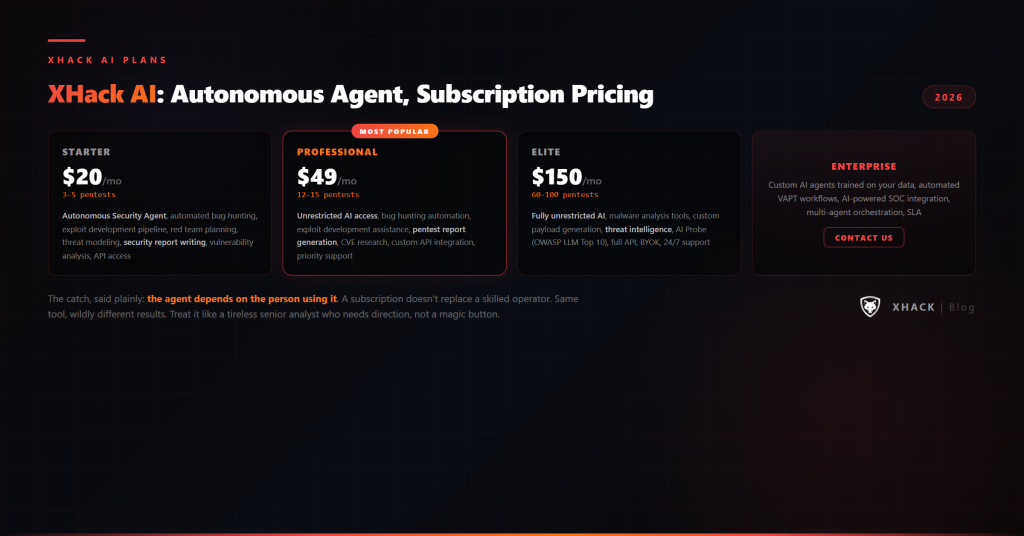
XHack AI is the deliberate outlier for security researchers. Its subscription model starts at $20/month for 3-5 automatic pentests, scales to $49/month for 12-15, and $150/month for 60-100 on the Elite tier, with Enterprise plans for custom agents, SOC integration, and multi-agent orchestration. For teams and solo security engineers, that changes the math completely: instead of one expensive engagement a year, you get continuous autonomous testing on a subscription that a startup can actually afford.
For companies, the Enterprise Security Platform runs $560/month (6 users, 2 VA scans, 10k SOC logs) up to $3,000/month (30+ users, 12 VA scans, 100k SOC logs, GitGuard, AI Probe, full threat intel). That’s the difference between “buy an agent” and “stand up an ongoing security operation around one.”
One quick clarification before you compare these numbers to the rest of this guide: XHack AI (the subscription, $20-$150/month for individuals) and XHack VAPT ($2,500 to $12,000 per engagement, scoped, human-led with optional AI-agent assistance) are two different products solving two different problems, and they’re priced completely differently on purpose.
XHack AI is a self-serve agent built for security researchers and companies who want to drive it themselves. You or your in-house security team scope the hunts, interpret the findings, and own the exploit pipeline directly. It’s priced like software because it works like software, a subscription that scales with how much autonomous testing you run.
XHack VAPT is the opposite delivery model, not the opposite technology. It’s not human-only. Our engagements combine expert human testers with the same agentic AI, the AI handles the breadth, speed, and continuous coverage, while our testers handle the business logic, judgment calls, and the gaps AI alone can’t close. You’re not choosing between “AI” and “humans”, you’re choosing whether you want to operate the AI yourself or have our team operate it for you, backed by human expertise, and hand you a validated, audit-ready report at the end. Pricing starts at $2,500 and scales with asset count and complexity.
So the real difference between these two products is who’s driving, not whether AI is involved. If you have a security researcher or team who wants to run the agent themselves, XHack AI at $20/month is built for that. If you want a full engagement where human experts and AI work together to close the gaps and deliver a report you can hand to an auditor, that’s what VAPT is priced and built for.
Here’s the framework I use when evaluating these agents, and what you should check in a proof of concept against your own environment.
1. Validation. Ask: do you prove every finding with a working exploit? The real agents do. The dressed-up scanners say “we generate a report your auditors will love.” Run a test against a target with known vulnerabilities and check what comes back.
2. Chaining. Ask: can you show me a multi-step attack path, not a list of CVEs? The serious agents chain. A CORS misconfiguration alone is low severity. Chained with an IDOR and a missing auth check, it’s account takeover. The agent that shows you the chain is the agent that understands the attack.
3. Autonomy. Ask: what happens when something unexpected happens mid-test? If the answer is “it stops and waits for a human,” that’s not an agent, that’s a script. The real agents adapt, retry, and redirect based on what they find.
4. Scope. Ask: what exactly does it test? Network? Web? API? Cloud? AI layer? Every agent has a home turf. Match the agent to the security question you most urgently need answered, not to whichever has the flashiest leaderboard.
5. False positives. Ask about the false positive rate, then verify it. This is the hidden cost. A tool that reports 100 “critical” findings, 90 of which are noise, costs your team weeks. The autonomous agents with deterministic validators (XBOW, and the hybrid reviewers in XHack AI) drive this down dramatically.
6. Remediation loop. Ask: what happens after the findings? Does it route to Jira? Does it retest? Does it feed a monitoring platform, or is the report a PDF you’ll file away forever?
Run a proof of concept against your own environment before committing. Vendor benchmarks are self-reported and run in controlled conditions. Your production environment is messier, and the real false positive rate only shows up when you test against actual systems.
Mistake 1: Buying the “best” agent instead of the right one. NodeZero is the best AD validator. XBOW is the best web validator. Buying the wrong one means paying for coverage you don’t need while missing the coverage you do.
Mistake 2: Believing the autonomy marketing. “Fully autonomous” doesn’t mean “set and forget.” Every serious platform still needs scoping, rules of engagement, and human review of critical findings. Anyone who tells you otherwise is selling you risk.
Mistake 3: Judging on findings count alone. A thousand theoretical findings is worse than ten validated exploits. Validation is the entire point. If the agent can’t prove it, it didn’t find it.
Mistake 4: Ignoring false positives. The hidden cost of an agent is the team time spent triaging noise. The deterministic-validator agents cost more per test for a reason, and the reason is your team’s time.
Mistake 5: Testing once and assuming you’re covered. The annual snapshot is dead. Agents exist precisely because continuous testing is now affordable. If you run an AI agent once a year, you’re using a race car for the parking lot.
Mistake 6: Skipping the human layer. The category converged on hybrid for a reason. Complex business logic, novel attack paths, and compliance sign-off still need humans. An agent-only program is a coverage gap in disguise.
The autonomous pentesting market matured fast. XBOW hit a billion-dollar valuation. Pentera crossed $100 million in ARR. NodeZero has run more than 235,000 production pentests. This is real, funded, deployed technology.
But the consensus across the entire category in 2026 is clear: the AI penetration testing agents that win are not the ones that remove humans from security. They’re the ones that combine autonomous AI for breadth and continuous coverage with human experts for depth, judgment, and the compliance sign-off AI can’t legally provide.
The winning pattern looks like this. AI agents test continuously, at machine speed, across your attack surface, chaining and validating findings. Human experts review the uncertain cases, hunt the business logic flaws, and own the report. The findings feed a monitoring platform so even unpatched issues are watched. That’s the model. Everything else is marketing.
So yeah, here’s where we talk about what XHack brings to the table. Since this guide is about comparing AI penetration testing agents honestly, here’s an honest look at ours.
XHack AI is a multi-agent autonomous penetration testing agent built around the hybrid model. The AI does what AI does best: breadth, speed, and continuous coverage. The humans do what humans do best: depth, judgment, and the compliance sign-off AI can’t provide.
The agent architecture uses specialized agents for reconnaissance, analysis, exploitation, validation, and reporting that coordinate like a real red team. The autonomous browsing engine controls a real browser, navigating applications, filling forms, and testing multi-step workflows the way a human attacker would. That catches DOM-based and client-side flaws that API-level testing misses.
Every finding is validated and chained into a complete attack path, not a flat list. The system flags genuinely uncertain cases for human review rather than hallucinating confidence. And findings feed into the XHack Security Platform for continuous monitoring, closing the loop between testing and defense. This is the same model our VAPT services use, where expert human testers handle the business logic and creative attack paths while the AI handles volume and continuous coverage.
The honest framing: if you need pure large-scale internal Active Directory validation, a network-specialized platform like NodeZero goes deeper on that specific job. Where XHack AI fits is teams that want validated autonomous web and API testing combined with human expertise and ongoing monitoring, at a price that doesn’t require a six-figure budget.
And here’s the pricing reality, because the other vendors hide it behind sales calls. XHack AI runs as a subscription. Starter is $20/month for 3-5 automatic pentests. Professional is $49/month for 12-15, and it’s the most popular plan. Elite is $150/month for 60-100 pentests with fully unrestricted AI, malware analysis tools, custom payload generation, threat intelligence access, and AI Probe for OWASP LLM Top 10 testing. Enterprise is custom: custom AI agents trained on your security data, automated VAPT workflows, AI-powered SOC integration, autonomous incident response, multi-agent orchestration, and SIEM/SOAR integrations.
For companies that want the whole platform, the Enterprise Security Platform starts at $560/month for 6 users with 2 VA scans and 10k SOC logs, and scales to $3,000/month for 30+ users, 12 VA scans, 100k SOC logs, GitGuard, and AI Probe. Every plan includes secure API access and multi-model support, and both individual and company plans include a 7-day free trial with no credit card required.
The catch, and we’ll say it plainly: the agent depends on the person using it. A subscription doesn’t replace a skilled operator. If you want to point an agent at your environment and get maximum value, you need someone who knows how to scope a hunt, interpret findings, and drive the exploit pipeline. That’s why we pair the AI with human experts on our managed engagements, and why our platform plans include the SOC and monitoring layer. The AI is the force multiplier. You’re still the operator.
Want a quote for your environment? Our team can scope an engagement based on your specific assets and compliance needs. Prefer to talk it through first? Book a free consultation and we’ll help you figure out what level of AI penetration testing actually makes sense for your situation, even if that turns out not to be us. Brutal honesty is kind of our thing.
An AI penetration testing agent is a system that uses large language models, planning logic, and tool execution to perform offensive security work with limited human intervention. It discovers the attack surface, identifies weaknesses, chains exploits, and produces validated proof. This is different from a scanner with an LLM wrapper that just narrates findings. The genuine agents in 2026 validate every finding through real exploitation.
No, and the entire category converged on this conclusion in 2026. AI agents excel at breadth, speed, and continuous coverage, finding known flaw patterns, chaining exploits, and running continuously. But complex business logic flaws, novel attack research, social engineering, and compliance sign-off still require human judgment. The AI penetration testing agents that win are explicitly the ones that combine autonomous AI with human expertise, not the ones claiming to remove it.
There’s no single best, because the agents specialize. XBOW is the strongest for validated autonomous web application testing. NodeZero is the strongest for internal network and Active Directory validation. Pentera is the enterprise standard for continuous adversarial validation. Hadrian owns external attack surface discovery. XHack AI offers a hybrid of autonomous web and API testing with human review and continuous monitoring. Match the agent to your most urgent security question.
XBOW runs roughly $4,000 to $8,000 per test on demand. NodeZero uses custom annual contracts with unlimited scheduled pentests. Pentera typically runs $46,000 to $100,000 per year. XHack AI is the outlier: a subscription from $20/month for 3-5 automatic pentests, $49/month for 12-15, and $150/month for 60-100 on the Elite tier, with Enterprise plans for custom agents and SOC integration. If a quote comes in dramatically cheaper than the real agents and claims “fully autonomous,” you’re almost certainly buying a scanner with a chatbot.
The serious ones are built specifically to minimize false positives. XBOW uses a deterministic validator to confirm exploitability before reporting. XHack AI uses multi-agent validation plus human review of uncertain findings. Cheaper tools with LLM narration can produce significant noise. In a proof of concept, check the false positive rate against a target with known vulnerabilities, because that’s the hidden cost of any agent.
Yes, more than any marketing page will admit. An AI penetration testing agent is a force multiplier, not a replacement for skill. The same agent produces completely different results depending on who drives it: a security engineer who scopes hunts, sets objectives, and interprets findings gets deep, validated results, while someone pointing it at random URLs gets noise. XHack AI is honest about this, it’s a tool that depends on the operator. The teams that get real value treat the agent like a tireless senior analyst that needs direction, not a magic button.
It depends on the agent. Web-focused agents like XBOW and XHack AI test web applications and APIs in depth, with XHack AI’s browser engine also handling client-side flaws. Cloud and mobile coverage is more common in infrastructure-focused agents like NodeZero and Pentera, which test AWS, Azure, Kubernetes, and identity systems. No single agent in 2026 covers everything, so match the agent’s scope to your actual attack surface.
An AI penetration testing agent is a specific type of AI pentesting tool: one that plans, adapts, and executes multi-step attacks with limited human intervention. An AI pentesting tool is the broader category, which includes agents, AI-augmented scanners, AI-assisted human pentesting platforms, and LLM wrappers around traditional tools. Every agent is a tool, but not every tool is an agent. When a vendor calls a scanner an “agent,” that’s your first red flag.
That’s the honest state of AI penetration testing agents in 2026.
The category is real. XBOW out-hunted human bug bounty researchers. NodeZero runs 235,000+ production pentests. Pentera crossed $100 million in ARR. These agents work, and they work impressively.
But the market has fractured by architecture and scope, and the marketing refuses to admit it. Some agents are web specialists. Some are network specialists. Some are external validation engines. Some are hybrids. None of them do everything, and the ones that claim otherwise are selling you a scanner with a chatbot.
The winning approach is the hybrid: autonomous AI for breadth and continuous coverage, human experts for depth and judgment, and continuous monitoring so findings actually get acted on. Run a proof of concept against your own environment before committing, check the false positive rate, and match the agent to the security question you most urgently need answered.
If you want validated autonomous web and API testing combined with human expertise and continuous monitoring, XHack AI was built for exactly that. Get a quote scoped to your environment, or book a free consultation to figure out what level of AI penetration testing actually makes sense for you.
The attackers are already automated. The question is whether your defenses will be too.
Categories
Related articles