Table of contents
18
By Salman Khan, OSCP+, Founder of XHack, SRT (Synack Red Team member)
Read this in 30 seconds: Jailbroken AI is a model pushed past its safeguards, and it is a real research topic, but it is a poor tool for paid security work. It breaks the provider’s terms, vendors close the gaps within months, and it does nothing to make answers more accurate. Since October 2026 there is a legitimate way to get fewer refusals for authorised work, and I read the primary pages for it this week.
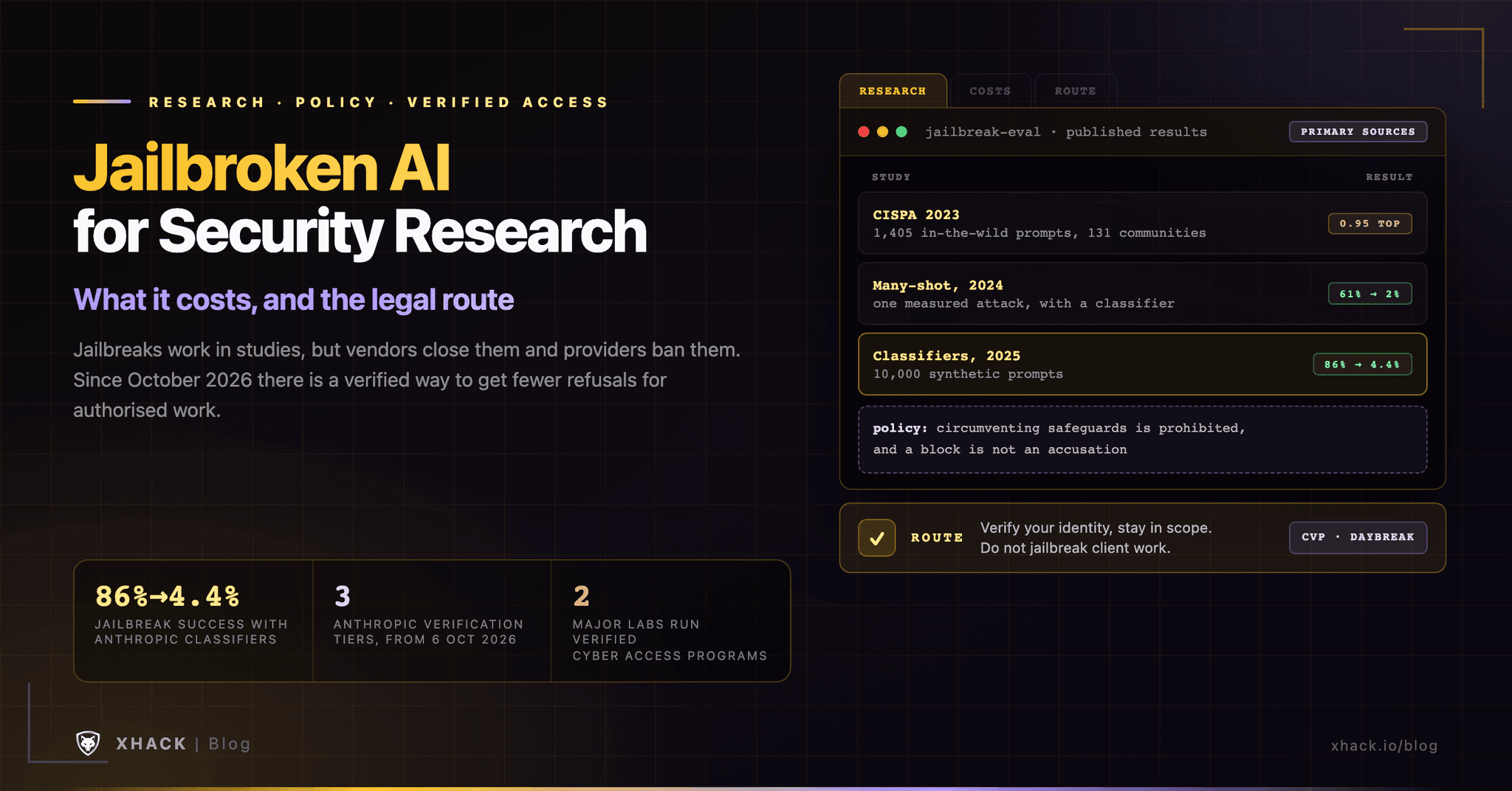
- Jailbroken AI works in studies but not for long. A 2023 CISPA study of 1,405 in-the-wild prompts found five that reached a 0.95 success rate on GPT-3.5 and GPT-4, but Anthropic’s classifier approach cut jailbreak success on its test set from 86% to 4.4%.
- The rules are explicit. Anthropic’s Usage Policy bars finding or exploiting vulnerabilities without the system owner’s authorisation, and OpenAI’s policy bars circumventing its safeguards and says rule-breaking can cost you access.
- A blocked request is not an accusation. Anthropic’s policy says a block does not by itself indicate a violation, which is why a verified route exists.
- The verified route is real but conditional. Anthropic’s Cyber Verification Program has three tiers, individuals can apply only for Defense Access, and data retention is required for everyone enrolled.
- A chatbot still does not run the test. Fewer refusals give you a better assistant, not a validated finding.
Jailbroken AI answers the question of what a model will say, and your client is paying for the question of what is actually broken.
If you search for jailbroken AI, you will find prompt lists, screenshots and arguments about what is allowed. This article is the legal, practical version for people who do security work for a living or are learning to. It covers what a jailbroken AI is, what the research shows about how well it works, the five costs of relying on one, and the verified routes that now exist.
It contains no jailbreak prompts, no refusal workarounds and no attack steps. I run XHack, so I also show where we fit, and I name the limits of every option, including ours.
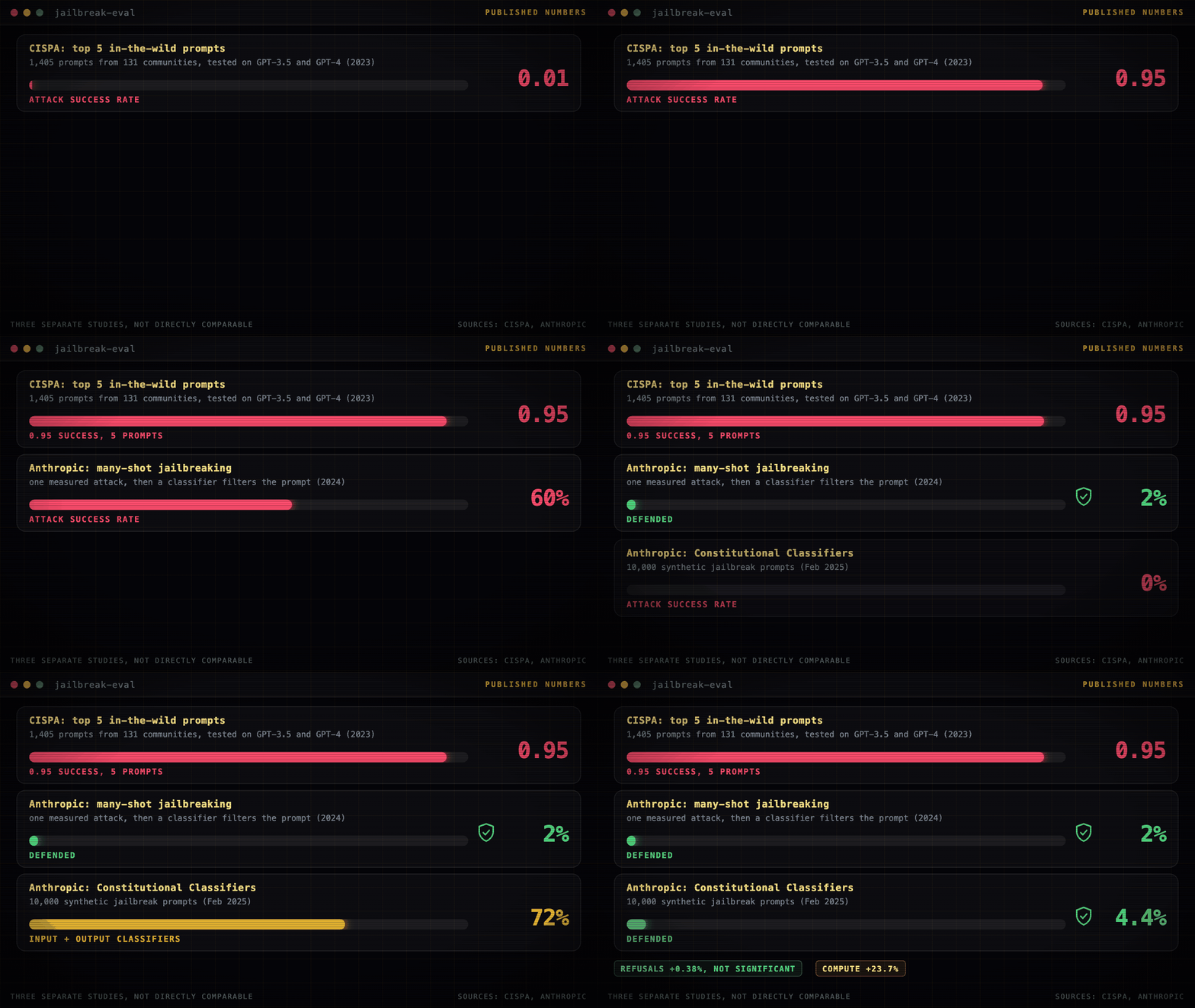
A jailbroken AI is a model that has been manipulated into ignoring the safety rules its maker trained into it. The word comes from phone jailbreaking, but the method is different: nobody modifies the software. A person writes input that persuades the model to do something it would normally decline.
The term covers two very different activities, and mixing them up is where most confusion starts.
I am not going to explain how any specific jailbreak works. That helps the wrong people, and the research I cite below does not need it.
The honest reason is that refusals get in the way of legitimate work. A tester asks about a malware sample, a vulnerable service in a lab or a proof of concept for a bug in a client’s own scope, and the assistant declines because the request looks like an attack. Our guide on why AI refuses hacking requests explains why the models cannot tell the two apart from the text alone.
That frustration is fair. Anthropic’s Usage Policy, effective 12 November 2026, says that running into a cyber block does not by itself indicate a violation. It also says security research on systems you own, with the owner’s authorisation, or inside an authorised bug bounty or disclosure policy is not what the rule is aimed at.
So the problem is real. The fix most people try first, a jailbroken AI assistant, is the one that costs the most.
The published research says jailbreaks can work, and that vendors keep closing them. Four sources are worth knowing on jailbroken AI, and each one is a primary page.
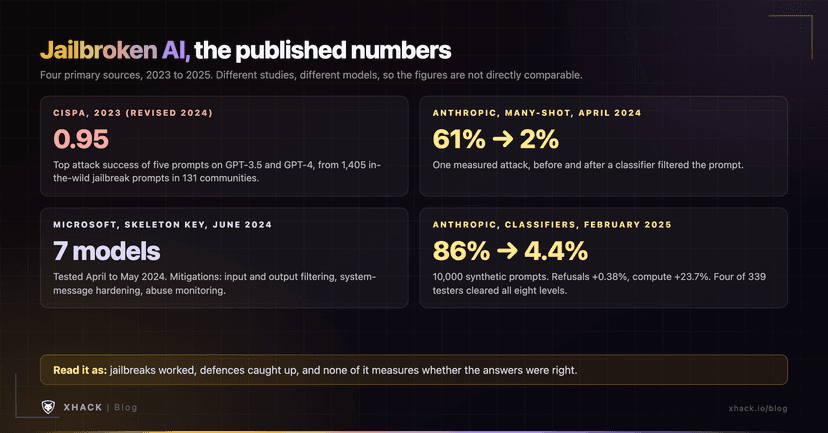
Read those together and the pattern for jailbroken AI is clear. Jailbreaks were effective against 2023 models, and by 2025 the defences were measurably better. The public test of the classifier setup is the honest counterweight: 339 participants sent more than 300,000 messages in a week, and four people cleared all eight levels, with one universal jailbreak and one borderline case. Anthropic says its classifiers may not stop every universal jailbreak.
Translation: the defences are strong but not perfect, and a method that works today is a method someone is already working to close. You cannot plan an engagement around it.
Jailbroken AI looks free but charges you in five places. Here they are, in the order I would worry about them.
None of this is legal advice. Whether circumventing a provider’s safeguards is unlawful depends on the country and the contract, and I am not a lawyer. The provider’s consequence, a terms violation and the loss of access, is clear from their own policies.
The law cares about your target first and your tool second, and jailbroken AI is no exception. In most countries, accessing a computer system without authorisation is a crime, for example under the US Computer Fraud and Abuse Act and the UK Computer Misuse Act. A jailbroken AI model does not change that, and it does not make unauthorised testing any safer.
For authorised work, four habits matter more than any tool choice:
You no longer have to choose between constant refusals and jailbroken AI, because the major labs now run verification programs. Both ask you to prove who you are in exchange for fewer automated blocks on authorised work.
Anthropic announced an expanded Cyber Verification Program on 6 October 2026. It merges the earlier program and Project Glasswing and has three tiers.
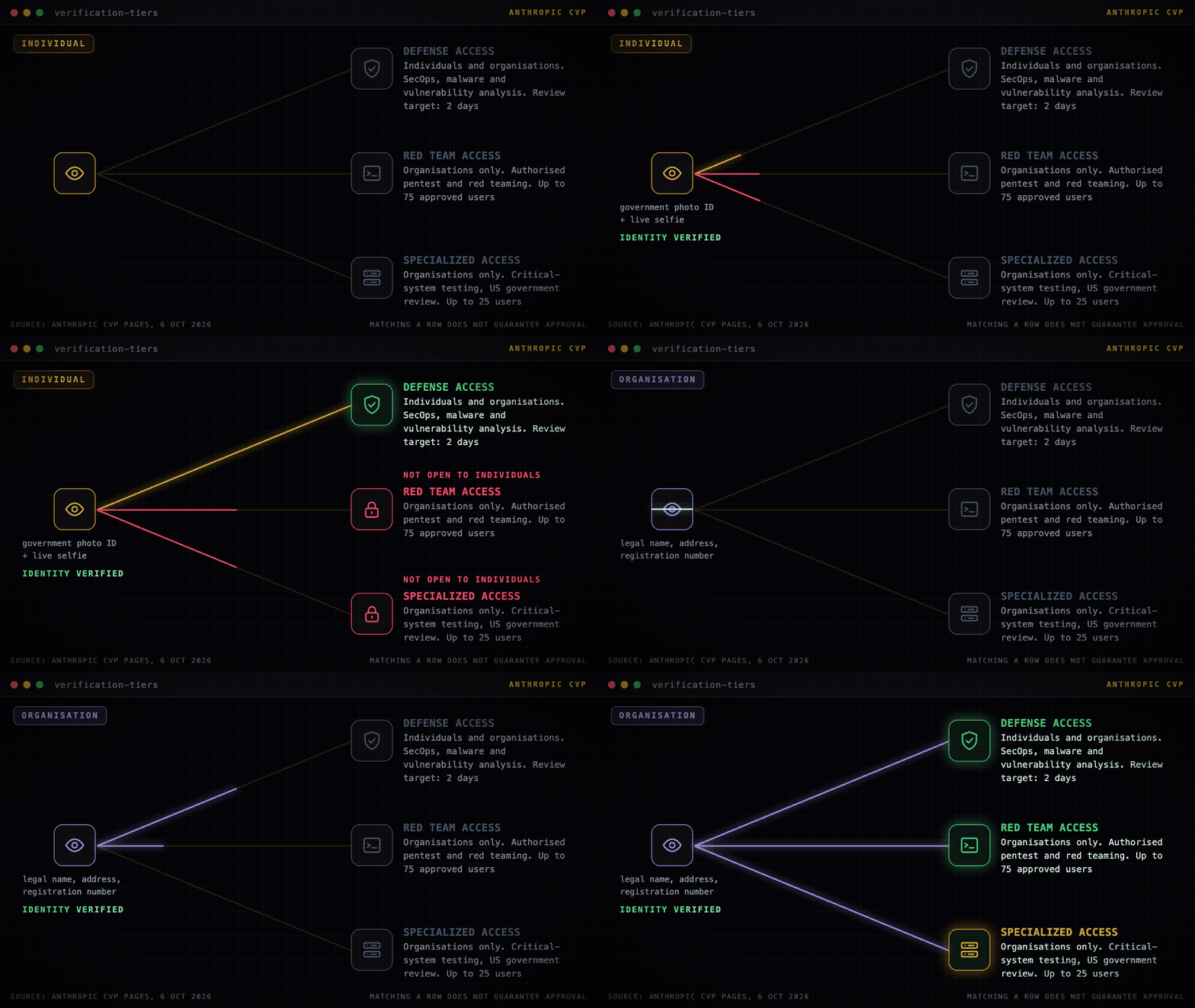
Everyone must verify identity: individuals provide a government photo ID and a live selfie, and organisations provide legal name, address and registration number. The conditions are real. Anthropic says data retention is required for everyone enrolled, the program is internal use only unless you get separate approval to serve customers, and some real-time blocks remain, such as deploying ransomware. From 15 December 2026, Defense Access also requires phishing-resistant MFA and no long-lived API keys. I found no statement of a program fee, but the program is not available on the Free plan.
OpenAI’s route is Daybreak, its Trusted Access for Cyber program. Blue gives reduced refusals for verified defensive work, and individuals need a paid plan, Advanced Account Security, a FIDO2 hardware key and identity verification, with approval not automatic. Red covers authorised pentesting and red teaming and is currently limited to approved business and enterprise organisations.
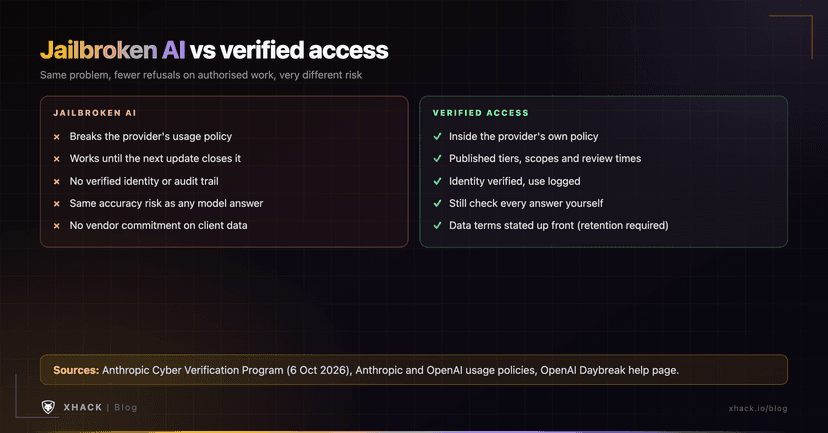
For the official terms, see Anthropic’s Cyber Verification Program announcement and OpenAI’s Daybreak overview.
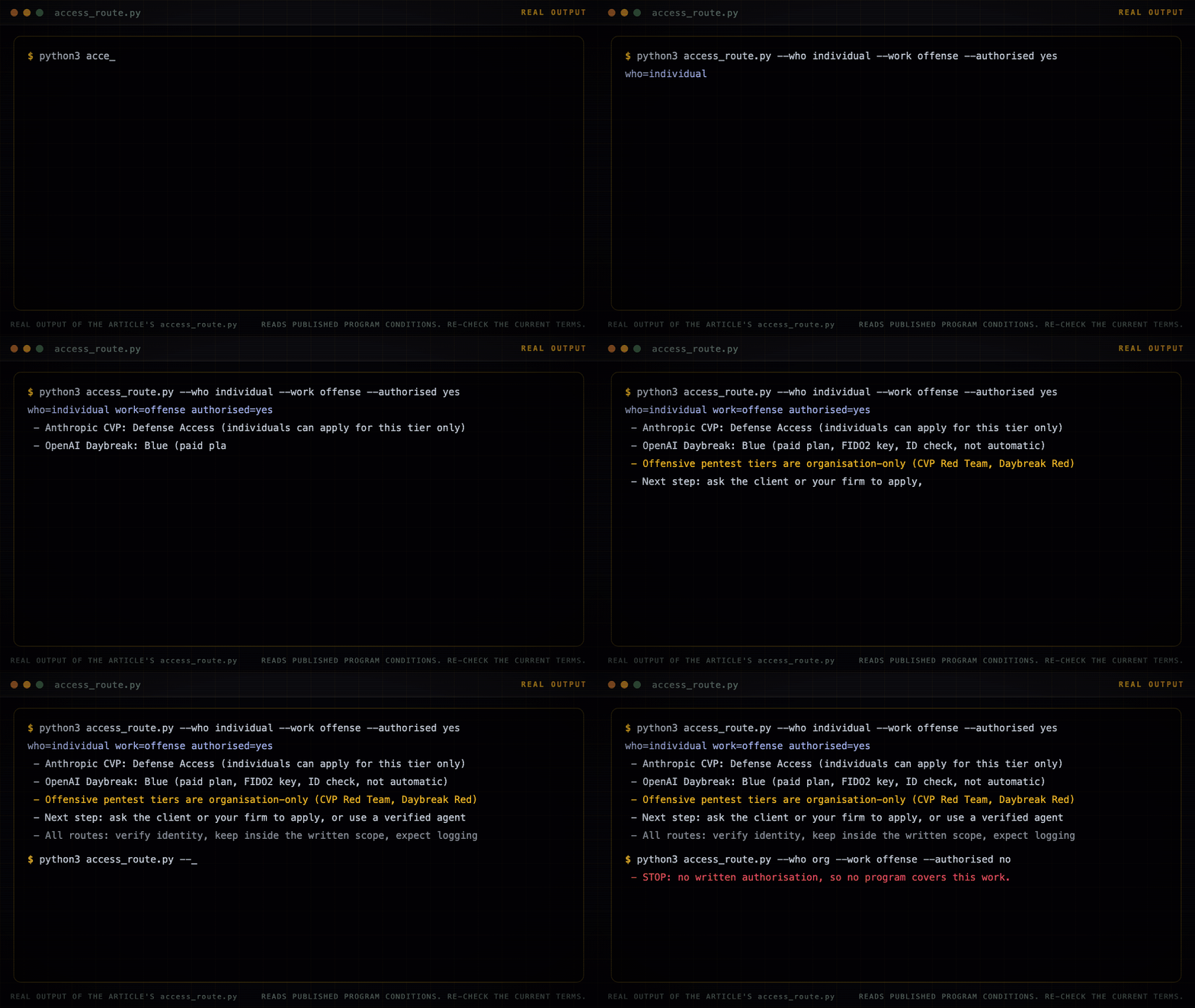
Your route, instead of jailbroken AI, depends on three things: whether you are an individual or an organisation, whether the work is defensive or offensive, and whether you have written authorisation. This short script encodes the rules above so you can see where you land. It is only a reader of the published conditions, not a decision-maker, so re-check the programs’ current terms before you apply.
import argparse

# Facts below come from Anthropic's Cyber Verification Program page (6 Oct 2026) and
# OpenAI's Daybreak help page (updated 12 Nov 2026). Terms change, so re-check them.


def routes(who, work, authorised):
    if not authorised:
        return ["STOP: no written authorisation, so no program covers this work."]
    out = []
    if who == "individual":
        out.append("Anthropic CVP: Defense Access (individuals can apply for this tier only)")
        out.append("OpenAI Daybreak: Blue (paid plan, FIDO2 key, ID check, not automatic)")
        if work == "offense":
            out.append("Offensive pentest tiers are organisation-only (CVP Red Team, Daybreak Red)")
            out.append("Next step: ask the client or your firm to apply, or use a verified agent")
    else:
        out.append("Anthropic CVP: Defense Access (organisations and individuals)")
        out.append("OpenAI Daybreak: Blue for defensive work")
        if work == "offense":
            out.append("Anthropic CVP: Red Team Access (organisations, up to 75 approved users)")
            out.append("OpenAI Daybreak: Red (approved business and enterprise orgs)")
    out.append("All routes: verify identity, keep inside the written scope, expect logging")
    return out


if __name__ == "__main__":
    p = argparse.ArgumentParser()
    p.add_argument("--who", choices=["individual", "org"], required=True)
    p.add_argument("--work", choices=["defense", "offense"], required=True)
    p.add_argument("--authorised", choices=["yes", "no"], required=True)
    a = p.parse_args()
    print(f"who={a.who} work={a.work} authorised={a.authorised}")
    for line in routes(a.who, a.work, a.authorised == "yes"):
        print(" -", line)
Run it with your own situation:
python3 access_route.py --who individual --work offense --authorised yesI ran it before publishing. For an individual doing authorised offensive work it printed this:
who=individual work=offense authorised=yes
 - Anthropic CVP: Defense Access (individuals can apply for this tier only)
 - OpenAI Daybreak: Blue (paid plan, FIDO2 key, ID check, not automatic)
 - Offensive pentest tiers are organisation-only (CVP Red Team, Daybreak Red)
 - Next step: ask the client or your firm to apply, or use a verified agent
 - All routes: verify identity, keep inside the written scope, expect logging
And for an organisation with no written authorisation, it stopped at the first line: STOP: no written authorisation, so no program covers this work.
Running a model on your own machine avoids the provider’s rules, but it does not remove the other costs. There is no account to lose, and you control where the data goes. That is a legitimate reason to use a local model, and our guide on unrestricted AI models covers the options.
The tradeoffs against jailbroken AI are quality and accountability. Local models are usually smaller than hosted ones, nobody verifies who is using them, and you are responsible for whatever they produce. Our uncensored LLM for security guide lists five questions to ask before you trust any model with client work, and is uncensored AI safe covers the data risk.
If you build an AI feature, jailbreak testing is a defensive job, and that is the best use of the knowledge. Any chatbot, copilot or agent you ship can be manipulated through its inputs, which is why the OWASP Top 10 for LLM applications lists prompt injection first. Testing your own system for it, with permission, is standard practice.
Microsoft says its PyRIT open-source toolkit includes a module for the Skeleton Key technique, so teams can check their own deployments. Our guide to AI red teaming covers how that fits into a wider program. The point is the direction of travel: the same research that explains jailbroken AI is what lets you harden your own product.
I am biased, it is my company, and I think XHack is the strongest answer to this problem because verification is built in and the work is actually run. XHack combines three things most providers sell separately: an autonomous AI agent, a continuous security platform and human testers.
Here is what I can state from our public pages.
If you want fewer refusals on authorised work, start from verification instead of a jailbroken AI workaround. See our unrestricted AI agent guide, the pricing page and our AI VAPT services. Brutal honesty is kind of our thing, so try it on a lab you own first.
Jailbroken AI is a model that has been manipulated into ignoring the safety rules its developer trained into it. Researchers also use the same word for the testing that finds those weaknesses, so vendors can fix them. The phone and console sense of jailbreaking is a different thing.
Using a jailbroken model against a target you are not authorised to test is illegal in most countries, under laws like the US Computer Fraud and Abuse Act. Circumventing a provider’s safeguards is also against OpenAI’s and Anthropic’s policies, which can end your access. This is not legal advice, so check your local law and your contract.
Published research says a jailbroken AI is possible in some cases: the CISPA study found five prompts with a 0.95 success rate on GPT-3.5 and GPT-4 in 2023. Vendors have since added defences, and OpenAI’s policy prohibits circumventing its safeguards. If you need fewer refusals for authorised work, OpenAI’s Daybreak is the legitimate route.
No evidence in the studies I read says so. They measure whether a model complies with a request, not whether its answer is correct, so every answer still needs checking against the real system. A verified agent that actually runs and validates tests adds more than fewer refusals do.
Apply to a verification program. Anthropic’s Cyber Verification Program has Defense Access for individuals and organisations, and OpenAI’s Daybreak Blue is open to individuals who meet its requirements. Both need identity verification, and neither authorises work outside your written scope.
Client secrets, credentials, private keys, personal data and anything under an NDA that you have not cleared. Anthropic says data retention is required for its verification program, and OpenAI says Daybreak does not give zero data retention by default, so redact first.
Jailbroken AI is a good subject for research and a bad foundation for client work. A jailbroken AI breaks the provider’s terms, the numbers show defences closing the gaps, and it improves compliance but not accuracy. Verified routes now exist, from Anthropic’s Cyber Verification Program to OpenAI’s Daybreak, and a verified agent goes further by running the tests. Get written permission, verify your identity, redact what you paste, and treat every answer as a lead to confirm.
Categories
Related articles