Table of contents
22
By Salman Khan, OSCP+, Founder of XHack, SRT (Synack Red Team member)
Read this in 30 seconds: Whether uncensored AI is safe depends on three things: what the tool actually is, where it runs, and what you use it for. A model you run yourself from a trusted source is a very different risk from a hosted chat app with no company behind it, and a tool built for criminals is not safe for anyone.
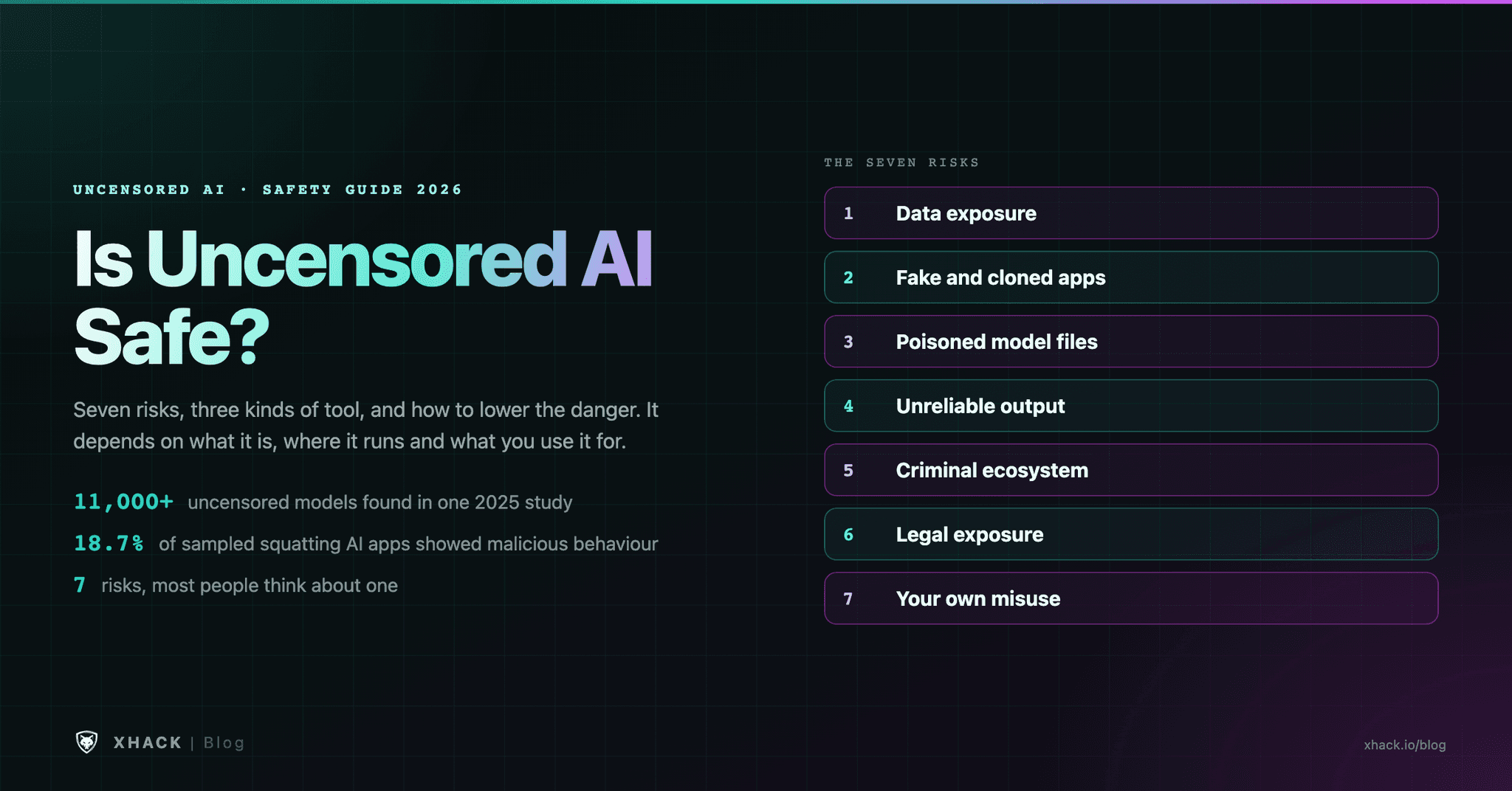
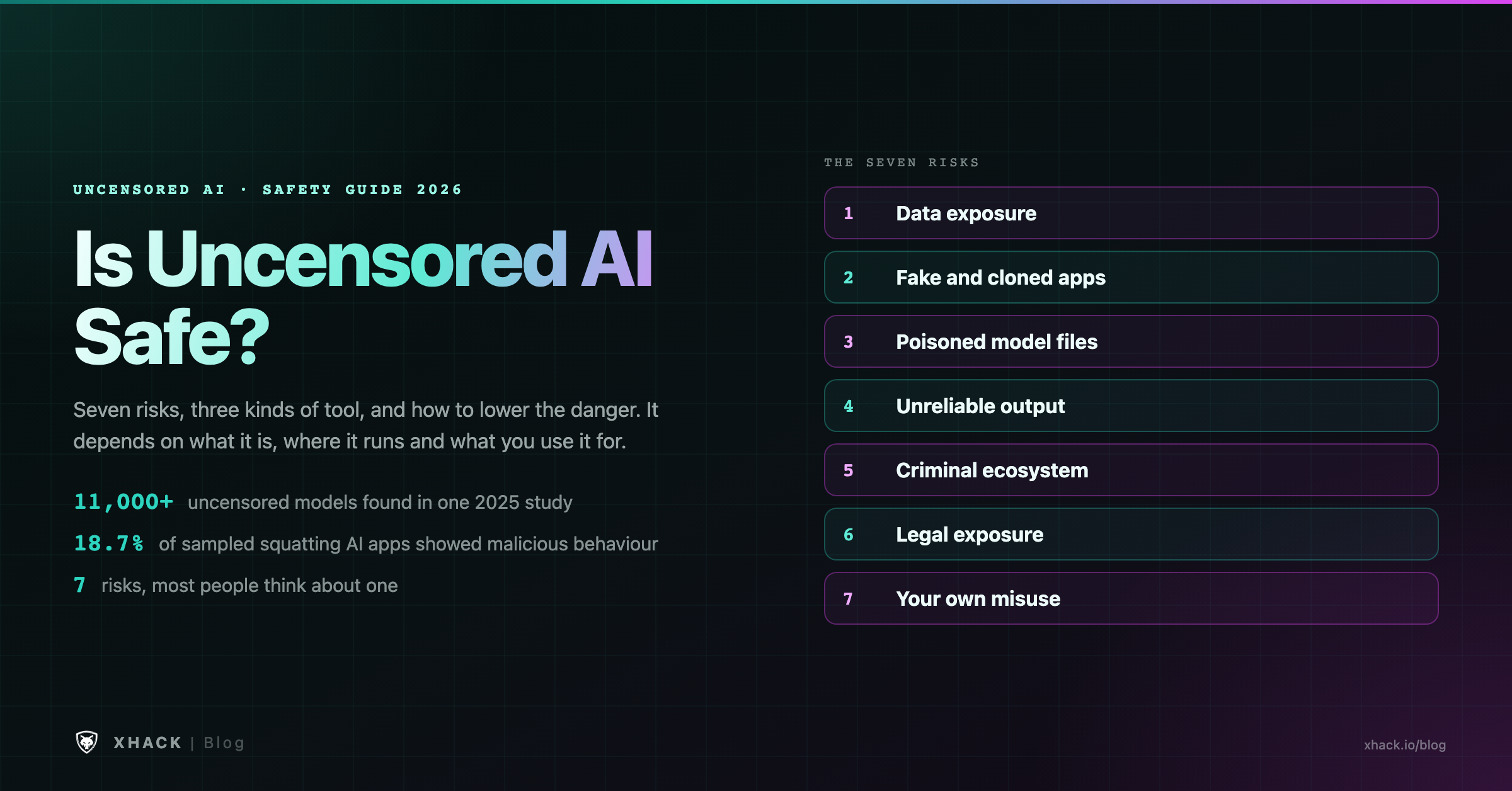
- There are seven distinct risks, and most people only think about one. Data exposure, fake apps, poisoned model files, unreliable output, a criminal ecosystem, legal exposure and your own misuse all apply in different ways.
- The ecosystem is large and mixed. A 2025 study found more than 11,000 uncensored models, some downloaded over a million times, and evidence of their use in hundreds of malicious applications.
- Fake and cloned AI apps are a real danger. In one study of AI app stores, 18.7% of sampled squatting apps and 4.9% of sampled cloning apps showed malicious behaviour.
- Running a model locally removes most server-side risk but adds file risk. Hugging Face warns that loading a pickle file can run arbitrary code, and recommends trusted sources and safer formats.
- Accountable access is the safer route for security work. XHack gates unrestricted capability behind identity verification and logs operations, but its output can still be wrong.
If you are asking whether uncensored AI is safe, you probably want one of two things. Either you want to know whether using one will hurt you, or you want to know whether it is a bad idea for security work. The honest answer to both is “it depends,” and this guide spells out what it depends on.
I run XHack, which sells a verified-access security agent, so I have a financial interest in the answer. I flag where a different choice is better, and I stick to sources I could read.
An uncensored AI model is one that answers requests a standard assistant would decline. It might be an open-weight model with its refusals edited out, a model fine-tuned to comply, or a product built on one.
Cisco Talos describes three ways such models appear in its 2025 report on criminal use of language models: uncensored models, jailbroken legitimate models, and models built specifically for crime. Many are easy to find. Talos notes that with a local runtime such as Ollama, a user can download and run one on their own machine.
That ease is why “is uncensored AI safe” is a fair question. So is uncensored AI safe? The label covers everything from a research model on your laptop to a forum tool sold for fraud. If you want the full sorting of those kinds, see uncensored AI alternatives for security work. This article focuses on the risks.
Here are the seven risks that decide whether uncensored AI is safe, and who they affect most.
| Risk | What can go wrong | Hits hardest |
|---|---|---|
| 1. Data exposure | Your prompts, files or client data end up stored or read by someone you do not know | Hosted apps |
| 2. Fake and cloned apps | You install malware or a phishing page posing as an AI tool | Anyone downloading |
| 3. Poisoned model files | Loading a model file runs hostile code on your machine | Local users |
| 4. Unreliable output | The model invents facts or breaks code with full confidence | Everyone |
| 5. Criminal ecosystem | You pay or sign up with operators who have no duty to protect you | Criminal-built tools |
| 6. Legal exposure | You use output in a way that breaks a law, contract or platform rule | Everyone |
| 7. Your own misuse | Without refusals, nothing stops a harmful request or a bad decision | Everyone |
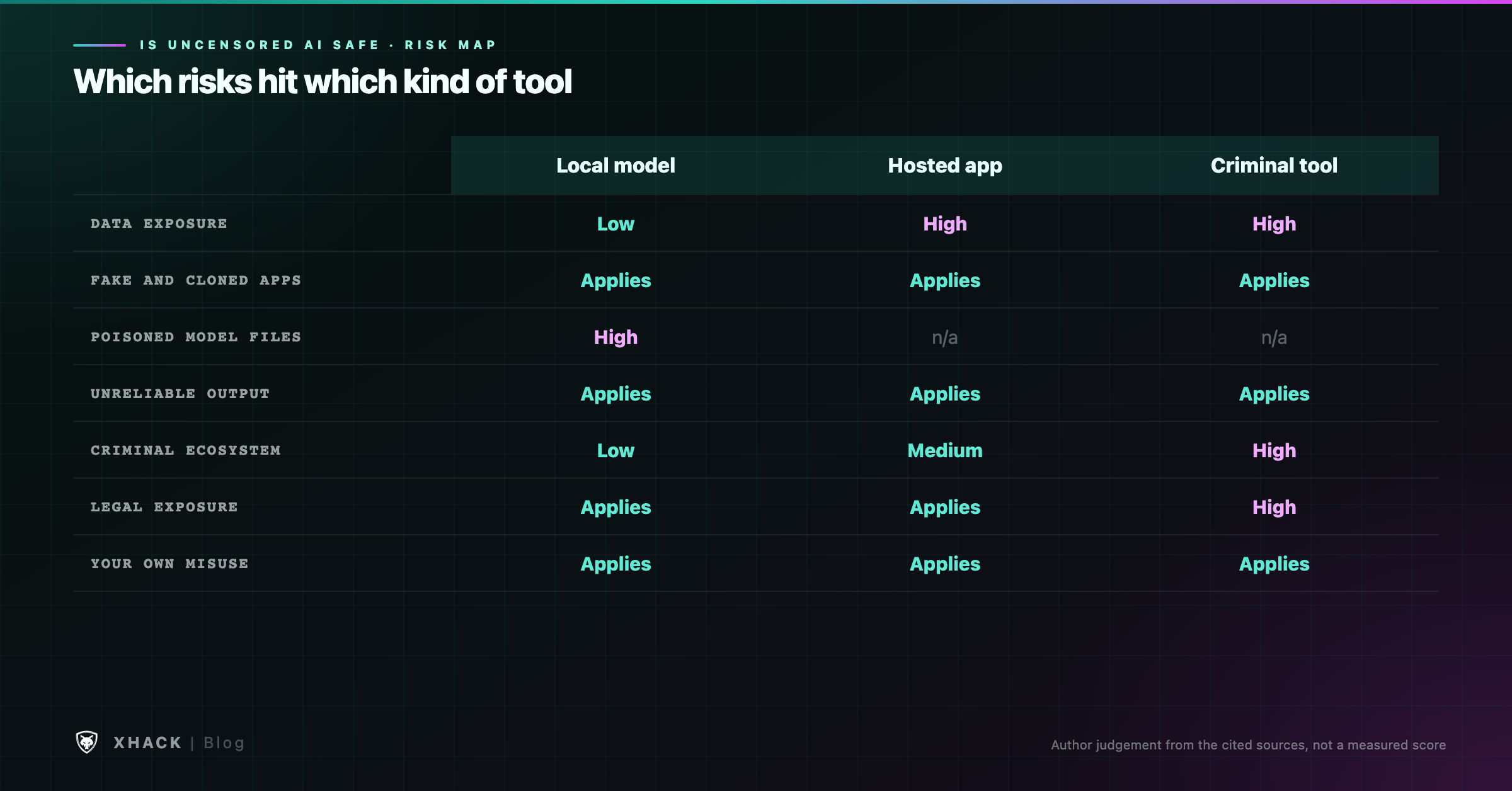
The sections below take each in turn, asking each time whether uncensored AI safe practice is possible.
A hosted AI app receives everything you type. If you paste a client’s source code, a customer list or a vulnerability report, the app’s operator can store it, and you often cannot check what they do with it.
Unverifiable promises are common. TrendAI’s research on the Xanthorox platform, which it analysed as a malicious LLM offering, notes that its developer insists privacy is central, “although there is no way to verify this.” The platform sells for $300 a month, payable only in cryptocurrency. That combination, a privacy claim nobody can check plus payment that cannot be reversed, is a pattern worth recognising.
So is uncensored AI safe for your data? Only if the data never leaves your control. The practical rule is simple. Treat anything you send to a hosted app as something the operator can read. Do not send client data, credentials or anything under an NDA to a service you have no contract with.
Where there is demand, there are imitations. A 2024 study of LLM app stores, “LLM App Squatting and Cloning,” generated look-alike names for the top 1,000 apps and found over 5,000 squatting apps. After sampling, the authors found that 18.7% of the squatting apps and 4.9% of the cloning apps showed malicious behaviour, including phishing, malware distribution, fake content and aggressive ad injection.
That study covers AI app stores in general, not only uncensored ones. But uncensored tools attract the same kind of copycat, and their buyers are often hunting for an unofficial download. The risk is highest when you search for “free uncensored AI” and install the first result.
Is uncensored AI safe to install from a search result? Usually not. Safer habits help. Download only from a project’s official repository or site. Check the publisher and the file hash where one is provided. And be wary of any installer, APK or chat-app bot that promises restricted features for free.
If you run a model locally, you download a file, and the file format matters. Hugging Face’s documentation explains that pickle is the default format for PyTorch model weights, and that there are dangerous arbitrary code execution attacks when you load a pickle file. It suggests loading models from users and organisations you trust, relying on signed commits, and says it is experimenting with a simpler weight format called safetensors to alleviate the problem.
The point for non-specialists is that a model file is not like a picture. Opening some formats can run code. That makes the source of the file a safety question.
Is uncensored AI safe to download from any open platform? A scale check helps. The 2025 study “Consiglieres in the Shadow” found over 11,000 uncensored models on open platforms, created by fine-tuning, merging or compressing other models. With that many, you cannot assume any given one is clean, and provenance matters more than popularity.
Removing refusals does not add accuracy. Editing a model can make it worse.
In the Hugging Face post that popularised the technique called abliteration, the author reports that the edited model scored lower than its source model across all the benchmarks he ran, and that he needed an extra round of training to recover the quality. Not every uncensored model is built this way, but the lesson holds: “uncensored” says nothing about “correct.”
Is uncensored AI safe to rely on? Not without checking. In security work, wrong output has a cost. A made-up command can break a test environment, and a fabricated finding can embarrass you in a report. Treat any AI answer, censored or not, as a draft you verify.
Some uncensored tools exist for crime. Talos describes uncensored models, jailbroken mainstream models and criminal-built models, and notes that advertised features of malicious tools include connecting to outside services for sending email, scanning sites for vulnerabilities and checking stolen credit card numbers.
“Consiglieres in the Shadow” found evidence of uncensored models being used in hundreds of malicious applications offering services such as malicious code generation. The same study reports underground forums where criminals share scripts to build cheap alternatives.
Is uncensored AI safe when the operator is a criminal? For you as a user, the risk is not only what the tool can do. It is who you are dealing with. A criminal operator has no duty to protect your data, your identity or your payment, and using such a tool ties your name to criminal infrastructure. If you are curious about why people look for these tools, WormGPT alternatives for verified pros explains the pattern.
Using an uncensored model is not automatically illegal in most places. What you do with it can be.
Three situations cause trouble. Testing systems you do not own or have written permission to test is illegal in most jurisdictions, whatever model helped you. Breaching a contract or platform rule, such as a bug bounty programme’s scope, can cost you an account or a payout. And using a tool you know to be criminal infrastructure can create problems of its own.
So is uncensored AI safe legally? That depends on use. Laws and contracts differ by country, so this is not legal advice. If you are unsure about your own situation, ask a lawyer before you start. For authorised work, written scope and permission are the baseline.
A guardrail does two jobs. It blocks harmful requests, and it sometimes stops you from making a mistake. Without it, nothing pushes back.
For security professionals that matters in concrete ways. A tool with no scope control will happily act on a system outside your authorisation if you point it there. A tool with no logging gives you nothing to show a client or an auditor afterwards. And a tool with no confirmation steps will run a destructive command if you ask for one.
Is uncensored AI safe without any controls? Not for professional work. This is the case for accountability features rather than for refusals: scope enforcement, logs and approval steps do not stop legitimate work, but they do catch errors. Why AI refuses hacking requests explains why blanket refusals are the wrong fix.
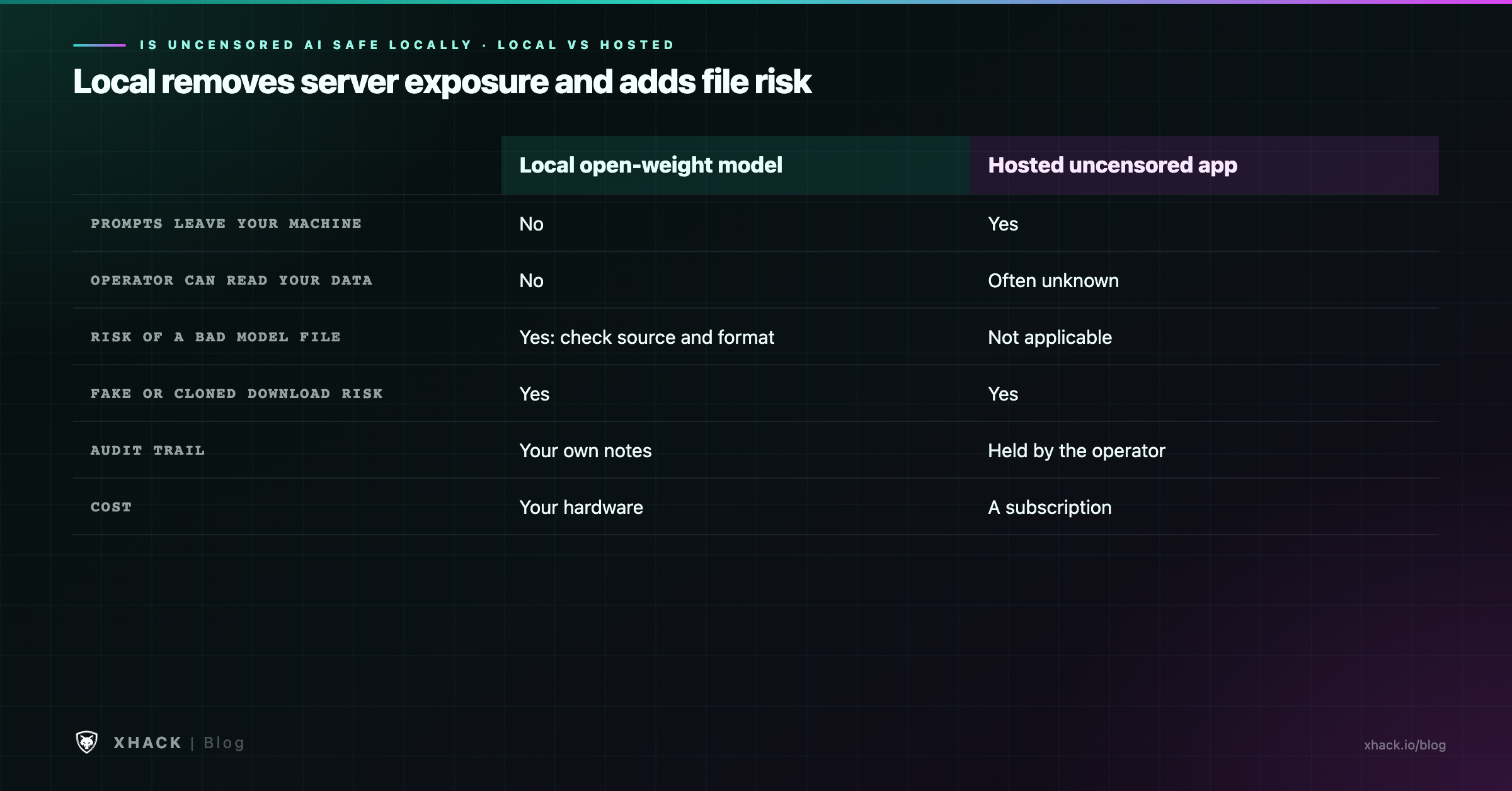
Is uncensored AI safe when it runs on your own machine? Running locally is often the safest choice for sensitive work, with a caveat about files.
| Local open-weight model | Hosted uncensored app | |
|---|---|---|
| Prompts leave your machine | No | Yes |
| Operator can read your data | No | Often unknown |
| Risk of a bad model file | Yes, check the source and format | Not applicable |
| Fake or cloned download risk | Yes | Yes |
| Output quality | Depends on size and edits | Depends on the service |
| Audit trail | You keep your own notes | The operator holds the logs |
| Cost | Your hardware | A subscription |
The trade is plain when you ask if uncensored AI is safe locally. Local removes server-side exposure, and in return you take on the job of vetting the model and running it in a sensible environment.
In most places, owning or running an uncensored model is not a crime by itself. The legal risk comes from what you do and from how the model was built or distributed.
Use is where the exposure sits. Generating content that is itself illegal, helping with an attack on a system you are not authorised to test, or breaching a licence or contract are the common problems. Some uncensored models are built from other models whose licences have conditions, so read the licence.
Laws differ widely, and the rules on tools and data change. If you plan to use uncensored AI in your work, put your scope and authorisation in writing, and ask a lawyer about anything you are unsure of.
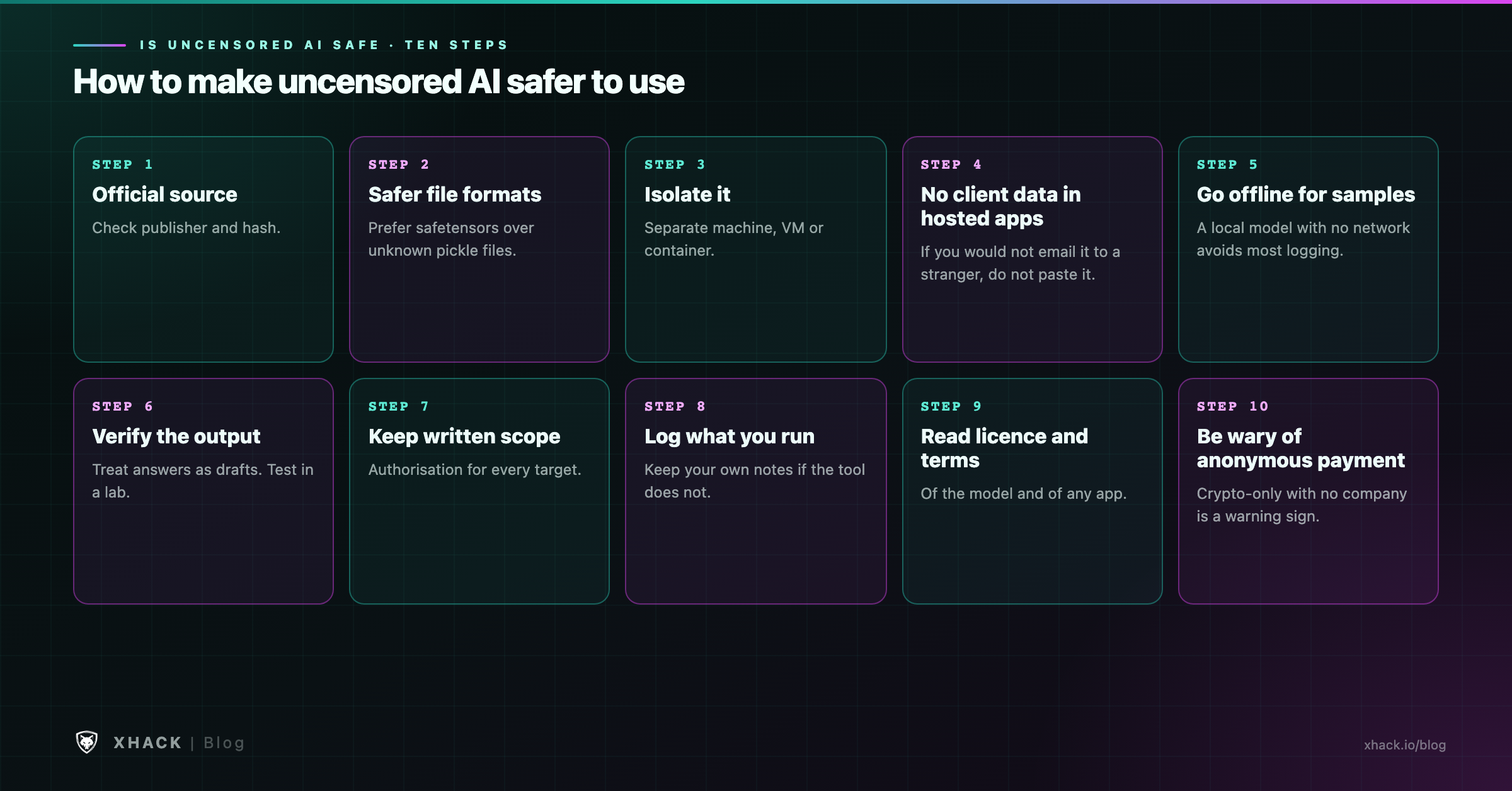
If you decide to use one, these steps make uncensored AI safer. They apply most to security professionals.
Some signs mean walk away.
XHack is built around the idea that unrestricted capability should come with accountability. It does not make uncensored AI risk-free, and I would rather say so plainly.
Verified access. Researcher accounts are approved on a government-issued photo ID plus at least one professional credential, such as OSCP, CEH, CISSP or Security+. The process takes about five minutes of your time and review is usually decided within one business day. Depending on current requirements, you verify first or start with limited access, where the agent finds vulnerabilities but does not exploit until you verify. The verification guide has the details.
Controls during a run. Every operation is logged, scope is enforced, and each chat has its own permission mode, from manual approval of every action to read-only planning. Destructive commands such as wiping disks or dropping databases are blocked even in the most permissive mode.
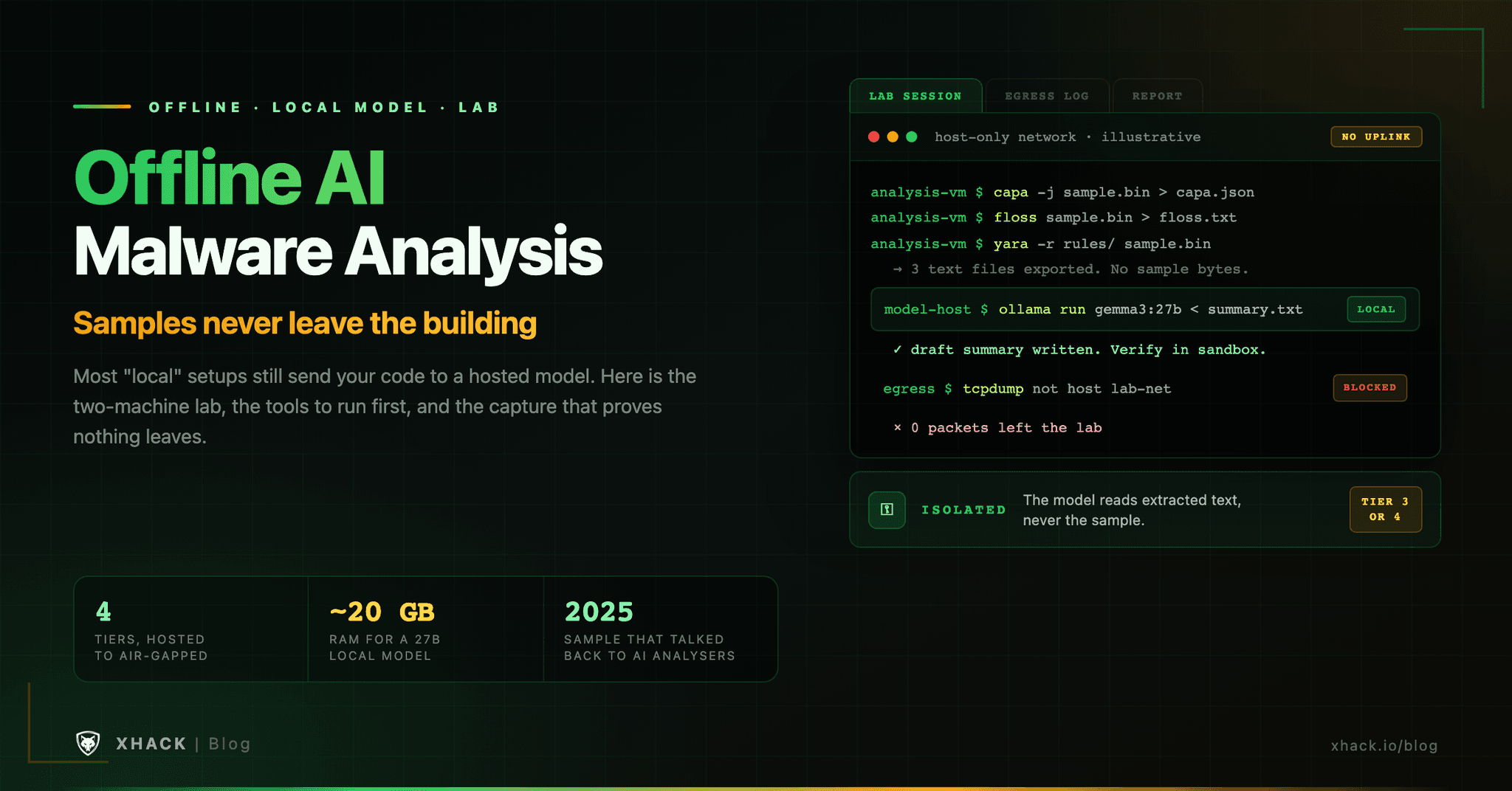
Privacy. XHack does not store your agent chats. For the strictest environments, the desktop agent can run fully offline against a local model.
What it does not remove. The self-serve agent is agent-driven, so you confirm what it finds. XHack’s Terms say AI output can be incomplete, inaccurate or wrong, and XHack AI mistakes explains where our own agent gets things wrong. The restrictions page lists what the agent must not be used for, including testing systems you do not own and live phishing.
For how the agent works day to day, see the unrestricted AI agent, and unrestricted AI for penetration testing for how verified access fits a real engagement. Individual plans run $20, $49 and $150 a month with a 7-day free trial, one per person, on the pricing page.
Is uncensored AI safe to use? It depends on the tool, where it runs and what you use it for. A model you run yourself from a trusted source is far lower risk than a hosted app with no company behind it, and criminal-built tools are not safe for anyone. Data exposure, fake apps, poisoned model files and unreliable output are the main risks.
Is uncensored AI safe and legal to own? Usually yes by itself. Owning or running an uncensored model is legal in most places. The risk is in use: testing systems without permission, breaching a contract or licence, or using a tool you know to be criminal infrastructure. This is not legal advice, so ask a lawyer about your situation.
Is uncensored AI safe when local? It removes most server-side exposure, because your prompts stay on your machine. It adds file risk: Hugging Face warns that loading a pickle file can run arbitrary code, so download from trusted sources, prefer safer formats and run models in an isolated environment.
Is uncensored AI safe from viruses? The model itself generates text, but the files and apps around it can carry malware. A study of AI app stores found malicious behaviour in 18.7% of sampled squatting apps and 4.9% of sampled cloning apps, and a model file can run code if you load it from an untrusted source.
Whether uncensored AI is safe for security research depends on accountability. Work only on systems you are authorised to test, keep written scope, log what you run, verify output and avoid sending client data to services you cannot vet. A verified-access tool adds identity checks, logs and scope control, which a raw model lacks.
Is XHack’s uncensored AI safe in the sense of accountable? XHack gates unrestricted capability behind identity verification, logs every operation, enforces scope and does not store agent chats. It is still an AI, so its output can be wrong, and you confirm findings yourself. No tool is risk-free.
Is uncensored AI safe? Uncensored AI is not safe or unsafe as a category. It is a set of tools with different risks, and the sorting question is who runs it, where your data goes and what controls exist.
For sensitive security work, an uncensored AI safe enough to rely on needs accountability. The safer paths are a local model from a trusted source in an isolated setup, or an accountable verified-access agent. Avoid hosted apps with no company behind them and criminal tools entirely. Verify everything the model tells you, and keep your scope in writing. If you want to see how verified access works in practice, start the 7-day free trial and read the verification terms first.
Categories
Related articles