Table of contents
16
By Salman Khan, OSCP+, Founder of XHack, SRT (Synack Red Team member)
Read this in 30 seconds:
- AI reverse engineering means using a large language model, usually wired into a disassembler like Ghidra, IDA Pro, or Binary Ninja, to rename functions, explain logic, and spot patterns a human would otherwise dig out by hand.
- It doesn’t replace a disassembler. It sits on top of one, reading the same decompiled pseudocode a human analyst reads, just faster.
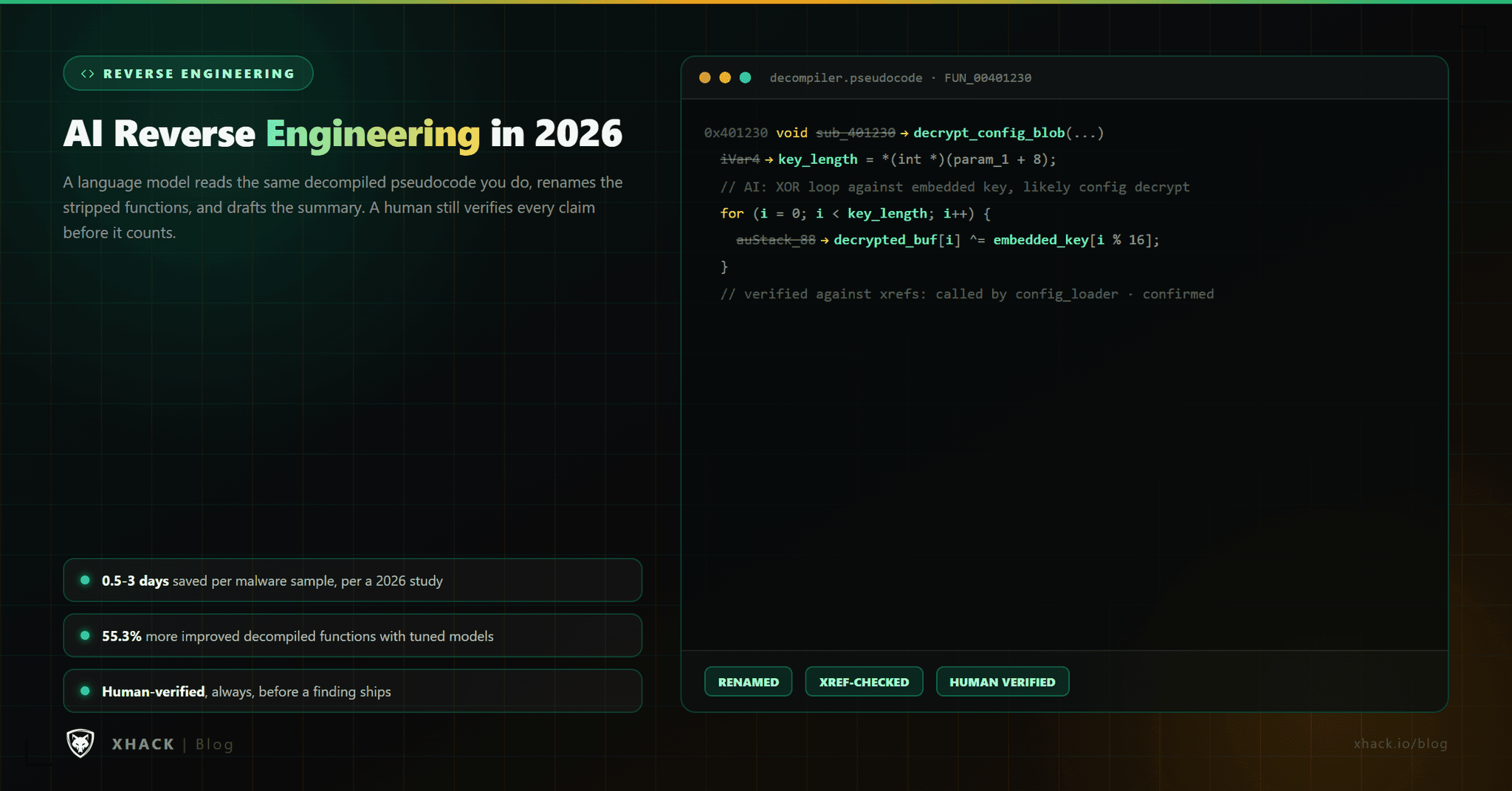
- A 2026 academic study on real malware samples found AI assistance saved 0.5 to 3 days per sample compared to fully manual analysis, while matching or beating human-only accuracy on most samples.
- The tools doing this right now are mostly free and open source: GhidraMCP, GhidrAssist, and an MCP bridge for IDA Pro, plus a commercial option in Binary Ninja’s Sidekick.
- It’s genuinely useful and genuinely flawed. The same research documented the AI inventing a botnet command that didn’t exist in the binary. Analyst oversight stays mandatory, not optional.
- XHack AI folds reverse engineering into its mobile and malware analysis pipeline, with every AI-surfaced claim run past a human before it lands in a report.
Reverse engineering has always been slow by nature. You take a binary that refuses to tell you anything, strip away the compiler’s optimizations, and rebuild a mental model of what it’s actually doing, one function at a time. AI reverse engineering doesn’t change that basic job. It changes how many of those functions you can get through in a day.
The idea is simple: point a language model at the same decompiled pseudocode you’re already staring at, and let it do the first pass. Rename the variables. Guess what a function does. Flag the fifteen lines that actually matter out of the eight hundred your decompiler spat out. A human still owns the final call, but the model does the tedious middle part that used to eat most of the clock.
This guide covers what AI reverse engineering actually means, the real tools people are using for it in 2026, how much faster it genuinely makes the work, and where it still falls apart without a human watching closely.
Strip away the buzzword and AI reverse engineering is a large language model reading decompiler output and doing the interpretive work a human analyst normally does by hand: renaming stripped symbols, describing what a function is for, spotting cryptographic constants, and pointing out control-flow patterns that look like a C2 beacon or an anti-debug check.
It’s not a new kind of disassembler. The disassembler (Ghidra, IDA Pro, Binary Ninja, radare2) still does the actual work of turning machine code into readable pseudocode. The AI layer sits on top of that output. Some tools go a step further and let the model drive the disassembler itself, issuing commands like “decompile this function” or “list every cross-reference to this address” through a structured interface, instead of a human clicking through menus.
That structured interface has a name in 2026: the Model Context Protocol (MCP), an open standard that lets an AI assistant call tools on your machine (like a Ghidra instance) through a defined request/response format instead of scraping screenshots or copy-pasting code back and forth. It’s the plumbing that turned “paste this function into ChatGPT” into “let the model drive the tool directly.”
The mechanics are less mysterious than the marketing suggests. A typical AI reverse engineering session runs through four repeating steps:
iVar4, function calls, string references) and generates a plain-language guess at what the function does, along with better names for the variables and the function itself.That fourth step is why AI reverse engineering compounds. Renaming sub_401230 to decrypt_config_blob doesn’t just help you. It helps every AI pass on every function that calls it afterward, because the model now has a real name to reason from instead of an address.
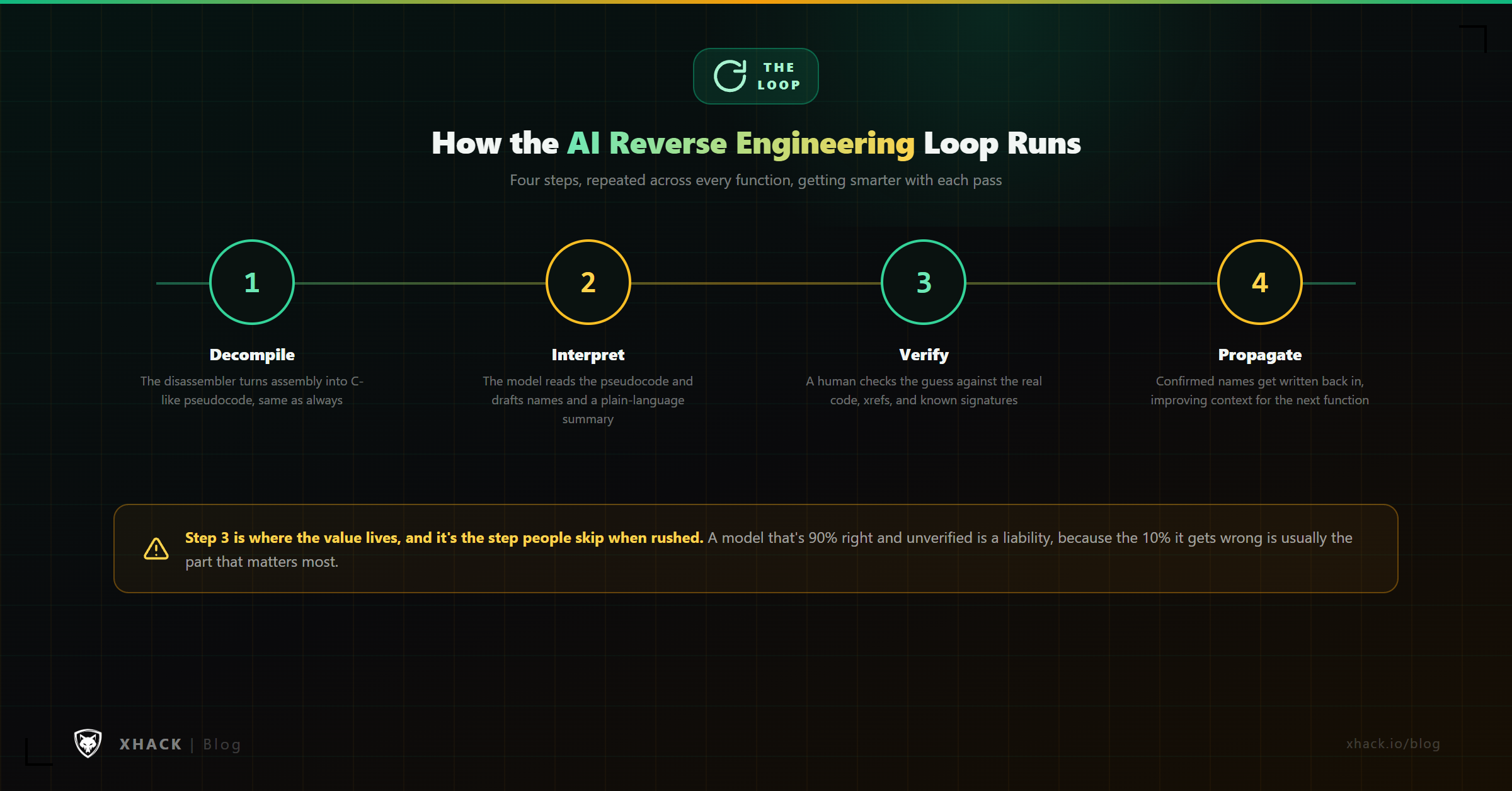
The honest caveat: step 3 is where most of the value lives, and it’s the step most people skip when they’re in a hurry. An LLM that’s 90% right on function summaries is genuinely useful. An LLM that’s 90% right and unverified is a liability, because the 10% it gets wrong tends to be exactly the part that matters (the actual malicious payload, the actual auth bypass).
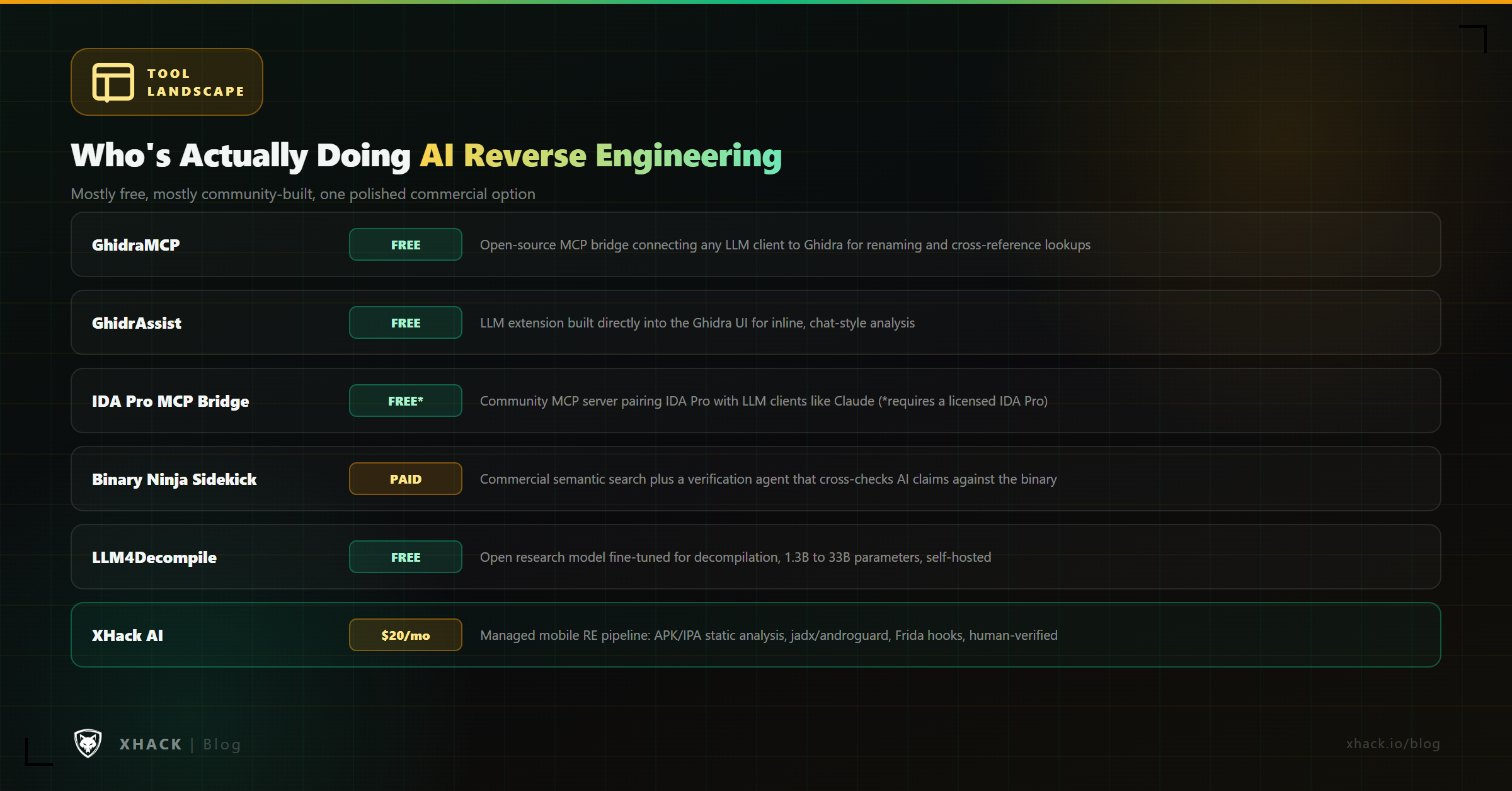
| Tool | What It Is | Cost | Best For | Limitation |
|---|---|---|---|---|
| GhidraMCP | Open-source MCP bridge connecting any MCP-compatible LLM client to Ghidra | Free | Automating renaming, summarizing, and cross-reference lookups inside Ghidra | Needs Ghidra installed separately; quality depends entirely on the LLM you connect |
| GhidrAssist | LLM extension built directly into the Ghidra UI | Free | Inline, chat-style analysis without leaving Ghidra | Smaller community than GhidraMCP; fewer integrations |
| IDA Pro MCP bridge | Community MCP server pairing IDA Pro with LLM clients like Claude | Free (requires a licensed IDA Pro) | Teams already standardized on IDA Pro | Still requires IDA Pro’s own commercial license |
| Binary Ninja Sidekick | Commercial, built-in AI research assistant with semantic search across a binary | Paid (bundled/add-on pricing) | Finding relevant code in large, stripped, or obfuscated binaries without manual hunting | Closed-source verification agent; model details aren’t published |
| LLM4Decompile | Open research model fine-tuned specifically for decompilation, 1.3B to 33B parameters | Free (self-hosted) | Teams that want a purpose-built decompilation model instead of a general LLM | Requires your own GPU infrastructure to run at useful speed |
| XHack AI | Managed AI agent with native APK/IPA static analysis, jadx and androguard pipelines, and Frida-based runtime hooks for mobile reverse engineering, all human-verified before delivery | Individual plans from $20/mo | Teams that want reverse engineering folded into a broader pentest/malware workflow, not a standalone tool | Mobile/Desktop |
Worth being precise here: none of this is an official NSA feature bolted onto Ghidra. GhidraMCP and GhidrAssist are community projects built by independent researchers on top of Ghidra’s plugin API. Ghidra itself, as of its latest 2026 release, ships with no built-in AI assistant. If a vendor implies otherwise, that’s marketing, not fact.
Binary Ninja’s Sidekick is the most polished commercial option, built around semantic search that finds relevant code even when function names are stripped and strings are sparse, plus a verification agent that cross-checks the model’s claims against the actual binary before surfacing them. That verification step matters more than almost any other feature on this list, for reasons the next section makes concrete.
This is where a lot of vendor claims get vague on purpose. The real numbers are more interesting than the marketing copy, and more honest about the limits.
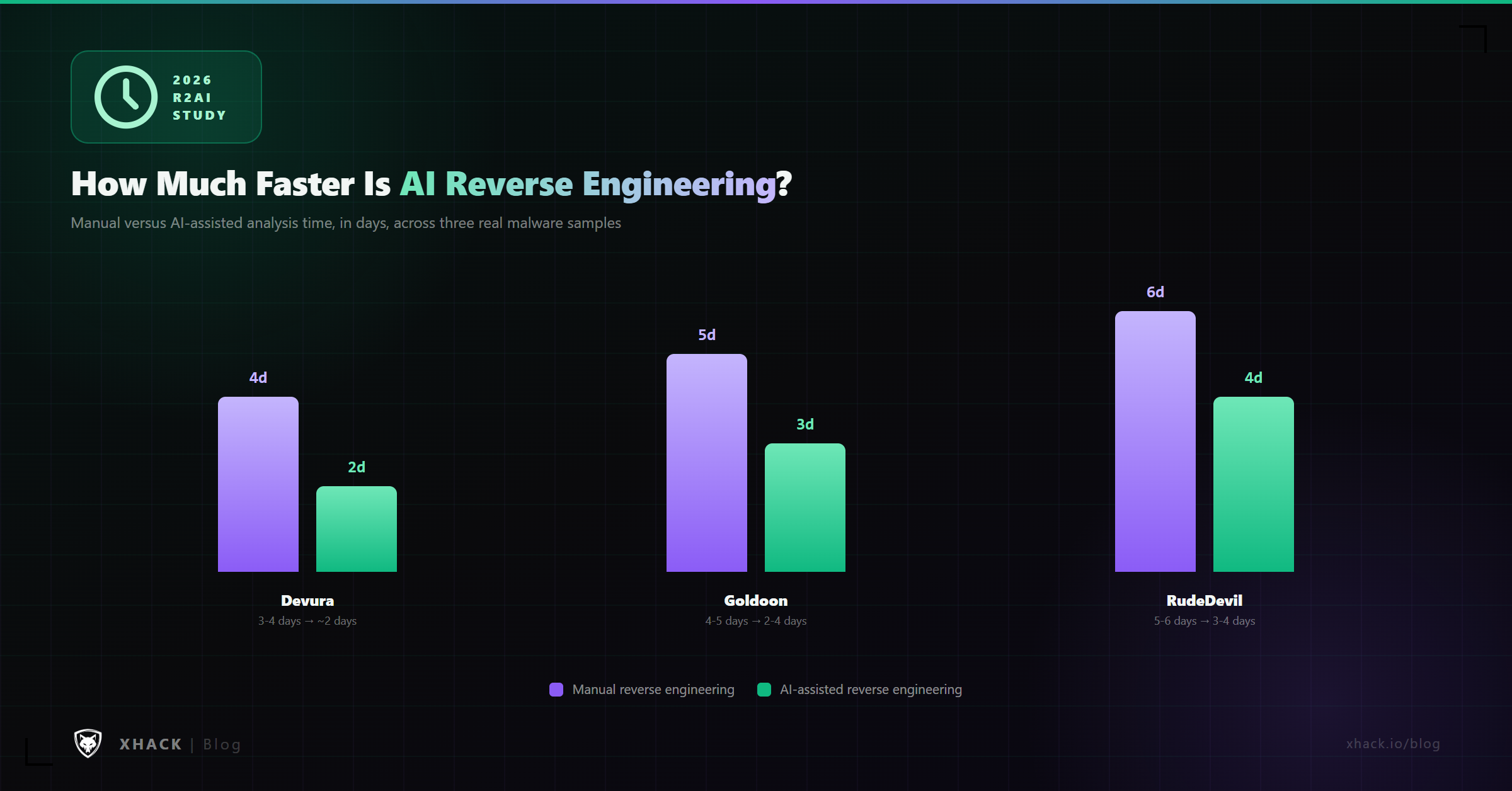
A 2026 academic study, R2AI: Malware Analysis Assisted by AI, ran Claude-based AI assistance against real Linux and IoT malware samples and compared the results to fully manual reverse engineering by independent analysts. The AI-assisted runs matched or exceeded the quality of human-only analysis on most samples, and in one case (a sample called Devura) the AI caught command-line argument handling the human analysis had missed entirely.
The time savings were concrete, not hand-wavy:
That works out to 0.5 to 3 days saved per sample, depending on how cooperative the malware was. Cost was modest too: the researchers logged $1-2/day in model usage for guided sessions, up to $7-10+/day when they let the agent run with less supervision.
On the pure decompilation side, a separate 2026 paper on quality-driven fine-tuning, D-LiFT, found that a fine-tuned decompiler LLM produced 55.3% more improved decompiled functions than a baseline model with no quality-focused training, and improved the output quality of 68.2% of all functions the underlying decompiler produced. That’s a specific, measured gain in how readable and correct the AI-generated pseudocode actually was, not a vague “faster” claim.
Here’s the part most write-ups gloss over, and it matters more than the speed numbers. The same R2AI research that documented real time savings also documented the AI hallucinating.
During analysis of a sample called Sshdinjector, the AI invented a botnet command that simply didn’t exist in the binary. In another case, it labeled a basic bit of code output as “MAC address manipulation,” a description far more dramatic than what the code actually did. The researchers’ own conclusion: “the AI cannot operate alone and must constantly be guided by an experienced analyst.”
A few other honest limitations worth knowing before you rely on this for anything real:
None of this makes AI reverse engineering not worth using. It makes unsupervised AI reverse engineering not worth trusting, which is a very different statement.
These two use cases get conflated a lot, and they’re not the same job.
Reverse engineering for malware analysis is about understanding what a sample already does: its capabilities, its command-and-control behavior, its persistence mechanism, so a defender can detect and remove it. Our deeper AI malware analysis guide covers that workflow end to end, including the static and dynamic analysis split.
Reverse engineering for exploit development goes further: understanding a binary well enough to find a flaw in it and build something that reliably triggers that flaw on purpose, for an authorized engagement. That’s a different skill stack (memory layout, calling conventions, mitigation bypasses) covered in our AI exploit development guide.
AI reverse engineering feeds both. The decompile-and-interpret loop described earlier is the shared foundation either job builds on top of.
Here’s roughly how a disciplined session actually runs, based on how the tools above are used in practice:
So yeah, here’s where we talk about what XHack brings to the table.
XHack combines three things most providers offer separately: expert human testers, an autonomous AI agent, and a continuous security platform. For reverse engineering specifically, that shows up in the mobile analysis stack: native APK and IPA static analysis, jadx and androguard decompilation pipelines, exported-component testing over ADB, and Frida hooks for runtime instrumentation, all running as part of the same seven-stage pipeline (prompt, planner, orchestrator, executor, findings, human, report) that powers the rest of XHack AI.
The honest limitation, matching the section above: XHack AI isn’t a general-purpose desktop RE workbench you’d use to reverse an arbitrary Windows binary the way you would with Ghidra or IDA Pro. It’s built around mobile app analysis and the reverse-engineering work that feeds a real penetration test or malware triage, not a standalone Ghidra replacement.
What it does bring that a bare tool doesn’t: every AI-surfaced finding gets checked by a human before it reaches a report, the same discipline the R2AI research says is mandatory for AI reverse engineering to be trustworthy. And on the privacy side, XHack doesn’t store your data on its servers. Session data and analysis chats stay on your own machine, and you can delete them whenever you want.
Individual plans for bug hunters and researchers start at $20/mo, with a 7-day free trial, no credit card required, for the full platform. Teams evaluating this for company-wide use should look at the separate company plans instead of the individual pricing above, since they’re structured differently.
Want to see it on a real target? Book a free consultation, even if XHack turns out not to be the right fit. Brutal honesty is kind of our thing.
Not yet, and probably not for a while. A 2026 academic study on real malware samples found AI-assisted analysis matched or beat manual analysis on quality, but the same study documented the AI inventing a botnet command that didn’t exist in the binary. Treat AI reverse engineering output as a strong first draft that needs verification on anything security-critical, not a final answer.
A decompiler (Ghidra, IDA Pro, Binary Ninja) turns machine code into readable pseudocode. That part hasn’t changed. AI reverse engineering adds a language model on top of that pseudocode to rename variables, summarize what functions do, and flag patterns worth a closer look, work a human used to do entirely by hand.
No. GhidraMCP and GhidrAssist are free, open-source additions to Ghidra, which is itself free. The IDA Pro MCP bridge is also free, though it requires an existing IDA Pro license. Binary Ninja’s Sidekick is the main paid option, built into Binary Ninja itself.
On real malware samples, a 2026 study measured 0.5 to 3 days saved per sample compared to fully manual analysis, depending on how the sample resisted analysis (packed and encrypted samples saved less time). That’s a measured range from real engagements, not a marketing estimate.
No, and the researchers behind the leading 2026 study on this were explicit about it: the AI cannot operate alone and must constantly be guided by an experienced analyst. It removes a lot of tedious manual labor. It doesn’t remove the need for someone who can catch a wrong answer.
Yes, as part of its mobile application analysis: native APK/IPA static analysis, jadx and androguard decompilation, and Frida-based runtime instrumentation, all folded into the same human-verified pipeline used across XHack AI’s other capabilities. It’s not a standalone desktop reverse engineering tool, it’s built to support real penetration testing and malware triage work.
AI reverse engineering earns its keep the same way most useful AI tools do: it takes the part of the job that was always mechanical (renaming stripped symbols, drafting a first-pass summary of what a function does) and does it fast, so the analyst’s time goes to the part that actually needs a trained eye. The 2026 research backs that up with real numbers: days saved per sample, a measurable jump in decompiled function quality, and a workflow that genuinely compounds as more functions get named correctly.
The same research is just as clear about the limits. An AI that confidently invents a botnet command that was never in the binary isn’t a rare edge case, it’s the exact failure mode that makes unsupervised AI reverse engineering dangerous. The tools covered here (GhidraMCP, GhidrAssist, the IDA Pro bridge, Sidekick, and XHack AI’s own mobile pipeline) are all built around a human staying in the loop, and that’s not a limitation to work around. It’s the part of the process that makes the rest of it trustworthy.
Categories
Related articles