Table of contents
13
By Salman Khan, OSCP+, Founder of XHack, SRT (Synack Red Team member) – AI and human penetration testing
Read this in 30 seconds:
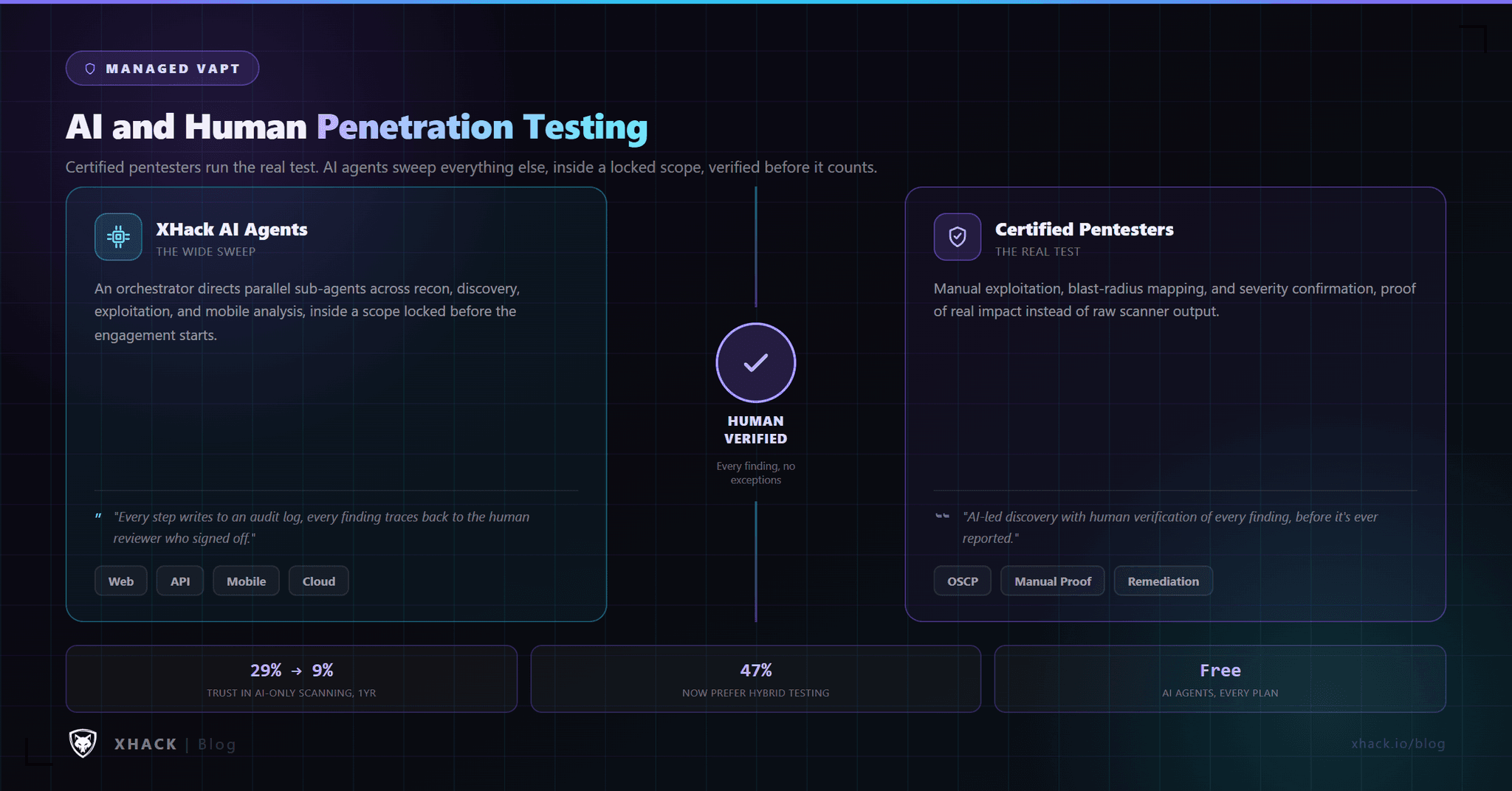
- Pure AI pentesting has a trust problem. A 2026 industry survey found trust in fully-automated AI scanning collapsed from 29% to just 9% in one year, because these tools kept missing real vulnerabilities.
- Pure human pentesting has a coverage problem. A small team can only manually check so much of your web apps, hosts, APIs, mobile apps, and cloud in the time an engagement allows.
- XHack’s managed VAPT closes both gaps: certified human pentesters do the real testing, while XHack AI agents run in parallel, sweeping your whole attack surface inside a locked scope.
- AI agents find candidates fast. Humans manually verify every single one before it’s ever called a finding. That’s what keeps false positives low.
- Every accepted vulnerability comes with real reproduction steps and remediation guidance, not a vague scanner alert.
- It maps to what you actually need for compliance, SOC 2, PCI DSS, ISO 27001, HIPAA, GDPR, and more.
- AI agents are included free on every managed plan. You’re not paying extra for the AI half of the work.
Ask most security teams what they think of “AI pentesting” right now, and you’ll get a wince, not excitement. That’s not an accident. A lot of AI-only tools got rushed to market, found a bunch of stuff that looked scary, and turned out to be noise. Real pentesting still needs a human who knows what “exploitable” actually means. But here’s the other side of that coin: a small human team, working alone, can only cover so much ground. Your attack surface is bigger than that.
XHack’s answer to AI and human penetration testing is to stop treating this as an either/or choice. Certified pentesters do the real work. XHack AI agents do the wide sweep. Here’s exactly how that split works, and why it actually holds up.
Let’s be honest about why this even needs explaining.
AI-only pentesting has a trust problem right now, and it’s backed by real numbers, not vibes. The Cobalt State of Pentesting Report 2026, which surveyed around 450 security professionals, found that trust in fully-automated AI vulnerability scanning dropped from 29% to just 9% in a single year. The main reason wasn’t false alarms, it was the opposite problem: 78% of respondents said fully automated tools missed critical vulnerabilities entirely. A scanner that misses the real bug while flagging fifty fake ones isn’t saving you time, it’s costing you trust.
Human-only pentesting has a scale problem, and this one’s simpler to explain. A skilled human tester is thorough, but thorough takes time, and time is the one thing a fixed-length engagement doesn’t have much of. Web apps, host infrastructure, APIs, mobile apps, cloud environments, each one takes real hours to test properly. A small team working alone has to make hard choices about what gets deep coverage and what gets a quick look.
Here’s the part that actually matters: the industry has noticed this too. That same Cobalt report found that 47% of organizations now prefer a hybrid approach that combines human expertise with AI, a jump of 22 percentage points in just one year. That’s not a fringe opinion anymore. That’s where the market is actually heading, and it’s exactly the model XHack has been running.
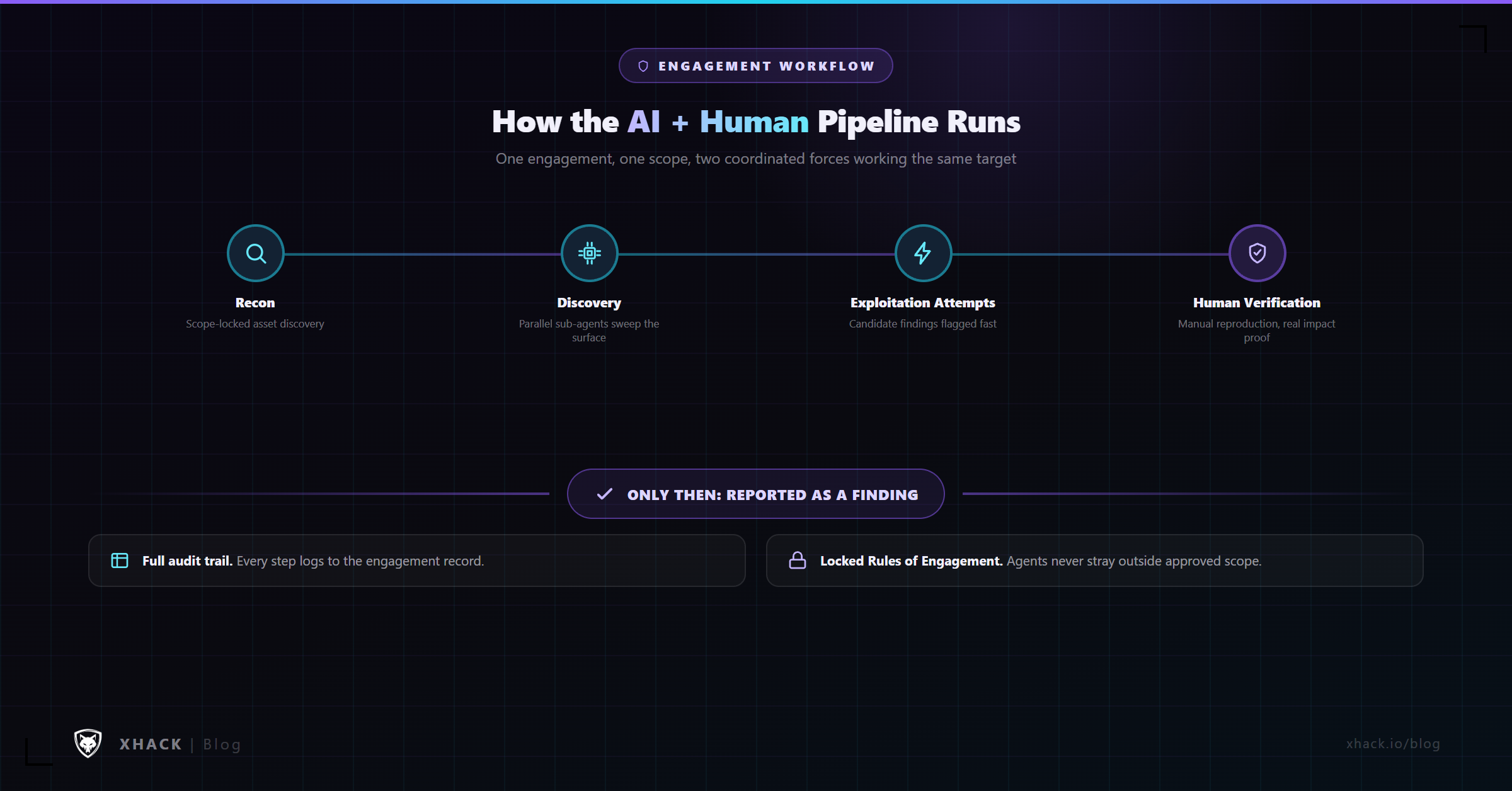
Here’s the plain version of AI and human penetration testing at XHack: certified human pentesters do the real penetration test, and XHack AI agents sweep everything in parallel, inside a scope that’s locked before the engagement even starts.
The AI side isn’t one tool doing one job. It’s a coordinated system, an orchestrator directing multiple sub-agents that work at the same time across recon, vulnerability discovery, exploitation attempts, and mobile analysis. XHack’s own platform describes it as running seven stages, fully observable, where “every step writes to an audit log, and every finding traces back to the exact tool invocation and the human reviewer who signed off.” That’s not marketing language, it’s a literal description of the trail every finding leaves behind.
And that scope boundary isn’t optional or loose. Authorization gets captured upfront, whether that’s a URL, an IP range, an APK, an IPA, or an entire ASN, and it’s locked into the engagement record so the agent never strays outside what you actually approved. That’s the “safe” part of “safe scope boundaries,” and it’s built into the process, not bolted on as an afterthought.
XHack’s managed engagements aren’t limited to one flavor of testing. Depending on what a client needs and what a compliance framework requires, that can mean:
That breadth is exactly where the AI agents earn their keep. Recon and discovery are naturally parallel work, dozens of endpoints, multiple hosts, a mobile app and its backend API, all at once, which is exactly the kind of ground a multi-agent sweep covers far faster than a person working sequentially through a checklist.
This is the part that separates a real hybrid model from a marketing slide.
XHack’s own materials describe the discovery-to-delivery flow as “AI-led discovery with human verification of every finding”, paired with “manual exploitation to prove real impact, never raw scanner output.” That second phrase matters more than it might look at first glance. A raw scanner output is a guess dressed up as a finding. Manual exploitation is proof.
A real, documented example shows exactly how this plays out. In one grey-box engagement on a team-collaboration SaaS platform, the XHack AI agent flagged an asymmetry automatically: a profile response was returning security-relevant fields the client interface never let a user edit, a classic red flag for a mass-assignment bug. The agent tested whether the update endpoint would silently accept those same fields back. It did. That surfaced the candidate finding within the first 48 hours.
Then the human side took over. Analysts independently reproduced the escalation on a second test account, mapped exactly what an Owner-level account could actually do, checked logs for any sign the flaw had already been exploited, and confirmed the real severity before anything got reported. The finding landed as High severity, and the client shipped a fix the very next day. That’s the model in one real case: AI flags fast, humans confirm hard, and nothing gets called a vulnerability until both halves agree it’s real.
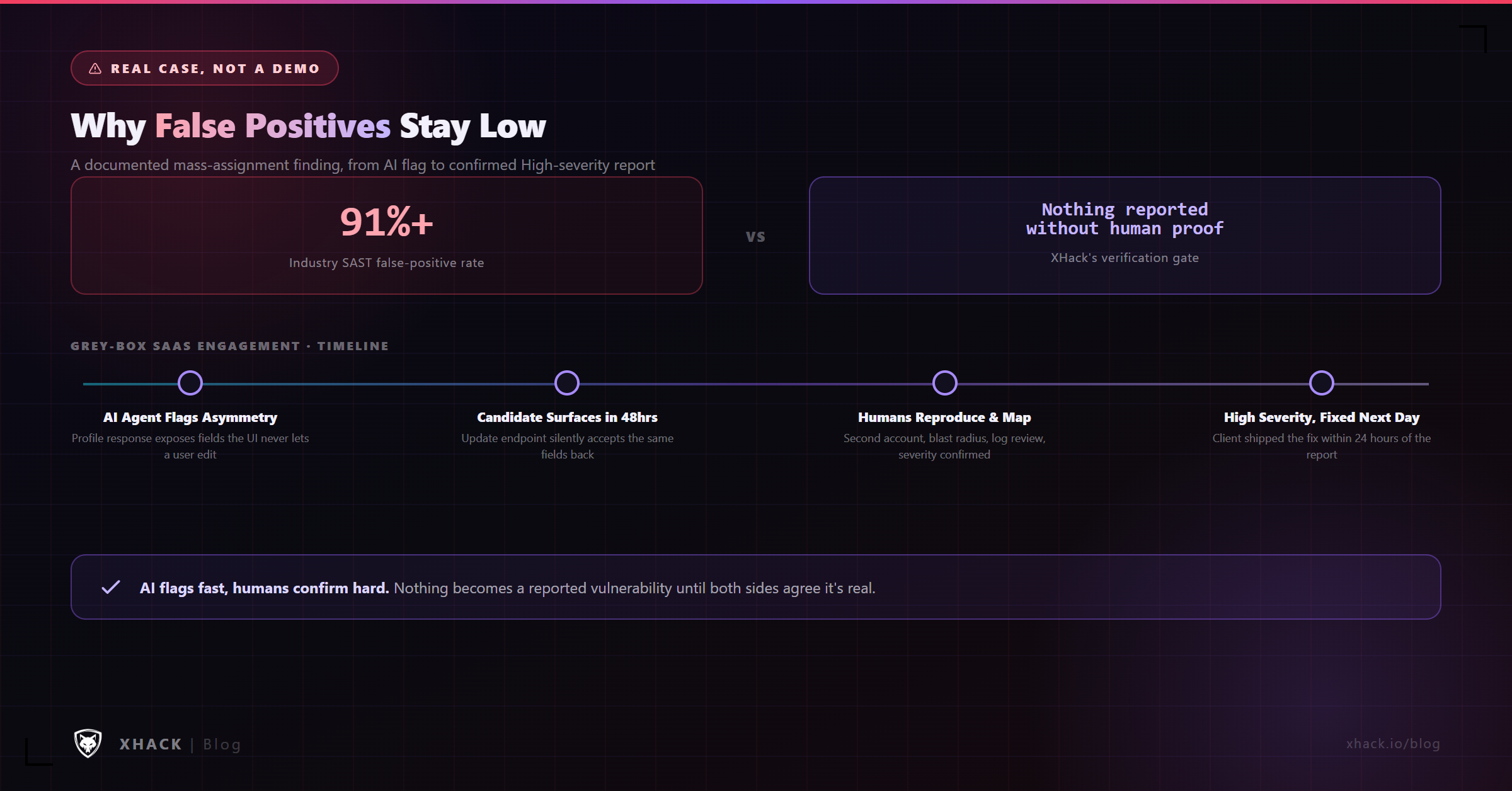
That’s also the honest answer to why XHack’s reported false-positive rate stays low while the industry average for automated scanning sits brutally high. A Ghost Security study of nearly 3,000 open-source repositories found SAST false-positive rates running above 91% across three languages, and DAST tools aren’t far behind. XHack’s process doesn’t try to make the AI agent smarter than that problem. It puts a human between the agent’s guess and your report, every single time.
A finding that survives verification doesn’t just show up as a red dot on a dashboard. Every accepted vulnerability comes with:
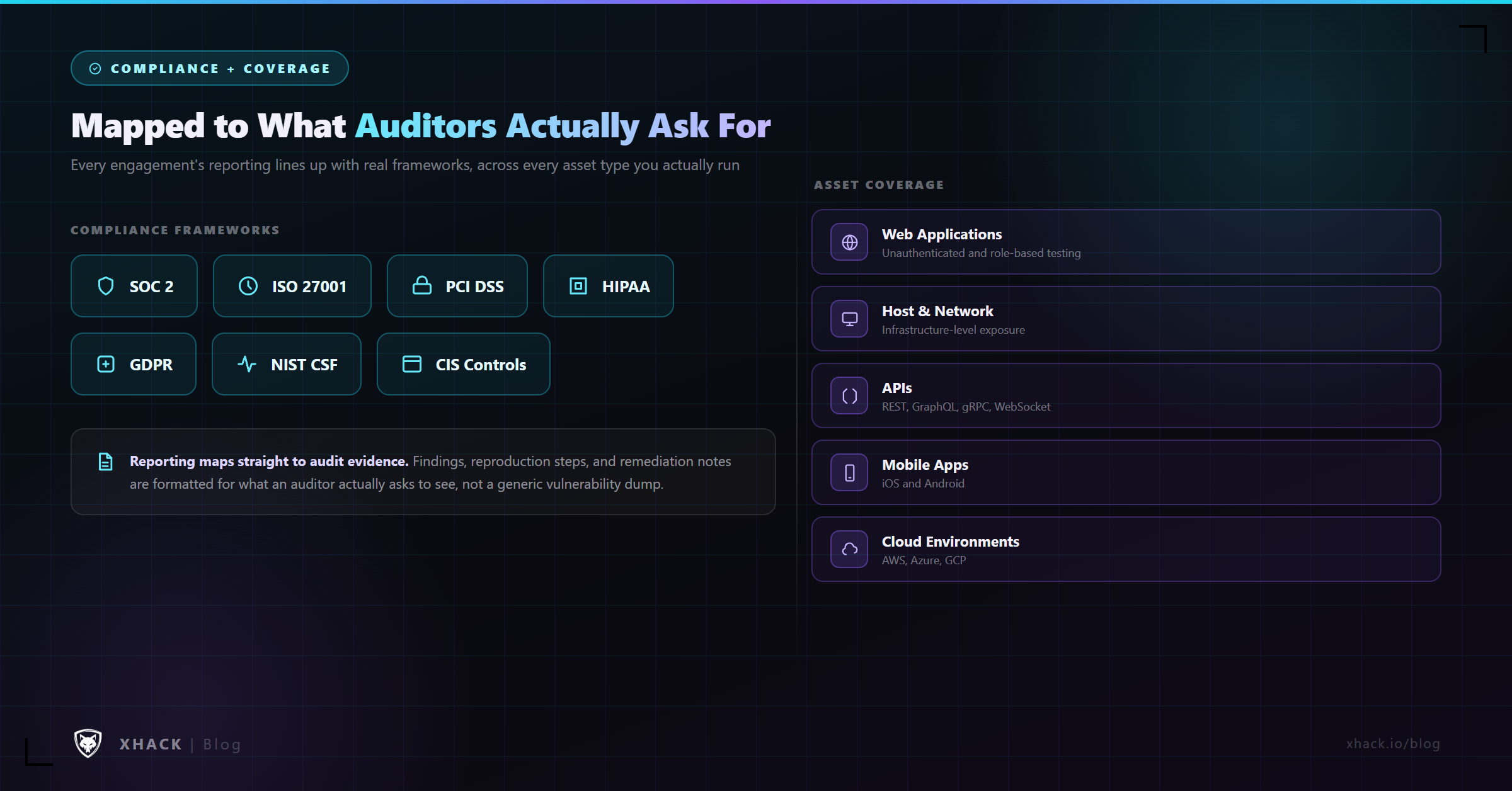
And because compliance is often the whole reason an engagement happens in the first place, the reporting maps cleanly to what auditors actually ask for: SOC 2, ISO 27001, PCI DSS, HIPAA, GDPR, NIST CSF, and CIS Controls are all frameworks XHack’s managed testing is built to support.
This part is simple, and worth saying plainly: AI agents are included at no extra charge on every managed plan. You’re not buying “the human pentest” and then paying a separate fee to unlock the AI sweep on top of it. The agents run alongside the human team, inside the same Rules of Engagement, with your explicit permission, as part of the engagement you already booked.
That matters because it removes the incentive problem a lot of “AI-augmented” pentest vendors quietly have, where the AI coverage becomes an upsell instead of a genuine part of the core service. Here, the AI sweep isn’t the premium tier. It’s just how the engagement works, on every tier, starting at $2,500.
One more thing worth saying plainly: XHack doesn’t store your data on our servers. Your engagement findings, scope details, and any chats with the platform stay local to you and are fully deletable whenever you want, by you.
No, and that’s the entire point of AI and human penetration testing done right. XHack uses certified human pentesters to actually run the engagement and verify findings, with XHack AI agents working in parallel to sweep the full attack surface faster than a human team could alone. The AI agent finds candidates. A human confirms them before they’re ever reported.
AI agents run on every managed VAPT plan at no additional cost. They operate inside the same Rules of Engagement as the human testers, with your explicit permission, as a standard part of the engagement you’re already paying for.
By never letting an AI-surfaced candidate become a reported finding on its own. Every result goes through manual exploitation and human review before it’s accepted, the same process that turned an automated flag into a confirmed, high-severity mass-assignment finding in under 48 hours in one documented engagement, verified independently before it ever reached a client.
Web applications, host and network infrastructure, APIs including REST, GraphQL, gRPC, and WebSocket, mobile apps on iOS and Android, and cloud environments across AWS, Azure, and GCP. Testing can be unauthenticated, authenticated across multiple roles, or a mix, depending on what the engagement actually needs.
Yes. XHack’s managed VAPT reporting is built to map to SOC 2, ISO 27001, PCI DSS, HIPAA, GDPR, NIST CSF, and CIS Controls, so the findings and documentation line up with what an auditor actually expects to see, not just a generic vulnerability list.
The industry spent the last year figuring out the hard way that neither extreme works well alone. Pure AI automation lost the industry’s trust because it kept missing real vulnerabilities while burying teams in noise. Pure human testing simply can’t cover a modern attack surface at the speed and breadth that’s now expected. XHack’s managed VAPT was built around the answer nearly half the industry has now landed on too: let certified humans do the real pentest, let AI agents handle the wide, fast sweep inside a locked scope, and never let a finding through without both sides agreeing it’s real. That’s what AI and human penetration testing actually means in practice, and it’s included in every plan, not sold as an upgrade.
Categories
Related articles