Table of contents
14
By Salman Khan, OSCP+, Founder of XHack, SRT (Synack Red Team member)
Read this in 30 seconds:
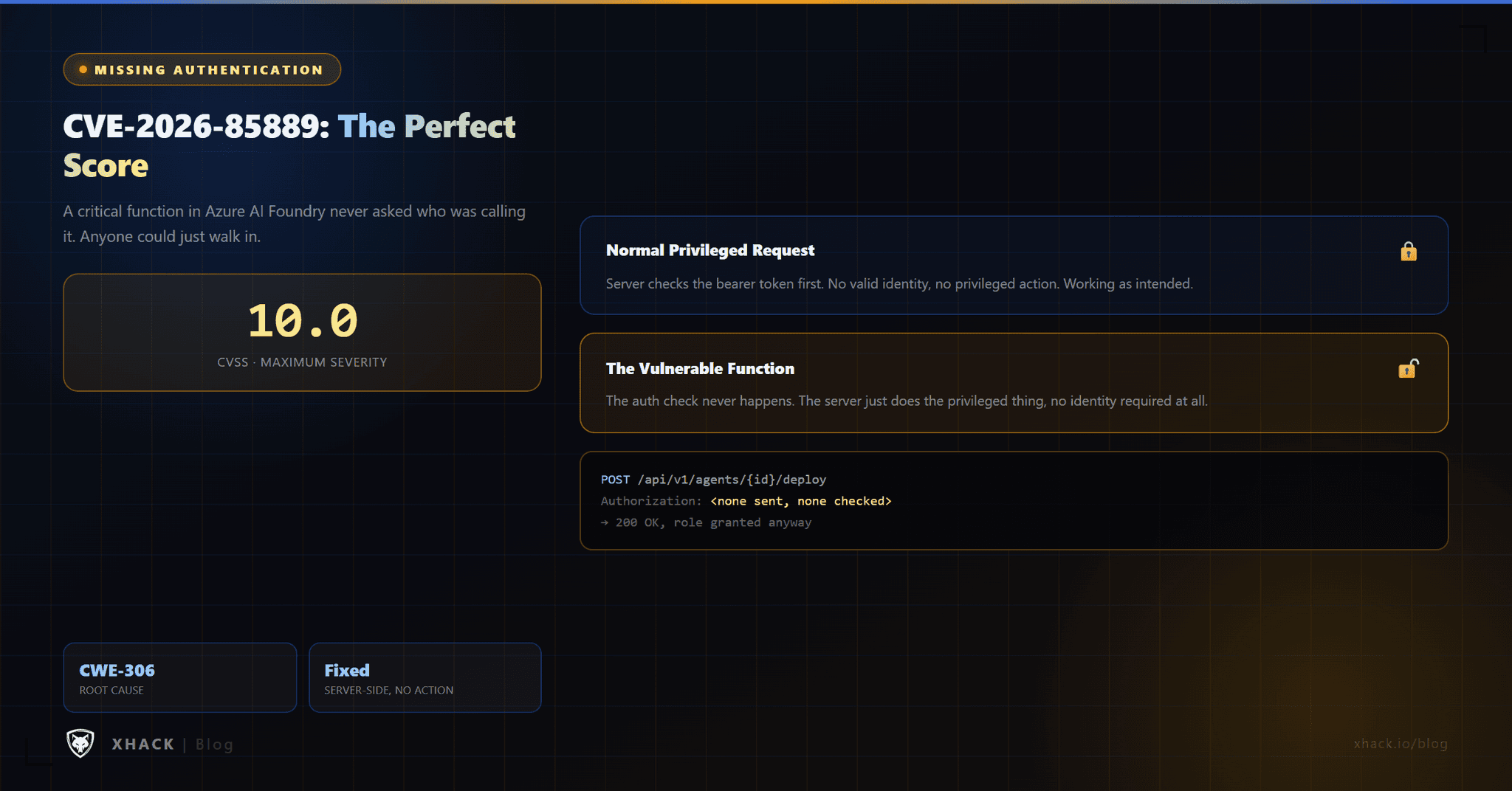
- CVE-2026-85889 is a CVSS 10.0 flaw in Microsoft Azure AI Foundry, the highest score a bug can get.
- The cause is simple to say and scary to have: a critical backend function had no authentication check at all.
- Anyone on the network could reach it, no password, no token, no click from a user needed.
- It hit Azure AI Foundry, the hub companies use to build and run AI agents, models, and workflows.
- Microsoft fixed it entirely on their side. There’s nothing for you to patch or update.
- No sign it was ever used in a real attack, and no public exploit code exists.
- It’s still worth understanding, because this exact bug class keeps showing up in cloud platforms, and it’s about to show up a lot more as AI platforms multiply.
A CVSS score of 10.0 doesn’t happen often. It means every box got checked in the worst possible way: reachable over the network, easy to pull off, no login needed, no user has to click anything, and the damage covers everything, your data, your integrity, your uptime. CVE-2026-85889 hit all of those boxes inside Azure AI Foundry, Microsoft’s platform for building and running AI agents at enterprise scale. Here’s what actually happened, why it matters even though it’s already fixed, and what this bug class looks like when you break it down.
Microsoft’s own advisory puts it plainly: missing authentication for a critical function in Azure AI Foundry let an unauthorized attacker escalate privileges over the network. Security researcher Rémy Marot found it and reported it through Microsoft’s coordinated disclosure program. Microsoft disclosed it on September 17, 2026, and it’s classified as CWE-306, Missing Authentication for Critical Function.
Strip away the formal language and here’s what that means in plain words: somewhere in Azure AI Foundry’s backend sat a function important enough to matter, a real privileged action, not something cosmetic, and nothing was checking who was calling it. No password. No API key. No session token. Just an open door where a locked one should have been. Cybersecurity News’ own breakdown of the advisory confirms the same picture: an attacker with zero credentials could reach and abuse the function directly.
The attack profile backs that up. It’s network-reachable, meaning an attacker doesn’t need to be sitting inside your infrastructure. It’s low complexity, meaning it doesn’t take a skilled operator threading a narrow window. It needs no privileges to start and no user interaction to trigger. And the impact is complete across confidentiality, integrity, and availability, the three things every security team is actually paid to protect.
A missing-auth bug in some forgotten internal tool is bad. A missing-auth bug in Azure AI Foundry is a different kind of bad, because of what that platform actually holds.
Azure AI Foundry is Microsoft’s hub for enterprises building generative AI applications and agents. Companies use it to deploy models, connect those models to real business data, and wire up agents that take actions on a company’s behalf, not just chat, actual workflows. That means Foundry sits in the middle of exactly the stuff a modern attacker wants most:
A privilege-escalation bug sitting in front of all that isn’t a “some data got exposed” story if it’s misused. It’s a “the thing running your AI agents got compromised” story, and AI agents increasingly have real permissions attached to them.
Microsoft hasn’t published the exact vulnerable endpoint or a proof of concept, and that’s normal. This was a cloud-only service, Microsoft fixed it on the backend before telling anyone it existed, so there’s nothing for the public writeup to protect by staying vague, but there’s also nothing left for an attacker to go find and use. MITRE’s own definition of CWE-306 describes the weakness class in exactly this shape: a product that doesn’t perform authentication for a function that genuinely needs a proven identity behind it.
Still, it helps to actually see what this bug class looks like, because CWE-306 is one of the most common ways cloud platforms get broken into. Here’s the general shape it takes, a simplified, illustrative example, not Azure AI Foundry’s real code:
POST /api/v1/agents/{agent_id}/deploy HTTP/1.1
Host: internal-api.example-ai-platform.com
Content-Type: application/json

{
  "target_environment": "production",
  "grant_role": "admin"
}
In a properly built API, that request gets rejected before it does anything, because the server checks for a valid bearer token or session cookie first, then checks whether that identity is actually allowed to deploy agents or grant roles. In a CWE-306 bug, that check is just… missing. The server reads the request, sees a well-formed body, and does the privileged thing anyway. No token required. No role check performed. The function does its job perfectly, it just never asked who was asking.
That’s the entire vulnerability class in one sentence: a function that should ask “who are you and are you allowed to do this” simply never asks.
CWE-306 has a long, well-documented history in cloud and enterprise software, and it’s worth knowing the pattern because it repeats.
One of the most famous examples is CVE-2022-1388, a CVSS 9.8 bug in F5’s BIG-IP iControl REST interface. An unauthenticated attacker could send crafted requests directly to the management API and execute arbitrary system commands, no login required. It was exploited within days of disclosure specifically because the flaw was so simple: a management interface that should have demanded authentication just didn’t enforce it on certain request paths. Sound familiar? Same root cause, different decade, different product.
The pattern holds because the root cause isn’t really technical, it’s organizational. A new API endpoint gets added for internal tooling, or a management function gets built quickly under deadline pressure, and the authentication middleware that protects the rest of the application never gets wired onto that one new route. It works fine in testing because whoever built it was, naturally, already authenticated to everything around it. Nobody notices the gap until someone goes looking specifically for it, which is exactly what a security researcher does for a living.
Every organization running workloads through Azure AI Foundry, full stop, since the vulnerable function lived in Microsoft’s shared backend infrastructure, not in something a customer configured themselves. That’s actually the reassuring part of this story: because it’s Microsoft’s own service code, Microsoft could fix it once, centrally, without needing a single customer to lift a finger.
Microsoft has stated there’s no evidence of active exploitation and no public proof-of-concept code circulating. That’s the best possible outcome for a CVSS 10.0 bug: found by a researcher doing responsible disclosure, fixed quietly on the backend, and closed before anyone malicious got a chance at it.
Here’s the short version: nothing, technically. Microsoft deployed the fix server-side, and there’s no patch to install, no configuration to change, no version to upgrade. But “nothing to patch” isn’t the same as “nothing to think about.”
Brand note: this bug is a clean example of why AI platforms deserve their own security attention, not a footnote inside a broader cloud security checklist. An agent-orchestration platform holds models, data connections, and the permissions those agents act with, all in one place, which makes a single missing-auth bug there worth more to an attacker than the same bug almost anywhere else.
The XHack AI agent treats exactly this kind of question, what does a piece of infrastructure actually expose, and what happens if the authentication in front of it fails, as a core part of how it maps an attack surface, not an afterthought. For teams running real workloads through platforms like this, human-led VAPT checks the access-control assumptions a managed cloud service asks you to trust, the way a real intrusion attempt would. And XHack doesn’t store your findings on our servers either, your engagement data stays local and fully deletable by you.
CVE-2026-85889 is a CVSS 10.0 vulnerability in Microsoft Azure AI Foundry, caused by a missing authentication check on a critical backend function. An unauthorized attacker could reach that function over the network, with no credentials and no user interaction, and use it to escalate privileges.
No. Microsoft fixed this entirely on the backend, since it’s a cloud service. There’s no update to install, no version to bump, and no configuration change required on your end.
Microsoft has stated there’s no evidence of active exploitation and no public proof-of-concept code circulating. It was found and reported by a security researcher through responsible disclosure, then fixed before any confirmed real-world use.
Because platforms like Azure AI Foundry sit at the center of models, connected data, and the permissions given to AI agents that take real actions. A privilege-escalation bug there can touch all of that at once, not just one isolated service, which is why AI orchestration platforms deserve the same serious security attention as a production database or an identity system.
CWE-306 means “Missing Authentication for Critical Function.” It happens when a piece of software has a sensitive action, like deploying something, changing a role, or reading privileged data, that doesn’t check who’s calling it before doing the action. It’s an old, well-known bug class (F5’s CVE-2022-1388 is a famous example), and it keeps reappearing because new API endpoints keep getting built without the authentication checks from the rest of the app attached to them.
CVE-2026-85889 is about as bad as a single bug can score, and about as well-handled as one can be after the fact: found by a researcher, not an attacker, fixed quietly on Microsoft’s side, and closed with zero confirmed damage. The real lesson isn’t about this one CVE, it’s about the pattern underneath it. Missing-auth bugs keep showing up in cloud platforms because it’s genuinely easy to forget one authentication check on one new endpoint, and as AI platforms become the place where models, data, and agent permissions all live together, that one forgotten check is worth more to an attacker than it’s ever been before.
Categories
Related articles