Table of contents
23
By Salman Khan, OSCP+, Founder of XHack, SRT (Synack Red Team member)
Read this in 30 seconds: An autonomous AI hacking agent is a system that plans its own attack path, runs the tools, reads the output, and decides its next move with little or no human steering, instead of following a fixed script like a scanner.
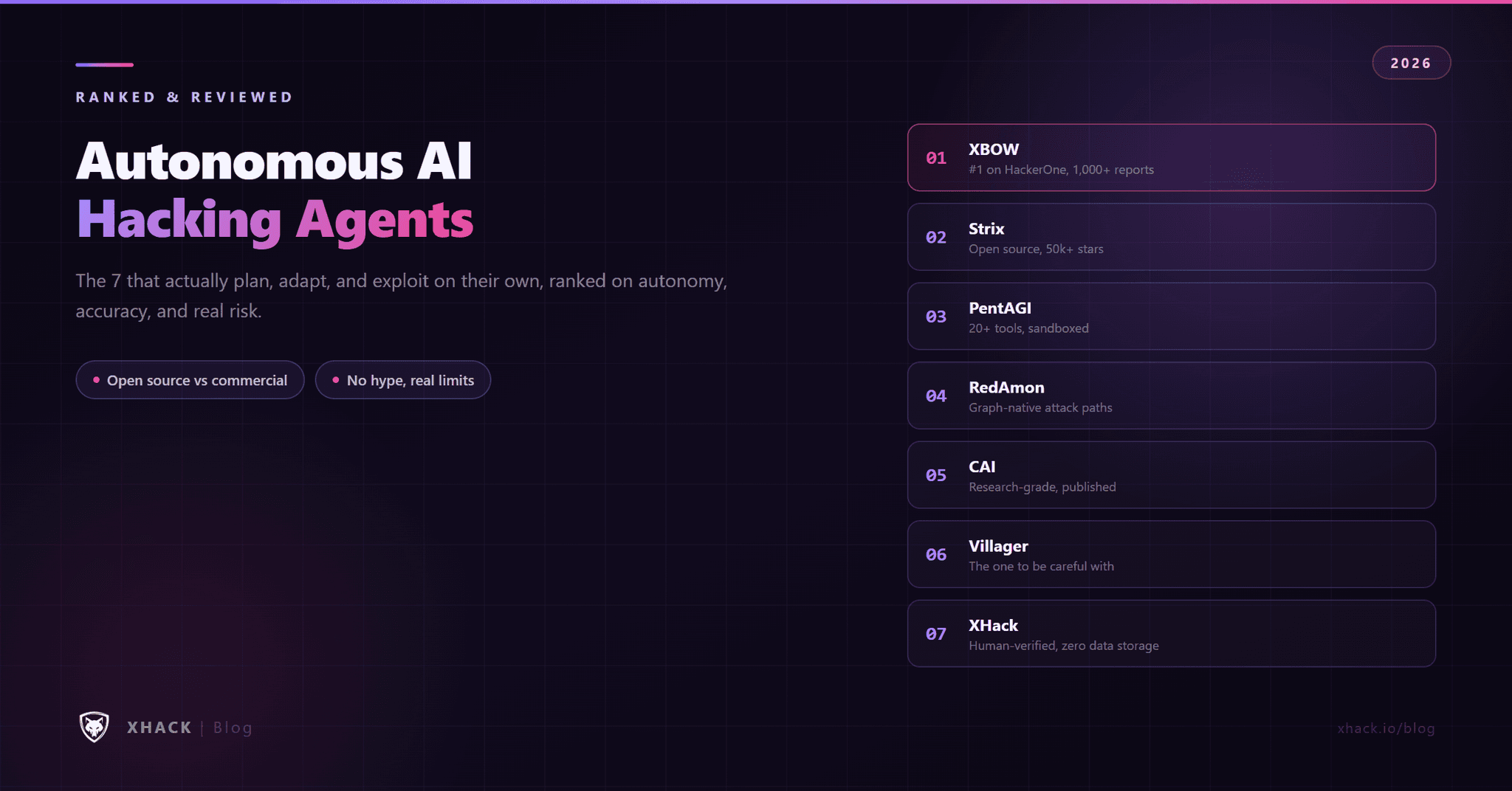
The seven that actually matter in 2026 span a wide range: XBOW (commercial, sits at the top of HackerOne’s leaderboard with over 1,000 submitted reports), Strix (open source, 50,000+ GitHub stars, dynamic PoC validation), PentAGI (open source, 22,000+ stars, 20+ integrated tools in Docker), RedAmon (open source, graph-native attack-surface mapping), CAI (open, research-grade, solves CTF tasks up to 3,600x faster than a human in specific benchmarks), Villager (a Chinese DeepSeek-powered tool researchers are actively worried about), and XHack (human-led testing plus a 15-sub-agent autonomous engine, no data retention). None of them replace a human operator. Every one of them still hallucinates, misses business logic, and needs a person to sign the report.
Every one of these tools claims to be “fully autonomous.” Most of them are lying, or at least stretching the truth.
I run a Synack Red Team account with hundreds of manually reported vulnerabilities, and I’ve spent the last year building an autonomous pentesting agent of my own. So I know exactly how much daylight there is between a marketing page that says “zero human intervention” and a system that actually plans, adapts, and exploits on its own.
Here’s the thing: some of the seven agents on this list genuinely deserve the label. One of them just beat thousands of human bug bounty hunters on a public leaderboard. Another is a DeepSeek-powered tool that researchers compare to Cobalt Strike right before it went from “red team tool” to “ransomware crew’s favorite toy.” And a couple are open-source projects with tens of thousands of GitHub stars that most security teams haven’t heard of yet.
This is the honest breakdown. Not a vendor roundup, not a listicle padded to hit a word count. Real architecture, real numbers, real limitations, and a framework for telling the difference between an autonomous AI hacking agent and automation with better marketing copy.
| Agent | Type | Autonomy Model | Best Known For | Access |
|---|---|---|---|---|
| XBOW | Commercial | Fully autonomous, human-reviewed before submission | #1 on HackerOne’s US leaderboard | Enterprise, by engagement |
| Strix | Open source | Multi-agent “graph of agents,” live steering optional | Working PoCs instead of false positives | Free, Apache 2.0 |
| PentAGI | Open source | Fully autonomous, sandboxed | 20+ integrated tools (nmap, sqlmap, Metasploit) | Free, MIT, self-hosted |
| RedAmon | Open source | Multi-agent with closed-loop remediation | Graph-native attack-surface knowledge | Free, self-hosted |
| CAI | Open source / research | Autonomous with optional human-in-the-loop | Solving CTF tasks up to 3,600x faster than a human | Free, MIT |
| Villager | Commercial (gray market) | Fully autonomous attack-chain orchestration | The tool researchers are actively warning about | PyPI, ~10,000 downloads in 2 months |
| XHack | Commercial + human-led | Autonomous multi-agent, human-verified findings | Human + AI hybrid, zero data retention | $20-$150/mo individual, $560-$3,000+/mo company |
An autonomous AI hacking agent isn’t a single category. It’s a spectrum, and where each of these tools sits on it matters more than whatever the landing page claims.
Most of the industry throws “AI-powered,” “agentic,” and “autonomous” around like they’re interchangeable. They aren’t.
A copilot suggests a command and waits for you to run it. A semi-autonomous tool chains a few steps together but stops for approval at anything risky. A genuinely autonomous AI hacking agent sets its own sub-goals, picks its own tools, reads the raw output, and decides the next move without a human clicking “continue” at every step. It behaves less like a scanner and more like a junior pentester who never sleeps and never gets bored halfway through enumeration.
The architecture behind that behavior is almost always the same shape, regardless of vendor:
What separates a genuinely autonomous AI hacking agent from a fancy wrapper around a scanner is step 4. If the system can’t read its own output and change strategy based on what it finds, it’s automation, not autonomy.
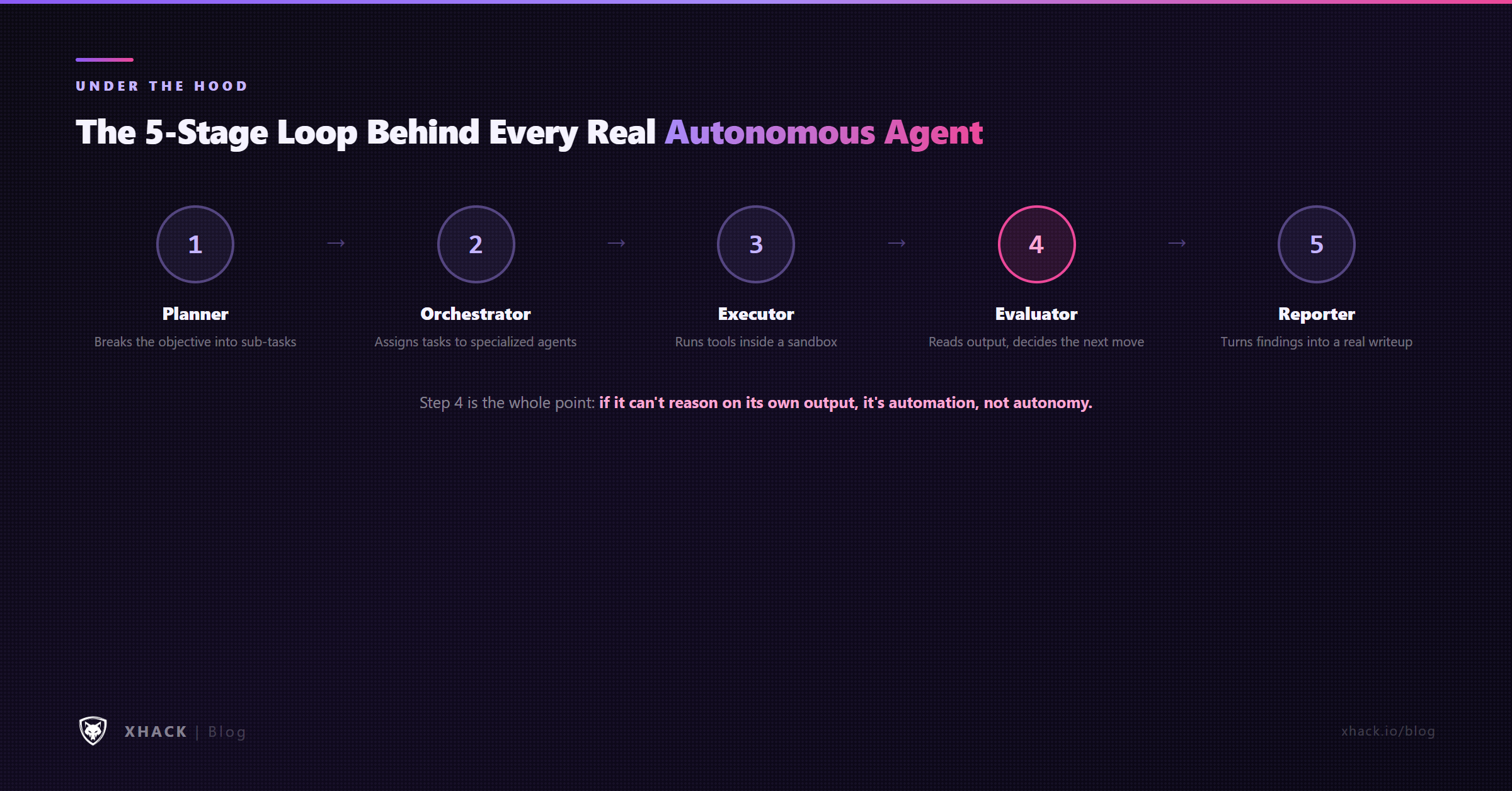
This category didn’t appear overnight. Early “AI pentesting” tools from 2023 and 2024 were mostly LLM copilots bolted onto existing scanners, useful for summarizing output or suggesting a next command, but nowhere near autonomous. The shift happened when teams started giving models real tool access inside a sandbox and letting them run multi-step loops unsupervised. XBOW’s HackerOne result in 2025 is the moment the rest of the industry stopped treating that shift as a demo and started treating it as a genuine category, and the open-source projects on this list (Strix, PentAGI, RedAmon, CAI) all shipped their most capable autonomous versions within roughly a year of that milestone.
I already covered the broader category distinctions in what autonomous penetration testing actually is and how agentic architecture works under the hood. This article is narrower on purpose: the seven specific agents worth knowing about right now, ranked on what they actually do, not what they claim.
XBOW is the autonomous AI hacking agent that made the rest of the industry take this category seriously. Founded by Oege de Moor, the creator of GitHub Copilot and GitHub Advanced Security, XBOW raised a $120 million Series C in early 2026 to scale what is, by public numbers, the most successful autonomous vulnerability-hunting system on the market.
What makes it different: XBOW became the first documented autonomous system to top HackerOne’s US leaderboard, submitting more than 1,000 vulnerability reports in a matter of months and outranking thousands of human researchers. XBOW’s own writeup of the milestone breaks down nearly 1,060 submissions, including 54 critical and 242 high-severity findings in a single 90-day window, and a previously unknown vulnerability in Palo Alto’s GlobalProtect VPN affecting over 2,000 hosts. It’s now deployed at Fortune 500 companies alongside its bug bounty work.
The catch: every finding gets reviewed by a human before submission, which HackerOne’s automated-tools policy requires. Roughly 45% of XBOW’s submissions were still awaiting resolution at the time researchers checked, which tells you something about the volume these agents produce versus how fast human triage teams can absorb it. XBOW is also enterprise-only, no public self-serve pricing, and it’s a closed system, so you’re trusting a black box with your attack surface.
Best for: enterprises that want a bug-bounty-style continuous testing engine and have the budget and trust relationship to hand a black-box agent real access.
Strix is the open-source answer to XBOW, and its GitHub numbers back that up: over 50,000 stars and 6,000+ forks on a tool that only became publicly prominent in late 2025.
What makes it different: Strix uses a “graph of agents” architecture where specialized agents handle recon, exploitation, and post-exploitation in parallel, coordinated through a local dashboard that lets you steer a scan mid-run. It integrates an HTTP interception proxy, browser automation for client-side testing (XSS, CSRF), and a Python runtime for custom exploit development, all running inside Docker sandboxes. The headline feature is “working PoCs, not false positives,” meaning it validates findings dynamically instead of just flagging a pattern match.
The catch: it’s a self-hosted tool, so you’re responsible for your own LLM API costs, sandboxing discipline, and keeping the agents scoped to authorized targets. Being open source and free doesn’t mean free to run at scale; a large multi-agent scan burns real tokens.
Best for: security teams and bug bounty hunters who want an autonomous AI hacking agent they fully control, with CI/CD integration for continuous testing inside their own pipeline.
PentAGI is a fully autonomous, MIT-licensed AI agent system built specifically for penetration testing workflows, with over 22,000 GitHub stars.
What makes it different: PentAGI ships with 20+ integrated security tools out of the box (nmap, Metasploit, sqlmap, and others), each running inside a sandboxed Docker environment, and it supports a wide range of LLM providers, OpenAI, Anthropic, AWS Bedrock, Google AI, Ollama, and DeepSeek, so you’re not locked into one model vendor. The multi-agent coordination is designed to chain a full workflow: recon, discovery, exploitation, and reporting, without a human directing each individual step.
The catch: as with most fully autonomous open-source agents, the public documentation is thinner on the guardrails than on the capabilities. There’s no built-in scope-enforcement layer stopping the agent from wandering past an authorized target if you misconfigure it, so operational discipline is entirely on the operator.
Best for: teams that want a self-hosted, model-agnostic autonomous AI hacking agent and are comfortable running and securing their own Docker-based deployment.
RedAmon is a newer open-source entrant that leans into a genuinely different architecture: a graph-native knowledge base of the attack surface, rather than a flat list of findings.
What makes it different: instead of treating each vulnerability as an isolated data point, RedAmon builds a graph of the target’s assets, relationships, and discovered weaknesses, which lets its agents reason about chained attack paths (this misconfiguration plus that exposed credential equals full compromise) more like a human red teamer connecting dots on a whiteboard. It runs reconnaissance, exploitation, and post-exploitation inside a Kali Linux sandbox, and it includes a closed-loop auto-remediation feature that can suggest or apply fixes for what it finds.
The catch: it’s early and less battle-tested than Strix or PentAGI, with a smaller community and less public benchmark data. Graph-native reasoning is a genuinely good idea for chained exploitation, but “zero human intervention” claims on a young project deserve extra scrutiny until it’s proven at scale.
Best for: teams specifically interested in attack-path visualization and chained exploitation logic, not just a flat vulnerability list.
CAI, built by the Spanish robotics and security research group Alias Robotics, is less a finished product and more a framework for building autonomous AI hacking agents, and it’s backed by real published research instead of just a landing page.
What makes it different: the peer-reviewed CAI paper reports the framework solving CTF challenges up to 3,600x faster than a human in specific tasks, averaging 11x faster overall, while enabling non-experts to find CVSS 4.3-7.5 vulnerabilities at rates comparable to trained professionals during live bug bounty exercises. It’s fully open source under MIT, supports 300+ AI models, and includes a human-in-the-loop mode for teams that want oversight without giving up the automation.
The catch: it’s a framework, not a turnkey product. You’re assembling and tuning agents yourself, which is exactly what makes it powerful for researchers and exactly why it’s the wrong pick if you just want to point an agent at a target and get a report.
Best for: security researchers, academics, and teams building custom autonomous testing pipelines who want a proven, published foundation instead of starting from scratch.
Villager needs to be on this list because it’s the clearest example of why “autonomous AI hacking agent” is a dual-use category, and because ignoring it doesn’t make it less relevant to your threat model.
What it is: released by Cyberspike, a China-based developer group, Villager combines containerized Kali Linux environments with DeepSeek AI models to convert natural-language objectives directly into executable attack chains, no manual tool chaining required. It accumulated roughly 10,000 downloads across Linux, macOS, and Windows in its first two months on PyPI, a legitimate, trusted package repository, which is exactly what worries researchers.
Why it’s a warning, not a recommendation: Villager’s containers are configured to self-destruct and erase logs after 24 hours, a detail security researchers have flagged as a forensics-evasion feature with no legitimate pentesting justification. Straiker’s analysis compares it directly to Cobalt Strike’s trajectory: a tool built for legitimate red teaming that becomes the go-to weapon for less-skilled attackers once it’s easy enough to use. The barrier to sophisticated intrusion dropping this fast, distributed through a trusted channel like PyPI, is the exact dynamic that turns a research tool into an incident report.
Best for: nobody you should be taking advice from on this list. It’s here so you know what “autonomous AI hacking agent” looks like when it’s built without any authorization gate, and so you recognize the pattern if you see Villager-style tooling show up in an incident.
Full disclosure: I built this one, and I’m not going to pretend I’m a neutral observer. I’m also not going to pretend it’s the only good option on this list, because it isn’t, and I’d rather you pick the right tool than pick mine for the wrong reason.
What makes it different: XHack pairs human-led penetration testing (real offensive experience, business logic testing, chained exploits a model still can’t reliably reason through) with an autonomous multi-agent engine that fans out across reconnaissance, vulnerability discovery, exploit chaining, and mobile analysis in parallel, up to 15 specialized sub-agents on a single engagement. It’s bring-your-own-key, supports a 1M-token context window, ships native macOS and Linux apps, and the whole thing runs an autonomous browser engine that navigates and interacts with targets the way a human tester would. I personally ran it through a live YesWeHack CTF (“Deadbolt”) and it solved the challenge autonomously in three minutes.
The privacy angle nobody else on this list has: XHack does not store user data. Pentest chats and session data stay on your own machine, and you can delete them any time, which matters if you’re testing something sensitive and don’t want your findings sitting on a vendor’s servers indefinitely.
The catch, because I said I’d be honest: it’s newer than PentAGI or Strix in the open-source community sense (it isn’t open source at all, it’s a commercial product), and if you want a cheap one-time scan with a cover page, XHack is not the right fit. It’s built for people who actually want the finding validated and the business logic tested, not a checkbox report.
Best for: individuals and companies that want autonomous AI hacking agent coverage backed by a human who’ll actually verify what the agent found, without handing a vendor your raw session data.
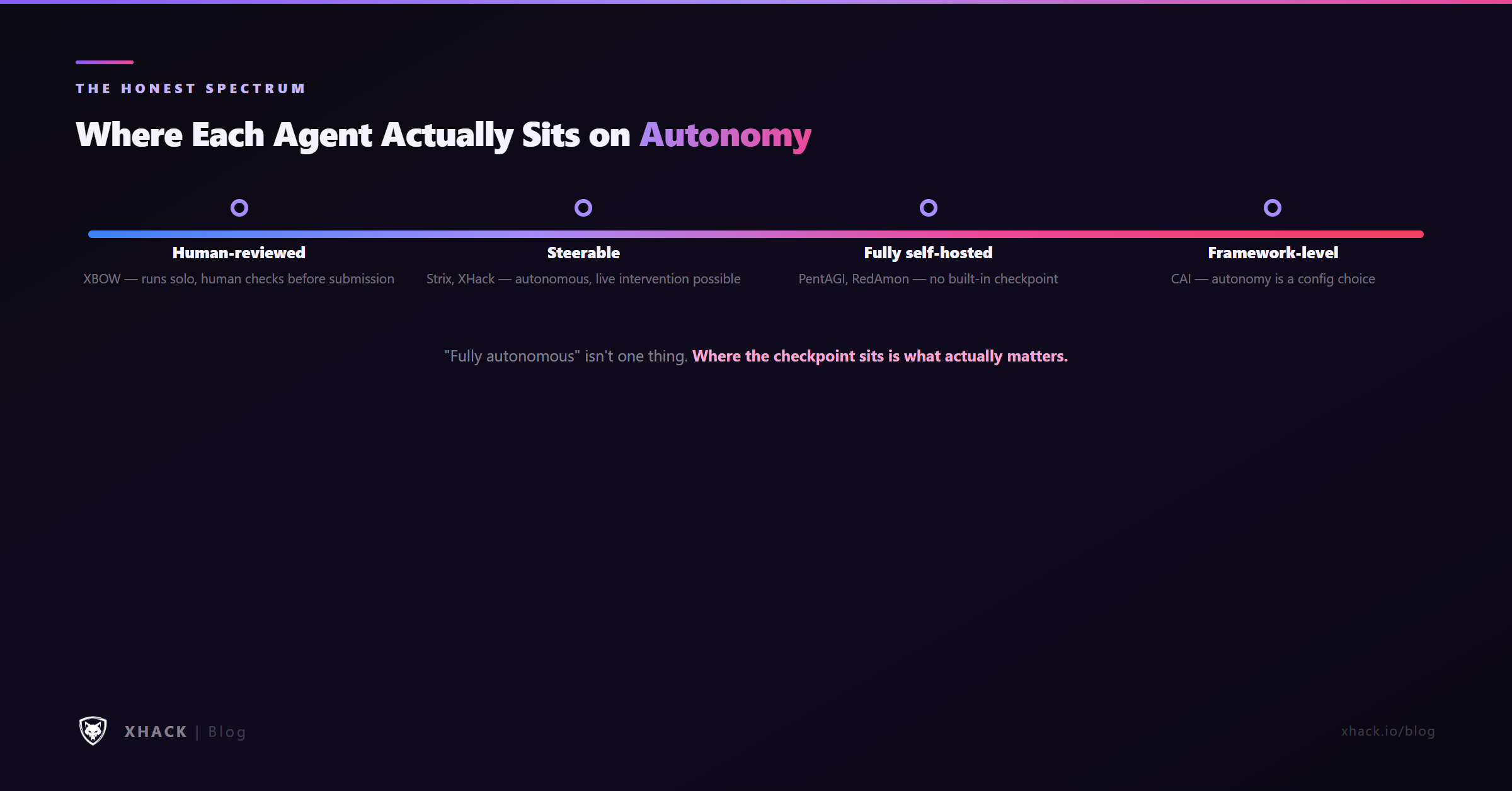
“Fully autonomous” gets claimed by almost every product on this list, but the honest picture is a spectrum, not a binary:
None of these categories are “better” in the abstract. They’re a tradeoff between speed, control, and how much you trust the operator (yourself, your team, or a stranger who downloaded it off PyPI) to keep the agent inside authorized scope.
I’d be lying if I said any agent on this list, including mine, doesn’t have real failure modes. The honest ones:
Continuous bug bounty hunting. XBOW’s whole model proves this out: point an autonomous AI hacking agent at a scope 24/7 instead of running a researcher’s attention span in bursts, and the volume of coverage changes completely. This is also the model most open-source agents like Strix and PentAGI get deployed for by independent researchers.
Internal red team augmentation. Enterprise security teams increasingly use agents like RedAmon or a CAI-based custom build to handle the repetitive first 80% of a red team engagement, recon, enumeration, initial exploitation, so human red teamers can spend their time on the creative 20%: chaining findings into a real business-impact story.
CI/CD pipeline testing. Strix ships GitHub Actions integration specifically so an autonomous AI hacking agent can scan every pull request before it merges, catching regressions a once-a-year pentest would miss for eleven months. This is the strongest argument for autonomous agents over traditional pentesting: code changes daily, testing should too.
Compliance validation between formal audits. A once-a-year PCI DSS or SOC 2 pentest still satisfies the paperwork requirement, but an autonomous agent running continuously in the background catches the misconfiguration introduced in month seven, not month twelve when the auditor shows up.
Training and research. CAI exists largely for this purpose, giving students and researchers a transparent, published framework to study how autonomous exploitation actually reasons, instead of a black box they can only observe from the outside.
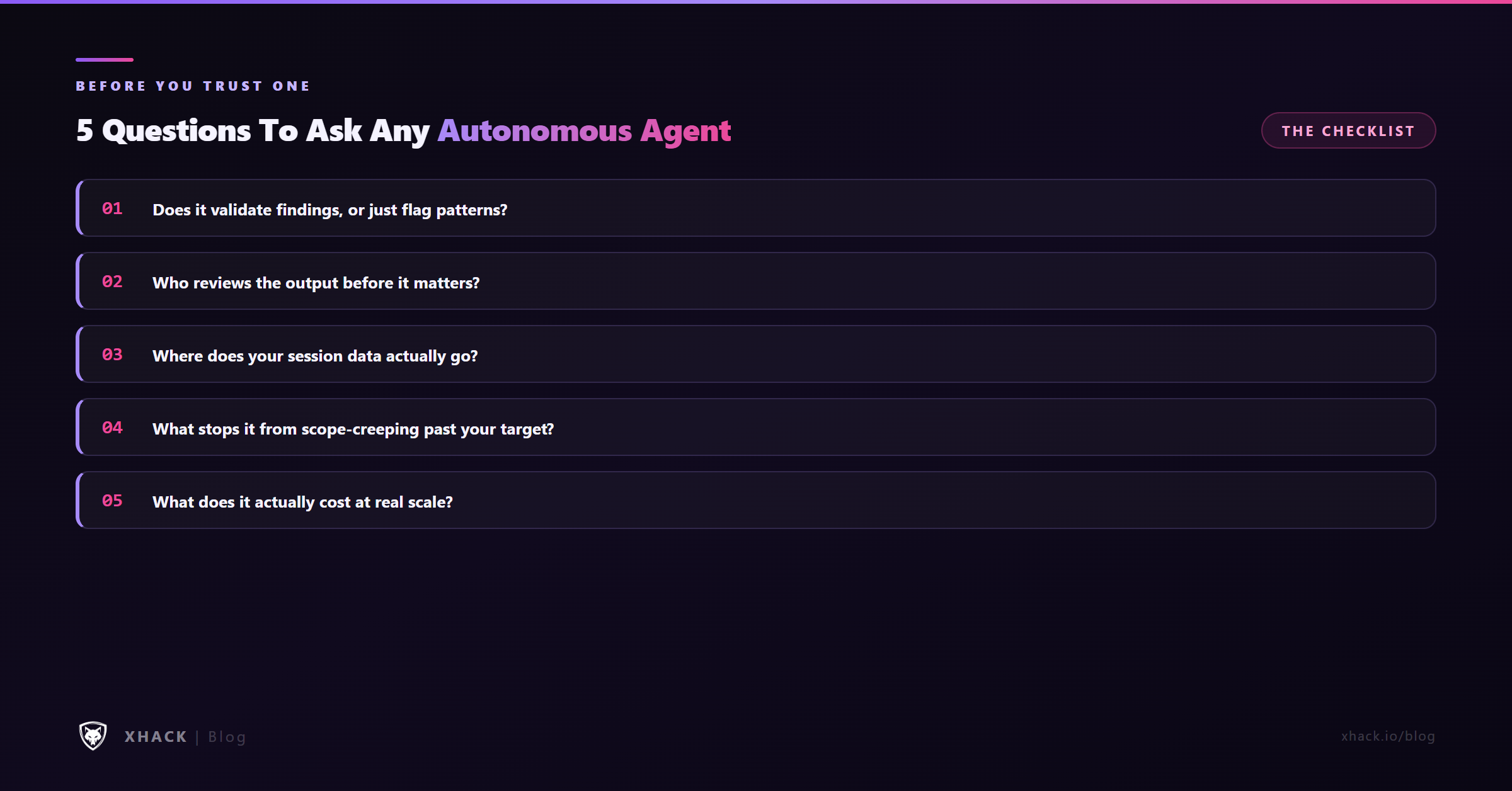
Before you pick one, run it through these questions:
So yeah, here’s where I talk about what XHack brings to the table, and I’ll try not to oversell it.
XHack combines three things most of the tools on this list offer separately: expert human penetration testing, an autonomous AI agent that actually does the multi-step reasoning I described above, and a continuous security platform that keeps watching between engagements instead of going quiet until the next scheduled test.
The human side handles what the agents on this list still can’t: business logic flaws, chained exploits that require creative reasoning across multiple systems, and the judgment call on whether a finding is actually exploitable in your specific environment. The AI side handles breadth: autonomous multi-agent recon, browser-based live vulnerability hunting, and exploit chaining at machine speed, running continuously instead of once a year.
Findings don’t just land in a PDF and disappear. They feed into XHack’s SOC and threat-detection layer, so a vulnerability the autonomous agent found last month is still being monitored, not just reported and forgotten.
And the privacy point matters more here than in most product categories: XHack does not store your pentest chats or session data. It stays on your machine, and you control it. When you’re running an autonomous AI hacking agent against your own infrastructure, that’s not a nice-to-have, it’s the difference between a tool you trust with sensitive findings and one you don’t.
If you want a cheap, one-time scan with a cover page, we’re genuinely not the right fit, and I’d rather tell you that now than after you’ve paid for it. Individual and bug-hunter plans run $20-$150/month; company-wide AI platform access is a separate track starting around $560/month; and full human-led VAPT engagements are scoped individually, typically $2,500-$12,000 depending on the target. Both AI platform tracks come with a 7-day free trial, no credit card required, so you can run the agent for real before paying anything. Want a quote, or want to talk it through first? A free consultation costs nothing, even if it turns out XHack isn’t the right fit for what you need. Brutal honesty is kind of our thing.
An autonomous AI hacking agent is a system that performs penetration testing tasks, reconnaissance, vulnerability discovery, exploitation, and reporting, by planning its own approach and adapting based on what it finds, rather than executing a fixed script like a traditional scanner. The defining trait isn’t speed, it’s the ability to read its own output and change strategy mid-task without a human directing every step.
Yes, when used against systems you own or have explicit written authorization to test, exactly like traditional penetration testing. Running any of the agents on this list, including open-source tools like Strix or PentAGI, against a target you don’t have permission to test is illegal under computer fraud laws in most jurisdictions, regardless of whether a human or an AI initiated the action.
Not yet, and not for the foreseeable future. Even XBOW, the most successful autonomous agent by public benchmark, has every finding reviewed by a human before it’s submitted anywhere. Agents excel at breadth, technical pattern-matching, and running continuously at a scale no human team can match, but they still struggle with business logic flaws, novel attack chains, and the judgment calls that come from understanding what a system is supposed to do, not just how it’s built.
CAI is the strongest starting point for learning how these systems work, since it’s an open research framework with published documentation and a human-in-the-loop mode that lets you watch and understand each decision the agent makes. Strix is the better pick if you want a more turnkey, production-ready open-source tool with an easier setup for actual testing work rather than research.
It ranges from free (Strix, PentAGI, RedAmon, and CAI are all open source, though you’ll pay for your own LLM API usage) to enterprise-only commercial pricing that isn’t publicly listed (XBOW). XHack’s individual AI plans run $20-$150 per month, company-wide platform access starts around $560 per month, and fully human-led VAPT engagements are scoped per project, typically $2,500-$12,000.
Treat it as a tool to understand, not to run. Villager is technically available on PyPI, but its self-destructing, log-erasing containers serve no legitimate pentesting purpose, and security researchers have directly compared its trajectory to Cobalt Strike’s path from red team tool to widely abused attacker framework. If you’re evaluating autonomous AI hacking agents for real work, choose one of the other six on this list. If your “real work” is bug bounty specifically, our guide to running an AI agent through an actual bug bounty workflow is the more direct read.
The autonomous AI hacking agent category split into two real camps in 2026: tools built with authorization, oversight, and accountability baked in (XBOW, Strix, PentAGI, RedAmon, CAI, XHack), and tools built without any of it, where Villager is the clearest warning sign of what that looks like at scale.
None of the legitimate seven are magic. They hallucinate, they miss business logic, and every one of them still needs a human somewhere in the loop, whether that’s XBOW’s pre-submission review or XHack’s human-verified findings. What actually separates a good choice from a bad one isn’t the autonomy claim on the landing page, it’s whether the agent validates what it finds, who’s accountable when it’s wrong, and where your data ends up when the scan is done.
If you’re evaluating one for real work, start with the five questions in the evaluation section above, not the marketing page. And if you want to see what a human-verified autonomous AI hacking agent looks like in practice, book a free consultation and I’ll walk you through it myself, brutal honesty included.
Categories
Related articles