Table of contents
24
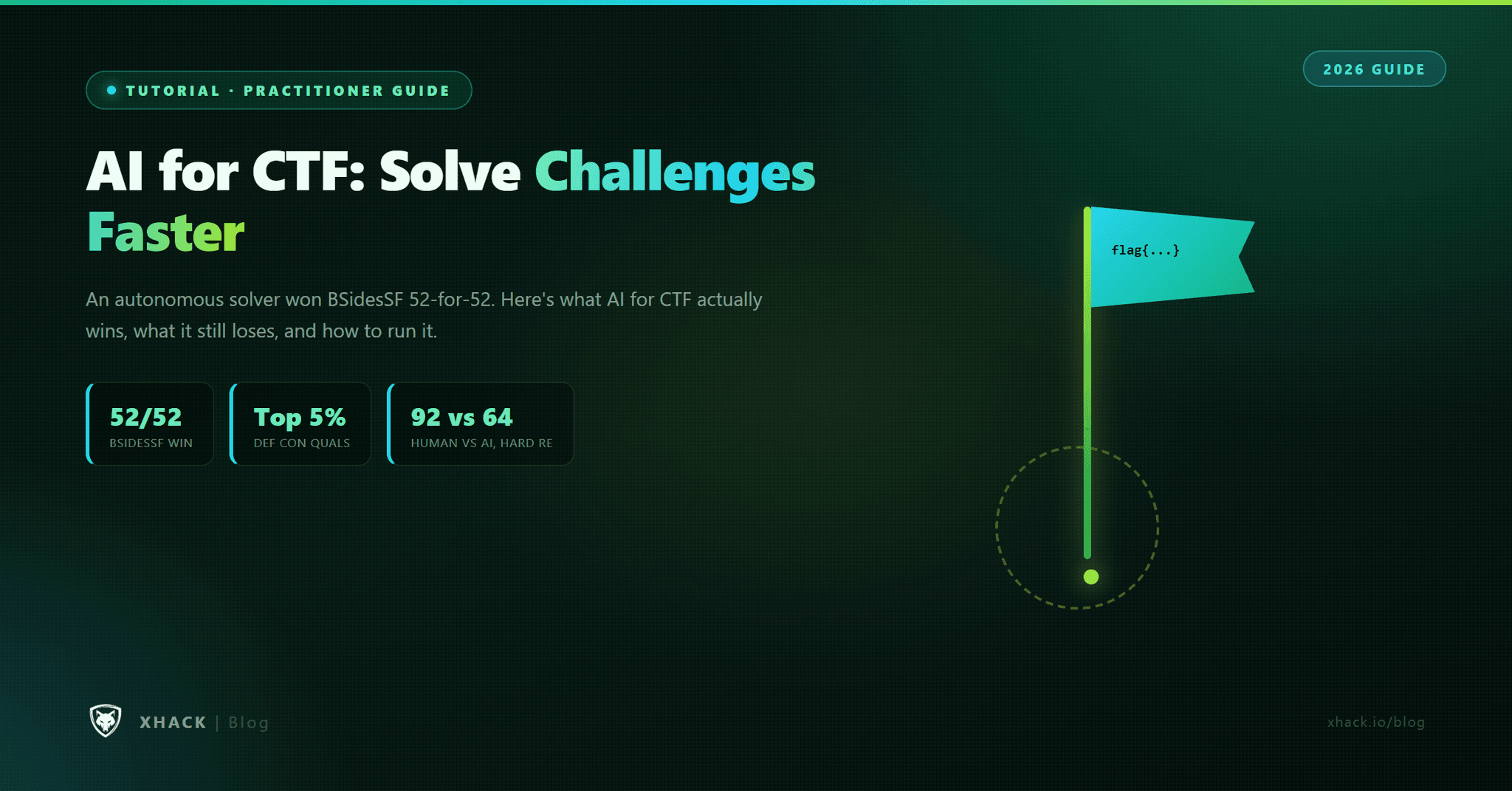
Read this in 30 seconds: AI for CTF went from novelty to standard toolkit in about eighteen months. An autonomous solver won BSidesSF 2026 outright, 52 out of 52 challenges, and a university-built agent placed in the top 5 percent of DEF CON’s qualifier field. On cryptographic reverse engineering, the strongest model solves 41 percent of challenges outright, against 92 percent for human experts, so the gap is real and specific: AI wins on speed and breadth, humans still win on judgment and the hard 10 percent.
This guide covers what AI for CTF actually does well across pwn, reverse engineering, web, and crypto, where it still falls apart, and exactly how to instruct an agent like XHack AI through a real challenge without it turning into false-flag guessing.
Easy-to-medium CTF challenges are a solved problem for AI now. What took a skilled player two hours a year ago takes an agent two minutes today. That sentence alone should change how you use your next event, whether you’re a player trying to place higher or an organizer trying to design a competition AI can’t just steamroll.
This is not hype. It is documented, competition-verified, and increasingly the default rather than the exception. This guide is the honest, practitioner-level picture of AI for CTF in 2026: what it wins, what it still loses to a sharp human, and how to actually run an agent through a live challenge.
Let’s be precise, because “AI for CTF” covers a wider range of tools than the headlines suggest.
At the simple end, AI for CTF means asking a chatbot to explain a decompiled function or suggest a next step, a copilot, not an operator. At the capable end, it means a fully autonomous agent that receives a challenge, spins up its own tooling in an isolated container, reasons through recon, exploitation, and flag extraction, and submits without a human touching a keyboard. Most of the interesting 2026 results come from the second category.
The core mechanism is the same one that makes AI useful in real-world penetration testing: an agent that can read a binary or a web app, form a hypothesis, run a tool, observe the result, and revise its approach, in a tight loop, much faster than a human can type. CTF challenges are, in a real sense, the perfect training ground for this because they are self-contained, have a verifiable success condition, and reward exactly the kind of fast hypothesis-testing loop AI agents are good at.
That self-contained, verifiable nature is also why CTF results are unusually trustworthy as a signal of real capability, compared to a lot of AI benchmark claims. A CTF flag either validates or it doesn’t. There is no ambiguous grading, no cherry-picked demo, no room for a vendor to quietly redefine success. When an autonomous solver wins a real, judged, public competition against human teams who showed up to win, that is about as hard a data point as this industry produces. It is one reason AI for CTF results get cited so heavily in broader conversations about how far offensive AI capability has actually come, beyond CTF itself.
Good enough to win outright, and the receipts are public.
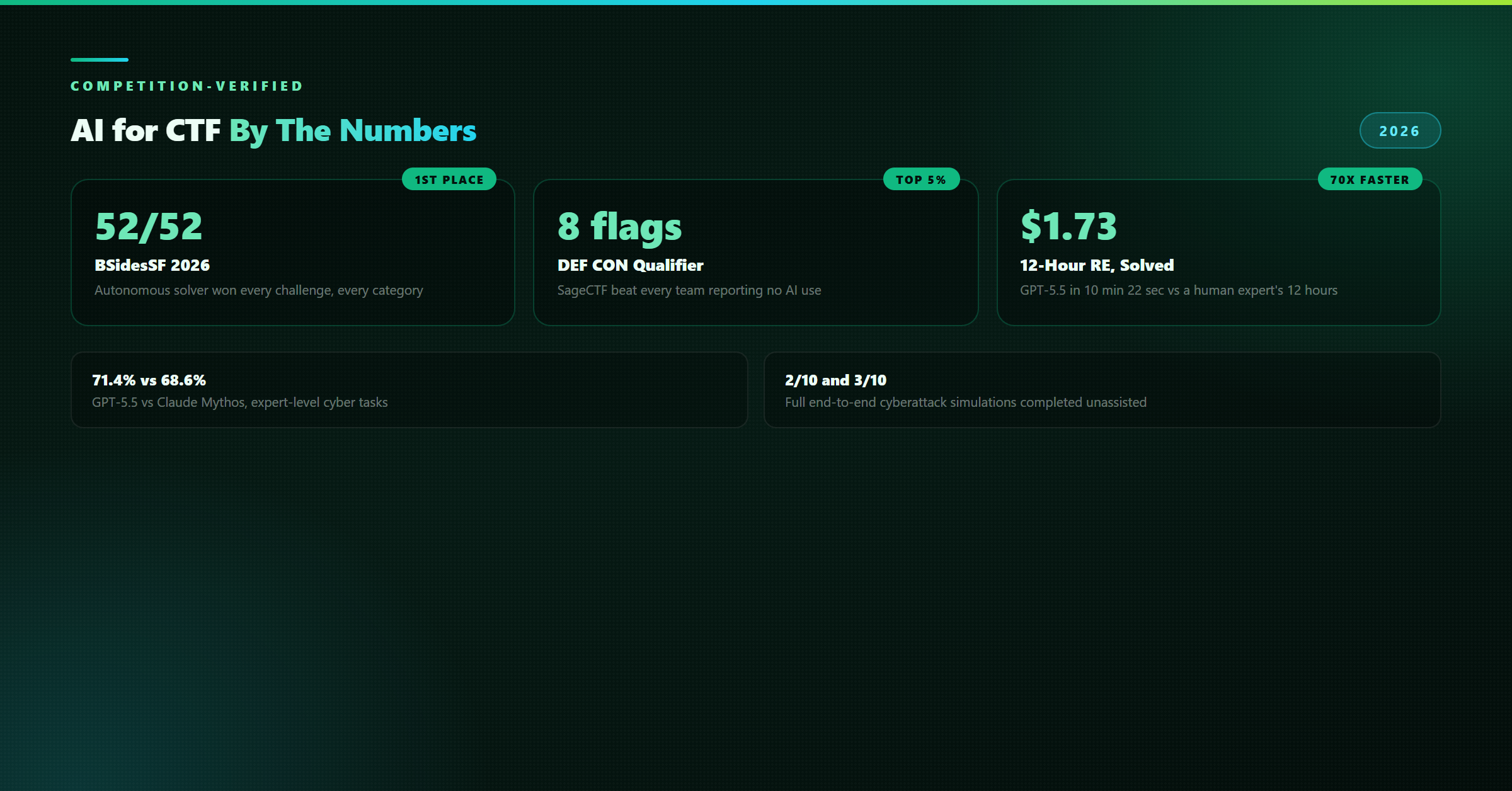
At BSidesSF 2026, an autonomous solver called ctf-agent, built by members of a top-ranked human CTF team, took first place by solving all 52 of 52 challenges, across pwn, reverse engineering, crypto, forensics, web, and misc categories, and won the competition’s $1,500 prize. It worked by racing multiple models, Claude Opus, GPT-5.4 variants, and specialized coding models, against each challenge in parallel, with the first solver to find the flag winning that round.
At the DEF CON 34 online qualifier, a research system called SageCTF, built by teams at UC Santa Barbara and UC Berkeley, recovered 8 flags and placed in the top 5 percent of all 686 scored teams, outperforming every team that self-reported using no AI assistance at all.
The raw model numbers back up why this works. On expert-level cyber tasks, GPT-5.5 scored 71.4 percent and Claude Mythos scored 68.6 percent. Both models have now completed a full end-to-end simulated cyberattack unassisted, GPT-5.5 in 2 of 10 attempts and Claude Mythos in 3 of 10. And on raw speed, GPT-5.5 solved a reverse-engineering challenge estimated to take a human expert 12 hours in 10 minutes and 22 seconds, for $1.73 in API cost.
That is the honest headline: AI for CTF is not “pretty good now.” In competitive, judged, public events, it is already winning.
On the hardest 10 percent, consistently, and the failure modes are specific enough to plan around.
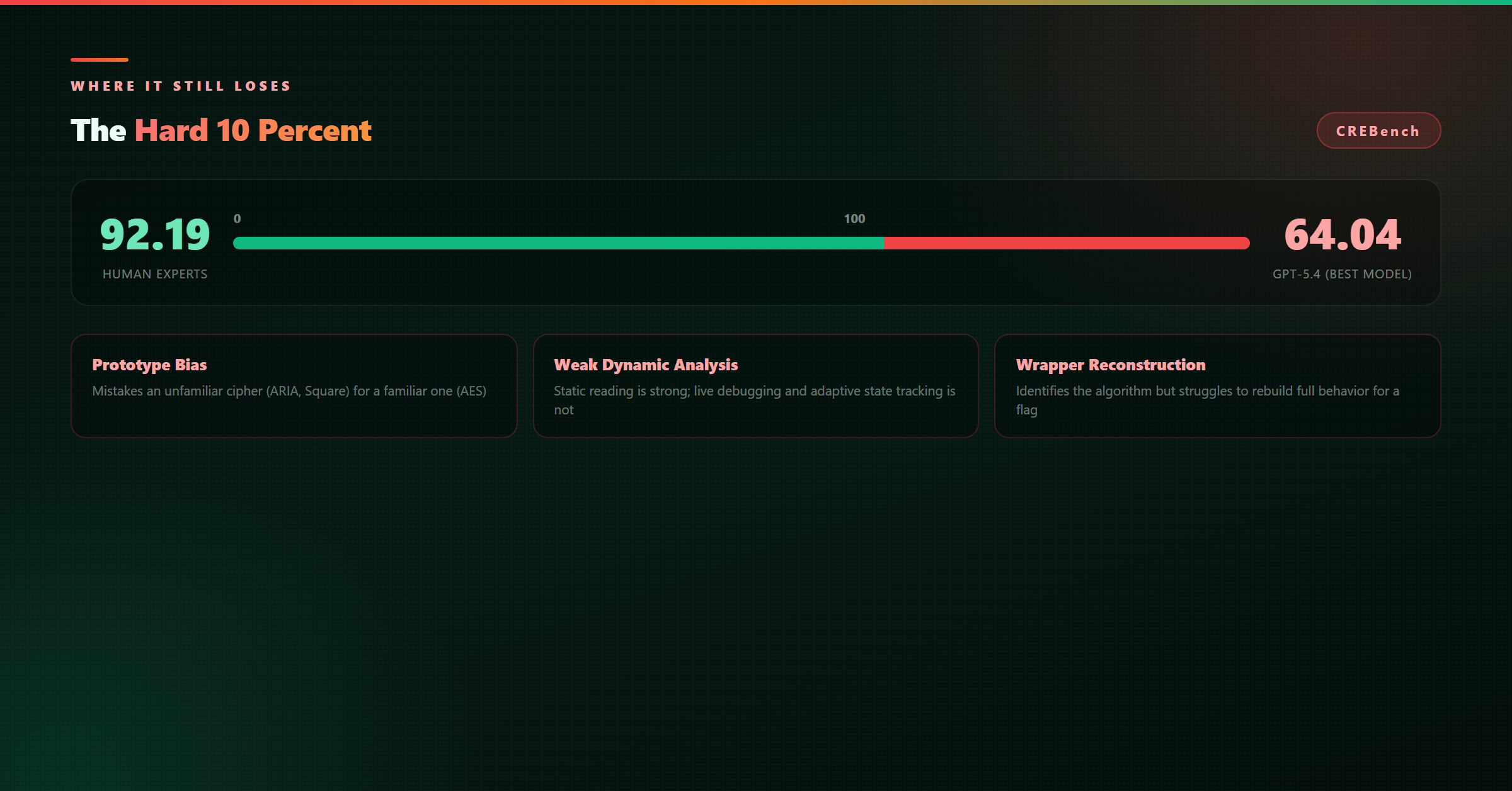
The clearest data point comes from CREBench, a 432-challenge benchmark specifically testing cryptographic binary reverse engineering. The strongest model tested, GPT-5.4, achieved a 41.0 percent perfect-solve rate. Claude-Sonnet-4.6 reached 28.9 percent. Human experts, on the same benchmark, averaged 92.19 out of 100, against GPT-5.4’s 64.04. That is not a small gap, and the researchers identified exactly where it comes from.
Prototype bias. Models tend to collapse an unfamiliar cryptographic algorithm onto a familiar one they’ve seen more of in training, mistaking ARIA or Square for AES rather than preserving genuine uncertainty about an unusual structure. A human expert holds that uncertainty. A model often guesses confidently wrong.
Weak dynamic analysis. Static reasoning, reading code and inferring behavior, is comparatively strong. Actually running a debugger, stepping through execution, and adapting based on live program state is a relative weakness, and the research notes that excessive, unfocused debugger use is itself a signal an AI for CTF attempt has stalled.
Wrapper-level reconstruction. Models are decent at identifying the core algorithm inside a binary. They fall off sharply when asked to reconstruct the full behavior around it, custom padding, key derivation wrappers, obfuscation layers, well enough to actually recover a flag. Getting the concept right and getting the flag are different tasks, and the second one is where AI for CTF still loses to a patient human.
The practical read: AI for CTF crushes anything that resembles a known pattern executed at speed. It struggles on genuinely novel construction, the kind of challenge designed specifically to not resemble anything in a training set. That is exactly why competitive CTF design in 2026 is shifting.
No, and knowing the spread changes how you should prep for each one.
| Category | AI for CTF strength | Why |
|---|---|---|
| Web exploitation | Very strong | Well-documented patterns, fast automated recon, huge training data overlap |
| Crypto (standard) | Strong | Known algorithms and known attack classes are largely solved |
| Crypto (novel construction) | Weak | Prototype bias; models default to the nearest familiar cipher |
| Reverse engineering (static) | Strong | Reading disassembly and inferring logic plays to model strengths |
| Reverse engineering (dynamic) | Moderate | Live debugging and adaptive state tracking is a documented weak spot |
| Pwn / binary exploitation | Moderate to strong | Classic patterns (stack overflow, ROP) are fast; novel primitives are not |
| Forensics / OSINT / misc | Strong | Broad pattern matching and search-heavy tasks suit AI well |
Tools built specifically for this space reflect that spread. Shannon AI reports covering all six major categories and scoring 96 percent on the DarkEval benchmark for offensive security challenges. Open-source Agent Skills packages now ship pre-built workflows spanning web exploitation, binary pwn, crypto, reverse engineering, forensics, and OSINT, so teams don’t have to build category-specific tooling from scratch.
Crowded, fast-moving, and split between three distinct approaches, and knowing which one you’re looking at matters before you commit a competition to it.
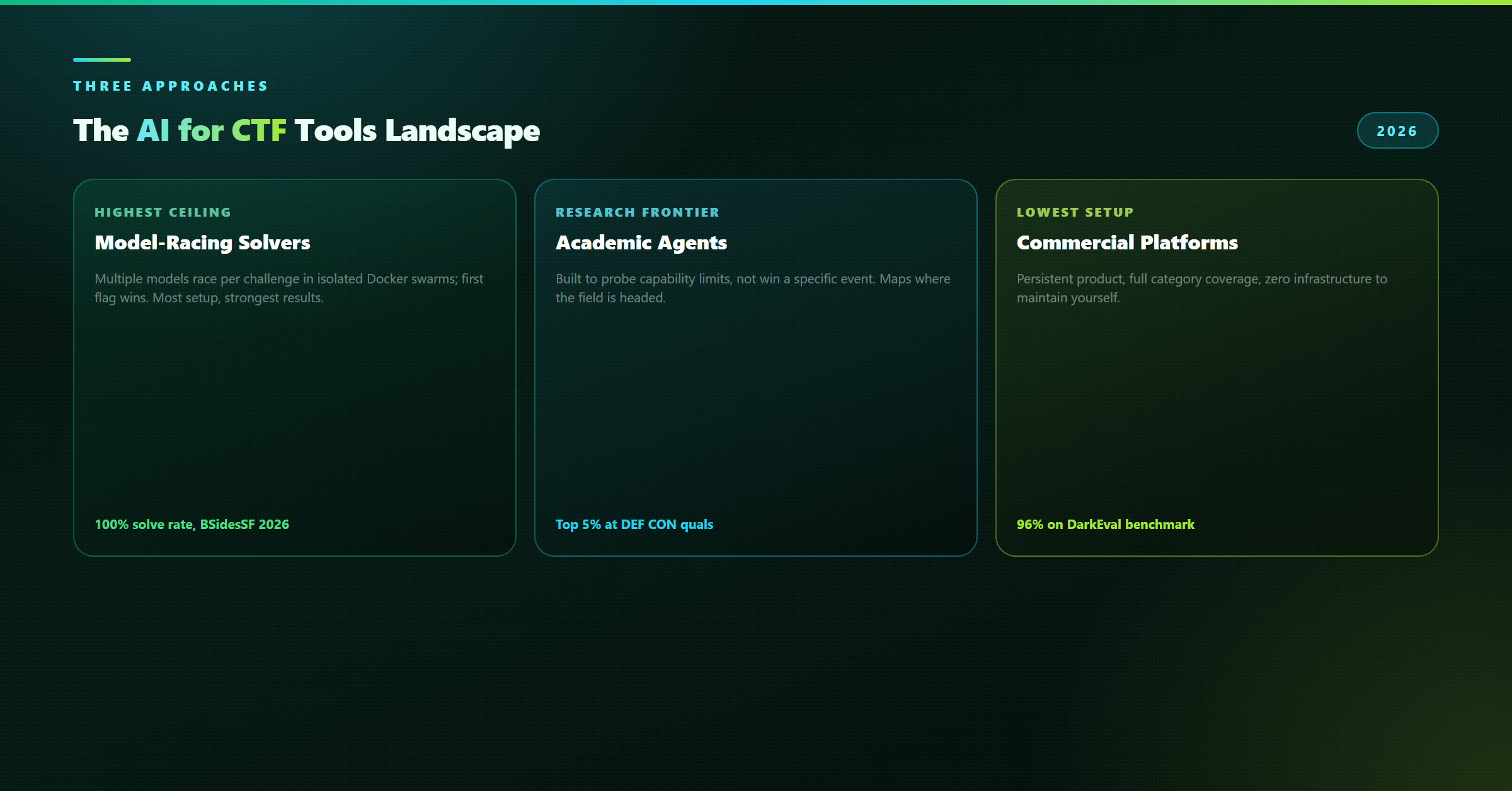
Parallel model-racing solvers. The BSidesSF 2026 winner, ctf-agent, exemplifies this approach: a coordinator LLM manages the overall competition while multiple solver “swarms” attack each challenge simultaneously, different models racing in parallel, with the first to find a flag winning that round. Each solver runs in an isolated Docker container loaded with binary analysis, exploitation, cryptography, forensics, steganography, and web-testing tools. This is the highest-performing pattern documented so far, reporting a 100 percent solve rate across every category at that event.
Research-grade autonomous agents. Systems like SageCTF, built by academic teams specifically to probe how far agentic reasoning can go, prioritize depth over breadth. These are less about winning a specific event and more about mapping the actual capability frontier, which is exactly why SageCTF’s top-5-percent DEF CON qualifier finish is treated as a meaningful research result rather than just a leaderboard entry.
Commercial, always-on platforms. Tools like Shannon AI package category coverage, web exploitation, pwn, reverse engineering, and cryptography, into a persistent product rather than a competition-day script, reporting a 96 percent score on the DarkEval offensive-security benchmark. Open-source Agent Skills packages take a lighter version of the same idea, shipping pre-built workflows for each category that plug into any agent supporting the Agent Skills spec, Claude Code included.
The practical difference for a team deciding what to actually run: model-racing solvers need the most setup, several API keys, Docker, and orchestration code, but currently post the strongest competitive results. Commercial platforms trade some of that raw performance for zero setup and ongoing support. Research agents are worth watching for where the field is headed, but aren’t built to be a plug-and-play team tool yet.
Here is the practical workflow for directing an agent like XHack AI through a real challenge, category by category. This assumes an authorized competition or a legal, sanctioned CTF environment.
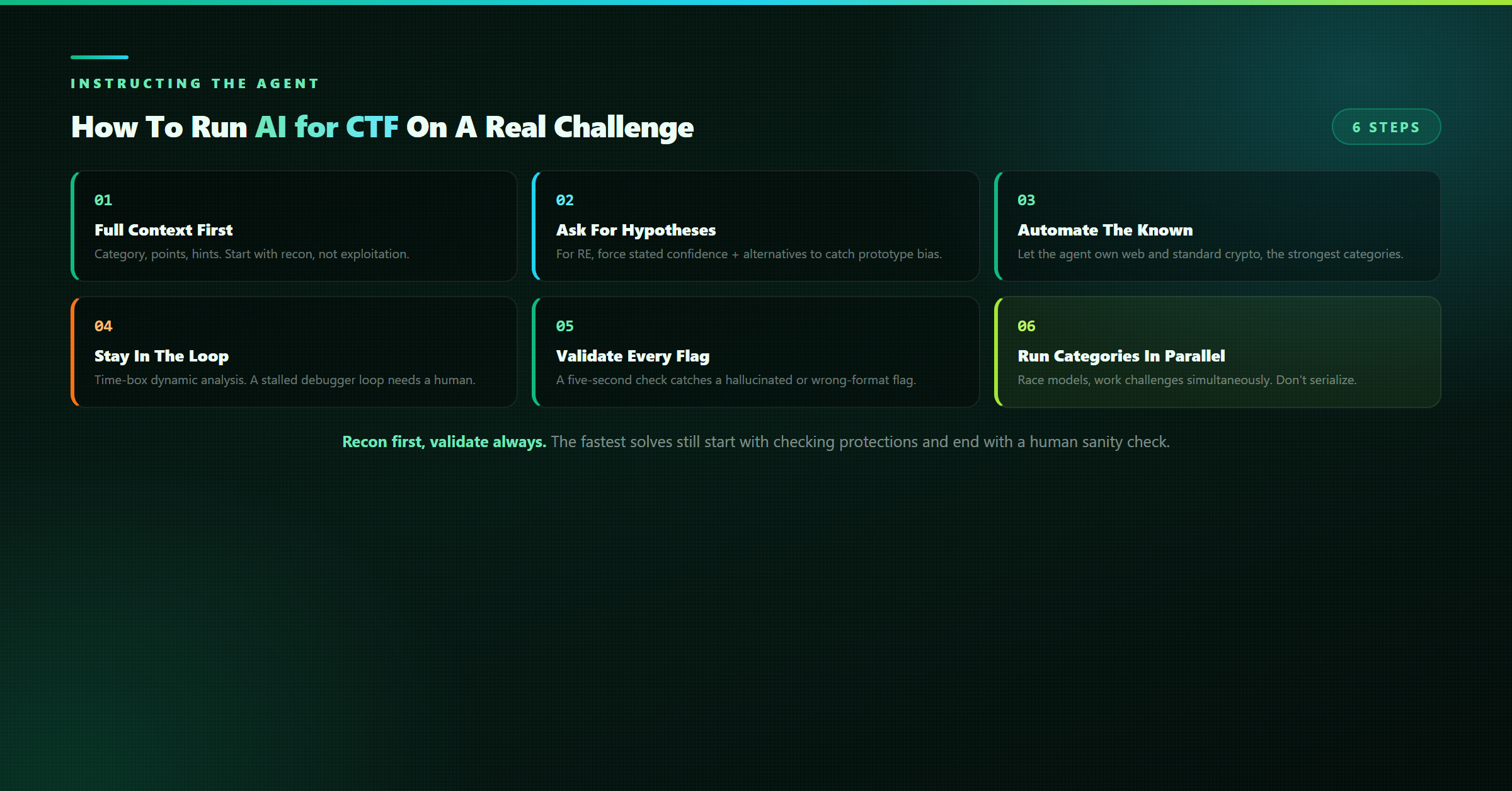
Don’t feed a binary or a URL with no framing. A strong opening instruction names the category, the point value, and any hints the challenge gives:
“This is a 400-point pwn challenge. Here is the binary and the remote connection string. Start with recon: architecture, protections enabled (NX, ASLR, canaries), and any obvious entry points before proposing an approach.”
Starting with recon and protection analysis, rather than jumping straight to exploitation, is what separates a fast solve from a wasted hour.
Given the documented prototype-bias problem, direct the agent to state its confidence and alternatives explicitly:
“Identify the cryptographic primitive used in this function. If it resembles a known algorithm, state your confidence and name at least one plausible alternative before committing.”
This single instruction catches a meaningful share of the AES-vs-ARIA style mistakes before they cost you the round.
Web exploitation and standard crypto attacks are exactly where AI for CTF is strongest. Direct it to handle the mechanical work, payload crafting, endpoint enumeration, known-attack-class testing, while you stay focused on anything that looks structurally unusual.
Because live debugging is a documented weak point, don’t let the agent run unsupervised debugger sessions indefinitely. Set a turn limit or a time box, and if it’s still cycling through the debugger without new information after a few minutes, that is your signal to step in, not a signal to let it keep going.
Never submit a flag an agent proposes without a sanity check, especially under a scoring system with submission penalties. A five-second human glance at the output catches a wrong-format or hallucinated flag before it costs you points.
The competition-winning approach at BSidesSF 2026 leaned heavily on parallelism, racing multiple models against a challenge and running different challenges simultaneously. If you have the tooling for it, don’t serialize; let an agent work the next category while you validate the last one.
Depends entirely on how often you compete and how much engineering time you’re willing to spend on tooling instead of solving.
Build your own if you compete often and have engineering capacity. The highest documented results in 2026 came from a custom-built, parallel model-racing solver, and teams with the skill to build and maintain that kind of orchestration get the strongest ceiling. The tradeoff is real setup cost: multiple API keys across providers, Docker infrastructure, and ongoing maintenance as models and challenge formats change.
Buy a commercial platform if you want reliable coverage without the engineering overhead. A tool like Shannon AI trades some of the raw ceiling of a custom multi-model swarm for zero setup, broad category coverage out of the box, and someone else maintaining the tooling as models update. For a team that competes occasionally or wants AI for CTF assistance without a dedicated infrastructure person, this is the more realistic starting point.
Use open-source skill packages if you want a middle ground. Pre-built Agent Skills for CTF categories plug into an agent you already run, giving you category-specific tooling without building an entire orchestration system from scratch. This is the lowest-commitment way to test whether AI for CTF assistance actually helps your specific team before investing further.
Whichever path you pick, the categories where the tooling matters least are the ones AI already handles well on its own, web exploitation and standard crypto. The categories where investing in better tooling pays off most are dynamic reverse engineering and novel pwn primitives, exactly where the documented failure modes live.
There is also a hybrid option worth naming explicitly: many of the strongest human CTF teams in 2026 are not choosing between AI and human effort at all, they are running both simultaneously and dividing labor deliberately. Let AI for CTF tooling burn through the easy and medium challenges across every category in the opening hour, freeing your strongest human solvers to focus exclusively on the two or three hardest problems from the start, instead of triaging through easy points first. That division of labor, not a pure build-versus-buy choice, is increasingly how the top-placing teams actually operate.
Treating every category as equally solved. Web and standard crypto are close to automatic. Novel reverse engineering is not. Budget your human attention accordingly instead of spreading it evenly.
Letting the agent guess flags blindly. Submission penalties exist for a reason, and an unchecked agent will happily submit a plausible-looking wrong answer with full confidence.
Ignoring the debugger-loop signal. If an AI for CTF attempt has been stepping through a debugger for ten minutes with no new findings, that is a stall, not progress. Intervene.
Running one model when you could race several. The competition data is consistent: parallel multi-model racing outperforms betting on a single model, especially under time pressure.
Skipping the recon step to save time. Agents that jump straight to exploitation without checking binary protections or app architecture waste more time backtracking than they save.
So yeah, here’s the dedicated brand section. Since this whole guide is about where AI for CTF actually helps and where it doesn’t, here’s our honest take.
XHack AI applies the same multi-agent, tool-driven architecture that works in competitive CTF to real authorized security work. Specialized agents handle reconnaissance, exploit development, and validation in parallel, the same pattern that won BSidesSF 2026 outright, coordinated rather than run as one generalist model trying to do everything.
Where XHack AI differs from a pure CTF solver is the validation layer. A competition rewards speed and a submitted flag. A real engagement needs a defensible finding. XHack AI routes results through human review before they reach a report, which is exactly the check this guide recommends for CTF flag submissions, just applied to production security work instead of a scoreboard.
Here’s what privacy-conscious teams care about. XHack does not store your user data, and it is privacy-focused by design. Your session data and chat history stay on your own local computer, and you can delete them any time.
Now the honest limit. XHack AI is built for authorized web and API security work, not CTF competition play specifically, and it inherits the same category strengths and weaknesses documented here: strong on web and standard crypto patterns, more human-dependent on genuinely novel reverse engineering. If you’re prepping a CTF team, a dedicated CTF-focused tool with built-in category tooling is the better fit; if you’re doing authorized professional security testing, that’s exactly XHack AI’s lane.
If you want more background, our guide to AI exploit development covers the same speed-versus-judgment tradeoff in a professional pentest context, and our deep dive on AI memory corruption exploitation covers the hardest category this guide touches on, in full technical depth.
Want to know whether an AI agent fits your workflow, competitive or professional? Book a free consultation and we’ll tell you straight.
Strong enough to win competitions outright. An autonomous solver took first place at BSidesSF 2026 by solving all 52 challenges, and a university-built agent placed in the top 5 percent of DEF CON’s 686-team qualifier field. On expert-level cyber benchmarks, top models score around 70 percent, and reverse-engineering tasks that take a human 12 hours can be solved in about 10 minutes. The gap that remains is on genuinely novel, hard challenges, where human experts still average roughly 92 percent against AI’s 64 percent on the toughest reverse-engineering benchmark.
Web exploitation, standard cryptography, and forensics or OSINT tasks are where AI for CTF is strongest, because they rely on well-documented patterns and fast automated recon. Reverse engineering is strong on static analysis but weaker on dynamic, live-debugging work, and pwn is fast on classic patterns like stack overflows but slower on genuinely novel exploitation primitives. Match your prep time to where the gap is real.
Yes, on easy-to-medium challenges, routinely. On hard, especially novel reverse-engineering or cryptography challenges, AI for CTF agents still fall well short of human experts, missing on prototype bias, where they mistake an unfamiliar algorithm for a familiar one, and struggling with dynamic analysis and full behavioral reconstruction needed to actually recover a flag rather than just identify the general approach.
There is no single best option; it depends on how you want to run it. Purpose-built CTF solvers, like the open-source ctf-agent that won BSidesSF 2026, use parallel multi-model racing across specialized Docker environments. Commercial platforms like Shannon AI report broad category coverage and strong benchmark scores. The strongest competitive results in 2026 have consistently come from running multiple models in parallel against each challenge rather than relying on any single model.
Many already are. Jeopardy-style contests, where challenges sit static and any competitor can attempt them independently, favor AI’s speed advantage. The security community has been shifting toward Attack & Defense formats, which demand adaptive, real-time reasoning under pressure, a mode that still leans more heavily on distinctly human judgment and creativity than static challenge-solving does.
No, but it is forcing the format to evolve. Static, Jeopardy-style challenges that any competitor can attempt independently favor AI’s speed advantage, and organizers increasingly know it. The shift toward Attack & Defense formats, live, adversarial, and demanding adaptive reasoning under real-time pressure, is a direct response, since that mode still rewards the creativity and judgment that AI for CTF has not caught up on. Competitions aren’t disappearing; the skills they test are shifting toward the parts of security work AI genuinely struggles to replicate.
Far less than a comparable human effort in raw hours, though setup cost varies by approach. A single reverse-engineering solve that would take a human expert 12 hours cost about $1.73 in API usage for a leading model. A full parallel model-racing setup, running several models simultaneously across many challenges over a multi-hour event, costs more in aggregate API spend but still typically comes in well under the cost of additional human team members, and commercial platforms bundle that cost into a subscription instead of metered API usage.
AI for CTF crossed from “interesting experiment” to “the thing that just won the competition” over the course of 2025, and the data backs it up at every level: a 52-out-of-52 outright win, a top-5-percent DEF CON qualifier finish, and reverse-engineering solves that cost under two dollars.
The honest caveat matters just as much as the headline. On the hardest, most novel challenges, especially reverse engineering and cryptography that don’t resemble anything in a training set, human experts still hold a real and measured advantage, roughly 92 versus 64 on the toughest benchmark tested. AI for CTF wins on speed, breadth, and anything pattern-shaped. It still loses on genuine novelty and judgment.
The players and teams getting the most out of AI for CTF right now are the ones treating it exactly like this guide does: automate the pattern-matching, race multiple models where you can, validate every flag before it’s submitted, and save your best human attention for the challenge that was specifically designed not to look like anything an AI has seen before.
Categories
Related articles