Table of contents
9
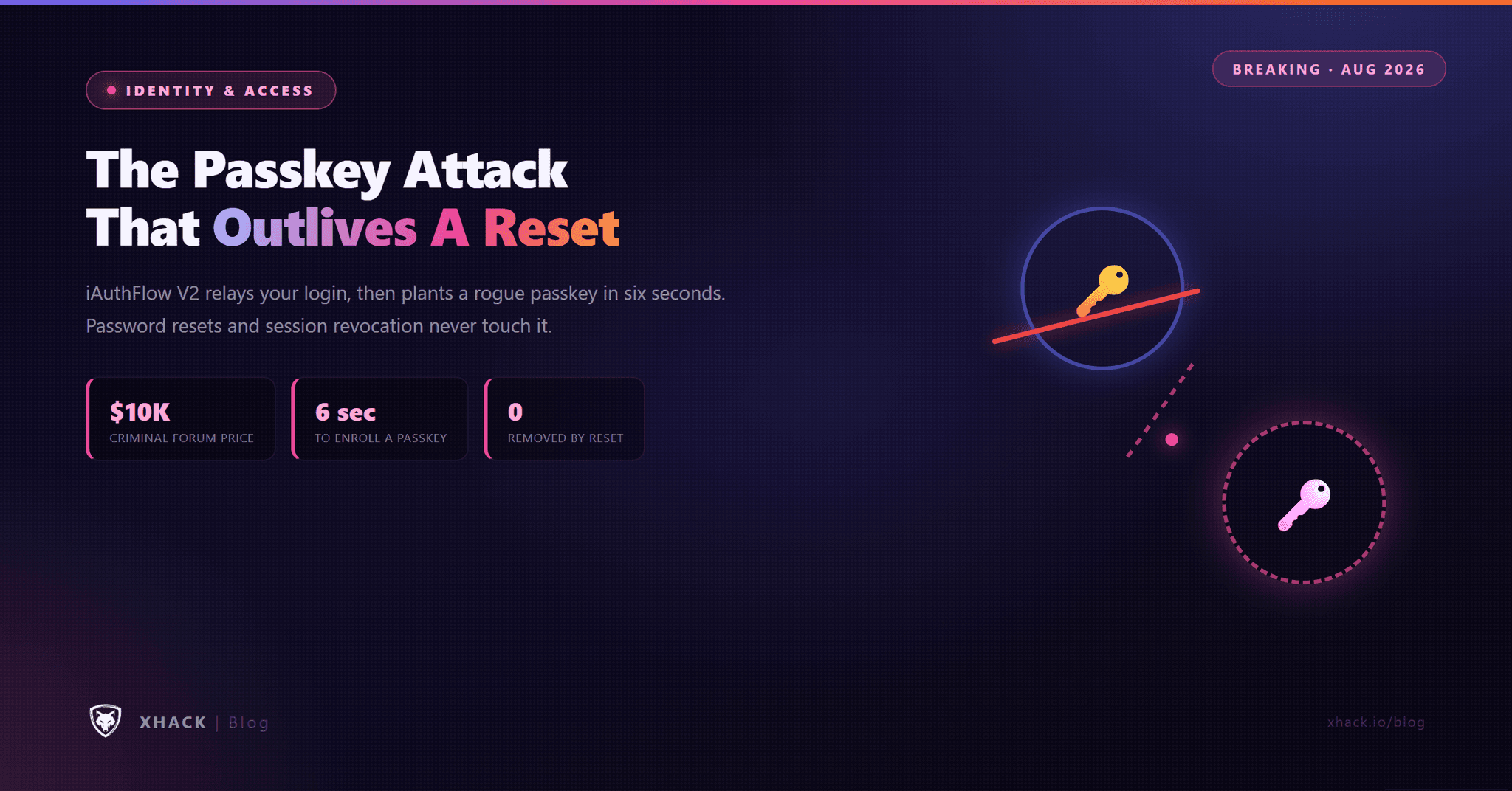
Read this in 30 seconds: A phishing toolkit called iAuthFlow V2, selling for roughly $10,000 on Russian-language cybercrime forums, claims to relay a victim’s login through an attacker-controlled browser, then use the resulting authenticated session to enroll a passkey the attacker controls, all within about six seconds. Because a passkey is a separate credential from a password, resetting the password and revoking sessions, the standard incident-response playbook, does not remove it. Security firm Abnormal AI documented the technique from the seller’s own materials but was explicit that it could not independently verify every claim. Real or partly exaggerated, the underlying mechanism behind the iAuthFlow V2 passkey attack is sound, and it breaks an assumption most incident responders still lean on.
“We reset the password, we’re clear” just stopped being reliably true.
That sentence has been the backbone of account-compromise response for two decades. The iAuthFlow V2 passkey attack is the first widely documented criminal toolkit built specifically to make it false, and it does so by abusing a feature designed to make you safer.
iAuthFlow V2 is a phishing kit marketed on Russian-language cybercrime forums for a base price of roughly $10,000, with additional capability modules sold separately. It primarily targets Google accounts, and the seller also advertises versions for Microsoft, iCloud, and LinkedIn.
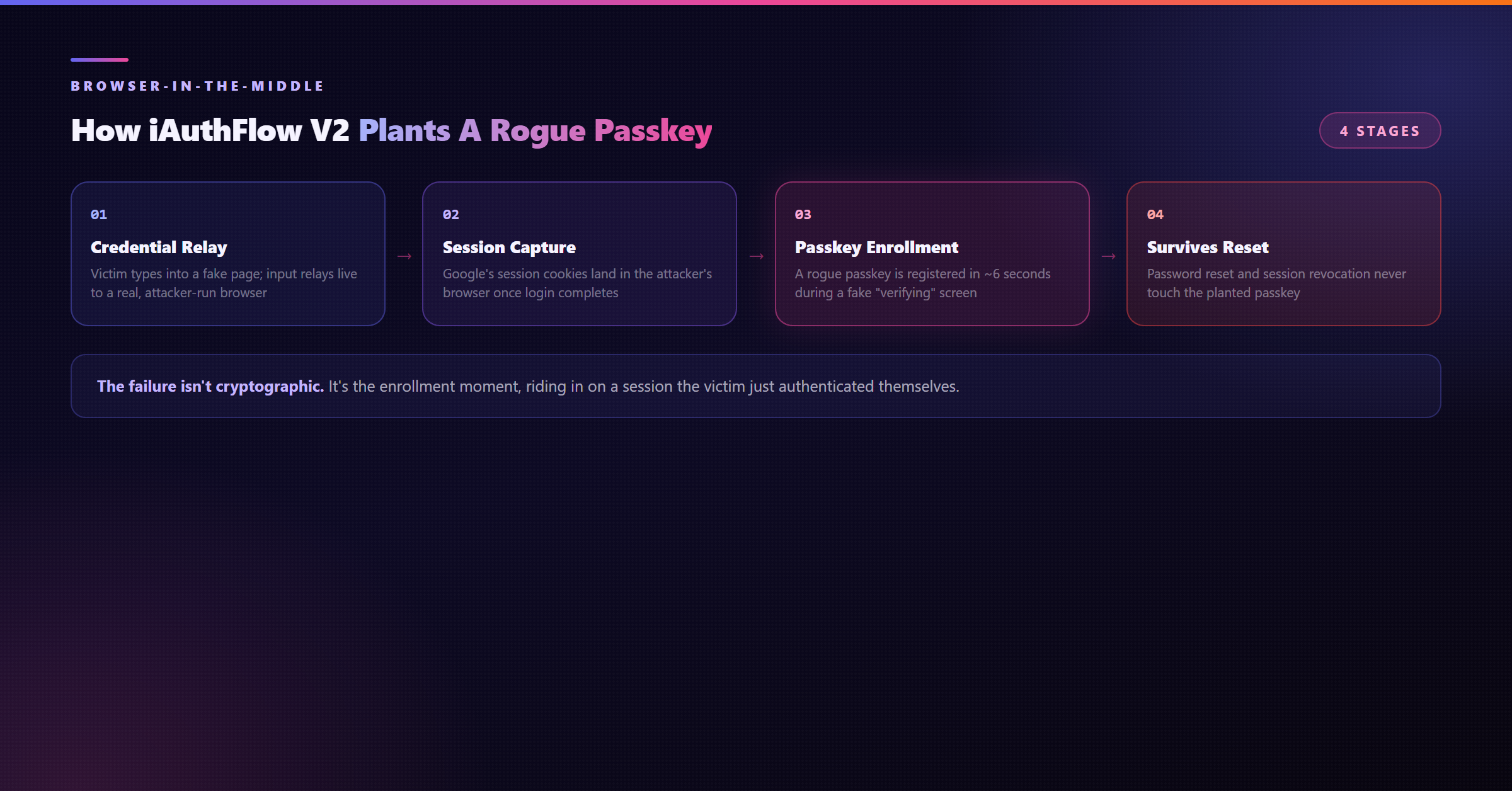
The iAuthFlow V2 passkey attack is a browser-in-the-middle (BitM) technique, and it unfolds in four stages, according to the analysis published by Abnormal AI and corroborating reporting from The Register:
Password reset and session revocation are the first two moves in almost every account-compromise runbook, and both are individually correct, useful steps. Neither one touches a passkey.
That is the entire point of the attack. Passkeys were built to be phishing-resistant and independent of passwords by design, which is exactly why security teams have been pushing users toward them. It does not break the cryptography behind passkeys at all, joining a wider 2026 pattern of passkey attacks that target implementation details instead. It exploits the enrollment step, the moment a new passkey gets attached to an account, by riding in on a session the victim themselves just authenticated.
Cornell University research on a related pattern reached the same blunt conclusion independently: passkeys are not revoked by a password reset, and unless a victim specifically finds and removes the rogue credential, which most people do not know how to do, the attacker keeps access indefinitely.
Here is the part responsible coverage should not skip. Abnormal AI, the firm that documented this, was explicit that it analyzed the seller’s own documentation and demo material, not a purchased and independently tested copy of the kit. They stated plainly that they could not confirm where the attacker’s private key gets stored, and could not independently verify the seller’s broader claims about how reliably the enrollment step works in practice.
That matters. Criminal marketplaces are full of exaggerated or outright fake capability claims designed to sell a $10,000 kit to less sophisticated buyers. It is entirely possible iAuthFlow V2 works less reliably, or with more caveats, than its own sales pitch suggests.
What is not in doubt is the underlying mechanism. Browser-in-the-middle phishing is a well-documented, proven technique, and passkey enrollment surviving a password reset is a straightforward, verifiable consequence of how passkeys are designed to work, confirmed independently by academic research, not just this seller’s marketing. Whether or not this specific kit performs exactly as advertised, the attack class it represents is real and here to stay.
The fix is not “don’t use passkeys.” Passkeys remain more phishing-resistant than passwords for the initial login. The fix is updating what “we’re secure now” means after a suspected compromise.
The iAuthFlow V2 passkey attack is a phishing toolkit sold on cybercrime forums for around $10,000 that uses a browser-in-the-middle technique to relay a victim’s login, capture the resulting authenticated session, and use it to enroll an attacker-controlled passkey. It primarily targets Google accounts, with versions also advertised for Microsoft, iCloud, and LinkedIn.
No. A passkey is a separate cryptographic credential from a password. Resetting a password does not remove or invalidate any passkey already enrolled on the account, which is exactly why iAuthFlow V2 targets passkey enrollment instead of just stealing a password.
Partially. Security researchers at Abnormal AI documented the technique from the seller’s own materials and demos but explicitly stated they did not purchase and independently test the kit, so some specific claims are unverified. The underlying mechanism, browser-in-the-middle phishing plus passkey persistence through a password reset, is independently confirmed as technically sound by separate academic research.
Whether iAuthFlow V2 performs exactly as its criminal seller claims or not, it names a real gap that most organizations have not closed: passkeys are, by design, invisible to a password reset. If your incident response plan stops at “reset the password, revoke the session,” it is missing exactly the step this toolkit is built to exploit. Check for unauthorized passkeys today, not after the next incident.
Categories
Related articles