Table of contents
20
By Salman Khan, OSCP+, Founder of XHack, SRT (Synack Red Team member)
Read this in 30 seconds: You can now buy and launch a pentest without talking to anyone, but a self-service pentest is not one product, and the price, the review and the paperwork differ far more than the label suggests. I read each vendor’s own pages on 23 November 2026 so you do not have to.
- The phrase means three different things. Bugcrowd sells human-run tests through a “self-service” checkout, HackerOne used the word in 2022 for an intake form, and TurboPentest uses it for an AI agent you run yourself.
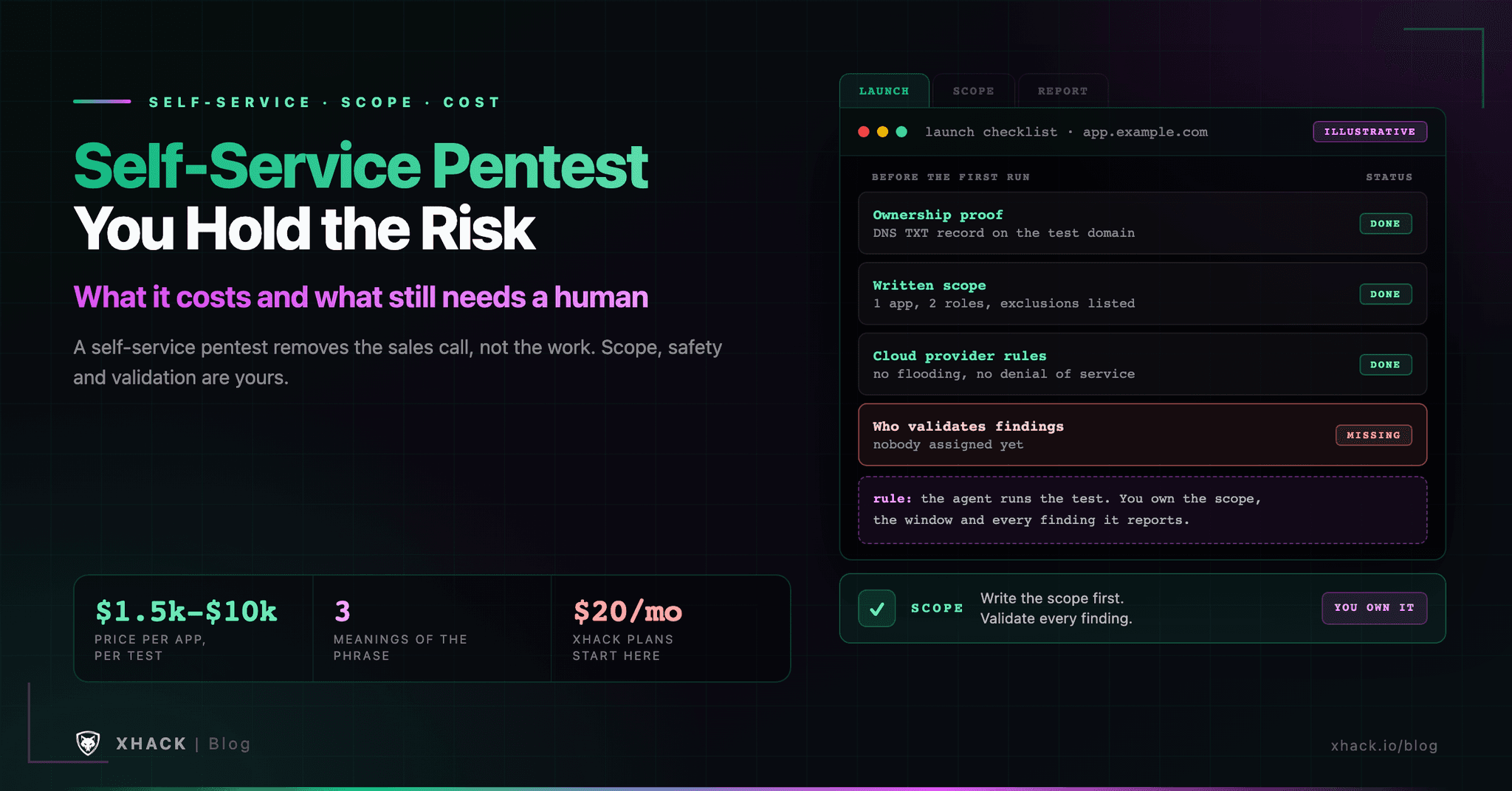
- Self-service removes the sales call but not the price gap. Published per-application prices run from $1,500 (Pentest-Tools.com AI Pentest) to $10,000 (NodeZero WebApp Flex), while XHack’s self-service plans start at $20 a month.
- A self-service pentest may not satisfy an auditor. Cobalt says its own autonomous pentest does not produce compliance attestation, and PCI DSS asks for a qualified tester with organisational independence.
- You own the scope. AWS, Microsoft and Google each publish rules for testing your own cloud, but on the pages I read only Aikido and TurboPentest describe a domain-ownership check.
- The numbers are in a script. I include
pentest_cost.py, tested on three sets of inputs, so you can price your own apps from published figures.
A self-service pentest is a test you start yourself, on your own systems, without a sales call or a scoping meeting, and the part nobody tells you is that you now hold the risk a consultant used to hold.
That risk is scope, timing, production safety and what the report is allowed to claim. This guide covers what the phrase means, what published prices look like side by side, what the rules say about testing your own cloud, and when a self-service pentest is the wrong tool. I run XHack, so I also say where we fit and where we do not.
It contains no attack techniques. It is written for testing systems you own or are authorised in writing to test.
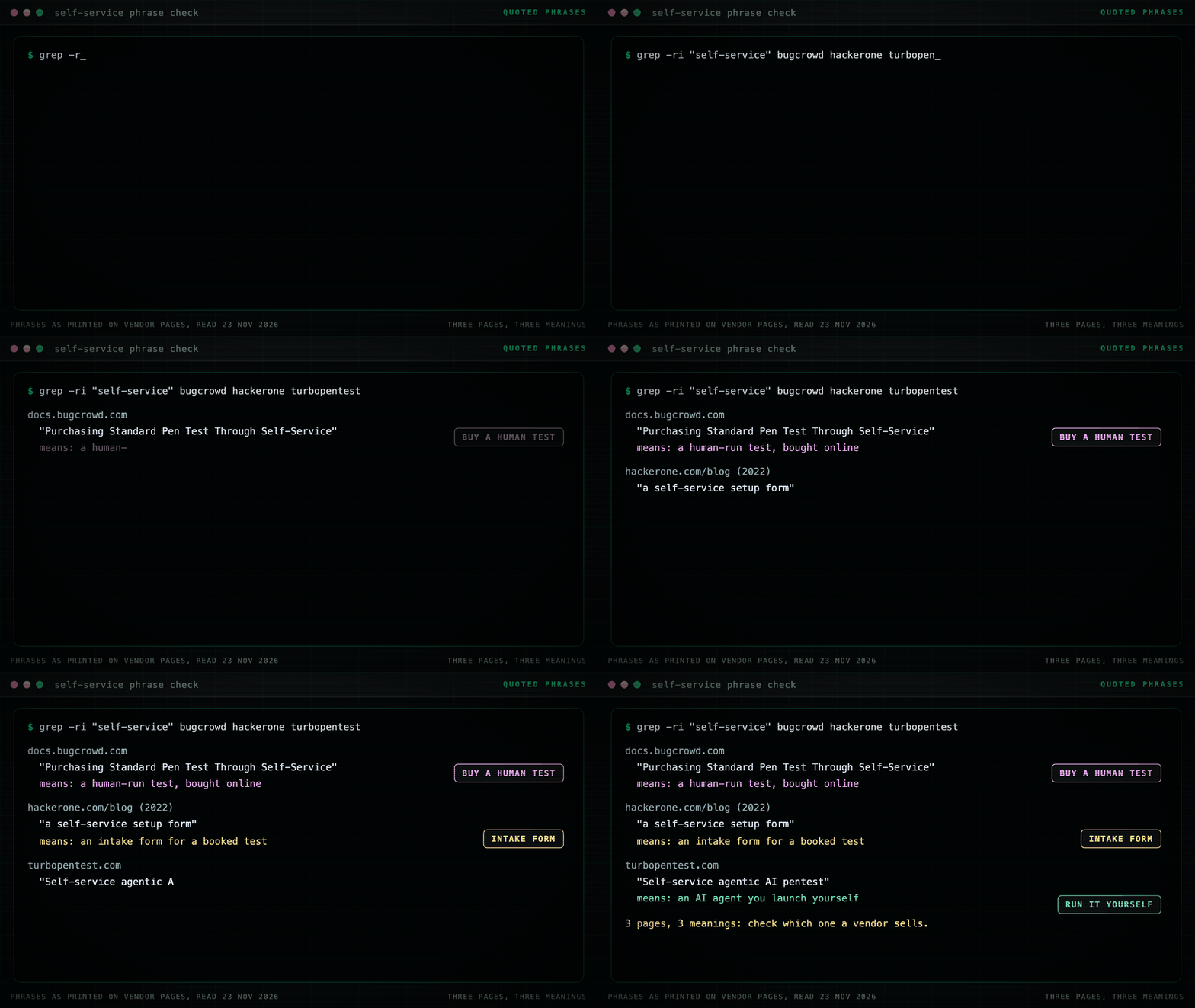
The label covers three different activities, and mixing them up is how people buy the wrong thing. When I searched the phrase, the results did not agree with each other.
Search results also surface vendor help pages about asking permission to test the vendor’s own hosted product. That is a different job entirely.
In this guide, a self-service pentest means the third kind: you sign up, define the target and launch an agent or tool without a human on the vendor side. Our guide to what AI pentesting is covers the technology underneath.
A self-service pentest sits between a vulnerability scanner and a managed engagement, and each of the three answers a different question. A scanner asks “what known weaknesses are visible?”. A self-service pentest asks “can the agent actually exploit and prove it?”. A managed test asks “what would a skilled human find, and can I show an auditor?”.
| Route | Who runs it | Human review | Typical published price | Best for | Drawback |
|---|---|---|---|---|---|
| Scanner | Software, scheduled | None | From $699 a year (Astra DAST Scanner) | Known-issue coverage, every week | Reports possible flaws, rarely proves impact |
| Self-service pentest | You, with an AI agent | Often none, sometimes optional | $1,500 to $4,000 per test, or $20 to $150 a month (XHack) | Frequent testing of apps you own | You own scope, safety and validation |
| Managed pentest | A vendor’s human testers | Built in | From $2,500 (XHack Essential) to $5,999 (Astra Expert) | Audits, first tests, complex logic | Slower, scoped by hand |
Prices for a self-service pentest are as published on 23 November 2026 and exclude tax. Each vendor defines “per test” differently, so treat the table as a map, not a quote.
If you need to choose between named tools, our 12-check guide to choosing an AI pentest tool goes deeper than this one on scoring.
Self-service pentest pricing is mostly per application per test, and the spread is six to one. I read each page directly. None of these is a quote, and several pages carry no date.
| Product | Published price | What it covers | Human review |
|---|---|---|---|
| Pentest-Tools.com AI Pentest | $1,500 per application | One-time, free rerun if nothing Medium or higher is found | None |
| Pentest-Tools.com Hybrid | $2,800 per application | AI plus certified pentester review | Yes |
| Astra Pentest Auto | $2,999 per pentest | 1 target, one human re-scan | Re-scan only |
| Intruder AI pentest | $4,000 standalone, $3,500 for customers | One test, must be used within a year | Vendor says not needed |
| Aikido typical pentest | $4,000 | One app and its APIs, free retests for 6 months | Not in the default test |
| NodeZero WebApp Flex | $10,000 per app, per test | 12-month term | Not stated |
| TurboPentest | $99, $299 or $699 plans | 1 to 8 targets, credits expire after a year | None in normal operation |
Two details matter more than the headline numbers.
Astra’s pricing page prints “$2999 /pentest” next to an unlabelled “$199/mo”. I could not tell from the page what the monthly figure covers, so I used the per-test price. Read the page again before you budget.
Aikido offers “Run now, pay later” for a first assessment. The report stays withheld and High and Critical findings are blurred until you pay. It is a fair way to try the product, but know that before you click it.
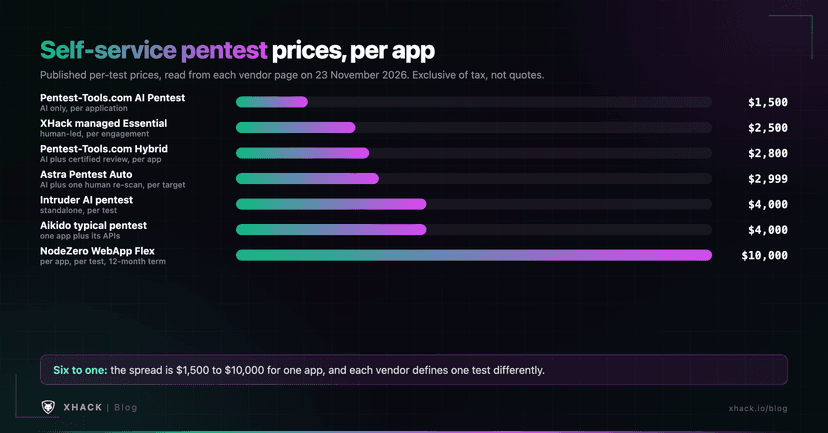
XHack’s own published self-service prices are the individual plans: Starter at $20 a month lists “enough for 1-4 Automatic Pentest”, Professional at $49 lists 3 to 6, and Elite at $150 lists 10 to 14. For the cheapest tools across categories, see our cheapest AI pentest tool comparison, and for the full cost picture see AI penetration testing cost.
The right comparison for a self-service pentest is cost per year for your number of apps, not the headline price. I wrote a small script that does it from the published figures above. It uses only the Python standard library.
#!/usr/bin/env python3
"""pentest_cost.py: yearly cost of testing web apps with published prices.

Usage: python3 pentest_cost.py --apps 3 --tests 2
  --apps   number of web applications you run
  --tests  full tests per application per year

Prices are copied from each vendor's public page on the read date shown in ROUTES.
Nothing here is a quote. Bundles, credits, discounts and VAT are not modelled.
Standard library only.
"""
import argparse

READ = "2026-11-23"

# name, kind, price in USD, unit, who reviews findings, ownership proof published, source
ROUTES = [
    ("Pentest-Tools.com AI Pentest", "per_test", 1500, "per application", "AI only (no human review)", "not published", "pentest-tools.com/pricing"),
    ("Pentest-Tools.com Hybrid", "per_test", 2800, "per application", "certified pentester review", "not published", "pentest-tools.com/pricing"),
    ("Astra Pentest Auto", "per_test", 2999, "per target", "AI plus 1 human re-scan", "not published", "getastra.com/pricing"),
    ("Intruder AI pentest (standalone)", "per_test", 4000, "per test", "AI only, vendor says none needed", "not published", "intruder.io"),
    ("Aikido typical pentest", "per_test", 4000, "per assessment", "AI only (human pentest on request)", "DNS, TXT or file", "aikido.dev"),
    ("XHack managed Essential", "per_test", 2500, "per engagement", "human-led, OSCP researchers", "scoped with client", "xhack.io/pricing"),
    ("NodeZero WebApp Flex", "per_test", 10000, "per app", "not stated", "not published", "horizon3.ai/pricing"),
]

# XHack individual plans: (name, monthly price, lower bound of 'automatic pentests' per month)
PLANS = [("XHack Starter", 20, 1), ("XHack Professional", 49, 3), ("XHack Elite", 150, 10)]


def plan_for(runs_per_year):
    for name, month, low in PLANS:
        if low * 12 >= runs_per_year:
            return name, month * 12
    return None, None


def main():
    ap = argparse.ArgumentParser()
    ap.add_argument("--apps", type=int, required=True)
    ap.add_argument("--tests", type=int, required=True)
    a = ap.parse_args()
    runs = a.apps * a.tests
    rows = []
    for name, kind, price, unit, review, proof, src in ROUTES:
        rows.append((price * runs, name, review, proof, f"{price:,} {unit}"))
    pname, pcost = plan_for(runs)
    if pname:
        rows.append((pcost, pname + " (self-service)", "you validate, agent assists", "identity check", f"lower bound of plan quota covers {runs} runs"))
    else:
        rows.append((None, "XHack self-service plans", "you validate, agent assists", "identity check", f"{runs} runs/yr is over the lowest published quota"))
    rows.sort(key=lambda r: (r[0] is None, r[0] or 0))
    print(f"apps={a.apps} tests/app/year={a.tests} total runs={runs}  (prices read {READ})")
    print(f"{'ROUTE':38} {'YEAR (USD)':>11}  REVIEW / OWNERSHIP PROOF")
    for cost, name, review, proof, note in rows:
        c = f"{cost:,}" if cost is not None else "n/a"
        print(f"{name:38} {c:>11}  {review}; proof: {proof}")
    print("Not a quote. Routes differ in depth, review and report type, so the cheapest row is not the best row.")
    print("XHack plan quotas use the low end of each published range of automatic pentests per month.")


if __name__ == "__main__":
    main()
I ran it on three input sets before publishing, and the file is in the article’s repository folder. This is the real output for 5 apps tested 4 times a year:
apps=5 tests/app/year=4 total runs=20  (prices read 2026-11-23)
ROUTE                                   YEAR (USD)  REVIEW / OWNERSHIP PROOF
XHack Professional (self-service)              588  you validate, agent assists; proof: identity check
Pentest-Tools.com AI Pentest                30,000  AI only (no human review); proof: not published
XHack managed Essential                     50,000  human-led, OSCP researchers; proof: scoped with client
Pentest-Tools.com Hybrid                    56,000  certified pentester review; proof: not published
Astra Pentest Auto                          59,980  AI plus 1 human re-scan; proof: not published
Intruder AI pentest (standalone)            80,000  AI only, vendor says none needed; proof: not published
Aikido typical pentest                      80,000  AI only (human pentest on request); proof: DNS, TXT or file
NodeZero WebApp Flex                       200,000  not stated; proof: not published
Not a quote. Routes differ in depth, review and report type, so the cheapest row is not the best row.
XHack plan quotas use the low end of each published range of automatic pentests per month.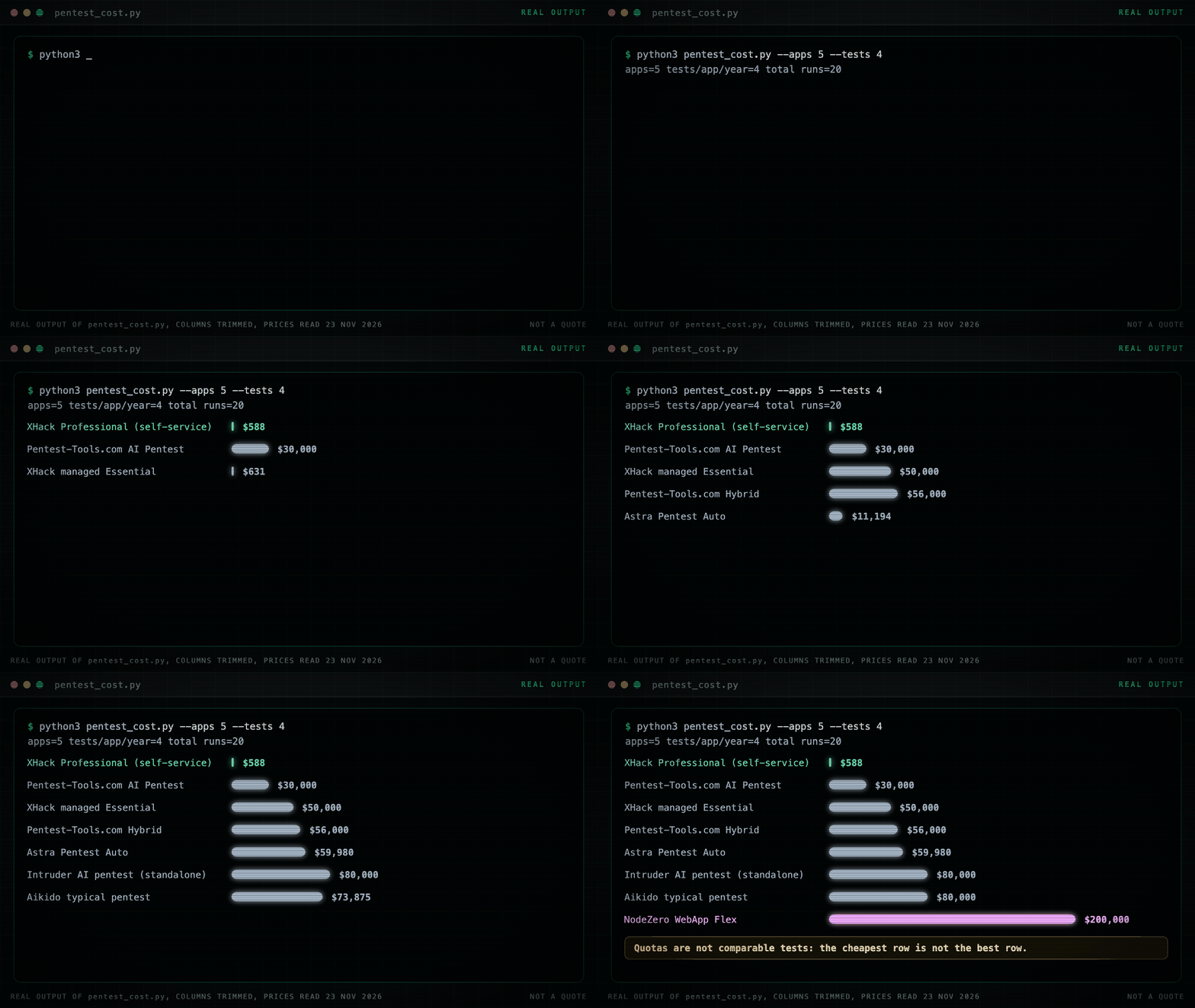
Read this table with suspicion, because the cheapest row is not comparable to the others. An XHack plan quota of “automatic pentests” is not a $4,000 vendor-run assessment, and the script uses the low end of each published quota range to avoid flattering our own numbers. A per-test price from another vendor includes that vendor’s own definition of one test.
What the table does show is the shape. If you run a self-service pentest often, a subscription is a different cost structure from per-test pricing, and the gap grows with every extra run. If you test once a year for an auditor, the subscription gap does not matter, because the auditor question comes first.
The moment you start a self-service pentest, you are the one who decides what is in scope, and you are the one who must be able to prove you were allowed to test it. A consultant used to carry that. Now the agent just does what you pointed it at.
NIST’s SP 800-115 says a plan “should be developed for every assessment” and that it should answer what the scope is and who is authorised. It also says the plan should list systems authorised for testing, an exclusion list, and the level of testing permitted. If a third party owns part of your stack, “the owner of the other network usually must also consent in writing.”
Scope verification is where vendors differ most. Aikido publishes a domain-verification step using a CNAME record, a TXT record or a file upload, plus pre-flight checks before every run. TurboPentest says domain ownership is verified in step two. On the pages I read, the other vendors in the table above describe no ownership proof, so the check, if there is one, lives inside the product. Ask before you buy.
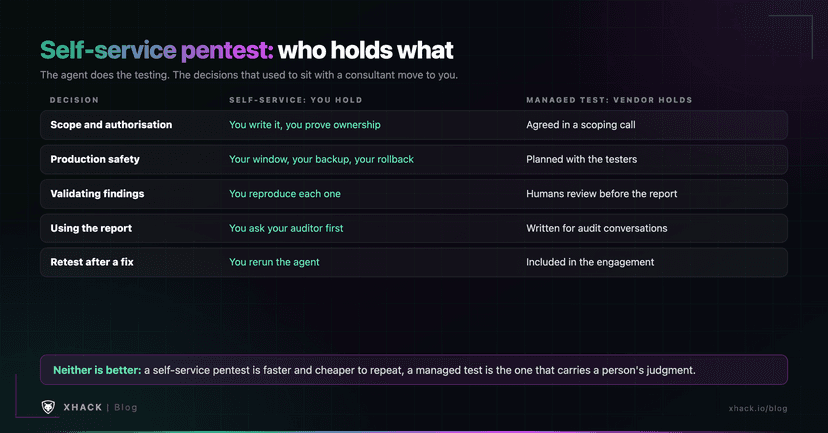
You still need the provider’s permission model. AWS, Microsoft and Google differ.
| Provider | Approval needed? | What it prohibits |
|---|---|---|
| AWS | Not for the listed services (EC2, RDS, CloudFront, Lambda and others) | DoS and DDoS, simulated DoS, port, protocol and request flooding, DNS zone walking via Route 53, S3 bucket and subdomain takeover |
| Microsoft | Page states no pre-test notification requirement | DoS testing, network-intensive fuzzing, post-exploit activity beyond an initial proof of concept, using credentials that are not yours |
| Google Cloud | “You are not required to contact us” | Anything that affects other customers; keep tests to your own projects and follow the Acceptable Use Policy |
AWS also says tests that include command and control need prior approval, and that other services require working with AWS Support. For Microsoft I used a summary of a script-rendered page, so read the rules of engagement yourself before relying on the exact wording.
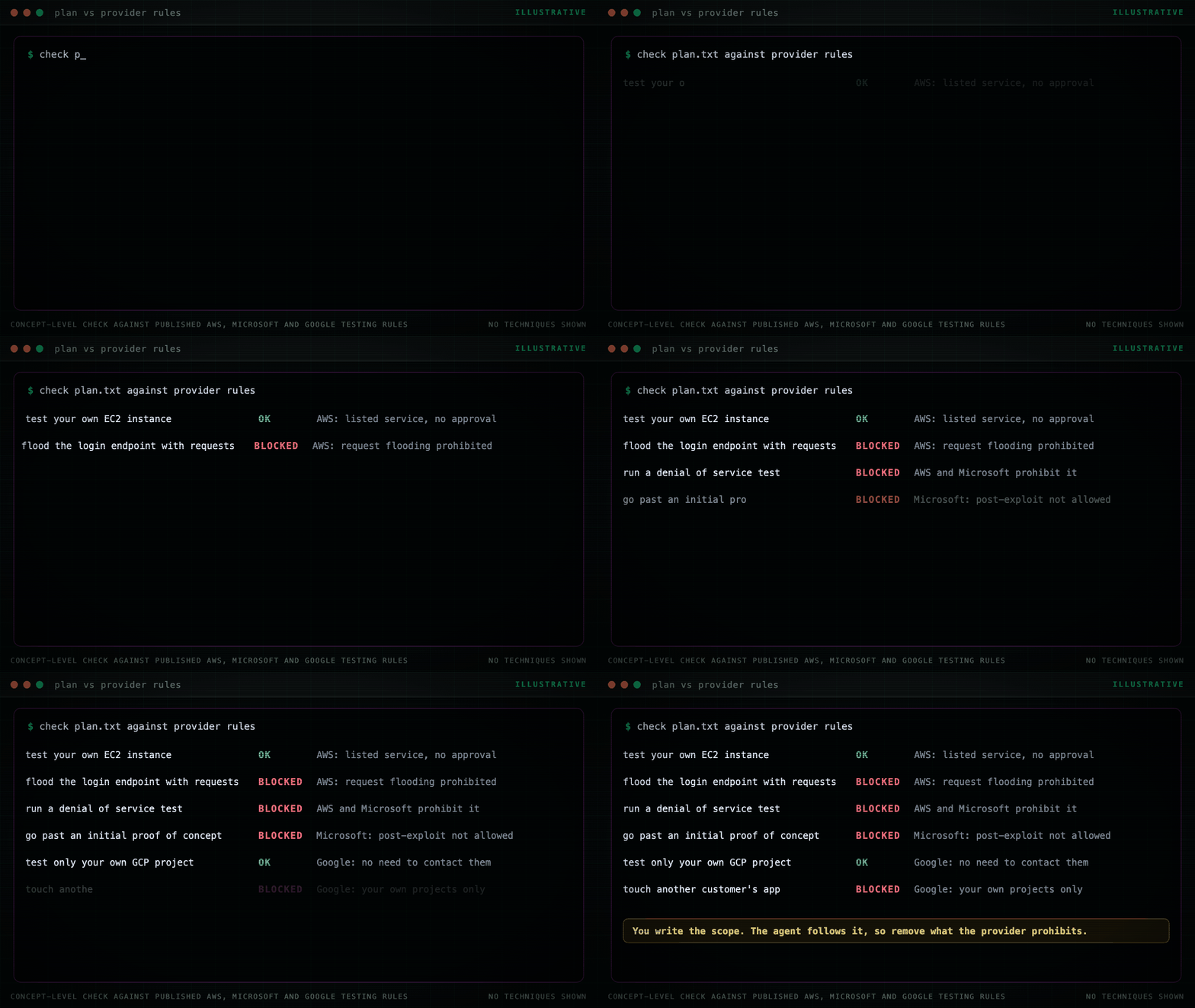
A self-service pentest agent can break these rules without anyone deciding to. Pentest-Tools.com says its AI pentest operates “within the authorized scope you define” and Intruder’s help centre warns that the agent takes real actions and recommends staging. Treat the agent’s scope file as the same document you would hand a contractor.
In the United States, the Department of Justice’s 2022 charging policy tells federal prosecutors to decline cases that rest on good-faith security research, defined as accessing a computer solely for good-faith testing, investigation or correction of a security flaw, carried out to avoid harm. It is a prosecutorial policy, not a licence, and it does not bind state prosecutors or civil plaintiffs. Testing something you own or are authorised to test is the simple path. This is not legal advice.
Often not on its own, and the vendors themselves disagree about whether a self-service pentest counts. Cobalt, which sells both human and autonomous tests, says its Autonomous Pentest “does not produce compliance attestation reports” and that PCI DSS, SOC 2, ISO 27001 and HIPAA generally need human-led testing. Pentest-Tools.com says acceptance “always depends on your auditor, customer, jurisdiction, and penetration testing requirements.” Intruder, by contrast, advertises a compliance guarantee for its pentests: auditor-accepted or your money back.
Here is what the frameworks actually say.
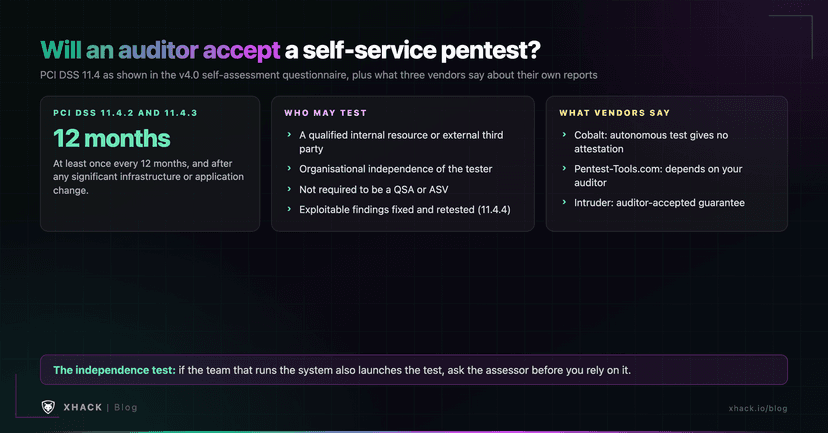
The practical test is independence. If the team that builds and runs the application also launches the self-service pentest, the PCI wording suggests that may fail. That is my reading of the text, not an assessor’s ruling.
Whatever you run, a pentest report does not certify compliance. Our guide to what auditors want in a pentest report explains what a report can and cannot support.
It is strongest on known weakness classes in web apps you can reach, and weakest where judgment matters. The vendors say so themselves.
If your app is a payments flow, a healthcare system or anything where a wrong request costs money, a human-led test is the better first purchase, and a self-service pentest is the follow-up between audits.
None of these steps needs an extra tool, and skipping any of them is how a self-service pentest turns into an incident. They need an hour, and that hour is what separates a self-service pentest from a self-inflicted incident.
So yeah, here is where I talk about my own company. XHack sells three things most vendors split apart: a self-service AI agent, a security platform, and human-led testing when you need a person to put a name on the report.
Self-service pentest. The individual plans are $20, $49 and $150 a month, and the live pricing page lists “enough for” 1-4, 3-6 and 10-14 automatic pentests a month. There is a 7-day free trial, one per person. The agent finds vulnerabilities from the start, and exploitation unlocks once your identity is verified. That is an identity check, not a domain-ownership check like Aikido’s, so keep your own written scope.
For teams. Company plans run from $560 to $3,000 a month and add seats, vulnerability assessment scans, SOC monitoring and GitHub pull request protection. They are a platform, not a pay-per-test pentest.
When you need a human. Managed engagements start at $2,500 for one unauthenticated web app or up to 50 host IPs, delivered in four days, and go up to $12,000. Our researchers are OSCP certified and the report supports your audit conversation, though XHack never certifies compliance and an assessor decides what counts. See AI VAPT services for how that works.
XHack does not store your agent chats. Sessions stay on your own computer, you can delete them any time, and your findings stay off our servers.
Honest positioning: if you want a one-click self-service pentest that produces a cover page for an auditor, we are not the right fit. If you want an agent you control, with a human option when the stakes rise, we are. Want a quote or a scoping call? Book a free consultation, even if it turns out not to be us. Brutal honesty is kind of our thing.
A self-service pentest is a test you launch yourself on systems you own or are authorised to test, without a sales call or scoping meeting. Most often the testing is done by AI or automated tools, though some vendors use the phrase for buying a human-run test through an online checkout. Check which one a vendor means.
Published prices I read on 23 November 2026 ran from $1,500 per application (Pentest-Tools.com AI Pentest) to $10,000 per app per test (NodeZero WebApp Flex), with Astra Pentest Auto at $2,999, Intruder and Aikido at $4,000, and TurboPentest plans from $99. XHack’s self-service plans are $20 to $150 a month.
Not automatically. Cobalt says its autonomous pentest does not produce compliance attestation, PCI DSS asks for a qualified tester with organisational independence, and SOC 2 has no explicit pentest requirement but auditors often expect one. Ask your auditor before you rely on any self-service report.
Yes, always. You need to own the target or hold written authorisation, and any third-party services in the path need the owner’s consent. Cloud providers publish their own rules: AWS lists services you can test without approval and prohibits denial-of-service testing, and Google says you are not required to contact them if you stay inside your own projects.
For frequent checks on known weakness classes, it can fill the gaps between tests. For business logic, first audits and complex authentication, a human-led test is still the better choice. Pentest-Tools.com itself says its AI pentest should not be considered complete business logic testing.
It can be, with care. Intruder recommends staging as the default and a backup before production, and the agent takes real actions. Choose a window, narrow the scope, allow for blocking by a WAF, and have a rollback ready.
A self-service pentest is a real option now, and the label hides three different products, a six-to-one price spread and a compliance question that vendors answer in opposite ways. The honest way to buy one is to ask who reviews findings, who proves ownership of the target, and whether your auditor will accept it, then price your own apps with real numbers, not headlines. Use a self-service pentest for frequent checks on systems you control, keep a human-led test for audits and complex logic, and write down your scope before the first run.
Categories
Related articles