Table of contents
15
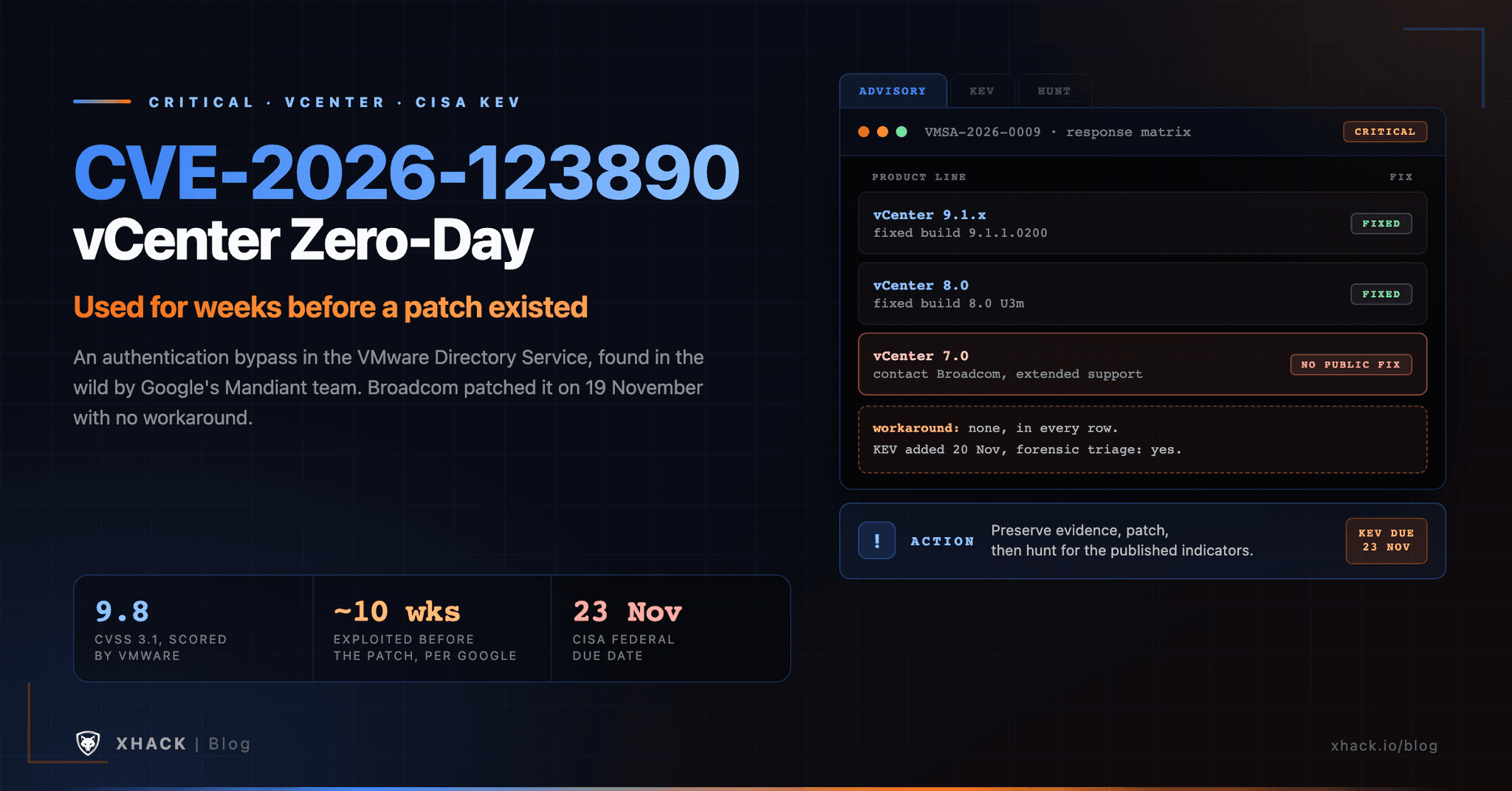
Read this in 30 seconds: CVE-2026-123890 is a critical authentication bypass in the VMware Directory Service inside vCenter, patched by Broadcom on 19 November 2026 after Google’s Mandiant team found a suspected Chinese espionage group using it. CISA added it to the Known Exploited Vulnerabilities catalog on 20 November with a federal due date of 23 November. There is no workaround, so the patch is the only fix, and a patched server may already have been compromised.
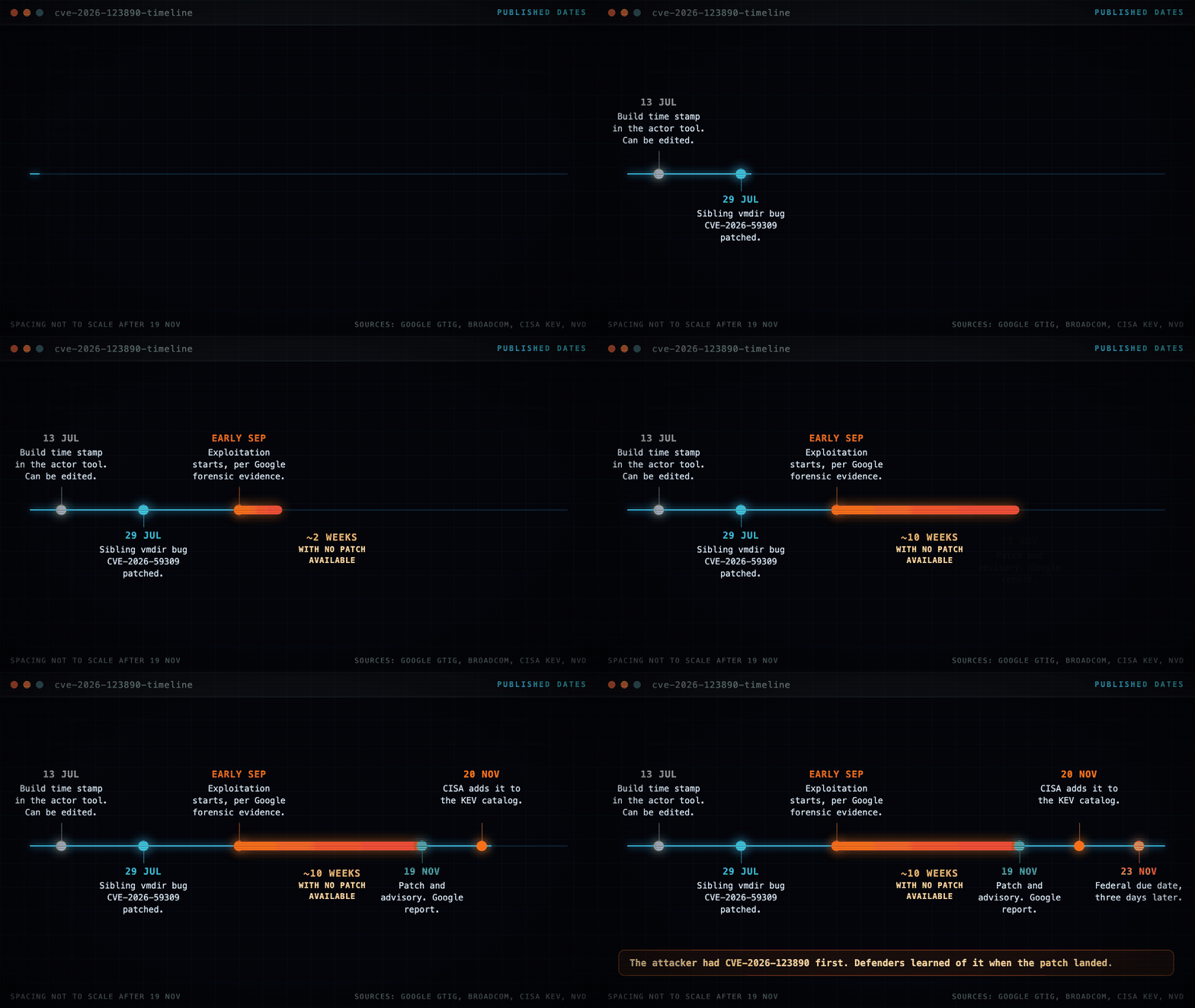
- The exploitation started before the fix existed. Google says forensic evidence shows ARMORY CASTLE used the bug in early September 2026, roughly ten weeks before Broadcom shipped a patch.
- Broadcom’s advisory does not say it is exploited. Its advisory VMSA-2026-0009 lists a 9.8 CVSS score and “Workaround: None” but makes no statement on exploitation, which is why Google’s post and the CISA catalog matter.
- The patch does not undo what an attacker already took. Google describes the actor extracting vCenter’s directory database and forging login tokens, so applying the update is step one of a compromise check, not the end of it.
- vCenter 7.0 has no public fix. The advisory tells customers to contact Broadcom support if they have an extended support contract, and fixes exist for 9.1, 9.0, 8.0 and VCF 5.x.
- It is not the first vmdir bug this year. A sibling flaw, CVE-2026-59309, was patched in July, and Google says the actor already knew about CVE-2026-123890 before disclosure.
The unsettling part of CVE-2026-123890 is the order of events: the attacker had the bug first, and the defenders found out when the patch landed.
If you run vCenter, the decision on CVE-2026-123890 is not whether to patch, because you should and the vendor gives you no alternative. The decision is what to check afterwards, because the people who found this bug in the wild describe an actor that stole material designed to outlive a patch.
This article covers what Broadcom, Google, CISA and NVD each say, where they disagree, which versions are fixed, and how to look for the indicators Google published. It does not contain exploit details, and I stay at the level the vendors themselves chose to publish.
Broadcom describes CVE-2026-123890 in one sentence: an authentication bypass in the VMware Directory Service. The advisory, VMSA-2026-0009, was published on 19 November 2026 and updated on 20 November to clarify the impacted VMware Tools versions. It covers five CVEs across vCenter, SDDC Manager and VMware Tools, and rates the set Critical.
For this CVE, the facts are:
The other four CVEs in the same advisory as CVE-2026-123890 are lower scored and not in the CISA catalog: three in SDDC Manager (CVE-2026-123891 at 8.1, CVE-2026-123892 at 7.2 and CVE-2026-123893 at 6.7) and a VMware Tools for Windows SAML token signature bypass, CVE-2026-123894, at 6.7.
Google’s Threat Intelligence Group says a suspected China-nexus espionage actor called ARMORY CASTLE exploited CVE-2026-123890 in early September 2026. The actor was formerly tracked as UNC5221. Google’s post, dated 19 November, says forensic evidence supports the September date.
Google describes the bug at concept level as an unauthenticated session key disclosure in the Secure Remote Password exchange handled by the directory service, which results in an authenticated session as the vCenter administrator account. It ties the weakness to predictable timestamp-based identifiers. I will not go further than that, and neither will most responsible write-ups.
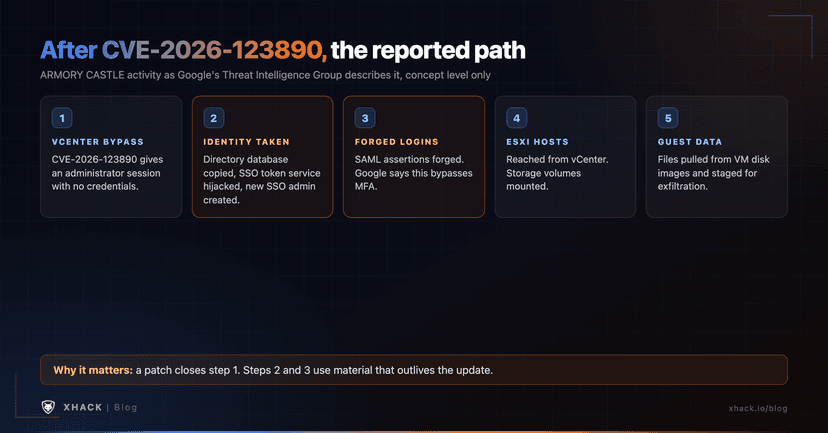
What happened after CVE-2026-123890 gave access is more instructive than how access was gained. According to Google, the actor used custom tooling to take the directory database, hijack the single sign-on token service and create a new SSO administrator. A second utility forged SAML assertions, an approach Google says bypasses multi-factor authentication and impersonates users. The actor also enabled SSH through the appliance management API, created a local admin account, extracted the vCenter master key and database credentials, then turned SSH off again.
From vCenter, Google says the actor moved to ESXi hosts, mounted storage volumes and pulled files out of guest virtual machine disk images, staging archives for exfiltration.
Two details deserve a caveat. Google says the actor ran its tooling against a vCenter that was already patched for the July bug, and that the recovered binary carries a build timestamp of 13 July 2026, which is before that July bug was disclosed. Google itself notes that such timestamps can be modified before compilation, so treat the date as a hint, not proof.
This is the same actor Google tied to the BeyondTrust zero-day in October. I covered that one in CVE-2026-102764 and the BeyondTrust Remote Support zero-day, where BeyondTrust assessed the same group with moderate to high confidence.
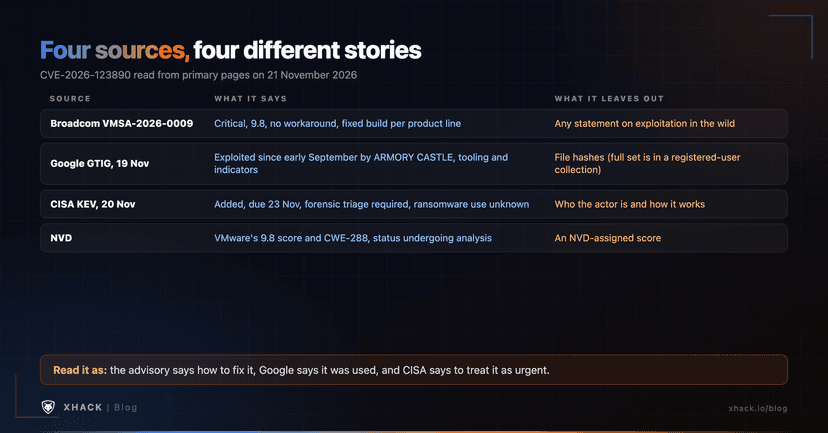
The sources agree on the bug and disagree on how much to say about exploitation. Putting them side by side shows what is established and what is a single source’s claim.
| Source | Date | What it says | What it leaves out |
|---|---|---|---|
| Broadcom VMSA-2026-0009 | 19 Nov (rev. 20 Nov) | Critical, 9.8, no workaround, fixed builds per product line | Any statement on exploitation in the wild |
| Google GTIG | 19 Nov | Exploited since early September by ARMORY CASTLE, tooling, indicators | Hashes (full set sits in a registered-user collection) |
| CISA KEV | 20 Nov | Added with due date 23 Nov, forensic triage flagged Yes, ransomware use Unknown | The actor, the technique |
| NVD | 19 Nov, modified 20 Nov | VMware’s 9.8 score, CWE-288, status undergoing analysis | Its own NVD score |
Three smaller discrepancies are worth knowing. SecurityWeek reports the exploitation as lasting “more than two months”, which is a fair reading of an early September start against a 19 November patch, but the duration is the outlet’s inference, not Google’s wording. SecurityWeek also gives the actor the alias Warp Panda, which does not appear in Google’s post, so I treat it as unverified. And CISA’s SSVC data for the entry lists exploitation as active, automatable as yes and technical impact as total.
I could not find any published count of internet-exposed vCenter instances for CVE-2026-123890, so I will not give one.
If an attacker already used CVE-2026-123890 to get an administrator session, the patch closes the door but does not remove what they carried out. Google’s description of the stolen material is the reason. A copied directory database, a forged token capability and extracted credentials do not depend on the original bug being open.
CISA’s catalog entry flags forensic triage as required, which means the catalog wants evidence preserved before systems are changed. Mandiant’s CTO Charles Carmakal, quoted by SecurityWeek, put it simply: apply the patches and also examine systems for evidence of compromise.
My reading, which is general practice and not something Broadcom or Google prescribes for this CVE, is that the order should be:
Google also recommends restricting the appliance with a default-deny host firewall policy and forwarding logs off the box, and it points to Mandiant’s open-source VCSA hardening tool. It cautions that such firewall changes need rigorous testing and change control.
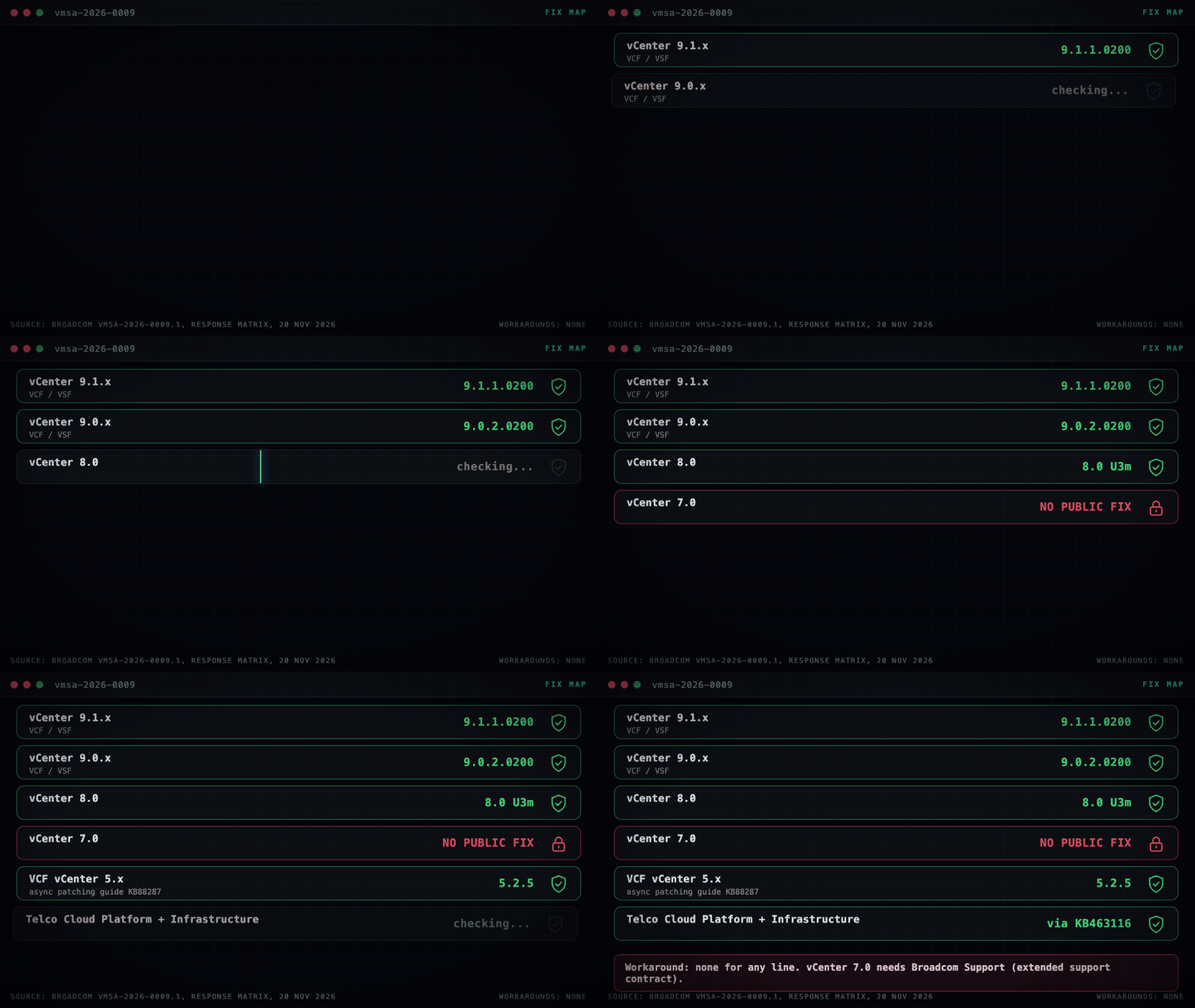
Every supported vCenter line has a fix for CVE-2026-123890 except 7.0, and none has a workaround. The advisory’s response matrix gives these builds.
| Product line | Fixed in |
|---|---|
| vCenter 9.1.x | 9.1.1.0200 |
| vCenter 9.0.x | 9.0.2.0200 |
| vCenter 8.0 | 8.0 U3m |
| vCenter 7.0 | No public fix: contact Broadcom Support if you have an extended support contract |
| VCF vCenter 5.x | 5.2.5 (async patching guide KB88287) |
| Telco Cloud Platform and Infrastructure | Via KB463116 |
Exposure comes down to reachability. The bug needs network access to vCenter, so a management interface reachable from user networks or the internet is the highest-risk case. A vCenter on a tightly isolated management network is harder to reach, but Google’s reported activity shows that a foothold elsewhere can change that.
Google published CVE-2026-123890 network and file indicators, and you can sweep copies of your logs and file listings for them in a few minutes. The network list is eleven addresses Google labels as suspected obfuscation infrastructure. The file list includes web shell names, temporary file paths and a backdoor path.
The script below checks every file under a folder for those indicators exactly as Google lists them, with guards so that a name like menu.jsp or an address embedded in a longer number does not count. It reads, it never changes anything, and you should run it on copies of evidence, not on the live appliance.
import pathlib
import re
import sys

# Indicators exactly as published by Google Threat Intelligence Group on 19 Nov 2026
# for ARMORY CASTLE activity against vCenter. Run it on COPIES of evidence only.
IPS = ["103.147.251.5", "103.190.38.3", "118.174.128.34", "118.174.128.36",
       "118.174.128.38", "176.9.89.66", "185.71.15.109", "220.121.128.41",
       "222.108.77.44", "61.216.56.127", "81.45.89.43"]
PATTERNS = [("ip", re.compile(r"(?<![\d.])" + re.escape(ip) + r"(?![\d.])")) for ip in IPS]
PATTERNS += [
    ("file", re.compile(r"(?<![\w.-])ActiveSer\.jsp")),
    ("file", re.compile(r"(?<![\w.-])u\.jsp")),
    ("file", re.compile(r"/tmp/(?:123|sss|dbr)(?![\w.])")),
    ("file", re.compile(r"/usr/bin/vmtoolscs")),
    ("api", re.compile(r"PUT\s+/rest/appliance/access/ssh")),
    ("banner", re.compile(r"SSH-2\.0-pulsesecure_23345")),
]


def sweep(root):
    hits = 0
    for path in sorted(pathlib.Path(root).rglob("*")):
        if not path.is_file() or path.stat().st_size > 50_000_000:
            continue
        try:
            lines = path.read_text(errors="ignore").splitlines()
        except OSError:
            continue
        for n, line in enumerate(lines, 1):
            for kind, rx in PATTERNS:
                m = rx.search(line)
                if m:
                    hits += 1
                    print(f"{kind:<6} {path.name}:{n}  {m.group(0)}")
    print(f"{hits} indicator hit(s) in {root}")
    return 1 if hits else 0


if __name__ == "__main__":
    sys.exit(sweep(sys.argv[1]))
Run it against a folder of collected logs and listings:
python3 ioc_sweep.py ./evidence-copyI tested it on three small synthetic files I wrote for the purpose: an SSH log, a file listing and a web access log, each containing one real indicator plus decoys such as menu.jsp, /tmp/1234.tmp and an address glued into a longer number. These are made-up logs, not real evidence. It printed this and exited with status 1:
file   file-listing.txt:1  /tmp/123
ip     vami-access.log:2  81.45.89.43
api    vami-access.log:2  PUT /rest/appliance/access/ssh
ip     vcsa-sshd.log:2  176.9.89.66
4 indicator hit(s) in sample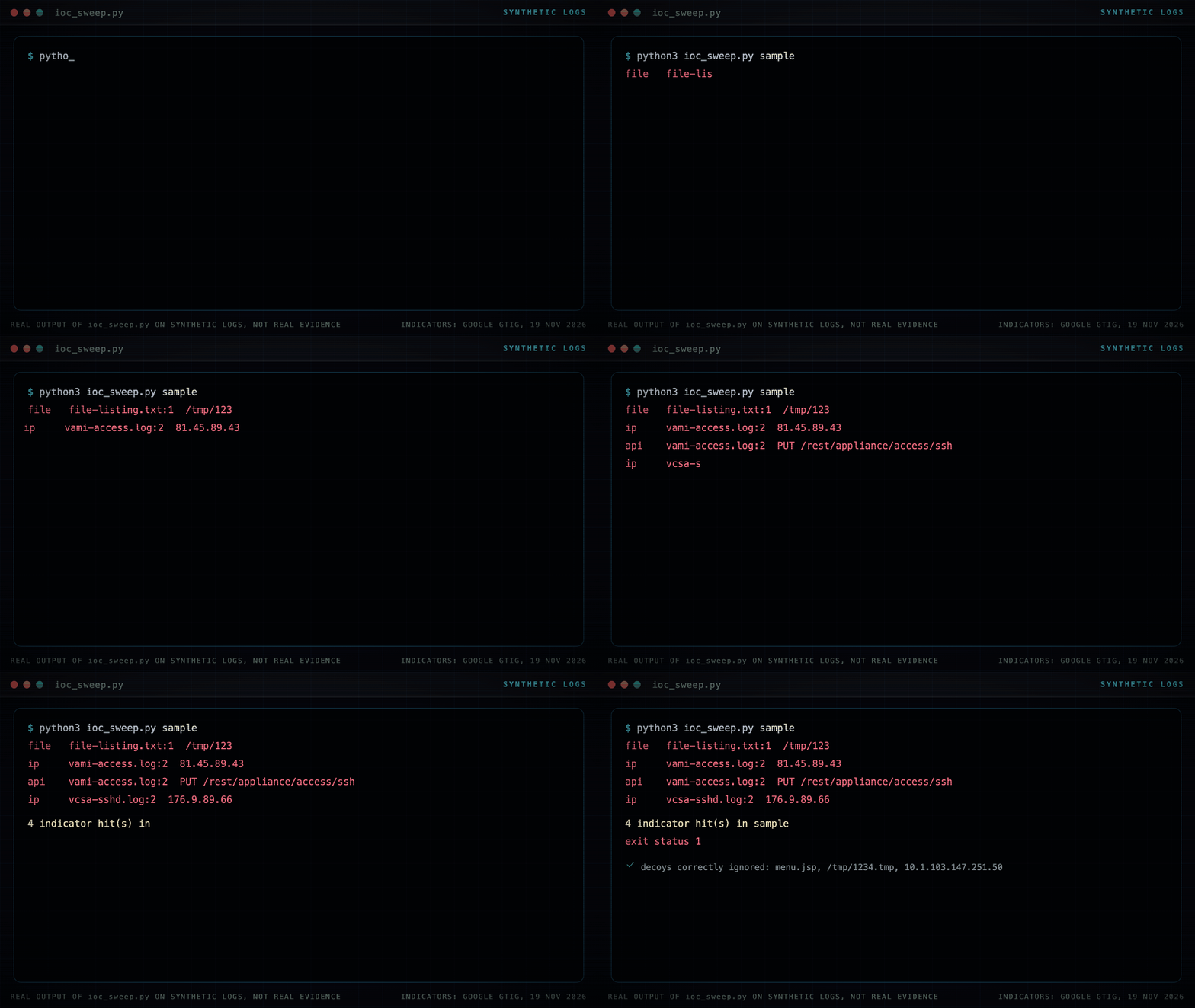
A clean result means none of Google’s published indicators appeared in what you scanned. It does not prove the server is clean, because an actor can change infrastructure and file names, and Google’s full indicator set, including file hashes, lives in a collection for registered users.
CVE-2026-123890 is a reminder that the management plane is part of your attack surface, and that is the angle we test from. I run XHack, so take this with the usual bias.
Our AI VAPT services check what an outsider can actually reach, including management interfaces that were never meant to face user networks or the internet. We do not run exploits for this bug, and I would not advise anyone to. What we can do is tell you whether the vCenter, ESXi and appliance interfaces are reachable from where an attacker would start, and which segmentation gaps would let a foothold elsewhere get there.
If your vCenter has been exposed and you suspect compromise, that is an incident response question first. Talk to the people who can preserve and analyse evidence, and treat a test as the follow-up once the environment is clean.
CVE-2026-123890 is a critical authentication bypass in the VMware Directory Service in vCenter, scored 9.8 by VMware. An attacker with network access to vCenter can gain administrator-level access without credentials. Broadcom patched it on 19 November 2026 in advisory VMSA-2026-0009.
Yes. CISA added CVE-2026-123890 to its Known Exploited Vulnerabilities catalog on 20 November 2026, and Google says a suspected Chinese espionage actor, ARMORY CASTLE, used it from early September. Broadcom’s advisory itself does not state that it is exploited.
No. Broadcom lists “None” for every product line, so the only fix is the patched build. If you cannot patch immediately, restrict network access to vCenter as tightly as you can, and treat that as risk reduction rather than a fix.
vCenter 9.1.x is fixed in 9.1.1.0200, 9.0.x in 9.0.2.0200, 8.0 in 8.0 U3m and VCF vCenter 5.x in 5.2.5. Telco Cloud products use KB463116. vCenter 7.0 has no public fix, and Broadcom tells customers with an extended support contract to contact support.
No. CVE-2026-59309 was the earlier directory service bypass patched in July, and Google says CVE-2026-123890 overlaps with it conceptually but is a separate flaw. Google reports the actor used its tooling against a vCenter already patched for the July bug.
Preserve evidence if you can, patch, and then hunt for the indicators Google published and for unexpected SSO administrator accounts. CISA flags forensic triage for this entry. If anything looks wrong, involve incident response before rotating credentials or rebuilding.
CVE-2026-123890 turned a vCenter patch into an investigation: the exploitation began about ten weeks before the fix, the vendor’s advisory is silent on it, and the actor reportedly took material that outlives the update. Patch CVE-2026-123890 to the fixed build, check the published indicators, look for accounts you did not create, and treat vCenter 7.0 without a public fix as a risk to plan around now. The federal deadline is Monday 23 November, and your own deadline should be sooner.
Categories
Related articles