Table of contents
19
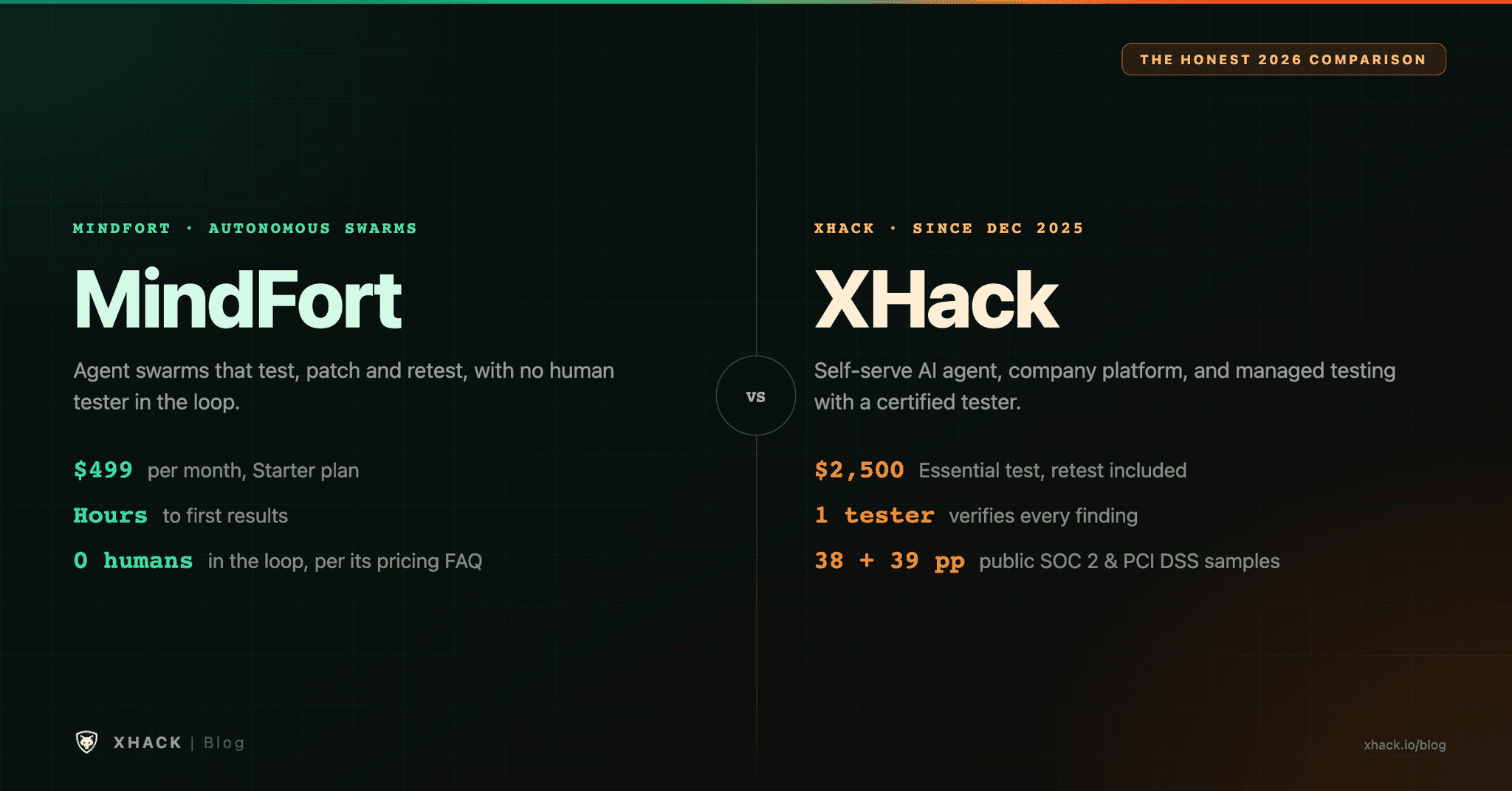
Read this in 30 seconds: MindFort is a seed-funded autonomous pentest platform that starts at $499 a month and runs without a human in the loop. XHack is a security company with a self-serve AI agent, a company platform and managed testing from $2,500 where a certified tester verifies findings. The MindFort vs XHack choice is about who you want standing behind the report.
- MindFort is the cheaper way to test often, but it has no human tester. Its Starter plan is $499 a month for 250 credits, and its own pricing FAQ answers “Are there humans in the loop?” with “No.”
- XHack costs more per test, but a certified tester verifies each finding. Essential starts at $2,500 for one web app in 4 days, with AI agents leading and one tester proving real impact before anything reaches the report.
- MindFort ships fixes as pull requests, but XHack ships a retest. MindFort charges 1 credit per retest and opens patch PRs, while every XHack engagement includes a patch verification retest in the fixed price.
- MindFort holds its own SOC 2 Type II report, but XHack lets you read a sample report first. XHack publishes a 38-page SOC 2 and a 39-page PCI DSS sample report; MindFort’s SOC 2 Type II report is requested through its Trust Center.
- Both vendors’ accuracy numbers are their own. MindFort says under 1% false positives, and our Terms of Service say AI output “may report false positives, and may miss real vulnerabilities.”
MindFort and XHack both put AI agents to work finding vulnerabilities, but they answer a different question. MindFort asks how cheaply and how often a team can run an autonomous pentest. XHack asks who is accountable for the result when an auditor, a customer or a regulator reads it. This MindFort vs XHack comparison walks through both, with every price and claim checked in October 2026.
I run XHack, so I have a financial interest in you picking us. I’m saying that first, and the “Where MindFort Genuinely Wins” section exists because on several points MindFort is the better choice. Where a number comes from MindFort or from us rather than from an outside source, I say so.
The MindFort vs XHack decision is not about which company is smarter. It is about whether you need continuous automated testing with fixes opened for you, or a verified, human-signed pentest report you can hand to an auditor. Many teams need a little of both.
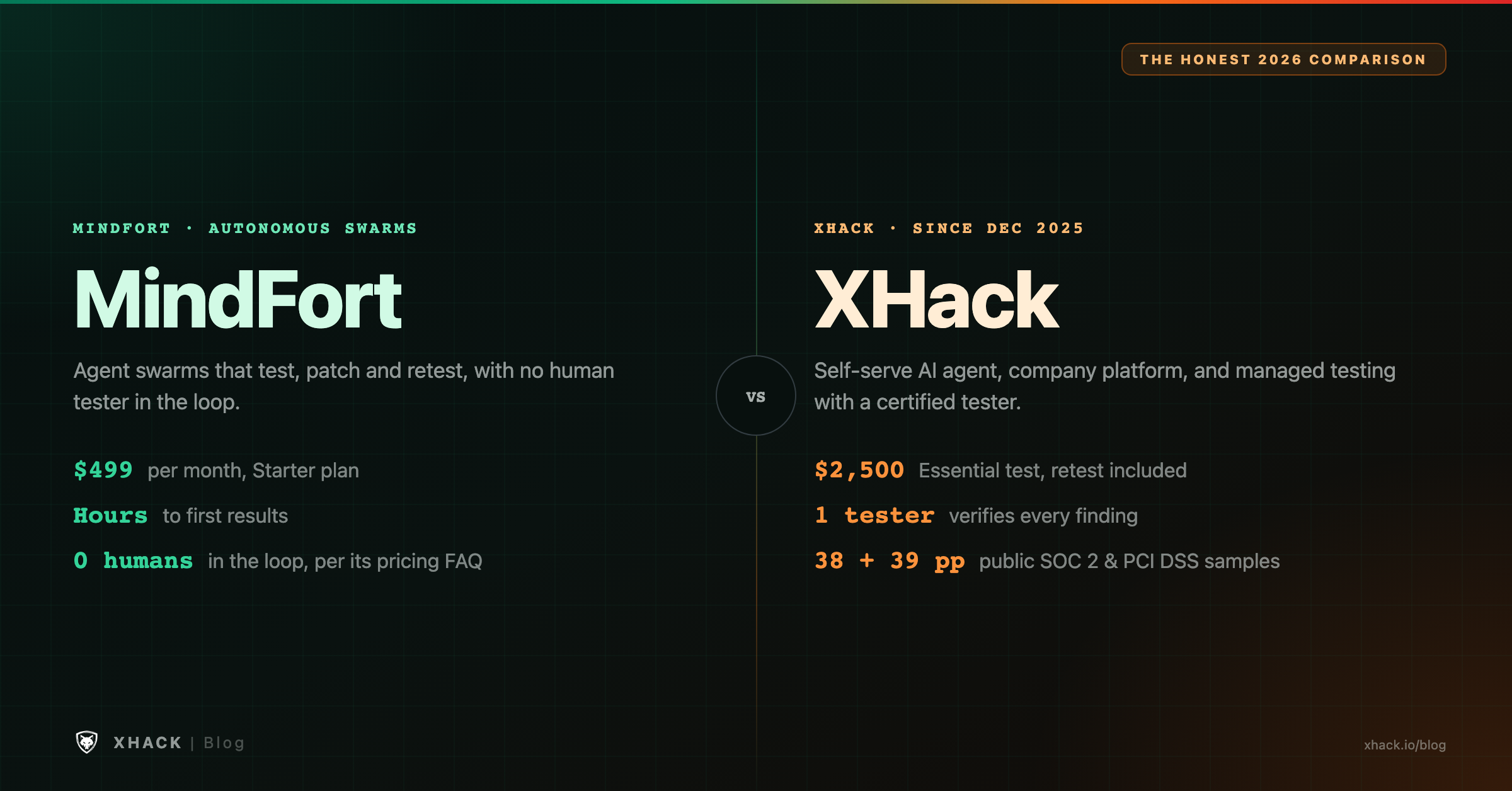
Both products test web applications and APIs, and both use AI agents to do the repetitive work. Here is the MindFort vs XHack comparison in one table, with MindFort’s figures read from its live pricing page and XHack’s from ours.
| MindFort | XHack | |
|---|---|---|
| What it is | Autonomous pentest platform built around agent swarms, with patching and retesting | Three layers: self-serve AI agent, company security platform, and managed testing by certified testers |
| Founded and funding | $3M+ seed announced April 2026, led by Soma Capital with Y Combinator, 468 Capital, CRV, Sandwith Ventures and Blast | Founded December 2025, small named team |
| Entry price | ✅ Starter $499/mo (250 credits), Scale $999/mo (800 credits), Enterprise custom | ✅ Agent for individuals $20 to $150/mo, company platform $560 to $3,000/mo, managed testing from $2,500 per engagement |
| Human tester | ❌ “No.” Agents plan, run and prove every finding, “the only human decision is merging the fix” | ✅ Managed plans: AI agents lead and a certified tester verifies every finding. ⚠️ The self-serve agent is agent-driven; you validate |
| Speed | ✅ First results in hours; Balanced run about 4 hours, Ultra about 8 hours | ✅ Self-service agent pentest: Instant |
| Fixes | ✅ Opens patch pull requests, reviews PRs, retests automatically when a patch merges | ⚠️ Fix steps in the report and a patch verification retest; GitGuard scans pull requests on Premium and Elite company plans |
| Retest cost | 1 credit per finding (about $1.25 to $2.00) | Included in every managed engagement |
| Coverage named | Web, API, code, cloud, network, infrastructure; mobile targets and infrastructure assets listed under Scale | Web, host, API, mobile and internal network on Assurance; cloud configuration review on Comprehensive; red team, SOC and incident response scoped separately |
| Company attestations | ✅ SOC 2 Type II, models hosted in the US, private deployment option | Certifications held by named testers (OSCP+, OSCP, C-AI/MLPen) |
| Sample report | ⚠️ Report contents (scope, findings, evidence, remediation) described in its docs | ✅ SOC 2 (38 pages) and PCI DSS (39 pages) sample reports, free to open after a short form |
| Free trial | ✅ First assessment complimentary on Starter | ✅ 7-day trial on individual and company plans, one per person |
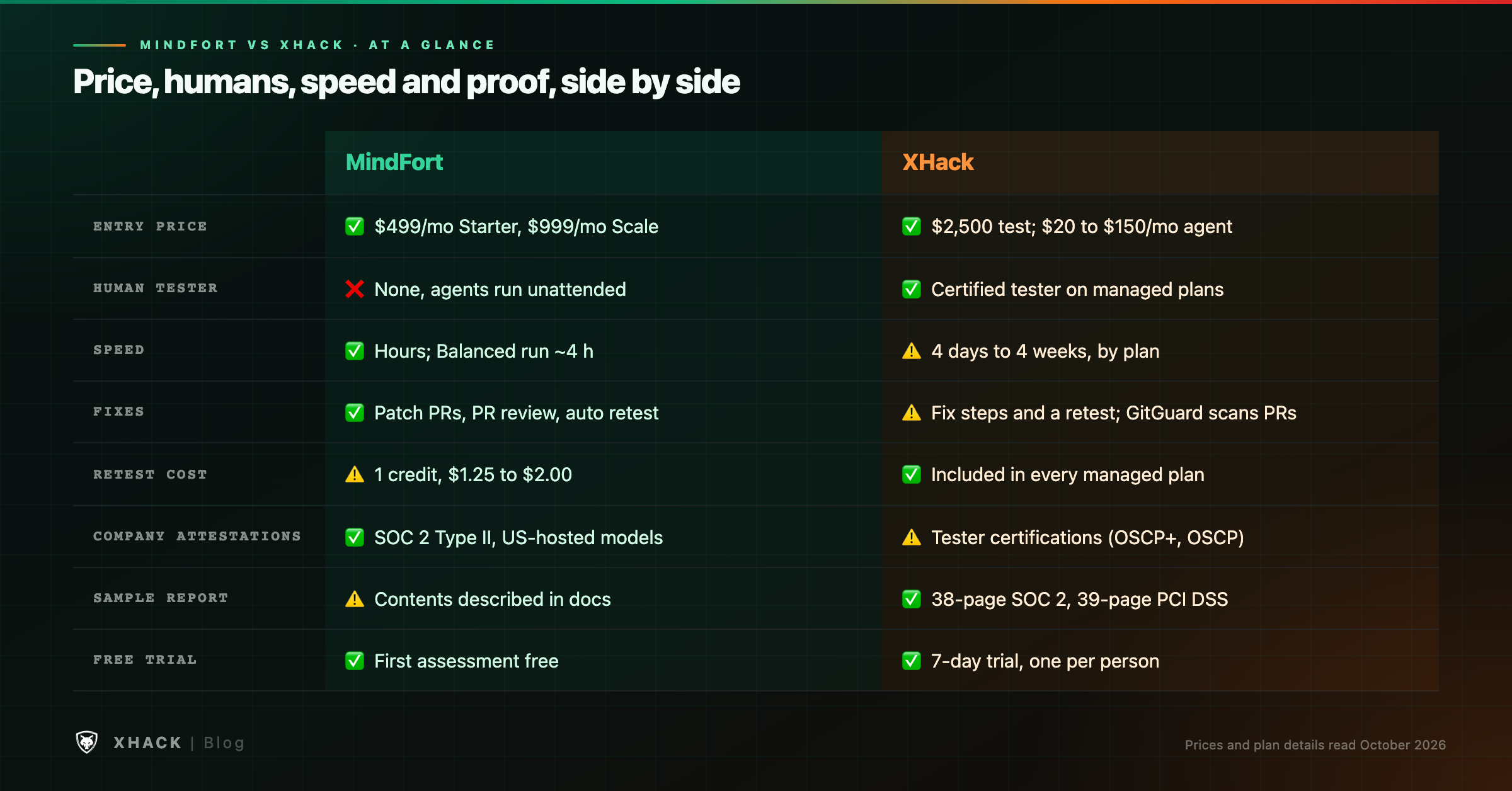
The MindFort vs XHack gap is widest in two rows: who verifies the findings and how fast you get them. MindFort answers in hours with no person involved. XHack’s managed plans answer in days with a certified person who signs for the proof.
If you are still building your shortlist, best AI pentesting tools 2026 ranks the wider field, and the questions at the end of this comparison work for any vendor on it.
MindFort describes itself as an applied AI security lab. Its platform sends swarms of AI agents at an application, API, cloud account or network range, proves each finding with a working exploit, and opens a fix. Co-founder and CEO Brandon Veiseh previously led product at ProjectDiscovery and built AI tooling for offensive security at NetSPI. Co-founder and CTO Akul Gupta has red-teamed models for OpenAI and Anthropic. The company announced a $3M+ seed round on 21 April 2026.
The product is broader than a scanner with a language model attached. Its documentation describes assessments for broad testing, directed agents for follow-up questions, a security reviewer for pull requests that became generally available on 1 October 2026, and an API and MCP server for working with findings from a coding assistant.
Three features stand out. Dual credential mode runs an assessment with two stored accounts, such as users in different tenants, and tests whether one can reach the other’s data. Agents log in through SSO redirects and complete authenticator app, SMS and email MFA on their own. And every agent action is logged, so the evidence behind a finding is stored as the agents work.
MindFort also publishes guardrails in plain language. You can tell the agents to use only the test accounts you provide, avoid payments, or stay out of one workspace. Its safety page describes default alignment, a monitoring agent that watches each agent’s behavior, and deterministic protections that do not depend on model judgment alone.
On cost and speed, the MindFort vs XHack comparison favors MindFort for repeat testing. A Starter plan includes up to one pen test a month, Scale up to four, and the first assessment on Starter is complimentary.
XHack is a security company with three layers, and the MindFort vs XHack comparison only makes sense once you see which layer you would buy.
The first layer is the XHack AI agent for individuals and bug hunters. Plans run $20, $49 and $150 a month, each with a 7-day trial. The agent covers recon, vulnerability discovery, exploit chaining, mobile app analysis, a traffic-capture Repeater, and findings scored with CVSS v4.0 and CWE. For more on its features, see every XHack AI agent feature. Exploitation features unlock after identity verification.
The second layer is the company security platform. Starter is $560 a month, Premium $1,099 and Elite $3,000. These plans bundle XHack AI access, vulnerability assessment scans, a SOC dashboard and, from Premium, GitGuard, which scans GitHub pull requests for vulnerabilities before they merge.
The third layer is managed testing. Essential starts at $2,500, Assurance at $5,000 and Comprehensive at $12,000, delivered by OSCP-certified testers working alongside the AI agents. Beyond those fixed engagements, XHack scopes red teaming, a managed SOC, incident response, threat intelligence, secure code review, reverse engineering and AI red teaming individually.
That structure is why the MindFort vs XHack question is rarely a like-for-like swap. MindFort competes most directly with the first two layers’ automated testing. The managed layer competes with the people-led pentest firms MindFort positions itself against.
For a longer view of how AI and human testers fit together, AI and human penetration testing covers the combination in detail.
MindFort sells credits. XHack sells fixed scopes. That makes the MindFort vs XHack pricing comparison easy to get wrong, so here is the math.
MindFort’s live pricing page lists Starter at $499 a month with 250 credits and Scale at $999 a month with 800 credits. A Balanced assessment costs 200 credits and runs about 4 hours, Deep costs 400 and runs about 6 hours, and Ultra costs 800 and runs about 8 hours. Retests, patches and small task agents cost 1 credit each. Credit packs carry volume discounts of up to 30%, and the page does not print the pack prices.
| MindFort run | Credits | Cost on Starter ($1.996/credit) | Cost on Scale ($1.249/credit) |
|---|---|---|---|
| Balanced assessment (~4 h) | 200 | $399.20 | $249.75 |
| Deep assessment (~6 h) | 400 | Beyond the 250 monthly credits | $499.50 |
| Ultra assessment (~8 h) | 800 | Beyond the 250 monthly credits | $999.00 |
| Retest of one finding | 1 | $2.00 | $1.25 |
Read that MindFort vs XHack pricing table carefully. Starter’s 250 credits fit one Balanced run plus about 50 retests. A Deep or Ultra run on Starter needs credit packs or overage billing at the standard credit cost, and the page does not state that cost. Starter is also limited to one target and one concurrent assessment.
Over a year, Starter costs $5,988 and Scale costs $11,988. XHack’s Comprehensive engagement is $12,000 once, and Assurance is $5,000 once. The numbers land close together, but they buy different things.
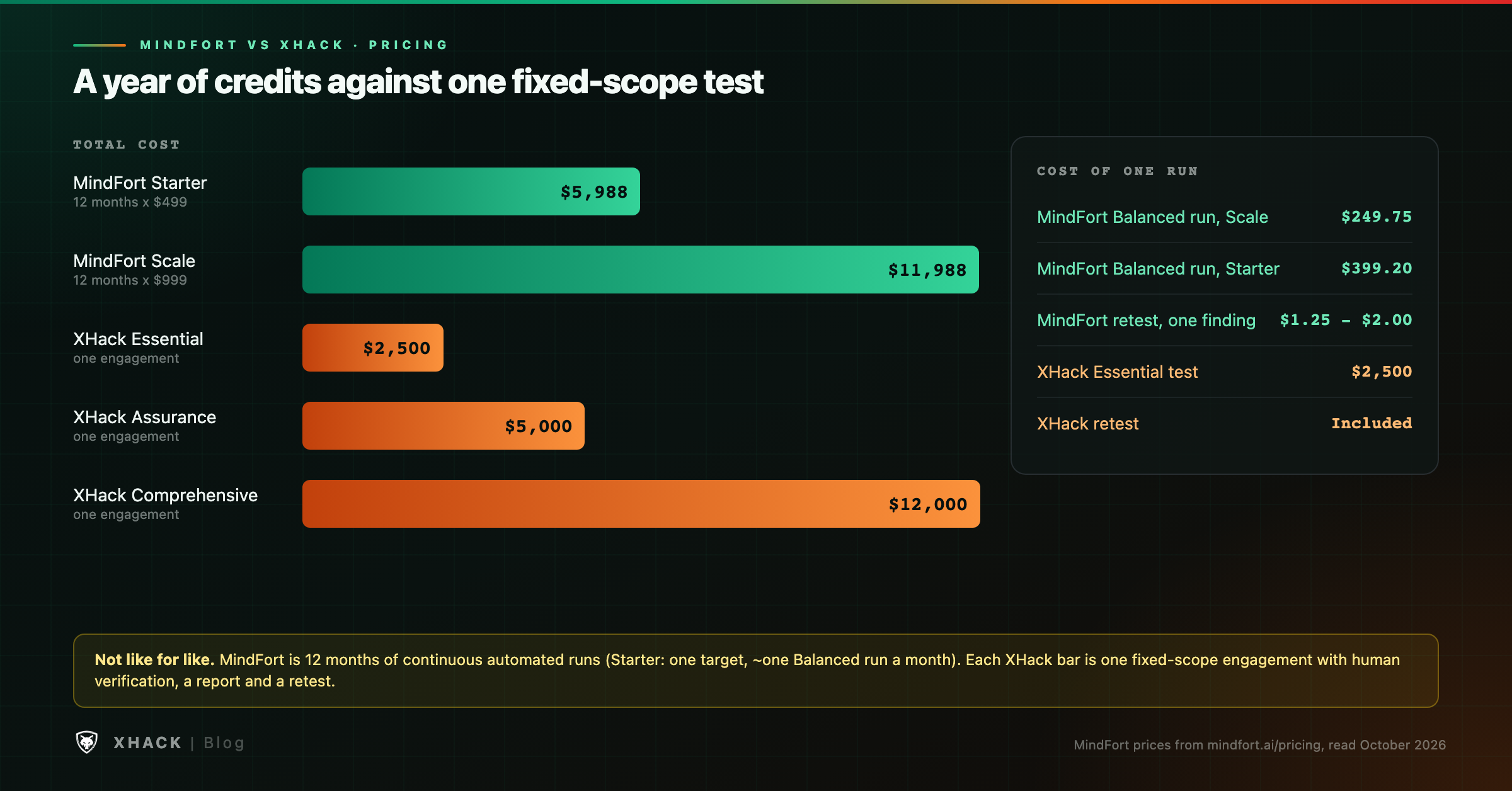
This is not like for like. A year of MindFort Scale is continuous, automated and unlimited in targets. One XHack Comprehensive engagement is a point-in-time test of up to 20 web apps or 200 hosts, verified by testers, with a report an auditor can read and a retest included. XHack’s engagement price is fixed for the agreed scope, with no change orders once testing starts.
Two more caveats belong here. XHack’s $20 to $150 plans are for individuals and bug hunters, not companies, and its company platform cards list vulnerability assessment scans, a SOC dashboard and GitGuard rather than a metered pentest allowance. For a company wanting a pentest-credit subscription, MindFort’s cards are the closer match. And earlier MindFort material quoted a $199 starting price, which our XBOW alternatives roundup repeated until this week. The pricing page now reads $499, so check it on the day you buy.
For market context, AI penetration testing cost lays out what each approach tends to run.
This is the section where the MindFort vs XHack comparison matters most.
MindFort’s position is stated plainly in its pricing FAQ. Agents plan the attacks, run them, prove each finding and write the patch unattended, and the only human step is merging the fix. That is a coherent design, and it is what makes the price and the speed possible.
XHack’s managed plans put a person in the middle. On Essential, AI agents lead discovery and one certified penetration tester verifies every finding, with manual exploitation to prove real impact rather than raw scanner output. Assurance uses two OSCP-certified testers working alongside the agents. The agents run inside the same rules of engagement, with your explicit permission, at no extra charge.
Be careful not to blur XHack’s layers. The self-serve XHack agent is agent-driven, like MindFort. The human verification belongs to the managed engagements. If you buy the $49 plan, you validate the findings; our Terms of Service say AI output “may report false positives, and may miss real vulnerabilities.” XHack AI mistakes explains where our own agent gets things wrong.
Two things follow for the MindFort vs XHack decision. If your goal is breadth and frequency, no human in the loop is a feature, because you are paying for hours of agent time rather than days of a tester’s time. If your goal is a report where a named tester accepts responsibility for what is in it, a test with no tester in the loop does not provide that.
MindFort’s own documentation is also more cautious than its marketing. The patching guide says to “treat it as a starting point” and notes that a merged patch “does not, by itself, prove that a deployed vulnerability is fixed.” The FAQ warns that testing “can generate traffic or affect application state” and recommends a non-production environment for sensitive targets. That is sensible advice, and worth reading before you point agents at production.
Both vendors list web applications and APIs, so the MindFort vs XHack coverage question is about everything around them.
MindFort defines a target as a web application, API or network address that you authorize it to assess, and it verifies the target before an assessment can start. Its comparison table lists web, API, code, cloud, network and infrastructure coverage, with business logic testing and white-box testing when you connect a repository. On the pricing page, mobile targets and infrastructure assets sit under Scale, not Starter. Source code is optional, which makes a first run quick.
XHack’s coverage depends on the layer. The managed Essential plan covers one unauthenticated web application or up to 50 host IPs. Assurance adds authenticated testing across user roles, internal network testing, APIs over REST, GraphQL, gRPC and WebSocket, and iOS and Android apps. Comprehensive adds cloud configuration review across AWS, Azure and GCP, plus attack-path chaining across targets. AI and LLM testing is a scopable target type, and AI Probe on Premium and Elite company plans tests AI systems adversarially, with the full OWASP LLM Top 10 on Elite.
The practical MindFort vs XHack difference is depth of judgment against breadth of cadence. A human tester can chase a strange business-logic flow for two days. A swarm can rerun a hundred checks every release.
Neither company approves your audit, and both say so. MindFort’s SOC 2 page answers “Does MindFort replace a SOC 2 auditor?” with “No.” XHack’s SOC 2 sample report states that the attestation opinion is issued by an independent licensed CPA firm. What a pentest vendor can supply is evidence, and the MindFort vs XHack difference is what kind.
MindFort supplies exportable reports, an attestation letter and a platform audit trail. Reports can include scope, validated findings, remediation status, retest results and activity logs. MindFort holds its own SOC 2 Type II report, which you can request from its Trust Center. Its own guide on whether auditors accept an AI pentest says the answer is “usually” yes, and it tells readers to reword any control that promises an “annual manual penetration test by a third party” and to confirm the approach with their auditor in writing.
XHack supplies a human-tested report mapped to the framework. Essential includes a letter of attestation covering scope and test dates. Assurance adds evidence mapped to PCI DSS, SOC 2, ISO 27001, HIPAA and GDPR, internal network testing and a findings walkthrough call. Sample SOC 2 and PCI DSS reports are public, so you can check the format against your auditor’s expectations before paying.
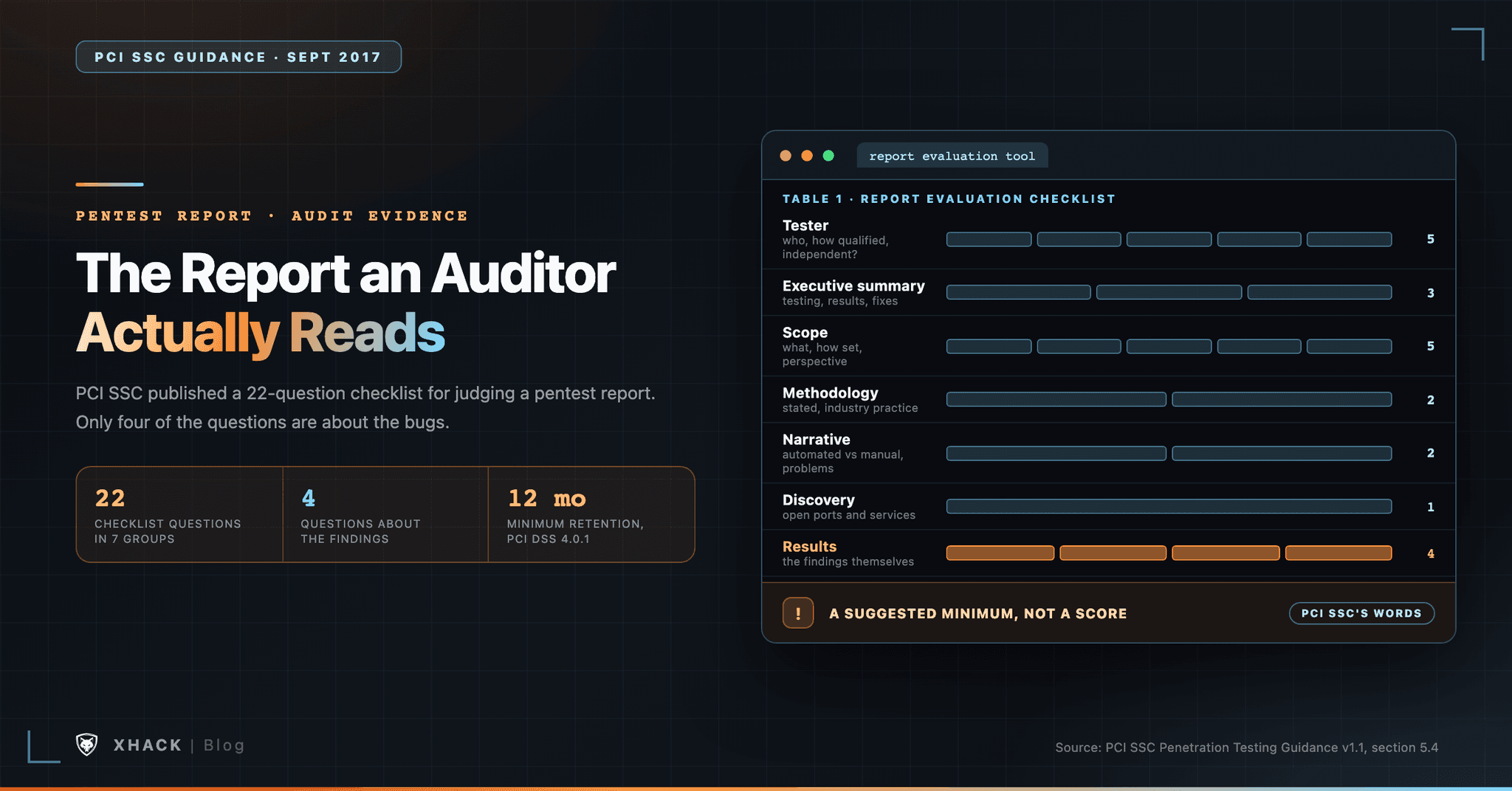
The PCI Security Standards Council’s own guidance gives context. It calls penetration testing “essentially a manual endeavor” and says tools can help with repetitive tasks, and its report checklist asks for a clear discussion of the automated and manual testing performed. That document dates from 2017, and it does not ban autonomous testing. But it explains why a PCI QSA may ask who tested and how, and why a PCI buyer should ask the QSA before choosing.
Frameworks with named tester rules go further. FedRAMP expects manual plus automated testing from an accredited assessor, and DORA sets conditions on who may run threat-led tests. Neither company’s self-serve product replaces those; see FedRAMP penetration testing and DORA’s Article 27 for the rules.
For a typical SaaS audit, SOC 2 penetration testing and whether auditors accept AI-run pentest evidence cover what auditors actually ask. The safe rule in any MindFort vs XHack audit decision is to ask your auditor first.
In a MindFort vs XHack comparison, the proof behind both companies is thinner than the marketing.
MindFort says its agents run at under 1% false positives, that they “have beaten human pen test teams head-to-head,” and that a MindFort benchmark called NexBench ranks models on pentest tasks. Those are MindFort’s own figures and its own benchmark. They are claims to test in a trial, not measured facts.
XHack’s proof gap is different. We were founded in December 2025, we have a small named team rather than a large bench, and we have no G2 or Gartner score yet. What we can offer is that the report format is public, the prices are on the page, and a certified tester signs for the findings on managed plans.
One more MindFort disclosure deserves a clear reading. On 26 October 2026, MindFort announced a partnership with MorphLLM to bring “abliterated open models,” meaning open-weight models with refusal behavior removed, to its swarms. MindFort says scoping, rate limits and validated findings stay the same. For authorized offensive work that is a defensible choice, and it means the guardrail layer, not the model’s own refusals, is the control that matters. XHack handles the same risk differently: exploitation features unlock only after identity verification. In either case of the MindFort vs XHack choice, ask what stops an agent from touching out-of-scope systems.
A short list of questions works for any MindFort vs XHack shortlist: Can I read a real report before I pay? What happens when the agent is wrong? Who is accountable? How are out-of-scope actions blocked? What does a retest cost?
A one-sided MindFort vs XHack comparison would not help you, so here is where MindFort is the stronger pick.
Price for frequent testing is MindFort’s biggest advantage. A Balanced run costs about $250 to $400 in credits, and a retest costs $1.25 to $2.00. XHack’s Essential at $2,500 is a one-off test, not a subscription, so it cannot match that cadence on price.
Speed is real. MindFort advertises first results in hours, with a Balanced run taking about 4 hours. XHack’s fastest managed plan takes 4 days from kickoff to report.
The fix loop is built in. MindFort opens patch pull requests with threat models, reviews every PR, files tickets in Jira and Linear, and retests automatically after a patch merges. XHack’s managed reports give fix steps and a verification retest, and GitGuard scans pull requests, but we do not describe opening fix PRs on our pricing pages.
It starts with a free assessment and a 15-minute setup. MindFort says first deployment takes about 15 minutes. For a team that wants to see output before talking to anyone, that is a low barrier.
MindFort has company-level attestations XHack does not publish. SOC 2 Type II, US-hosted models, SSO and SAML, role-based access and a private deployment option on AWS, Azure or GCP all appear on its enterprise page. XHack’s published credentials are the certifications its testers hold.
It has funding and a documented API. A $3M+ seed with Y Combinator and Soma Capital behind it, plus a public API reference, makes MindFort easier to justify to a procurement team than a company founded in December 2025.
The strongest MindFort case: if you ship weekly, have no security team, want continuous coverage with fixes opened for you, and your auditor accepts an AI-run test, MindFort is the more efficient purchase.
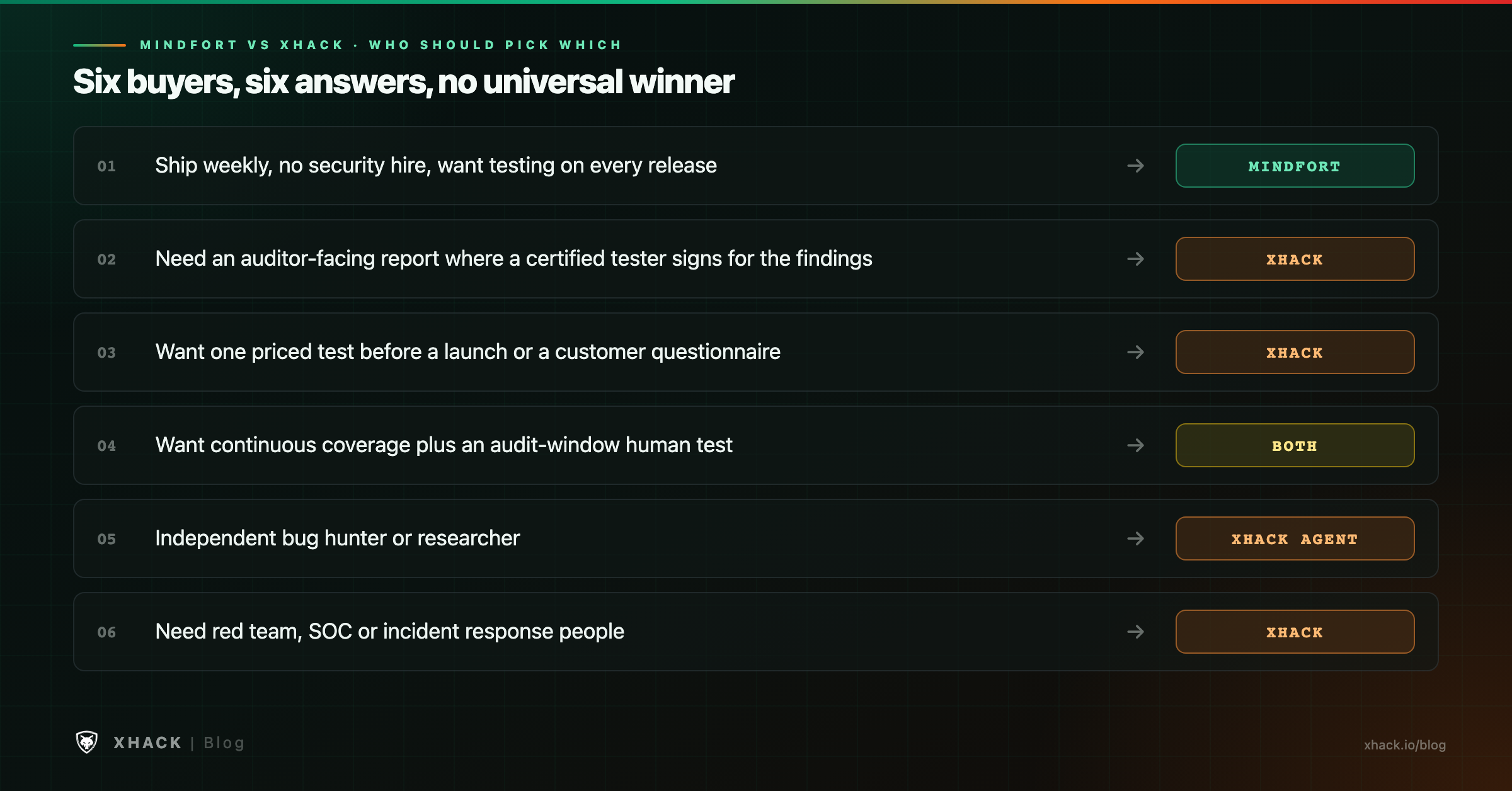
Neither company wins for every buyer. Here is how the MindFort vs XHack decision breaks down.
You ship weekly, have no security hire and want testing on every release. Pick MindFort. Continuous runs, pull request review and patch PRs fit that rhythm, and a year of Starter is $5,988, less than four $2,500 Essential tests.
You need a report an auditor can rely on, signed by a certified tester. Pick XHack. Assurance starts at $5,000 with evidence mapped to SOC 2, PCI DSS, ISO 27001, HIPAA and GDPR, a retest, and a findings call.
You need a single priced test before a launch or a customer questionnaire. Pick XHack. Essential is $2,500 for one web app in 4 days, and a letter of attestation covers scope and test dates.
You want both continuous coverage and an annual audit-grade test. Use an automated tool between tests and a human-verified report at audit time. The two can be bought separately, and a MindFort vs XHack framing misses that they can coexist.
You are an independent bug hunter or researcher. Pick XHack’s individual plans. MindFort’s docs say a target must be verified before an assessment can start, which suits assets you own, and its plans are priced for organizations.
You need people, not only testing. Pick XHack. Red teaming, a managed SOC, incident response and secure code review delivered by people are scoped as XHack services, while MindFort’s published product is agent-run testing, patching and pull request review.
If you are weighing other options, Cobalt vs XHack covers a human-led network of 500+ testers, XBOW vs XHack covers a pay-per-test autonomous competitor, and Strix vs XHack covers an open-source agent.
MindFort is cheaper for repeated testing. Starter is $499 a month and Scale is $999, against XHack’s one-off managed engagements from $2,500. A single XHack Essential test costs about five months of MindFort Starter. But a MindFort vs XHack price check must note that Starter covers one target and about one Balanced run a month, while XHack’s price includes human verification, a report and a retest.
No, and that is the central MindFort vs XHack difference. MindFort’s pricing FAQ says agents plan, run and prove every finding unattended, and the only human decision is merging the fix. XHack’s managed plans use certified testers who verify findings alongside AI agents. XHack’s self-serve agent plans do not include a tester, so you validate the output yourself.
It depends on your auditor, and neither side of the MindFort vs XHack pair can promise it. MindFort provides an attestation letter and SOC 2 evidence, and tells readers to confirm the approach with their auditor in writing. XHack provides a human-tested report with a letter covering scope and test dates, and its sample SOC 2 report is public. Neither one certifies your compliance.
Yes, on both sides of the MindFort vs XHack pair. MindFort offers a complimentary first assessment on Starter. XHack offers a 7-day trial on individual and company plans, one per person, with exploitation features unlocking after identity verification. XHack’s managed engagements are scoped and quoted, so there is no self-serve trial for them.
Nobody can say yet in the MindFort vs XHack matchup. MindFort claims under 1% false positives, and that figure comes from MindFort. XHack’s Terms of Service state that AI output may be wrong, and on managed plans a tester verifies findings before delivery. Run a trial on a system you know well, and count the findings that do not reproduce.
On fixes, MindFort comes closer in the MindFort vs XHack comparison. It opens patch pull requests against your repository, files tickets and retests after a merge, though its docs say to treat the patch as a starting point. XHack gives fix steps, a developer-focused findings walkthrough on Assurance, and a patch verification retest, and its GitGuard scans pull requests on Premium and Elite company plans.
Yes, and the MindFort vs XHack choice does not have to be either-or. A reasonable pattern is an automated platform for continuous coverage and a human-verified test for your audit window. Ask each vendor what overlap you would be paying for, and check your auditor accepts the automated evidence you plan to supply.
The MindFort vs XHack choice comes down to what you need to prove. MindFort gives you the lowest price in this comparison for frequent testing, results in hours, patch pull requests, a free first assessment, and company-level attestations including SOC 2 Type II, at the cost of having no human tester behind the report.
XHack gives you a certified tester who verifies each finding on managed plans, public sample reports you can read before signing, fixed prices on the page, and a retest in every engagement, at the cost of slower delivery, a higher price per test and a younger company. Both have accuracy claims you should test for yourself, and I have tried to state MindFort’s side as fairly as ours.
Categories
Related articles