Table of contents
17
By Salman Khan, OSCP+, Founder of XHack, SRT (Synack Red Team member)
Read this in 30 seconds: Cobalt is a 13-year-old pentest-as-a-service company with a large tester network and real third-party proof. XHack is a ten-month-old company with a small named team and prices on the page. Both facts matter, and neither one settles the Cobalt vs XHack question by itself.
- Cobalt publishes one real price, but only for one product and only this year. Its Autonomous Pentest is a promotional $3,500 per test if run before Dec 31, 2026, while its Standard, Premium and Enterprise tiers stay quote-only.
- XHack puts a starting price on every tier below Enterprise, but it has no third-party review score yet. Managed Services start at $2,500, $5,000 and $12,000, and self-serve AI plans run $20 to $150 a month for individuals.
- XHack lets you read its report format before you buy, but the audit opinion still comes from your CPA firm or QSA. Its 38-page SOC 2 and 39-page PCI DSS penetration test reports are free to open, and both say in writing who signs the final opinion.
- Cobalt holds its own SOC 2 report, ISO 27001 certification and CREST accreditation, but XHack’s credentials belong to its people. OSCP+, OSCP, C-AI/MLPen and Synack Red Team membership are held by named testers, not audited attestations for the company.
Cobalt was founded in 2013. XHack was founded in December 2025. That gap alone should shape how you read this Cobalt vs XHack comparison.
I run XHack, so I have a financial interest in you picking us. I’m putting that upfront rather than letting you find it halfway through. Where Cobalt is the better fit, I’ll say so plainly, and the “Where Cobalt Genuinely Wins” section exists specifically to make that case.
The real Cobalt vs XHack question isn’t which company is “better.” It’s which one matches what you actually need: a large, established, audited vendor with a big bench, or a small named team that shows you the report format and the price before you talk to a salesperson. This comparison walks through both, and says plainly whenever a number comes from someone other than the vendor itself.
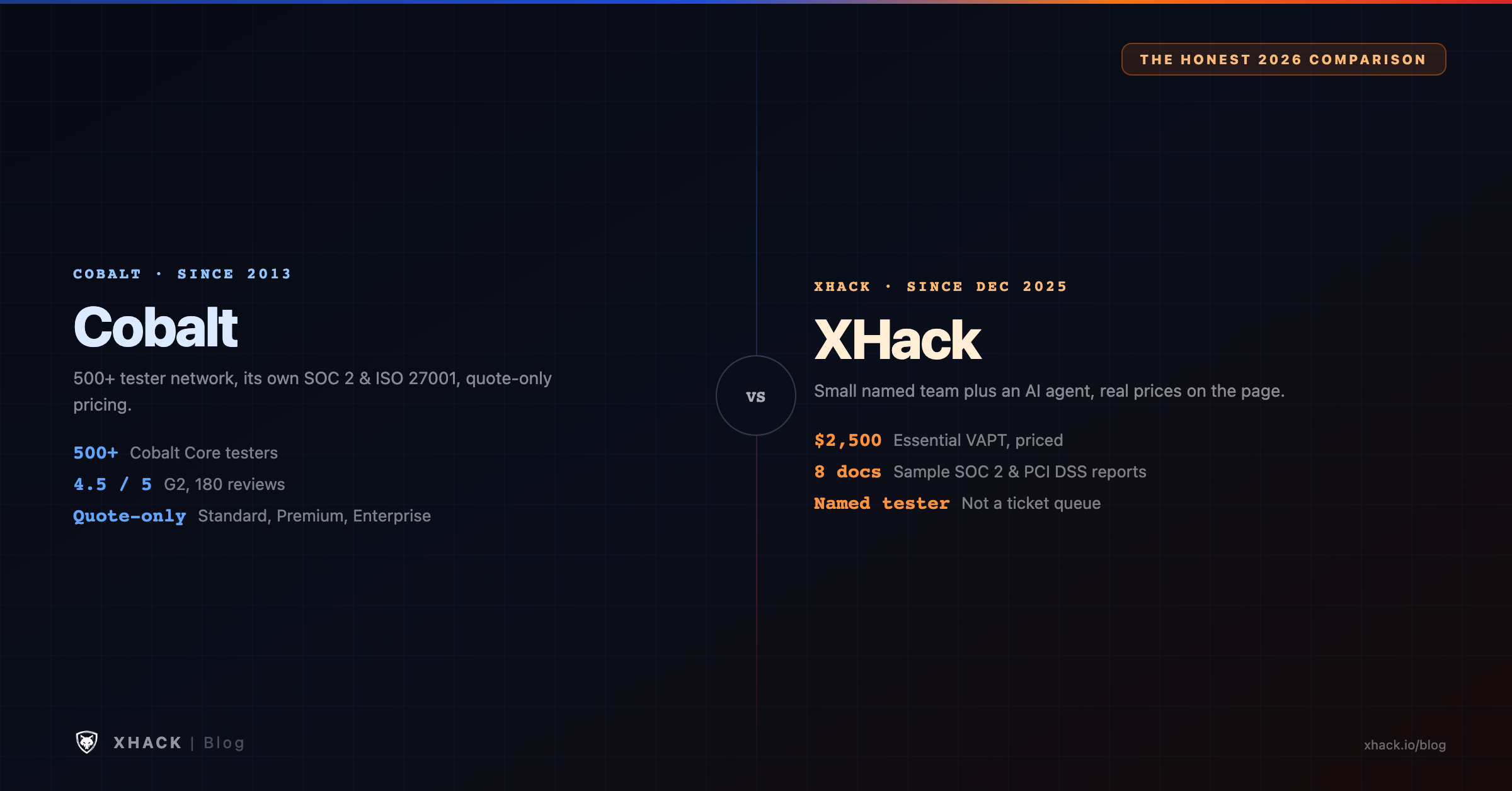
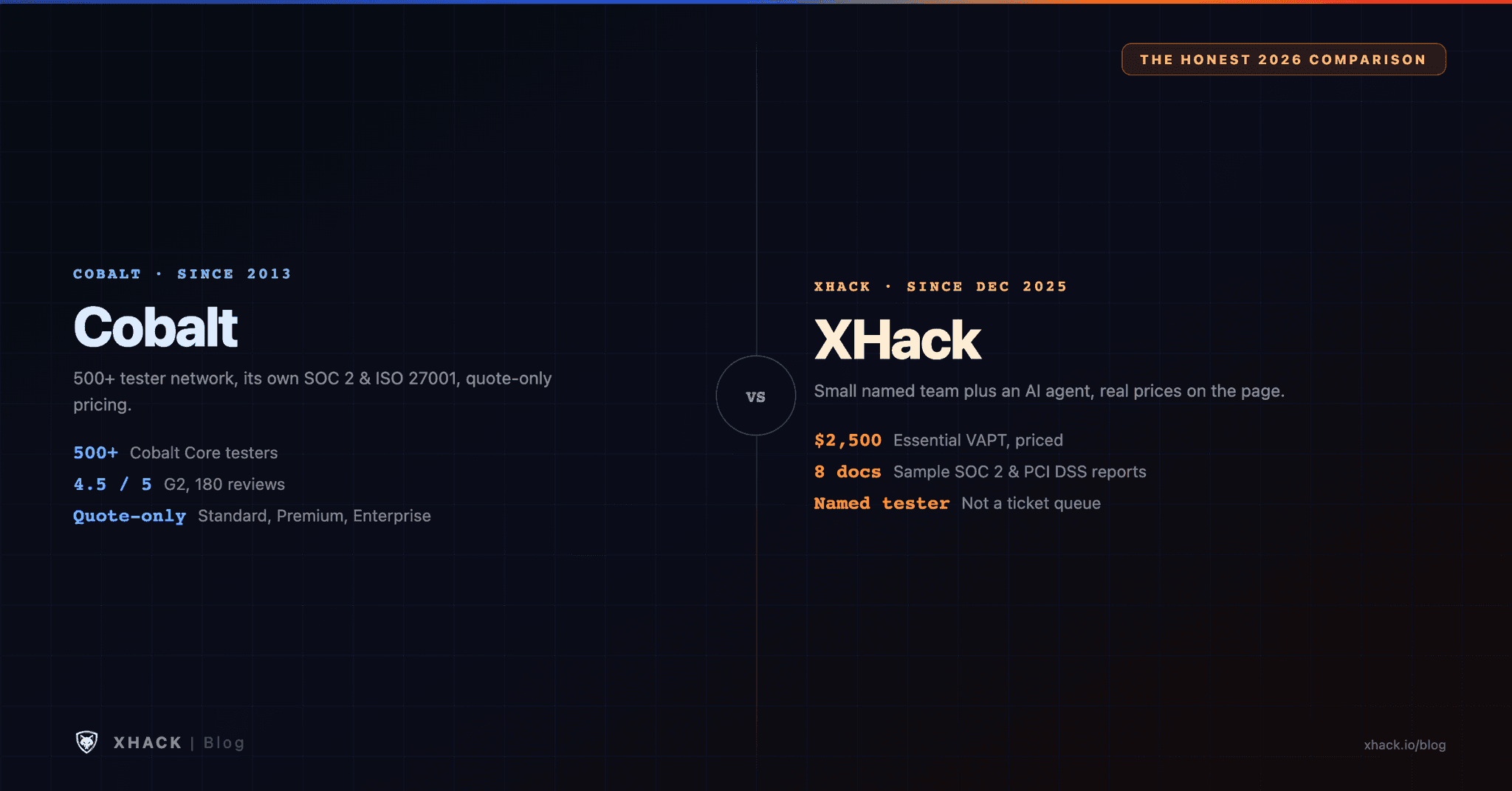
Both companies sell penetration testing, but they built it on different foundations. Cobalt built a large vetted tester network, Cobalt Core, with a SaaS dashboard on top. XHack built a small team that pairs human testers with its own AI agent. Here’s the Cobalt vs XHack comparison in one table.
| Cobalt | XHack | |
|---|---|---|
| Founded | 2013, by four Danish co-founders. Now Boston HQ, with a UK office in Oxford | December 2025, Peshawar, Pakistan |
| Pricing model | ⚠️ Standard, Premium, Enterprise: quote-only. One published price, Autonomous Pentest at $3,500/test, promotional for tests run before Dec 31, 2026 | ✅ Managed Services from $2,500 / $5,000 / $12,000, Enterprise custom. Self-serve AI plans $20 to $150/mo individual, $560 to $3,000/mo company |
| Tester model | Cobalt Core: 500+ vetted testers, five-stage vetting, employment status not disclosed | Small named team: OSCP+, plus an “8+” extended team, one office |
| Turnaround | Human-led: 3, 2 or 1 business days to start, by tier. Autonomous: 24 hours to findings | Essential 4 days kickoff to report. Assurance 5 days to 2 weeks. Comprehensive 2 to 4 weeks |
| Asset coverage | Web, API, mobile, desktop, internal and external network, cloud (AWS, Azure, GCP), AI and LLM apps | Web, host, API, mobile (iOS, Android), internal and external network, cloud config review. AI and LLM testing folded into VAPT and red teaming, not its own line |
| AI’s role | Cobalt Sage handles discovery, scanning and triage. Humans direct the engagement and approve tool calls | AI agents run recon and discovery breadth. Human testers verify, chain findings and sign off, with your explicit permission and at no extra cost |
| Retest | Free retest eligible for 6 months (Standard) or 12 months (Premium, Enterprise), with a separate 7-day turnaround SLA once requested | Included in every human-led plan, no stated time window. “Part of the price, not an upsell” |
| Compliance frameworks named | SOC 2, ISO 27001, PCI DSS, HIPAA, NIST SP 800-53, EU Cyber Resilience Act | PCI DSS, SOC 2, ISO 27001, HIPAA, GDPR on the Assurance tier, plus dedicated downloadable SOC 2 and PCI DSS sample reports |
| Vendor’s own certifications | ✅ SOC 2 Type II report from its own annual audits, ISO/IEC 27001 certified, CREST Penetration Testing Service accreditation | OSCP+, OSCP, C-AI/MLPen, CASA held by named individuals, plus Synack Red Team membership. No CREST accreditation |
| Third-party reviews | ✅ G2 4.5/5 across 180 reviews. Gartner Peer Insights 4.5/5 across 15 reviews | G2 4.7/5 across 3 reviews (XHack launched recently) |
| Scale claims | 500+ testers, 5,000+ pentests a year, 1,500+ companies | 6 clients secured, 32 assessments done, 8 years of combined experience |
| Sample reports | ⚠️ Deliverables described (customizable reports, letters of attestation, executive summaries); ask for a sample during scoping | ✅ 8 documents, including a 38-page SOC 2 penetration test report and a 39-page PCI DSS penetration test report, free to open after a short contact form |
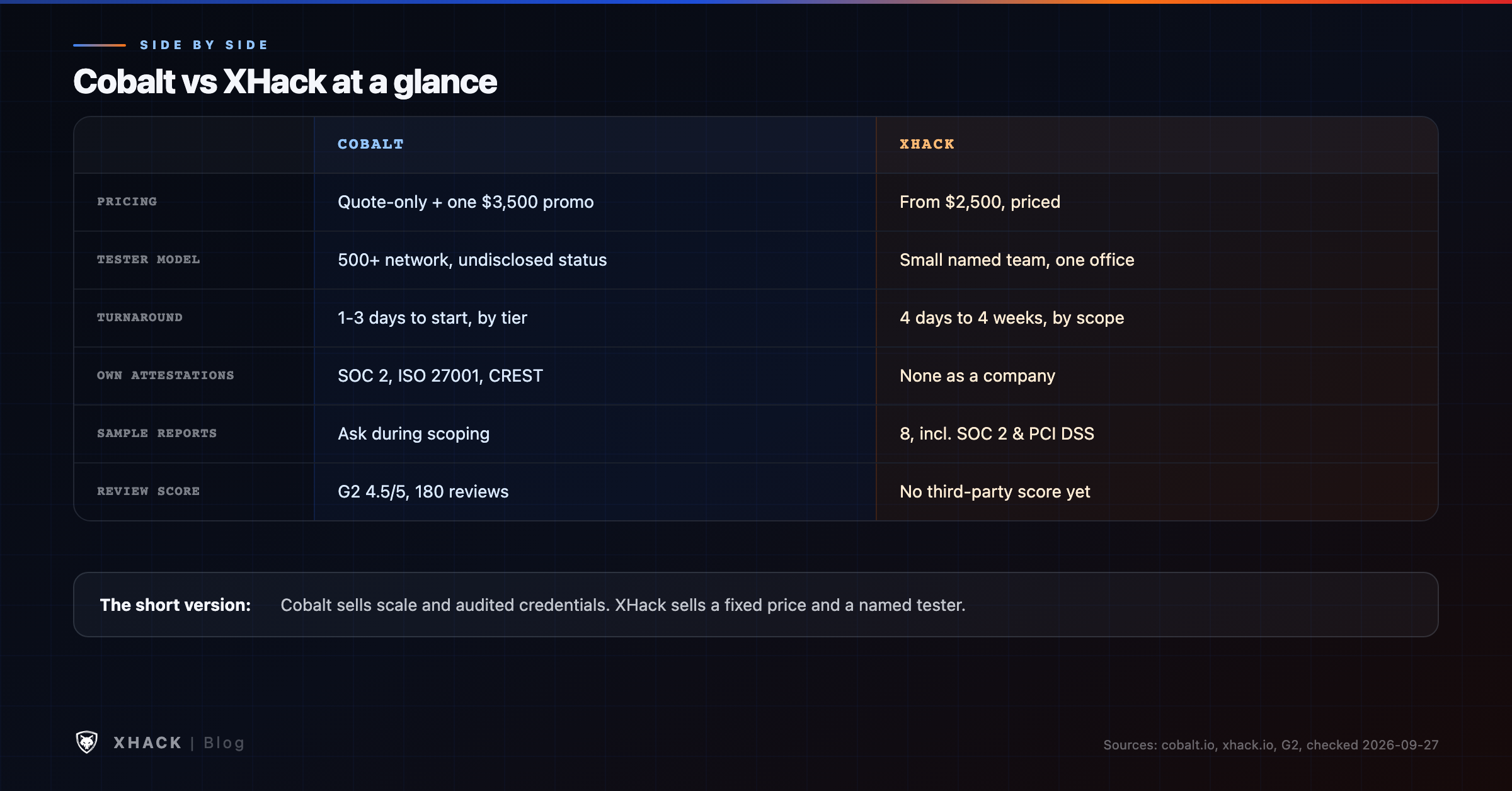
The top half of that table is where the two look closest: both test web apps, APIs, networks and cloud, and both blend AI into the process. The bottom half is where the Cobalt vs XHack comparison actually splits: one sells scale and audited credentials, the other sells a fixed price and a named tester.
For the wider landscape, how to choose a pentest provider walks through the questions worth asking any pentest vendor, including on a Cobalt vs XHack shortlist.
Cobalt Labs, Inc. started in 2013 as a bug-bounty platform, then pivoted to pentest-as-a-service when the bug-bounty model didn’t gain investor traction. Thirteen years later, it’s headquartered in Boston with an office in Oxford, UK, and Sonali Shah has run the company as CEO since August 2024.
Cobalt calls its product “human-led, AI-powered pentesting that scales with your attack surface.” The core of that is Cobalt Core, a network of more than 500 vetted testers who go through a five-stage process: sourcing, a skills assessment, interviews, background checks and tax verification, then ongoing lead review. That bench is the backbone of Cobalt’s side of the Cobalt vs XHack matchup; certifications named across the network include OSCP, OSWE, CREST, CRTO, CRTM and CISSP.
Its users rate the support and the tester communication. G2’s own AI summary of Cobalt’s reviews highlights “exceptional customer support” (19 mentions) and “strong communication” with pentesters (16 mentions), and Cobalt publishes named case studies with customers such as Flexport, MuleSoft and Vonage, another point squarely in Cobalt’s favor on the Cobalt vs XHack scorecard.
One thing worth stating plainly: Cobalt’s site doesn’t say whether Cobalt Core testers are employees or independent contractors. The vetting language (tax documentation, NDAs, a “Terms of Engagement” rather than an employment contract) reads closer to a contractor model, but that’s an inference, not something Cobalt has confirmed. Treat it as undisclosed.
Cobalt’s AI layer is called Cobalt Sage. It runs discovery, initial scanning and triage, while Cobalt Core testers direct the engagement, review the AI’s execution plans, and approve or redirect its tool calls. Cobalt’s own pitch is that fully autonomous testing “is a starting point, not a security program,” and that its testers add the chained exploitation and business-logic testing that AI alone tends to miss.
The asset coverage is genuinely broad. Cobalt’s platform page lists web applications, APIs, mobile applications, internal and external networks, cloud environments across AWS, Azure and GCP, AI and LLM applications, and desktop applications, all under one platform. That desktop-application line is the clearest Cobalt vs XHack coverage gap: it’s something XHack doesn’t name as its own asset type, and it’s a real point in Cobalt’s favor for a buyer with a mixed asset inventory.
On the Cobalt vs XHack turnaround question, Cobalt follows the tier: Standard starts in 3 business days, Premium in 2, Enterprise in 1. Every human-led pentest includes free retesting of individual findings, with a 6-month eligibility window on Standard and 12 months on Premium and Enterprise. So a Standard customer has six months to ask for a retest, and each retest is completed within a separate seven-day turnaround SLA once requested.
Cobalt’s own third-party proof is real. It holds a SOC 2 Type II report from its own annual audits, ISO/IEC 27001 certification, and CREST Penetration Testing Service accreditation. On review sites, G2 lists Cobalt at 4.5 out of 5 across 180 reviews, and Gartner Peer Insights lists it at 4.5 out of 5 across 15 reviews, as of September 2026. That’s a company with an established name, audited attestations of its own, and independent review scores, which is exactly what a risk-averse buyer is paying for when the price is quote-only.
XHack was founded in December 2025, which makes it about ten months old as of September 2026. It’s upfront about where it’s based: “XHack was founded in Pakistan, and our main office is in Peshawar,” with the whole delivery team sitting together in that office.
The team itself is small and named, not a network. Founder and lead tester Salman Khan and penetration tester Nasur both hold OSCP+ and OSCP, plus an “8+” extended team who aren’t individually named. XHack’s security page puts it plainly: “Named, accountable team. You know who is on your engagement.” XHack’s own site stats, 6 clients secured, 32 assessments done, 8 years of combined experience, don’t pretend otherwise, the honest baseline this Cobalt vs XHack comparison keeps returning to.
XHack sells on two published price tracks instead of a quote form, the sharpest Cobalt vs XHack contrast. The first is Managed Services: Essential from $2,500 for one unauthenticated web app or up to 50 host IPs in four days, with AI agents leading and one certified tester verifying; Assurance from $5,000 adding internal, API and mobile coverage over 5 days to 2 weeks, with two certified testers working alongside AI agents; and Comprehensive from $12,000 adding attack-path chaining and a cloud configuration review across 2 to 4 weeks, with a full research team and AI agents running in parallel. Enterprise is custom, for continuous programs, red teaming and a managed SOC.
The second track is self-serve AI subscriptions, split into individual plans ($20, $49 and $150 a month) for solo researchers and bug hunters, and company plans ($560, $1,099 and $3,000 a month) for teams that want a SOC dashboard and vulnerability scanning, with GitGuard pull request protection and AI Probe added from the $1,099 Premium plan. XHack’s guide to AI penetration testing costs breaks that ladder down tier by tier if you want the full picture before comparing it to anyone else.
On every Managed Services tier, AI agents run recon and discovery, and a human tester verifies, exploits and signs off. XHack’s own FAQ states it plainly: “With your explicit permission our autonomous agents run alongside the human researchers at no additional cost, strictly inside the agreed Rules of Engagement.” The tier cards list AI agents as part of the team by default, and the FAQ frames that same involvement as permissioned; both are true at once. XHack’s piece on how it bridges human and AI testing goes deeper into why that combination is the point rather than a compromise.
On the Cobalt vs XHack retest question, XHack includes it in every human-led plan with no stated time window, described on the pricing page as “part of the price, not an upsell.” First-time clients can also split the invoice across three milestones (signature, halfway point, and report delivery) without changing the total, which lowers the upfront cost of a first engagement.
XHack doesn’t claim Cobalt’s scale, and in a Cobalt vs XHack comparison it shouldn’t pretend to. What it claims instead is a fixed price you can see before any call, a named tester instead of a ticket number, and a clear privacy rule for its self-serve AI agent: XHack’s privacy policy says it does not store the chats from a local agent session at all, so “we cannot recover it for you, produce it in response to a request from you, or disclose it to anyone else, including in response to a legal demand.”
Here’s the part most Cobalt vs XHack buyers are really trying to answer, and it’s more complicated than a single number on either side.
| Published price | What it buys | |
|---|---|---|
| Cobalt Autonomous Pentest | $3,500 per test (promotional, for tests run before Dec 31, 2026; credits vary by contracted rate) | One 24-hour automated test, scoped to web application testing, with Cobalt Core oversight, not compliance-attestation evidence |
| Cobalt Standard, Premium, Enterprise | Quote-only | An ongoing PTaaS program with credits, a dashboard, and a named or pooled CSM |
| XHack Essential | From $2,500 | One unauthenticated web app or up to 50 host IPs, 4 days, AI agents leading with one certified tester verifying |
| XHack Assurance | From $5,000 | Up to 3 unauthenticated web apps, 1 authenticated app or 100 host IPs, internal and external, web, host, API and mobile, 5 days to 2 weeks, two certified testers working alongside AI agents |
| XHack Comprehensive | From $12,000 | Estate-scale coverage plus cloud config review, 2 to 4 weeks, full research team with AI agents in parallel |
| XHack individual AI plans | $20 to $150/month | Self-serve autonomous agent, roughly 3-5, 12-15 or 60-100 automated pentests a month by plan |
| XHack company AI plans | $560 to $3,000/month | SOC dashboard, vulnerability scanning, GitGuard and AI Probe for a team |
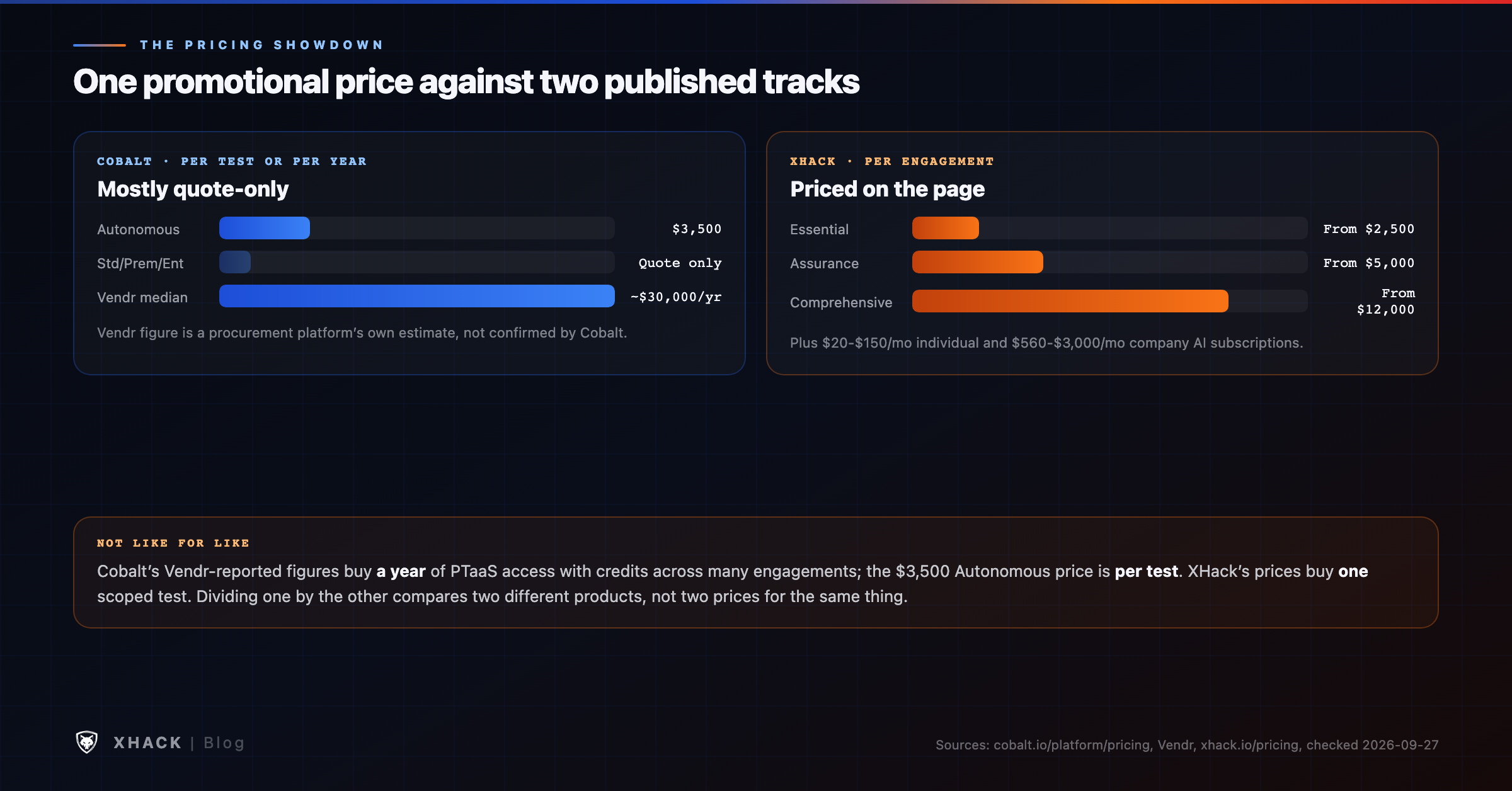
Cobalt does publish one price, and it’s worth being precise about it. As of September 2026, Cobalt lists exactly one real price: $3,500 for its Autonomous Pentest, promotional for tests run before Dec 31, 2026, scoped to web application testing. Cobalt’s own footnote on that price says “the exact number of credits debited from your account may vary based on your contracted rate per credit,” which means even the one flat number sits on top of the same credit system that prices everything else. G2’s own AI summary of Cobalt’s reviews lists cost as the most-mentioned complaint: users find it “expensive, especially for small organizations and when integrating with existing systems” (9 mentions).
Standard, Premium and Enterprise stay 100% quote-only, with “get a quote” as the only call to action on Cobalt’s own pricing page. Vendr, a SaaS procurement platform that negotiates pricing on behalf of buyers (not a competing vendor, but one with a commercial reason to frame pricing as complex), reports that its median buyer pays $30,000 a year, and separately lists tier packages with total annual spend from $65,000 to $300,000 or more, plus a per-credit cost of $800 to $1,500. Vendr’s two figures don’t line up with each other, which is one more reason to treat them as rough. That’s Vendr’s own estimate, not a number Cobalt has confirmed, and Vendr’s own tier names (“Essentials,” “Professional”) don’t match Cobalt’s actual tier names, so the mapping between them is Vendr’s inference, not Cobalt’s.
The Cobalt vs XHack price gap is really a difference in what the money buys. The Managed Services prices (from $2,500, $5,000 and $12,000) buy one scoped engagement, not a year of ongoing access. The self-serve AI plans ($20 to $150 a month individual, $560 to $3,000 a month company) buy continuous platform access with a monthly allowance, closer in shape to a SaaS subscription than to a single pentest.
That difference matters more than any single number: Cobalt’s reported annual figures buy a year of PTaaS access with credits to spend across multiple engagements and, on Premium and Enterprise, a named customer success manager. XHack’s Managed Services prices buy one scoped test. These aren’t substitutes for each other, and dividing one by the other to produce a “Cobalt costs this many times more” number would be comparing two different products, not two prices for the same thing. The honest Cobalt vs XHack comparison is what each model is actually for: continuous access with a large tester bench on one side, fixed-price single-engagement transparency on the other.
Where Cobalt vs XHack pricing sits closest is a single web app test. Cobalt’s Autonomous Pentest is a promotional $3,500 per test for a 24-hour automated web application test with Cobalt Core oversight, and Cobalt says its report does not carry compliance-attestation weight. XHack’s Essential tier starts at $2,500 for one unauthenticated web app over 4 days, with AI agents leading and a certified tester verifying the findings and exploiting them by hand.
If an auditor is the reason you’re buying, the like-for-like options are Cobalt’s quote-only human-led tiers and XHack’s Assurance tier, from $5,000, which XHack names for SOC 2, ISO 27001 and PCI DSS cycles. XHack’s VAPT services buyer guide covers what should be included in a scoped engagement at that price point, regardless of which vendor you’re evaluating.
Past the price tag, the Cobalt vs XHack decision comes down to a structural question: do you want a large network, or a small named team? Three questions, answered from each vendor’s own language.
Does the vendor publish real self-serve prices? XHack does, on two tracks, both with real floor prices sitting on the page itself. Cobalt publishes one promotional exception (the $3,500 Autonomous Pentest); everything else needs a quote.
Is there a “platform” concept, and what does it actually coordinate? Cobalt’s platform is the dashboard that coordinates its own tester network, tracking engagements, credits and communication with Cobalt Core. XHack’s “platform” (its self-serve company tier) is a different thing entirely: a security-tooling product the buyer’s own team operates, architecturally separate from the human-delivered engagements. XHack’s own FAQ draws the line directly: “The subscription plans give you access to the XHack AI platform, which your own team operates. These [Managed Services] plans are engagements our researchers deliver for you.”
Is it a large vetted network or a small named team? Cobalt runs a documented network of 500+ testers, with employment status undisclosed. XHack runs a small, named team that sits together in one office, the opposite structural choice. “A named tester, not a ticket queue” isn’t a slogan on one page; it repeats across XHack’s red teaming, threat intelligence, incident response and SOC service pages.
Neither structure is automatically better in a Cobalt vs XHack decision. A large network means more simultaneous capacity and more specialists for an unusual asset type. A small named team means the person scoping your engagement is the same person running it, with no handoff to whoever gets assigned later. XHack’s penetration testing checklist walks through what a real engagement looks like phase by phase, useful context for judging either model against what actually happens, not just what the sales page promises.
If you’re reading a Cobalt vs XHack comparison because an auditor is asking for a pentest report, this is the section that matters most, and it’s where the two companies show up very differently.
For a Cobalt vs XHack buyer with an audit coming, Cobalt names SOC 2, ISO 27001, PCI DSS, HIPAA, NIST SP 800-53 and the EU Cyber Resilience Act as frameworks its reports support, with deliverables including “letters of attestation” and executive summaries mapped to those controls. Before you sign, ask Cobalt for a sample report so you can see the format your auditor will get.
XHack publishes its format up front. Its documents page lists eight free items, opened after a short contact form with no account needed, including a 38-page SOC 2 penetration test report and a 39-page PCI DSS penetration test report, both dated September 2026. Each includes a dedicated “auditor acceptance” section and a cross-framework table mapping every finding to its SOC 2, PCI DSS, ISO 27001 and OWASP references.
Who signs off matters here too, and XHack’s own sample report states it better than any marketing page could. The SOC 2 report’s glossary describes the framework as an AICPA examination of controls against the Trust Services Criteria, and says: “the opinion is issued by a licensed CPA firm.” Its closing disclaimer goes further: “the SOC 2 attestation opinion itself is issued only by an independent licensed CPA firm.”
The PCI DSS report says the same thing in its own terms: “the formal PCI DSS assessment and Attestation of Compliance (AoC) are signed by your QSA,” and it describes itself as the penetration test evidence that supports that assessment.
XHack never certifies, approves, or issues a compliance certificate for any framework. What it delivers is the technical evidence an auditor or QSA looks for, not the opinion itself.
Cobalt’s own Autonomous Pentest tier states a similar boundary from the opposite direction, the most important Cobalt vs XHack caveat for an auditor: its automated 24-hour report explicitly does not carry compliance-attestation weight, and organizations needing that documentation are told to use the human-led tiers instead. That’s a fair, stated limitation on Cobalt’s own fastest product, and its only publicly priced one.
On company credentials, Cobalt vs XHack favors Cobalt: it holds its own SOC 2 Type II report, ISO/IEC 27001 certification and CREST accreditation, all belonging to Cobalt itself, not just to the testers in its network. XHack holds none of these as a company. Its team holds individual, exam-based credentials (OSCP+, OSCP, C-AI/MLPen, CASA) plus Synack Red Team membership, real and verifiable, but they’re credentials for the people, not attestations for the business.
XHack’s agent page describes the product as “ISO 27001 · SOC 2 ready.” That describes readiness, not an audit XHack has passed: XHack publishes no SOC 2 report or ISO 27001 certificate of its own, and its SOC 2 sample report says the attestation opinion “is issued only by an independent licensed CPA firm.” XHack’s guide on whether auditors accept AI-run pentests and its dedicated SOC 2 penetration testing guide go deeper into what an auditor actually wants to see.
A one-sided Cobalt vs XHack comparison isn’t useful to anyone, so here’s where Cobalt is the better pick, stated as plainly as the rest of this piece.
Scale and bench depth are real, and XHack doesn’t pretend otherwise. Cobalt Core’s 500+ named-network testers against XHack’s small named team that sits together in one office is a genuine gap. A buyer who needs many simultaneous engagements or true surge capacity across a large estate has a real reason to prefer Cobalt.
Thirteen years in the category is not a small thing, the biggest Cobalt vs XHack difference in maturity. Cobalt survived a full business-model pivot from bug bounty to PTaaS and a 2024 CEO transition, and it’s still shipping new product, including the Autonomous Pentest launched in July 2026. XHack is ten months old.
Cobalt has independent review scores that XHack simply doesn’t have yet. G2 lists it at 4.5 out of 5 across 180 reviews, and Gartner Peer Insights lists it at 4.5 out of 5 across 15 reviews, as of September 2026. XHack has no equivalent third-party review-site presence.
Cobalt holds its own audited attestations as a company. SOC 2 Type II, ISO/IEC 27001 certification and CREST accreditation all belong to Cobalt itself, not just to the testers in its network. A buyer who needs their vendor to hold its own third-party attestations should weigh this heavily.
Cobalt’s asset coverage is broader on one platform, including desktop applications, which XHack doesn’t name as its own asset type. For a buyer with a genuinely mixed inventory, that’s one less vendor relationship to manage.
Cobalt publishes real annual research. Its State of Pentesting report, now in its eighth year, combines “thousands of real-world penetration tests” with a survey of 450 security leaders and practitioners, and its April 2026 data found one in five organizations had an LLM security incident in the past year. XHack has no equivalent dataset.
The strongest Cobalt vs XHack case for Cobalt: if you want a large vetted tester bench, an established 13-year-old vendor with its own SOC 2, ISO 27001 and CREST credentials, broad asset-type coverage, including desktop apps, under one relationship, and you’re comfortable with a quote-based sales process to get there, Cobalt is the safer, more proven choice.
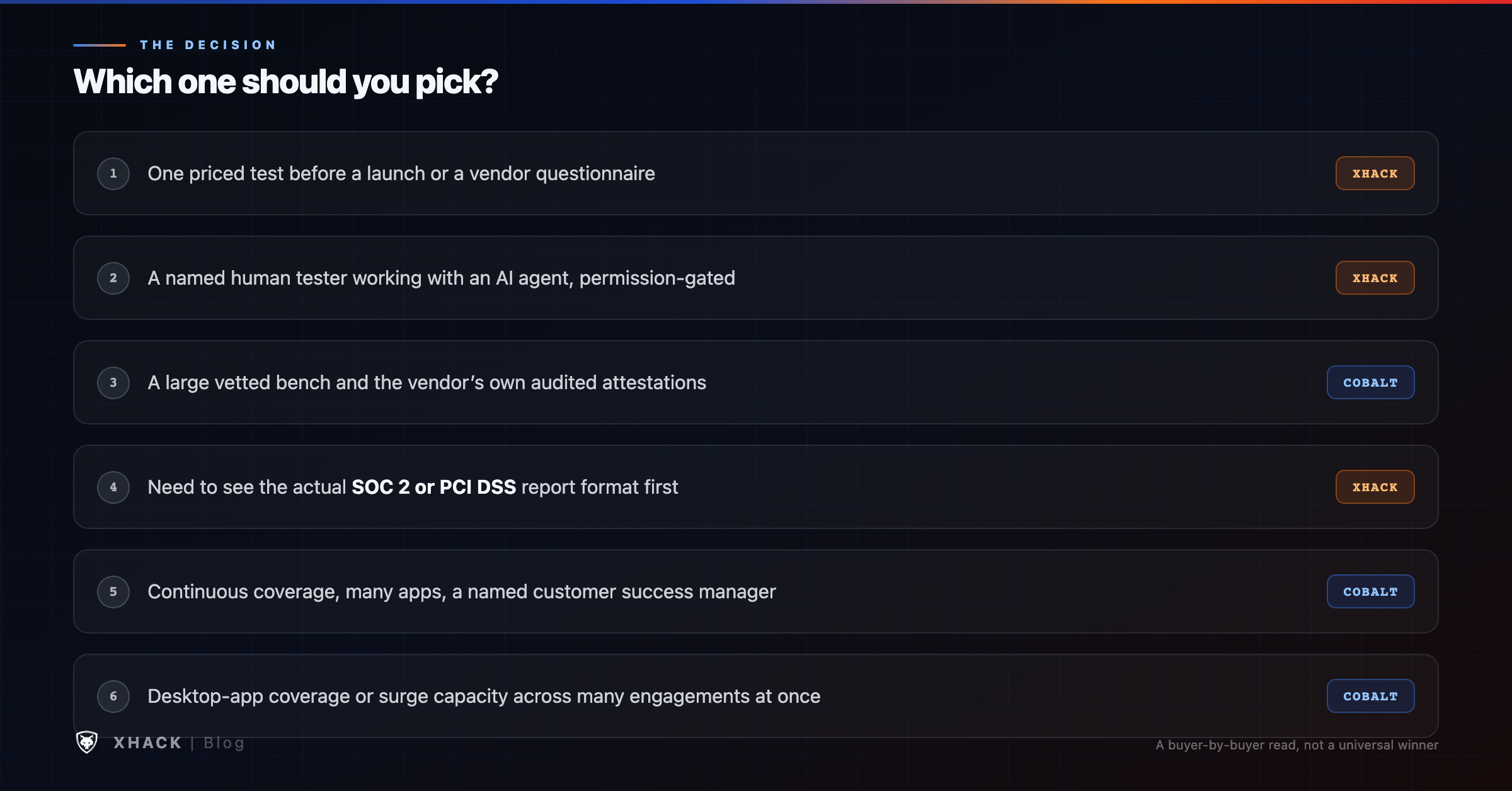
Neither company wins for every buyer. Here’s how the Cobalt vs XHack decision breaks down by who’s actually asking.
You’re a startup that needs one priced test before a launch or a customer questionnaire. Pick XHack. Essential VAPT starts at $2,500 with a stated 4-day timeline, and you know the number before you talk to anyone.
You want a named human tester working alongside an AI agent, with permission-gated automation. Pick XHack. Each priced Managed Services tier states the AI’s role in writing, and it runs “with your explicit permission… at no additional cost.”
You’re a mid-market or enterprise buyer who wants a large vetted bench and the vendor’s own audited attestations. Pick Cobalt. Its 500+ tester network, SOC 2 Type II, ISO 27001 and CREST accreditation are real, and they’re exactly what that kind of buyer’s own auditors and procurement teams tend to ask about.
You need to see the actual report format before you sign anything, especially for SOC 2 or PCI DSS. Pick XHack. Its 38-page SOC 2 and 39-page PCI DSS sample reports are free to download, as of September 2026, with the compliance-role boundary written into the document itself.
You need continuous coverage across many applications and want the bigger bench running it. Pick Cobalt. Its Premium and Enterprise tiers are built for ongoing programs with a named customer success manager; XHack’s Enterprise tier also runs continuous programs with a named point of contact, but at custom pricing and with a much smaller team.
Your asset inventory includes desktop applications or you need surge capacity across many simultaneous engagements. Pick Cobalt. That breadth and bench depth is a real gap on XHack’s side.
If you’re weighing other options beyond Cobalt vs XHack, XBOW vs XHack covers a pay-per-test autonomous competitor, Horizon3 vs XHack covers NodeZero’s Active Directory-focused approach, Pentera vs XHack covers the six-figure enterprise end of automated testing, and Strix vs XHack covers an open-source agent with paid pentests from $60, at the other end of the price range.
In the Cobalt vs XHack pricing split, Cobalt publishes exactly one real price: $3,500 for its Autonomous Pentest, promotional for tests run before December 31, 2026, scoped to web application testing. Standard, Premium and Enterprise remain quote-only. Procurement platform Vendr reports that its median buyer pays $30,000 a year for the human-led tiers, but that figure comes from Vendr’s own estimate, not from Cobalt directly.
Yes, and team size is the widest Cobalt vs XHack gap. Its founder and a second penetration tester hold OSCP+ and OSCP, with an “8+” extended team who aren’t individually named, all sitting together in one office. Cobalt Core, by comparison, is a documented network of more than 500 vetted testers. XHack calls its own model “a named tester, not a ticket queue,” a deliberate choice that trades bench size for continuity.
You can with XHack, which is the clearest Cobalt vs XHack difference for a SOC 2 or PCI DSS buyer. Its documents page lists eight free items, opened after a short contact form with no account needed, including a 38-page SOC 2 sample report and a 39-page PCI DSS sample report, both dated September 2026. With Cobalt, ask for a sample during scoping; its platform pages describe the deliverables as customizable reports, letters of attestation and executive summaries.
Neither one does, and on this point Cobalt vs XHack is a tie: no pentest vendor should claim to. Both issue a letter of attestation for the test itself (XHack’s covers scope, test dates and independence), and neither letter is a SOC 2 opinion or a PCI DSS AoC. XHack’s own SOC 2 sample report puts it directly: “the SOC 2 attestation opinion itself is issued only by an independent licensed CPA firm.”
Cobalt does, and it’s the one Cobalt vs XHack category XHack can’t close quickly. G2 lists Cobalt at 4.5 out of 5 across 180 reviews, and Gartner Peer Insights lists it at 4.5 out of 5 across 15 reviews, as of September 2026. XHack, ten months old, has no G2 or Gartner Peer Insights score yet.
No, and Cobalt says so itself. The Autonomous Pentest runs in 24 hours with Cobalt Core pentesters reviewing execution plans, but its auto-generated report explicitly does not carry compliance-attestation weight. Buyers who need audit documentation are directed to the human-led Standard, Premium or Enterprise tiers instead.
In Cobalt vs XHack terms, XHack’s entry price is lower, but the two tests are built differently. Cobalt’s Autonomous Pentest is a promotional $3,500 per test for a 24-hour automated web application test, and Cobalt says its report is not compliance evidence. XHack’s Essential tier starts at $2,500 for one unauthenticated web app over 4 days, with a certified tester verifying the AI’s findings; for an audit, compare XHack’s Assurance tier (from $5,000) with Cobalt’s human-led tiers instead.
The Cobalt vs XHack choice comes down to what kind of proof you want before you buy. Cobalt gives you 13 years in business, a 500+ tester network, and its own SOC 2, ISO 27001 and CREST attestations, at the cost of a quote-based sales process for anything beyond one promotional test.
XHack gives you real prices on the page, a named team instead of a ticket queue, and a downloadable sample report you can read before signing anything, at the cost of being ten months old with no independent review score yet. Both Cobalt vs XHack tradeoffs are real, and I’ve tried to state Cobalt’s side as honestly as XHack’s.
If you want the large bench and the audited vendor credentials, Cobalt is the safer call. Either way, the Cobalt vs XHack choice starts with seeing the price and the report format first: XHack’s Managed Services pricing is on the page with no form at all, and its SOC 2 and PCI DSS sample reports open after a short contact form, no account needed.
Categories
Related articles