Table of contents
39
By Salman Khan, OSCP+, Founder of XHack, SRT (Synack Red Team member)
Read this in 30 seconds: VAPT combines vulnerability assessment (finding the weaknesses) and penetration testing (proving they are exploitable). Most buyers overpay for a scan dressed up as a pentest, or underpay for a checkbox test that misses the bug that gets them breached.
- The price range is real but it is not random. A basic external test runs about $4,000, an enterprise continuous program runs past $150,000, and what moves the number is scope, not luck.
- A vulnerability scan is not a pentest, even when the invoice says VAPT. Anything near $2,000 for “comprehensive” testing is almost always an automated scan with a cover page.
- Black, grey, and white box are not difficulty levels, they are access levels. Each answers a different question about what an attacker with that starting point can reach.
- Compliance decides the floor, your risk decides the ceiling. PCI DSS, SOC 2, ISO 27001, and HIPAA all point at VAPT, but a framework tells you the minimum, not what you actually need.
- XHack VAPT starts at $2,500, human-led with AI-agent assistance only if you authorize it. This guide shows how to scope the work and spot a scanner with a logo before you pay one.
Most companies buy VAPT services the same way they buy car insurance. They pick the cheapest option, hope they never need it, and have no idea what they actually bought until something goes wrong.
Then the breach happens, the auditor asks for the report, or the enterprise customer demands proof of testing, and suddenly that $2,000 “penetration test” turns out to be an automated scan with a cover page.
Here’s the uncomfortable truth about the VAPT services market in 2026: the gap between the best and worst providers is enormous, and the pricing barely reflects it. You can pay $3,000 for a glorified Nessus scan or $30,000 for a team of skilled testers who actually break into your systems. Both will call themselves “VAPT services.” Only one will find the vulnerability that gets you breached.
Nobody explains how to tell the difference. So I will.
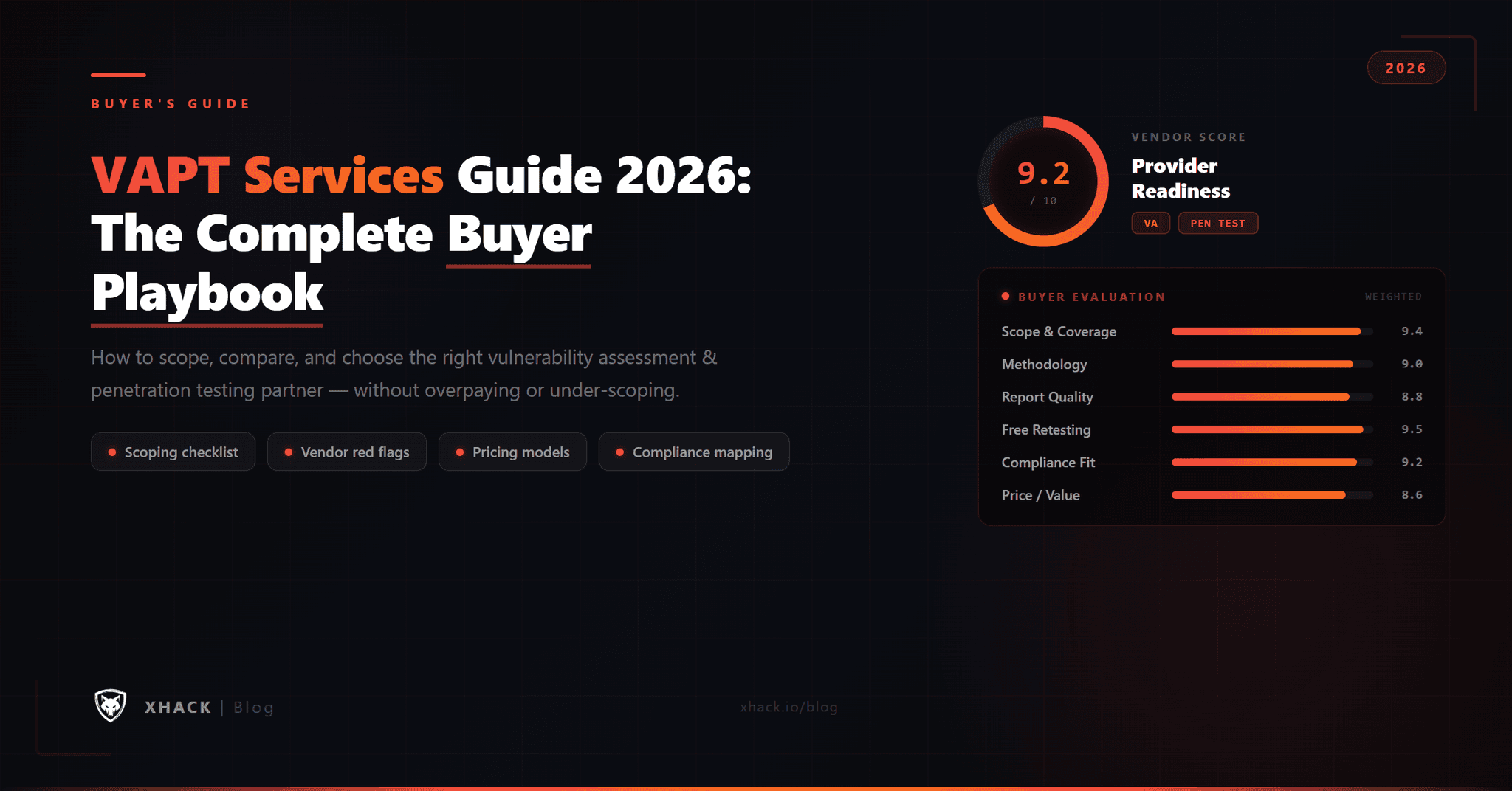
This guide covers everything you need to buy VAPT services intelligently. What they actually include, what they really cost, how to scope an engagement, what compliance demands, and how to avoid the scanner-with-a-logo crowd. Whether you’re a budget-conscious startup or an enterprise running a mature security program, there’s a section here for you.
VAPT stands for Vulnerability Assessment and Penetration Testing. It’s two distinct activities bundled into one acronym because the industry can’t resist a good initialism.
Let’s separate them, because understanding the difference is the foundation of buying VAPT services intelligently.
Vulnerability Assessment (VA) is the broad sweep. You run automated scanners against your systems to identify known vulnerabilities, missing patches, and misconfigurations. It’s fast, it covers a lot of ground, and it produces a list of potential weaknesses with severity ratings. VA answers the question: “What known issues exist in my environment?”
Penetration Testing (PT) is the deep dive. A human tester actively tries to exploit the vulnerabilities found during assessment, plus ones the scanners missed. They chain weaknesses together, escalate privileges, move laterally, and prove actual business impact. PT answers the question: “What can an attacker actually do?”
Translation: vulnerability assessment tells you the front door lock looks weak. Penetration testing picks the lock, walks through your house, opens your safe, and leaves a photo on your pillow to prove it.
Good VAPT services combine both. The automated assessment provides breadth. The manual penetration testing provides depth and proof. Skip the assessment and you might miss obvious issues. Skip the penetration testing and you have no idea which “vulnerabilities” are actually exploitable.
This distinction matters financially too. A pure vulnerability assessment is cheap because it’s mostly automated. Real penetration testing costs more because skilled humans spend days or weeks on it. When a provider quotes you $2,000 for “VAPT services,” they’re almost certainly selling you a vulnerability scan and calling it a pentest.
When you buy VAPT services, the provider will ask which testing approach you want. This choice dramatically affects both the cost and what the test reveals.
Black Box Testing means the tester gets nothing. No credentials, no documentation, no network diagrams. They start from zero, exactly like an external attacker would. This simulates a real-world attack from someone with no insider knowledge.
The upside: it’s the most realistic simulation of an external threat. The downside: testers spend significant time on reconnaissance and may never reach internal systems that a real attacker with more time or luck could compromise. Black box VAPT services are great for testing your external perimeter but can leave internal weaknesses untested.
Grey Box Testing means the tester gets partial access. Usually standard user credentials, some documentation, and basic information about the environment. This simulates an attacker who has already gained a foothold, like through a phishing attack or a compromised employee account.
Grey box is the sweet spot for most organizations. It balances realism with efficiency. The tester doesn’t waste days trying to get initial access and can focus on what happens after a breach, which is usually where the real damage occurs. Most modern VAPT services default to grey box for this reason.
White Box Testing means the tester gets everything. Full source code, admin credentials, architecture diagrams, the works. This simulates an insider threat or a determined attacker with complete knowledge, and it provides the most thorough coverage.
White box VAPT services find the most vulnerabilities because nothing is hidden. The downside is that it’s the least realistic simulation of an external attack and the most expensive because of the depth involved.
| Approach | Tester Knowledge | Simulates | Best For | Relative Cost |
|---|---|---|---|---|
| Black Box | Nothing | External attacker | Perimeter testing, realistic external threat | Lower |
| Grey Box | Partial (user creds) | Post-breach attacker | Most engagements, balanced realism | Medium |
| White Box | Full (code, admin) | Insider threat, max coverage | Critical systems, code-level assurance | Higher |
My honest recommendation for most buyers: grey box. It catches the realistic threats without burning your budget on reconnaissance that automated tools can do faster. Reserve white box for your most critical applications where you need maximum assurance, and black box when you specifically want to test your external perimeter defenses.
VAPT services aren’t one-size-fits-all. Different assets need different testing approaches. Here’s what’s on the menu.
This covers your network infrastructure: servers, firewalls, routers, switches, and the services running on them. Network VAPT services split into two flavors:
External network testing simulates an attacker coming from the internet. It targets your public-facing IP addresses, looking for exposed services, weak configurations, and exploitable vulnerabilities on your perimeter.
Internal network testing simulates an attacker who’s already inside, whether through a phishing attack, a malicious insider, or a compromised device. It tests lateral movement, privilege escalation, and how far an attacker could go once they’re past the perimeter.
This is the most commonly purchased VAPT service because web applications are the most common attack surface. It tests your websites and web apps for vulnerabilities like SQL injection, cross-site scripting, authentication bypasses, broken access controls, and business logic flaws.
Good web application VAPT services go far beyond automated scanning. They test the business logic that scanners can’t understand, like whether a user can manipulate a shopping cart to get free products or access another user’s account by changing an ID in the URL.
APIs are the backbone of modern applications, and they’re increasingly the primary attack surface. API VAPT services test REST, GraphQL, and SOAP endpoints for issues like broken object level authorization (BOLA), broken authentication, excessive data exposure, and rate limiting failures.
If your application has a mobile app or a single-page frontend, it’s almost certainly powered by APIs, and those APIs need dedicated testing. Many breaches happen through APIs that were never tested because the company only tested the web frontend.
As organizations move to AWS, Azure, and GCP, cloud-specific VAPT services have become essential. These test for misconfigured storage buckets, overprivileged IAM roles, exposed metadata services, insecure container configurations, and the cloud-specific attack paths that traditional network testing misses.
Cloud testing requires specialized knowledge because the attack surface is fundamentally different from traditional infrastructure. A misconfigured S3 bucket or an overprivileged service account can expose your entire environment.
Mobile VAPT services test Android and iOS applications for insecure data storage, weak encryption, certificate pinning failures, insecure API communication, and reverse engineering risks. With mobile apps handling everything from banking to healthcare, mobile testing is critical for any company with a consumer-facing app.
The most advanced VAPT services include social engineering (phishing simulations, pretexting) and full red team engagements that combine technical attacks with human manipulation to test your entire security posture, including your people and processes, not just your technology.
Let’s talk money, because this is where most buyers get confused or ripped off.
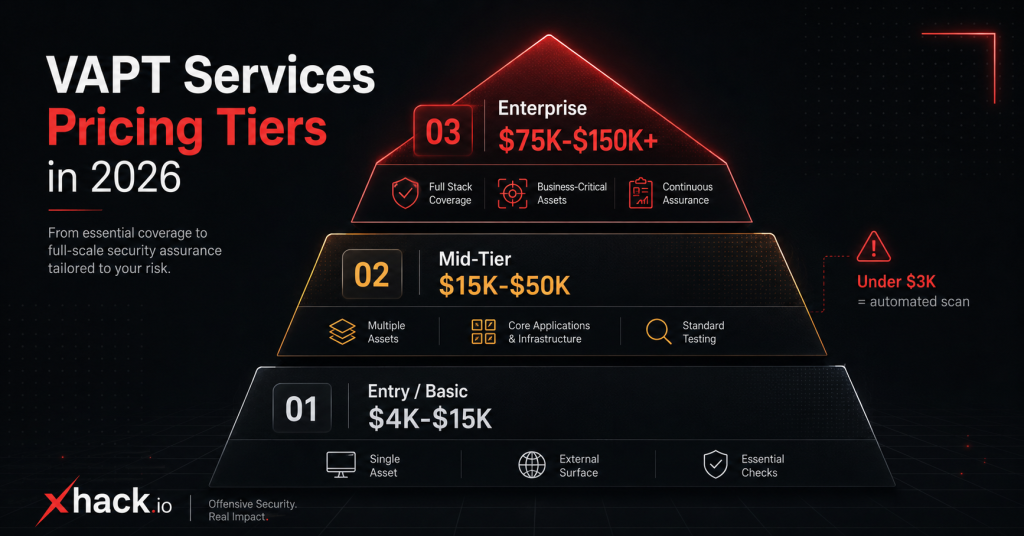
VAPT services pricing in 2026 typically ranges from around $4,000 for a basic external test to over $150,000 for enterprise-grade continuous testing programs. That’s a huge range, and the reason is that “VAPT services” can mean wildly different things.
Here’s a realistic breakdown of what you get at each price tier:
| Price Tier | Range | What You Get | Best For |
|---|---|---|---|
| Entry / Basic | $4,000 – $15,000 | Single web app or external network, mostly automated with light manual testing, standard report | Startups, first pentest, single asset |
| Mid-Tier | $15,000 – $50,000 | Deeper human-led testing, external network plus authenticated web app, manual analysis, remediation guidance | Growing companies, compliance needs, multiple assets |
| Enterprise | $75,000 – $150,000+ | Full-stack coverage (API, mobile, internal, external, cloud), continuous testing, mature application coverage | Large organizations, ongoing programs, complex environments |
The pricing models also vary:
Per-asset pricing charges you for each website, application, or system tested. This is common and transparent, but costs add up quickly if you have many assets.
Hourly or day-rate pricing charges for the tester’s time. Day rates for skilled penetration testers typically range from $1,000 to $2,500+ depending on experience and region. A typical web app test might run 5 to 10 days.
Subscription / PTaaS pricing (Penetration Testing as a Service) charges a recurring fee for continuous or on-demand testing. This model has grown popular because it spreads cost over time and provides ongoing coverage instead of a once-a-year snapshot.
The cost of VAPT services depends on several factors:
Here’s the catch most buyers miss. The cheapest quote is rarely the best value. A $3,000 automated scan that misses the SQL injection vulnerability in your payment system is infinitely more expensive than a $15,000 manual test that catches it, once you factor in the cost of a breach. Cybercrime is projected to cost the world over $10 trillion annually, and a single data breach can cost millions. The math on quality VAPT services is not close.
For many organizations, VAPT services aren’t optional. They’re mandated by compliance frameworks and increasingly by enterprise customers who won’t sign a contract without proof of security testing.
Here’s what the major frameworks require:
PCI DSS (for anyone handling payment card data) requires both internal and external penetration testing annually and after any significant infrastructure change, under requirements 11.3.1 and 11.3.2. If you process credit cards, VAPT services are mandatory.
ISO 27001 requires management of technical vulnerabilities (Annex A.8.8) and security testing in development (Annex A.8.29). Annual VAPT is the accepted evidence for these controls.
SOC 2 requires detection and monitoring procedures including vulnerability scanning and penetration testing under CC7.1. Most SOC 2 audits expect to see a recent pentest report.
HIPAA (for healthcare) requires regular evaluation of security controls. While it doesn’t explicitly mandate penetration testing by name, VAPT services are the standard evidence that your technical safeguards actually work.
GDPR Article 32 requires “regular testing, assessing and evaluating the effectiveness of technical measures.” VAPT services satisfy this requirement.
EU AI Act (for high-risk AI systems) includes cybersecurity obligations under Article 15 that effectively require security testing of AI systems, though the enforcement timeline has shifted and you should confirm current dates before relying on a specific deadline.
The practical reality in 2026 is that VAPT services have become a business requirement beyond compliance. Enterprise customers routinely demand a recent penetration test report before signing contracts. Your VAPT report has become a sales enablement document as much as a security one.
When buying VAPT services for compliance, make sure your provider issues a proper attestation letter confirming the findings, methodology, and remediation status. That’s the document your auditor actually wants to see.
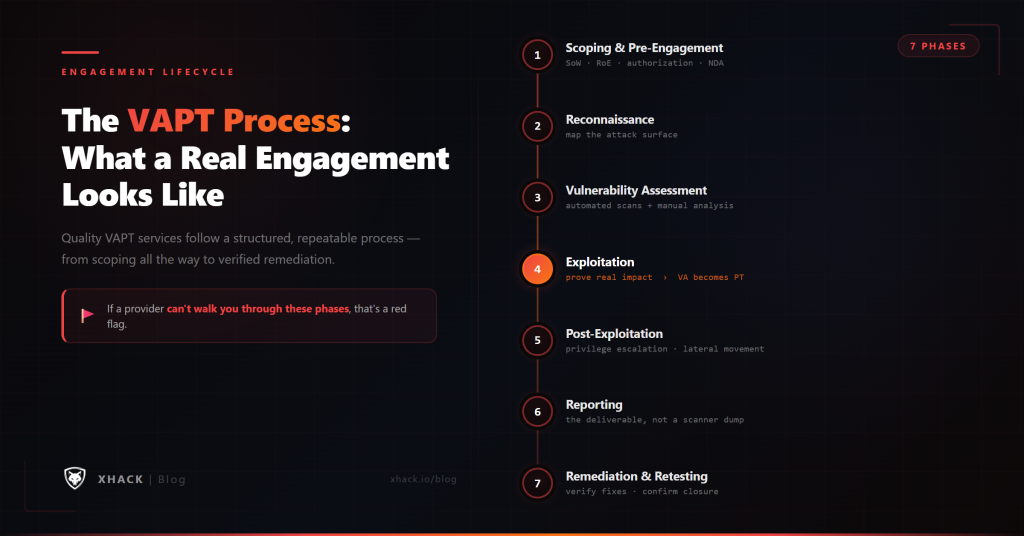
Quality VAPT services follow a structured process. If a provider can’t walk you through these phases, that’s a red flag.
Before any testing begins, you and the provider define exactly what gets tested. This includes the target assets, the testing approach (black/grey/white box), the testing window, the rules of engagement, and emergency contacts. This phase also handles the legal paperwork: the statement of work, rules of engagement document, authorization letter, and NDA.
Good scoping is everything. A rushed or vague scope leads to incomplete testing or, worse, accidental damage to production systems.
The testers map your attack surface. For external tests, this means discovering subdomains, identifying exposed services, and fingerprinting technologies. For internal tests, this means understanding the network topology and identifying targets.
This is the automated scanning phase combined with manual analysis. The testers identify potential vulnerabilities across the scoped assets, using both automated tools and human expertise to find issues the scanners miss.
The testers attempt to exploit identified vulnerabilities to prove real impact. This is where penetration testing separates from vulnerability assessment. Instead of just reporting that a vulnerability exists, the testers demonstrate what an attacker could actually do with it.
For deeper engagements, testers explore how far an attacker could go after initial compromise. Can they escalate privileges? Access sensitive data? Move to other systems? This phase reveals the true business impact of your vulnerabilities.
The deliverable. A quality VAPT report includes an executive summary for leadership, detailed technical findings with evidence and reproduction steps, severity ratings, business impact analysis, and prioritized remediation guidance. The report is the product, and it’s where many cheap VAPT services fall apart, delivering a raw scanner export with a cover page instead of actionable intelligence.
The best VAPT services don’t end at the report. They support your team during remediation and then retest to verify that your fixes actually worked. A finding isn’t truly closed until it’s been retested and confirmed fixed.
The VAPT services market is full of providers ranging from elite boutique firms to scanner resellers with a sales team. Here’s how to tell them apart.
“What’s your methodology?” A legitimate provider references established frameworks like PTES (Penetration Testing Execution Standard), the OWASP Testing Guide, OSSTMM, or NIST SP 800-115. If they can’t name a methodology, walk away.
“How much of the testing is manual vs automated?” This is the single most revealing question. If the answer is “our platform does it automatically,” you’re buying a vulnerability scan, not penetration testing. Real VAPT services involve significant manual testing by skilled humans.
“Can I see a sample report?” A quality provider will share a redacted sample. Look for detailed findings, clear reproduction steps, business impact analysis, and actionable remediation guidance. If the sample is a scanner export, you know what you’re getting.
“What certifications do your testers hold?” Look for OSCP, OSWE, GWAPT, CREST, or similar hands-on certifications. These indicate testers who can actually exploit vulnerabilities, not just run tools.
“Is retesting included?” Verifying your fixes should be part of the engagement, not an expensive add-on.
“How do you handle critical findings during the test?” A good provider notifies you immediately if they find something critical, rather than waiting for the final report. If they find active compromise or a severe vulnerability, you need to know now.
In 2026, the VAPT services landscape has shifted with the rise of AI-powered testing. The best providers now combine human expertise with autonomous AI agents that can test continuously, cover more ground, and find vulnerabilities at machine speed, while human experts handle the business logic flaws and creative attack paths that AI still misses.
This hybrid model is where the industry is heading. AI handles breadth and continuous coverage. Humans handle depth and creativity. Together they deliver more thorough testing than either could alone, often at better value than traditional manual-only engagements.
The right VAPT services look very different depending on your size and maturity. Here’s how to approach it from both ends.
Your challenge is getting meaningful security testing on a limited budget. Here’s the smart approach:
Start with your most critical asset. You probably can’t afford to test everything, so test what matters most. For most startups, that’s the primary web application and its APIs, especially if you handle customer data or payments.
Choose grey box testing. It gives you the best coverage per dollar by skipping the expensive reconnaissance phase.
Prioritize the report quality. As a startup, your VAPT report often doubles as sales enablement. Enterprise customers will ask for it. Make sure you get a professional report you can share (in redacted form) with prospects.
Consider AI-augmented or PTaaS models. These often provide better value for budget-conscious teams than traditional high-day-rate consultancies, giving you continuous coverage instead of a once-a-year snapshot.
Budget realistically. A meaningful first pentest of a single web application typically starts around $8,000 to $15,000. Anything dramatically cheaper is probably just a scan.
Your challenge is comprehensive coverage across a complex environment with compliance requirements and ongoing risk. Here’s the approach:
Build a continuous testing program, not annual snapshots. Your attack surface changes constantly. Annual testing leaves you blind for 51 weeks a year. Continuous or quarterly testing, augmented by AI for ongoing coverage, is the modern standard.
Map testing to compliance. Align your VAPT services schedule with your PCI DSS, SOC 2, ISO 27001, and other compliance requirements so a single program satisfies multiple frameworks.
Cover the full stack. External network, internal network, web apps, APIs, cloud infrastructure, and mobile. Gaps in coverage are where breaches happen.
Integrate findings into your SOC. The real value of VAPT services for enterprises comes from feeding findings into continuous monitoring. Every vulnerability found should become a detection rule in your security operations center, so even unpatched issues are monitored for exploitation.
Demand attack path analysis. Individual vulnerabilities matter less than how they chain together. Enterprise-grade VAPT services should map complete attack paths, not just list isolated findings.
So yeah, here’s where we talk about what XHack brings to the table. Since this guide is about helping you buy VAPT services intelligently, here’s an honest look at our approach.
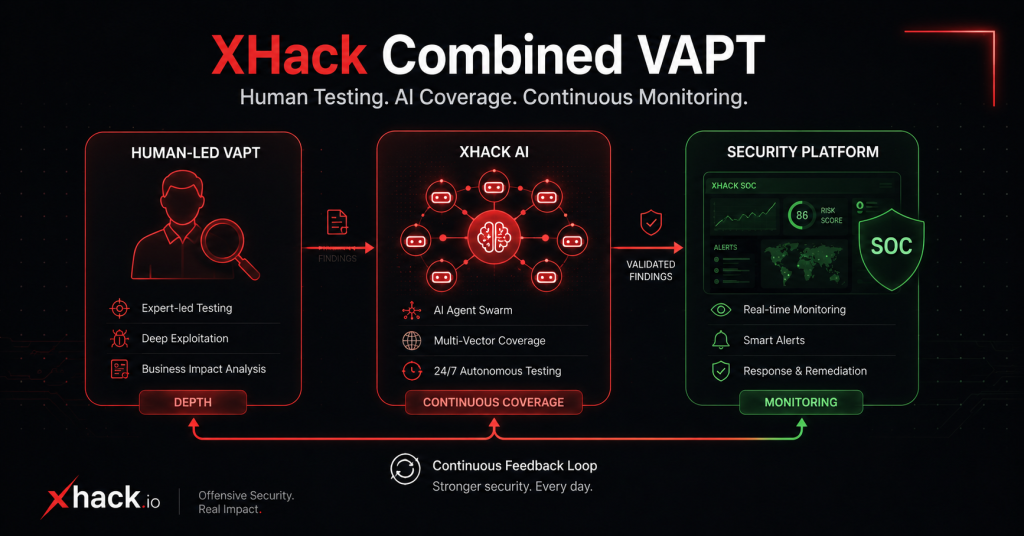
XHack combines three things most providers offer separately: expert human penetration testing, an autonomous AI pentesting agent, and a continuous security operations platform. That combination is the entire point.
Human-led VAPT for depth. Our security researchers bring real-world offensive experience, including bug bounty findings and hands-on exploitation skills. They handle the business logic flaws, creative attack paths, and complex chained exploits that automated tools miss. This is the manual testing that separates real penetration testing from a vulnerability scan.
XHack AI for breadth and continuous coverage. Our autonomous multi-agent AI system performs deep reconnaissance, browser-based live hunting, and exploit chaining at machine speed. It can test continuously between your formal engagements, so your attack surface isn’t left unmonitored for 51 weeks a year. The AI handles the volume; the humans handle the nuance.
The XHack Security Platform for ongoing defense. Findings from your VAPT engagement don’t just sit in a PDF. They feed into our SOC and threat detection platform, so even vulnerabilities you can’t patch immediately are monitored for exploitation attempts in real time. This closes the gap between “we found the vulnerability” and “we’ll catch anyone trying to exploit it.”
Since I promised an honest take, here’s what this means for you as a buyer. If you want a cheap one-time scan with a cover page, we’re not the right fit. If you want testing that actually proves business impact, combined with continuous AI-powered coverage and ongoing monitoring, that’s exactly what we built.
Our VAPT services run $2,500 to $12,000 per engagement, combining our human testers with XHack AI agents when the client authorizes AI-agent involvement, with final pricing scoped to your specific requirements, asset complexity, and compliance needs. We’d rather scope it to what you actually need than quote you a flat rate for testing you don’t.
Want a quote for your environment? Our team can scope an engagement based on your specific assets and compliance needs. Prefer to talk it through first? Book a free consultation and we’ll help you figure out what level of VAPT services actually makes sense for your situation, even if that turns out not to be us. Brutal honesty is kind of our thing.
Even experienced teams get this wrong. Here are the mistakes that waste budget and leave you exposed.
Mistake 1: Buying on price alone. The cheapest quote wins the deal but loses the war. A $2,500 automated scan feels like a bargain until the breach comes through the vulnerability it never tested for. Evaluate value, not just price.
Mistake 2: Testing once and forgetting. “We did a pentest last year” is one of the most dangerous sentences in security. Your infrastructure has changed hundreds of times since then. New services, new code, new misconfigurations. Last year’s clean report means nothing today.
Mistake 3: Scoping too narrowly to save money. Testing only your main website while ignoring the APIs behind it, the cloud infrastructure hosting it, and the mobile app accessing it leaves enormous gaps. Attackers don’t respect your scope boundaries. They find the asset you didn’t test.
Mistake 4: Ignoring the report. The most common outcome of a pentest is a report that gets read once and filed away. The vulnerabilities never get fixed, the retest never happens, and the next year’s test finds the same issues. A report you don’t act on is money set on fire.
Mistake 5: Not feeding findings into monitoring. When you find a vulnerability you can’t immediately patch, you should at least monitor for its exploitation. Most companies don’t. They know about the weakness, leave it unpatched during a change freeze, and have no detection in place if someone attacks it. This is where pairing VAPT services with continuous monitoring pays off.
Mistake 6: Treating compliance as the goal. Passing the audit is not the same as being secure. Plenty of breached companies had passing compliance checkmarks. Use VAPT services to actually reduce risk, not just to satisfy a checkbox. The compliance certificate is a byproduct of real security, not a substitute for it.
Mistake 7: Not verifying the testers’ skills. Anyone can buy a scanner license and call themselves a penetration testing company. Verify that actual humans with real offensive security certifications are doing the work. Ask who specifically will test your environment and what their background is.
The VAPT services market is changing faster in 2026 than at any point in its history, and understanding the direction helps you make smarter buying decisions.
Continuous replaces periodic. The annual pentest is dying. Attack surfaces change too fast for once-a-year snapshots to provide meaningful protection. The future is continuous testing that runs alongside your development cycle, catching vulnerabilities as they’re introduced rather than months later.
AI handles the volume, humans handle the nuance. Autonomous AI agents now perform reconnaissance, vulnerability identification, and even exploit chaining at a scale and speed no human team can match. But the creative, contextual work of finding business logic flaws and novel attack paths remains firmly human. The winning model combines both, and providers offering only one or the other will struggle to compete.
Testing shifts left. Security testing is moving earlier into the development process. Instead of testing applications after they’re built, modern VAPT services integrate into CI/CD pipelines, catching vulnerabilities before they ever reach production.
Reports become living dashboards. Static PDF reports are giving way to live platforms where you can track findings, monitor remediation progress, and see your security posture change over time. The report is becoming a continuous feed rather than a once-a-year document.
The line between testing and monitoring blurs. As VAPT findings increasingly feed into security operations platforms, the gap between offensive testing and defensive monitoring is closing. The most effective security programs treat them as one continuous loop, where every vulnerability found becomes something the SOC watches for.
For buyers, the takeaway is clear. Look for VAPT services that embrace continuous testing, combine AI with human expertise, and connect findings to ongoing monitoring. The providers stuck in the annual-PDF-report model are selling you the past.
A vulnerability scan is automated. It runs tools against your systems and produces a list of known vulnerabilities. VAPT services include that scanning (the vulnerability assessment part) plus manual penetration testing where skilled humans actively exploit vulnerabilities to prove real business impact. A scan tells you what might be wrong. VAPT services prove what an attacker can actually do. Many cheap providers sell scans as “VAPT services,” so always ask how much of the testing is manual.
At minimum, annually, which is what most compliance frameworks require. However, your attack surface changes constantly with new deployments, configuration changes, and new vulnerabilities. The modern best practice is continuous or quarterly testing, especially for organizations with frequent code changes. Compliance frameworks like PCI DSS also require testing after any significant infrastructure change, not just on an annual schedule. AI-augmented VAPT services make continuous coverage affordable by handling ongoing testing between formal engagements.
For a startup testing a single web application, budget $8,000 to $15,000 for meaningful manual testing. Mid-sized companies needing multiple assets and compliance coverage typically spend $15,000 to $50,000. Enterprises running full-stack continuous programs spend $75,000 to $150,000 or more annually. Be wary of quotes under $2,000 for “comprehensive” testing, as these almost always mean automated scanning rather than real penetration testing.
Professional VAPT services are designed to minimize disruption. Testers use careful, non-destructive techniques and coordinate testing windows with your team. The rules of engagement document defines exactly what’s permitted, and good providers avoid actions that could cause downtime. That said, you should always discuss production testing carefully during scoping and consider testing in a staging environment for the most sensitive systems. Reputable providers carry insurance and have emergency procedures if anything goes wrong.
A quality VAPT report includes an executive summary written for non-technical leadership, a clear scope and methodology section, a findings summary table with severity ratings, detailed technical findings with evidence and reproduction steps, business impact analysis for each finding, prioritized remediation guidance with timelines, and ideally a retest confirmation showing which issues were fixed. If your report is just a raw scanner export with a cover page, you didn’t get real VAPT services.
Not fully, at least not in 2026. AI excels at breadth, speed, and continuous coverage. It can run reconnaissance, test known vulnerability patterns, and chain exploits at machine speed. But AI still struggles with business logic flaws, creative attack paths, social engineering, and the contextual judgment that experienced human testers bring. The best VAPT services combine both: AI for continuous coverage and volume, humans for depth and creativity. This hybrid model delivers more thorough testing than either approach alone.
That’s the complete playbook for buying VAPT services in 2026.
The core lesson is simple: VAPT services vary enormously in quality, and price alone won’t tell you what you’re getting. The cheapest quote is usually an automated scan in disguise. The most expensive isn’t automatically the best. What matters is the depth of manual testing, the quality of the report, the methodology behind it, and whether the findings actually get monitored and retested.
Know what you need. Test your most critical assets first if you’re a startup, build a continuous program if you’re an enterprise, and always ask how much of the testing is done by skilled humans versus automated tools.
If you want VAPT services that combine expert human testing with autonomous AI coverage and continuous monitoring, XHack was built for exactly that. Get a quote scoped to your environment, or book a free consultation to figure out what level of testing actually makes sense for you.
The vulnerabilities are already there. The only question is whether you find them first, or an attacker does.
Follow Us on X: @xhackio
Related articles