Table of contents
21
Read this in 30 seconds: Autonomous penetration testing uses AI agents to run reconnaissance, find vulnerabilities, chain exploits, and generate reports with little or no human direction. It solves the core problem of modern security: you ship code faster than any human team can test it. The market is real and funded (XBOW hit a billion-dollar valuation, Pentera passed $100M ARR, Horizon3.ai’s NodeZero has run 235,000+ production tests). But autonomous tools still hallucinate, miss business logic flaws, and can’t sign off on compliance. The winning model in 2026 is hybrid: AI owns breadth and continuous coverage, humans own validation and judgment. This guide covers how it works, what’s real, where it breaks, and how to actually adopt it.
Your last penetration test took two weeks, cost five figures, and tested maybe 20% of your actual attack surface.
In those same two weeks, your team shipped 40 deployments. None of them were tested.
That gap, between how fast you ship and how slowly you test, is the entire reason autonomous penetration testing exists. Traditional pentesting was built for a world where applications changed a few times a year. That world is gone. Modern teams deploy continuously, infrastructure shifts daily, and new vulnerabilities surface roughly every 17 minutes. A once-a-year manual pentest in that environment is like checking your smoke detectors one day a year and hoping the house doesn’t burn down the other 364.
Here’s the thing. The security industry has known about this gap for a decade and mostly responded by selling you more scanners. Scanners that find thousands of “vulnerabilities” and prove zero of them. Autonomous penetration testing is the first genuinely new answer: AI agents that don’t just scan but actually think, adapt, and exploit like a human attacker would, at machine speed and scale.
But there’s a lot of hype to cut through. Every vendor slapped “AI-powered” and “autonomous” on their product page in 2025. Most of it is marketing. Some of it is real and genuinely changing how security works. This guide separates the two, explains how autonomous penetration testing actually works under the hood, and shows you how to adopt it without setting your budget on fire.
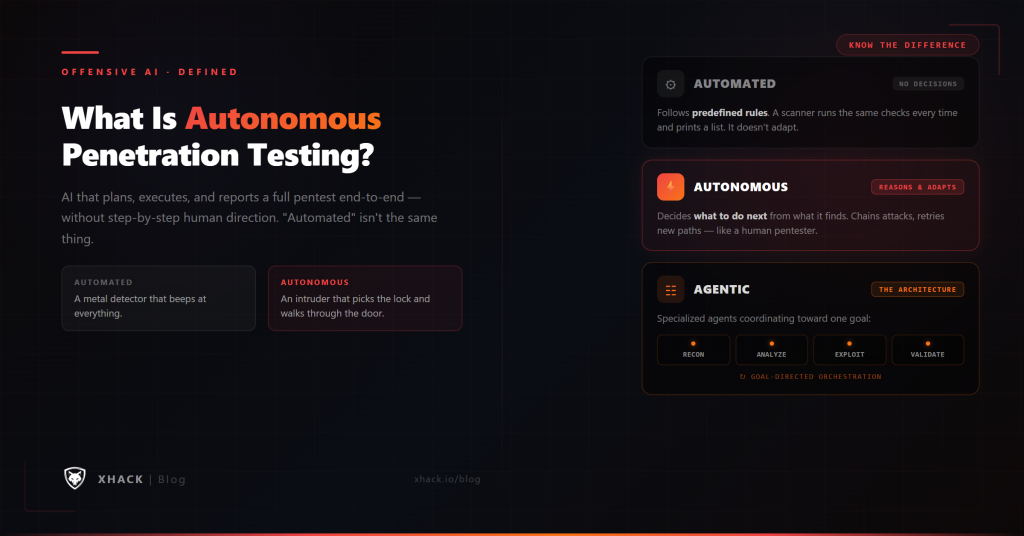
Autonomous penetration testing is the use of AI systems to plan, execute, and report on a penetration test end-to-end, without step-by-step human direction.
That last part is the key distinction. Plenty of tools are “automated.” Autonomous is different. Let’s be precise about the difference, because vendors blur it constantly.
Automated means a tool follows predefined rules. A vulnerability scanner is automated. It runs the same checks every time, matches signatures against a CVE database, and produces a list. It doesn’t make decisions. It doesn’t adapt. Point it at a target and it does exactly what it was programmed to do, no more.
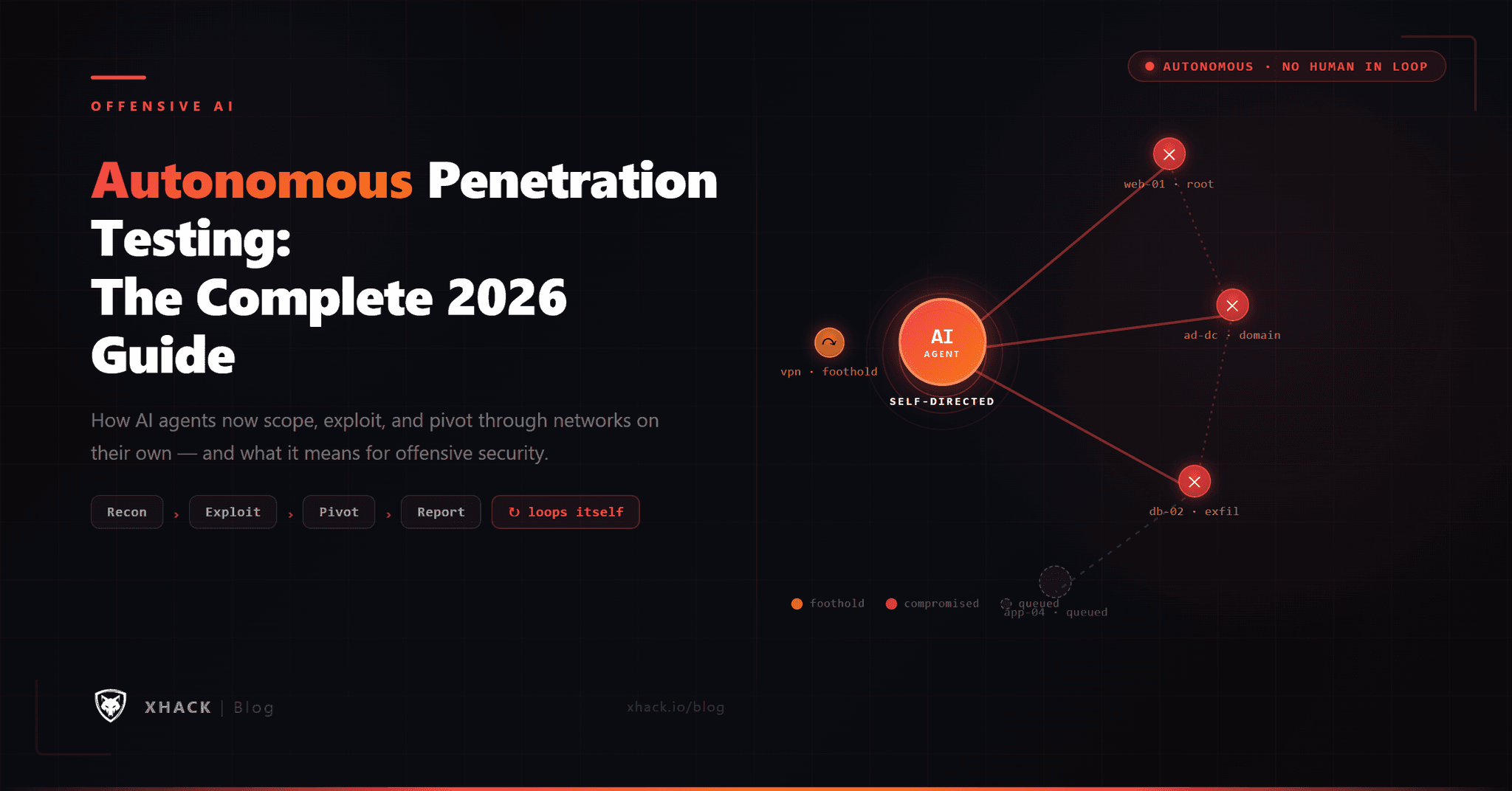
Autonomous means the system makes its own decisions about what to do next based on what it finds. It reasons. When an autonomous penetration testing agent discovers a login panel, it decides to test for default credentials, then SQL injection, then authentication bypass, adapting its approach based on each result. When one attack path fails, it tries another. It chains findings together the way a human pentester would.
Agentic describes the architecture underneath. Modern autonomous penetration testing platforms use multiple specialized AI agents coordinating through a goal-directed orchestration layer. One agent handles reconnaissance, another analyzes findings, another attempts exploitation, another validates results. They communicate and coordinate to achieve an objective, much like a real red team where different specialists handle different parts of the engagement.
Translation: a scanner is a metal detector that beeps at everything. Autonomous penetration testing is a digital intruder that walks your perimeter, finds the weak spot, picks the lock, and walks through the door to prove it can be done.
The goal isn’t to find more vulnerabilities. Scanners already find more than you can handle. The goal is to find the ones that actually matter and prove they’re exploitable, continuously, at a scale no human team could match.
Under the hood, autonomous penetration testing follows a loop that mirrors how human attackers operate, but executes it at machine speed. Understanding this loop helps you evaluate whether a tool is genuinely autonomous or just an automated scanner with a chatbot bolted on.
Step 1: Reconnaissance. The system maps the target’s attack surface. It discovers subdomains, identifies open ports and services, fingerprints technologies, finds exposed assets, and gathers intelligence. Good autonomous penetration testing tools perform deep reconnaissance across breach databases, certificate transparency logs, and cloud asset discovery, building a comprehensive picture before any attack begins.
Step 2: Reasoning and Planning. This is what separates autonomous from automated. The system analyzes what it found and decides what to attack and how. It prioritizes based on likely exploitability, reasons about which attack paths are most promising, and builds a plan. A login panel on a known-vulnerable framework gets a different approach than a hardened API gateway.
Step 3: Exploitation. The system attempts to exploit identified weaknesses. It crafts payloads, sends them, reads the responses, and adapts. If a SQL injection payload fails, it tries a variation. If it hits a 403, it looks for a bypass. This adaptive, response-driven behavior is the hallmark of genuine autonomy.
Step 4: Chaining. This is where autonomous penetration testing gets genuinely impressive. The system connects individual findings into full attack paths. An SSRF that reaches an internal service, which has an RCE, which accesses a database with customer data, becomes a single critical attack chain rather than three disconnected medium findings. Mapping these paths is something a spreadsheet of CVSS scores will never do.
Step 5: Validation. The best platforms don’t just claim a vulnerability exists. They validate it by actually exploiting it and capturing proof. This is critical because it slashes false positives. A finding that comes with a working proof-of-concept is one you can trust, unlike a scanner result that might be a false alarm.
Step 6: Reporting. The system documents everything: the attack chain, the evidence, severity ratings, business impact, and remediation guidance. Modern autonomous penetration testing tools map findings to frameworks like MITRE ATT&CK and to compliance controls, generating audit-ready reports.
The engine driving most autonomous penetration testing in 2026 is large language models combined with deterministic validators and specialized tooling. The LLM provides the reasoning, the ability to look at a situation and decide what to do next. The validators confirm that claimed exploits actually work, filtering out the hallucinations that pure LLM approaches produce.
An interesting development in 2026 is that domain adaptation matters more than raw model size. Fine-tuned open-source models trained specifically on penetration testing tasks are competing with and sometimes outperforming general-purpose frontier models on security-specific work. The lesson is that a smaller model trained deeply on offensive security can beat a bigger model that knows a little about everything.
This is also why pure LLM approaches struggle on their own. An LLM left to its own devices will confidently report vulnerabilities that don’t exist. That’s why serious autonomous penetration testing platforms wrap the AI reasoning in validation layers that demand proof before a finding surfaces.
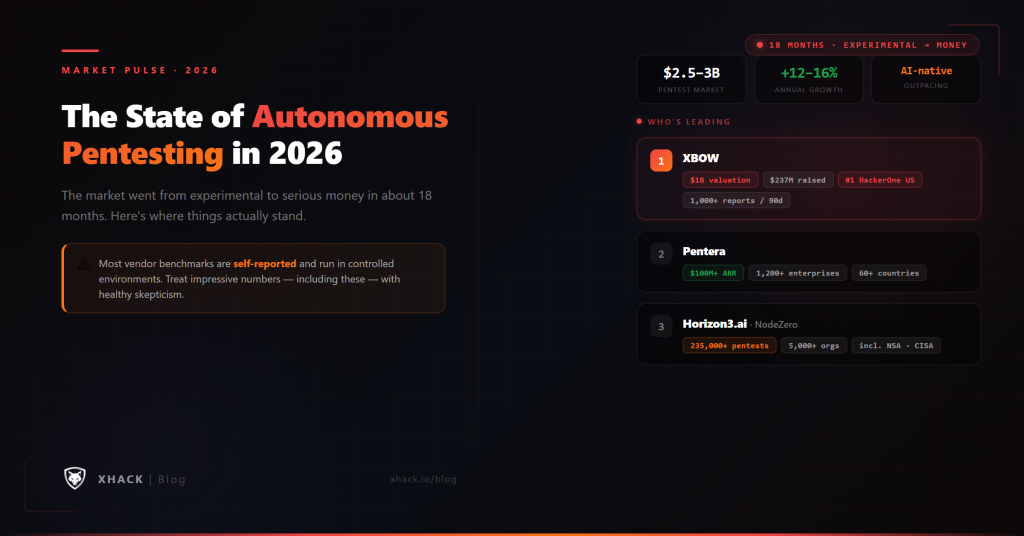
The autonomous penetration testing market went from experimental to serious money in about 18 months. Here’s where things actually stand.
The penetration testing market overall is valued at roughly $2.5 to $3 billion and growing 12 to 16% annually, but the AI-native segment is growing much faster. The funding and traction tell the story:
XBOW reached a billion-dollar valuation on $237 million in total funding, and became the first autonomous AI to top HackerOne’s US bug bounty leaderboard, submitting over 1,000 validated vulnerability reports in roughly 90 days. An AI out-hunting human bug bounty researchers was science fiction two years ago.
Pentera surpassed $100 million in annual recurring revenue, serving more than 1,200 enterprises across 60+ countries with its automated attack simulation approach.
Horizon3.ai’s NodeZero has run more than 235,000 autonomous penetration tests in production environments, more than the total number of manual pentests in history, across 5,000+ organizations including the NSA and CISA.
Beyond these headline names, the field has fragmented into specialized categories: automated security validation platforms focused on internal networks and Active Directory, agentic web and API testing tools, AI application red teaming for LLM systems, and continuous external attack surface platforms. The market has matured from “does this work at all” to “which specialized approach fits my environment.”
A word of caution on the numbers, though. Most vendor benchmarks are self-reported, and independent third-party evaluations remain rare. Even the best benchmarks run in controlled environments with known boundaries, not the messy reality of production systems with weird configurations and active defenders. Treat impressive-sounding statistics with healthy skepticism, including the ones in this section.
When autonomous penetration testing works, it solves real problems that human-only testing never could. Here’s where it earns its place.
Speed and scale. A human pentester thoroughly tests a handful of applications per week. An autonomous system tests dozens simultaneously. For organizations with hundreds of applications, APIs, and services, this is transformative. The assets that never got tested because there wasn’t budget or time can finally get covered.
Continuous coverage. This is the killer capability. Traditional pentesting is a snapshot. Autonomous penetration testing runs continuously, integrating into CI/CD pipelines and testing every deployment. The gap between “code shipped” and “code tested” shrinks from months to minutes. Your attack surface gets monitored as it changes, not once a year.
Consistency. Human testers have good days and bad days, specialties and blind spots. An autonomous system applies the same thoroughness to every target, every time. It doesn’t get tired, doesn’t rush because it’s behind schedule, and doesn’t skip the boring checks.
Known vulnerability exploitation. For documented CVEs and established attack techniques, autonomous penetration testing is fast and reliable. It maintains current exploit knowledge and methodically tests every service against it.
Cost efficiency at scale. Testing 100 applications manually would cost a fortune. Autonomous penetration testing makes broad coverage economically feasible. You still invest in human testing for critical assets, but you no longer leave 80% of your attack surface untested because of budget.
Attack path discovery. Graph-based reasoning lets autonomous systems map how vulnerabilities chain across an environment, surfacing critical attack paths that isolated findings would hide.
Now the honest part, because anyone selling you “fully autonomous, replace your whole team” is lying.
Business logic flaws. This is the biggest gap. Business logic vulnerabilities require understanding what an application is supposed to do, then figuring out how to abuse that intent. Can you apply a discount twice? Change a quantity to negative and get a refund? Skip the payment step? These don’t have signatures and don’t follow patterns AI learned from training data. They require contextual understanding of your specific business, and they remain firmly human territory.
Hallucination and false positives. Autonomous systems, especially those leaning heavily on LLMs, can confidently report vulnerabilities that don’t exist. This is why validation layers matter so much. Without them, you get a report full of phantom findings that waste your team’s time chasing ghosts.
Lack of transparent decision-making. When an autonomous system makes a decision, it’s often hard to know why. This opacity is a problem for regulated industries and for security teams that need to understand and trust the testing process. The reasoning happens inside a black box.
Social engineering and physical security. No autonomous penetration testing tool can phish your receptionist, tailgate through a badge door, or drop a malicious USB in your parking lot. The human-layer attacks that cause many real breaches remain entirely outside autonomous capability.
Novel attack paths. Autonomous systems test known patterns efficiently. They don’t invent genuinely new attack techniques the way a creative human researcher does. The weird, lateral-thinking vulnerability that nobody would think to test for is still a human discovery.
Compliance sign-off. This is a hard limit. Frameworks like PCI DSS 4.0 still require human-attested methodology and qualified-tester sign-off. An autonomous tool can do the testing and generate the report, but a qualified human still has to stand behind it for compliance purposes. The AI cannot legally vouch for itself.
| Capability | Autonomous Penetration Testing | Human Pentesters |
|---|---|---|
| Speed and scale | Dozens of targets at once | A few per week |
| Continuous coverage | 24/7 automated | Periodic engagements |
| Known CVE exploitation | Fast, methodical | Selective |
| Business logic flaws | Weak | Strong |
| Social engineering | Cannot do it | Core skill |
| Novel attack paths | Pattern-based only | Creative |
| False positive risk | Needs validation layers | Low |
| Compliance sign-off | Cannot attest | Required and qualified |
Here’s the consensus that emerged across the industry in 2026, and it’s worth tattooing on the wall of every security team: autonomous agents own breadth and continuous coverage, human experts own validation, judgment, and regulatory sign-off.
This isn’t a compromise. It’s the optimal architecture. The two approaches have almost perfectly complementary strengths and weaknesses.
Autonomous penetration testing handles the volume. It tests every deployment, covers your entire attack surface continuously, exploits known vulnerabilities reliably, and surfaces attack chains across hundreds of assets. It does the work that would be impossibly tedious and expensive for humans.
Human experts handle the nuance. They find the business logic flaws, invent creative attack paths, exercise judgment on ambiguous findings, perform social engineering, and provide the qualified sign-off that compliance demands. They do the work that requires genuine understanding and accountability.
The math is simple. Autonomous penetration testing catches the 80% of testing that’s systematic and repeatable. Humans catch the 20% that requires creativity and context. Together they cover far more than either could alone, and they do it at better value than a human-only engagement that leaves most of your attack surface untested.
The organizations winning at security in 2026 aren’t the ones who fired their pentesters to buy an AI tool, and they’re not the ones refusing to adopt autonomous testing because “real hackers are human.” They’re the ones who put AI on breadth and humans on depth, and built a continuous loop between the two.
The platforms that win reflect this. The most credible vendors explicitly position autonomous agents as augmentation, not replacement. Anyone promising to remove humans entirely is either misunderstanding the problem or lying about their capabilities.
Theory is nice. Here’s where autonomous penetration testing delivers concrete value.
Continuous application security. A SaaS company deploying dozens of times per week integrates autonomous penetration testing into its CI/CD pipeline. Every deployment gets tested automatically. Human pentesters run quarterly deep-dives on the most critical services. The 49 weekly deployments that used to ship untested now get covered.
Mobile and API testing at scale. A fintech with multiple mobile apps and dozens of API endpoints uses autonomous testing to cover the automated surface (endpoint security, authentication flows, data exposure) while human testers focus on transaction manipulation and privilege escalation logic.
Enterprise network validation. A large organization with thousands of hosts uses autonomous penetration testing to continuously validate internal network segmentation, Active Directory security, and credential hygiene, surfacing lateral movement paths that a quarterly manual test would miss entirely.
Pre-deployment AI security. As companies ship LLM-powered features, specialized autonomous testing probes those AI systems for prompt injection, tool abuse, and agent manipulation before they reach production.
Third-party and vendor assessment. An enterprise with hundreds of vendor integrations runs autonomous surface-level assessments across all of them, flagging the high-risk ones for human deep-dive testing. Testing 200 vendors manually would be impossible; autonomous testing makes it feasible.
If you’re convinced autonomous penetration testing belongs in your security program, here’s how to actually roll it out without wasting money or creating false confidence.
Start with a clear problem, not a tool. Don’t buy autonomous penetration testing because it’s trendy. Identify your actual gap. Is it that you can’t test fast enough to keep up with deployments? That you have too many assets to cover manually? That you need continuous coverage between annual pentests? The problem determines which category of tool fits.
Match the tool to your environment. The market is specialized. Internal network validation, web and API testing, AI application red teaming, and external attack surface management are different problems solved by different tools. Don’t expect a web app testing tool to validate your Active Directory, or vice versa.
Demand proof-based validation. Insist on autonomous penetration testing that validates findings by actually exploiting them and capturing evidence. Tools that just report theoretical vulnerabilities without proof will bury you in false positives. Proof-first architecture is the single most important quality differentiator.
Keep humans in the loop. Use autonomous testing for breadth and continuous coverage, but keep human experts for validation, business logic testing, and compliance sign-off. Plan your program around the hybrid model from day one.
Integrate with your existing workflow. The value of continuous testing is realized when it plugs into your CI/CD pipeline, your ticketing system, and your security operations. Autonomous penetration testing that produces findings nobody acts on is just expensive noise.
Feed findings into monitoring. When autonomous testing finds vulnerabilities you can’t immediately patch, feed them into your security operations center as detection rules. Even unpatched issues should be monitored for exploitation. This closes the loop between offensive testing and defensive monitoring.
Verify, don’t trust blindly. Remember that vendor benchmarks are self-reported and benchmarks aren’t production. Run a proof of concept against your own environment before committing. Measure false positive rates, coverage, and whether the findings are actually actionable.
So yeah, here’s our part. Since this guide is about understanding autonomous penetration testing properly, here’s an honest look at how XHack AI is built and where it fits.
XHack AI is a multi-agent autonomous penetration testing system designed around the hybrid model this entire guide has been building toward. It doesn’t try to replace human testers. It handles the breadth and continuous coverage so human experts can focus on depth and judgment.
Multi-agent architecture. Rather than one AI trying to do everything, XHack AI deploys specialized agents that collaborate. Reconnaissance agents map the attack surface, analysis agents reason about findings and prioritize attack paths, exploit agents attempt validated exploitation, and reporting agents compile evidence into structured output. They coordinate the way a real red team divides labor.
Self-aware decision making. XHack AI’s agents know their own limitations. When the system encounters something it can’t handle confidently, it flags it for human review rather than guessing or hallucinating a finding. This self-awareness is what keeps false positives down. When XHack AI reports something, the confidence is earned through validation, not assumed.
Browser-based live hunting. Most autonomous penetration testing tools interact with targets through APIs and command-line tools. XHack AI’s autonomous browsing engine controls a real browser to navigate applications, fill forms, click through workflows, and test authentication flows the way a human attacker would. This catches DOM-based vulnerabilities, client-side auth bypasses, and multi-step workflow flaws that API-level testing misses entirely.
Deep reconnaissance and exploit chaining. XHack AI performs deep reconnaissance across technology fingerprinting, exposed credential detection, and cloud asset discovery, then chains findings into complete attack paths rather than reporting isolated issues.
Intelligent, fast, and careful. XHack AI is fast, but it throttles based on target behavior rather than blindly hammering systems. It can make critical decisions autonomously, like escalating immediately if it detects signs of an active compromise during testing, rather than continuing the engagement as if nothing happened.
Here’s the honest framing. XHack AI handles the autonomous breadth. Our human security researchers handle the business logic flaws, creative attacks, and qualified sign-off that AI can’t provide. And findings feed into the XHack Security Platform for continuous monitoring, so vulnerabilities are watched even before they’re patched. That’s the full hybrid loop, not a magic box that claims to replace your team.
The hype cycle created a lot of confusion. Here are the myths worth killing before they cost you money or false confidence.
Myth 1: “It fully replaces human pentesters.” Already covered, but it bears repeating because it’s the most damaging myth. Companies that fire their security team and buy an autonomous tool end up with great coverage of known attack patterns and zero coverage of the creative, business-logic, and social engineering attacks that cause real breaches. The tool is augmentation, not replacement.
Myth 2: “Autonomous means zero human effort.” Even the best autonomous penetration testing requires humans to scope engagements, validate critical findings, interpret results in business context, and act on remediation. The AI does the heavy lifting, but a human still drives the program. “Autonomous” describes how the testing runs, not that your team gets to disappear.
Myth 3: “More agents means better results.” Some vendors market the raw number of AI agents as a feature, as if 1,000 agents must be better than 100. The number of agents is an architecture detail, not a quality metric. What matters is whether findings are validated, whether false positives are controlled, and whether the tool covers your actual environment. A well-designed system with fewer agents beats a sprawling one that floods you with unvalidated noise.
Myth 4: “It’s only for big enterprises.” The economics have shifted. Continuous autonomous penetration testing platforms now start at accessible monthly price points, putting machine-speed coverage within reach of startups and mid-market companies, not just enterprises with seven-figure security budgets.
Myth 5: “Benchmarks prove it works.” Be skeptical of impressive statistics. Most vendor benchmarks are self-reported, and even rigorous benchmarks run in controlled environments with known boundaries. Real targets have unpredictable configurations, weird network conditions, and sometimes active defenders making things worse on purpose. A tool that scores well on a benchmark may still struggle in your specific production environment. Run your own proof of concept.
Adopting autonomous penetration testing successfully depends on organizational readiness, not just buying the tool. Here’s an honest checklist for evaluating whether you’re positioned to get value from it.
You ship frequently. If you deploy code multiple times a week, you have the exact problem autonomous penetration testing solves. Your testing can’t keep up with your shipping, and continuous automated coverage closes that gap. If you ship a few times a year, the urgency is lower and periodic manual testing may suffice.
You have more assets than you can test manually. Organizations with dozens or hundreds of applications, APIs, and services can’t realistically cover everything with human-only testing. Autonomous penetration testing makes broad coverage feasible. If you have one application, the calculus is different.
You have a process to act on findings. This is the readiness factor most companies underestimate. Autonomous penetration testing will surface findings continuously. If you don’t have a process to triage, prioritize, and remediate them, you’ll just accumulate a growing backlog of ignored alerts. The tool only delivers value if findings flow into action.
You understand the hybrid model. Organizations ready for autonomous penetration testing understand that it complements human expertise rather than replacing it. They plan to keep human testers for validation, business logic, and compliance, and they budget accordingly. Companies expecting the AI to do literally everything will be disappointed.
You can integrate it into your stack. The value of continuous testing depends on integration with your CI/CD pipeline, ticketing, and security operations. If your environment can support that integration, you’ll get continuous value. If it can’t, you’ll get periodic reports that aren’t much better than traditional testing.
You’re prepared to validate before trusting. Ready organizations run a proof of concept against their own environment before committing, measure false positive rates, and verify that findings are actionable. They don’t take vendor claims at face value. If you’re prepared to do that homework, you’ll pick the right tool and avoid the overhyped ones.
If you checked most of these boxes, autonomous penetration testing will likely deliver real value. If you didn’t, fix the gaps first. The tool amplifies a mature security process; it doesn’t create one from scratch.
No, and any vendor claiming otherwise is overselling. Autonomous penetration testing excels at breadth, speed, and continuous coverage, handling known vulnerabilities and surfacing attack chains at machine scale. But it struggles with business logic flaws, novel attack paths, social engineering, and it cannot provide the qualified human sign-off that compliance frameworks like PCI DSS 4.0 require. The proven 2026 model is hybrid: autonomous agents own breadth and continuous coverage, human experts own validation, judgment, and regulatory attestation. Together they outperform either approach alone.
Yes, under the same legal framework as traditional penetration testing. You need explicit authorization to test systems you own or have permission to test. Using autonomous penetration testing tools against systems without authorization is illegal in most jurisdictions, exactly like unauthorized manual hacking. Additionally, the EU AI Act adds requirements for autonomous systems including model evaluation and incident reporting, though the enforcement timeline has shifted, so confirm current dates before relying on a specific deadline. Always operate within a proper rules-of-engagement agreement.
Accuracy varies enormously by architecture. Tools that rely purely on LLM reasoning without validation produce significant false positives because language models can confidently report vulnerabilities that don’t exist. The best autonomous penetration testing platforms use proof-first validation, meaning they only surface a finding after actually exploiting it and capturing evidence. When evaluating tools, demand proof-based validation and run a proof of concept against your own environment to measure the real false positive rate, since vendor benchmarks are self-reported and run in controlled conditions.
A vulnerability scanner is automated but not autonomous. It follows fixed rules, matches signatures against a CVE database, and produces a list of potential issues without proving any of them. Autonomous penetration testing reasons about what it finds, adapts its approach, chains vulnerabilities into attack paths, and validates findings by actually exploiting them. The scanner tells you what might be wrong. Autonomous penetration testing proves what an attacker can actually do, the same distinction that separates a vulnerability scan from a real manual pentest.
Pricing models vary widely. Some continuous autonomous platforms start around $1,000 per month for ongoing coverage, while enterprise security validation suites run into six figures annually depending on scope and environment size. The cost advantage shows up at scale: covering hundreds of assets continuously with autonomous testing costs a fraction of testing them all manually. Most organizations combine an autonomous platform for breadth with periodic human testing for critical assets and compliance sign-off, which delivers better total coverage than spending the entire budget on either one alone.
Yes, and it’s a fast-growing specialized category. As organizations deploy LLM-powered features and AI agents, specialized autonomous testing probes these systems for prompt injection, retrieval and memory attacks, tool abuse, excessive agency, and multi-step AI exploit chains. This is a distinct discipline from traditional web or network testing because the attack surface is conversational and the vulnerabilities are AI-specific. If you’re shipping AI features, they need dedicated security testing that traditional tools weren’t built to provide.
That’s the complete picture of autonomous penetration testing in 2026.
The technology is real, the funding is real, and the problem it solves is real: you ship faster than any human team can test, and autonomous AI agents finally close that gap with continuous, machine-speed coverage. XBOW topping a bug bounty leaderboard and NodeZero running more tests than exist in all of manual pentest history aren’t marketing fluff. They’re signals that something fundamental shifted.
But the hype needs cutting. Autonomous penetration testing doesn’t replace human testers. It hallucinates without validation layers, misses business logic flaws, and can’t sign off on compliance. The organizations getting this right run the hybrid model: AI for breadth and continuous coverage, humans for depth, judgment, and accountability.
If you want autonomous penetration testing built around that hybrid model, with multi-agent intelligence, browser-based live hunting, validated findings, and a human team plus continuous monitoring behind it, that’s exactly what XHack AI was designed to be.
The attack surface changes every day. The only question is whether you’re testing it continuously, or checking the smoke detectors once a year and hoping for the best.
Follow Us on X @xhackio
Related articles