Table of contents
26
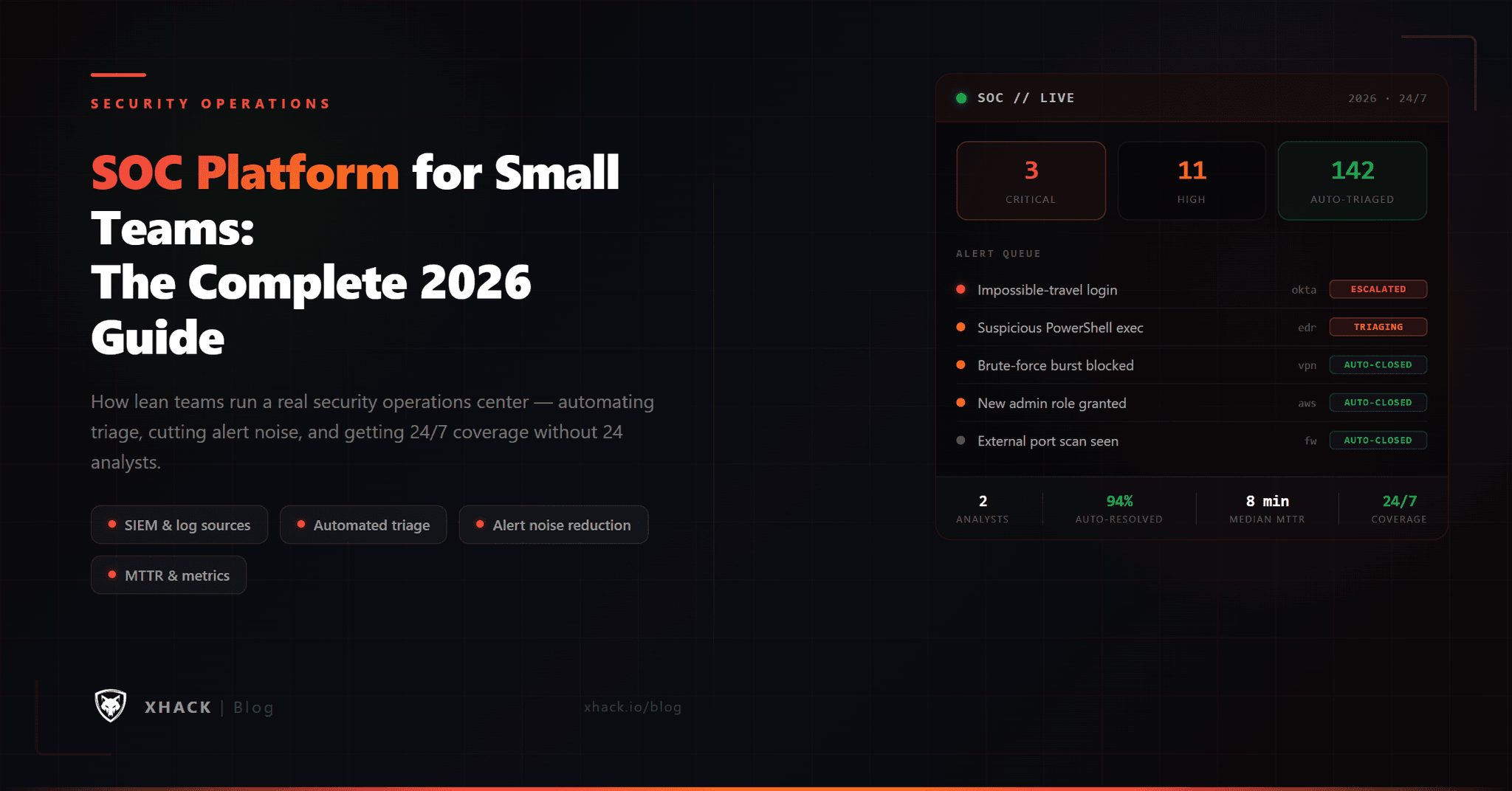
Read this in 30 seconds: A SOC platform gives small teams 24/7 threat detection, alert triage, and incident response without building a million-dollar in-house security operations center. The old model required hiring 8 to 15 analysts and buying an enterprise SIEM that priced you by data volume until your budget screamed. Modern SOC platforms flip that: cloud-native, AI-driven, predictable pricing, and designed for teams of one to five people instead of a dozen. This guide covers what a SOC platform actually does, the difference between SOC, SIEM, and SOAR, how to evaluate one, real pricing models, and how AI changed the game so a three-person team can now defend like a twenty-person one.
Building a traditional Security Operations Center costs around half a million dollars a year and requires hiring 8 to 15 analysts you can’t find and can’t afford.
For a small team, that’s not a security strategy. That’s a fantasy.
Here’s the brutal reality most small and mid-sized companies face in 2026. The threats are identical to what enterprises face. The same ransomware, the same credential attacks, the same supply chain compromises. But the resources to defend against them are nowhere close. Enterprises have a 15-person SOC running three shifts. You have one overworked IT person who also resets passwords and fixes the printer.
The security industry’s answer for years was “buy a SIEM.” So companies bought enterprise SIEMs, priced by data volume, that cost a fortune to feed, required a specialist to configure, and then sat there generating thousands of alerts that nobody had time to read. A SIEM without anyone to run it is just an expensive log storage system that occasionally beeps.
That’s the problem a modern SOC platform solves. Not by giving you more tools, but by giving you the detection, triage, and response capabilities of a full security operations center in a form a small team can actually run. AI handles the heavy lifting. Humans handle the decisions. And the pricing doesn’t require enterprise budget.
This guide breaks down everything a small team needs to know about choosing and running a SOC platform in 2026.
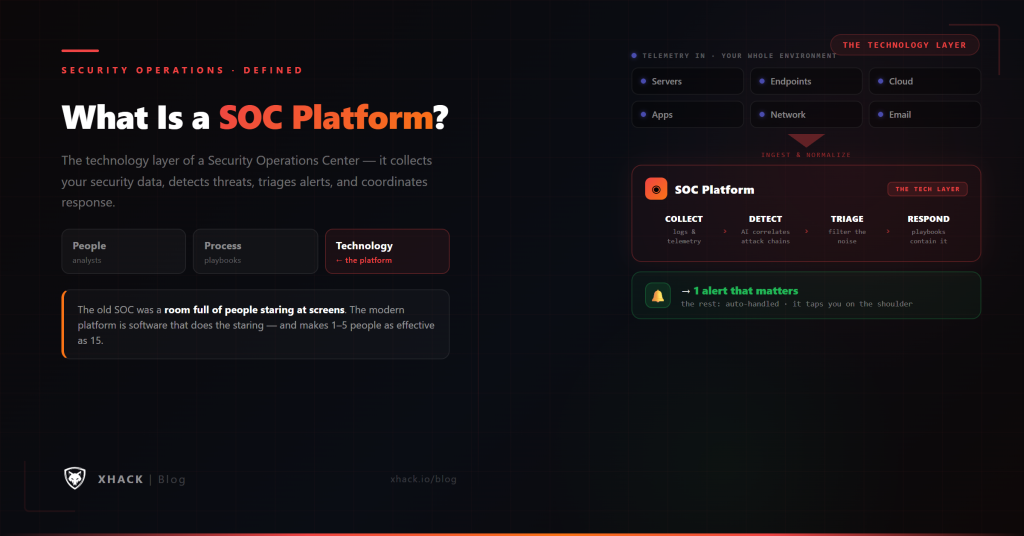
A SOC platform is the technology that powers a Security Operations Center: the centralized system that collects security data, detects threats, triages alerts, and coordinates incident response.
Let’s unpack what that actually means, because “SOC platform” gets used loosely and you need to understand what you’re buying.
A Security Operations Center, traditionally, is three things: people, processes, and technology, all working together to monitor an organization’s security around the clock. The people are analysts watching for threats. The processes are the playbooks for how they respond. The technology is the platform that gives them visibility and tools.
A SOC platform is that technology layer. It ingests logs and telemetry from across your environment, your servers, endpoints, cloud services, applications, network devices, and email. It analyzes that data to detect threats. It generates prioritized alerts when something looks wrong. And it provides the workspace where security work gets done: investigation, response, and reporting.
For a small team, the modern SOC platform does something the old model never could. It automates the parts that used to require a roomful of analysts. AI-driven correlation connects related events into coherent attack chains. Automated triage filters the noise so a human only sees what matters. Built-in response playbooks contain threats without waiting for a human to wake up at 3 AM.
Translation: the old SOC was a building full of people staring at screens. The modern SOC platform is software that does most of that staring for you and taps you on the shoulder only when it finds something real.
This is the shift that makes a real SOC accessible to small teams. You’re no longer buying a tool that requires 15 people to operate. You’re buying a platform designed to make one to five people as effective as that old team of fifteen.
Before you can choose a SOC platform, you need to understand three terms that get thrown around interchangeably but mean different things. Getting this wrong leads to buying the wrong thing.
SIEM (Security Information and Event Management) is the data engine. It collects logs from across your environment, normalizes them into a common format, correlates events to spot patterns, and generates alerts. SIEM is fundamentally about visibility and detection. It answers the question “what is happening across my environment?” A SIEM is a component, often the core component, of a SOC platform, but on its own it’s just data and alerts.
SOAR (Security Orchestration, Automation, and Response) is the action engine. It takes the alerts a SIEM generates and automates the response. Instead of a human manually isolating an infected machine, SOAR can do it automatically based on a playbook. SOAR answers the question “what do we do about it?” It turns detection into response.
SOC (Security Operations Center) is the whole operation. It’s the combination of SIEM for detection, SOAR for response, threat intelligence for context, human analysts for judgment, and the processes that tie it all together. A SOC platform delivers this complete capability rather than just one piece.
Here’s why the distinction matters for small teams. If you buy just a SIEM, you get alerts but no help responding to them, and you still need analysts to make sense of the noise. If you buy a complete SOC platform, you get detection, automated triage, response, and the AI assistance that makes it runnable by a small team. Many companies waste money buying a standalone SIEM and then discover they don’t have anyone to operate it.
| Component | What It Does | The Question It Answers | On Its Own? |
|---|---|---|---|
| SIEM | Collects, correlates, alerts | What is happening? | Just data and alerts |
| SOAR | Automates response actions | What do we do about it? | Needs a SIEM feeding it |
| SOC Platform | Detection + triage + response + intelligence | Are we secure, and how do we stay that way? | Complete operation |
The modern SOC platform bundles these together and adds AI on top, which is exactly what makes it viable for teams that can’t staff each layer separately.
Understanding why the old model fails small teams explains why the SOC platform approach matters. The struggles are specific and predictable.
The staffing problem. A traditional 24/7 SOC needs analysts across three shifts, plus tier 2 investigators and tier 3 threat hunters. That’s 8 to 15 people minimum. The cybersecurity skills shortage means these people are expensive and hard to find, with millions of unfilled security positions worldwide. A small company simply cannot hire its way to round-the-clock coverage.
The alert fatigue problem. Traditional SIEMs generate thousands of alerts per day, most of them false positives. With a small team, those alerts pile up unread. Research consistently shows that a large share of security alerts never get investigated. The one real threat hiding among 5,000 false alarms goes unnoticed because nobody has time to dig through the pile.
The cost problem. Enterprise SIEMs traditionally priced by data volume, meaning the more you logged, the more you paid. This created a brutal choice: log everything and blow your budget, or log selectively and create blind spots. Neither works for a small team trying to get real coverage on a limited budget.
The expertise problem. Configuring and tuning a traditional SIEM requires specialized skills. Writing detection rules, reducing false positives, building response playbooks, all of it demands expertise a small team usually doesn’t have. The tool that was supposed to help becomes a burden nobody can fully operate.
The 24/7 problem. Attackers don’t work business hours. The majority of serious attacks happen at night, on weekends, and on holidays precisely because that’s when defenses are thinnest. A small team that only watches during business hours is blind for most of the week, exactly when attacks are most likely.
A modern SOC platform attacks every one of these problems directly. AI reduces the staffing need by automating analysis. Intelligent correlation slashes alert fatigue. Predictable pricing solves the cost problem. Built-in detection content removes the expertise burden. And continuous automated monitoring provides the 24/7 coverage no small team could staff.
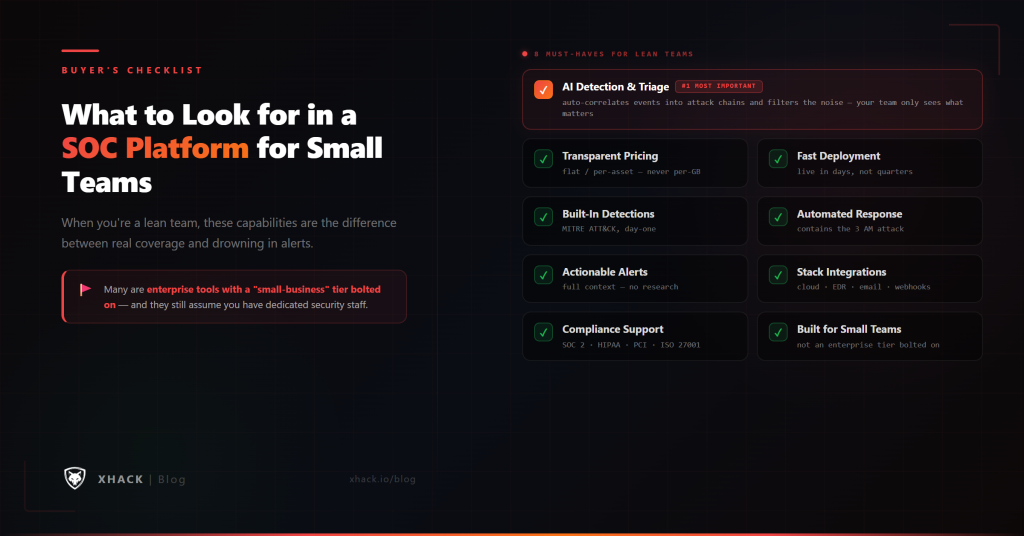
Not all SOC platforms are built for small teams. Many are enterprise tools with a “small business” tier bolted on that still assumes you have dedicated security staff. Here’s what actually matters when you’re a lean team.
This is the single most important capability for a small team. The platform should use AI to correlate events, identify real threats, and filter out noise automatically. Without this, you’re back to drowning in alerts. With it, your team only sees the threats that matter, already investigated and prioritized. Look for a SOC platform that reconstructs attack chains automatically rather than just dumping individual alerts on you.
Avoid platforms that price by data volume, which punishes you for logging more and makes your bill unpredictable. Look for predictable pricing models, whether by monitored assets, flat rate, or tiered subscription. A small team needs to know what it’s paying without fear that a busy month spikes the bill.
Enterprise SIEM deployments can take months. A SOC platform built for small teams should deploy in days, not quarters. Cloud-native platforms with pre-built integrations get you protected quickly without a lengthy professional services engagement.
A small team doesn’t have time to write detection rules from scratch. The platform should come with detection content out of the box, mapped to frameworks like MITRE ATT&CK, and updated continuously as new threats emerge. You want protection on day one, not after months of tuning.
The platform should be able to take automated action on threats, containing them before a human even sees the alert. For a small team without 24/7 staff, automated response is what stops a 3 AM attack from becoming a 9 AM disaster.
When the platform does surface something for human review, the alert should include full context: what happened, why it matters, what the impact is, and what to do about it. A small team can’t afford to spend an hour researching every alert. The platform should do that research for you.
The platform should integrate with the tools you already use: your cloud provider, your endpoints, your email, your existing security tools, and your workflow tools. Look for support for automation platforms and webhook integrations so alerts flow into wherever your team already works.
If you have compliance requirements like SOC 2, HIPAA, PCI DSS, or ISO 27001, the SOC platform should help you meet them by generating the logs, reports, and audit trails those frameworks demand. For many small companies, compliance is a primary driver for getting a SOC platform in the first place.
Let’s talk money, because pricing is where small teams get burned most often. SOC platform pricing has evolved significantly, and understanding the models helps you avoid budget surprises.
Per-asset pricing charges based on the number of devices, endpoints, or assets you monitor. This is one of the more predictable models because your cost scales with your environment size, not with how much data you happen to generate. A growing number of modern platforms use this approach specifically because it’s predictable for buyers.
Flat-rate pricing charges a fixed monthly fee regardless of data volume or asset count within a tier. This is the most predictable model and increasingly popular with platforms targeting small teams, because you know exactly what you’re paying with no surprises.
Tiered subscription pricing offers packages at different capability levels, letting you start small and upgrade as you grow. This works well for small teams that want to begin with core capabilities and expand over time.
Data-volume pricing is the traditional enterprise SIEM model, charging based on how much data you ingest. For small teams, this model is dangerous because costs become unpredictable and you’re incentivized to under-log, creating blind spots. Approach this model with caution.
Managed SOC (SOC-as-a-Service) adds human analysts who monitor the platform for you, typically for a higher monthly fee. This gives you 24/7 expert coverage without hiring, and it’s a popular middle path for teams that want the platform plus human eyes but can’t staff their own analysts.
Here’s the honest guidance. For a small team, prioritize predictable pricing above almost everything else. A platform that costs a bit more but never surprises you is better than a cheaper one that spikes unpredictably. And factor in the total cost: a cheap platform that requires a specialist to operate isn’t cheap once you count the expertise you’d need to hire.
The reason a three-person team can now defend like a twenty-person team comes down to one thing: AI fundamentally changed what a SOC platform can do without human labor.
In the old model, every layer of the SOC required human effort. Analysts manually reviewed alerts. Investigators manually correlated events across systems. Responders manually executed containment steps. The whole operation scaled with headcount, which is exactly why small teams couldn’t do it.
AI broke that link between security capability and headcount. Here’s how modern SOC platforms use it:
Automated correlation. Instead of an analyst manually connecting a failed login, a privilege escalation, and a data access into an attack story, AI does it instantly. It sees the pattern across thousands of events that no human could track manually and assembles the complete attack chain automatically.
Intelligent triage. AI evaluates each alert in context and determines whether it’s a real threat or noise. This is what slashes the false positive problem. Instead of a human reviewing 5,000 alerts to find the 5 that matter, AI surfaces those 5 directly.
Automated investigation. When a real threat appears, AI gathers the context a human would otherwise spend an hour collecting: where it came from, what it touched, how it relates to other activity, and what the likely impact is. The human gets a complete picture instead of a starting point.
AI-generated remediation guidance. Rather than a human researching how to respond, modern platforms generate specific remediation steps for the detected threat, often mapped to the exact technique used. The analyst reviews and acts rather than researching from scratch.
Natural language interaction. Newer platforms let analysts query their environment in plain language instead of learning complex query syntax, lowering the expertise barrier that traditionally made SIEMs hard for small teams to use.
The result is a force multiplier. The work that used to require a tier 1 analyst, a tier 2 investigator, and hours of manual effort now happens automatically in the background. Your small team gets to focus on decisions and response instead of drowning in manual correlation. This is the entire reason the modern SOC platform is viable for teams that could never have run the old model.
Even with the right intentions, small teams make predictable mistakes. Here’s what to avoid.
Buying a SIEM and calling it a SOC. A standalone SIEM gives you alerts but no triage, no response, and no AI to make it manageable. Small teams that buy a bare SIEM end up with thousands of unread alerts. Buy a complete SOC platform, not just the detection layer.
Choosing on price alone. The cheapest platform that requires a specialist to operate isn’t cheap. Factor in the expertise, time, and effort needed to run it. A slightly pricier platform that a non-specialist can actually use delivers far more real security.
Ignoring the alert quality. A platform that generates thousands of alerts isn’t protecting you if your team can’t process them. Prioritize platforms with strong AI triage that surface only what matters. Alert quality beats alert quantity every time.
Underestimating deployment effort. Some platforms marketed to small teams still require lengthy, complex deployments. Confirm realistic deployment timelines and verify the platform fits your actual technical capacity.
Forgetting about response. Detection without response is half a solution. A small team without 24/7 staff especially needs automated response to contain threats outside business hours. Make sure the platform acts, not just alerts.
Not planning for 24/7. If your team works business hours, you need either automated response or a managed option to cover nights and weekends when attacks are most likely. Don’t leave yourself blind for most of the week.
So yeah, here’s where we talk about what we built. Since this guide is about helping small teams get real security operations, here’s an honest look at how XHack SOC fits.
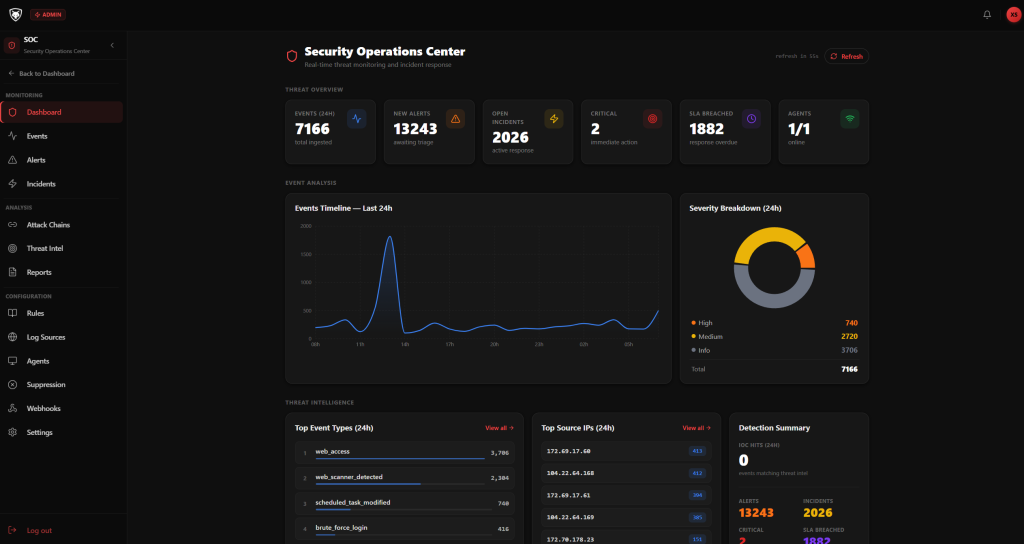
XHack SOC is an AI-powered security operations platform built specifically for the problem this entire guide describes: giving small teams the detection, triage, and response capabilities of a full SOC without the headcount, cost, or complexity of the traditional model.
Here’s what it does in practice. During live production testing, XHack SOC generated over 10 security alerts across multiple servers running against real environments and live websites, detecting multiple attack patterns with near-zero false positives. That last part matters most for a small team. The whole point is that you only see real threats, not a flood of noise.
AI-powered attack chain reconstruction. Instead of dumping individual alerts on your team, XHack SOC automatically connects related events into coherent attack chains. You see the full story, not 50 disconnected alerts you’d have to piece together yourself.
Near-zero false positives. The AI does the triage so your team doesn’t drown. This is the difference between a platform a small team can actually run and one that buries them.
Automated alerting that fits your workflow. Alerts reach your team via email, n8n, webhooks, or whatever integration you’ve configured. No need to staff someone watching a dashboard 24/7. The platform taps you on the shoulder when something real happens.
Custom detection rules built with AI. You can create detection rules tailored to your specific environment using AI, defending against targeted attacks without needing a detection engineering specialist on staff.
AI-generated remediation guidance. When a threat is detected, XHack SOC tells you what happened, maps it to the relevant technique, and provides specific remediation steps. Your team reviews and acts instead of researching from scratch at 3 AM.
Complete attack chain tracking. The platform tracks the full progression from initial detection to impact, so you understand not just that something happened but how far it got.
Here’s the honest framing. XHack SOC doesn’t replace human judgment. AI removes the noise and does the heavy correlation work so your small team can focus on decisions and response. Security teams shouldn’t have to stare at screens 24/7 anymore, and with the right platform, they don’t have to. A lean team gets to defend like a much larger one.
If you’re a small team trying to run real security operations without an enterprise budget or a 15-person staff, that’s exactly the gap XHack SOC was built to close. You can sign up to see how it handles your environment, or start with the core detection and alerting and expand from there.
One question every small team eventually asks: should we build our own security operations capability or buy a SOC platform? For almost every small team, the answer is buy, and here’s the honest math behind it.
The cost of building. A genuine in-house SOC requires the SIEM technology, the integration work, the detection content, the response playbooks, and most expensively, the people. Even a minimal round-the-clock operation needs multiple analysts across shifts. The fully loaded cost of building and staffing a real SOC runs into the hundreds of thousands of dollars annually, before you’ve stopped a single attack. For a small company, that capital is better spent almost anywhere else.
The time of building. Building a functional SOC from scratch takes months. You have to select and deploy the technology, write detection rules, tune out false positives, build response playbooks, hire and train staff, and establish processes. During all those months, you’re not protected. A SOC platform gives you working detection in days.
The expertise of building. Running a SOC well requires specialized skills in detection engineering, threat hunting, incident response, and security operations. These skills are scarce and expensive. A small team rarely has them in-house and struggles to hire them in a market with millions of unfilled security roles. A SOC platform packages that expertise into the product so you don’t have to source it.
The maintenance of building. A SOC isn’t a one-time build. Detection rules need constant updating as threats evolve. The platform needs ongoing tuning. Staff need retention and training. This is a permanent operational burden that a small team can’t sustain while also running the rest of its business.
There’s a narrow case for building: very large organizations with unique requirements, dedicated security budgets, and the ability to hire and retain a full security team. For everyone else, especially small teams, buying a SOC platform delivers better protection, faster, at a fraction of the cost. The modern platform exists precisely so you don’t have to build the thing yourself.
The middle path worth considering is the managed SOC platform, where you get the technology plus human analysts monitoring it for you. This gives you expert coverage without hiring, sitting between pure self-service and building your own team. For many small teams that want human eyes but can’t staff them, this hybrid is the sweet spot.
When you’re ready to choose, use this framework to evaluate options systematically rather than getting dazzled by feature lists. Score each platform across these dimensions based on your actual needs.
Coverage. Does the platform monitor everything that matters in your environment? Servers, endpoints, cloud, applications, email, identity. Gaps in coverage are gaps in protection. Map your actual attack surface and confirm the platform sees all of it.
Detection quality. How good is the platform at finding real threats while controlling false positives? Ask for evidence, request a trial, and measure the false positive rate against your own environment. A platform that floods you with noise fails the most important test for a small team.
Ease of operation. Can your actual team run this platform, or does it assume security specialists you don’t have? Be honest about your team’s capacity. The best platform for you is one your people can actually operate, not the one with the most features.
Response capability. Does the platform take automated action, or just alert? For a small team without 24/7 staff, automated response is what protects you during the hours nobody is watching. Confirm the platform acts, not just notifies.
Pricing predictability. Will you know what you’re paying every month, or could a busy period spike your bill? Favor predictable models. Run the numbers for your environment at current size and projected growth.
Deployment speed. How fast can you actually get protected? Confirm realistic timelines, not best-case marketing claims. A small team needs protection quickly, not a six-month implementation project.
Integration. Does the platform connect to the tools your team already uses, including your cloud provider, existing security tools, and workflow systems? Smooth integration means the platform fits into how your team already works rather than forcing new habits.
Compliance fit. If you have regulatory requirements, does the platform support your specific frameworks and produce audit-ready documentation? Confirm this explicitly rather than assuming.
Support and onboarding. Will the vendor help you get set up and succeed, or drop a login and disappear? For a small team without deep security expertise, vendor support during onboarding and beyond is genuinely valuable.
Score each platform across these dimensions, weight them by what matters most for your situation, and the right choice usually becomes clear. Don’t choose on a single flashy feature. Choose the platform that scores well across the dimensions that matter for a small team: detection quality, ease of operation, predictable pricing, and automated response.
A SIEM is one component of a SOC platform. The SIEM collects logs, correlates events, and generates alerts, answering “what is happening?” A SOC platform is the complete operation: it includes SIEM-style detection plus automated triage, response, threat intelligence, and increasingly AI that makes it all runnable by a small team. If you buy just a SIEM, you get alerts but no help responding to them and still need analysts to manage the noise. A full SOC platform gives you the whole capability, which is what small teams actually need.
Yes, and that’s precisely what modern SOC platforms are designed for. AI-driven correlation, automated triage, and built-in response handle the work that used to require a roomful of analysts. The platform surfaces only real threats with full context and remediation guidance, so a non-specialist can act on them. For 24/7 coverage outside business hours, you rely on automated response or choose a managed option. A team of one to five people can now run security operations that previously required fifteen.
Pricing varies by model. The most small-team-friendly options use predictable pricing, either per monitored asset, flat monthly rate, or tiered subscription, so you know exactly what you’ll pay. Avoid data-volume pricing, the traditional enterprise SIEM model, because it makes costs unpredictable and pushes you to under-log. Always factor in total cost: a cheap platform that needs a specialist to operate costs more than a slightly pricier one your existing team can actually run. Managed options that add human analysts cost more but provide 24/7 expert coverage.
A SOC platform built for small teams should deploy in days, not months. Cloud-native platforms with pre-built integrations get you protected quickly without a lengthy professional services engagement. Traditional enterprise SIEMs can take months to deploy and tune, which is one reason they’re a poor fit for small teams. When evaluating a platform, confirm the realistic deployment timeline and make sure it matches your team’s technical capacity, not an idealized scenario.
Yes. Most SOC platforms help you meet compliance requirements like SOC 2, HIPAA, PCI DSS, and ISO 27001 by generating the logs, monitoring records, reports, and audit trails those frameworks require. For many small companies, a compliance requirement is the reason they adopt a SOC platform in the first place. If compliance is a driver for you, confirm the platform supports your specific frameworks and produces the documentation your auditor expects to see.
Yes. A SOC platform is defensive, detecting and responding to attacks in real time. Penetration testing is offensive, proactively finding vulnerabilities before attackers do. They’re complementary, not alternatives. The strongest approach feeds penetration testing findings into your SOC platform as detection rules, so even vulnerabilities you can’t immediately patch are monitored for exploitation. A SOC platform watches for attacks; penetration testing finds the weaknesses those attacks would target.
That’s the complete guide to choosing a SOC platform for a small team in 2026.
The core shift is simple. The old security operations model required a half-million-dollar budget and 15 analysts you couldn’t find or afford. The modern SOC platform replaces that with AI-driven detection, automated triage, and predictable pricing designed for teams of one to five. You no longer need a roomful of people to run real security operations. You need the right platform doing the heavy lifting.
When you evaluate options, prioritize AI-driven triage that controls false positives, predictable pricing that won’t surprise you, fast deployment, and automated response for the hours you can’t staff. Those four things separate a platform a small team can actually run from one that becomes shelf-ware.
If you want a SOC platform built specifically for lean teams, with AI-powered attack chain reconstruction, near-zero false positives, and alerting that fits your existing workflow, XHack SOC was designed for exactly that. Start with the core capabilities and see how it handles your environment.
The attackers are coming for small companies precisely because they assume you can’t defend yourself. The right SOC platform proves them wrong.
Follow Us on X: @xhackio
Related articles