Table of contents
17
By Salman Khan, OSCP+, Founder of XHack, SRT (Synack Red Team member)
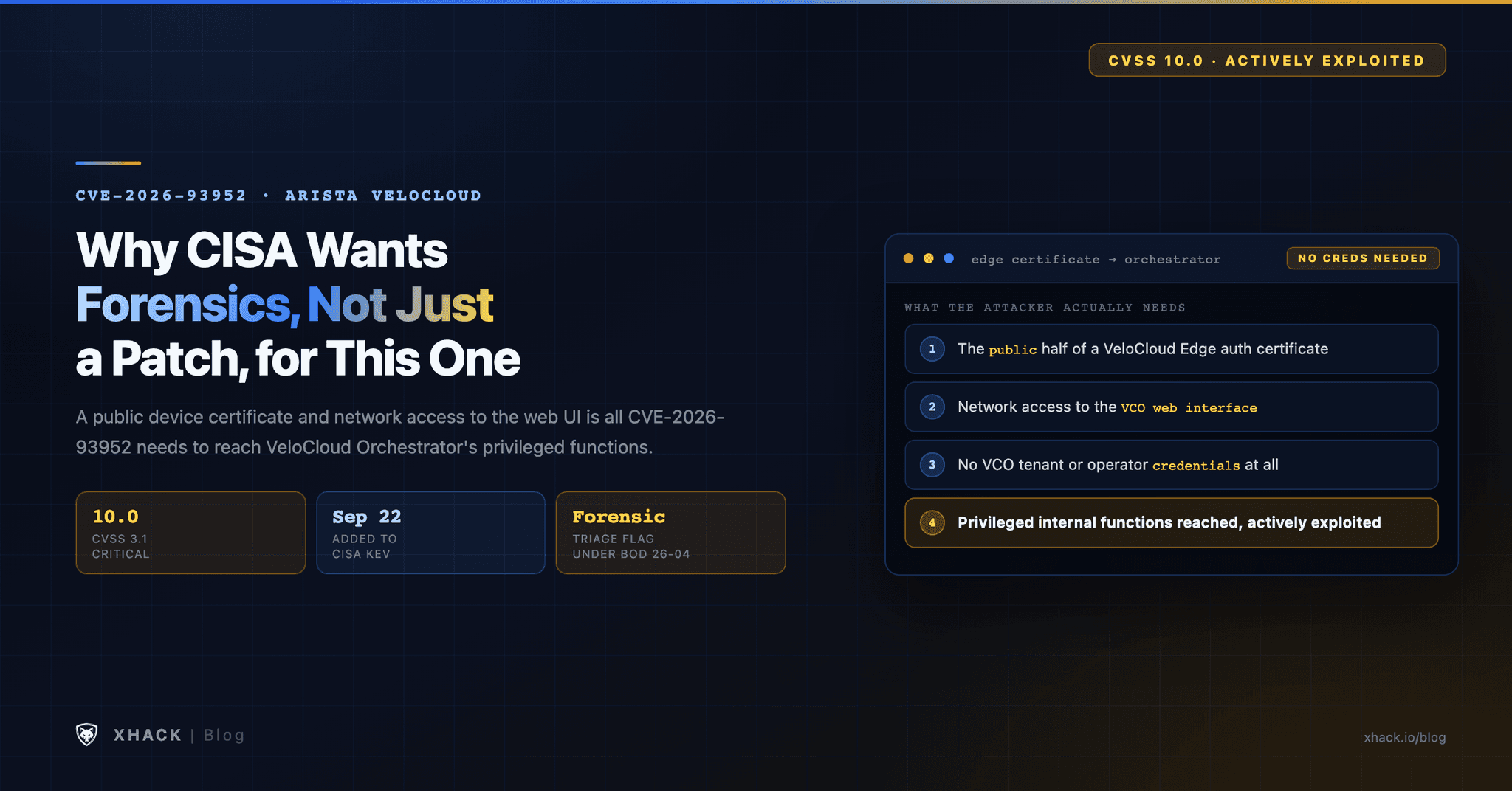
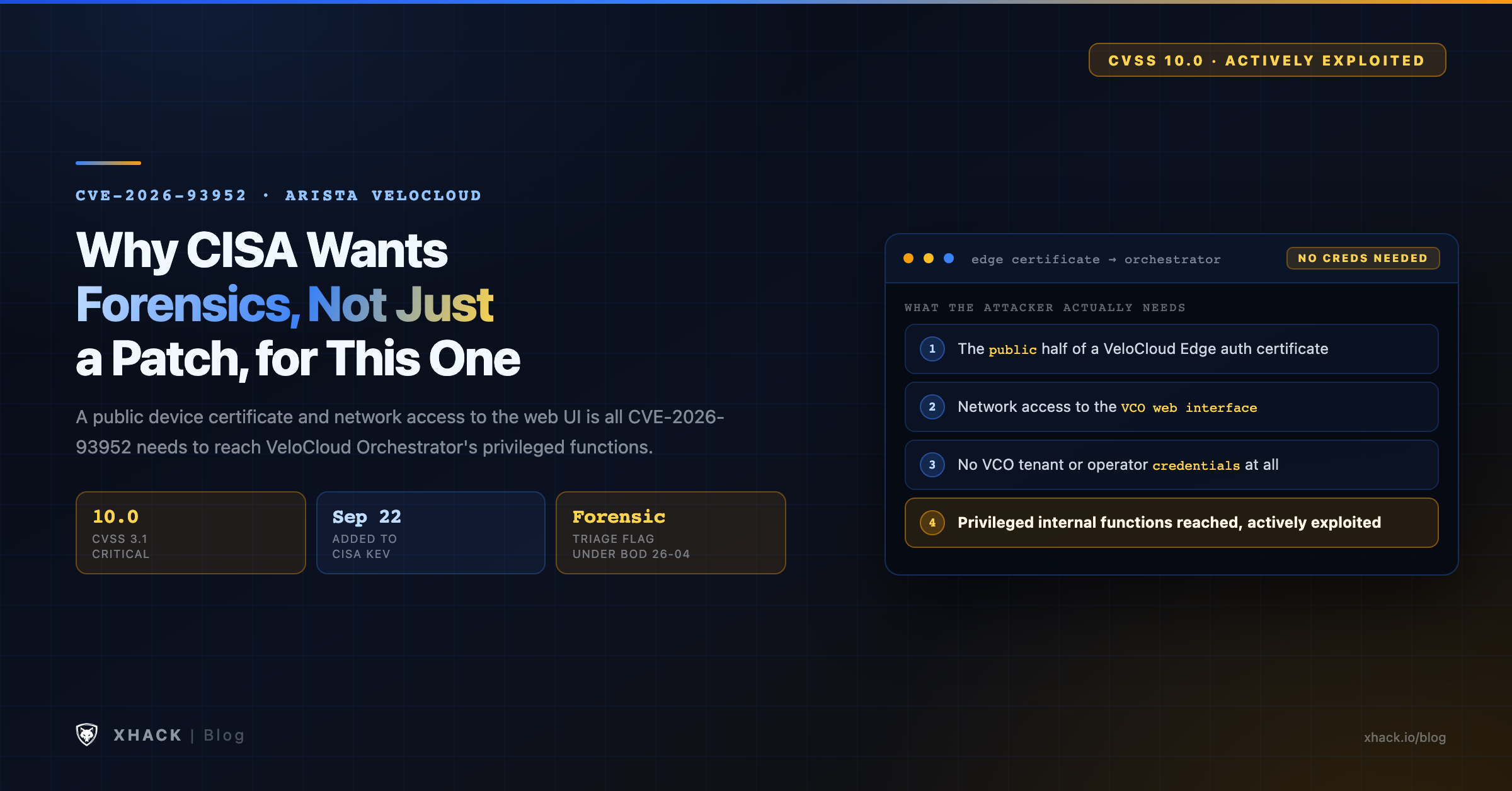
Read this in 30 seconds: CVE-2026-93952 is a CVSS 10.0 (3.1) / 9.5 (4.0) improper input validation bug in Arista’s VeloCloud Orchestrator (VCO) On-Prem, the control plane for its SD-WAN fleet. Arista says it is actively exploited, and CISA flagged the KEV entry for mandatory forensic triage, not just patching.
- It needs a certificate, not a password. An attacker with network access to the VCO web interface and the public half of a VeloCloud Edge device’s authentication certificate can reach privileged internal functions, no tenant or operator login required.
- Two release trains have no fix yet. Arista shipped VCO 5.2.3.16 and 6.4.2.8. The 6.1.x and 7.0.x trains are still listed as affected with no patched version named, only a promise that “releases in other release trains that fix this will be added over time.”
- CISA didn’t just set a deadline, it ordered an investigation. The KEV entry carries a
forensicTriage: Yesflag under Binding Operational Directive 26-04, meaning agencies had to hunt for prior compromise, not just apply the patch.- Arista published usable indicators of compromise. Two suspicious file paths, a known-malicious hash, a C2 HTTP header, and two attacker IP addresses are in the advisory itself.
- A compromised orchestrator can reach further than itself. Arista’s own advisory says a compromised VCO “may allow access to managed VeloCloud Edge devices,” meaning the blast radius isn’t the control plane alone.
A CVE that ships with attacker IP addresses in the vendor’s own advisory is not a routine patch Tuesday item.
CVE-2026-93952 hit Arista’s VeloCloud Orchestrator on-prem product on September 22, 2026, rated CVSS 3.1 10.0, the maximum possible score. Arista says it was discovered externally and is already being exploited. CISA’s response went further than its usual “patch by” language: it flagged the entry for mandatory forensic triage under a directive that treats some KEV entries as evidence of a possible break-in, not just a bug to close.
Here’s what the bug is, what’s still undisclosed, how to tell if you’re exposed, and exactly what to hunt for.
VeloCloud Orchestrator is the management and control plane for Arista’s SD-WAN product line: the console that provisions VeloCloud Edge appliances, pushes configuration, and holds the certificates those Edges use to authenticate back to it. VeloCloud has changed hands twice since Arista didn’t build it: VMware bought it in 2017, Broadcom inherited it with the VMware acquisition in 2023, and Arista bought the SD-WAN business from Broadcom in mid-2025. CVE-2026-93952 is one of the first major security incidents to hit VCO under Arista’s ownership.
A VCO instance isn’t one customer’s problem, which is exactly why CVE-2026-93952 matters beyond a single appliance. A single orchestrator typically manages every branch-office Edge appliance in an organization’s SD-WAN fleet, sometimes across hundreds of sites. That’s what makes the control plane worth attacking: compromise the orchestrator, and you’re positioned above every Edge it manages, not inside just one of them.
Here’s NVD’s description:
“VeloCloud Orchestrator (VCO) on-prem has a security issue where this issue may allow a remote attacker to access privileged internal functionality and impact the VCO host. Successful exploitation may compromise the confidentiality, integrity, and availability of the orchestrator and data managed by the orchestrator.”
Arista’s own Security Advisory 0183 fills in the numbers:
AV:N/AC:L/PR:N/UI:N/S:C/C:H/I:H/A:H) and CVSS 4.0 base 9.5. Both are Critical; the 3.1 score is the maximum a vulnerability can receive.That last requirement is worth sitting with: the attacker needs the public half of a device certificate, which is a meaningfully lower bar than needing the private key, and something that can circulate in ways a private key normally wouldn’t.
Every CISA Known Exploited Vulnerabilities entry comes with a remediation deadline. CVE-2026-93952’s was tight even by KEV standards: added September 22, due September 25, a 3-day window. But the KEV record for this entry also carries a field most CVEs don’t get: forensicTriage: Yes.
Under CISA’s Binding Operational Directive 26-04, that flag isn’t decorative. It’s reserved for vulnerabilities that meet a 3-day-or-faster remediation threshold and require agencies to actively investigate whether they were already compromised, not simply apply the patch and move on. The implementation guidance lays out a structured six-step process: scope affected systems, preserve evidence before it’s overwritten, patch, contain anything found, analyze for indicators of compromise, and escalate confirmed compromises through incident-response channels, all within roughly 48 to 72 hours.
Federal agencies were bound by that requirement; anyone else running VCO on-prem should treat the same order as good advice. A bug this cleanly exploitable, already confirmed active in the wild, with a vendor advisory that publishes IOCs instead of just a changelog entry, is not a “patch when convenient” item. Assume investigation is warranted until you’ve actually looked.
Arista’s advisory tells you the shape of CVE-2026-93952: improper input validation somewhere in how VCO validates the certificate-based Edge-to-Orchestrator handshake, reachable by anyone who has the public half of a device certificate and network access to the web interface. It does not publish the specific request, endpoint, or code path involved. As of this writing, no independent technical write-up has filled that gap either; a September 26 analysis from Hive Security explicitly declined to speculate, noting that “the advisory does not describe the complete exploit, so calling this a stolen-private-key attack or inventing an endpoint-level exploit chain would go beyond the evidence.”
So treat any claim about exactly how the certificate validation fails, beyond what’s quoted above, as unconfirmed until Arista or an independent researcher publishes more. What is confirmed is the precondition list, the CVSS score, and that it’s being exploited now.
Arista’s CVE-2026-93952 advisory doesn’t stop at “the VCO host is at risk.” It adds one sentence that matters more than the CVSS score: a compromised VCO “may allow access to managed VeloCloud Edge devices.”
That’s the control-plane-to-data-plane jump that makes an orchestrator bug different from a bug in any single branch appliance. VCO holds the relationship with every Edge device it manages, including the certificates and configuration those Edges trust. An attacker who gets privileged internal access to the orchestrator isn’t just reading one company’s SD-WAN dashboard, they’re sitting at the point that every managed Edge already trusts by design.
Arista has not published confirmation that any specific attacker has made that jump in the wild. It’s stated as a possible consequence of compromise, not a confirmed outcome, and this article treats it that way. But it’s the reason the hunting section below checks the orchestrator host itself rather than stopping at “did I patch.”
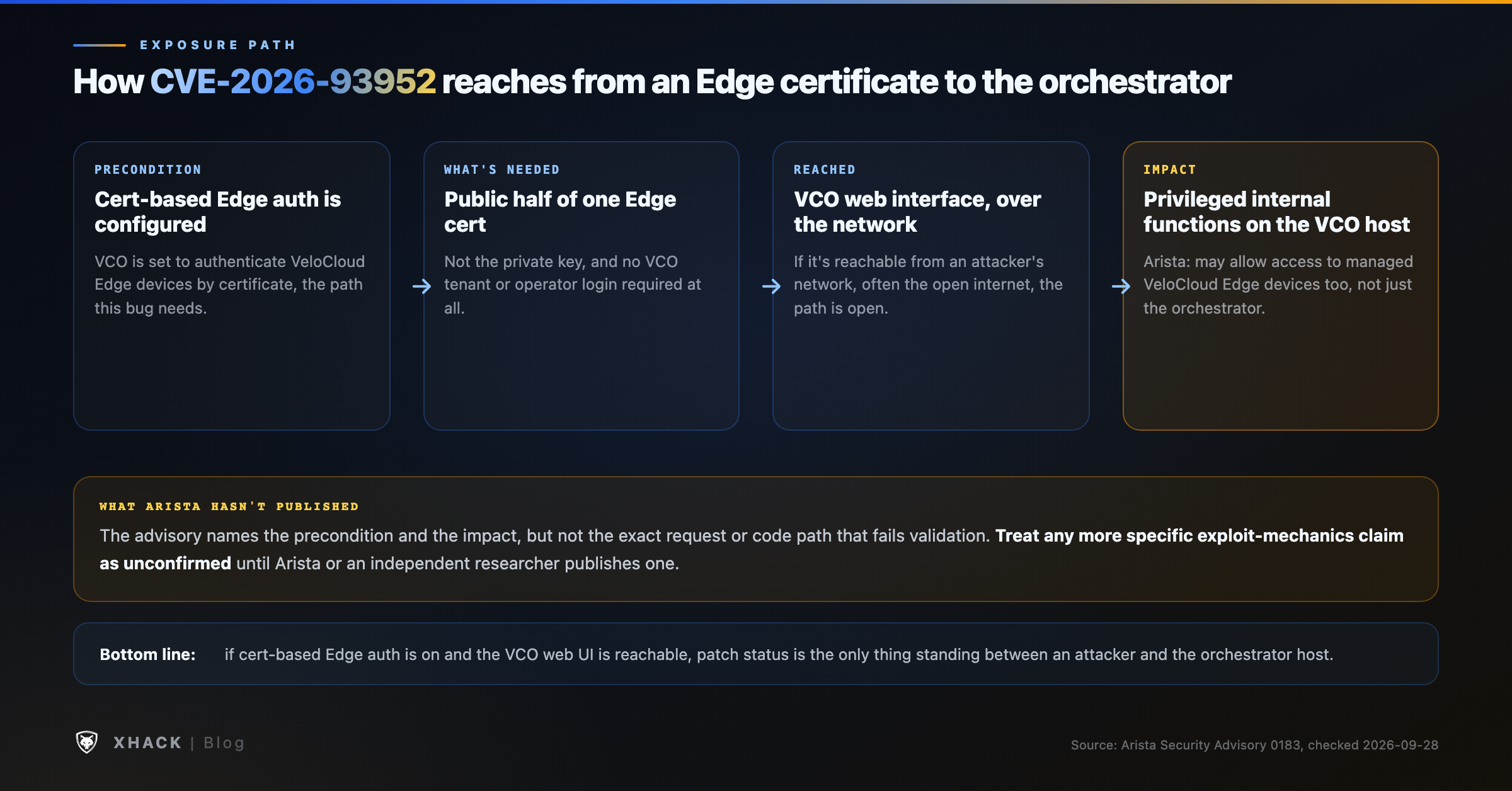
You’re only exposed to CVE-2026-93952 if all of the following are true:
If you’re not sure which train you’re on, check the build version in the VCO admin console or ask whoever manages your SD-WAN contract with Arista.
Arista’s CVE-2026-93952 advisory publishes concrete indicators, which is unusual enough to be worth using directly rather than paraphrasing:
File artifacts on the VCO host:
/usr/local/sbin/.vcnode.js
/usr/local/sbin/vc-sysmond
Both are named to blend in with legitimate VeloCloud processes. Check file hashes against Arista’s published known-malicious hash for these paths, not just filenames, since an attacker who knows the IOCs can rename a payload.
Network indicators:
x-vc-opt in requests to the VCO web interface, which Arista flags as associated with the exploitation activity.What to actually do with these:
x-vc-opt header on any request to the VCO web interface, going back to at least early September.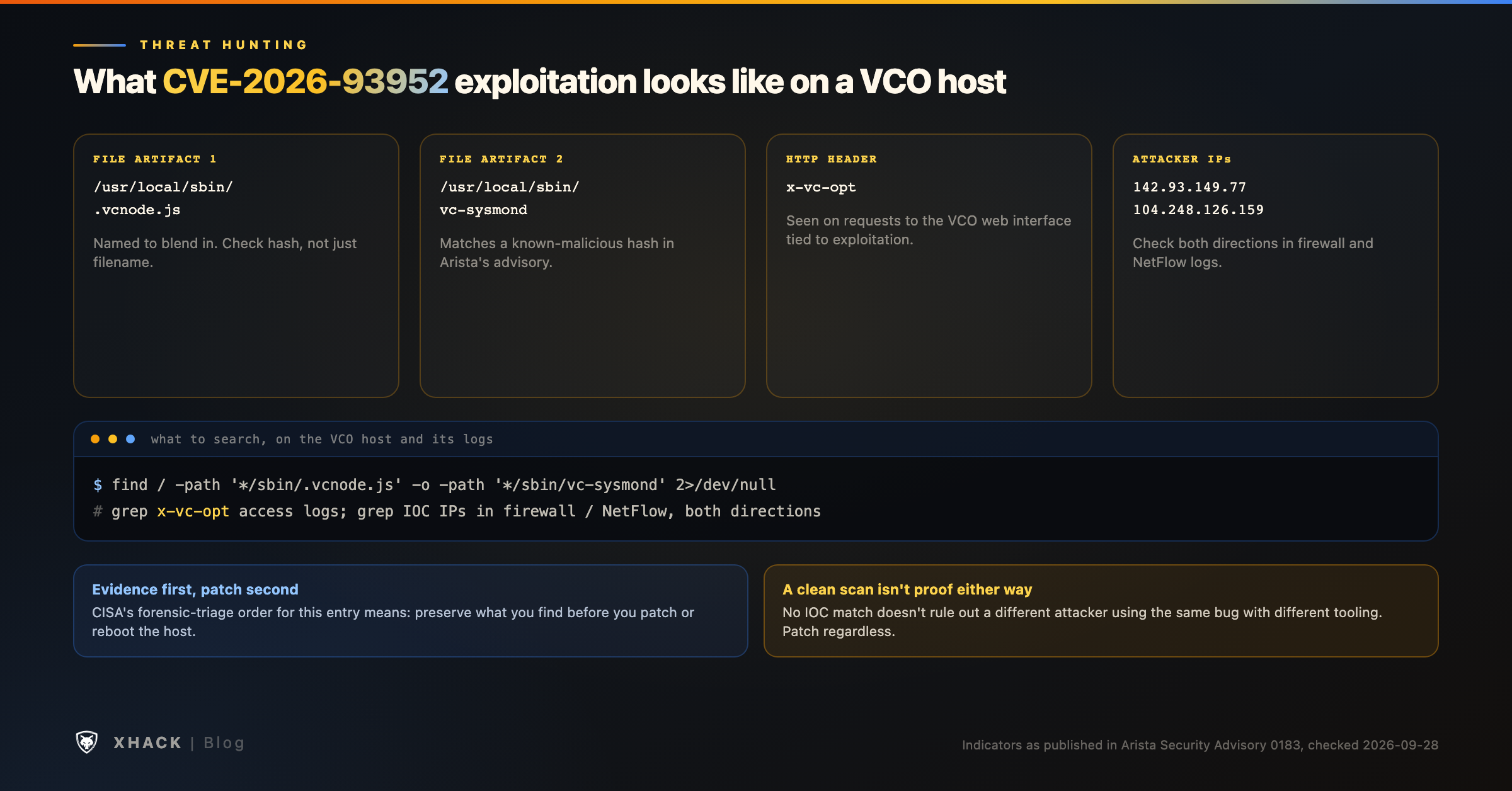
The part of this bug worth testing for isn’t “can I reach the VCO web interface,” it’s “what does an attacker actually need to get there, and is that thing findable.” A certificate’s public half moving somewhere it shouldn’t, an orchestrator’s management interface reachable from further than intended, a network boundary that assumes SD-WAN control planes are internal when they’re actually internet-facing: those are exactly the questions an external and internal network penetration test is built to answer before an attacker answers them first.
We’d start by mapping what’s actually reachable from outside your network, then work inward to see what an authenticated-adjacent position (someone holding a device certificate’s public half, the precondition CVE-2026-93952 actually needs) can actually reach once inside. That’s the same model this bug exploits: something short of full credentials, used to reach something that should have needed more.
Our ultimate penetration testing checklist walks through how that kind of engagement is scoped end to end, and our cloud infrastructure penetration testing methodology covers the hosted-management-plane side of the same problem for teams running orchestration tools like VCO alongside cloud infrastructure.
CVE-2026-93952 is a CVSS 10.0 improper input validation vulnerability in Arista’s VeloCloud Orchestrator (VCO) On-Prem. An attacker with network access to the VCO web interface and the public portion of a VeloCloud Edge authentication certificate can reach privileged internal functionality on the orchestrator host, without needing VCO tenant or operator credentials.
Yes, CVE-2026-93952 is being actively exploited. Arista’s advisory states the vulnerability is “known to be actively exploited” and was discovered externally. CISA added it to the Known Exploited Vulnerabilities catalog on September 22, 2026.
CVE-2026-93952 affects on-prem VCO versions 5.2.0 through 5.2.3.15, 6.1.0 through 6.1.3.7, 6.4.0 through 6.4.2.7, and 7.0.0 through 7.0.0.2. Hosted and Dedicated (SaaS) VCO instances were already patched by Arista. Patched on-prem versions exist for the 5.2.x train (5.2.3.16) and 6.4.x train (6.4.2.8); the 6.1.x and 7.0.x trains had no dedicated patch as of this writing.
The KEV entry carries a forensicTriage: Yes flag under CISA’s Binding Operational Directive 26-04, reserved for vulnerabilities with a 3-day-or-faster remediation deadline that also require checking for prior compromise, not just patching. Given confirmed active exploitation and a public vendor advisory with indicators of compromise, CISA treated this as a possible-breach scenario for federal agencies, not a routine update.
Arista’s advisory lists two suspicious file paths (/usr/local/sbin/.vcnode.js and /usr/local/sbin/vc-sysmond) with a known-malicious hash, an HTTP header (x-vc-opt) associated with exploitation traffic, and two attacker IP addresses (142.93.149.77 and 104.248.126.159).
Upgrade to VCO 5.2.3.16 or 6.4.2.8 if your train has a patch. If you’re on 6.1.x or 7.0.x, restrict the VCO web interface to trusted networks now, since no dedicated patch existed for those trains at the time of writing, and check for the indicators of compromise above before and after patching.
CVE-2026-93952 is a maximum-severity bug in a product built to sit above an entire SD-WAN fleet, already being exploited, and serious enough that CISA didn’t just set a patch deadline, it ordered an investigation. Two of Arista’s own release trains still don’t have a fix as this is written, which makes the interim mitigation, restricting who can reach the VCO web interface, the only real control some customers have right now.
Check your VCO version and train, patch what you can, lock down the web interface either way, and run Arista’s own indicators of compromise against your logs before you assume the patch closed the door on time.
Categories
Related articles