Table of contents
18
By Salman Khan, OSCP+, Founder of XHack, SRT (Synack Red Team member)
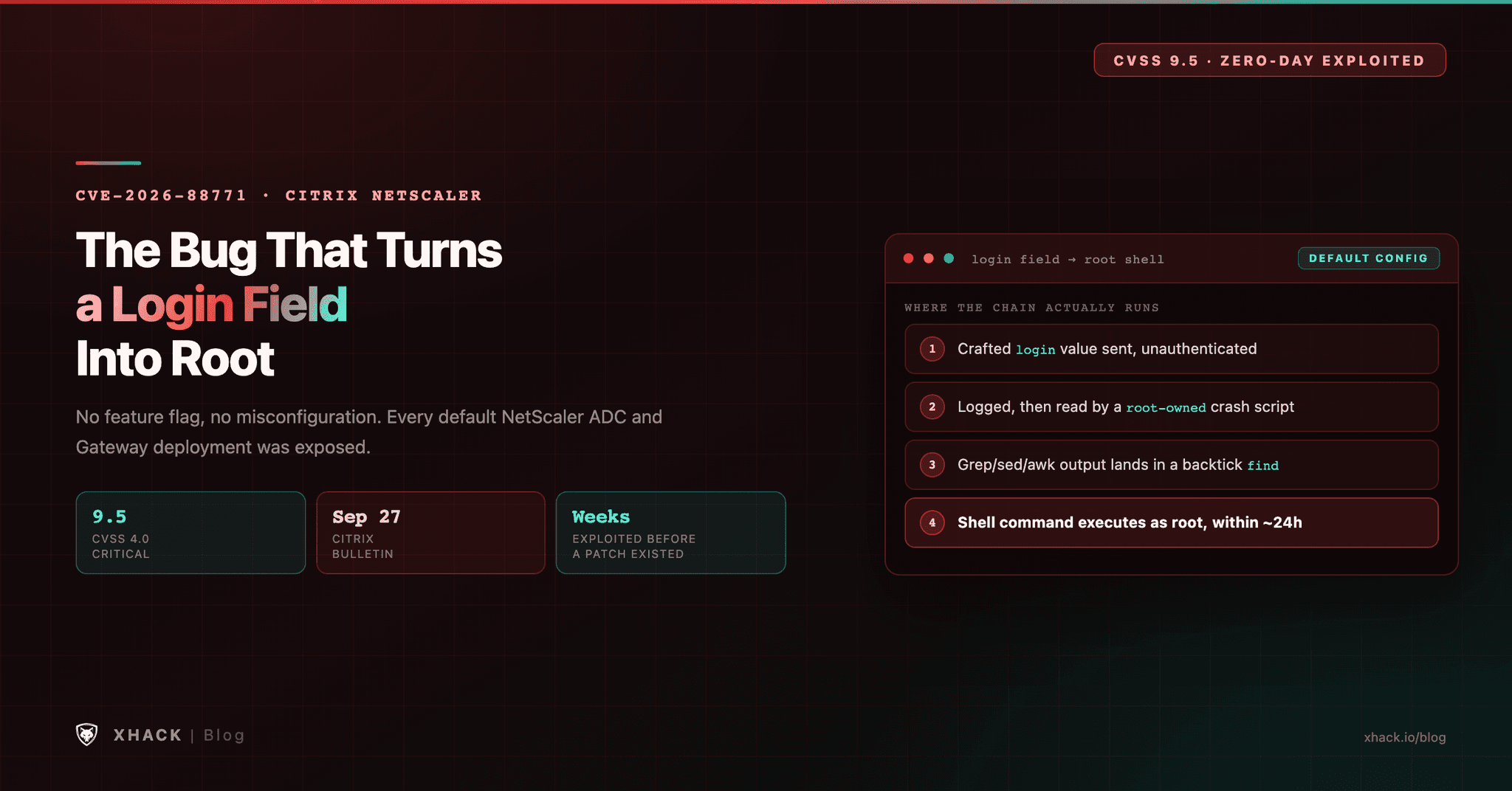
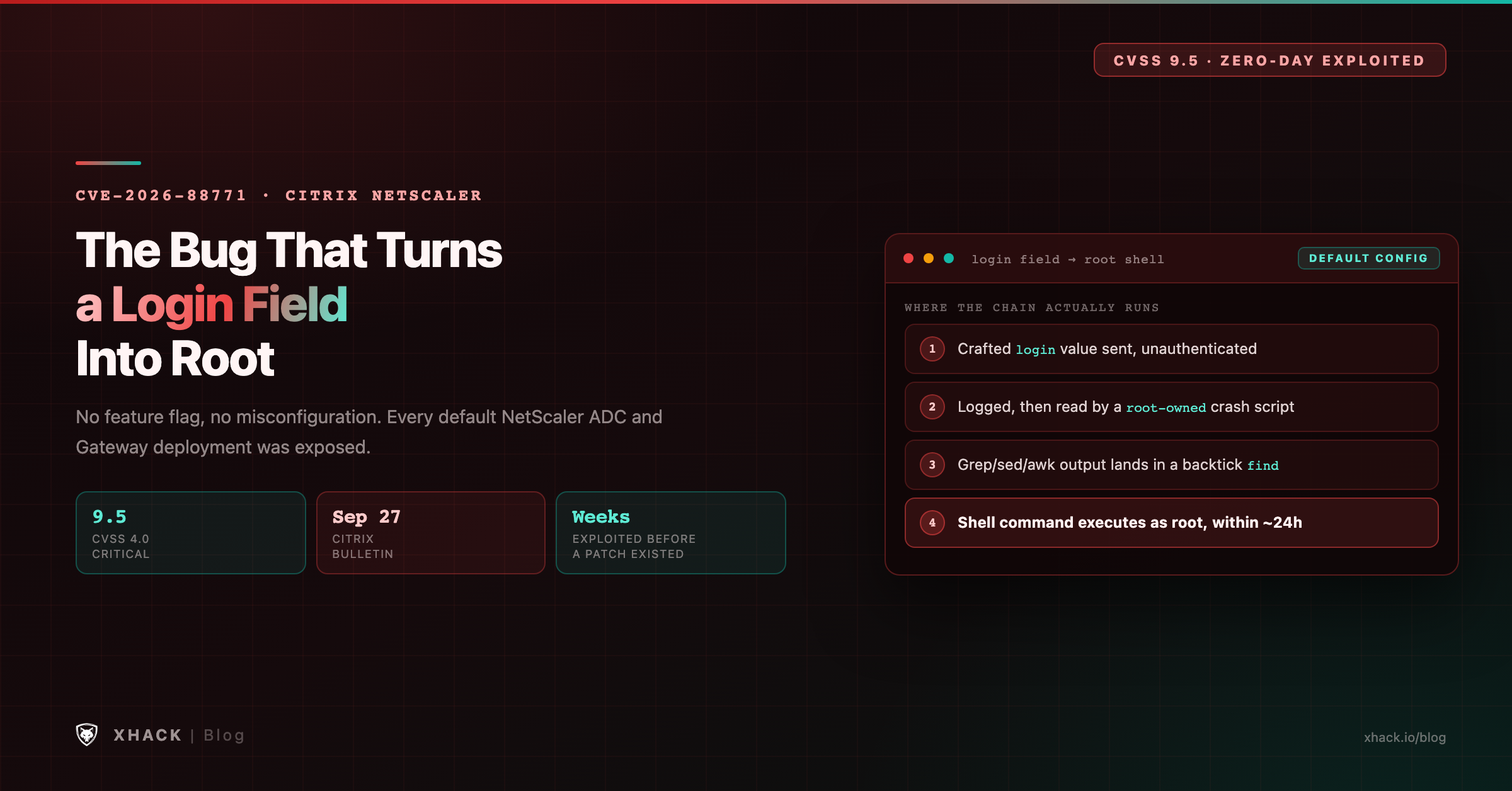
Read this in 30 seconds: CVE-2026-88771 is a CVSS 9.5 unauthenticated command injection in every NetScaler ADC and Gateway deployment, default configuration included. Citrix confirms it was exploited as a zero-day, weeks before a patch existed.
- No precondition, no feature flag. Citrix’s own bulletin says every NetScaler ADC and Gateway deployment is affected, “including the default configuration.”
- The path is a login field, not an admin panel. watchTowr traced it to the
loginparameter on the authentication endpoint, logged, then unsafely reprocessed by a root-privileged crash-monitoring script.- It doesn’t fire instantly. The poisoned log entry only executes when that monitoring script next runs, normally within 24 hours, which is an unusual delay for a “critical unauthenticated RCE.”
- CISA didn’t just say patch, it said preserve evidence first. The KEV entry is flagged for forensic triage, and CISA’s own alert warns that patching “may result in loss of forensic visibility.”
- A field report already describes a matching webshell. A NetScaler Console IoC scan shared publicly points at a specific path and a matching download pattern; treat it as an unconfirmed lead worth checking, not a confirmed indicator.
Citrix shipped eight CVEs in one bulletin. Two of them were already being used against real NetScaler boxes before the bulletin existed.
CVE-2026-88771 is the more dangerous of that pair: a command injection that needs nothing from the attacker but network reach to a NetScaler ADC or Gateway appliance running its out-of-the-box configuration. Citrix confirms it was exploited as a zero-day. Independent research has since traced exactly how, and it runs through a place nobody was watching: a Perl script that processes crash logs.
Here’s what the bug is, how it actually works, and what to check on your own appliance.
NetScaler ADC and NetScaler Gateway (the products formerly branded Citrix ADC and Citrix Gateway) sit at the edge of a network: load balancing, SSL VPN, and the authentication front door for the applications behind them. That position is exactly what makes a NetScaler bug worth more to an attacker than almost any other appliance bug: get past it, and you’re not inside one application, you’re inside the path everything else trusts.
Citrix’s September 27 bulletin covers eight CVEs at once, CVE-2026-88771 through CVE-2026-88778, ranging from HTTP request smuggling to TCP sequence-number prediction. Only two, CVE-2026-88771 and CVE-2026-88772, are confirmed exploited. The bulletin itself opens with an unusual line for a vendor advisory: Citrix notes that “AI-assisted research and automation may contribute to” the faster pace of vulnerability discovery it’s seeing across the industry, without directly attributing this particular bulletin to it. Take that as color on why eight CVEs landed at once, not as a claim about how either exploited bug was found.
This article focuses on CVE-2026-88771, the one that needs nothing but network access to a default install. Its sibling, CVE-2026-88772, gets its own section under Fixing, below, since both were exploited and both are patched by the same upgrade.
Here’s Citrix’s own description, from its security bulletin:
“Remote code execution due to improper input validation that can allow an unauthenticated attacker to execute arbitrary commands.”
And the precondition, which is really the headline fact:
“All NetScaler ADC and NetScaler Gateway deployments, including default configuration. No additional features are required.”
NVD’s own record describes the same issue across the same affected-version list: ADC before 14.1-73.37, before 13.1-64.23, before 14.1-73.37 FIPS, and before 13.1.37.279 FIPS and NDcPP; Gateway before 14.1-73.37 and before 13.1-64.23.
Nearly every NetScaler CVE in the last several years has needed some specific feature turned on, some non-default virtual server type, some configuration flag. CVE-2026-88771 needs none of that. If you run NetScaler ADC or Gateway at all, on any version before the patch, you had this bug.
Citrix’s own bulletin doesn’t explain how CVE-2026-88771 is actually exploited, only the precondition. That gap has since been filled by watchTowr’s technical analysis, published September 28. Their finding is unusual enough to be worth walking through directly.
The vulnerable code isn’t in NSPPE, the packet-processing engine where most past NetScaler CVEs have lived. It’s in ns_monuploadd_err.pl, a Perl monitoring script that runs with root privileges and processes NetScaler’s own crash logs. The script greps recent log entries for known crash patterns, extracts a value from a match, and feeds that value into a shell command built with backticks:
grep -E -i "pitboss.*PPE.*missed too many heartbeats|pitboss.*PPE.*unexpectedly died" @WR_FILES | tail -1 | sed -e 's!.*NSPPE!NSPPE!g' -e 's!(!!g' -e 's!)!!g' | awk '{ print $1"-"$2 }'Whatever that pipeline extracts gets interpolated straight into a second command: find $OFF_DIR/var/core -name ${WR_PPE_COREFILE_NAME}* -print. Nothing sanitizes it first.
The entry point is the authentication endpoint, /nf/auth/doAuthentication.do, which accepts a login parameter and logs it. watchTowr’s proof-of-concept sends a login value crafted to look like a real crash-log line, with shell metacharacters riding along: pitboss PPE unexpectedly died NSPPE;:id>/var/tmp/watchTowr;# X. After the script’s own sed and awk processing, that becomes NSPPE-00;id>/var/tmp/watchTowr;-X, a value the find command then executes as a shell command, as root.
Notice what’s not required anywhere in that chain: a login that succeeds, an admin session, or any feature flag. The login field just needs to be logged, which it is by default on every deployment.
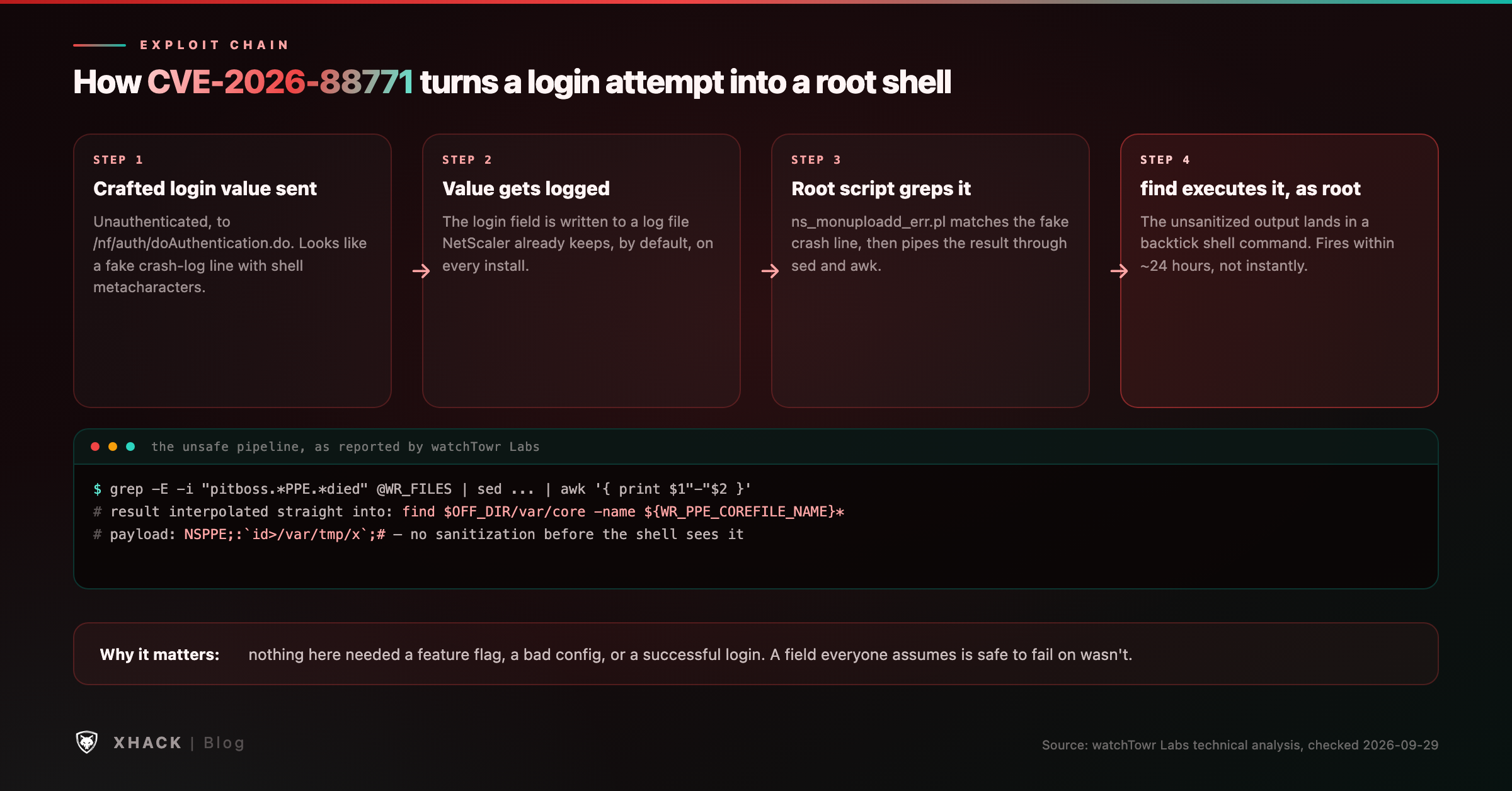
Most “critical unauthenticated RCE” write-ups describe something that happens the moment the request lands. CVE-2026-88771 doesn’t. The poisoned log entry only turns into a command when ns_monuploadd_err.pl next runs, which happens on its own schedule, normally within 24 hours, or can be forced by anyone who can already reach /netscaler/ns_monuploadd_err.pl -WR on the box.
That delay cuts both ways. For a defender, it means a request logged today may not fire until tomorrow, so a clean scan of “did anything execute in the last hour” tells you less than it sounds like it should. For an attacker running this at scale, it means the exploit doesn’t need to be fast or reliable in real time, a single poisoned log line sits there until the monitoring script does the work for them. That combination, a pre-auth injection point paired with a delayed, root-privileged trigger, is why watchTowr frames this less as one clever bug and more as a structural anti-pattern: mixing shell command construction with attacker-controlled data anywhere in the pipeline, even a monitoring script nobody thinks of as attack surface.
This wasn’t caught, disclosed, then exploited. Citrix’s own bulletin confirms the reverse order: CVE-2026-88771 and CVE-2026-88772 were already being used against real appliances when the September 27 patch shipped. Help Net Security’s reporting puts the exploitation window at “this entire month,” meaning attacks were underway for weeks before any fix existed, with the Dutch National Cyber Security Center (NCSC-NL) and European government sources issuing warnings through the week leading up to disclosure.
Security researcher Kevin Beaumont, who has tracked prior NetScaler mass-exploitation incidents closely, characterized the activity as “probably nation state aligned as well resourced, espionage rather than teens,” though that’s his read on the pattern, not a confirmed attribution from Citrix or CISA. His more concrete warning is the one worth planning around: “You will need to check every box after patching for webshells.” Tenable’s Satnam Narang added the honest caveat that scale is still unclear: “it has not been determined whether exploitation has reached widespread scale.”
NCSC-NL’s description of the impact is the plainest statement of why this matters more than a typical appliance bug: “This vulnerability gives attackers full control of the gateway, providing direct access to the internal corporate network behind it.”
Unusually for this kind of writeup, there’s no checklist. Per Citrix’s own bulletin, every NetScaler ADC and NetScaler Gateway deployment is affected, in its default configuration, on any version before the patched builds listed below. There’s no feature to check, no virtual server type to confirm, no configuration string to grep for. If you’re running an unpatched, internet-reachable NetScaler ADC or Gateway, you were exposed.
The only real question is whether your specific version falls before the patched line:
show ns variable output. Check that command before you upgrade if you’re moving to 13.1-64.23, and go straight to 13.1-64.24 if it returns anything.Citrix built IOC detection directly into NetScaler Console (version 14.1-73.36 and later, with the telemetry channel enabled), reachable from the Security Advisory page once you accept its terms and start a scan. If you don’t run NetScaler Console, Citrix says to contact support directly for the same generic indicators. Citrix is explicit that this detection is not exhaustive: “the IoC Information might be of limited forensic value and might fail to identify actual compromises,” and recommends experienced forensic investigators for anything it flags.
Beyond Citrix’s own tooling, one specific, unconfirmed field report is worth checking directly. A NetScaler administrator posting in the Citrix Community comments under the official bulletin described their own NetScaler Console IoC scan results:
/var/netscaler/logon/LogonPoint/custom/.ctxs.receiver., described by the poster as “apparently a webshell.”/vpn/scripts/linux/nsgclient18.deb and /vpn/scripts/linux/nsgclient18_32.deb.Treat this as a lead, not a confirmed indicator. It’s one administrator’s field report in a public comment thread, not something Citrix, CISA, or an independent research firm has verified or published as an official IOC. But it’s specific enough, a real file path and a real download pattern, to be worth a five-minute check of your own logs and filesystem while you wait for anything more authoritative. Search for that path on any NetScaler filesystem you can access, and check outbound request logs for either .deb filename.
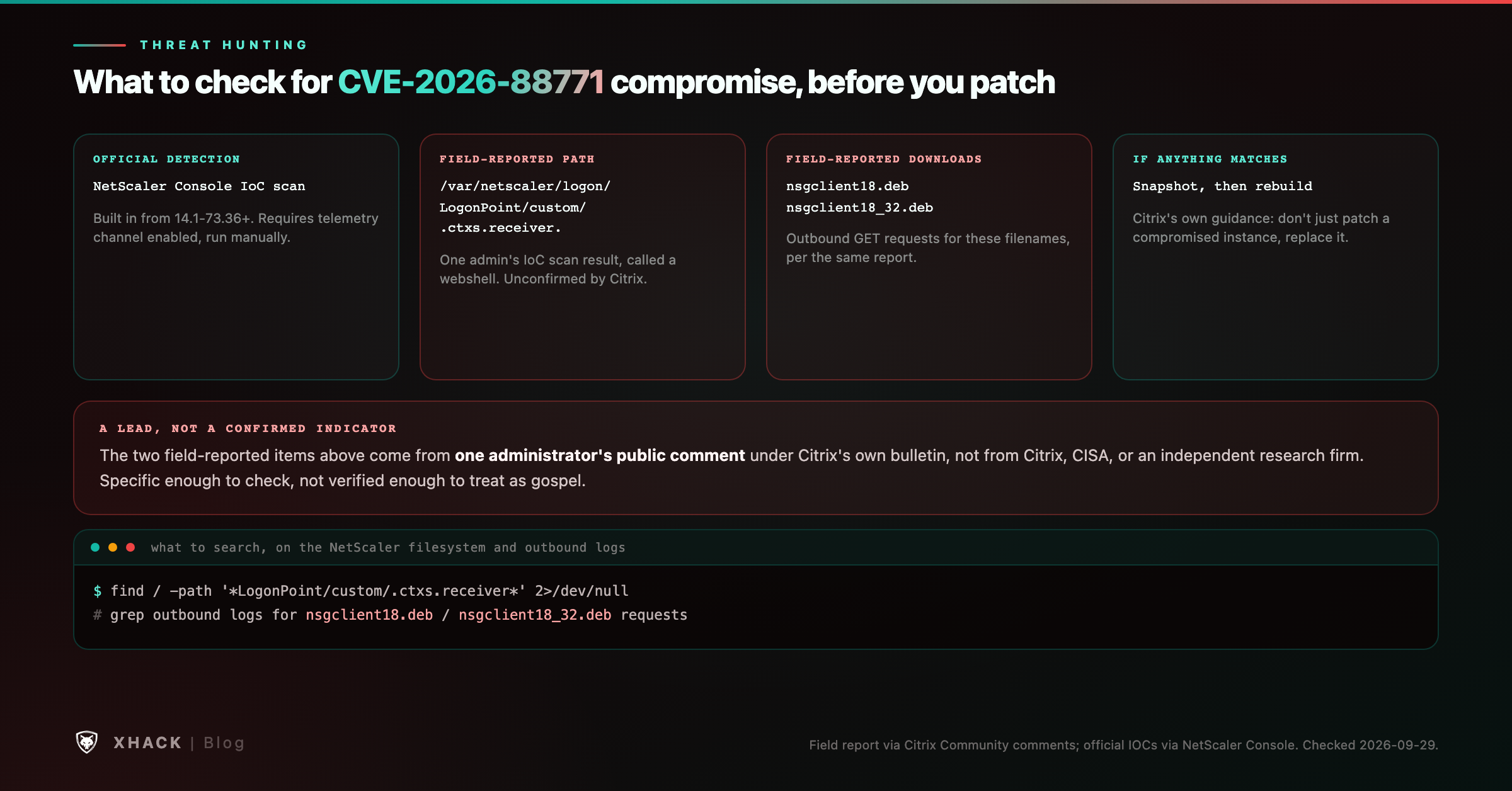
Citrix’s own incident-response guide for a NetScaler ADC suspected of a CVE-2026-88771-style compromise is unambiguous on this point, and it goes further than most vendor advisories: patching a compromised appliance is not remediation. For a VPX instance, the documented recommendation is to snapshot it for forensic analysis, then replace and restore the instance entirely rather than patch in place. For MPX or SDX hardware, the guidance includes powering down after memory preservation and imaging the physical disks before any rebuild.
The same guide lists what to rotate once you’re confident the instance is clean: every service-account secret the NetScaler had access to (LDAP, RADIUS, OAuth tokens, API keys, SNMP community strings), every certificate and private key stored on it, and every local account password. It also states plainly what shouldn’t need saying but apparently does: “NetScaler Management Services should never be exposed to the public internet.”
If your CVE-2026-88771 IOC check above comes back clean, that’s good news, not proof. Patch on the emergency basis Citrix recommends either way.
The part of this bug worth testing for isn’t the NetScaler code itself, it’s the assumption underneath it: that a field only an unauthenticated visitor can reach, a login attempt, is low-risk because failed logins don’t do anything. Here, a failed login became a logged string, and a logged string became a root command, three steps removed from anything that looks like “the login form.” That’s exactly the kind of chain a thorough external penetration test is built to trace: not just “can I authenticate,” but “what happens to everything I send, even when authentication fails.”
We’d start the same way any assessment of an edge appliance should: confirm the exposed version and build against the vendor’s own advisory, then map what unauthenticated input actually touches, logging, monitoring, error handling, not just the obvious login path. That’s the difference between a scan that checks a version banner and a test that checks what the appliance actually does with what you send it.
Our ultimate penetration testing checklist covers how that kind of engagement is scoped end to end.
CVE-2026-88771 is a CVSS 9.5 unauthenticated command injection in Citrix NetScaler ADC and NetScaler Gateway. An attacker sends a crafted value in the login field of the authentication endpoint; it’s logged, then unsafely reprocessed by a root-privileged crash-monitoring Perl script, resulting in arbitrary command execution as root. No feature flag or non-default configuration is required.
Yes. Citrix confirms exploitation “on unmitigated NetScaler deployments” as a zero-day, before any patch existed. Reporting citing security researcher Kevin Beaumont and NCSC-NL indicates exploitation had been underway for weeks before the September 27, 2026 disclosure.
CVE-2026-88771 affects all NetScaler ADC and NetScaler Gateway deployments before 14.1-73.37, before 13.1-64.23, before 14.1-73.37 FIPS, and before 13.1.37.279 FIPS/NDcPP, in their default configuration. No additional features need to be enabled to be affected.
Per watchTowr’s technical analysis, a crafted login value is logged by the authentication endpoint, then matched and processed by the ns_monuploadd_err.pl crash-monitoring script, which unsafely interpolates the matched value into a shell command run as root. Execution isn’t instant, it happens when the monitoring script next runs, typically within 24 hours.
For CVE-2026-88771 specifically, use Citrix’s built-in NetScaler Console IoC detection if available, or request generic indicators from Citrix Support. A public field report also points to the file path /var/netscaler/logon/LogonPoint/custom/.ctxs.receiver. and outbound requests for nsgclient18.deb/nsgclient18_32.deb as possible indicators, unconfirmed by Citrix but specific enough to be worth checking. Preserve logs and any snapshot capability before applying the patch.
Upgrade to NetScaler ADC/Gateway 14.1-73.37, 13.1-64.23, 14.1-73.37 FIPS, or 13.1.37.279 FIPS/NDcPP (or later in the same branch), on an emergency basis. If you find evidence of compromise, Citrix’s own guidance recommends rebuilding the instance rather than patching in place.
CVE-2026-88771 didn’t need a misconfiguration, an enabled feature, or a mistake by whoever set up the appliance. It needed a default NetScaler ADC or Gateway install and a monitoring script nobody was auditing for shell injection. Citrix confirms it was used against real appliances for weeks before a patch existed, and CISA’s own guidance treats this as a possible-breach scenario, not a routine update.
Patch on an emergency basis, check your logs and filesystem against the leads above before you do if you can, and if you find anything, rebuild the instance rather than trust a patch alone to have cleaned it.
Categories
Related articles